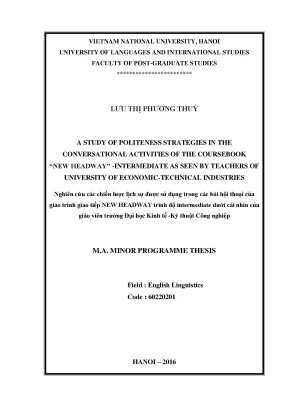
Nghiên cứu chiến lược lịch sự trong New Headway Intermediate: Góc nhìn giáo viên UNETI

Luận văn về chiến lược lịch sự trong giáo trình New Headway Intermediate, góc nhìn từ giảng viên Đại học Kinh tế. Nghiên cứu ngôn ngữ học ứng dụng.

Chuyên ngành

English Linguistics

Người đăng

Ẩn danh

Thể loại

Minor Programme Thesis

2016

70
0
0

Phí lưu trữ

30 Point

Mục lục chi tiết

DECLARATION

ACKNOWLEDGEMENTS

ABSTRACT

ABBREVIATIONS

LIST OF TABLES AND FIGURES

TABLE OF CONTENTS

1. PART A: INTRODUCTION

1.1. Aims of the study

1.2. Scope of the study

1.3. Significance of the study

1.4. Design of the study

2. Chapter I: THEORETICAL BACKGROUND

2.1. Theory of Speech Acts

2.2. Theory of politeness and politeness strategies

2.2.1. Theory of politeness

2.2.2. Role relationships affecting politeness strategies

3. CHAPTER II: METHODOLOGY

3.1. Multiple choice questionnaires

3.2. Discourse completion task

3.3. Data collection procedure

3.4. Politeness strategies under the inference of role relationships in NHW

3.5. Politeness strategies under the inference of role relationships in NHW as seen by UNETI teachers of English

3.6. Data analysis method

4. CHAPTER III: FINDINGS AND DISCUSSION

4.1. Positive and negative politeness in conversational activities in the course book “NEW HEADWAY, INTERMEDIATE”

4.2. Overview of politeness strategies in “New Headway” intermediate (NHW)

4.3. Frequency of occurrence of positive and negative politeness strategies in conversational activities in the course book “New Headway, Intermediate”

4.4. Negative Politeness strategies in conversational activities

4.5. Politeness Strategies in terms of role- relationship

4.6. Politeness in terms of role - relationship in NHW as seen by UNETI teachers of English

4.7. Summary of main findings

4.8. Suggestions for further study

5. PART A: INTRODUCTION

6. PART B: DEVELOPMENT

6.1. Chapter I: THEORETICAL BACKGROUND

6.1.1. Theory of Speech Acts

6.1.2. Theory of politeness and politeness strategies

6.1.2.1. Theory of politeness

Tóm tắt

I. Tổng Quan Về Nghiên Cứu Politeness Strategies Trong Giáo Trình

Nghiên cứu về politeness strategies (chiến lược lịch sự) trong giao tiếp là một lĩnh vực quan trọng trong pragmatics (ngữ dụng học) và sociolinguistics (xã hội ngôn ngữ học). Luận văn thạc sĩ này tập trung vào việc phân tích các politeness strategies được sử dụng trong các bài hội thoại của giáo trình New Headway Intermediate, một giáo trình tiếng Anh phổ biến. Nghiên cứu này xem xét cách các giáo viên của University of Economics (Đại học Kinh tế) nhận thức và đánh giá việc sử dụng các chiến lược này. Mục tiêu chính là khám phá cách các chiến lược lịch sự được thể hiện trong giáo trình và liệu chúng có phù hợp với bối cảnh giảng dạy tiếng Anh như một ngoại ngữ (English as a Foreign Language - EFL) tại Việt Nam hay không. Interlanguage pragmatics (ngữ dụng học trung gian) đóng vai trò quan trọng trong việc hiểu cách người học tiếng Anh sử dụng và tiếp nhận các chiến lược này, đặc biệt trong môi trường học tập.

1.1. Tầm quan trọng của Politeness Strategies trong Giao Tiếp

Trong giao tiếp hàng ngày, politeness strategies đóng vai trò then chốt trong việc duy trì các mối quan hệ xã hội và tránh gây ra những hiểu lầm hoặc xung đột. Các chiến lược này giúp người nói thể hiện sự tôn trọng đối với người nghe, đồng thời bảo vệ thể diện của cả hai bên (face-saving). Việc nắm vững và sử dụng thành thạo các politeness strategies là một yếu tố quan trọng để giao tiếp thành công trong các bối cảnh khác nhau, đặc biệt là trong môi trường đa văn hóa. Việc phân tích classroom discourse (diễn ngôn trong lớp học) cho thấy cách các politeness strategies ảnh hưởng đến tương tác giữa giáo viên và học sinh.

1.2. Giới thiệu giáo trình New Headway Intermediate và bối cảnh nghiên cứu

New Headway Intermediate là một giáo trình tiếng Anh được sử dụng rộng rãi trên toàn thế giới, bao gồm cả Việt Nam. Giáo trình này cung cấp một loạt các bài học và hoạt động thực hành, giúp người học phát triển các kỹ năng ngôn ngữ cần thiết để giao tiếp hiệu quả. Nghiên cứu này tập trung vào việc phân tích các bài hội thoại trong giáo trình, nhằm xác định các politeness strategies được sử dụng và đánh giá tính phù hợp của chúng với context of learning (bối cảnh học tập) tại University of Economics. Nghiên cứu cũng xem xét teachers' perspectives (quan điểm của giáo viên) về việc sử dụng các chiến lược này trong lớp học. Textbook evaluation (đánh giá sách giáo khoa) là một phần quan trọng trong quá trình này.

II. Vấn Đề Thách Thức Coursebook Analysis và Teacher Beliefs

Một trong những thách thức lớn nhất trong việc dạy và học tiếng Anh là làm thế nào để giúp người học sử dụng ngôn ngữ một cách phù hợp và lịch sự. Coursebook analysis (phân tích sách giáo khoa) cho thấy rằng không phải tất cả các giáo trình đều chú trọng đến việc giảng dạy politeness strategies. Một số giáo trình có thể tập trung quá nhiều vào ngữ pháp và từ vựng, mà bỏ qua các khía cạnh quan trọng của giao tiếp, chẳng hạn như cách thể hiện sự tôn trọng và lịch sự. Ngoài ra, teacher beliefs (niềm tin của giáo viên) cũng đóng vai trò quan trọng trong việc quyết định cách họ giảng dạy và đánh giá việc sử dụng politeness strategies của học sinh. Một số giáo viên có thể coi đây là một khía cạnh quan trọng của language teaching methodology (phương pháp giảng dạy ngôn ngữ), trong khi những người khác có thể không coi trọng nó bằng các khía cạnh khác.

2.1. Sự thiếu hụt Politeness Strategies trong Teaching Materials

Nhiều teaching materials (tài liệu giảng dạy) hiện nay vẫn chưa đáp ứng được nhu cầu của người học trong việc phát triển các kỹ năng giao tiếp lịch sự. Điều này có thể dẫn đến việc người học sử dụng ngôn ngữ một cách không phù hợp hoặc gây khó chịu cho người nghe. Việc phân tích speech acts (hành vi ngôn ngữ) trong giáo trình cho thấy rằng không phải tất cả các hành vi đều được thể hiện một cách lịch sự. Điều này đặt ra một thách thức lớn cho các nhà thiết kế giáo trình, những người cần phải tạo ra các tài liệu giảng dạy có thể giúp người học phát triển các kỹ năng giao tiếp toàn diện.

2.2. Ảnh hưởng của Teacher Beliefs đến việc giảng dạy Pragmatics

Teacher beliefs (niềm tin của giáo viên) có thể ảnh hưởng đáng kể đến cách họ giảng dạy pragmatics (ngữ dụng học) và politeness strategies. Nếu một giáo viên không coi trọng khía cạnh này của giao tiếp, họ có thể không dành đủ thời gian và sự chú ý để giảng dạy nó. Điều này có thể dẫn đến việc học sinh không được trang bị đầy đủ các kỹ năng cần thiết để giao tiếp hiệu quả trong các bối cảnh khác nhau. Nghiên cứu về applied linguistics (ngôn ngữ học ứng dụng) cho thấy rằng việc thay đổi teacher beliefs có thể là một quá trình khó khăn, nhưng nó là cần thiết để cải thiện chất lượng giảng dạy tiếng Anh.

III. Phương Pháp Nghiên Cứu Discourse Analysis và Khảo Sát Giáo Viên

Nghiên cứu này sử dụng một phương pháp hỗn hợp, kết hợp giữa discourse analysis (phân tích diễn ngôn) và khảo sát giáo viên. Discourse analysis được sử dụng để phân tích các bài hội thoại trong giáo trình New Headway Intermediate, nhằm xác định các politeness strategies được sử dụng. Khảo sát giáo viên được sử dụng để thu thập thông tin về quan điểm và kinh nghiệm của giáo viên trong việc giảng dạy và đánh giá việc sử dụng politeness strategies của học sinh. Phương pháp này cho phép nghiên cứu khám phá cả các khía cạnh lý thuyết và thực tiễn của việc sử dụng politeness strategies trong môi trường giảng dạy tiếng Anh.

3.1. Áp dụng Discourse Analysis để xác định Politeness Strategies

Discourse analysis (phân tích diễn ngôn) là một phương pháp nghiên cứu ngôn ngữ được sử dụng để phân tích cách ngôn ngữ được sử dụng trong các bối cảnh khác nhau. Trong nghiên cứu này, discourse analysis được sử dụng để phân tích các bài hội thoại trong giáo trình New Headway Intermediate, nhằm xác định các politeness strategies được sử dụng. Phương pháp này cho phép nghiên cứu khám phá cách các chiến lược này được thể hiện bằng ngôn ngữ và cách chúng ảnh hưởng đến ý nghĩa và hiệu quả của giao tiếp. Phân tích tập trung vào speech acts, face-saving techniques và communication strategies.

3.2. Thu thập Teachers Perspectives thông qua Khảo Sát

Khảo sát giáo viên là một phương pháp nghiên cứu được sử dụng để thu thập thông tin về quan điểm, kinh nghiệm và niềm tin của giáo viên. Trong nghiên cứu này, khảo sát giáo viên được sử dụng để thu thập thông tin về quan điểm của giáo viên về việc sử dụng politeness strategies trong lớp học. Khảo sát cũng thu thập thông tin về kinh nghiệm của giáo viên trong việc giảng dạy và đánh giá việc sử dụng các chiến lược này của học sinh. Các câu hỏi tập trung vào teacher beliefs, pedagogical implications (ý nghĩa sư phạm) và các thách thức trong việc dạy pragmatics.

IV. Kết Quả Nghiên Cứu Đánh Giá Politeness Strategies trong Giáo Trình

Kết quả nghiên cứu cho thấy rằng giáo trình New Headway Intermediate có sử dụng một số politeness strategies, nhưng không phải tất cả các chiến lược đều được thể hiện một cách đầy đủ và phù hợp. Một số giáo viên cho rằng giáo trình cần phải chú trọng hơn đến việc giảng dạy các chiến lược này, và cung cấp cho học sinh nhiều cơ hội hơn để thực hành sử dụng chúng trong các tình huống giao tiếp thực tế. Nghiên cứu cũng cho thấy rằng teacher beliefs đóng vai trò quan trọng trong việc quyết định cách giáo viên giảng dạy và đánh giá việc sử dụng politeness strategies của học sinh.

4.1. Mức độ thể hiện Positive and Negative Politeness trong hội thoại

Phân tích chỉ ra sự phân bố của cả positive and negative politeness strategies trong các đoạn hội thoại của New Headway Intermediate. Mức độ sử dụng, tính đa dạng và tính phù hợp với ngữ cảnh được xem xét kỹ lưỡng. Phân tích sâu hơn có thể tiết lộ xu hướng ưa chuộng một loại chiến lược lịch sự nào đó và các yếu tố ảnh hưởng đến xu hướng đó. Điều này giúp hiểu rõ hơn về cách giáo trình này hỗ trợ người học trong việc sử dụng các chiến lược lịch sự khác nhau.

4.2. Quan điểm của giáo viên về tính hiệu quả và Pedagogical Implications

Kết quả khảo sát thu thập ý kiến của giáo viên về tính hiệu quả của các politeness strategies thể hiện trong giáo trình và đề xuất những pedagogical implications (ý nghĩa sư phạm). Những đề xuất này có thể bao gồm cách cải thiện việc giảng dạy các chiến lược lịch sự trong lớp học, cách sử dụng giáo trình một cách hiệu quả hơn và cách phát triển các tài liệu giảng dạy bổ sung. Những thông tin này đặc biệt hữu ích cho các nhà thiết kế giáo trình và giáo viên để nâng cao chất lượng giảng dạy và học tập về pragmatics.

V. Ứng Dụng Thực Tế Curriculum Development và Learner Autonomy

Nghiên cứu này có một số ứng dụng thực tế quan trọng, đặc biệt là trong lĩnh vực curriculum development (phát triển chương trình giảng dạy). Kết quả nghiên cứu có thể được sử dụng để cải thiện giáo trình New Headway Intermediate, bằng cách bổ sung thêm các bài học và hoạt động thực hành tập trung vào việc giảng dạy politeness strategies. Nghiên cứu cũng có thể giúp giáo viên phát triển các phương pháp giảng dạy hiệu quả hơn, giúp học sinh phát triển learner autonomy (tính tự chủ của người học) trong việc sử dụng politeness strategies trong các tình huống giao tiếp thực tế.

5.1. Đề xuất cải tiến Teaching Materials và Phương Pháp Giảng Dạy

Nghiên cứu đưa ra các đề xuất cụ thể để cải thiện teaching materials (tài liệu giảng dạy) và phương pháp giảng dạy pragmatics (ngữ dụng học). Các đề xuất này có thể bao gồm việc bổ sung thêm các ví dụ về cách sử dụng politeness strategies trong các tình huống giao tiếp khác nhau, cách tạo ra các hoạt động thực hành có tính tương tác cao và cách đánh giá việc sử dụng các chiến lược này của học sinh một cách hiệu quả. Các đề xuất cũng có thể tập trung vào cách tích hợp cross-cultural communication (giao tiếp đa văn hóa) vào chương trình giảng dạy.

5.2. Nâng cao Learner Autonomy thông qua Nhận Thức về Pragmatics

Nghiên cứu nhấn mạnh tầm quan trọng của việc nâng cao learner autonomy (tính tự chủ của người học) thông qua việc giúp học sinh nhận thức rõ hơn về pragmatics (ngữ dụng học) và politeness strategies. Khi học sinh hiểu rõ hơn về cách sử dụng ngôn ngữ một cách phù hợp và lịch sự, họ sẽ tự tin hơn trong việc giao tiếp trong các tình huống khác nhau. Điều này có thể dẫn đến việc học sinh chủ động hơn trong việc học tập và phát triển các kỹ năng giao tiếp của mình. Nghiên cứu cũng đề xuất các hoạt động có thể khuyến khích learner autonomy (tính tự chủ của người học) trong việc sử dụng communication strategies.

VI. Kết Luận Hướng Nghiên Cứu Second Language Acquisition Tương Lai

Nghiên cứu này đã cung cấp một cái nhìn sâu sắc về việc sử dụng politeness strategies trong giáo trình New Headway Intermediate, và quan điểm của giáo viên về việc sử dụng các chiến lược này. Kết quả nghiên cứu có thể được sử dụng để cải thiện giáo trình và phương pháp giảng dạy, giúp người học phát triển các kỹ năng giao tiếp hiệu quả hơn. Nghiên cứu cũng mở ra một số hướng nghiên cứu tương lai, đặc biệt là trong lĩnh vực second language acquisition (quá trình tiếp thu ngôn ngữ thứ hai).

6.1. Đề xuất cho Nghiên Cứu Cross Cultural Communication tiếp theo

Nghiên cứu này đề xuất các hướng nghiên cứu tiếp theo trong lĩnh vực cross-cultural communication (giao tiếp đa văn hóa), đặc biệt là về cách các politeness strategies được sử dụng trong các nền văn hóa khác nhau. Nghiên cứu có thể tập trung vào việc so sánh cách người học tiếng Anh ở Việt Nam và các quốc gia khác nhau sử dụng các chiến lược này, và cách các yếu tố văn hóa ảnh hưởng đến việc sử dụng của họ. Nghiên cứu cũng có thể khám phá cách người học tiếng Anh tiếp nhận các politeness strategies từ các nền văn hóa khác nhau.

6.2. Các Yếu Tố Validity and Reliability Cần Cân Nhắc trong Nghiên cứu

Nghiên cứu này nhấn mạnh tầm quan trọng của việc đảm bảo validity and reliability (tính giá trị và độ tin cậy) trong các nghiên cứu về politeness strategies. Các nhà nghiên cứu cần phải sử dụng các phương pháp nghiên cứu đáng tin cậy và đảm bảo rằng các kết quả nghiên cứu của họ có thể được áp dụng cho các bối cảnh khác nhau. Nghiên cứu cũng cần phải xem xét các yếu tố có thể ảnh hưởng đến validity and reliability (tính giá trị và độ tin cậy), chẳng hạn như kích thước mẫu, phương pháp thu thập dữ liệu và phương pháp phân tích dữ liệu. Nghiên cứu sâu hơn có thể tập trung vào communication strategieslearner autonomy.

22/09/2025

Trích đoạn nội dung tài liệu

VIETNAM NATIONAL UNIVERSITY, HANOI UNIVERSITY OF LANGUAGES AND INTERNATIONAL STUDIES FACULTY OF POST-GRADUATE STUDIES ************************ LƯU THI ̣PHƯƠNG THUÝ A STUDY OF POLITENESS STRATEGIES IN THE CONVERSATIONAL ACTIVITIES OF THE COURSEBOOK “NEW HEADWAY” -INTERMEDIATE AS SEEN BY TEACHERS OF UNIVERSITY OF ECONOMIC-TECHNICAL INDUSTRIES Nghiên cứu các chiến lược lịch sự được sử dụng trong các bài hội thoại của giáo trình giao tiếp NEW HEADWAY trình độ intermediate dưới cái nhìn của giáo viên trường Đại học Kinh tế -Kỹ thuật Công nghiệp M. MINOR PROGRAMME THESIS Field : English Linguistics Code : 60220201 HANOI – 2016 TIEU LUAN MOI download : skknchat@gmail.com VIETNAM NATIONAL UNIVERSITY, HANOI UNIVERSITY OF LANGUAGES AND INTERNATIONAL STUDIES FACULTY OF POST-GRADUATE STUDIES ************************ LƯU THI ̣PHƯƠNG THUÝ A STUDY OF POLITENESS STRATEGIES IN THE CONVERSATIONAL ACTIVITIES OF THE COURSEBOOK “NEW HEADWAY” -INTERMEDIATE AS SEEN BY TEACHERS OF UNIVERSITY OF ECONOMIC-TECHNICAL INDUSTRIES Nghiên cứu các chiến lược lịch sự được sử dụng trong các bài hội thoại của giáo trình giao tiếp NEW HEADWAY trình độ intermediate dưới cái nhìn của giáo viên trường Đại học Kinh tế -Kỹ thuật Công nghiệp M. MINOR PROGRAMME THESIS Field: English Linguistics Code : 60220201 Supervisor : Prof. Nguyễn Quang HANOI - 2016 TIEU LUAN MOI download : skknchat@gmail.com DECLARATION I hereby certify that this thesis is my own work.

I confirm that this work is for the requirement of the M.A, and this thesis has not been submitted for elsewhere in any other form for the fulfilment of any other degree or tertiary institution. Hanoi, November 2016 Luu Thi Phuong Thuy i TIEU LUAN MOI download : skknchat@gmail.com ACKNOWLEDGEMENTS At the completion of this thesis, I would like to show my sincerest gratitude and appreciation to a number of people for their encouragement and support. To begin with, I would like to express my greatest and deepest thankfulness to Prof. Nguyen Quang, my supervisor, for his valuable guidance, and advice during the procedure of my thesis.

Without his supervision, this M.A thesis could not have been accomplished In addition, I would like to give my thanks to Mrs. Le Ngoc Hanh, dean of English Faculty as well as all UNETI teachers who participated in my study, for their wholehearted facilitation. Without their ideas, their support and their contribution, I cannot complete my thesis. Last but not least, I wish to send my special thanks to my family particularly my mother, my father and my husband for their help on the completion of this thesis.

They have always supplied the best conditions form me to fulfil the thesis. ii TIEU LUAN MOI download : skknchat@gmail.com ABSTRACT This paper is carried out at endeavour of exploring UNETI teachers‟ perception in the linguistics politeness strategies under the influence of role relationships in the conversational activities in New Headway. On the basis of quantitative method, survey questionnaire with multiple choice questions and discourse completion task are employed to collect data from fifteen UNETI teachers of English. The research shows that the frequencies of politeness strategy occurrence in conversational activities of the material are not always the same.

The result reveals that positive politeness strategies are preferred more than negative politeness strategies in almost all kinds of conversational activities. Moreover, the role relationships relating to relative power, social distance and ranking of impositions make considerable impact on the choice of politeness strategies. The study reveals that all the UNETI consume politeness in both utterances in NHW and the significant role relationships in the selection of the types of politeness strategies. In addition, they classified them into positive and negative politeness strategies.

iii TIEU LUAN MOI download : skknchat@gmail.com ABBREVIATIONS NHW : New Headway (Intermediate- The Third Edition) E. : For example FTA : Face Threatening Act H : The hearer S : The speaker NPS : Negative politeness strategies PPS : Positive politeness strategies P : Relative Power D : Social Distance R : Rate of imposition UNETI : University of Economic and Technical Industries iv TIEU LUAN MOI download : skknchat@gmail.com LIST OF TABLES AND FIGURES Figure 1: Possible Strategies for Doing FTAs (Brown /Levinson, 1987: 60) Figure 2: Frequency of negative and positive politeness strategies found in the conversations. Figure 3: Frequency of positive politeness strategies used in the conversations. Figure 4: Frequency of negative politeness strategies used in the conversations.

Table 1: The statistics of the appearance of positive and negative politeness strategies based on the roles of participants Table 2: The statistics of the choice of the appearance of positive or negative politeness strategies based on the roles relationships under UNETI teachers‟ perception v TIEU LUAN MOI download : skknchat@gmail.com TABLE OF CONTENTS DECLARATION. iv LIST OF TABLES AND FIGURES. vii PART A: INTRODUCTION. Aims of the study.

Scope of the study. Significance of the study. Design of the study.6 Chapter I: THEORETICAL BACKGROUND .Theory of Speech Acts .Theory of politeness and politeness strategies .Theory of politeness .Role relationships affecting politeness strategies .16 CHAPTER II: METHODOLOGY .19 vi TIEU LUAN MOI download : skknchat@gmail.Multiple choice questionnaires. Discourse completion task.

Data collection procedure. Politeness strategies under the inference of role relationships in NHW. Politeness strategies under the inference of role relationships in NHW as seen by UNETI teachers of English. Data analysis method .21 CHAPTER III: FINDINGS AND DISCUSSION.

Positive and negative politeness in conversational activities in the course book “NEW HEADWAY, INTERMEDIATE”. Overview of politeness strategies in “New Headway” intermediate (NHW) .Frequency of occurrence of positive and negative politeness strategies in conversational activities in the course book “New Headway, Intermediate”.Negative Politeness strategies in conversational activities .Politeness Strategies in terms of role- relationship .Politeness in terms of role - relationship in NHW as seen by UNETI teachers of English. Summary of main findings. Suggestions for further study.

I vii TIEU LUAN MOI download : skknchat@gmail.com PART A: INTRODUCTION 1. Rationale Language has always been an indispensable part not only in communication among people who share or do not share the same nationality, social or ethnic background but also in recording and understanding culture. Among languages all over the world, English is considered the most powerful language. The number of people learning English has sharply increased and a variety of learning and teaching materials are available to meet their learning demands.

In Vietnam, English has developed with an unprecedented speed and become a compulsory subject in schools, colleges and universities. Although a lot of Vietnamese learners of English master grammar rules and accumulate as much vocabulary as possible, they often experience communication breakdown when participating in a real daily conversations. In order to communicate successfully across cultures, learners need to be provided with cultural knowledge and the relationship between language and culture. Additionally, learners must be aware of the hidden parts of culture including politeness strategies in daily social interaction.

In communication, people use the politeness strategies to save hearers‟ face and avoid making other people feel uncomfortable. This research paper entitled “A study of politeness strategies and role relationships in the conversational activities of the course book “New Headway” (intermediate) as seen by teachers of English at University of Economic-Technical Industries” is motivated by the above reasons. Hopefully, the research would supply teachers with an insight into the politeness strategies under the influential role relationships in the conversational activities of the course book “New Headway” (intermediate). Aims of the study The study is carried out to achieve the following objectives: - To identify and classify positive and negative politeness employed in the 1 TIEU LUAN MOI download : skknchat@gmail.com conversations of the course book “New Headway” (intermediate).

- To investigate how positive and negative politeness strategies are realized with reference to role relationships in the conversations. - To find out how UNETI teachers identify politeness under the influence of role relationships in conversations in NHW. Scope of the study The study focuses on analyzing politeness strategies used under the inference of role relationships in the conversational activities of the course book “New Headway” (intermediate) as seen by teachers of English at University of Economic- Technical Industries 4. Significance of the study The study deals with giving a theoretical background on politeness strategies in verbal communication.

As stated in the study, politeness strategies play an integral role in daily communication. Hence, the study is carried out to show the readers how the politeness strategies utilized in cross-cultural communication to avoid cultural conflicts. In addition, this study is expected to make contributions to raising the awareness of the importance of politeness strategies in real life situations for learners. Practically, the study also supplies the readers with the analysis of the politeness strategies in conversations of the course book “New Headway” (intermediate) as seen by teachers of English at University of Economic-Technical Industries.

Research questions The thesis aims to address the following research questions: - What are positive and negative politeness strategies used in the conversational activities in NHW? - How do role relationships influence the use of positive and negative politeness strategies in the conversations of the course book “New Headway” 2 TIEU LUAN MOI download : skknchat@gmail.com (intermediate)? - How do UNETI teachers realize positive and negative politeness strategies under the influence of role relationships? 5. Research method This paper applies qualitative method and quantitative method because these methods are supposed to describe the way politeness strategies are used, provides the answers to the questions of what types of something happened and seeks to how teachers realize politeness under the influence of role relationships in the course book. All the considerations, remarks, interpretations, comments and assumptions given in this study will be based largely on the analysis of statistic data. Furthermore, survey research is the method of gathering data from respondents.

In a survey, the researcher selects a population. Since population can be quite large, the author directly questions only a number of samples of the population. That is why survey research is a suitable choice for a cross-cultural study. All the considerable comments are based on the author‟s description and analysis of the data and questionnaires.

Instrument The instrument used in this thesis is questionnaires which consists of 8 real-life situations, which are aimed at eliciting positive and negative strategies that are recognized in the conversational activities of the course book “New Headway” (the third edition) (intermediate). In these situations, various variables are reflected such as role relationships and positive/negative strategies. Data analysis  Types of data Data used in this thesis are collected from the course book “New Headway” (the third edition) (intermediate). The book was designed to develop the communicative ability in daily interaction for learners.

The thesis is only to focus on one course book. All units in these textbooks are divided into four teaching sections such as: reading, listening, speaking and writing. Furthermore, in order to answer the third 3 TIEU LUAN MOI download : skknchat@gmail.com research question, the researcher employs questionnaire.  Data collection The data of the study are all utterances in conversations in every unit in the textbook, mainly in listening sections.

In order to collect the data, the author observed all conversational activities in the course book “New Headway” (intermediate) to find out all utterances including politeness strategies. Additionally, the author gives and collects questionnaires for UNETI teachers.  Data analysis Step 1: All the data in this thesis are intended to be analyzed according the following steps: - The researcher would study the course book carefully. All utterances appearing in the units would be picked up.

- The researcher would find out and discuss with colleagues and supervisor to identify which utterances consist of politeness strategies. - The researcher would classify the politeness strategies in these utterances. - The researcher would consult with supervisor and colleagues. - The researcher would interpret the data.

Step 2: - The researcher would deliver and gather questionnaires - The researcher would analyze questionnaires. Design of the study The study consists of three main parts: introduction, development and conclusion.

Nội dung được bảo vệ bản quyền — Tải xuống đầy đủ