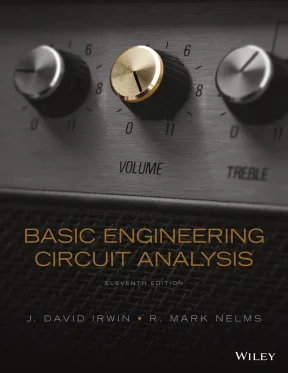
Basic Engineering Circuit Analysis 11th Edition - J. David Irwin & R. Mark Nelms (Auburn University)

Trường đại học

Auburn University

Người đăng

Ẩn danh

Thể loại

Giáo trình

2015

690
0
0

Phí lưu trữ

135 Point

Tóm tắt

I. Tổng quan về Basic Engineering Circuit Analysis 2015

Basic Engineering Circuit Analysis là giáo trình kỹ thuật mạch cơ bản do J. David Irwin và R. Mark Nelms biên soạn, xuất bản lần thứ 11 năm 2015 bởi nhà xuất bản Wiley. Cuốn sách thuộc hệ thống WileyPLUS, nền tảng học tập trực tuyến dựa trên nghiên cứu khoa học. Nội dung sách trình bày các khái niệm cốt lõi về mạch điện như định luật Ohm, định luật Kirchhoff, phân tích mạch điện trở, và các phương pháp giải mạch nâng cao. Mỗi chương cung cấp lý thuyết, ví dụ minh họa và bài tập thực hành đa dạng. Hệ thống hình ảnh trực quan giúp người học nắm bắt nguyên lý nhanh chóng. Sách được sử dụng rộng rãi tại các trường đại học kỹ thuật trên toàn thế giới. Ấn bản 2015 cập nhật nội dung mới, bổ sung công cụ mô phỏng Multisim và PSpice. Đây là tài liệu không thể thiếu cho sinh viên ngành kỹ thuật điện tử và điện lực.

1.1. Thông tin xuất bản và tác giả

Cuốn sách do hai giáo sư hàng đầu tại Đại học Auburn biên soạn. J. David Irwin là chuyên gia về kỹ thuật điện với nhiều năm kinh nghiệm giảng dạy. R. Mark Nelms đồng tác giả, đảm bảo nội dung cập nhật và phù hợp với chương trình đào tạo hiện đại. Nhà xuất bản Wiley phát hành ấn bản thứ 11 vào năm 2015, đánh dấu sự cải tiến đáng kể so với các phiên bản trước. Sách được thiết kế với định dạng 10/12 Times LT Std, in ấn chuyên nghiệp bởi Courier-Kendallville. Bản quyền thuộc John Wiley & Sons, Inc., bảo vệ nội dung theo luật bản quyền Hoa Kỳ năm 1976.

1.2. Vị trí trong chương trình đào tạo kỹ thuật

Basic Engineering Circuit Analysis nằm trong chương trình cốt lõi của ngành kỹ thuật điện và điện tử tại hầu hết các trường đại học. Nội dung sách phục vụ cho môn Phân tích Mạch cơ bản, thường được giảng dạy trong năm thứ hai đại học. Sinh viên sử dụng sách để nắm vững nguyên lý hoạt động của mạch điện tử đơn giản và phức tạp. Kiến thức từ sách là nền tảng cho các môn nâng cao như mạch số, hệ thống điều khiển, và xử lý tín hiệu. Nhiều trường đại học xếp đây là tài liệu tham khảo chính thức cho kỳ thi chứng chỉ kỹ thuật.

II. Phân tích nội dung và phương pháp giảng dạy

Nội dung sách được cấu trúc logic, bắt đầu từ các đại lượng cơ bản như điện áp, dòng điện, và công suất. Chương đầu tiên giới thiệu các khái niệm nền tảng với hình minh họa trực quan, bao gồm so sánh điện áp trong các ứng dụng thực tế từ pin đèn flash đến đường dây tải điện cao thế. Phương pháp giảng dạy kết hợp lý thuyết và thực hành thông qua các ví dụ solved problems. Mỗi chương đều có bài tập từ cơ bản đến nâng cao, giúp sinh viên tự đánh giá tiến độ học tập. Sách trình bày định luật Kirchhoff về dòng điện (KCL) và điện áp (KLV) một cách hệ thống. Các phương pháp phân tích nút và phân tích mắt được giải thích chi tiết với sơ đồ minh họa rõ ràng. Phụ thuộc nguồn (dependent sources) được giới thiệu để chuẩn bị cho việc phân tích mạch với các phần tử chủ động như transistor. Văn phong trình bày mạch lạc, dễ tiếp cận cho người mới bắt đầu.

2.1. Hệ thống đại lượng cơ bản trong mạch điện

Sách trình bày hai đại lượng cơ bản nhất là điện áp và dòng điện. Điện áp được đo bằng vôn (V), biểu thị hiệu điện thế giữa hai điểm trong mạch. Dòng điện tính bằng ampe (A), thể hiện tốc độ di chuyển của điện tích qua tiết diện dẫn. Hình minh họa trong sách so sánh điện áp từ nhiều nguồn khác nhau: pin đèn flash có điện áp 1.5V, acquy ô tô 12V, ổ cắm điện gia đình 120V, đường dây tải điện cao thế đến hàng triệu vôn. Quan hệ giữa công suất, điện áp và dòng điện được thể hiện qua công thức P=VI. Mỗi culông điện tích mất đi hoặc thu được năng lượng khi đi qua phần tử mạch.

2.2. Định luật Kirchhoff và ứng dụng phân tích mạch

Định luật Kirchhoff về dòng điện (KCL) phát biểu rằng tổng đại số dòng điện tại một nút bằng không. Định luật Kirchhoff về điện áp (KLV) phát biểu rằng tổng đại số điện áp quanh một mạch kín bằng không. Sách sử dụng sơ đồ tôpô (topological diagram) để minh họa cách áp dụng KCL tại các nút trong mạch phức tạp. Ví dụ 2.6 trình bày cách tìm dòng điện chưa biết trong mạng nhiều nút bằng cách thiết lập hệ phương trình liên kết. Phương pháp giải hệ phương trình tuyến tính được áp dụng để tìm nghiệm. Sách nhấn mạnh tầm quan trọng của tính độc lập tuyến tính giữa các phương trình, yếu tố quyết định khả năng giải mạch.

III. Giải pháp học tập hiệu quả với nền tảng WileyPLUS

WileyPLUS là nền tảng học tập trực tuyến nghiên cứu, tích hợp đầy đủ tài nguyên hỗ trợ giảng dạy và học tập hiệu quả. Nền tảng cung cấp lộ trình học tập rõ ràng cho sinh viên: biết cần làm gì, cách thực hiện, và cách đánh giá kết quả. Tài liệu kỹ thuật số tương tác giúp sinh viên hiểu sâu hơn lý thuyết mạch điện. Sinh viên có thể tiếp cận bài tập đã được chuyên gia môn học thiết kế sẵn. Hệ thống hỗ trợ kỹ thuật hoạt động 24/7 qua chat trực tuyến, điện thoại và email. Chương trình Student Partner Program kết nối sinh viên với mentor có kinh nghiệm. Hướng dẫn nhanh 2 phút giúp sinh viên làm quen công cụ ngay lập tức. WileyPLUS tạo môi trường học tập chủ động, nâng cao thành tích học tập trong và ngoài lớp học.

3.1. Tính năng tương tác và tài nguyên số

WileyPLUS cung cấp sách giáo trình kỹ thuật số hoàn chỉnh kèm tài nguyên tương tác đa phương tiện. Sinh viên có thể mô phỏng mạch điện bằng công cụ Multisim và PSpice tích hợp sẵn. Hệ thống bài tập tự động cho phép sinh viên luyện tập không giới hạn số lần. Mỗi bài tập đi kèm giải thích chi tiết giúp sinh viên hiểu lỗi sai và cải thiện. Tài nguyên bao gồm video hướng dẫn, hình ảnh minh họa chất lượng cao, và bài kiểm tra tự đánh giá. Nền tảng hoạt động trên nhiều thiết bị, cho phép học tập mọi lúc mọi nơi. Công cụ theo dõi tiến độ giúp sinh viên và giảng viên nắm bắt tình hình học tập.

3.2. Hệ thống hỗ trợ và cộng đồng học tập

WileyPLUS xây dựng hệ sinh thái hỗ trợ toàn diện cho cả giảng viên và sinh viên. Tài khoản quản lý cá nhân (Account Manager) cung cấp đào tạo và hỗ trợ riêng biệt cho từng người dùng. Chương trình cộng tác đồng nghiệp giúp giảng viên chia sẻ tài nguyên và kinh nghiệm giảng dạy. Sự kiện ảo và trực tuyến được tổ chức thường xuyên để cập nhật phương pháp dạy học mới. Thư viện tài nguyên tại www.wiley.com/resources tập hợp mọi công cụ cần thiết để bắt đầu. Đội ngũ kỹ thuật hỗ trợ liên tục qua nhiều kênh đảm bảo trải nghiệm học tập không bị gián đoạn.

IV. Kết luận và ứng dụng thực tế của kiến thức mạch điện

Kiến thức từ Basic Engineering Circuit Analysis có ứng dụng rộng rãi trong thực tế công nghiệp và đời sống. Nền tảng phân tích mạch giúp kỹ sư hiểu nguyên lý hoạt động của mọi thiết bị điện tử. Từ mạch đơn giản như đèn pin đến hệ thống phức tạp như truyền tải điện cao thế, nguyên lý cơ bản đều giống nhau. Điện áp dao động từ 10^-10 vôn trên anten radio đến 10^8 vôn trong tia sét cho thấy phạm vi ứng dụng cực kỳ rộng. Kiểu dòng điện và hướng năng lượng quyết định phần tử đang hấp thụ hay cung cấp năng lượng. Khi dòng dương đi vào cực dương của phần tử, phần tử hấp thụ năng lượng. Ngược lại, phần tử cung cấp năng lượng cho mạch ngoài. Cuốn sách trang bị kiến thức nền tảng vững chắc để sinh viên tiến xa hơn trong các lĩnh vực kỹ thuật điện tử hiện đại.

4.1. Phạm vi điện áp và dòng điện trong thực tế

Sách trình bày phổ điện áp thực tế rất rộng, từ mức siêu nhỏ đến mức khổng lồ. Điện áp giữa hai điểm trên da đầu người đo bằng điện não đồ (EEG) chỉ khoảng 10^-6 vôn. Điện áp qua lồng ngực đo bằng điện tâm đồ (EKG) khoảng 10^-2 vôn. Pin đèn flash cung cấp 1.5V, acquy ô tô 12V, ổ cắm điện gia đình 120V. Đường dây tải điện cao thế đạt hàng trăm kilovôn. Tia sét tự nhiên có thể đạt điện áp 10^8 vôn. Hiểu biết phổ điện áp giúp kỹ sư thiết kế mạch phù hợp với từng ứng dụng cụ thể, đảm bảo an toàn và hiệu quả.

4.2. Hướng dẫn xác định năng lượng trong mạch điện

Sách giải thích rõ ràng cách xác định phần tử đang hấp thụ hay cung cấp năng lượng dựa vào hướng dòng điện và cực điện áp. Quy tắc vàng: khi dòng dương đi vào cực dương của phần tử, phần tử hấp thụ năng lượng từ mạch. Ngược lại, khi dòng dương rời khỏi cực dương, phần tử cung cấp năng lượng cho mạch. Ví dụ minh họa với mạch đèn pin: acquy cung cấp năng lượng, bóng đèn hấp thụ năng lượng. Công suất được tính bằng tích điện áp và dòng điện, đơn vị oát (W). Hiểu nguyên lý năng lượng là cơ sở để phân tích và thiết kế mạch điện phức tạp trong công nghiệp.
21/04/2026

Trích đoạn nội dung tài liệu

WileyPLUS is a research-based online environment for effective teaching and learning. WileyPLUS builds students’ confidence because it takes the guesswork out of studying by providing students with a clear roadmap: • what to do • how to do it • if they did it right It offers interactive resources along with a complete digital textbook that help students learn more. With WileyPLUS, students take more initiative so you’ll have greater impact on their achievement in the classroom and beyond. Now available for For more information, visit www.com ALL THE HELP, RESOURCES, AND PERSONAL SUPPORT YOU AND YOUR STUDENTS NEED! www.com/resources Student Partner Program 2-Minute Tutorials and all Student support from an Collaborate with your colleagues, of the resources you and your experienced student user find a mentor, attend virtual and live students need to get started events, and view resources www.com Quick Start © Courtney Keating/iStockphoto Pre-loaded, ready-to-use Technical Support 24/7 Your WileyPLUS Account Manager, assignments and presentations FAQs, online chat, providing personal training created by subject matter experts and phone support and support www.com/support Basic Engineering Circuit Analysis 11e J. David Irwin Auburn University R. Mark Nelms Auburn University Vice President and Executive Publisher Don Fowley Executive Editor Dan Sayre Senior Content Manager Karoline Luciano Production Editor James Metzger Executive Marketing Manager Christopher Ruel Design Director Harry Nolan Senior Designer Maureen Eide Cover Designer Tom Nery Senior Photo Editor Lisa Gee Editorial Assistant Francesca Baratta Product Designer Jennifer Welter Associate Editor Wendy Ashenberg Cover Photo © GrahamMoore999/iStockphoto Chapter Opener Image © liangpv/Digital Vision Vectors/Getty Images This book was set in 10/12 Times LT Std by MPS Limited and printed and bound by Courier-Kendallville. The cover was printed by Courier-Kendallville. Copyright © 2015, 2011, 2008, 2005 John Wiley & Sons, Inc. All rights reserved. No part of this publication may be reproduced, stored in a retrieval system or transmitted in any form or by any means, electronic, mechanical, photocopying, recording, scanning or otherwise, except as permitted under Sections 107 or 108 of the 1976 United States Copyright Act, without either the prior written permission of the Publisher, or authorization through payment of the appropriate per-copy fee to the Copyright Clearance Center, Inc. 222 Rosewood Drive, Danvers, MA 01923, website www. Requests to the Publisher for permission should be addressed to the Permissions Department, John Wiley & Sons, Inc., 111 River Street, Hoboken, NJ 07030-5774, (201)748-6011, fax (201)748-6008, website http://www. com/go/permissions. Multisim is a trademark of National Instruments. Neither Wiley, nor any software programs or other goods or ser- vices offered by Wiley, are affiliated with, endorsed by, or sponsored by National Instruments. PSpice is a registered trademark of Cadence Design Systems, Inc. in the United States and/or other jurisdictions. MATLAB is a registered trademark of The MathWorks, Inc. Founded in 1807, John Wiley & Sons, Inc. has been a valued source of knowledge and understanding for more than 200 years, helping people around the world meet their needs and fulfill their aspirations. Our company is built on a foundation of principles that include responsibility to the communities we serve and where we live and work. In 2008, we launched a Corporate Citizenship Initiative, a global effort to address the environmental, social, economic, and ethical challenges we face in our business. Among the issues we are addressing are carbon impact, paper specifications and procurement, ethical conduct within our business and among our vendors, and community and charitable support. For more information, please visit our website: www.com/go/citizenship. Evaluation copies are provided to qualified academics and professionals for review purposes only, for use in their courses during the next academic year. These copies are licensed and may not be sold or transferred to a third party. Upon completion of the review period, please return the evaluation copy to Wiley. Return instructions and a free of charge return shipping label are available at www.com/go/returnlabel. Outside of the United States, please contact your local representative. ISBN-13 978-1-118-53929-3 BRV ISBN-13: 978-1-118-99266-1 Library of Congress Cataloging-in-Publication Data Irwin, J. David, 1939- Basic engineering circuit analysis/J. Includes bibliographical references and index. Description based on print version record and CIP data provided by publisher; resource not viewed. ISBN 978-1-118-95598-7 (pdf)—ISBN 978-1-118-53929-3 (cloth : alk. Electric circuit analysis— Textbooks.3815—dc23 2014046173 Printed in the United States of America 10 9 8 7 6 5 4 3 2 1 To my loving family: Edie Geri, Bruno, Andrew, and Ryan John, Julie, John David, and Abi Laura To my parents: Robert and Elizabeth Nelms BRIEF CONTENTS Chapter1 Basic Concepts 1 Chapter2 Resistive Circuits 24 Chapter3 Nodal and Loop Analysis Techniques 89 Chapter4 Operational Amplifiers 147 Chapter5 Additional Analysis Techniques 171 Chapter6 Capacitance and Inductance 219 Chapter7 First- and Second-Order Transient Circuits 252 Chapter8 AC Steady-State Analysis 305 Chapter9 Steady-State Power Analysis 362 Chapter10 Magnetically Coupled Networks 411 Chapter11 Polyphase Circuits 450 Chapter12 Variable-Frequency Network Performance 482 Chapter13 The Laplace Transform 543 Chapter14 Application of the Laplace Transform to Circuit Analysis 569 Chapter15 Fourier Analysis Techniques 617 Appendix Complex Numbers 659 vi CONTENTS Preface ix 5.3 Thévenin’s and Norton’s Theorems 179 5.4 Maximum Power Transfer 197 Chapterone Summary 202 Basic Concepts 1 Problems 202 1.1 System of Units 2 1.2 Basic Quantities 2 Chaptersix 1.3 Circuit Elements 8 Capacitance and Inductance 219 Summary 17 6.3 Capacitor and Inductor Combinations 236 Chaptertwo Summary 241 Resistive Circuits 24 Problems 241 2.2 Ohm’s Law 25 Kirchhoff’s Laws 30 Chapterseven First- and Second-Order Transient Circuits 252 2.3 Single-Loop Circuits 38 2.4 Single-Node-Pair Circuits 45 7.5 Series and Parallel Resistor Combinations 50 7.2 First-Order Circuits 254 2.6 Wye Delta Transformations 59 7.3 Second-Order Circuits 275 2.7 Circuits with Dependent Sources 63 Summary 289 Summary 68 Problems 289 Problems 69 Chaptereight Chapterthree AC Steady-State Analysis 305 Nodal and Loop Analysis Techniques 89 8.2 Sinusoidal and Complex Forcing Functions 309 3.4 Phasor Relationships for Circuit Elements 314 Summary 128 8.5 Impedance and Admittance 318 Problems 129 8.6 Phasor Diagrams 325 Chapterfour 8.7 Basic Analysis Using Kirchhoff’s Laws 328 8.8 Analysis Techniques 331 Operational Amplifiers 147 Summary 344 4.2 Op-Amp Models 148 4.3 Fundamental Op-Amp Circuits 154 Chapternine Summary 163 Steady-State Power Analysis 362 Problems 163 9.1 Instantaneous Power 363 Chapterfive 9.3 Average Power 364 Maximum Average Power Transfer 369 Additional Analysis Techniques 171 9.4 Effective or rms Values 374 5.5 The Power Factor 377 5.6 Complex Power 379 vii viii CONTENTS 9.7 Power Factor Correction 384 13.8 Single-Phase Three-Wire Circuits 388 13.4 Properties of the Transform 549 9.5 Performing the Inverse Transform 551 Summary 399 13.6 Convolution Integral 557 Problems 399 13.7 Initial-Value and Final-Value Theorems 560 13.8 Solving Differential Equations with Laplace Chapterten Transforms 562 Magnetically Coupled Networks 411 Summary 564 Problems 564 10.3 The Ideal Transformer 426 Chapterfourteen Application of the Laplace Transform to 10.4 Safety Considerations 436 Summary 437 Circuit Analysis 569 Problems 438 14.1 Laplace Circuit Solutions 570 14.2 Circuit Element Models 571 Chaptereleven 14.3 Analysis Techniques 573 Polyphase Circuits 450 14.5 Steady-State Response 603 11.1 Three-Phase Circuits 451 Summary 606 11.2 Three-Phase Connections 456 Problems 606 11.3 Source/Load Connections 457 11.5 Power Factor Correction 471 Chapterfifteen Summary 475 Fourier Analysis Techniques 617 Problems 475 15.2 Fourier Transform 641 Chaptertwelve Summary 651 Variable-Frequency Network Performance 482 Problems 651 12.1 Variable Frequency-Response Analysis 483 12.2 Sinusoidal Frequency Analysis 491 Appendix 12.3 Resonant Circuits 500 Complex Numbers 659 12.5 Filter Networks 523 Index 666 Summary 534 Problems 535 Chapterthirteen The Laplace Transform 543 13.2 Two Important Singularity Functions 544 PREFACE Circuit analysis is not only fundamental to the entire breadth of electrical and computer To the Student engineering—the concepts studied here extend far beyond those boundaries. For this reason, it remains the starting point for many future engineers who wish to work in this field. The text and all the supplementary materials associated with it will aid you in reaching this goal. We strongly recommend while you are here to read the Preface closely and view all the resources available to you as a learner. One last piece of advice: Learning to analyze electric circuits is like learning to play a musical instrument. Most people take music lessons as a starting point. Then, they become proficient through practice, practice, and more practice. Lessons on circuit analysis are provided by your instructor and this textbook. Proficiency in circuit analysis can only be obtained through practice. Take advantage of the many opportunities throughout this textbook to practice, practice, and practice. In the end, you’ll be thankful you did. The Eleventh Edition has been prepared based on a careful examination of feedback received To the from instructors and students. The revisions and changes made should appeal to a wide vari- Instructor ety of instructors. We are aware of significant changes taking place in the way this material is being taught and learned. Consequently, the authors and the publisher have created a formi- dable array of traditional and nontraditional learning resources to meet the needs of students and teachers of modern circuit analysis. By design, the book contains an enormous number of end-of-chapter problems that provide significant advantages for the instructor. As a time-saving measure, the instruc- tor can use this bank of problems to select both homework problems and exam questions, term after term, without repetition. Dedicated students will find this problem set, typically graduated in difficulty, an excellent resource for testing their understanding on a range of problems. Flipping the classroom has risen recently as an alternative mode of instruction, which attempts to help the student grasp the material quicker. Studies to date have shown that this mode also tends to minimize instructor office time. This book, with its combination of Learning Assessments, problem-solving videos, and WileyPLUS software, is an ideal vehicle for teaching in this format. These resources provide the instructor with the tools necessary to modify the format of the presentation in the hope of enhancing the student’s rapid understand- ing of the material. Engineering educators have long recognized that coupling traditional lecture courses with laboratory experiences enhances student interest and learning. The trend in hands-on learning has been spurred by the development of inexpensive USB-powered instruments and inexpensive portable laboratory kits that allow the student to explore electrical theory in environments that vary from a traditional laboratory classroom to an environment where the experiments can be performed anywhere at any time. Research has shown that students gain a deeper understanding of abstract theoretical concepts when the concepts are applied in practical circuits. The response of students, both male and female, to hands-on learning with such kits has been overwhelmingly positive. New to this edition, a list of such experiments is provided at the beginning of each chapter. The experiments, which demonstrate some of the concepts introduced in the chapters, can be conducted under the guidance of an instructor or independently. In accordance with the earlier editions, the book contains a plethora of examples that are designed to help the student grasp the salient features of the material quickly. A number of new examples have been introduced, and MATLAB® has been employed, where appropriate, to provide a quick and easy software solution as a means of comparison, as well as to check on other solution techniques. ix x PREFACE Highlights of A four-color design is employed to enhance and clarify both text and illustrations. This the Eleventh sharply improves the pedagogical presentation, particularly with complex illustrations. For example, see Figure 2. Edition End-of-chapter homework problems have been substantially revised and augmented. There are now approximately 1,400 problems in the Eleventh Edition, of which over 400 are new! Multiple-choice Fundamentals of Engineering (FE) Exam problems also appear at the end of each chapter. Problem-solving videos (PSVs) have been created, showing students step by step how to solve all Learning Assessment problems within each chapter. This is a special fea- ture that should significantly enhance the learning experience for each subsection in a chapter. In order to provide maximum flexibility, online supplements contain solutions to exam- ples in the book using MATLAB, PSpice®, or MultiSim®.

Nội dung được bảo vệ bản quyền — Tải xuống đầy đủ