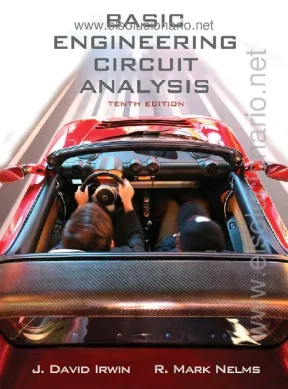
Basic Engineering Circuit Analysis by David Irwin & R. Mark Nelms - 10th Edition

Trường đại học

Auburn University

Chuyên ngành

Kỹ thuật điện

Người đăng

Ẩn danh

Thể loại

Giáo trình

2011

866
0
0

Phí lưu trữ

135 Point

Tóm tắt

I. Tổng quan về giáo trình Basic Engineering Circuit Analysis 10th

Basic Engineering Circuit Analysis 10th Edition là giáo trình phân tích mạch điện cơ bản do hai giáo sư David Irwin và R. Mark Nelms thuộc Đại học Auburn biên soạn. Cuốn sách được nhà xuất bản John Wiley & Sons phát hành năm 2011, đánh dấu lần tái bản thứ mười kể từ khi tác phẩm ra đời. Nội dung sách trình bày các nguyên lý nền tảng về mạch điện, bao gồm định nghĩa điện áp, dòng điện và điện trở. Giáo trình sử dụng hình ảnh trực quan như quả bowling trong nước để giải thích khái niệm dòng điện một cách sinh động. Điển hình, điện áp được định nghĩa là năng lượng trên mỗi đơn vị điện tích, đơn vị tính bằng vôn. Sách đi kèm nền tảng học tập trực tuyến WileyPLUS, cung cấp tài nguyên tương tác, bài tập có sẵn và hỗ trợ kỹ thuật toàn diện cho cả giảng viên lẫn sinh viên trong suốt quá trình giảng dạy và học tập.

1.1. Thông tin xuất bản và tác giả

Giáo trình Basic Engineering Circuit Analysis ấn bản lần thứ mười do David Irwin và R. Mark Nelms đồng tác giả. Cả hai đều công tác tại Đại học Auburn, Hoa Kỳ. Nhà xuất bản John Wiley & Sons chịu trách nhiệm phát hành, với bản quyền được bảo hộ từ các năm 2005, 2008 và 2011. Sách được biên tập bởi đội ngũ chuyên gia dày dạn kinh nghiệm, bao gồm phó chủ tịch xuất bản Don Fowley và biên tập sản xuất cao cấp Valerie A. Vargas. Quá trình sản xuất do Furino Production đảm nhận, đảm bảo chất lượng in ấn và trình bày đạt chuẩn học thuật quốc tế.

1.2. Nền tảng học tập WileyPLUS đi kèm

WileyPLUS là nền tảng học tập trực tuyến tích hợp sẵn với giáo trình Basic Engineering Circuit Analysis. Nền tảng này cung cấp video hướng dẫn ngắn, bài tập được thiết kế sẵn và hệ thống theo dõi tiến độ học tập. Giảng viên có thể cộng tác với đồng nghiệp, tìm kiếm cố vấn và tham gia các sự kiện đào tạo trực tuyến. Sinh viên nhận được hỗ trợ kỹ thuật 24/7 qua mục hỏi đáp thường gặp, chat trực tuyến và điện thoại. WileyPLUS thúc đẩy sự tự tin của sinh viên bằng phản hồi tức thì và bằng chứng tiến bộ rõ ràng, đồng thời cung cấp cho giảng viên nguồn tài liệu đáng tin cậy để đạt mục tiêu khóa học.

II. Phân tích nội dung cốt lõi và vấn đề học tập mạch điện

Nội dung giáo trình Basic Engineering Circuit Analysis xoay quanh các khái niệm cốt lõi của mạch điện tuyến tính. Điện áp là hiệu năng lượng giữa hai điểm khi di chuyển một đơn vị điện tích dương, đo bằng vôn. Dòng điện thể hiện sự chuyển động của các điện tích, được so sánh với quả bowling di chuyển qua cột nước. Điện trở mô tả lực cản mà mạch điện tạo ra đối với dòng điện, tương tự lực cản của nước đối với chuyển động của quả bowling. Giáo trình trình bày các mức dòng điện điển hình từ dòng synapse trong tế bào não khoảng 10⁻¹⁴ ampe đến dòng sét đạt 10⁴ ampe. Ohm's law là mối quan hệ cơ bản nhất giữa điện áp và dòng điện trong mạch tuyến tính. Phương pháp phân tích nối tiếp-song song được áp dụng cho mạch có nguồn điện duy nhất. Sinh viên thường gặp khó khăn trong việc xác định cực tính điện áp và áp dụng đúng định luật Kirchhoff cho các mạch phức tạp.

2.1. Các khái niệm điện áp dòng điện và điện trở

Điện áp, dòng điện và điện trở là ba khái niệm nền tảng trong phân tích mạch điện. Điện áp được tính bằng công thức: 1 vôn bằng 1 jun trên mỗi culông, tức là 1 niutơn mét trên mỗi culông. Dòng điện được đo bằng ampe, với biên độ dao động rất lớn trong thực tế. Dòng điện qua chip nhớ vi mạch chỉ khoảng 10⁻⁸ ampe, trong khi dòng điện công nghiệp lớn đạt tới 10² ampe. Điện trở xuất hiện ở chương hai, mô tả sự cản trở chuyển động của điện tích trong mạch. Việc hiểu rõ mối quan hệ giữa ba đại lượng này là điều kiện tiên quyết để phân tích mạch điện thành công.

2.2. Thách thức trong việc áp dụng định luật Ohm và Kirchhoff

Sinh viên khi học phân tích mạch điện thường đối mặt với nhiều thách thức khi áp dụng định luật Ohm và các định luật Kirchhoff. Định luật Ohm chỉ đúng cho mạch tuyến tính, đòi hỏi người học phải nhận diện được tính tuyến tính của mạch trước khi áp dụng. Định luật Kirchhoff về điện áp yêu cầu tổng điện áp quanh một vòng kín bằng không, còn định luật về dòng điện quy định tổng dòng điện tại một nút bằng không. Giáo trình sử dụng ví dụ thực tiễn như xe điện Tesla Roadster với hơn 6.800 pin lithium-ion để minh họa cách các nguyên lý này áp dụng vào thiết kế thực tế, giúp sinh viên liên kết lý thuyết với ứng dụng.

III. Giải pháp và phương pháp học tập hiệu quả với giáo trình

Để học tập hiệu quả với giáo trình Basic Engineering Circuit Analysis, sinh viên cần áp dụng nhiều phương pháp kết hợp. Thứ nhất, sử dụng nền tảng WileyPLUS để xem video hướng dẫn ngắn và hoàn thành bài tập tương tác. Thứ hai, nắm vững khái niệm thông qua các phép so sánh trực quan mà sách cung cấp, ví dụ so sánh dòng điện với quả bowling trong nước. Thứ ba, luyện tập thường xuyên với các mạch nối tiếp và song song trước khi chuyển sang mạch phức tạp hơn. Giáo trình cung cấp bài tập và bài trình bày được thiết kế sẵn bởi chuyên gia, tiết kiệm thời gian chuẩn bị cho giảng viên. Phương pháp học chủ động với phản hồi tức thì giúp sinh viên xây dựng sự tự tin. Việc hiểu rõ sự đánh đổi giữa các phương pháp phân tích khác nhau, tương tự cách chọn xe điện Tesla thay vì xe hybrid, giúp phát triển tư duy kỹ thuật toàn diện cho người học mạch điện.

3.1. Tận dụng tài nguyên trực tuyến WileyPLUS

WileyPLUS cung cấp hệ sinh thái học tập phong phú cho môn phân tích mạch điện. Giảng viên được hỗ trợ triển khai bởi quản lý tài khoản WileyPLUS cá nhân, cùng đào tạo riêng và hướng dẫn thực hiện. Nền tảng bao gồm video hướng dẫn hai phút giúp sinh viên làm quen nhanh với giao diện. Các bài tập và bài trình bày được tạo sẵn bởi chuyên gia, cho phép sử dụng ngay mà không cần soạn lại từ đầu. Sinh viên có thể hợp tác với bạn học, tham gia sự kiện ảo và xem tài liệu bổ sung. Hệ thống phản hồi tiến độ giúp theo dõi quá trình học tập liên tục.

3.2. Phương pháp phân tích mạch nối tiếp và song song

Phương pháp nối tiếp-song song là kỹ thuật phân tích quan trọng được trình bày trong giáo trình. Mạch nối tiếp là các phần tử có cùng dòng điện chạy qua, trong khi mạch song song có cùng điện áp trên mỗi nhánh. Giáo trình hướng dẫn sinh viên áp dụng phương pháp này cho mạch có một nguồn điện duy nhất kết hợp với các điện trở. Trước khi phân tích, cần vẽ sơ đồ mạch rõ ràng và xác định chiều dòng điện tham chiếu. Áp dụng định luật Ohm và quy tắc phân áp, phân dòng để tìm điện áp và dòng điện tại từng phần tử. Thực hành thường xuyên với các bài tập từ đơn giản đến phức tạp sẽ củng cố kỹ năng phân tích hiệu quả.

IV. Kết luận và ứng dụng thực tế của phân tích mạch điện

Giáo trình Basic Engineering Circuit Analysis 10th Edition cung cấp nền tảng vững chắc cho kỹ sư điện và điện tử. Các nguyên lý cơ bản về điện áp, dòng điện, điện trở và định luật Ohm được trình bày một cách hệ thống và dễ tiếp cận. Kiến thức từ giáo trình có ứng dụng rộng rãi trong thực tế, từ thiết kế mạch vi xử lý đến hệ thống điện công nghiệp. Ví dụ điển hình là xe điện Tesla Roadster sử dụng hơn 6.800 pin lithium-ion nặng khoảng 454 kilogram, hiệu quả gấp đôi xe hybrid. Người thiết kế xe Tesla áp dụng chính các nguyên tắc phân tích mạch được trình bày trong sách để tối ưu hóa hiệu suất và chi phí. Các kỹ năng phân tích mạch cũng áp dụng trong lĩnh vực y tế với dòng điện qua synapse tế bào não, hay trong công nghiệp vi mạch với dòng điện cực nhỏ. Giáo trình trang bị cho sinh viên khả năng đưa ra quyết định kỹ thuật dựa trên đánh đổi giữa hiệu suất, chi phí và an toàn.

4.1. Ứng dụng trong ngành công nghiệp ô tô điện

Ngành công nghiệp ô tô điện là minh chứng sống động cho ứng dụng của phân tích mạch điện. Xe Tesla Roadster năm 2010 là xe thể thao điện hiệu suất cao đầu tiên trên thế giới, có khả năng tăng tốc mạnh mẽ và thân thiện môi trường. Hệ thống pin lithium-ion chứa hơn 6.800 cell riêng lẻ, yêu cầu phân tích mạch chính xác để đảm bảo an toàn và hiệu quả. Giá thành hơn 100.000 đô la phản ánh sự đánh đổi giữa hiệu suất cao và chi phí sản xuất. Việc lựa chọn giữa xe thuần điện và xe hybrid đòi hỏi cân nhắc nhiều yếu tố: hiệu suất, chi phí, hiệu quả năng lượng, tác động môi trường, an toàn và độ tin cậy. Đây chính là tư duy kỹ thuật mà giáo trình rèn luyện cho sinh viên.

4.2. Phạm vi dòng điện trong thực tế và ý nghĩa kỹ thuật

Phạm vi dòng điện trong thực tế trải rộng từ cực nhỏ đến cực lớn, mỗi mức có ý nghĩa kỹ thuật riêng. Dòng điện synapse trong tế bào não chỉ khoảng 10⁻¹⁴ ampe, đại diện cho tín hiệu sinh học cực yếu. Dòng điện qua chip nhớ vi mạch khoảng 10⁻⁸ ampe, phục vụ lưu trữ dữ liệu trong thiết bị điện tử. Ngưỡng gây rung tâm thất ở người là 10⁻² ampe, đặt ra yêu cầu an toàn nghiêm ngặt. Dòng điện gia dụng đạt 10⁰ ampe, còn dòng động cơ công nghiệp lớn khoảng 10² ampe. Tia sét đạt 10⁴ ampe, minh họa dòng điện thiên nhiên mạnh nhất. Việc hiểu các mức dòng điện này giúp kỹ sư thiết kế mạch phù hợp với từng ứng dụng cụ thể.
21/04/2026

Trích đoạn nội dung tài liệu

net This page intentionally left blank www.net irwin_fm_i-xxii-hr.qxd 3-09-2010 15:50 Page i www.net accessible, affordable, active learning :LOH\3/86LVDQLQQRYDWLYHUHVHDUFKEDVHGRQOLQHHQYLURQPHQWIRU HIIHFWLYHWHDFKLQJDQGOHDUQLQJ :LOH\3/86 «PRWLYDWHVVWXGHQWVZLWK «VXSSRUWVLQVWUXFWRUVZLWK www.net FRQÀGHQFHERRVWLQJ UHOLDEOHUHVRXUFHVWKDW IHHGEDFNDQGSURRIRI UHLQIRUFHFRXUVHJRDOV SURJUHVV LQVLGHDQGRXWVLGHRI WKHFODVVURRP ,QFOXGHV ,QWHUDFWLYH 7H[WERRN  5HVRXUFHV :LOH\3/86/HDUQ0RUH ZZZZLOH\SOXVFRP irwin_fm_i-xxii-hr.qxd 3-09-2010 15:50 Page ii www.net $//7+(+(/35(6285&(6$1'3(5621$/6833257 <28$1'<285678'(1761((' ZZZZLOH\SOXVFRPUHVRXUFHV www.net 0LQXWH7XWRULDOVDQGDOO 6WXGHQWVXSSRUWIURPDQ &ROODERUDWHZLWK\RXUFROOHDJXHV RIWKHUHVRXUFHV\RX \RXU H[SHULHQFHGVWXGHQWXVHU ILQGDPHQWRUDWWHQGYLUWXDODQGOLYH VWXGHQWVQHHGWRJHWVWDUWHG HYHQWVDQGYLHZUHVRXUFHV ZZZ:KHUH)DFXOW\&RQQHFWFRP 3UHORDGHGUHDG\WRXVH 7HFKQLFDO6XSSRUW <RXU:LOH\3/86$FFRXQW0DQDJHU DVVLJQPHQWVDQGSUHVHQWDWLRQV )$4VRQOLQHFKDW 3HUVRQDOWUDLQLQJDQG &UHDWHGE\VXEMHFWPDWWHUH[SHUWV DQGSKRQHVXSSRUW LPSOHPHQWDWLRQVXSSRUW ZZZZLOH\SOXVFRPVXSSRUW irwin_fm_i-xxii-hr.qxd 3-09-2010 15:50 Page iii www.net BASIC ENGINEERING CIRCUIT ANALYSIS www.net This page intentionally left blank www.net irwin_fm_i-xxii-hr.qxd 3-09-2010 15:50 Page v www.net BASIC ENGINEERING CIRCUIT ANALYSIS Tenth Edition www. DAVID IRWIN Auburn University R. MARK NELMS Auburn University John Wiley & Sons, Inc. irwin_fm_i-xxii-hr.qxd 3-09-2010 15:50 Page vi www.net Vice President and Executive Publisher Don Fowley Associate Publisher Dan Sayre Production Manager Dorothy Sinclair Senior Production Editor Valerie A. Vargas Marketing Manager Christopher Ruel Creative Director Harry Nolan Senior Designer Kevin Murphy Production Management Services Furino Production Senior Illustration Editor Anna Melhorn Senior Photo Editor Lisa Gee Editorial Assistant Katie Singleton Executive Media Editor Thomas Kulesa Cover Photo provided courtesy of Tesla Motors, Inc. This book was set in 10/12 Times by Prepare and printed and bound by Courier-Kendallville. The cover was printed by Courier-Kendallville. Copyright © 2011, 2008, 2005 John Wiley & Sons, Inc. All rights reserved. No part of this publication may be reproduced, stored in a retrieval system or transmitted in any form or by any means, electronic, mechanical, photocopying, recording, scanning or otherwise, except as permitted under Sections 107 or 108 of the 1976 United States Copyright Act, without either the prior written permission of the Publisher, or authorization through payment of the appropriate per-copy fee to the Copyright Clearance Center, Inc. 222 Rosewood Drive, Danvers, MA 01923, website www. Requests to the Publisher for permission should be addressed to the Permissions Department, John Wiley & Sons, Inc., 111 River Street, Hoboken, NJ 07030-5774, (201)748-6011, fax (201)748-6008, website http://www.com/go/permissions. Founded in 1807, John Wiley & Sons, Inc. has been a valued source of knowledge and understanding for more than 200 years, helping people around the world meet their needs and fulfill their aspirations. Our company is built on a foundation of principles that include responsibility to the communities we serve and where we live and work. In 2008, we launched a Corporate Citizenship Initiative, a global effort to address the environmental, social, economic, and ethical challenges we face in our business. Among the issues we are addressing are carbon impact, paper specifications and procurement, ethical conduct within our business and among our vendors, and community and charitable support. For more information, please visit our website: www.com/go/citizenship. Evaluation copies are provided to qualified academics and professionals for review purposes only, for use in their courses during the next academic year. These copies are licensed and may not be sold or transferred to a third party. Upon completion of the review period, please return the evaluation copy to Wiley. Return instructions and a free of charge return shipping label are available at www.com/go/returnlabel. Outside of the United States, please contact your local representative. ISBN-13 978-0-470-63322-9 Printed in the United States of America 10 9 8 7 6 5 4 3 2 1 irwin_fm_i-xxii-hr.qxd 3-09-2010 15:50 Page vii www.net To my loving family: Edie Geri, Bruno, Andrew and Ryan John, Julie, John David and Abi www.net Laura To my parents: Robert and Elizabeth Nelms www.net This page intentionally left blank www.net irwin_fm_i-xxii-hr.qxd 3-09-2010 15:50 Page ix www.net BRIEF CONTENTS www.net CHAPTER 1 Basic Concepts 1 C H A P T E R 2 Resistive Circuits 25 C H A P T E R 3 Nodal and Loop Analysis Techniques 102 C H A P T E R 4 Operational Amplifiers 156 C H A P T E R 5 Additional Analysis Techniques 189 C H A P T E R 6 Capacitance and Inductance 245 C H A P T E R 7 First- and Second-Order Transient Circuits 296 C H A P T E R 8 AC Steady-State Analysis 369 C H A P T E R 9 Steady-State Power Analysis 435 C H A P T E R 10 Magnetically Coupled Networks 491 C H A P T E R 11 Polyphase Circuits 541 C H A P T E R 12 Variable-Frequency Network Performance 577 C H A P T E R 13 The Laplace Transform 667 C H A P T E R 14 Application of the Laplace Transform to Circuit Analysis 695 CHAPTER 15 Fourier Analysis Techniques 751 C H A P T E R 16 Two-Port Networks 801 www.net This page intentionally left blank www.net irwin_fm_i-xxii-hr.qxd 3-09-2010 15:50 Page xi www.net CONTENTS www.net Preface xiii CHAPTER 3 NODAL AND LOOP ANALYSIS TECHNIQUES 102 CHAPTER 1 3.1 Nodal Analysis 102 BASIC CONCEPTS 1 3.1 System of Units 2 3.2 Basic Quantities 2 Summary 139 1.3 Circuit Elements 8 Problems 140 Summary 17 Problems 17 CHAPTER 4 CHAPTER 2 OPERATIONAL AMPLIFIERS 156 RESISTIVE CIRCUITS 25 4.2 Op-Amp Models 157 2.3 Fundamental Op-Amp Circuits 163 2.3 Single-Loop Circuits 39 4.4 Single-Node-Pair Circuits 46 4.5 Series and Parallel Resistor Combinations 51 Summary 179 2.6 Circuits with Series-Parallel Problems 180   Combinations of Resistors 55 2.7 Wye Delta Transformations 61 2.8 Circuits with Dependent Sources 64 2.9 Resistor Technologies for Electronic Manufacturing 69 CHAPTER 5 ADDITIONAL ANALYSIS TECHNIQUES 189 2.3 Thévenin’s and Norton’s Theorems 198 irwin_fm_i-xxii-hr.qxd 3-09-2010 15:50 Page xii www.net xii CONTENTS 5.4 Maximum Power Transfer 216 8.10 Design Examples 410 Summary 227 Summary 413 Problems 227 Problems 414 CHAPTER 9 CHAPTER 6 STEADY-STATE POWER ANALYSIS 435 CAPACITANCE AND INDUCTANCE 245 9.3 Maximum Average Power Transfer 442 6.3 Capacitor and Inductor Combinations 264 9.4 Effective or rms Values 447 6.4 RC Operational Amplifier Circuits 272 9.5 The Power Factor 450 www.7 Power Factor Correction 457 Summary 280 9.8 Single-Phase Three-Wire Circuits 461 Problems 281 9.11 Design Examples 476 Summary 478 CHAPTER 7 Problems 478 FIRST- AND SECOND-ORDER TRANSIENT CIRCUITS 7.1 Introduction 297 296 CHAPTER 10 MAGNETICALLY COUPLED NETWORKS 491 7.2 First-Order Circuits 298 7.3 Second-Order Circuits 319 10.3 The Ideal Transformer 506 Summary 351 10.4 Safety Considerations 515 Problems 351 10.6 Design Examples 521 Summary 525 Problems 526 CHAPTER 8 AC STEADY-STATE ANALYSIS 369 8.1 Sinusoids 370 CHAPTER 11 POLYPHASE CIRCUITS 541 8.2 Sinusoidal and Complex Forcing Functions 373 8.1 Three-Phase Circuits 542 8.4 Phasor Relationships for Circuit Elements 379 11.2 Three-Phase Connections 547 8.5 Impedance and Admittance 383 11.3 Source/Load Connections 548 8.7 Basic Analysis Using Kirchhoff’s Laws 393 11.5 Power Factor Correction 561 irwin_fm_i-xxii-hr2.qxd 6-09-2010 14:10 Page xiii www.net CONTENTS xiii 11.4 Transfer Function 712 Summary 570 14.5 Pole-Zero Plot/Bode Plot Connection 724 Problems 570 14.6 Steady-State Response 727 14.8 Design Examples 731 CHAPTER 12 Summary 738 Problems 738 VARIABLE-FREQUENCY NETWORK PERFORMANCE 577 12.2 Variable Frequency-Response Analysis 578 Sinusoidal Frequency Analysis 586 CHAPTER 15 FOURIER ANALYSIS TECHNIQUES 751 12.2 Fourier Transform 773 www.4 Design Example 787 Summary 655 Summary 793 Problems 656 Problems 794 CHAPTER 13 CHAPTER 16 THE LAPLACE TRANSFORM 667 TWO-PORT NETWORKS 801 13.2 Two Important Singularity Functions 669 16.4 Properties of the Transform 673 16.5 Performing the Inverse Transform 676 16.6 Interconnection of Two-Ports 811 13.7 Initial-Value and Final-Value Theorems 685 16.8 Design Example 819 Summary 689 Summary 821 Problems 689 Problems 821 CHAPTER 14 APPENDIX APPLICATION OF THE LAPLACE COMPLEX NUMBERS 829 TRANSFORM TO CIRCUIT ANALYSIS 695 Index 834 14.1 Laplace Circuit Solutions 696 14.2 Circuit Element Models 697 www.net This page intentionally left blank www.net irwin_fm_i-xxii-hr.qxd 3-09-2010 15:50 Page xv www.net PREFACE www.net Circuit analysis is not only fundamental to the entire breadth of electrical and computer engineering—the concepts studied here extend far beyond those boundaries. For this reason To the Student it remains the starting point for many future engineers who wish to work in this field. The text and all the supplementary materials associated with it will aid you in reaching this goal. We strongly recommend while you are here to read the Preface closely and view all the resources available to you as a learner. And one last piece of advice, learning requires practice and rep- etition, take every opportunity to work one more problem or study one more hour than you planned. In the end, you’ll be thankful you did. The Tenth Edition has been prepared based on a careful examination of feedback received To the from instructors and students. The revisions and changes made should appeal to a wide vari- ety of instructors. We are aware of significant changes taking place in the way this material Instructor is being taught and learned. Consequently, the authors and the publisher have created a for- midable array of traditional and non-traditional learning resources to meet the needs of stu- dents and teachers of modern circuit analysis. • A four-color design is employed to enhance and clarify both text and illustrations. This Highlights of the sharply improves the pedagogical presentation, particularly with complex illustrations. For example, see Figure 2. Tenth Edition • New chapter previews provide motivation for studying the material in the chapter. See page 25 for a chapter preview sample. Learning objectives for each chapter have been updated and appear as part of the new chapter openers. • End of chapter homework problems have been substantially revised and augmented. There are now approximately 1400 problems in the Tenth Edition, of which over 400 are new! Multiple-choice Fundamentals of Engineering (FE) Exam problems also appear at the end of each chapter. • Practical applications have been added for nearly every topic in the text. Since these are items students will naturally encounter on a regular basis, they serve to answer ques- tions such as, “Why is this important?” or “How am I going to use what I learn from this course?” For a typical example application, see page 333. irwin_fm_i-xxii-hr.qxd 3-09-2010 15:50 Page xvi www.net xvi P R E FAC E • Problem Solving videos have been created showing students step-by-step how to solve all Learning Assessment problems within each chapter. This is a special feature that should significantly enhance the learning experience for each subsection in a chapter. The problem-solving videos (PSVs) are now also available for the Apple iPod. • In order to provide maximum flexibility, online supplements contain solutions to exam- ples in the book using MATLAB, PSPICE or MultiSim. The worked examples can be supplied to students as digital files, or one or more of them can be incorporated into custom print editions of the text, depending upon the instructor’s preference. • Problem-Solving Strategies have been retained in the Tenth Edition. They are utilized as a guide for the solutions contained in the PSVs. • The WileyPLUS resources have been greatly updated and expanded, with additional algorithmic problems, problem-solving videos and much more. New Reading Quiz questions give instructors the opportunity to track student reading and measure their comprehension. New Math Skills Assessments provide faculty with tools to assess stu- dents’ mastery of essential mathematical concepts. Not only can faculty measure their students’ math comprehension at the beginning of the term, they also now have www.net resources to which they can direct students to help them reinforce areas where they need to upgrade their skills. This text is suitable for a one-semester, a two-semester or a three-quarter course sequence. Organization The first seven chapters are concerned with the analysis of dc circuits. An introduction to operational amplifiers is presented in Chapter 4. This chapter may be omitted without any loss of continuity; a few examples and homework problems in later chapters must be skipped. Chapters 8–12 are focused on the analysis of ac circuits beginning with the analysis of single- frequency circuits (single-phase and three-phase) and ending with variable-frequency circuit operation. Calculation of power in single-phase and three-phase ac circuits is also presented. The important topics of the Laplace transform, Fourier transform, and two-port networks are covered in Chapters 13–16. The organization of the text provides instructors maximum flexibility in designing their courses.

Nội dung được bảo vệ bản quyền — Tải xuống đầy đủ