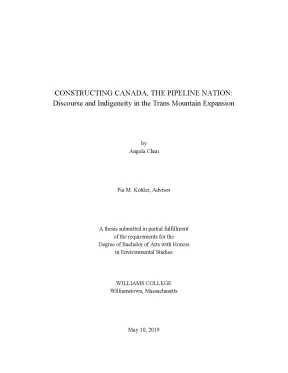
Luận văn về dự án mở rộng Trans Mountain và người bản địa - Angela Chan

Nghiên cứu chuyên sâu về luận án Chanangela thesis trong lĩnh vực khoa học xã hội. Phân tích cấu trúc, nội dung và đóng góp học thuật của đề tài nghiên cứu này.

Trường đại học

Williams College

Chuyên ngành

Nghiên cứu môi trường

Tác giả

Ẩn danh

Người đăng

Ẩn danh

Thể loại

Khóa luận tốt nghiệp

2019

121
0
0

Phí lưu trữ

35 Point

Tóm tắt

I. Tổng quan về luận văn Chanangela về đường ống Trans Mountain

Luận văn của Angela Chan mang tên "Constructing Canada, the Pipeline Nation" nghiên cứu dự án mở rộng đường ống Trans Mountain tại Canada. Tác giả hoàn thành công trình này tại Williams College năm 2019, dưới sự hướng dẫn của Giáo sư Pia Kohler. Luận văn thuộc chuyên ngành Environmental Studies, cấp độ Honors Bachelor of Arts. Nội dung chính tập trung vào diễn ngôn chính trị và vấn đề bản địa liên quan đến dự án đường ống. Tác giả phân tích cách chính phủ liên bang Canada xây dựng hình ảnh quốc gia thông qua ngành công nghiệp dầu khí. Luận văn xem xét lịch sử chính sách năng lượng, khung pháp lý, và vai trò của Ủy ban Năng lượng Quốc gia. Công trình cũng đề cập đến quyết định mua lại Trans Mountain của chính phủ Trudeau với giá 4,5 tỷ đô la năm 2018. Đây là một nghiên cứu liên ngành, kết hợp phân tích chính sách, luật pháp và diễn ngôn xã hội. Tác phẩm cung cấp góc nhìn học thuật sâu sắc về xung đột giữa phát triển kinh tế và quyền lợi người bản địa tại Canada.

1.1. Bối cảnh và mục tiêu nghiên cứu

Angela Chan bắt đầu nghiên cứu chủ đề này sau khi tham gia khóa học kinh tế môi trường của Giáo sư Sarah Jacobson. Dự án mở rộng Trans Mountain trở thành tâm điểm tranh luận chính trị tại Canada trong giai đoạn 2018-2019. Tác giả đặt mục tiêu phân tích cách nhà nước Canada sử dụng ngôn ngữ và chính sách để hợp thức hóa dự án đường ống. Nghiên cứu xem xét mối quan hệ giữa chính phủ liên bang, các tỉnh bang và cộng đồng bản địa. Mục tiêu cuối cùng là làm rõ vai trò của diễn ngôn trong việc định hình bản sắc quốc gia gắn với ngành dầu khí.

1.2. Cấu trúc và phạm vi luận văn

Luận văn được chia thành nhiều chương, bao gồm phần giới thiệu, chính sách năng lượng, khung pháp lý và phân tích diễn ngôn. Chương một trình bày lịch sử chính sách năng lượng Canada và thị trường dầu mỏ. Chương hai tập trung vào khung pháp lý, bao gồm vai trò của Ủy ban Năng lượng Quốc gia. Tác giả giới hạn phạm vi phân tích đến ngày 22 tháng 2 năm 2019, thời điểm NEB công bố báo cáo tái xem xét. Phạm vi này giúp luận văn giữ tính tập trung và độ sâu phân tích cao.

II. Vấn đề bản địa và tranh chấp pháp lý trong dự án

Dự án mở rộng Trans Mountain vấp phải sự phản đối mạnh mẽ từ nhiều cộng đồng bản địa tại British Columbia. Vụ kiện Tsleil-Waututh Nation kiện Chính phủ Canada năm 2018 là một cột mốc pháp lý quan trọng. Tòa án Liên bang phúc thẩm đã ra phán quyết yêu cầu chính phủ tham vấn lại với các nhóm bản địa. Vấn đề cốt lõi nằm ở quyền tham vấn và sự đồng thuận của người bản địa đối với các dự án ảnh hưởng đến đất đai. Luận văn phân tích cách chính phủ Trudeau công bố khung pháp lý về công nhận quyền bản địa vào tháng 2 năm 2018. Tác giả cũng xem xét bài phát biểu của Trudeau trước Hội đồng các Dân tộc Đầu tiên vào tháng 12 năm 2018. Những sự kiện này cho thấy căng thẳng giữa cam kết hòa giải và lợi ích kinh tế từ ngành dầu khí. Nghiên cứu chỉ ra mâu thuẫn trong diễn ngôn chính trị, khi chính phủ vừa thúc đẩy dự án vừa tuyên bố tôn trọng quyền bản địa. Đây là phần phân tích trọng tâm, làm nổi bật xung đột lợi ích trong chính sách năng lượng quốc gia.

2.1. Vụ kiện Tsleil Waututh Nation

Vụ kiện Tsleil-Waututh Nation kiện Tổng chưởng lý Canada năm 2018 đánh dấu bước ngoặt pháp lý quan trọng. Tòa án Liên bang phúc thẩm phán quyết rằng quá trình tham vấn của chính phủ với cộng đồng bản địa chưa đầy đủ. Phán quyết này buộc chính phủ phải tiến hành đánh giá môi trường lại và tham vấn bổ sung. Sự kiện này trì hoãn tiến độ dự án và làm tăng chi phí tổng thể. Vụ kiện trở thành ví dụ điển hình về xung đột giữa phát triển hạ tầng và quyền lợi bản địa tại Canada.

2.2. Khung pháp lý công nhận quyền bản địa

Thủ tướng Trudeau công bố khung pháp lý mới về công nhận và thực thi quyền bản địa vào tháng 2 năm 2018. Khung pháp lý này nhằm định hình lại mối quan hệ giữa chính phủ liên bang và các dân tộc bản địa. Chính phủ dự kiến triển khai khung này trước cuộc bầu cử liên bang mùa thu 2019. Tuy nhiên, luận văn chỉ ra sự mâu thuẫn khi chính phủ đồng thời thúc đẩy dự án đường ống gây tranh cãi. Điều này đặt câu hỏi về tính nhất quán trong chính sách hòa giải của Canada.

III. Phương pháp phân tích diễn ngôn trong luận văn

Angela Chan sử dụng phương pháp phân tích diễn ngôn để nghiên cứu ngôn ngữ chính trị xung quanh dự án Trans Mountain. Phương pháp này tập trung vào cách chính phủ, doanh nghiệp và truyền thông xây dựng câu chuyện về đường ống. Tác giả thu thập dữ liệu từ các bài phát biểu chính thức của Thủ tướng Trudeau, tài liệu chính phủ và báo cáo pháp lý. Nghiên cứu cũng phân tích timeline sự kiện quan trọng, từ khi đường ống Trans Mountain bắt đầu hoạt động năm 1953 đến năm 2019. Phương pháp này giúp làm rõ cách quốc gia được xây dựng thông qua ngôn ngữ về năng lượng và tài nguyên. Tác giả so sánh diễn ngôn chính thức với thực tế pháp lý và phản ứng của cộng đồng bản địa. Cách tiếp cận liên ngành kết hợp lý thuyết chính trị, luật học và nghiên cứu môi trường. Phương pháp này phù hợp để phân tích các dự án hạ tầng lớn có tính chính trị cao. Nghiên cứu cung cấp một mô hình phân tích có thể áp dụng cho các trường hợp tương tự khác.

3.1. Nguồn dữ liệu và tài liệu tham khảo

Luận văn dựa trên nhiều nguồn tài liệu sơ cấp, bao gồm bài phát biểu chính thức, thông cáo báo chí và hồ sơ tòa án. Tác giả tham khảo báo cáo của Ủy ban Năng lượng Quốc gia và các văn bản pháp lý liên quan đến vụ kiện Tsleil-Waututh Nation. Nguồn tin từ Reuters, CBC và Globe and Mail cũng được sử dụng để xây dựng timeline sự kiện. Việc kết hợp nhiều loại nguồn giúp tăng độ tin cậy và chiều sâu phân tích. Phương pháp thu thập dữ liệu này đảm bảo tính khách quan và toàn diện cho nghiên cứu.

3.2. Khung lý thuyết áp dụng

Nghiên cứu áp dụng khung lý thuyết về xây dựng quốc gia thông qua diễn ngôn chính trị. Tác giả kết hợp lý thuyết hậu thuộc địa để phân tích mối quan hệ giữa nhà nước và người bản địa. Khung lý thuyết này giúp làm rõ cách ngôn ngữ chính trị tạo ra và duy trì quyền lực nhà nước. Phương pháp phân tích cũng xem xét vai trò của truyền thông trong việc định hình nhận thức công chúng. Cách tiếp cận lý thuyết đa chiều này làm luận văn có giá trị học thuật cao.

IV. Kết luận và ứng dụng thực tiễn của nghiên cứu

Luận văn của Angela Chan kết luận rằng dự án Trans Mountain phản ánh mâu thuẫn sâu sắc trong chính sách quốc gia Canada. Chính phủ vừa muốn thúc đẩy phát triển kinh tế qua ngành dầu khí, vừa cam kết hòa giải với người bản địa. Hai mục tiêu này thường xuyên xung đột trên thực tế, như vụ kiện Tsleil-Waututh Nation đã chứng minh. Nghiên cứu nhấn mạnh vai trò quan trọng của diễn ngôn trong việc hợp thức hóa các quyết định chính trị lớn. Kết quả nghiên cứu có giá trị tham khảo cho các nhà hoạch định chính sách năng lượng và môi trường. Luận văn cũng cung cấp bài học cho các dự án hạ tầng tương tự tại nhiều quốc gia khác. Ứng dụng thực tiễn bao gồm việc cải thiện quy trình tham vấn cộng đồng bản địa trong các dự án lớn. Nghiên cứu góp phần vào lĩnh vực nghiên cứu môi trường và chính trị năng lượng đương đại. Đây là tài liệu tham khảo hữu ích cho sinh viên và nhà nghiên cứu quan tâm đến chủ đề tương tự.

4.1. Bài học chính sách từ nghiên cứu

Nghiên cứu chỉ ra rằng chính phủ cần cải thiện quy trình tham vấn thực chất với cộng đồng bản địa trước khi phê duyệt dự án lớn. Việc chỉ tuân thủ hình thức pháp lý mà thiếu đối thoại thực sự dễ dẫn đến tranh chấp kéo dài. Bài học từ vụ Tsleil-Waututh Nation cho thấy chi phí trì hoãn pháp lý có thể rất lớn. Chính sách năng lượng cần cân bằng giữa lợi ích kinh tế và trách nhiệm với môi trường, cộng đồng bản địa. Đây là bài học có giá trị cho các nhà hoạch định chính sách tương lai.

4.2. Giá trị học thuật và hướng nghiên cứu tiếp theo

Luận văn mở ra hướng nghiên cứu mới về diễn ngôn chính trị trong các dự án hạ tầng năng lượng. Các nghiên cứu tiếp theo có thể mở rộng phân tích sang các đường ống khác tại Bắc Mỹ. Chủ đề quyền bản địa và phát triển tài nguyên vẫn còn nhiều khía cạnh chưa được khai thác đầy đủ. Phương pháp phân tích diễn ngôn của Angela Chan có thể áp dụng cho nhiều bối cảnh chính trị khác. Nghiên cứu này đóng góp giá trị lâu dài cho lĩnh vực môi trường và chính sách công.
Tóm tắt và mô tả trên trang này được tạo với sự hỗ trợ của AI. Nếu bạn thấy nội dung không chính xác hoặc có vấn đề, vui lòng Báo lỗi nội dung.

31/05/2026
Chanangela thesis

Trích đoạn nội dung tài liệu

CONSTRUCTING CANADA, THE PIPELINE NATION: Discourse and Indigeneity in the Trans Mountain Expansion by Angela Chan Pia M. Kohler, Advisor A thesis submitted in partial fulfillment of the requirements for the Degree of Bachelor of Arts with Honors in Environmental Studies WILLIAMS COLLEGE Williamstown, Massachusetts May 10, 2019 ACKNOWLEDGMENTS To Professor Pia Kohler, without whom this thesis would not exist. Thank you for being a most incredible mentor and inspiring teacher; for pushing me through this process; for encouraging me through every twist and turn of this winding road. To Professor Sarah Jacobson, for being my second reader and catalyzing the shift in my thesis topic late last year.

Thank you for your fantastic course on environmental economics, without which I never would have looked into the Trans Mountain Expansion. To my parents, who are aware that I have been researching something about pipelines for the past year and a half. Thank you for always believing in me when I don’t believe in myself. To my American Eskimo, Amethyst, for being the cutest dog in the whole world.

To Henry, for being you. To all my friends, for your extraordinary love and support. Thank you for making my Williams experience magical. To Vincent Lin, who wanted his own clause in my acknowledgments section.

To Ben, for introducing me to Zotero. To Jesup, my home away from home. Thank you for the late nights, the laughter, and the memories I will never forget. To ​The Beaverton,​ the Canadian news satire publication that kept me going with headlines like: (These will make a lot more sense after you’ve read the rest of this thesis.)1,2 1 Alex Huntley, “Pei Threatens to Cut Off New Brunswick’s Potato Shipments Unless They Approve New Potato Pipeline,” ​The Beaverton​ (blog), April 18, 2018, https://www.com/2018/04/pei-threatens-cut-off-new-brunswicks-potato-shipments-unless-approve-ne w-potato-pipeline/​.

2 Alex Huntley, “Notley to Flood BC so Pipelines Reach Pacific,” ​The Beaverton​ (blog), April 11, 2018, https://www.com/2018/04/notley-flood-bc-pipelines-reach-pacific/​. 1 TABLE OF CONTENTS INTRODUCTION​ ​……………………………………………………………………………. 3 Constructing the Nation​ ……………………………………………………………………… 3 Literature Review​ …………………………………………………………………………….11 CHAPTER 1: ENERGY POLICY AND THE TRANS MOUNTAIN PIPELIN​E​ ……….1​3 History of Energy Policy​ …………………………………………………………………… 1​3 A Trickle and a Flood​ …………………………………………………………………. 1​3 Pipelines and Parliamentary Pandemonium​ …………………………………………….

1​4 The Changing Federation​ ………………………………………………………………. 1​6 Canadian Oil Today​ ……………………………………………………………………. 1​8 The Oil Market​ …………………………………………………………………………. 2​0 The Trans Mountain Expansion​ …………………………………………………………….

2​6 CHAPTER 2: LEGAL NARRATIVES​ ​……………………………………………………… 29 Regulatory Framework​ ……………………………………………………………………. 29 National Energy Board​ …………………………………………………………………. 29 Federal and Provincial Acts​ ……………………………………………………………. 3​0 Timeline of Pipeline Review Process​ ………………………………………………….

3​2 Legal Discourse Analysis​ …………………………………………………………………. 3​4 Tsleil-Waututh Nation v. 4​5 CHAPTER 3: POLITICAL NARRATIVES​ ​…………………………………………………4​8 Overview​ ……………………………………………………………………………………. 10​4 2 INTRODUCTION Constructing the Nation In 1971, the Government of Canada, under Prime Minister Pierre Elliott Trudeau, declared that Canada would adopt a multicultural policy and affirm its dedication to diversity, tolerance, and inclusivity.

In 1988, Prime Minister Brian Mulroney enacted the ​Canadian Multiculturalism Act​, enshrining multiculturalism in Canadian policy. On June 27, 2018, designated as Canadian Multiculturalism Day, Prime Minister Justin Trudeau gave a statement highlighting Canada’s achievement as the first country in the world to adopt a policy of multiculturalism: “May we never forget, or take for granted, that Canada is an accepting, compassionate, and respectful country—and an example to the world—because we are accepting, compassionate, and respectful to each other.”3 Canada prides itself in its tolerance and recognition of the variety of citizens that constitute the country’s cultural mosaic. Peaceful inclusivity has become part of the official construction of Canada’s national identity; Canada differentiates itself from other countries, particularly the United States, by highlighting difference instead of forcing assimilation. Though Canada’s policy of multiculturalism is intended for immigrants, Indigenous peoples have been swept under the term.

Critics argue that Canada’s ostentatious displays of tolerance merely serve to manage and utilize difference for its Western nation-building project. Instead of breaking the colonial structures of domination imposed by the settler state upon Indigenous peoples, Canada’s liberal politics of recognition absorbs and uses difference to perpetuate the state’s authority and its mythical story of inclusive, multicultural progress.4 In my thesis, I build upon critiques of Canada’s dominant narrative—that is, the story of the country’s progressive march towards an inclusive, tolerant, and free society. Eva Mackey, 3 Justin Trudeau, “Statement by the Prime Minister on Canadian Multiculturalism Day,” June 27, 2018, https://pm.ca/eng/news/2018/06/27/statement-prime-minister-canadian-multiculturalism-day. 4 See Eva Mackey, ​The House of Difference: Cultural Politics and National Identity in Canada,​ Anthropological Horizons (University of Toronto Press, 2002); Glen S.

Coulthard, “Subjects of Empire: Indigenous Peoples and the ‘Politics of Recognition’ in Canada,” ​Contemporary Political Theory​ 6, no. 4 (2007): 437–60; David Bruce MacDonald, “Reforming Multiculturalism in a Bi-National Society: Aboriginal Peoples and the Search for Truth and Reconciliation in Canada,” ​The Canadian Journal of Sociology​ 39, no. 3 whose work inspires and guides my project, says the following about her own analysis on cultural politics and national identity in Canada: [I] explore how representations of [the relationship between British and French colonizers and Indigenous peoples] have been configured in constructions of Canadian national identity. I do not provide a ‘history’ of Canada, but rather examine particular moments in history, and specific ‘telling cases’ (Mitchell 1984), in order to explore the contradictory cultural politics of the process of managing and representing difference.5 My specific ‘telling cases’ revolve around the Trans Mountain Expansion (TMX), a planned crude oil pipeline from Alberta to the British Columbian coast.

I use these cases to examine topics like Canada’s relationship with Indigenous nations, how discourse is framed and used to serve broader agendas, and Canada’s national identity. My research stems from my first academic foray into Canadian politics the spring of my sophomore year, when I took Environmental Economics with Professor Sarah Jacobson and wrote a final research paper on the Trans Mountain Expansion. The spring of my junior year, I undertook an independent study with Professor Pia Kohler (who is also my thesis advisor) on Canadian pipeline politics, where I did a case study on Indigenous resistance in the Northern Gateway pipeline, a similar project that was eventually scrapped by the federal government. I am Canadian and grew up in Vancouver, the terminus of the Trans Mountain Expansion and a city founded on the unceded territories of the Musqueam, Squamish, and Tsleil-Waututh First Nations.

Studying at an American college has made me realize how much of Canada’s identity is rooted in its apparent differences from the United States—in its tolerance and appreciation of minorities, in its relative lack of political polarization, and in its approach to cultural difference as mosaic instead of as melting pot. My thesis examines the often unchallenged assumptions behind Canada’s official narrative and explores the tension between Indigenous sovereignty and the asserted sovereignty of the Canadian state. Literature Review I build upon literature that examines policies of recognition as methods for managing difference in favour of the ultimate authority, i. the settler colonial nation-state.

Some praise 5 Mackey, ​The House of Difference,​ 24. 4 Canada for its recent efforts to improve its relationship with Indigenous peoples based on a “recognition of rights, respect, and partnership”6 and a nation-to-nation approach. An emerging body of work, however, analyzes the power dynamics behind the Crown7-Indigenous relationship and how the state uses liberal policies of tolerance and recognition to further entrench the nation-building project. In ​The House of Difference: Cultural Politics and National Identity in Canada,​ Eva Mackey explores the uniquely Canadian method of nation-building, in which those in power use and manage the recognition of difference to achieve certain goals.

Instead of obliterating difference, as may be the case in countries like the U., political supremacy in Canada works through the “institutionalisation of differences.”8 Rather than engaging with binary oppositions like erasure / inclusion and homogeneity / heterogeneity, Canada uses inconsistency and contradiction. The state may shy away from repressive homogeneity and the erasure of difference, but Mackey suggests that its embrace of hybridity may not be as revolutionary as many believe: “Multiple cultures—as long as they are properly managed, institutionalised, and hierarchised—are not a problem so long as these cultures are loyal to the Western project of nation-building, a project which entails creating unified totalities of governable populations according to progressive principles.”9 Mackey does not ask, ‘How does the dominant power erase difference?’ but rather, ‘How might we map the ways in which dominant powers maintain their grip despite the proliferation of cultural difference?’10 Glen S. Coulthard offers a similar critique of the Canadian state by using Frantz Fanon’s critique of Hegel’s master-slave dialectic to argue that “the politics of recognition in its contemporary form promises to reproduce the very configurations of colonial power that Indigenous peoples’ demands for recognition have historically sought to transcend.”11 This “politics of recognition” refers to “the now expansive range of recognition-based models of 6 Government of Canada, “Indigenous Justice, Recognition and Reconciliation,” January 11, 2019, https://www.ca/eng/csj-sjc/ijr-dja/index. 7 The Crown is a symbol for the state and its government, and I use it interchangeably with Canada (for the Canadian government).

8 Mackey, ​The House of Difference,​ 17. 11 Coulthard, “Subjects of Empire,” 439. 5 liberal pluralism that seek to reconcile Indigenous claims to nationhood with Crown sovereignty via the accommodation of Indigenous identities in some form of renewed relationship with the Canadian state.”12 Colonial domination relies on both the state’s overt force and the internalization of state-imposed racist recognition. Granting limited rights and concessions to Indigenous nations does not address the material base of the colonial relationship, such as a “racially stratified capitalist economy,”13 nor does it change the inherently unequal relationship between oppressor and oppressed.

The liberal paradigm of recognition is not a regime of reciprocal recognition amongst equals and instead creates ‘emancipated slaves’ living under “white liberty and white justice; that is, values secreted by [their] masters.”14 Mackey traces representations of Indigenous peoples from Canada’s founding until her present day (1999) to argue that though Canada has promoted the myth of tolerant nationhood from the beginning, its history is actually “one long confrontation.”15 The politics of recognition depends on a power imbalance that allows the tolerator to choose whether to accept or reject difference. Furthermore, Mackey uses Goldberg (1993) to argue that “tolerance… presupposes that its object is morally repugnant, that it really needs to be reformed, that is, altered… The commitment to tolerance turns only on modernity’s ‘natural inclination’ to ​int​ olerance: acceptance of otherness presupposes and at once necessitates ‘delegitimation of the other.’”16 Mackey suggests that the Canadian nationalist vision of progress “begins with Native peoples in harmony with the land and ends with Canadians of all cultures in harmony with the land. [It] is a story of ​tolerant,​ ​inclusive,​ ​multicultural​ progress that functions by appropriating Aboriginal people, cultural pluralism, and environmentalism into its plot.”17 In discussions of what it means to be a Canadian, comparisons to the United States often come up—that Canada is nicer, more inclusive, and more humane. Celebrations of Canada often consist of “national self-congratulation.”18 But, as Mackey warns, unquestioned pride in “Canadian tolerance, and 12 Coulthard, 438.

15 Mackey, ​The House of Difference,​ 24. 6 how far Canada has come by celebrating how far the nation has let ‘them’ come, erases the difficult question of how far the nation still needs to go in order to have genuine justice and equality for Aboriginal people.”19 Also engaged with debate on the Canadian identity, Darin Barney argues that national infrastructure, such as pipelines, materialize the Canadian nation.20 Barney shows how technological nationalism shapes the country’s physical and ideological geographies. As contention over the harms and benefits of the oil industry threatens the state’s exploitation of the resource, pipelines have emerged as the latest medium of technological nationalism—Barney calls Canada a ‘pipeline nation.’ The danger is that this technological nationalism “represent[s] the particular, private interest of the (increasingly transnational) capitalist class in developing commodity infrastructure as the general, collective interest of the nation.”21 A collective investment in the national interest, which has become reduced to that of the economy, becomes a moral imperative for all. Yet who does this “all” include?

Nội dung được bảo vệ bản quyền — Tải xuống đầy đủ