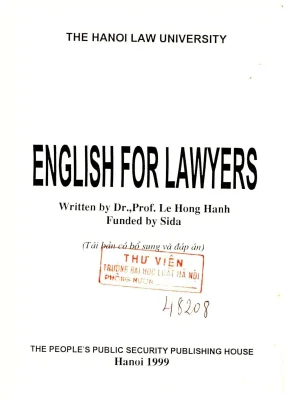
THE HANOI LAW UNIVERSITY ENGLIOH FOR LAWYE Written by Dr. Le Hong Hanh Funded by Sida ) sung và dap án) THE PEOPLE`S PUBLIC SECURITY PUBLISHING HOUS E Hanoi 1999 LỜI NÓI ĐẦU Nén kinh tế thị trường và nhà nước pháp quyền đòi hỏi phải có hệ thống pháp luật hoàn thiện và cơ chế thực hiện pháp luật có hiệu lực thông qua đội ngũ cán bộ pháp luật có trình độ chuyên môn cao và đạo đức nghề nghiệp tốt. Trong bối cảnh đất nước đang chuyển từ cơ chế quản lý kế hoạch hóa tập trung sang nền kinh tế thị trường có điều tiết theo định hướng xã hội chủ nghĩa, những điều nói trên phải được coi như là những yếu tố cấu thành của chiến lược phát triển. Xây dựng hệ thông pháp luật thích ứng với nền kinh tế thị trường có định hướng xã hội chủ nghĩa, đào tạo đội ngũ cán bộ có nang lực thực thi và bao vệ pháp luật là những nhiệm vụ không hề đơn giản.
Sự thành công trong việc tạo dựng hệ thống pháp luật hoàn thiện phụ thuộc vào nhiều yếu tố khách quan và chủ quan khác nhau. Bên cạnh những yếu tố nội tại mang tính quyết định đối với việc hoàn thiện hệ thống pháp luật, kinh nghiệm của các nước có nền kinh tế thị trường phát triển rất cần được lưu ý. Việc nghiên cứu và áp dụng những kinh nghiệm tiến bộ và phù hợp với hoàn cảnh của đất nước sẽ giúp rút ngắn con đường tiến tới hệ thốrg pháp luật hoàn thiện. Bên cạnh đó, việc thực hiện chính sách mở cửa hướng vào sự phát triển kinh tế đối ngoại, hòa nhập và hợp tác quốc tế đã dẫn đến một nhu cầu hết sức 4 tự nhién đối với pháp luật quốc tế cũng như đôi với he thong pháp lý của các nước có dau tư, buôn bán với nước ta.
° Điều kiện quan trọng cho việc tìm hiệu, nghiên cứu pháp luất quốc tế và hệ thong pháp lý của các nước khác là tiếng Anh - ngôn ngữ phổ biến nhất trên thế giới hiện nay. O nước ta, tiếng Anh cũng đã trở thành ngoại ngữ thông dụng và chủ yếu nhất trong các hoạt động đối ngoại, thương mại và trao đổi thông tin quốc tế. Đáp ứng nhu cầu học tiếng Anh của cán bộ, sinh viên và nhân dân trong ca nước, nhiều giáo trình và sách hướng dẫn học tiếng Anh đã được xuất bản. Đáng tiếc là do nhiều lý do khác nhau, giáo trình tiếng Anh chuyên ngành luật chưa được biên soạn, pho biến để trợ giúp quá trình tìm hiểu, nghiên cứu pháp luật các nước và pháp luật quốc tế.
Để tạo ra cơ sở ban đầu cho việc dạy tiếng Anh chuyên ngành pháp lý, Đại học luật Hà Nội cho xuất ban cuốn sách “Tiếng Anh dành cho luật gia” cua PGSPTSLê Hồng Hạnh. Cuốn sách này có mục dich giúp sinh viên luật tiếp cận, phát triển vốn thuật ngữ tiếng Anh chuyên ngành luật để đáp ứng yêu cầu học tập, nghiên cứu. Mặt khác, nó cũng tìm cách đáp ứng yêu cầu của các cán bộ công tác trong các cơ quan nghiên cứu, xây dung và bảo vệ pháp luật có nhu cầu tìm hiểu, nghiên cứu pháp luật quốc tế và pháp luật các nước khác. Vì nhằm mục đích chủ yếu là hướng dẫn học tiếng Anh pháp lý nên cuốn sách không chú trọng vào các cấu trúc ngữ pháp tiếng Anh thông thường.
Chúng tôi giả định rằng người học chương trình tiếng Anh chuyên ngành luật đã có những kiến thức cơ bản về ngữ pháp và văn phạm tiếng Anh. Phần lớn các bài tập chủ yếu nhằm vào việc phát triển vốn thuật ngữ chuyên ngành được trình bày dưới nhiều hình thức bài tập Khác nhau. Các bài tập ngữ pháp chi được đưa vào Khi điều đó thực sự cần cho người học hiểu tốt hơn cấu trúc đặc trưng của tiếng Anh chuyên ngành luật. Các tài liệu sử dụng trong cuốn sách này là pháp luật của các nước Việt Nam, Anh, My, Thuy Điển, Philipin, Singapo nên những người đã học luật sẽ thuận lợi hơn trong việc tiếp thu tiếng Anh chuyên ngành luật.
Cuon sách chứa đựng kiến thức tiếng Anh ve nhiều lĩnh vực pháp luật khác nhau từ luật nhà nước, luật hành chính cho đến luật hình sự, luật công ty. Các thuật ngữ tiếng Anh, tiếng Việt dùng trong cuốn sách này chi dùng ở văn cảnh của lĩnh vực luật học. Tiếng Anh chuyên ngành luật là loại ngôn ngữ rất Khó và phức tạp. Khi biên soạn cuốn sách này, tác giả đã hết sức cố găng để tránh những sai sót.
Sau lần xuất bản thứ nhất, tác gia đã nhận được rất nhiều góp ý của những người đã tham khảo và sử dụng cuốn sách này. Nhiều sinh viên luật đã viết thư yêu cầu cần có đáp án cho các bài tập để họ tu nghiên cứu có hiệu quả hơn. Đáp ứng yêu cầu của sinh viên và tiếp thu những đóng góp quí báu của nhiều nhà khoa học, nghiên cứu, Đại học luật Hà Nội tái bản cuốn sách đã được chinh lý và sửa chữa cùng với đáp án các bài tập. Hà Nội, tháng 4 năm 1999 PREFACE A market economy and a state based on Rule of Law always require the presence of a perfect legal system and sufficient number of qualified and impartial lawyers.
In context of Vietnam, which is transforming from a centrally planned economy to a market economy with socialist orientation, the mentioned factors should be considered constituents of the country’s development strategy. Building up a legal system that satisfies the requirements of a market economy with socialist orientation, training highly qualified lawyers, is not an easy task for the country. Successful carrying out of this task depends on different factors, both subjective and objective. In building up the needed legal system, besides the internal factors, which play determinative role, the experiences of other countries should be considered.
To study and apply those foreign experiences that are advanced and relevant to the current situation of the country will shorten the way to an improved legal system. That is why we should study foreign law. In addition tc this, the open-door policy, which aims at developing international cooperation and integration calls for the very natural need in knowledge of international law and the legal systems of the countries Vietnam has investment and trade relations with. The most important prerequisite for studying international law and the legal systems of other countries 1s 6 knowledge of English, the most popular language in the world at the present time.
In Vietnam, English has become the most popular and important language in the country’s foreign trade and international communication. To meet the needs of the people in studying English, many English textbooks, guidebooks have been published in different areas such as economics, politics, informatics and etc. Unfortunately, due to different reasons, legal English is not paid much attention. The lack of textbooks and guidebooks of legal English limits the ability of our lawyers, researchers in studying international law and the legal systems of other countries.
To create the first basis for teaching and learning legal English, the Hanoi Law University published the textbook “English for lawyers” written by Dr. Le Hong Hanh. This book was prepared to assist students, and any possible learners, to develop their legal vocabulary to the extent that they can understand law materials published in English, and do research on foreign and international law. Since the book aims at legal English, attention is not paid to ordinary vocabulary and grammatical structures.
We sppose that the users of this book have already learned basic knowledge of English. Most of exercises in this book are aiming at developing legal vocabulary and are given in various forms. Grammatical exercises are given only if they are necessary for better understanding specific features of legal English by the learners. Materials used in this book cover the law of Vietnam, the United States, Great Britain, Sweden, Philippine and some other countries.
The materials used in this book are adapted from law textbook and journals on different law areas such as criminal law, civil law, 4 commercial law, constitutional law etc. The vocabulary used in this book is restricted in law context. Legal English is difficult and very complicated. In preparing this book the author did all his bests to avoid mistakes.
After the publication of the book, the author has received a lot of comments and remarks from the users. Many students asked for the key answers of the exercises to facilitate their self-study. To satisfy the students’ request and to respond to the remarks and comments of the users, with the permission of the Hanoi Law University the author publishes the book in the revised version with key answers for the given exercises. Hanoi April 1999 và ¥ t Text I DEFINITION OF CONSTITUTION A constitution is a system of fundamental laws or principles for the government of a nation or state.
In the Umited States, a constitution 1s a written charter adopted by the people, creating a government and outlining the forms and powers thereof, and defining the basic rights of the people. The Constitution of England 1s of different nature, consisting of an indefinite body of rules and principles in the form of customs, Judicial decisions, and basic statutes and not formalized in any written charter. In America a constitution is the supreme law, binding upon all branches of government, inciuding the legislative department, whereas in England the supreme power is vested’ in Parliament. Under the American ' 1s vested in Parliament: Được piao cho nghi viện system the ultimate and supreme power resides in the people, including the power to make and change constitutions.
“Constitutional law” consists of the principles and decisions governing the interpretation and operation of constitutions. The constitution of the United States, together with laws made in accordance therewith and treaties made under the authority of the United States, 1s, by the express declaration of Article 6, item 2, the supreme law of the land. As a general rule, the adoption of a constitution does not affect the operation of law not in conflict therewith, and some constitutions contain express provision to that effect. No emergency justifies the violation or disregard of any provisions of a constitution.
However, while an emergency cannot create a governmental power where none existed before, it may furnish* a proper occasion for the exercise of an existing power. Adapted from Summary of American Law, Backroft-Whitney Co. “ may furnish: Có thé tao ra 10 IEXERCISES FOR TEXTE [| exercise 1. Hay cho biét trong số các tu cho dưới day thi từ nào là tu dong nghĩa.
Fundamental Act Basic Highest Operation Functioning Constitution Substance Competence Charter Nature Justify Ultimate Authority Treaty Prove Supreme Agreement l¿xcrcise 2. Complete the following sentences using the correct form of the vocabulary given at the end and then translate them into Vietnamese. The legislative power in Vietnam. in the National Assembly.
The Constitution of 1992 provides that the supreme and ultimate power. in the people. In Article 2 the Constitution. that the Socialist Republic of Vietnam is a state of the people, from the people, and for the people.
No emergency state can. the violation of the Constitution. The State carries out a policy of equality, solidarity, and mutual assistance among all nationalities, and. All acts of national discrimination.