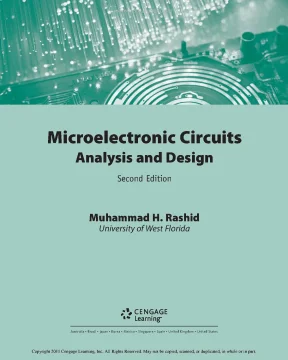
Phân tích và Thiết kế Mạch Vi Điện tử, 2nd Edition - Muhammad H. Rashid

Chuyên ngành

Kỹ thuật điện tử

Người đăng

Ẩn danh

Thể loại

Sách giáo khoa

2011

1.3K
0
0

Phí lưu trữ

0 Point

Tóm tắt

I. Tổng quan về giáo trình Microelectronic Circuits Analysis and Design của Muhammad H

Microelectronic Circuits: Analysis and Design là giáo trình nổi tiếng do giáo sư Muhammad H. Rashid biên soạn, xuất bản lần thứ hai bởi Cengage Learning năm 2011. Cuốn sách trình bày toàn diện nền tảng lý thuyết và thực hành của mạch vi điện tử. Nội dung bao gồm ba lĩnh vực chính: điện tử tương tự, điện tử số và điện tử công suất. Điện tử tương tự xử lý tín hiệu liên tục với độ méo thấp nhất. Điện tử số sử dụng transistor như công tắc bật tắt để xử lý tín hiệu xung không liên tục. Điện tử công suất điều khiển và chuyển đổi điện năng với hiệu suất cao. Cuốn sách được thiết kế cho sinh viên kỹ thuật điện, cung cấp cả lý thuyết lẫn bài tập thiết kế thực tế. Đây là tài liệu tham khảo quan trọng trong đào tạo kỹ sư vi điện tử toàn cầu.

1.1. Thông tin xuất bản và cấu trúc cuốn sách

Cuốn sách Microelectronic Circuits: Analysis and Design ấn bản thứ hai được Cengage Learning phát hành năm 2011 với ISBN-13: 978-0-495-66772-8. Tác giả Muhammad H. Rashid công tác tại Đại học West Florida. Sách được biên tập bởi đội ngũ chuyên gia bao gồm biên tập viên phát triển Hilda Gowans, biên tập viên mua lại Swati Meherishi và nhiều cộng sự khác. Ấn phẩm được in tại Canada với sự phân phối toàn cầu qua các văn phòng ở Singapore, Anh, Australia, Mexico, Brazil và Nhật Bản. Cấu trúc sách chia thành nhiều chương, mỗi chương tập trung vào một chủ đề cụ thể trong mạch vi điện tử.

1.2. Phạm vi nội dung và đối tượng độc giả

Giáo trình Microelectronic Circuits Analysis and Design hướng đến sinh viên đại học và sau đại học ngành kỹ thuật điện tử. Nội dung sách bao phủ ba phạm vi lớn. Thứ nhất là điện tử tương tự, tập trung vào vận chuyển và xử lý tín hiệu analog với độ méo tối thiểu. Thứ hai là điện tử số, sử dụng transistor như thiết bị chuyển mạch on-off để xử lý tín hiệu xung. Thứ ba là điện tử công suất, liên quan đến các thiết bị bán dẫn công suất cho việc điều khiển và chuyển đổi điện năng. Sách cung cấp cả lý thuyết phân tích lẫn phương pháp thiết kế thực tế.

II. Phân tích các mạch vi điện tử tương tự và số trong thiết kế

Phân tích mạch vi điện tử là quá trình nghiên cứu hành vi điện của các thành phần bán dẫn trong mạch. Điện tử tương tự xử lý tín hiệu có biên độ thay đổi liên tục theo thời gian. Mục tiêu là truyền tải thông tin với độ méo tín hiệu thấp nhất có thể. Điện tử số hoạt động dựa trên nguyên lý transistor đóng vai trò công tắc bật và tắt. Cả tín hiệu đầu vào và đầu ra đều là xung không liên tục xuất hiện tại các thời điểm cách đều. Chức năng của điện tử số là xử lý thông tin với sai số thấp nhất ở tốc độ nhanh nhất. Sự phân biệt giữa hai loại điện tử này là nền tảng để hiểu toàn bộ mạch vi điện tử hiện đại. Cuốn sách của Rashid trình bày rõ ràng cả hai hướng tiếp cận này với ví dụ minh họa cụ thể và bài tập thực hành phong phú.

2.1. Điện tử tương tự và xử lý tín hiệu liên tục

Điện tử tương tự tập trung vào việc vận chuyển và xử lý thông tin chứa trong tín hiệu đầu vào analog. Tín hiệu analog là hàm của biên độ giá trị thay đổi liên tục theo thời gian. Thách thức lớn nhất là giảm thiểu độ méo tín hiệu trong quá trình khuếch đại và xử lý. Các mạch tương tự bao gồm bộ khuếch đại thuật toán, bộ lọc, mạch dao động và mạch nguồn. Mỗi loại mạch đòi hỏi phương pháp phân tích riêng biệt. Cuốn sách của Rashid trình bày chi tiết nguyên lý hoạt động và phương pháp thiết kế từng loại mạch tương tự cơ bản này.

2.2. Điện tử số và ứng dụng transistor chuyển mạch

Điện tử số sử dụng transistor như thiết bị chuyển mạch on-off để xử lý tín hiệu xung không liên tục. Tín hiệu đầu vào và đầu ra đều là các xung số xuất hiện tại các thời điểm cách đều nhau. Chức năng chính là vận chuyển và xử lý thông tin với sai số tối thiểu ở tốc độ cao nhất. Các ứng dụng bao gồm bộ vi xử lý, bộ nhớ, mạch logic số và hệ thống truyền thông kỹ thuật số. Phương pháp phân tích mạch số khác biệt hoàn toàn so với mạch tương tự. Cuốn sách cung cấp nền tảng vững chắc về nguyên lý hoạt động của transistor trong chế độ chuyển mạch.

III. Phương pháp thiết kế mạch điện tử công suất và chuyển đổi năng lượng

Điện tử công suất là lĩnh vực quan trọng trong giáo trình Microelectronic Circuits Analysis and Design. Lĩnh vực này liên quan đến hoạt động và ứng dụng của các thiết bị bán dẫn công suất. Các thiết bị này bao gồm transistor công suất đóng vai trò công tắc on-off. Mục tiêu là điều khiển và chuyển đổi điện năng với hiệu suất chuyển đổi cao nhất. Có bốn loại chuyển đổi chính: AC/DC, AC/AC, DC/AC và DC/DC. Điện tử tương tự và số được sử dụng để tạo tín hiệu điều khiển cho các thiết bị bán dẫn công suất. Điều này đảm bảo đạt được chiến lược chuyển đổi mong muốn với độ méo dạng sóng tối thiểu. Đầu vào của hệ thống điện tử công suất là điện áp hoặc dòng điện nguồn DC hoặc AC. Điện tử công suất quan tâm chủ yếu đến nội dung và chất lượng công suất, không phải thông tin chứa trong tín hiệu.

3.1. Các loại chuyển đổi điện năng trong mạch công suất

Bốn loại chuyển đổi điện năng cơ bản trong mạch công suất gồm: AC/DC chỉnh lưu, DC/AC nghịch lưu, AC/AC biến đổi tần và DC/DC biến đổi điện áp. Mỗi loại chuyển đổi sử dụng cấu hình mạch và chiến lược điều khiển riêng biệt. Bộ chỉnh lưu AC/DC chuyển đổi điện áp xoay chiều thành điện áp một chiều. Bộ nghịch lưu DC/AC thực hiện quá trình ngược lại. Bộ biến đổi DC/DC điều chỉnh mức điện áp một chiều phù hợp với tải. Cuốn sách của Rashid trình bày nguyên lý và thiết kế từng loại chuyển đổi với ví dụ thực tế minh họa rõ ràng.

3.2. Vai trò của tín hiệu điều khiển trong hệ thống công suất

Trong hệ thống điện tử công suất, mạch điện tử tương tự và số đóng vai trò tạo tín hiệu điều khiển cho các thiết bị bán dẫn công suất. Tín hiệu điều khiển xác định thời điểm bật và tắt của transistor công suất. Điều này cho phép đạt được chiến lược chuyển đổi mong muốn với hiệu suất tối đa. Bộ điều khiển PWM là ví dụ điển hình của mạch tạo tín hiệu điều khiển. Bộ vi xử lý và mạch FPGA cũng được sử dụng để tạo xung điều khiển phức tạp. Cuốn sách nhấn mạnh sự phối hợp giữa điện tử công suất và điện tử điều khiển trong thiết kế hệ thống hiện đại.

IV. Kết luận và ứng dụng thực tế của giáo trình Microelectronic Circuits

Giáo trình Microelectronic Circuits: Analysis and Design của Muhammad H. Rashid là tài liệu toàn diện về mạch vi điện tử. Cuốn sách bao phủ ba lĩnh vực cốt lõi: điện tử tương tự, điện tử số và điện tử công suất. Nội dung được trình bày logic từ lý thuyết cơ bản đến thiết kế thực tế. Cuốn sách giới thiệu cả các thành phần mạch mới như memristor, phần tử mạch thứ tư bên cạnh điện trở, tụ điện và cuộn cảm. Memristor được định nghĩa bởi mối quan hệ giữa từ thông và điện tích tích lũy. Ứng dụng thực tế của kiến thức trong sách rất rộng rãi, từ thiết kế vi xử lý, hệ thống nhúng đến hệ thống chuyển đổi năng lượng tái tạo. Đây là tài liệu không thể thiếu cho sinh viên và kỹ sư ngành điện tử viễn thông.

4.1. Giới thiệu memristor và phần tử mạch thứ tư

Từ quan điểm mạch, các phần tử mạch được định nghĩa bởi bốn biến số: dòng điện, điện áp, điện tích và từ thông. Ba mối quan hệ đầu mô tả ba phần tử cơ bản: điện trở, cuộn cảm và tụ điện. Mối quan hệ thứ tư giữa điện tích và từ thông được Chua phát hiện, gọi là memristor. Memristor là phần tử mạch mà từ thông là hàm của điện tích tích lũy. Giá trị memristance là tỷ lệ giữa điện áp và dòng điện. Phát hiện này mở ra hướng nghiên cứu mới cho thiết bị mật độ cao. Cuốn sách của Rashid trình bày lý thuyết memristor một cách rõ ràng.

4.2. Ứng dụng trong đào tạo và nghiên cứu kỹ thuật điện tử

Giáo trình Microelectronic Circuits Analysis and Design được sử dụng rộng rãi trong đào tạo kỹ sư điện tử toàn cầu. Nội dung sách phục vụ cho cả bậc đại học và sau đại học. Sinh viên học cách phân tích và thiết kế mạch từ cơ bản đến nâng cao. Các bài tập trong sách giúp rèn luyện kỹ năng tính toán và tư duy thiết kế. Nghiên cứu viên sử dụng tài liệu để tham khảo phương pháp phân tích mạch phức tạp. Cuốn sách cũng hữu ích cho kỹ sư làm việc trong lĩnh vực viễn thông, năng lượng và hệ thống nhúng. Giá trị của giáo trình nằm ở sự kết hợp giữa lý thuyết chặt chẽ và ứng dụng thực tiễn phong phú.
21/04/2026

Trích đoạn nội dung tài liệu

org Microelectronic Circuits Analysis and Design Second Edition Muhammad H. Rashid University of West Florida Australia • Brazil • Japan • Korea • Mexico • Singapore • Spain • United Kingdom • United States Copyright 2011 Cengage Learning, Inc. All Rights Reserved. May not be copied, scanned, or duplicated, in whole or in part. Microelectronic Circuits: Analysis © 2011, 1999 Cengage Learning and Design, Second Edition ALL RIGHTS RESERVED. No part of this work covered by the copyright Muhammad H. Rashid herein may be reproduced, transmitted, stored, or used in any form or by Publisher, Global Engineering Program: any means graphic, electronic, or mechanical, including but not limited to Christopher M. Shortt photocopying, recording, scanning, digitizing, taping, Web distribution, information networks, or information storage and retrieval systems, except Acquisitions Editor: Swati Meherishi as permitted under Section 107 or 108 of the 1976 United States Copyright Senior Developmental Editor: Act, without the prior written permission of the publisher. Hilda Gowans Assistant Development Editor: For product information and technology assistance, contact us at Yumnam Ojen Singh Cengage Learning Customer & Sales Support, 1-800-354-9706. For permission to use material from this text or product, submit all Editorial Assistant: Tanya Altieri requests online at www. Team Assistant: Carly Rizzo Further permissions questions can be emailed to permissionrequest@cengage. Marketing Manager: Lauren Betsos Media Editor: Chris Valentine Library of Congress Control Number: 2009943075 Production Manager: ISBN-13: 978-0-495-66772-8 Jennifer Ziegler ISBN-10: 0-495-66772-2 Project Manager: Deepti Narwat Agarwal Cengage Learning Copyeditor: Betty Duncan 200 First Stamford Place, Suite 400 Proofreader: Anne Matera Stamford, CT 06902 Indexer: Kevin Broccoli USA Compositor: Glyph International Cengage Learning is a leading provider of customized learning solutions Senior Art Director: Michelle Kunkler with office locations around the globe, including Singapore, the United Cover Designer: idesign Kingdom, Australia, Mexico, Brazil, and Japan. Locate your local office at: Cover Images: © Macs Peter/Shutterstock www. and Angelo Giampiccolo/Shutterstock Chapter Opener Image: Cengage Learning products are represented in Canada by © Stefan Glebowski/Shutterstock Nelson Education, Ltd. Permissions Account Manager, Text: For your course and learning solutions, visit Katie Huha www. Rights Acquisition Specialist: John Hill Purchase any of our products at your local college store or at our Manufacturing Buyer: Arethea Thomas preferred online store www. Printed in Canada 1 2 3 4 5 6 7 14 13 12 11 10 Copyright 2011 Cengage Learning, Inc. All Rights Reserved. May not be copied, scanned, or duplicated, in whole or in part. To my parents, my wife, Fatema, my children, Faeza, Farzana, and Hasan Copyright 2011 Cengage Learning, Inc. All Rights Reserved. May not be copied, scanned, or duplicated, in whole or in part.org CONTENTS Preface xiii Teaching Plans and Suggested Course Outlines xvii About the Author xix Chapter 1 Introduction to Electronics and Design 1.2 History of Electronics 2 1.4 Electronic Signals and Notation 6 1.5 Classifications of Electronic Systems 10 1.6 Specifications of Electronic Systems 12 1.7 Types of Amplifiers 15 1.8 Design of Electronic Systems 17 1.9 Design of Electronic Circuits 20 1.11 Emerging Electronics 32 References 36 Problems 37 Chapter 2 Introduction to Amplifiers and Frequency Response 2.5 Frequency Response of Amplifiers 62 2.7 Frequency Response Methods 72 2.8 PSpice/SPICE Amplifier Models 87 2.9 Amplifier Design 88 Summary 91 References 92 Review Questions 92 Problems 93 Chapter 3 Introduction to Operational Amplifiers and Applications 3.2 Characteristics of Ideal Op-Amps 104 Copyright 2011 Cengage Learning, Inc. All Rights Reserved. May not be copied, scanned, or duplicated, in whole or in part.3 Op-Amp PSpice/SPICE Models 111 3.4 Analysis of Ideal Op-Amp Circuits 114 3.5 Op-Amp Applications 128 3.6 Op-Amp Circuit Design 164 Summary 165 References 166 Review Questions 166 Problems 167 Chapter 4 Semiconductor Diodes 4.3 Transfer Characteristics of Diode Circuits 183 4.5 Analysis of Practical Diode Circuits 192 4.6 Modeling of Practical Diodes 196 4.8 Light-Emitting Diodes 220 4.10 Diode Data Sheets 222 Summary 226 References 226 Review Questions 226 Problems 227 Chapter 5 Applications of Diodes 5.3 Output Filters for Rectifiers 260 5.4 Diode Peak Detectors and Demodulators 272 5.6 Diode Clamping Circuits 279 5.7 Diode Voltage Multipliers 284 5.8 Diode Function Generators 287 Summary 290 References 291 Review Questions 291 Problems 291 Chapter 6 Semiconductors and pn Junction Characteristics 6.2 Semiconductor Materials 300 Copyright 2011 Cengage Learning, Inc. All Rights Reserved. May not be copied, scanned, or duplicated, in whole or in part.3 Zero-Biased pn Junction 307 6.4 Reverse-Biased pn Junction 314 6.5 Forward-Biased pn Junction 319 6.6 Junction Current Density 323 6.8 High-Frequency AC Model 326 Summary 329 References 330 Review Questions 330 Problems 331 Chapter 7 Metal Oxide Semiconductor Field-Effect Transistors 7.2 Metal Oxide Field-Effect Transistors 336 7.5 MOSFET Models and Amplifier 349 7.7 DC Biasing of MOSFETs 357 7.8 Common-Source (CS) Amplifiers 364 7.9 Common-Drain Amplifiers 375 7.10 Common-Gate Amplifiers 380 7.12 DC Level Shifting and Amplifier 386 7.13 Frequency Response of MOSFET Amplifiers 393 7.14 Design of MOSFET Amplifiers 408 Summary 413 References 413 Review Questions 414 Problems 414 Chapter 8 Bipolar Junction Transistors and Amplifiers 8.2 Bipolar Junction Transistors 434 8.3 Principles of BJT Operation 436 8.4 Input and Output Characteristics 447 8.5 BJT Circuit Models 449 8.6 The BJT Switch 455 8.7 DC Biasing of Bipolar Junction Transistors 457 8.8 Common-Emitter Amplifiers 467 8.10 Common-Base Amplifiers 483 8.11 Multistage Amplifiers 488 Copyright 2011 Cengage Learning, Inc. All Rights Reserved. May not be copied, scanned, or duplicated, in whole or in part.org viii Contents 8.12 The Darlington Pair Transistor 491 8.13 DC Level Shifting and Amplifier 495 8.14 Frequency Model and Response of Bipolar Junction Transistors 501 8.15 Frequency Response of BJT Amplifiers 508 8.16 MOSFETs versus BJTs 528 8.17 Design of Amplifiers 528 Summary 533 References 533 Review Questions 533 Problems 534 Chapter 9 Differential Amplifiers 9.2 Internal Structure of Differential Amplifiers 554 9.3 MOSFET Current Sources 558 9.4 MOS Differential Amplifiers 566 9.5 Depletion MOS Differential Amplifiers 580 9.6 BJT Current Sources 586 9.7 BJT Differential Amplifiers 602 9.8 BiCMOS Differential Amplifiers 620 9.9 Frequency Response of Differential Amplifiers 626 9.10 Design of Differential Amplifiers 628 Summary 629 References 629 Review Questions 629 Problems 630 Chapter 10 Feedback Amplifiers 10.3 Characteristics of Feedback 644 10.5 Analysis of Feedback Amplifiers 656 10.6 Series-Shunt Feedback 657 10.7 Series-Series Feedback 667 10.8 Shunt-Shunt Feedback 677 10.9 Shunt-Series Feedback 686 10.10 Feedback Circuit Design 692 10.12 Compensation Techniques 711 Summary 721 References 721 Review Questions 722 Problems 722 Copyright 2011 Cengage Learning, Inc. All Rights Reserved. May not be copied, scanned, or duplicated, in whole or in part. Contents ix Chapter 11 Power Amplifiers 11.2 Classification of Power Amplifiers 740 11.5 Class B Push-Pull Amplifiers 756 11.6 Complementary Class AB Push-Pull Amplifiers 766 11.10 Short-Circuit and Thermal Protection 786 11.11 Power Op-Amps 788 11.13 Design of Power Amplifiers 796 Summary 797 References 797 Review Questions 797 Problems 798 Chapter 12 Active Filters 12.2 Active versus Passive Filters 804 12.3 Types of Active Filters 805 12.4 First-Order Filters 808 12.5 The Biquadratic Function 810 12.7 Transfer Function Realization 818 12.8 Low-Pass Filters 819 12.9 High-Pass Filters 829 12.10 Band-Pass Filters 837 12.11 Band-Reject Filters 843 12.12 All-Pass Filters 848 12.13 Switched-Capacitor Filters 849 12.14 Filter Design Guidelines 854 Summary 855 References 855 Review Questions 855 Problems 856 Chapter 13 Oscillators 13.2 Principles of Oscillators 862 13.3 Audio-Frequency Oscillators 867 Copyright 2011 Cengage Learning, Inc. All Rights Reserved. May not be copied, scanned, or duplicated, in whole or in part.4 Radio Frequency Oscillators 881 13.6 Active-Filter Tuned Oscillators 899 13.7 Design of Oscillators 902 Summary 903 References 903 Review Questions 903 Problems 903 Chapter 14 Operational Amplifiers 14.2 Internal Structure of Op-Amps 910 14.3 Parameters and Characteristics of Practical Op-Amps 911 14.4 CMOS Op-Amps 933 14.5 BJT Op-Amps 940 14.6 Analysis of the LM741 Op-Amp 944 14.7 BiCMOS Op-Amps 962 14.8 Design of Op-Amps 974 Summary 975 References 976 Review Questions 976 Problems 977 Chapter 15 Introduction to Digital Electronics 15.4 Performance Parameters of Logic Gates 985 15.6 NMOS Logic Circuits 1014 15.8 CMOS Logic Circuits 1022 15.9 Comparison of CMOS and NMOS Gates 1026 15.11 Transistor-Transistor Logic Gates 1033 15.12 Emitter-Coupled Logic OR/NOR Gates 1049 15.14 Interfacing of Logic Gates 1060 15.15 Comparison of Logic Gates 1063 15.16 Design of Logic Circuits 1064 Summary 1068 References 1068 Review Questions 1068 Problems 1069 Copyright 2011 Cengage Learning, Inc. All Rights Reserved. May not be copied, scanned, or duplicated, in whole or in part.org Contents xi Chapter 16 Integrated Analog Circuits and Applications 16.2 Circuits with Op-Amps and Diodes 1080 16.4 Zero-Crossing Detectors 1100 16.6 Square-Wave Generators 1110 16.7 Triangular-Wave Generators 1113 16.8 Sawtooth-Wave Generators 1117 16.9 Voltage-Controlled Oscillators 1120 16.11 Phase-Lock Loops 1139 16.12 Voltage-to-Frequency and Frequency-to-Voltage Converters 1147 16.13 Sample-and-Hold Circuits 1155 16.14 Digital-to-Analog Converters 1158 16.15 Analog-to-Digital Converters 1165 16.16 Circuit Design Using Analog Integrated Circuits 1169 Summary 1170 References 1170 Review Questions 1170 Problems 1171 Appendix A Introduction to OrCAD 1177 Appendix B Review of Basic Circuits 1213 Appendix C Low-Frequency Hybrid BJT Model 1261 Appendix D Ebers–Moll Model of Bipolar Junction Transistors 1267 Appendix E Passive Components 1275 Appendix F Design Problems 1281 Answer to Selected Problems A1 Index I1 Copyright 2011 Cengage Learning, Inc. All Rights Reserved. May not be copied, scanned, or duplicated, in whole or in part. PREFACE Semiconductor devices and integrated circuits (ICs) are the backbone of modern technology, and thus the study of electronics—which deals with their characteristics and applications—is an integral part of the un- dergraduate curriculum for students majoring in electrical, electronics, or computer engineering. Tradi- tionally, the basic course in electronics has been a one-year (two-semester) course at most universities and colleges. However, with the emergence of new technologies and university-wide general education re- quirements, electrical engineering departments are under pressure to reduce basic electronics to a one- semester course. This book can be used for a one-semester course as well as a two-semester course. The only prerequisite is a course in basic circuit analysis. A one-semester course would cover Chapters 1 through 8, in which the basic techniques for analyzing electronic circuits are introduced using ICs as examples. In a two-semester course, the second semester would focus on detailed analysis of devices and circuits within the ICs and their applications. The objectives of this book are: • To develop an understanding of the characteristics of semiconductor devices and commonly used ICs • To develop skills in analysis and design of both analog and digital circuits • To introduce students to the various elements of the engineering design process, including formu- lation of specifications, analysis of alternative solutions, synthesis, decision-making, iterations, consideration of cost factors, simulation, and tolerance issues Approach This book adopts a top-down approach to the study of electronics, rather than the traditional bottom-up approach. In the classical bottom-up approach, the characteristics of semiconductor devices and ICs are studied first, and then the applications of ICs are introduced. Such an approach generally requires a year of instruction, as it is necessary to cover all the essential materials in order to give students an overall knowledge of electronic circuits and systems. In the top-down approach used here, the ideal characteris- tics of IC packages are introduced to establish the design and analytical techniques, and then the charac- teristics and operation of devices and circuits within the ICs are studied to understand the imperfections and limitations of IC packages. This approach has the advantage of allowing the instructor to cover only the basic techniques and circuits in the first semester, without going into detail on discrete devices. If the curriculum allows, the course can continue in the second semester with detailed analysis of discrete de- vices and their applications. In practice, the lectures and laboratory experiments run concurrently. If students’ experimental results differ from the ideal characteristics because of the practical limitations of IC packages, students may be- come concerned. This concern may be addressed by a brief explanation of the causes of discrepancies. The experimental results, however, will not differ significantly from the theoretically obtained results.

Nội dung được bảo vệ bản quyền — Tải xuống đầy đủ