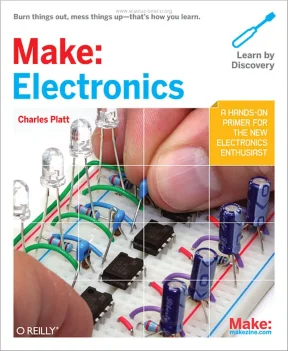
Make: Electronics: Học bằng khám phá với Charles Platt

Chuyên ngành

Kỹ thuật điện tử

Người đăng

Ẩn danh

2009

352
0
0

Phí lưu trữ

75 Point

Tóm tắt

I. Tổng quan về Make Electronics Charles Platt

"Make: Electronics" là cuốn sách hướng dẫn học điện tử thực hành do Charles Platt chấp bút, được O'Reilly Media xuất bản lần đầu vào tháng 12 năm 2009. Cuốn sách áp dụng phương pháp "học qua khám phá" (Learning by Discovery), khuyến khích người đọc tự tay thực hiện các thí nghiệm thay vì chỉ đọc lý thuyết suông. Sách được trình bày theo cấu trúc thí nghiệm từ cơ bản đến nâng cao. Phần đầu giới thiệu các khái niệm nền tảng như điện áp, dòng điện và điện trở. Người đọc bắt đầu bằng những thí nghiệm đơn giản như cảm nhận điện từ pin, phá hủy pin hay lắp mạch điện đầu tiên. Điểm đặc biệt nằm ở cách tiếp cận thực tiễn. Mỗi thí nghiệm đi kèm danh sách mua sắm chi tiết, hình ảnh minh họa rõ ràng và hướng dẫn từng bước. Tác giả không chỉ giải thích làm thế nào mà còn giải thích tại sao, giúp người học hiểu sâu nguyên lý hoạt động. Cuốn sách bao gồm 36 thí nghiệm được chia thành nhiều chương, từ mạch cơ bản, transistor, logic số đến các dự án phức tạp hơn.

1.1. Giới thiệu về tác giả Charles Platt

Charles Platt là nhà văn, nhà thiết kế và nhiếp ảnh gia người Anh. Ông nổi tiếng với khả năng giải thích các khái niệm kỹ thuật phức tạp bằng ngôn ngữ đơn giản, dễ hiểu. Platt có nhiều năm kinh nghiệm trong lĩnh vực điện tử và đã đóng góp nhiều bài viết cho tạp chí Make Magazine. Với cuốn "Make: Electronics", Platt đã tạo ra một hướng dẫn học tập hoàn chỉnh. Ông tự chụp ảnh và vẽ minh họa cho toàn bộ nội dung sách. Sự tận tâm này đảm bảo tính nhất quán và chính xác trong từng thí nghiệm. Phong cách viết mang tính thực dụng cao, tránh thuật ngữ phức tạp không cần thiết.

1.2. Mục tiêu và đối tượng đọc giả

Cuốn sách hướng đến đối tượng người mới bắt đầu tìm hiểu về điện tử. Không yêu cầu kiến thức nền tảng trước đó. Người đọc chỉ cần sự tò mò và sẵn sàng thực hành. Mục tiêu chính là xây dựng hiểu biết vững chắc qua trải nghiệm trực tiếp. Thay vì học thuộc công thức, người đọc sẽ quan sát hiện tượng và rút ra bài học từ thành công lẫn thất bại. Sách cũng phù hợp cho giáo viên giảng dạy môn STEM. Cấu trúc thí nghiệm rõ ràng giúp dễ dàng tích hợp vào chương trình giảng dạy cho học sinh trung học.

II. Phân tích nội dung và cấu trúc Make Electronics

Cuốn sách được tổ chức thành nhiều chương, mỗi chương tập trung vào một nhóm kỹ năng cụ thể. Chương đầu tiên bắt đầu với các thí nghiệm cơ bản nhất: cảm nhận dòng điện, phá hủy pin, lắp mạch đơn giản, thay đổi điện áp và tự tạo pin. Cấu trúc lặp lại xuyên suốt sách rất khoa học. Mỗi chương mở đầu bằng danh sách mua sắm liệt kê đầy đủ linh kiện cần thiết. Tiếp theo là các thí nghiệm với hướng dẫn chi tiết kèm hình ảnh minh họa. Cuối mỗi chương có phần tổng kết kiến thức quan trọng. Nội dung tăng dần độ phức tạp. Chương hai chuyển sang chủ đề chuyển mạch, rơ-le và tụ điện. Chương ba giới thiệu kỹ thuật hàn nối và LED. Chương bốn đi sâu vào logic số và vi xử lý. Mỗi thí nghiệm không chỉ dạy kỹ năng kỹ thuật mà còn rèn luyện tư duy giải quyết vấn đề. Người học được khuyến khích thử nghiệm, quan sát và đặt câu hỏi. Phương pháp này tạo nền tảng vững chắc cho việc học nâng cao sau này.

2.1. Cấu trúc các thí nghiệm trong sách

Hệ thống thí nghiệm trong sách được đánh số từ 1 đến 36. Mỗi nhóm thí nghiệm liên quan được gom vào một chương riêng. Cách sắp xếp này giúp người học theo dõi tiến trình dễ dàng. Thí nghiệm 1-5 tập trung vào kiến thức nền tảng về điện. Thí nghiệm 6-11 khám phá kỹ thuật chuyển mạch và rơ-le. Thí nghiệm 12-15 giới thiệu kỹ thuật hàn và mạch LED. Thí nghiệm 16-24 đi sâu vào logic số và bộ hẹn giờ. Mỗi thí nghiệm có thời gian thực hiện ước tính, cho phép học theo tốc độ cá nhân.

2.2. Phương pháp học qua khám phá

Phương pháp "học qua khám phá" là triết lý cốt lõi của cuốn sách. Người học không được cho sẵn đáp án. Thay vào đó, phải tự mình tìm hiểu qua thực hành. Khi một thí nghiệm không thành công, đó không phải thất bại mà là cơ hội học hỏi. Platt khuyến khích người đọc phân tích nguyên nhân lỗi và thử lại. Quá trình lặp lại này củng cố kiến thức hiệu quả hơn việc đọc lý thuyết. Phương pháp này tương tự cách trẻ em học hỏi thế giới xung quanh. Thông qua thử và sai, người học xây dựng hiểu biết sâu sắc và bền vững về nguyên lý điện tử.

III. Phương pháp học điện tử qua Make Electronics

Để bắt đầu với "Make: Electronics", cần chuẩn bị đầy đủ dụng cụ và vật liệu. Danh sách mua sắm được cung cấp chi tiết trong sách. Các linh kiện cơ bản bao gồm điện trở, tụ điện, LED, transistor và dây nối. Dụng cụ cần thiết gồm kìm cắt, kìm bẻ, máy hàn và đồng hồ đo đa năng. Không cần đầu tư thiết bị đắt tiền ngay từ đầu. Các dụng cụ cơ bản đủ để hoàn thành phần lớn thí nghiệm trong sách. Môi trường làm việc cũng rất quan trọng. Cần một bàn làm việc sạch sẽ, thoáng mát và có ánh sáng tốt. Sách có chương riêng hướng dẫn cách tổ chức không gian làm việc hiệu quả. An toàn luôn được đặt lên hàng đầu. Platt nhấn mạnh tầm quan trọng của việc ngắt nguồn trước khi sửa chữa mạch. Ông cũng cảnh báo về nguy cơ bỏng khi hàn và cách phòng tránh. Việc tuân thủ nguyên tắc an toàn giúp trải nghiệm học tập luôn tích cực. Cộng đồng Make rất sôi nổi và sẵn sàng hỗ trợ người mới.

3.1. Chuẩn bị dụng cụ và vật liệu

Danh sách mua sắm được chia theo từng nhóm thí nghiệm. Cách này giúp người học không cần mua tất cả linh kiện cùng lúc. Chỉ cần chuẩn bị cho thí nghiệm hiện tại và sắp tới. Các linh kiện điện tử cơ bản có giá rất rẻ. Điện trở, tụ điện và LED thường chỉ vài nghìn đồng mỗi loại. Đầu tư ban đầu khoảng vài trăm nghìn đồng là đủ để bắt đầu. Nhiều cửa hàng điện tử và trang thương mại điện tử cung cấp bộ kit Make: Electronics. Các bộ kit này đã được chuẩn bị sẵn theo danh sách trong sách, là lựa chọn tiện lợi cho người mới.

3.2. Kỹ thuật thực hành an toàn

Kỹ thuật hàn là một trong những kỹ năng quan trọng được dạy trong sách. Platt hướng dẫn cách hàn nối dây điện và linh kiện từng bước. Nhiệt độ phù hợp và thời gian hàn chính xác là yếu tố quyết định chất lượng mối hàn. Đồng hồ đo đa năng là công cụ không thể thiếu. Sách hướng dẫn cách đo điện áp, dòng điện và điện trở. Việc đọc và hiểu các phép đo cơ bản giúp chẩn đoán lỗi mạch nhanh chóng. Kỹ năng đọc sơ đồ mạch cũng được rèn luyện dần từ đơn giản đến phức tạp.

IV. Kết luận và ứng dụng Make Electronics

"Make: Electronics" đã trở thành một trong những cuốn sách hướng dẫn điện tử phổ biến nhất thế giới. Phương pháp học qua thực hành của Platt đã chứng minh hiệu quả qua hàng nghìn người đọc thành công. Cuốn sách không chỉ dạy kỹ năng kỹ thuật mà còn phát triển tư duy sáng tạo. Người học biết cách tiếp cận vấn đề một cách có hệ thống. Họ học cách thử nghiệm, đánh giá và cải thiện. Ứng dụng của kiến thức từ sách rất rộng rãi. Từ dự án DIY tại nhà đến nghiên cứu khoa học, nền tảng điện tử luôn cần thiết. Nhiều người đọc đã tiếp tục theo đuổi nghề nghiệp trong lĩnh vực kỹ thuật. Cuốn sách cũng mở đường cho phong trào maker đang phát triển mạnh. Tinh thần tự làm, khám phá và chia sẻ kiến thức là giá trị cốt lõi mà Platt truyền tải. Đây không chỉ là sách giáo khoa mà còn là nguồn cảm hứng cho thế hệ kỹ sư tương lai. Phiên bản cập nhật và tài liệu bổ sung liên tục được phát hành.

4.1. Ứng dụng trong giáo dục STEM

Trong giáo dục STEM, "Make: Electronics" đóng vai trò tài liệu tham khảo giá trị. Cấu trúc thí nghiệm rõ ràng giúp giáo viên dễ dàng thiết kế bài giảng. Học sinh được tiếp cận kiến thức qua trải nghiệm thực tế. Nhiều trường học và câu lạc bộ khoa học sử dụng cuốn sách này. Phương pháp học tập chủ động phù hợp với xu hướng giáo dục hiện đại. Học sinh không chỉ ghi nhớ mà còn hiểu sâu nguyên lý. Sách cũng khuyến khích tinh thần hợp tác nhóm. Nhiều thí nghiệm có thể thực hiện cùng nhau, tạo cơ hội học tập từ bạn bè.

4.2. Hướng phát triển tiếp theo cho người học

Sau khi hoàn thành cuốn sách, người đọc có nhiều hướng phát triển tiếp theo. Lập trình vi điều khiển là bước đi tự nhiên. Arduino và Raspberry Pi là hai nền tảng phổ biến để bắt đầu. Thiết kế mạch in PCB cũng là lĩnh vực đáng khám phá. Từ mạch nối dây trên breadboard đến mạch in chuyên nghiệp, quá trình này rất thú vị. Nhiều phần mềm miễn phí hỗ trợ thiết kế PCB. Người đọc có thể tham gia cộng đồng maker địa phương. Các buổi gặp gỡ, workshop và triển lãm là cơ hội tuyệt vời để học hỏi và chia sẻ.
21/04/2026

Trích đoạn nội dung tài liệu

org Make: Electronics www.org Make: Electronics Learning by Discovery Charles Platt with photographs and illustrations by the author Beijing • Cambridge • Farnham • Köln • Sebastopol • Taipei • Tokyo Make: Electronics by Charles Platt Copyright © Helpful Corporation. All rights reserved. Printed in Canada. Published by O’Reilly Media, Inc., 1005 Gravenstein Highway North, Sebastopol, CA 95472. O’Reilly Media books may be purchased for educational, business, or sales promotional use. Online editions are also avail- able for most titles (my. For more information, contact our corporate/institutional sales department: 800-998-9938 or corporate@oreilly. Editors: Dale Dougherty and Brian Jepson Development Editor: Gareth Branwyn Production Editor: Rachel Monaghan Technical Editor: Andrew “Bunnie” Huang Copyeditor: Nancy Kotary Proofreader: Nancy Reinhardt Indexer: Julie Hawks Cover Designer: Mark Paglietti Interior Designer: Ron Bilodeau Illustrator/Photographer: Charles Platt Cover Photographer: Marc de Vinck Print History: December 2009: First Edition. The O’Reilly logo is a registered trademark of O’Reilly Media, Inc. Many of the designations used by manufacturers and sellers to distinguish their products are claimed as trademarks. Where those designations appear in this book, and O’Reilly Media, Inc., was aware of a trademark claim, the designations have been printed in caps or initial caps. While every precaution has been taken in the preparation of this book, the publisher and author assume no responsibility for errors or omissions, or for damages resulting from the use of the information contained herein. ISBN: 978-0-596-15374-8 [TI] For my dearest Erico www.org Contents Preface. 1 Shopping List: Experiments 1 Through 5 . 1 Experiment 1: Taste the Power!. 5 Experiment 2: Let’s Abuse a Battery!. 9 Experiment 3: Your First Circuit. 13 Experiment 4: Varying the Voltage. 18 Experiment 5: Let’s Make a Battery. Switching Basics and More. 39 Shopping List: Experiments 6 Through 11. 39 Experiment 6: Very Simple Switching. 43 Experiment 7: Relay-Driven LEDs. 55 Experiment 8: A Relay Oscillator. 60 Experiment 9: Time and Capacitors. 68 Experiment 10: Transistor Switching. 73 Experiment 11: A Modular Project. Getting Somewhat More Serious. 95 Shopping List: Experiments 12 Through 15. 95 Experiment 12: Joining Two Wires Together. 104 Experiment 13: Broil an LED. 114 Experiment 14: A Pulsing Glow. 117 Experiment 15: Intrusion Alarm Revisited. 147 Shopping List: Experiments 16 Through 24. 147 Experiment 16: Emitting a Pulse. 153 Experiment 17: Set Your Tone. 162 Experiment 18: Reaction Timer. 170 Experiment 19: Learning Logic. 181 Experiment 20: A Powerful Combination. 197 Experiment 21: Race to Place. 205 Experiment 22: Flipping and Bouncing. 211 Experiment 23: Nice Dice. 214 Experiment 24: Intrusion Alarm Completed. 227 Shopping List: Experiments 25 Through 36. 228 Customizing Your Work Area. 236 Experiment 26: Tabletop Power Generation. 239 Experiment 27: Loudspeaker Destruction. 242 Experiment 28: Making a Coil React. 246 Experiment 29: Filtering Frequencies . 257 Experiment 31: One Radio, No Solder, No Power. 262 Experiment 32: A Little Robot Cart. 268 Experiment 33: Moving in Steps. 284 Experiment 34: Hardware Meets Software. 293 Experiment 35: Checking the Real World. 306 Experiment 36: The Lock, Revisited. Online Retail Sources and Manufac- turers. 325 viii Contents www.org Preface How to Have Fun with This Book Everyone uses electronic devices, but most of us don’t really know what goes on inside them. Of course, you may feel that you don’t need to know. If you can drive a car without understanding the workings of an internal combustion engine, pre- sumably you can use an iPod without knowing anything about integrated cir- cuits. However, understanding some basics about electricity and electronics can be worthwhile for three reasons: • By learning how technology works, you become better able to control your world instead of being controlled by it. When you run into problems, you can solve them instead of feeling frustrated by them. • Learning about electronics can be fun—so long as you approach the pro- cess in the right way. The tools are relatively cheap, you can do all the work on a tabletop, and it doesn’t consume a lot of time (unless you want it to). • Knowledge of electronics can enhance your value as an employee or per- haps even lead to a whole new career. Learning by Discovery Most introductory guides begin with definitions and facts, and gradually get to the point where you can follow instructions to build a simple circuit. This book works the other way around. I want you to start putting components together right away. After you see what happens, you’ll figure out what’s go- ing on. I believe this process of learning by discovery creates a more powerful and lasting experience. ix How Hard Will It Be? Learning by discovery occurs in serious research, when scientists notice an un- usual phenomenon that cannot be explained by current theory, and they start to investigate it in an effort to explain it. This may ultimately lead to a better Stay Within the Limits! understanding of the world. Although I believe that everything We’re going to be doing the same thing, although obviously on a much less suggested in this book is safe, I’m as- ambitious level. suming that you will stay within the limits that I suggest. Please always Along the way, you will make some mistakes. This is good. Mistakes are the follow the instructions and pay best of all learning processes. I want you to burn things out and mess things attention to the warnings, denoted up, because this is how you learn the limits of components and materials. by the icon you see here. If you go beyond the limits, you will expose Since we’ll be using low voltages, there’ll be no chance of electrocution, and yourself to unnecessary risks. so long as you limit the flow of current in the ways I’ll describe, there will be no risk of burning your fingers or starting fires. Learning by discovery allows you to start building simple circuits right away, using a handful of cheap components, a few batteries, and some alligator clips. How Hard Will It Be? I assume that you’re beginning with no prior knowledge of electronics. So, the first few experiments will be ultra-simple, and you won’t even use solder or prototyping boards to build a circuit. You’ll be holding wires together with alligator clips. Very quickly, though, you’ll be experimenting with transistors, and by the end of Chapter 2, you will have a working circuit that has useful applications. I don’t believe that hobby electronics has to be difficult to understand. Of course, if you want to study electronics more formally and do your own circuit design, this can be challenging. But in this book, the tools and supplies will be inexpensive, the objectives will be clearly defined, and the only math you’ll need will be addition, subtraction, multiplication, division, and the ability to move decimal points from one position to another. x Preface Fundamentals Moving Through This Book Basically there are two ways to present information in a book of this kind: in tutorials and in reference sections. I’m going to use both of these methods. You’ll find the tutorials in sections headed as follows: • Shopping Lists • Using Tools • Experiments You’ll find reference sections under the following headings: • Fundamentals • Theory • Background How you use the sections is up to you. You can skip many of the reference sections and come back to them later. But if you skip many of the tutorials, this book won’t be of much use to you. Learning by discovery means that you absolutely, positively have to do some hands-on work, and this in turn means that you have to buy some basic components and play with them. You will gain very little by merely imagining that you are doing this. It’s easy and inexpensive to buy what you need. In almost any urban or sub- urban area in the United States, chances are you live near a store that sells electronic components and some basic tools to work with them. I am referring, of course, to RadioShack franchises. Some Shacks have more components than others, but almost all of them have the basics that you’ll need. You can also visit auto supply stores such as AutoZone and Pep Boys for basics such as hookup wire, fuses, and switches, while stores such as Ace Hardware, Home Depot, and Lowe’s will sell you tools. If you prefer to buy via mail order, you can easily find everything you need by searching online. In each section of the book, I’ll include the URLs of the most popular supply sources, and you’ll find a complete list of URLs in the appendix. Fundamentals Mail-ordering components and tools Here are the primary mail-order sources that I use myself online: http://www. For tools and components. Not always the cheapest, but the site is easy and convenient, and some of the tools are exactly what you need.com Mouser Electronics.com Digi-Key Corporation. Preface xi www.org Fundamentals http://www. Mouser, Digi-Key, and Newark are all good sources for components, usually requiring no minimum quantities.com All Electronics Corporation. A narrower range of components, but specifi- cally aimed at the hobbyist, with kits available.com You can find surplus parts and bargains here, but you may have to try several eBay Stores to get what you want. Those based in Hong Kong are often very cheap, and I’ve found that they are reliable.com McMaster-Carr. Especially useful for high-quality tools. Lowe’s and Home Depot also allow you to shop online. You’ll find no shortage of parts, tools, kits, and gadgets online. xii Preface Safari® Books Online Companion Kits Maker Shed (www.com) offers a number of Make: Electronics companion kits, both toolkits and bundles of the various components used in the book’s experi- ments. This is a simple, convenient, and cost-­effective way of getting all the tools and materials you need to do the projects in this book. Comments and Questions Please address comments and questions concerning this book to the publisher: O’Reilly Media, Inc. 1005 Gravenstein Highway North Sebastopol, CA 95472 800-998-9938 (in the United States or Canada) 707-829-0515 (international or local) 707-829-0104 (fax) We have a web page for this book, where we list errata, examples, larger ver- sions of the book’s figures, and any additional information. You can access this page at: http://oreilly.com/catalog/9780596153748 To comment or ask technical questions about this book, send email to: bookquestions@oreilly.com For more information about our books, conferences, Resource Centers, and the O’Reilly Network, see our website at: http://oreilly.com Safari® Books Online Safari Books Online is an on-demand digital library that lets you easily search over 7,500 technology and creative reference books and videos to find the answers you need quickly. With a subscription, you can read any page and watch any video from our library online. Read books on your cell phone and mobile devices. Access new titles before they are available for print, and get exclusive access to manu- scripts in development and post feedback for the authors. Copy and paste code samples, organize your favorites, download chapters, bookmark key sec- tions, create notes, print out pages, and benefit from tons of other time-saving features. O’Reilly Media has uploaded this book to the Safari Books Online service. To have full digital access to this book and others on similar topics from O’Reilly and other publishers, sign up for free at http://my. Preface xiii www.org Experiencing Electricity 1 I want you to get a taste for electricity—literally!—in the first experiment. This In this chapter first chapter of the book will show you: Shopping List: Experiments 1 Through 5 • How to understand and measure electricity and resistance Experiment 1: Taste the Power! • How to handle and connect components without overloading, damaging, Experiment 2: Let’s Abuse a Battery! or destroying them Experiment 3: Your First Circuit Even if you have some prior knowledge of electronics, you should try these Experiment 4: Varying the Voltage experiments before you venture on to the rest of the book. Experiment 5: Let’s Make a Battery Shopping List: Experiments 1 Through 5 Maker Shed (www.

Nội dung được bảo vệ bản quyền — Tải xuống đầy đủ