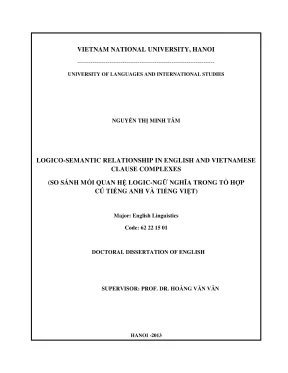
Luận án tiến sĩ ngôn ngữ học so sánh mối quan hệ logicngữ nghĩa trong tổ hợp cú tiếng anh và tiếng việt

Luận án tiến sĩ phân tích mối quan hệ logic-ngữ nghĩa trong tổ hợp cú tiếng Anh và tiếng Việt, đóng góp giá trị cho ngôn ngữ học so sánh.

Chuyên ngành

English Linguistics

Người đăng

Ẩn danh

Thể loại

Doctoral Dissertation

2013

212
2
0

Phí lưu trữ

55 Point

Mục lục chi tiết

INTRODUCTION

1. CHƯƠNG 1: SYSTEMIC FUNCTIONAL LINGUISTICS AND THE THEORETICAL FRAMEWORK OF LOGICO-SEMANTIC RELATIONSHIP IN CLAUSE COMPLEXES

1.1. Systemic functional theory

1.2. Historical context of the emergence of systemic functional theory: a brief overview

1.3. Functional approach — a general description

1.4. Systemic functional linguistics

1.5. Text and context in the view of SFL

1.6. Review of related studies

1.6.1. An overview of studies in Vietnamese grammar

1.6.2. SFL studies in other languages

1.7. The theoretical framework of logico-semantic relationship in clause complexes

1.7.1. The notion of clause complex in the light of SFL

1.7.2. What is a clause complex?

1.7.3. Where is the clause complex located in the overall linguistic system?

1.7.4. How is the clause complex organized?

1.7.5. Analytical frameworks of logico-semantic relations in clause complexes

1.7.5.1. Projection in clause complexes
1.7.5.2. Expansion in clause complexes

2. CHƯƠNG 2: METHODOLOGY, DATA, AND GENERAL FINDINGS

2.1. Research question restated

2.2. Methods of the study

2.3. Data collecting procedure

2.4. Corpus annotation and data processing

2.5. The computational tool

2.6. The process of annotating and processing the data

2.7. Describing the data

2.8. Comparing the two groups of data

2.9. General findings

3. CHƯƠNG 3: FINDINGS AND DISCUSSION: PROJECTION IN ENGLISH AND VIETNAMESE CLAUSE COMPLEXES

3.1. Projection in English Clause Complexes

3.1.1. How is projection realized in English Clause Complexes

3.1.2. Projecting and projected clauses paratactically related

3.1.3. Projecting and projected clauses hypotactically related

3.1.4. How does Projection work in English clause complexes

3.1.5. How does quoting work in English clause complexes

3.1.6. How does hypotactic reporting work in English clause complexes

3.1.7. How does paratactic reporting work in English clause complexes

3.1.8. How does projection facilitate other linguistic phenomena in English clause complexes

3.2. Projection in Vietnamese clause complexes

3.2.1. How is projection realized in Vietnamese Clause Complexes

3.2.2. Projecting and projected clauses paratactically related

3.2.3. Projecting and projected clauses hypotactically related

3.2.4. How does projection work in Vietnamese clause complexes

3.2.5. How does quoting work in Vietnamese clause complexes

3.2.6. How does hypotactic reporting work in English clause complexes

3.2.7. How does paratactic reporting work in English clause complexes

3.2.8. How does projection facilitate other linguistic phenomena in English clause complexes

3.3. Comparing logico-semantic relation of projection in English and Vietnamese clause complexes

3.3.1. Realization of projection in English and Vietnamese clause complexes

3.3.2. Projecting and projected clauses paratactically related

3.3.3. Projecting and projected clauses hypotactically related

3.3.4. Operation of projection in English and Vietnamese clause complexes

3.3.5. Operation of quoting in English and Vietnamese clause complexes

3.3.6. Operation of hypotactic reporting in English and Vietnamese clause complexes

3.3.7. Operation of paratactic reporting in English and Vietnamese clause complexes

3.3.8. Projection in relation with other linguistic phenomena in English and Vietnamese clause complexes

3.3.9. Summary

4. CHƯƠNG 4: FINDINGS AND DISCUSSION: EXPANSION IN ENGLISH AND VIETNAMESE CLAUSE COMPLEXES

4.1. Expansion in English clause complexes

4.1.1. How is expansion realized in English clause complexes

4.1.2. Conjunctions in English clause complexes of expansion

4.1.3. Expanding clause and expanded clause paratactically related

4.1.4. Expanding clause and expanded clause hypotactically related

4.1.5. How does expansion work in English clause complexes

4.1.6. How does elaboration work in English clause complexes

4.1.7. How does extension work in English clause complexes

4.1.8. How does enhancement work in English clause complexes

4.1.9. How does expansion facilitate ellipsis in the clause complex

4.2. Expansion in Vietnamese clause complexes

4.2.1. How is expansion realized in Vietnamese clause complexes

4.2.2. Conjunctions in Vietnamese clause complexes of expansion

4.2.3. Expanding clause and expanded clause paratactically related

4.2.4. Expanding clause and expanded clause hypotactically related

4.2.5. How does expansion work in English clause complexes

4.2.6. How does elaboration work in English clause complexes

4.2.7. How does extension work in English clause complexes

4.2.8. How does enhancement work in English clause complexes

4.2.9. How does expansion facilitate ellipsis in the clause complex

4.3. Comparing the logico-semantic relation of expansion in English and Vietnamese clause complexes

4.3.1. Comparing the realization of expansion in English and Vietnamese clause complexes

4.3.2. Expanding clause and expanded clause paratactically related

4.3.3. Expanding clause and expanded clause hypotactically related

4.3.4. Comparing the operation of expansion in English and Vietnamese clause complexes

4.3.5. Elaboration in English and Vietnamese clause complexes

4.3.6. Extension in English and Vietnamese clause complexes

4.3.7. Enhancement in English and Vietnamese clause complexes

4.3.8. Expansion and ellipsis in English and Vietnamese clause complexes

CONCLUSION

THESIS-RELATED PUBLICATION

BIBLIOGRAPHY

SOURCES OF DATA

Tóm tắt

I. Luận án tiến sĩ

Luận án tiến sĩ này tập trung vào việc so sánh mối quan hệ logic-ngữ nghĩa trong tổ hợp câu tiếng Anhtổ hợp câu tiếng Việt. Nghiên cứu sử dụng lý thuyết ngữ pháp chức năng hệ thống (SFL) để phân tích và so sánh cách thức các mối quan hệ logic-ngữ nghĩa được thể hiện và vận hành trong hai ngôn ngữ. Mục tiêu chính là tìm ra sự tương đồng và khác biệt trong cách thức tổ chức và vận hành của các mối quan hệ này, từ đó đóng góp vào việc xây dựng mô hình ngữ pháp chức năng hệ thống cho tiếng Việt.

1.1. So sánh mối quan hệ logic ngữ nghĩa

Nghiên cứu này so sánh mối quan hệ logic-ngữ nghĩa trong tổ hợp câu tiếng Anhtổ hợp câu tiếng Việt dựa trên lý thuyết ngữ pháp chức năng hệ thống (SFL). Các mối quan hệ này bao gồm projection (chiếu xạ) và expansion (mở rộng), được phân tích chi tiết thông qua các ví dụ cụ thể từ ngữ liệu. Kết quả cho thấy sự khác biệt đáng kể trong cách thức thể hiện và vận hành của các mối quan hệ này giữa hai ngôn ngữ, đặc biệt là trong việc sử dụng các từ nối và cấu trúc câu.

1.2. Tổ hợp câu tiếng Anh và tiếng Việt

Tổ hợp câu tiếng Anhtổ hợp câu tiếng Việt được phân tích dựa trên các tiêu chí về ngữ nghĩa họclogic học. Nghiên cứu chỉ ra rằng, trong khi tiếng Anh thường sử dụng các cấu trúc câu phức tạp với nhiều mệnh đề phụ, tiếng Việt lại có xu hướng sử dụng các câu đơn giản hơn với ít mệnh đề phụ hơn. Điều này phản ánh sự khác biệt trong cách thức tổ chức thông tin và biểu đạt ý nghĩa giữa hai ngôn ngữ.

II. Ngữ nghĩa học và logic học

Nghiên cứu này áp dụng các khái niệm từ ngữ nghĩa họclogic học để phân tích các mối quan hệ logic-ngữ nghĩa trong tổ hợp câu tiếng Anhtổ hợp câu tiếng Việt. Các khái niệm như projectionexpansion được sử dụng để mô tả cách thức các mệnh đề trong câu tương tác với nhau về mặt ngữ nghĩa và logic. Kết quả cho thấy sự khác biệt trong cách thức thể hiện các mối quan hệ này giữa hai ngôn ngữ, đặc biệt là trong việc sử dụng các từ nối và cấu trúc câu.

2.1. Ngữ nghĩa học trong tổ hợp câu

Ngữ nghĩa học đóng vai trò quan trọng trong việc phân tích các mối quan hệ logic-ngữ nghĩa trong tổ hợp câu tiếng Anhtổ hợp câu tiếng Việt. Nghiên cứu chỉ ra rằng, trong khi tiếng Anh thường sử dụng các cấu trúc câu phức tạp với nhiều mệnh đề phụ, tiếng Việt lại có xu hướng sử dụng các câu đơn giản hơn với ít mệnh đề phụ hơn. Điều này phản ánh sự khác biệt trong cách thức tổ chức thông tin và biểu đạt ý nghĩa giữa hai ngôn ngữ.

2.2. Logic học trong tổ hợp câu

Logic học được áp dụng để phân tích cách thức các mệnh đề trong câu tương tác với nhau về mặt logic. Nghiên cứu chỉ ra rằng, trong khi tiếng Anh thường sử dụng các từ nối phức tạp để thể hiện mối quan hệ logic giữa các mệnh đề, tiếng Việt lại có xu hướng sử dụng các từ nối đơn giản hơn. Điều này phản ánh sự khác biệt trong cách thức tổ chức thông tin và biểu đạt ý nghĩa giữa hai ngôn ngữ.

III. Ngôn ngữ học đối chiếu

Nghiên cứu này áp dụng phương pháp ngôn ngữ học đối chiếu để so sánh các mối quan hệ logic-ngữ nghĩa trong tổ hợp câu tiếng Anhtổ hợp câu tiếng Việt. Kết quả cho thấy sự khác biệt đáng kể trong cách thức thể hiện và vận hành của các mối quan hệ này giữa hai ngôn ngữ, đặc biệt là trong việc sử dụng các từ nối và cấu trúc câu. Nghiên cứu cũng chỉ ra rằng, việc hiểu rõ các mối quan hệ logic-ngữ nghĩa trong hai ngôn ngữ có thể giúp cải thiện việc dạy và học ngôn ngữ, cũng như hỗ trợ trong việc dịch thuật và biên tập văn bản.

3.1. Phân tích cú pháp

Phân tích cú pháp được sử dụng để phân tích cấu trúc của tổ hợp câu tiếng Anhtổ hợp câu tiếng Việt. Nghiên cứu chỉ ra rằng, trong khi tiếng Anh thường sử dụng các cấu trúc câu phức tạp với nhiều mệnh đề phụ, tiếng Việt lại có xu hướng sử dụng các câu đơn giản hơn với ít mệnh đề phụ hơn. Điều này phản ánh sự khác biệt trong cách thức tổ chức thông tin và biểu đạt ý nghĩa giữa hai ngôn ngữ.

3.2. Ngữ pháp tiếng Anh và tiếng Việt

Ngữ pháp tiếng Anhngữ pháp tiếng Việt được so sánh dựa trên các tiêu chí về ngữ nghĩa họclogic học. Nghiên cứu chỉ ra rằng, trong khi tiếng Anh thường sử dụng các từ nối phức tạp để thể hiện mối quan hệ logic giữa các mệnh đề, tiếng Việt lại có xu hướng sử dụng các từ nối đơn giản hơn. Điều này phản ánh sự khác biệt trong cách thức tổ chức thông tin và biểu đạt ý nghĩa giữa hai ngôn ngữ.

IV. Nghiên cứu ngôn ngữ và lý thuyết ngôn ngữ

Nghiên cứu này đóng góp vào lĩnh vực nghiên cứu ngôn ngữ bằng cách áp dụng lý thuyết ngôn ngữ để phân tích các mối quan hệ logic-ngữ nghĩa trong tổ hợp câu tiếng Anhtổ hợp câu tiếng Việt. Kết quả cho thấy sự khác biệt đáng kể trong cách thức thể hiện và vận hành của các mối quan hệ này giữa hai ngôn ngữ, đặc biệt là trong việc sử dụng các từ nối và cấu trúc câu. Nghiên cứu cũng chỉ ra rằng, việc hiểu rõ các mối quan hệ logic-ngữ nghĩa trong hai ngôn ngữ có thể giúp cải thiện việc dạy và học ngôn ngữ, cũng như hỗ trợ trong việc dịch thuật và biên tập văn bản.

4.1. Phân tích ngữ nghĩa

Phân tích ngữ nghĩa được sử dụng để phân tích cách thức các mệnh đề trong câu tương tác với nhau về mặt ngữ nghĩa. Nghiên cứu chỉ ra rằng, trong khi tiếng Anh thường sử dụng các cấu trúc câu phức tạp với nhiều mệnh đề phụ, tiếng Việt lại có xu hướng sử dụng các câu đơn giản hơn với ít mệnh đề phụ hơn. Điều này phản ánh sự khác biệt trong cách thức tổ chức thông tin và biểu đạt ý nghĩa giữa hai ngôn ngữ.

4.2. Lý thuyết ngôn ngữ

Lý thuyết ngôn ngữ được áp dụng để phân tích các mối quan hệ logic-ngữ nghĩa trong tổ hợp câu tiếng Anhtổ hợp câu tiếng Việt. Nghiên cứu chỉ ra rằng, trong khi tiếng Anh thường sử dụng các từ nối phức tạp để thể hiện mối quan hệ logic giữa các mệnh đề, tiếng Việt lại có xu hướng sử dụng các từ nối đơn giản hơn. Điều này phản ánh sự khác biệt trong cách thức tổ chức thông tin và biểu đạt ý nghĩa giữa hai ngôn ngữ.

21/02/2025
Luận án tiến sĩ ngôn ngữ học so sánh mối quan hệ logicngữ nghĩa trong tổ hợp cú tiếng anh và tiếng việt

Trích đoạn nội dung tài liệu

VIETNAM NATIONAL UNIVERSITY, HANOI UNIVERSITY OF LANGUAGES AND INTERNATIONAL STUDIES NGUYEN THI MINH TAM LOGICO-SEMANTIC RELATIONSHIP IN ENGLISH AND VIETNAMESE CLAUSE COMPLEXES (SO SANH MOI QUAN HE LOGIC-NGỮ NGHĨA TRONG TO HỢP Major: English Linguistics Code: 62 22 15 01 DOCTORAL DISSERTATION OF ENGLISH SUPERVISOR: PROF. HOANG VAN VAN HANOI -2013 TABLE OF CONTENTS INTRODUCTION Rationale CnBaW2k Aims of the study Significant of the study Scope of the study The research question The research design, methodology, and data The organization of the study CHAPTER 1: SYSTEMIC FUNCTIONAL LINGUISTICS AND THE THEORETICAL FRAMEWORK OF LOGICO-SEMANTIC RELATIONSHIP IN CLAUSE COMPLEXES 1. Systemic functional theory nN 1. Historical context of the emergence of systemic functional theory: a brief overview 1.

Functional approach — a general description 1. Systemic functional linguistics 11 1. Text and context in the view of SFL 12 1. Review of related studies 20 1.

An overview of studies in Vietnamese grammar 20 1. SFL studies in other languages 22 1. The theoretical framework of logico-semantic relationship in clause 23 complexes 1. The notion of clause complex in the light of SFL 23 1.

What is a clause complex? 29 1. Where is the clause complex located in the overall linguistic 36 system? 1. How is the clause complex organized? 38 1. Analytical frameworks of logico-semantic relations in clause complexes 41 1.

Projection in clause complexes 41 1. Expansion in clause complexes 50 iv CHAPTER 2: METHODOLOGY, DATA, AND GENERALFINDINGS 59 2. Research question restated 59 2. Methods of the study 62 2.

Data collecting procedure 62 2. Corpus annotation and data processing 64 2. The computational tool 64 2. The process of annotating and processing the data 67 2.

Describing the data 71 2. Comparing the two groups of data 72 2.General findings 73 CHAPTER 3: FINDINGS AND DISCUSSION: PROJECTION IN ENGLISH AND VIETNAMESE CLAUSE COMPLEXES 75 3. Projection in English Clause Complexes 75 3. How is projection realized in English Clause Complexes 75 3.

Projecting and projected clauses paratactically related 87 3. Projecting and projected clauses hypotactically related 88 3. How does Projection work in English clause complexes 90 3. How does quoting work in English clause complexes 90 3.

How does hypotactic reporting work in English clause 91 complexes 3. How does paratactic reporting work in English clause complexes 94 3. How does projection facilitate other linguistic phenomena in 96 English clause complexes 3. Projection in Vietnamese clause complexes 104 3.

How is projection realized in Vietnamese Clause Complexes 104 3. Projecting and projected clauses paratactically related 115 3. Projecting and projected clauses hypotactically related 117 3. How does projection work in Vietnamese clause complexes 118 3.

How does quoting work in Vietnamese clause complexes 118 3. How does hypotactic reporting work in English clause complexes 119 3. How does paratactic reporting work in English clause complexes 122 3. How does projection facilitate other linguistic phenomena in 124 English clause complexes 3.

Comparing logico-semantic relation of projection in English and Vietnamese clause complexes 130 3. Realization of projection in English and Vietnamese clause complexes 130 3. Projecting and projected clauses paratactically related 132 3. Projecting and projected clauses hypotactically related 133 3.

Operation of projection in English and Vietnamese clause complexes 133 3. Operation of quoting in English and Vietnamese clause 133 complexes 3. Operation of hypotactic reporting in English and Vietnamese 133 clause complexes 3. Operation of paratactic reporting in English and Vietnamese 134 clause complexes 3.

Projection in relation with other linguistic phenomena in English 134 and Vietnamese clause complexes 3. Summary 135 CHAPTER 4: FINDINGS AND DISCUSSION: EXPANSION IN ENGLISH AND VIETNAMESE CLAUSE COMPLEXES 136 4. Expansion in English clause complexes 136 4. How is expansion realized in English clause complexes 136 4.

Conjunctions in English clause complexes of expansion 141 4. Expanding clause and expanded clause paratactically related 143 4. Expanding clause and expanded clause hypotactically related 145 4. How does expansion work in English clause complexes 147 4.

How does elaboration work in English clause complexes 147 4. How does extension work in English clause complexes 150 4. How does enhancement work in English clause complexes 152 4. How does expansion facilitate ellipsis in the clause complex 155 4.

Expansion in Vietnamese clause complexes 160 4. How is expansion realized in Vietnamese clause complexes 160 vi 4. Conjunctions in Vietnamese clause complexes of 164 expansion 4. Expanding clause and expanded clause paratactically 168 related 4.

Expanding clause and expanded clause hypotactically 170 related 4._ How does expansion work in English clause complexes 172 5. How does elaboration work in English clause complexes 172 5. How does extension work in English clause complexes 175 5. How does enhancement work in English clause complexes 178 5.

How does expansion facilitate ellipsis in the clause complex 180 4.Comparing the logico-semantic relation of expansion in English and Vietnamese clause complexes 186 4. Comparing the realization of expansion in English and Vietnamese clause complexes 186 4. Expanding clause and expanded clause paratactically related 188 4. Expanding clause and expanded clause hypotactically related 189 4.

Comparing the operation of expansion in English and Vietnamese clause complexes 189 4. Elaboration in English and Vietnamese clause complexes 189 4. Extension in English and Vietnamese clause complexes 190 4. Enhancement in English and Vietnamese clause complexes 190 4.

Expansion and ellipsis in English and Vietnamese clause complexes 191 CONCLUSION 192 THESIS-RELATED PUBLICATION 202 BIBLIOGRAPHY 203 SOURCES OF DATA 210 vii LIST OE FIGURES Fig.1: “Systemic” means making choice in a network 14 Fig 2: The Stratification 15 Fig. 3: The View of the Grammar so far, Relative to Expansion by Metafunction and 16 Rank Fig. 4: Metafunctions as manifested in the system network of the clause 19 Fig. 5: Rank-based Constituency (Matthiessen & Halliday 24 Fig.

6: The Rank scale 25 Fig. Delicacy in relation to the metafunctions of language and rank 26 Fig. Univariate and Multivariate Structure 27 Fig. 9: Three lines of meanings in a clause — 1 29 Fig.

10: Three lines of meanings in a clause — 2 30 Fig. 11: Combining clauses into clause complex 31 Fig. 12: The rank of the clause complex 33 Fig. 13: The Location of Clause Complex in the Overall Linguistic System 38 Fig.

14: Clauses in paratactic and hypotactic clause complexes 39 Fig. 15: The Logico-semantic Relations 40 Fig.16: Positions of Projecting Clauses 42 Fig.17: Speech Functions of Projected Clauses 43 Fig. 18: Clause Moods of Projected Clauses 44 Fig. Paratactic Reporting 44 Fig.

Hypotactic Projection 45 Fig. 21: Projecting Processes and Mood of Projected Clause in Combination 46 viii Fig. 22: Projecting Processes in Quoting and Hypotactic Reporting 47 Fig. 23: The framework of projection in clause complexes 49 Fig.

24: Possible Positions of Expanding Clauses 51 Fig.25: An Analysis of a Clause complex of Expansion 51 Fig. 26: Clause Moods of Expanded Clauses 52 Fig. 27: Expanding and Expanded Clauses Paratactically Related 53 Fig. 28: Meaning of some Verbal Hypotactic Expanding Markers 54 Fig.

29: Modes of Elaborating Relation 55 Fig. 30: Modes of Extending Relation 56 Fig. 31: Modes of Enhancement 56 Fig. 32: The Framework of Expansion in Clause Complexes 58 Fig.

33: Overview of the analysis process in SysFan 66 Fig. 34: Chunking a group into clause complexes 68 Fig. 35: Chunking a clause complex into clauses 69 Fig. 36: Seven possible levels of chunking clause complexes 69 Fig.

37: Labeling the clauses in analysis 70 Fig.38: Distribution maps of clause complex relation types 71 Fig. 39: Complex Combination of Clauses — 1 124 Fig. 40: Complex Combination of Clauses - 2 125 Fig.41: The multi-function expanded clause in English 140 Fig.42: A Multi-function Expanded Clause in Vietnamese 163 ix LIST OF SYMBOLS SYMBOLS MEANING OF SYMBOLS clause divider complex divider clause conjunction œ,B,X. hypotactic related clauses 1, 2, 3,.

paratactic related clauses Idea Locution ” Proposition Proposal Extension Elaboration Enhancement Embedding INTRODUCTION 1. Rationale Over the years, functional approach has had a significant impact on the study of grammar. This theoretical approach tries to incorporate meaning, function, context, and grammatical categories. Funtionalism has been developed by many functional grammarians like Dik (1978), Halliday (1985, 1994), Bloor (1994), Eggins (1994), Thompson (1996), Lock (1997), Martin (1997), VanValin and LaPolla (1997), Matthiessen (2002), and many others.

Different functional theories have emerged, representing a great range of theoretical opinion, but the central theme of the functionalist theories is: functional motivation is an alternative to innateness. Linguistic theories which reject the syntactocentric or formal view and adopt the communication and cognition perspective include Functional Grammar (Dik, 1978, 1991), Systemic Functional Grammar (Halliday 1994), Role and Reference Grammar (RRG; VanValin and LaPolla 1997), Lexical Functional Grammar (LFG; Bresnan 2001), etc. Unlike the linguistic theory that is still the received tradition in school, functionalism takes the resource perspective rather than the rule perspective; and it is designed to display the overall system of grammar rather than only fragments. It wishes to be a theory which is ‘functional’ in at least three different, though interrelated senses: i.

It takes a functional view on the nature of language; ii. It attaches primary importance to functional relations at different levels in the organization of language; iii. It wishes to be practically applicable to the analysis of different aspects of language and language use. Functional theories can be described in three groups: extreme, moderate and conservative, all are common in basically a rejection of the syntactocentric view of formalists and a recognition of the importance of the communicative factors, cognitive factors or both in grammatical theory and analysis.

Among the three, systemic functional grammar (SFL) belongs to the moderate group. Systemic functional linguistics (SFL) is an approach to language developed mainly by M. Halliday in the UK and later in Australia. This approach has its origin in the main intellectual tradition of European linguistics that developed following the work of Saussure.

Its primary source was the work of J. Firth (1957) and his colleagues in London, who defines “system” in systemic functional linguistics, as, in its technical sense, the “theoretical representation of paradigmatic relations, contrasted 1 with “structure” for syntagmatic relations”, and who characterizes systemic theory as the theory in which the system takes priority, the most abstract representation at any level is in paradigmatic terms. As well as other schools of thought in Europe such as glossemantics, this theory also draws on American anthropological linguistics, and on traditional and modern linguistics as developed in China. While American-style linguistics evolved in the modeling of the world’s languages, SFL was developed to address the need of language teaching and learning.

A significant milestone in the development of this theory is when it was wholly developed in the work on the grammar of Chinese by Halliday (1956); and it has been used in educational and computational contexts from an early stage. With the primary goal of addressing the needs of language teaching / learning, systemic functional grammar (SFG), the theory of grammar in the light of SFL, lays an emphasis on the functions of language - what language is used for. Although SFG is a theory of grammar, it focuses more on the meaning, not the pure form of what is said like what formalists have long been doing. Since 1980, SFL has been expanded considerably in various directions; further studies have been devoted to languages other than English, notably Chinese, French, Indonesian, Japanese and some other Asian and African languages.

It has not been of much popular use in Vietnam studies of grammar. In Vietnamese, the first functional studies that should be counted are Tiếng Việt: Sơ Thảo Ngữ Pháp Chức Nang by Cao Xuân Hạo (1991), Ngữ Pháp Kinh Nghiệm của cú Tiếng Việt: Mô tả theo quan niệm chức năng hệ thống by Hoàng Văn Vân (2002), Ngữ Pháp Chức Năng Tiếng Việt: Câu trong Tiếng Việt, and Ngữ Pháp Chức Năng Tiếng Việt: Ngữ Đoạn và Từ Loại by Cao Xuân Hạo (2007), and some PhD thesis by Hoàng Văn Vân (1997), Thái Minh Đức (1998), and Đỗ Tuấn Minh (2007).

Nội dung được bảo vệ bản quyền — Tải xuống đầy đủ

Luận Án Tiến Sĩ: So Sánh Mối Quan Hệ Logic-Ngữ Nghĩa Trong Tổ Hợp Câu Tiếng Anh Và Tiếng Việt là một nghiên cứu chuyên sâu về sự tương đồng và khác biệt trong cấu trúc logic và ngữ nghĩa giữa tiếng Anh và tiếng Việt. Tài liệu này không chỉ làm rõ cách hai ngôn ngữ xử lý các tổ hợp câu mà còn cung cấp cái nhìn sâu sắc về cách thức biểu đạt ý nghĩa trong từng ngữ cảnh. Điều này giúp người đọc hiểu rõ hơn về sự phức tạp của ngôn ngữ và cách áp dụng kiến thức này vào việc học tập, dịch thuật hoặc nghiên cứu ngôn ngữ học.

Nếu bạn quan tâm đến các khía cạnh khác của ngữ nghĩa và biểu đạt ngôn ngữ, bạn có thể khám phá thêm qua Luận án phương tiện biểu hiện nghĩa tình thái ở hành động hỏi tiếng Anh và tiếng Việt. Nghiên cứu này tập trung vào cách thức biểu hiện nghĩa tình thái trong các hành động hỏi, mang lại góc nhìn mới mẻ về sự tương tác giữa ngôn ngữ và cảm xúc. Bên cạnh đó, Luận văn thạc sĩ kết cấu nghĩa của nhóm từ chỉ hành động nói năng trong tiếng Anh và tiếng Việt cũng là một tài liệu đáng đọc, giúp bạn hiểu sâu hơn về cách các từ chỉ hành động nói năng được sử dụng và biểu đạt trong hai ngôn ngữ. Cả hai tài liệu này đều mở rộng kiến thức của bạn về ngữ nghĩa và cách thức ngôn ngữ hoạt động trong các tình huống cụ thể.