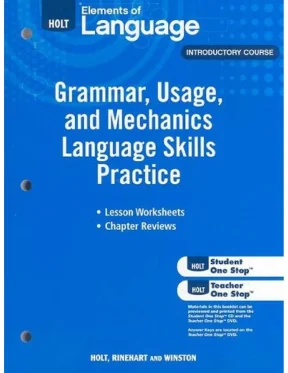
Luyện tập ngữ pháp tiếng Anh lớp 6 - Chương trình giới thiệu kỹ năng ngôn ngữ

Chuyên ngành

Ngữ pháp tiếng Anh

Người đăng

Ẩn danh

Thể loại

Sách bài tập

2007

397
0
0

Phí lưu trữ

75 Point

Tóm tắt

I. Tổng quan về ngữ pháp cách dùng và kỹ năng ngôn ngữ lớp 6

Khóa học Grammar, Usage, and Mechanics: Language Skills Practice Intro Course Grade 6 cung cấp nền tảng toàn diện về ngữ pháp tiếng Anh. Chương trình bao gồm nhiều chủ đề quan trọng. Đầu tiên là các từ loại (parts of speech): danh từ, đại từ, tính từ, động từ, phó từ, giới từ, liên từ và thán từ. Tiếp theo là cấu trúc câu, bao gồm chủ ngữ, vị ngữ và các loại câu. Học sinh cũng được tiếp cận cụm từ và mệnh đề. Nội dung về bổ ngữ, sự hòa hợp giữa chủ ngữ và động từ cũng được đề cập chi tiết. Cuối cùng là cách sử dụng động từ và đại từ đúng ngữ pháp. Mỗi chương đều có bài tập thực hành và bài tổng hợp. Phương pháp học đi từ lý thuyết đến thực hành. Học sinh rèn luyện qua nhiều dạng bài khác nhau. Chương trình giúp xây dựng kỹ năng viết và đọc hiểu vững chắc.

1.1. Các từ loại trong chương trình lớp 6

Từ loại là nền tảng cơ bản nhất trong ngữ pháp tiếng Anh. Chương trình giới thiệu tám từ loại chính. Danh từ (noun) dùng để chỉ người, nơi chốn, sự vật hoặc ý niệm. Đại từ (pronoun) thay thế cho danh từ để tránh lặp lại. Tính từ (adjective) bổ nghĩa cho danh từ hoặc đại từ. Động từ (verb) diễn tả hành động hoặc trạng thái. Phó từ (adverb) bổ nghĩa cho động từ, tính từ hoặc phó từ khác. Giới từ (preposition) chỉ mối quan hệ giữa các từ trong câu. Liên từ (conjunction) nối các từ, cụm từ hoặc mệnh đề. Thán từ (interjection) diễn tả cảm xúc đột ngột. Mỗi loại từ đều có vai trò riêng trong câu.

1.2. Cấu trúc câu và thành phần câu

Cấu trúc câu là yếu tố then chốt trong ngữ pháp. Một câu hoàn chỉnh cần có chủ ngữ và vị ngữ. Chủ ngữ đơn giản (simple subject) là danh từ hoặc đại từ chính. Chủ ngữ đầy đủ (complete subject) bao gồm tất cả từ bổ nghĩa. Vị ngữ đơn giản (simple predicate) là động từ chính. Vị ngữ đầy đủ (complete predicate) gồm động từ và các từ đi kèm. Chương trình cũng phân biệt câu hoàn chỉnh và cụm từ thiếu vị ngữ. Học sinh học cách nhận biết câu ghép (compound) với chủ ngữ hoặc vị ngữ ghép. Việc hiểu cấu trúc câu giúp học sinh viết đúng và rõ ràng hơn.

II. Các vấn đề ngữ pháp thường gặp ở học sinh lớp 6

Học sinh lớp 6 thường gặp nhiều khó khăn khi học ngữ pháp tiếng Anh. Một vấn đề phổ biến là nhầm lẫn giữa các từ loại. Nhiều em không phân biệt được tính từ và phó từ trong câu. Sự hòa hợp giữa chủ ngữ và động từ cũng gây nhiều lỗi sai. Học sinh hay quên thêm 's' với chủ ngữ ngôi thứ ba số ít. Cách sử dụng động từ đúng thì (tense) cũng là thách thức lớn. Các động từ bất quy tắc như sit/set, rise/raise, lie/lay thường bị nhầm lẫn. Việc dùng đúng hình thức chủ ngữ và tân ngữ của đại từ cũng khó khăn. Cụm từ giới từ và mệnh đề phụ thường bị xác định sai. Nhiều em chưa phân biệt được câu đơn, câu ghép và câu phức. Những lỗi này ảnh hưởng trực tiếp đến kỹ năng viết và đọc hiểu.

2.1. Lỗi hòa hợp chủ ngữ và động từ

Sự hòa hợp giữa chủ ngữ và động từ là một trong những lỗi phổ biến nhất. Quy tắc cơ bản: chủ ngữ số ít đi với động từ số ít, chủ ngữ số nhiều đi với động từ số nhiều. Tuy nhiên, nhiều tình huống gây nhầm lẫn. Chủ ngữ có cụm từ giới từ xen giữa thường khiến học sinh chọn sai dạng động từ. Ví dụ: 'The list of items is long' - động từ 'is' hòa hợp với 'list', không phải 'items'. Chủ ngữ ghép nối bằng 'and' thường dùng động từ số nhiều. Chủ ngữ ghép nối bằng 'or' hoặc 'nor' hòa hợp với chủ ngữ gần nhất. Chương trình cung cấp nhiều bài tập thực hành để khắc phục lỗi này.

2.2. Nhầm lẫn trong sử dụng đại từ

Đại từ là từ loại gây nhiều nhầm lẫn cho học sinh lớp 6. Hình thức chủ ngữ (subject form) và hình thức tân ngữ (object form) thường bị đảo lộn. Ví dụ: 'Him went to school' thay vì 'He went to school'. Đại từ phản thân (reflexive) và đại từ nhấn mạnh (intensive) có hình thức giống nhau nhưng chức năng khác nhau. Đại từ quan hệ (relative pronoun) như who, whom, which, that cần được dùng đúng ngữ cảnh. Việc xác định danh từ đi trước (antecedent) để chọn đại từ phù hợp cũng là thách thức. Đại từ bất định như everyone, somebody luôn đi với động từ số ít trong tiếng Anh chuẩn.

III. Phương pháp luyện tập kỹ năng ngữ pháp hiệu quả cho lớp 6

Việc luyện tập kỹ năng ngữ pháp cần có phương pháp rõ ràng và hệ thống. Đầu tiên, học sinh nên học từng chủ đề theo trình tự từ cơ bản đến nâng cao. Chương trình trong sách cung cấp cấu trúc học tập hợp lý. Mỗi chương bắt đầu bằng phần lý thuyết ngắn gọn, dễ hiểu. Tiếp theo là các bài tập thực hành đa dạng. Học sinh nên hoàn thành từng bài tập trước khi chuyển sang phần mới. Việc ghi chép các quy tắc ngữ pháp vào sổ tay rất hữu ích. Ôn tập thường xuyên giúp củng cố kiến thức đã học. Các bài tổng hợp (review) cuối mỗi chương giúp đánh giá mức độ nắm vững. Học sinh nên tìm thêm ví dụ thực tế trong sách báo tiếng Anh. Luyện tập hàng ngày với thời lượng vừa phải hiệu quả hơn học dồn. Phụ huynh và giáo viên nên theo dõi tiến bộ của học sinh thường xuyên.

3.1. Sử dụng bài tập trong sách giáo khoa

Sách giáo khoa Grammar, Usage, and Mechanics cung cấp hệ thống bài tập phong phú. Mỗi chủ đề có nhiều dạng bài tập khác nhau. Bài tập điền từ (fill in the blanks) giúp học sinh ghi nhớ quy tắc. Bài tập gạch chân từ (underline exercises) rèn luyện khả năng nhận biết từ loại. Bài tập sửa lỗi (error correction) phát triển kỹ năng phân tích câu. Các bài tổng hợp (review) cuối chương đánh giá toàn diện kiến thức. Bài tập được sắp xếp theo mức độ khó tăng dần. Học sinh nên hoàn thành tất cả bài tập trong mỗi chương. Việc kiểm tra đáp án và sửa sai ngay sau khi làm bài rất quan trọng.

3.2. Chiến lược ôn tập và ghi nhớ quy tắc

Ôn tập hiệu quả đòi hỏi chiến lược rõ ràng. Flashcard là công cụ hữu ích để ghi nhớ các quy tắc ngữ pháp. Viết mặt trước là quy tắc, mặt sau là ví dụ minh họa. Học sinh nên ôn lại bài cũ trước khi học bài mới. Phương pháp lặp lại cách quãng (spaced repetition) giúp ghi nhớ lâu dài. Tạo bảng tổng hợp các từ loại với định nghĩa và ví dụ. So sánh các quy tắc dễ nhầm lẫn để tránh sai sót. Viết câu sử dụng đúng quy tắc vừa học là cách luyện tập thực tế. Thảo luận nhóm giúp học sinh hiểu sâu hơn các khái niệm. Kiểm tra định kỳ giúp đánh giá tiến bộ và xác định điểm yếu cần cải thiện.

IV. Kết luận và ứng dụng kỹ năng ngữ pháp lớp 6 vào thực tế

Kỹ năng ngữ pháp, cách dùng và cơ chế ngôn ngữ là nền tảng quan trọng cho việc học tiếng Anh. Chương trình lớp 6 cung cấp kiến thức nền tảng vững chắc. Học sinh nắm được các từ loại, cấu trúc câu và quy tắc ngữ pháp cơ bản. Những kiến thức này áp dụng trực tiếp vào kỹ năng viết. Viết đúng ngữ pháp giúp bài văn rõ ràng và chuyên nghiệp hơn. Kỹ năng đọc hiểu cũng cải thiện khi hiểu cấu trúc ngữ pháp. Học sinh có thể phân tích câu phức tạp một cách dễ dàng. Nền tảng ngữ pháp lớp 6 là bước đệm cho chương trình nâng cao hơn. Các chủ đề như mệnh đề phụ, câu phức hợp đòi hỏi hiểu biết sâu về cấu trúc câu. Việc luyện tập đều đặn tạo thói quen sử dụng ngôn ngữ chính xác. Kết quả là học sinh tự tin hơn trong giao tiếp và học tập tiếng Anh.

4.1. Xây dựng nền tảng viết tiếng Anh

Ngữ pháp là xương sống của kỹ năng viết tiếng Anh. Học sinh lớp 6 cần nắm vững cấu trúc câu đơn giản trước. Câu hoàn chỉnh phải có chủ ngữ và vị ngữ rõ ràng. Biết cách sử dụng đúng từ loại giúp câu văn chính xác hơn. Tính từ làm cho bài viết sinh động và cụ thể. Phó từ bổ sung thông tin về thời gian, địa điểm và mức độ. Câu ghép và câu phức cho phép diễn đạt ý tưởng phức tạp hơn. Học sinh nên bắt đầu viết đoạn văn ngắn áp dụng các quy tắc đã học. Viết nhật ký hàng ngày bằng tiếng Anh là bài tập thực tế hữu ích. Giáo viên nên hướng dẫn sửa lỗi ngữ pháp trong bài viết của học sinh.

4.2. Chuẩn bị cho chương trình ngữ pháp nâng cao

Kiến thức ngữ pháp lớp 6 là nền tảng cho các lớp cao hơn. Học sinh cần nắm chắc các từ loại trước khi học cấu trúc phức tạp. Mệnh đề quan hệ (relative clause) đòi hỏi hiểu biết về đại từ quan hệ. Mệnh đề trạng ngữ (adverb clause) cần kiến thức về liên từ. Câu bị động (passive voice) yêu cầu hiểu cách sử dụng động từ. Thì động từ nâng cao bao gồm thì hoàn thành và thì tiếp diễn. Kỹ năng phân tích câu giúp học sinh đối phó với văn bản phức tạp. Chương trình lớp 6 xây dựng kỹ năng phân tích và nhận diện quy tắc. Những học sinh nắm vững ngữ pháp cơ bản sẽ tiến bộ nhanh hơn ở các lớp sau.
22/04/2026

Trích đoạn nội dung tài liệu

qxd 11/1/07 7:17 AM Page iii Contents Grammar, Usage, and Mechanics Chapter 3 Language Skills Practice PARTS OF SPEECH OVERVIEW: USING THIS WORKBOOK.vii VERB, ADVERB, PREPOSITION, CONJUNCTION, INTERJECTION Chapter 1 The Verb.36 THE SENTENCE Main Verbs and Helping Verbs .37 Sentences and Sentence Fragments A.38 Sentences and Sentence Fragments B .39 Sentences and Sentence Fragments C .40 Simple Subjects and Complete Subjects .4 Transitive and Intransitive Verbs .41 Simple Predicates and Complete Predicates .5 Kinds of Verbs.43 Simple and Complete Subjects and Predicates A .44 Simple and Complete Subjects and Predicates B.8 Adverb or Adjective? .10 The Prepositional Phrase.47 Compound Subjects and Compound Verbs.11 Preposition or Adverb?.48 Subjects and Verbs A .49 Subjects and Verbs B.50 Sentences Classified by Purpose A.51 Sentences Classified by Purpose B .15 Determining Parts of Speech .52 REVIEW A: Sentences and Sentence Fragments .16 REVIEW A: Parts of Speech .53 REVIEW B: Sentence Parts .17 REVIEW B: Parts of Speech.54 REVIEW C: Sentence Parts.18 REVIEW C: Parts of Speech .55 REVIEW D: Kinds of Sentences.19 Chapter 4 Chapter 2 THE PHRASE AND THE CLAUSE PARTS OF SPEECH OVERVIEW: Identifying Phrases.56 NOUN, PRONOUN, ADJECTIVE Prepositional Phrases A.57 Copyright © by Holt, Rinehart and Winston. All rights reserved.58 Proper and Common Nouns A.59 Proper and Common Nouns B .60 Pronouns and Antecedents.23 Adjective and Adverb Phrases A.61 Personal, Reflexive, and Intensive Pronouns .24 Adjective and Adverb Phrases B .62 Demonstrative Pronouns and Relative The Clause.64 Indefinite Pronouns and Interrogative Subordinate Clauses.66 Identifying Kinds of Pronouns.28 Adjective and Adverb Clauses A.29 Adjective and Adverb Clauses B .30 Simple and Compound Sentences .70 Noun, Pronoun, or Adjective? A .31 Compound and Complex Sentences .71 Noun, Pronoun, or Adjective? B .32 Complex and Compound-Complex Sentences .33 Identifying Kinds of Sentences .34 REVIEW A: Phrases and Clauses.74 REVIEW C: Nouns, Pronouns, and Adjectives .35 REVIEW B: Phrases and Clauses .76 iii L09NAGUML6_i-viii.qxd 11/1/07 7:17 AM Page iv Contents Chapter 5 Identifying Tense .114 COMPLEMENTS Using Tense Consistently .77 Using Sit and Set.78 Using Rise and Raise.79 Using Lie and Lay.118 Direct Objects and Indirect Objects A.80 Six Confusing Verbs .119 Direct Objects and Indirect Objects B .81 REVIEW A: Using Regular and Irregular Subject Complements.84 REVIEW C: Writing Correct Verb Forms .122 Predicate Nominatives and Predicate REVIEW D: Using Correct Verb Forms .85 Predicate Nominatives and Predicate Chapter 8 Adjectives B .86 USING PRONOUNS CORRECTLY REVIEW A: Complements .87 Forms of Personal Pronouns .88 Using the Subject Form A .89 Using the Subject Form B.126 Using the Object Form A.127 Chapter 6 Using the Object Form B .128 AGREEMENT Subject Form and Object Form Pronouns A .90 Subject Form and Object Form Pronouns B.130 Subject and Verb Agreement A .91 Who and Whom.131 Subject and Verb Agreement B.92 Pronouns with Appositives .132 Phrases Between Subject and Verb.93 REVIEW A: Using Pronouns Correctly .133 Agreement with Indefinite Pronouns A.94 REVIEW B: Using Pronouns Correctly.134 Agreement with Indefinite Pronouns B .95 REVIEW C: Using Pronouns Correctly .96 Subject After the Verb.97 Chapter 9 Don’t and Doesn’t.98 USING MODIFIERS CORRECTLY Copyright © by Holt, Rinehart and Winston. All rights reserved. Agreement of Pronoun and Antecedent A .99 One-Word Modifiers .136 Agreement of Pronoun and Antecedent B .100 Phrases Used as Modifiers.137 Indefinite Pronouns as Antecedents .101 Clauses Used as Modifiers.138 Antecedents Joined by Or, Nor, or And .102 Words, Phrases, and Clauses Used REVIEW A: Subject-Verb Agreement.139 REVIEW B: Pronoun-Antecedent Agreement.106 Regular and Irregular Comparisons A.142 Regular and Irregular Comparisons B .143 Chapter 7 Use of Comparative and Superlative Forms A .144 USING VERBS CORRECTLY Use of Comparative and Superlative Forms B .145 Identifying the Principal Parts of Verbs .107 Good and Well .146 Using Regular Verbs .108 Adjective or Adverb? .147 Using Irregular Verbs A.148 Using Irregular Verbs B .149 Using Irregular Verbs C.111 Misplaced One-Word Modifiers .150 Using Irregular Verbs D .112 Misplaced Prepositional Phrases.151 Using Irregular Verbs E .113 Misplaced Adjective Clauses.152 iv L09NAGUML6_i-viii.qxd 11/1/07 7:17 AM Page v Contents Placement of Modifiers A .153 Commas in Compound Sentences.190 Placement of Modifiers B.154 Commas with Interrupters .191 REVIEW A: Forms and Comparisons.155 Commas with Introductory Elements.192 REVIEW B: Special Problems and Double Commas A.194 REVIEW C: Misplaced Modifiers .157 Conventional Uses of Commas .195 REVIEW D: All Types of Problems.198 A GLOSSARY OF USAGE Colons .199 Avoiding Usage Problems A .159 REVIEW A: End Marks and Abbreviations.200 Avoiding Usage Problems B.201 Avoiding Usage Problems C .161 REVIEW C: Semicolons and Colons .202 Avoiding Usage Problems D .162 REVIEW D: End Marks, Commas, Avoiding Usage Problems E.163 Semicolons, and Colons .203 REVIEW A: Common Usage Problems.164 REVIEW B: Common Usage Problems.165 Chapter 13 REVIEW C: Common Usage Problems.204 First Words and I .168 Quotation Marks with Direct Quotations.169 Quotation Marks in Dialogue .170 Quotation Marks with Titles .172 Underlining (Italics) and Quotation Marks A .173 Underlining (Italics) and Quotation Marks B.174 Apostrophes with Possessives .212 Copyright © by Holt, Rinehart and Winston. All rights reserved. School Subjects and Proper Adjectives.213 Proper Nouns and Proper Adjectives A .176 Apostrophes in Possessives.214 Proper Nouns and Proper Adjectives B.177 Apostrophes in Contractions .178 Apostrophes in Plurals.216 Personal Titles and Familial Titles.217 Titles of Books and Other Works.218 Abbreviations and Titles A .181 REVIEW A: Underlining (Italics) and Abbreviations and Titles B.219 REVIEW A: Capital Letters .220 REVIEW B: Capital Letters.221 REVIEW C: Capital Letters .185 REVIEW D: Underlining (Italics), Quotation Marks, Apostrophes, Hyphens.222 Chapter 12 PUNCTUATION: Chapter 14 END MARKS, SEMICOLONS, COLONS, COMMAS SPELLING End Marks.186 Good Spelling Habits.187 ie and ei .224 End Marks and Abbreviations.225 Commas with Items in a Series .189 Adding –ness and –ly.qxd 11/1/07 7:17 AM Page vi Contents Adding Suffixes to Words Ending in Silent e.227 Pronoun-Antecedent Agreement B.249 Adding Suffixes to Words Ending in y .250 Doubling Final Consonants When Verb Forms B .253 Forming the Plurals of Nouns A .231 Comparative and Superlative Forms of Forming the Plurals of Nouns B.254 Forming the Plurals of Nouns C .255 Forming Plurals: Review.234 Double Comparisons and Double Negatives .256 Words Often Confused A.257 Words Often Confused B .258 Words Often Confused C.259 Words Often Confused D.260 REVIEW A: Spelling Rules.261 REVIEW B: Words Often Confused .262 REVIEW C: Spelling Rules and Words Semicolons and Colons .241 Quotation Marks and Other Punctuation A .264 REVIEW D: Spelling Rules and Words Quotation Marks and Other Punctuation B.266 All Marks of Punctuation A .267 Chapter 15 All Marks of Punctuation B.268 CORRECTING COMMON ERRORS Spelling A .270 Run-on Sentences.244 Words Often Confused.271 Sentence Fragments and Run-on Sentences.245 Spelling and Words Often Confused.272 Subject-Verb Agreement A.273 Subject-Verb Agreement B .274 Pronoun-Antecedent Agreement A .248 REVIEW C: Usage and Mechanics .275 Copyright © by Holt, Rinehart and Winston. All rights reserved. vi L09NAGUML6_i-viii.qxd 11/12/07 3:34 PM Page vii Using This Workbook The worksheets in this workbook provide practice, reinforcement, and extension for Chapters 1–15 of Elements of Language. Most of the worksheets you will find in this workbook are traditional worksheets providing practice and reinforcement activities on every rule and on all major instructional topics in the grammar, usage, and mechanics chapters in Elements of Language. The Teaching Resources include the Answer Key, which is located on the Teacher One Stop. Copyright © by Holt, Rinehart and Winston. All rights reserved. Grammar, Usage, and Mechanics: Language Skills Practice vii L09NAGUML6_001-019.qxd 11/1/07 8:44 AM Page 1 NAME CLASS DATE GRAMMAR for CHAPTER 1: THE SENTENCE pages 50–51 Sentences and Sentence Fragments A 1a. A sentence is a word group that contains a subject and a verb and that expresses a complete thought. EXAMPLE The American bison is brown and black. A sentence fragment is a word group that looks like a sentence but either does not contain both a subject and a verb or does not express a complete thought. SENTENCE FRAGMENT Graze on the plain. SENTENCE The bison graze on the plain. EXERCISE Decide whether each group of words is a sentence or a sentence fragment. Write S for sentence or SF for sentence fragment on the line provided. Has a large head and humped shoulders. Zoologists call the American buffalo a bison. May weigh up to three thousand pounds. Live in herds and feed on grass. Once roamed across North America. In 1850, there were still about twenty million bison. By 1890, bison were almost extinct. Didn’t kill all those bison. Now, more than thirty thousand. Bison were difficult to hunt on foot. Copyright © by Holt, Rinehart and Winston. All rights reserved. The horse and the gun changed Plains Indian life. Moved from camp to camp. Plains Indians began to use horses about 1600. Brought to America by the Spanish. Wild herds of mustangs in the American West. Mustang may come from a Spanish word meaning “ownerless horses. Bronco another Spanish word. Some people call any bad-tempered horse a bronco. Also another word for mustang. Descendants of wild mustangs are still used to herd cattle. Broncos, or broncs, in rodeo competitions. Grammar, Usage, and Mechanics: Language Skills Practice 1 L09NAGUML6_001-019.qxd 11/1/07 8:44 AM Page 2 NAME CLASS DATE GRAMMAR for CHAPTER 1: THE SENTENCE pages 50–51 Sentences and Sentence Fragments B 1a. A sentence is a word group that contains a subject and a verb and that expresses a complete thought. EXAMPLES Didn’t a picture of that headdress appear on a United States stamp? What a beautiful arrangement of feathers it is! A sentence fragment is a word group that looks like a sentence but either does not contain both a subject and a verb or does not express a complete thought. SENTENCE FRAGMENT Brown feathers of the golden eagle. SENTENCE Brown feathers of the golden eagle adorn the headdress. EXERCISE A Decide whether each group of words is a sentence or a sentence fragment. Write S for sentence or SF for sentence fragment on the line provided. When we entered the museum’s exhibit area. No two headdresses of the Plains Indians. The feathers of the male golden eagle are a sign of bravery and speed. Have you ever seen a real Plains Indian headdress? 4. At the famous Battle of the Little Bighorn, General George Custer! 5. What a fierce battle that was! 6. Lived in earth lodges or tepees. Villages along rivers and streams. As they followed herds of buffalo across the vast plains. Copyright © by Holt, Rinehart and Winston. All rights reserved. Buffalo meat a main part of their diet. The skins of the buffalo were used for bedding, clothing, and tepees. EXERCISE B On each line below, write a sentence that includes each sentence fragment. Add punctua- tion and change capitalization as needed for your sentence. Hissing, the cat Hissing, the cat swatted at the unfamiliar dog. After the football game 12. Gave the school a donation 13. Standing by the mailbox 14. Will become a firefighter 15. Jumping up and down 2 ELEMENTS OF LANGUAGE Introductory Course L09NAGUML6_001-019.qxd 11/1/07 8:44 AM Page 3 NAME CLASS DATE GRAMMAR for CHAPTER 1: THE SENTENCE pages 50–51 Sentences and Sentence Fragments C 1a. A sentence is a word group that contains a subject and a verb and that expresses a complete thought. A sentence fragment is a word group that looks like a sentence but either does not contain both a subject and a verb or does not express a complete thought. SENTENCE FRAGMENT Because we were tired. SENTENCE We left early because we were tired. EXERCISE Each item below shows one way a sentence fragment can be corrected. Study each correction. Then, on the line provided, show another way each fragment can be corrected. Fragment: Studying the solar system. Correction: Kim is studying the solar system. The class was studying the solar system. Fragment: My neighbor Flo. Correction: My neighbor Flo is a dancer. Fragment: Waiting for the bus. Bossio is waiting for the bus. Fragment: Cutting the apple into four pieces. Correction: Cut the apple into four pieces. Fragment: Len’s new puppy. Correction: Have you seen Len’s new puppy? Copyright © by Holt, Rinehart and Winston.

Nội dung được bảo vệ bản quyền — Tải xuống đầy đủ