Nguyên lý và Ứng dụng Kỹ thuật Điện của Giorgio Rizzoni - Phân tích Mạch, Điện tử

Chuyên ngành

Kỹ thuật điện

Người đăng

Ẩn danh

Thể loại

Sách giáo khoa
965
0
0

Phí lưu trữ

135 Point

Tóm tắt

I. Tổng quan về giáo trình Principles and Applications of Electrical Engineering

Principles and Applications of Electrical Engineering là bộ giáo trình kỹ thuật điện kinh điển do giáo sư Giorgio Rizzoni biên soạn, được xuất bản bởi nhà McGraw-Hill. Cuốn sách được thiết kế dành cho sinh viên kỹ thuật không chuyên ngành điện, cung cấp nền tảng vững chắc về nguyên lý và ứng dụng kỹ thuật điện. Nội dung bao gồm nhiều chủ đề cốt lõi: phân tích mạch điện, mạng điện trở, phân tích mạng xoay chiều, phân tích quá độ, công suất AC và biến đổi Laplace. Điểm nổi bật của giáo trình là cách tiếp cận thực tiễn, kết hợp lý thuyết với các ví dụ từ thực tế như hệ thống điện ô tô, thiết bị cơ điện tử. Sách trình bày các phương pháp giải tích mạch cơ bản như định luật Kirchhoff, phương pháp nút điện áp, phương pháp dòng mắt lưới. Mỗi chương đều có bài tập kiểm tra Understanding và ví dụ minh họa chi tiết. Đây là tài liệu tham khảo quan trọng cho sinh viên kỹ thuật cơ khí, kỹ thuật cơ điện tử và các ngành liên quan.

1.1. Cấu trúc nội dung và phạm vi của giáo trình

1.2. Đặc điểm sư phạm và phương pháp giảng dạy

II. Phân tích mạng điện trở và các vấn đề trọng tâm

Phân tích mạng điện trở là nền tảng cốt lõi trong giáo trình Giorgio Rizzoni, đặt cơ sở cho toàn bộ kiến thức kỹ thuật điện. Chương 3 trình bày hai phương pháp giải tích chính: phương pháp nút điện áp và phương pháp dòng mắt lưới. Phương pháp nút điện áp xác định điện áp tại các nút trong mạch, sử dụng định luật dòng điện Kirchhoff làm cơ sở. Phương pháp dòng mắt lưới áp dụng định luật điện áp Kirchhoff cho các vòng kín. Giáo trình cũng giới thiệu nguyên lý chồng chập, cho phép giải mạch có nhiều nguồn bằng cách xét riêng từng nguồn. Mạng một cổng và mạch tương đương Thévenin-Norton là công cụ quan trọng để đơn giản hóa mạch phức tạp. Bài toán truyền công suất cực đại cũng được đề cập chi tiết. Các phần tử mạch phi tuyến được giới thiệu kèm phương pháp giải đồ thị đường tải. Giáo trình sử dụng ví dụ thực tế về hệ thống điện ô tô để minh họa cách áp dụng định luật Kirchhoff.

2.1. Phương pháp nút điện áp và dòng mắt lưới

2.2. Mạch tương đương Thévenin và Norton

III. Phương pháp phân tích mạch xoay chiều và quá độ

Phân tích mạch xoay chiều là chủ đề trọng tâm của Chương 4 trong giáo trình Giorgio Rizzoni. Giáo trình bắt đầu bằng việc giới thiệu các phần tử tích trữ năng lượng: tụ điện và cuộn cảm. Tụ điện tích trữ năng lượng trong điện trường, trong khi cuộn cảm tích trữ năng lượng trong từ trường. Khái niệm fasor được giới thiệu dựa trên đồng nhất thức Euler, cho phép biến đổi tín hiệu sin từ miền thời gian sang miền tần số. Trở kháng là khái niệm mở rộng của điện trở cho mạch AC, bao gồm phần thực và phần ảo. Phương trình trở kháng cho điện trở, cuộn cảm và tụ điện được trình bày chi tiết. Đơn vị dẫn nạp cũng được giới thiệu như nghịch đảo của trở kháng. Các phương pháp giải tích mạch AC tương tự mạch DC nhưng áp dụng số phức. Chương 5 tiếp tục với phân tích quá độ, sử dụng phương trình vi phân để mô tả phản hồi tức thời của mạch chứa phần tử động.

3.1. Fasor và trở kháng trong mạch AC

3.2. Phân tích quá độ và phương trình vi phân

IV. Kết luận và ứng dụng thực tế của giáo trình Rizzoni

Giáo trình Principles and Applications of Electrical Engineering của Giorgio Rizzoni cung cấp nền tảng toàn diện cho sinh viên kỹ thuật. Nội dung sách trải dài từ nguyên lý cơ bản đến ứng dụng nâng cao, bao gồm công suất AC, biến đổi Laplace và hàm truyền. Chương 7 trình bày công suất trong mạch AC, bao gồm công suất tức thời, công suất trung bình và hệ số công suất. Biến đổi Laplace là công cụ toán học mạnh mẽ, biến đổi phương trình vi phân thành đại số. Hàm truyền, cực điểm và điểm zero được phân tích để hiểu hành vi hệ thống. Ứng dụng thực tế của giáo trình rất đa dạng: từ thiết kế mạch điện ô tô, hệ thống cơ điện tử đến phân tích mạng điện công nghiệp. Cuốn sách cũng đề cập đến hệ thống điện ba pha, biến áp và nối đất an toàn. Đây là tài liệu không thể thiếu cho bất kỳ kỹ sư nào cần hiểu biết cơ bản về kỹ thuật điện.
4.1. Công suất AC và hệ thống điện ba pha

4.2. Ứng dụng trong kỹ thuật cơ điện tử và hệ thống ô tô

21/04/2026

Trích đoạn nội dung tài liệu

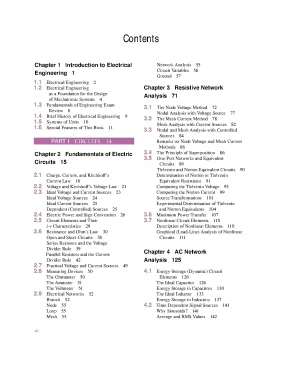
Contents Chapter 1 Introduction to Electrical Network Analysis 55 Circuit Variables 56 Engineering 1 Ground 57 1.2 Electrical Engineering Chapter 3 Resistive Network as a Foundation for the Design Analysis 71 of Mechatronic Systems 4 1.3 Fundamentals of Engineering Exam 3.1 The Node Voltage Method 72 Review 8 Nodal Analysis with Voltage Source 77 1.4 Brief History of Electrical Engineering 9 3.2 The Mesh Current Method 78 1.5 Systems of Units 10 Mesh Analysis with Current Sources 82 1.6 Special Features of This Book 11 3.3 Nodal and Mesh Analysis with Controlled Sources 84 PART I CIRCUITS 14 Remarks on Node Voltage and Mesh Current Methods 86 Chapter 2 Fundamentals of Electric 3.4 The Principle of Superposition 86 3.5 One-Port Networks and Equivalent Circuits 15 Circuits 89 Thévenin and Norton Equivalent Circuits 90 2.1 Charge, Current, and Kirchhoff’s Determination of Norton or Thévenin Current Law 16 Equivalent Resistance 91 2.2 Voltage and Kirchhoff’s Voltage Law 21 Computing the Thévenin Voltage 95 2.3 Ideal Voltage and Current Sources 23 Computing the Norton Current 99 Ideal Voltage Sources 24 Source Transformations 101 Ideal Current Sources 25 Experimental Determination of Thévenin Dependent (Controlled) Sources 25 and Norton Equivalents 104 2.4 Electric Power and Sign Convention 26 3.6 Maximum Power Transfer 107 2.5 Circuit Elements and Their 3.7 Nonlinear Circuit Elements 110 i-v Characteristics 29 Description of Nonlinear Elements 110 2.6 Resistance and Ohm’s Law 30 Graphical (Load-Line) Analysis of Nonlinear Open and Short Circuits 38 Circuits 111 Series Resistors and the Voltage Divider Rule 39 Parallel Resistors and the Current Chapter 4 AC Network Divider Rule 42 Analysis 125 2.7 Practical Voltage and Current Sources 49 2.1 Energy-Storage (Dynamic) Circuit The Ohmmeter 50 Elements 126 The Ammeter 51 The Ideal Capacitor 126 The Voltmeter 51 Energy Storage in Capacitors 130 2.9 Electrical Networks 52 The Ideal Inductor 133 Branch 52 Energy Storage in Inductors 137 Node 55 4.2 Time-Dependent Signal Sources 141 Loop 55 Why Sinusoids? 141 Mesh 55 Average and RMS Values 142 xii Contents xiii 4.3 Solution of Circuits Containing Dynamic The Laplace Transform 263 Elements 145 Transfer Functions, Poles, and Zeros 267 Forced Response of Circuits Excited by Sinusoidal Sources 146 Chapter 7 AC Power 281 4.4 Phasors and Impedance 148 Euler’s Identity 148 7.1 Power in AC Circuits 282 Phasors 149 Instantaneous and Average Power 282 Superposition of AC Signals 151 AC Power Notation 284 Impedance 153 Power Factor 288 The Resistor 153 7.2 Complex Power 289 The Inductor 154 Power Factor, Revisited 294 The Capacitor 155 7.3 Transformers 308 Admittance 161 The Ideal Transformer 309 4.5 AC Circuit Analysis Methods 162 Impedance Reflection and Power AC Equivalent Circuits 166 Transfer 311 7.4 Three-Phase Power 315 Balanced Wye Loads 318 Chapter 5 Transient Analysis 181 Balanced Delta Loads 319 5.5 Residential Wiring; Grounding 5.2 Solution of Circuits Containing Dynamic and Safety 322 Elements 183 7.6 Generation and Distribution of AC Power 325 5.3 Transient Response of First-Order Circuits 186 PART II ELECTRONICS 336 Natural Response of First-Order Circuits 187 Forced and Complete Response of First-Order Chapter 8 Semiconductors Circuits 191 and Diodes 337 Continuity of Capacitor Voltages and Inductor Circuits 192 8.1 Electrical Conduction in Semiconductor Complete Solution of First-Order Circuits 194 Devices 338 5.4 Transient Response of First-Order 8.2 The pn Junction and the Semiconductor Circuits 203 Diode 340 Deriving the Differential Equations 8.3 Circuit Models for the Semiconductor for Second-Order Circuits 204 Diode 343 Natural Response of Second-Order Large-Signal Diode Models 343 Circuits 205 Small-Signal Diode Models 351 Overdamped Solution 208 Piecewise Linear Diode Model 357 Critically Damped Solution 209 8.4 Practical Diode Circuits 360 Underdamped Solution 209 The Full-Wave Rectifier 360 Forced and Complete Response The Bridge Rectifier 362 of Second-Order Circuits 210 DC Power Supplies, Zener Diodes, and Voltage Regulation 364 Chapter 6 Frequency Respose Signal-Processing Applications 370 Photodiodes 377 and System Concepts 231 6.1 Sinusoidal Frequency Response 232 Chapter 9 Transistor 6.2 Filters 238 Fundamentals 391 Low-Pass Filters 239 High-Pass Filters 245 9.1 Transistors as Amplifiers and Switches 392 Band-Pass Filters 248 9.2 The Bipolar Junction Transistor (BJT) 394 Decibel (db) or Bode Plots 257 Determining the Operating Region 6.3 Complex Frequency and the Laplace of a BJT 397 Transform 260 Selecting an Operating Point for a BJT 399 xiv Contents 9.3 BJT Large-Signal Model 407 Power MOSFETs 505 Large-Signal Model of the npn BJT 407 Insulated-Gate Bipolar Transistors 9.4 Field-Effect Transistors 415 (IGBTs) 508 9.5 Overview of Enhancement-Mode 11.5 Rectifiers and Controlled Rectifiers MOSFETs 415 (AC-DC Converters) 508 Operation of the n-Channel Enhancement- Three-Phase Rectifiers 511 Mode MOSFET 416 Thyristors and Controlled Rectifiers 512 p-Channel MOSFETs and CMOS 11.6 Electric Motor Drives 518 Devices 421 Choppers (DC-DC Converters) 518 9.6 Depletion MOSFETs and JFETs 423 Inverters (DC-AC Converters) 523 Depletion MOSFETs 423 Junction Field-Effect Transistors 424 Chapter 12 Operational Depletion MOSFET and JFET Amplifiers 531 Equations 426 12.1 Amplifiers 532 Ideal Amplifier Characteristics 532 Chapter 10 Transistor Amplifiers 12.2 The Operational Amplifier 533 and Switches 437 The Open-Loop Model 534 The Operational Amplifier 10.1 Small-Signal Models of the BJT 438 in the Closed-Loop Mode 535 Transconductance 441 12.2 BJT Small-Signal Amplifiers 443 12.4 Integrator and Differentiator Circuits 559 DC Analysis of the Common-Emitter The Ideal Differentiator 562 Amplifier 446 12.5 Analog Computers 562 AC Analysis of the Common-Emitter Scaling in Analog Computers 564 Amplifier 453 12.6 Physical Limitations of Op-Amps 569 Other BJT Amplifier Circuits 457 Voltage Supply Limits 569 10.3 FET Small-Signal Amplifiers 457 Frequency Response Limits 571 The MOSFET Common-Source Input Offset Voltage 574 Amplifier 461 Input Bias Currents 575 The MOSFET Source Follower 465 Output Offset Adjustment 576 10.4 Transistor Amplifiers 468 Slew Rate Limit 577 Frequency Response of Small-Signal Short-Circuit Output Current 579 Amplifiers 468 Common-Mode Rejection Ratio 580 Multistage Amplifiers 470 10.5 Transistor Gates and Switches 472 Chapter 13 Digital Logic Analog Gates 473 Circuits 599 Digital Gates 473 13.1 Analog and Digital Signals 600 Chapter 11 Power Electronics 495 13.2 The Binary Number System 602 Addition and Subtraction 602 11.1 Classification of Power Electronic Multiplication and Division 603 Devices 496 Conversion from Decimal to Binary 603 11.2 Classification of Power Electronic Complements and Negative Numbers 604 Circuits 497 The Hexadecimal System 606 11.3 Voltage Regulators 499 Binary Codes 606 11.4 Power Amplifiers and Transistor 13.3 Boolean Algebra 610 Switches 502 AND and OR Gates 610 Power Amplifiers 502 NAND and NOR Gates 617 BJT Switching Characteristics 504 The XOR (Exlusive OR) Gate 619 Contents xv 13.4 Karnaugh Maps and Logic Design 620 15.2 Wiring, Grounding, and Noise 695 Sum-of-Products Realizations 623 Signal Sources and Measurement System Product-of-Sums Realizations 627 Configurations 695 Don’t Care Conditions 631 Noise Sources and Coupling 13.5 Combinational Logic Modules 634 Mechanisms 697 Multiplexers 634 Noise Reduction 698 Read-Only Memory (ROM) 635 15.3 Signal Conditioning 699 Decoders and Read and Write Memory 638 Instrumentation Amplifiers 699 Active Filters 704 Chapter 14 Digital Systems 647 15.4 Analog-to-Digital and Digital-to-Analog Conversion 713 Digital-to-Analog Converters 714 14.1 Sequential Logic Modules 648 Analog-to-Digital Converters 718 Latches and Flip-Flops 648 Data Acquisition Systems 723 Digital Counters 655 15.5 Comparator and Timing Circuits 727 Registers 662 The Op-Amp Comparator 728 14.2 Sequential Logic Design 664 The Schmitt Trigger 731 14.3 Microcomputers 667 The Op-Amp Astable Multivibrator 735 14.4 Microcomputer Architecture 670 The Op-Amp Monostable Multivibrator 14.5 Microcontrollers 671 (One-Shot) 737 Computer Architecture 672 Timer ICs: The NE555 740 Number Systems and Number Codes 15.6 Other Instrumentation Integrated Circuits in Digital Computers 674 Amplifiers 742 Memory Organization 675 DACs and ADCs 743 Operation of the Central Processing Unit Frequency-to-Voltage, (CPU) 677 Voltage-to-Frequency Converters Interrupts 678 and Phase-Locked Loops 743 Instruction Set for the MC68HC05 Other Sensor and Signal Conditioning Microcontroller 679 Circuits 743 Programming and Application Development 15.7 Data Transmission in Digital in a Microcontrollerr 680 Instruments 748 14.6 A Typical Automotive Engine The IEEE 488 Bus 749 Microcontroller 680 The RS-232 Standard 753 General Description 680 Processor Section 681 Memory 682 PART III ELECTROMECHANICS 766 Inputs 684 Outputs 685 Chapter 16 Principles Chapter 15 Electronic of Electromechanics 767 Instrumentation and Measurements 689 16.1 Electricity and Magnetism 768 The Magnetic Field and Faraday’s Law 768 15.1 Measurement Systems and Transducers 690 Self- and Mutual Inductance 771 Measurement Systems 690 Ampère’s Law 775 Sensor Classification 690 16.2 Magnetic Circuits 779 Motion and Dimensional 16.3 Magnetic Materials and B-H Circuits 793 Measurements 691 16.4 Transformers 795 Force, Torque, and Pressure 16.5 Electromechanical Energy Conversion 799 Measurements 691 Forces in Magnetic Structures 800 Flow Measurements 693 Moving-Iron Transducers 800 Temperature Measurements 693 Moving-Coil Transducers 809 xvi Contents Chapter 17 Introduction Find Chapter 19 on the Web to Electric Machines 827 http://www.com/engcs/electrical/rizzoni 17.1 Rotating Electric Machines 828 Chapter 19 Introduction Basic Classification of Electric Machines 828 to Communication Performance Characteristics of Electric Systems Machines 830 Basic Operation of All Electric 19.1 Introduction to Communication Systems Machines 837 Information, Modulation, and Carriers Magnetic Poles in Electric Machines 837 Communications Channels 17.2 Direct-Current Machines 840 Classification of Communication Systems Physical Structure of DC Machines 840 19.2 Signals and Their Spectra Configuration of DC Machines 842 Signal Spectra DC Machine Models 842 Periodic Signals: Fourier Series 17.3 Direct-Current Generators 845 Non-Periodic Signals: The Fourier Transform 17.4 Direct-Current Motors 849 Bandwidth Speed-Torque and Dynamic Characteristics 19.3 Amplitude Modulation and Demodulation of DC Motors 850 Basic Principle of AM DC Drives and DC Motor Speed AM Demodulaton: Integrated Circuit Receivers Control 860 Comment on AM Applications 17.4 Frequency Modulation and Demodulation Rotating Magnetic Fields 862 Basic Principle of FM 17.6 The Alternator (Synchronous FM Signal Models Generator) 864 FM Demodulation 17.7 The Synchronous Motor 866 19.5 Examples of Communication Systems 17.8 The Induction Motor 870 Global Positioning System Performance of Induction Motors 877 Sonar AC Motor Speed and Torque Control 879 Radar Adjustable-Frequency Drives 880 Cellular Phones Local-Area Computer Networks Chapter 18 Special-Purpose Electric Machines 889 Appendix A Linear Algebra 18.1 Brushless DC Motors 890 and Complex Numbers 933 18.3 Switched Reluctance Motors 905 Appendix B Fundamentals Operating Principles of SR Machine 906 of Engineering 18.4 Single-Phase AC Motors 908 (FE) Examination 941 The Universal Motor 909 Single-Phase Induction Motors 912 Appendix C Answers Classification of Single-Phase Induction Motors 917 to Selected Problems 955 Summary of Single-Phase Motor Characteristics 922 Index 961 18.5 Motor Selection and Application 923 Motor Performance Calculations 923 Motor Selection 926 C H A P T E R 1 Introduction to Electrical Engineering he aim of this chapter is to introduce electrical engineering. The chapter is organized to provide the newcomer with a view of the different specialties making up electrical engineering and to place the intent and organization of the book into perspective. Perhaps the first question that surfaces in the mind of the student approaching the subject is, Why electrical engineering? Since this book is directed at a readership having a mix of engineering backgrounds (including electrical engineering), the question is well justified and deserves some discussion. The chapter begins by defining the various branches of electrical engi- neering, showing some of the interactions among them, and illustrating by means of a practical example how electrical engineering is intimately connected to many other engineering disciplines. In the second section, mechatronic systems engi- neering is introduced, with an explanation of how this book can lay the foundation for interdisciplinary mechatronic product design. This design approach is illus- trated by an example. The next section introduces the Engineer-in-Training (EIT) national examination. A brief historical perspective is also provided, to outline the growth and development of this relatively young engineering specialty. Next, the fundamental physical quantities and the system of units are defined, to set the stage for the chapters that follow. Finally, the organization of the book is discussed, to give the student, as well as the teacher, a sense of continuity in the development of the different subjects covered in Chapters 2 through 18. 1 2 Chapter 1 Introduction to Electrical Engineering 1.1 ELECTRICAL ENGINEERING The typical curriculum of an undergraduate electrical engineering student includes the subjects listed in Table 1.

Nội dung được bảo vệ bản quyền — Tải xuống đầy đủ