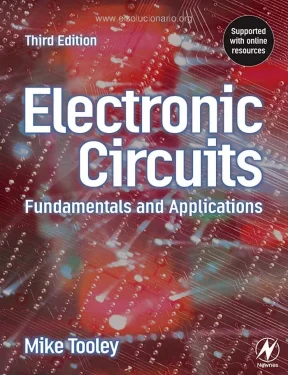
Nguyên lý và Ứng dụng Mạch điện tử - Michael Tooley, Ấn bản thứ ba

Chuyên ngành

Điện tử

Người đăng

Ẩn danh

Thể loại

Sách giáo khoa

2006

442
0
0

Phí lưu trữ

75 Point

Tóm tắt

I. Tổng quan về sách Electronic Circuits Fundamentals and Applications Mike Tooley 3rd Edition

Electronic Circuits: Fundamentals and Applications là giáo trình kinh điển về mạch điện tử do Mike Tooley biên soạn, được xuất bản bởi Newnes thuộc Elsevier. Ấn bản thứ ba ra mắt năm 2006, đánh dấu sự cập nhật toàn diện so với các phiên bản trước. Cuốn sách trình bày kiến thức nền tảng về mạch điện tử một cách có hệ thống, từ các nguyên lý điện cơ bản đến các ứng dụng thực tiễn. Nội dung bao gồm 19 chương chính và nhiều phụ lục hỗ trợ học tập. Các chủ đề trải dài từ thành phần thụ động, mạch một chiều, điện áp và dòng điện xoay chiều, linh bán dẫn cho đến nguồn điện, bộ khuếch đại, mạch dao động và vi xử lý. Cuốn sách được thiết kế cho sinh viên cao đẳng và đại học, cũng như kỹ thuật viên muốn củng cố kiến thức nền tảng. Mike Tooley, nguyên Phó Hiệu trưởng Brooklands College, mang đến kinh nghiệm giảng dạy sâu sắc giúp nội dung dễ tiếp cận.

1.1. Cấu trúc nội dung và phạm vi kiến thức

Cuốn sách Electronic Circuits Mike Tooley 3rd Edition được tổ chức thành 19 chương học logic. Phần đầu tiên tập trung vào nguyên lý điện cơ bản, bao gồm mạch từ và đặc tính từ hóa. Tiếp theo là các chương về thành phần thụ động như điện trở, tụ điện và cuộn cảm. Phần giữa sách đi sâu vào mạch điện một chiều, điện xoay chiều và linh bán dẫn. Các chương nâng cao bao gồm bộ khuếch đại thuật toán, mạch logic số, vi xử lý PIC và mô phỏng mạch. Phụ lục cung cấp bài tập, đáp án, datasheet linh kiện và công thức toán học cần thiết cho điện tử.

1.2. Đối tượng và phương pháp tiếp cận

Sách hướng đến sinh viên chương trình cao đẳng, đại học và kỹ thuật viên điện tử. Phương pháp tiếp cận kết hợp lý thuyết và thực hành. Mỗi chương đều có bài tập đánh giá được thiết kế theo chuẩn quốc gia. Cuốn sách nhấn mạnh tính ứng dụng thực tế, giúp người học liên kết kiến thức với công việc hàng ngày. Phụ lục Student Assignments và Revision Problems cung cấp tài liệu ôn tập toàn diện. Phương pháp giảng dạy của Tooley dựa trên nguyên tắc xây dựng kiến thức từng bước, từ đơn giản đến phức tạp, phù hợp cho người mới bắt đầu học mạch điện tử.

II. Phân tích nội dung cốt lõi trong Electronic Circuits Mike Tooley

Nội dung cốt lõi của cuốn sách tập trung vào nhiều khái niệm then chốt trong mạch điện tử. Chương về nguyên lý điện giới thiệu mạch từ, độ từ thẩm và hiện tượng bão hòa từ. Phần thành phần thụ động phân tích chi tiết đặc tính điện trở, tụ điện và cuộn cảm trong mạch thực tế. Điện trở trong tụ điện và điện trở tổn hao trong cuộn cảm được giải thích rõ ràng. Cuốn sách cũng đề cập đến tụ điện biến đổi sử dụng trong dò sóng radio. Phần mạch điện một chiều và xoay chiều cung cấp nền tảng vững chắc cho việc hiểu hành vi dòng điện. Các chương về bán dẫn giải thích nguyên lý hoạt động của diode, transistor và các thiết bị bán dẫn khác. Phần nguồn điện trình bày cách chuyển đổi và điều chỉnh điện áp. Bộ khuếch đại và khuếch đại thuật toán được phân tích kỹ lưỡng với các ứng dụng thực tiễn.

2.1. Nguyên lý điện và mạch từ cơ bản

Chương Electrical Fundamentals trong sách trình bày mối tương quan giữa mạch điện và mạch từ. Sức điện động được so sánh với sức từ động. Điện trở tương ứng với độ từ trở trong mạch từ. Dòng điện tương đương với từ thông. Công thức độ từ trở S bằng l chia cho tích µA, trong đó l là độ dài đường từ, A là tiết diện và µ là độ từ thẩm tuyệt đối. Hiện tượng mép từ xảy ra tại khe hở không khí trong mạch từ. Đường cong B-H minh họa hiện tượng bão hòa từ, ảnh hưởng trực tiếp đến phạm vi làm việc của vật liệu từ trong mạch thực tế.

2.2. Thành phần thụ động và đặc tính thực tế

Thành phần thụ động bao gồm điện trở, tụ điện và cuộn cảm là nền tảng của mọi mạch điện tử. Cuộn cảm thực tế chứa cả độ tự cảm L và điện trở tổn hao R. Sách trình bày cấu trúc cuộn cảm dạng xuyến trên lõi ferit có độ từ thẩm cao. Tụ điện biến đổi cho phép thay đổi giá trị bằng cách di chuyển các bản cực, sử dụng chất điện môi không khí hoặc nhựa. Giá trị thông thường từ 25 pF đến 500 pF, thường dùng trong mạch tần số chọn lọc. Khi mắc nối tiếp, điện áp chia đều giữa các tụ có giá trị bằng nhau. Điện trở cao mắc song song giúp đảm bảo chia điện áp đều.

III. Phương pháp học tập và ứng dụng từ sách Electronic Circuits

Phương pháp học tập hiệu quả với cuốn sách này đòi hỏi sự kết hợp giữa lý thuyết và thực hành. Mỗi chương trong sách đều đi kèm bài tập đánh giá được thiết kế theo chuẩn quốc gia. Người học nên bắt đầu từ các nguyên lý điện cơ bản trước khi tiến đến các mạch phức tạp hơn. Phần Fault Finding trong chương 15 cung cấp kỹ năng sửa lỗi mạch thực tế vô cùng giá trị. Chương Sensors and Interfacing giúp hiểu cách kết nối cảm biến với mạch xử lý. Phần Circuit Simulation giới thiệu công cụ mô phỏng mạch hiện đại. Chương về vi điều khiển PIC cung cấp kiến thức lập trình nhúng cơ bản. Circuit Construction hướng dẫn cách xây dựng mạch trên breadboard và PCB. Việc thực hành thường xuyên với các mạch ví dụ trong sách giúp củng cố kiến thức lý thuyết một cách vững chắc.

3.1. Kỹ thuật sửa lỗi mạch và đo lường

Chương 14 về thiết bị thử nghiệm và đo lường cung cấp kiến thức sử dụng đồng hồ vạn năng, máy hiện sóng và các dụng cụ đo chuyên dụng. Chương 15 về sửa lỗi mạch hướng dẫn phương pháp tiếp cận có hệ thống để xác định và khắc phục lỗi. Kỹ thuật viên học cách chia mạch thành các khối nhỏ để kiểm tra từng phần. Việc hiểu rõ đặc tính của từng linh kiện giúp dự đoán lỗi chính xác hơn. Đo lường chính xác là yếu tố then chốt trong mọi quy trình sửa chữa mạch điện tử. Kỹ năng này đặc biệt quan trọng trong môi trường công nghiệp và sản xuất.

3.2. Mô phỏng mạch và xây dựng prototype

Chương 17 về mô phỏng mạch giới thiệu phần mềm Spice và các công cụ mô phỏng hiện đại. Mô phỏng cho phép kiểm tra thiết kế trước khi hàn linh kiện thực tế, tiết kiệm thời gian và chi phí. Chương 18 về vi điều khiển PIC cung cấp hướng dẫn lập trình và giao tiếp phần cứng. Chương 19 hướng dẫn kỹ thuật xây dựng mạch từ breadboard đến PCB hoàn chỉnh. Người học được khuyến khích kết hợp mô phỏng máy tính với thực hành trên mạch thật. Phụ lục Pin Connections cung cấp thông tin kết nối chi tiết cho các linh kiện phổ biến. Datasheet của 1N4148 và 2N3904 được trình bày đầy đủ trong phụ lục để tham khảo nhanh.

IV. Kết luận và giá trị thực tiễn của Electronic Circuits Mike Tooley

Electronic Circuits: Fundamentals and Applications ấn bản thứ ba của Mike Tooley là tài liệu tham khảo không thể thiếu cho bất kỳ ai theo đuổi lĩnh vực điện tử. Cuốn sách cung cấp nền tảng kiến thức toàn diện từ cơ bản đến nâng cao. Giá trị thực tiễn nằm ở cách trình bày kết hợp lý thuyết với ứng dụng thực tế. Các chương về bộ nguồn, bộ khuếch đại, dao động và mạch logic đều có ví dụ minh họa cụ thể. Phụ lục về toán học cho điện tử giúp người học bổ sung kiến thức toán cần thiết. Các trang web hữu ích được liệt kê trong phụ lục hỗ trợ nghiên cứu thêm. Cuốn sách đã được dịch và sử dụng rộng rãi trong các trường kỹ thuật trên toàn thế giới. Nội dung cập nhật phù hợp với tiêu chuẩn công nghiệp hiện đại. Đây là nguồn tài liệu đáng tin cậy cho cả sinh viên và kỹ thuật viên chuyên nghiệp.

4.1. Ứng dụng trong đào tạo và công nghiệp

Cuốn sách được sử dụng rộng rãi trong chương trình đào tạo kỹ thuật viên điện tử tại các trường cao đẳng và đại học. Nội dung bám sát tiêu chuẩn đánh giá quốc gia, phù hợp với hệ thống giáo dục nghề nghiệp. Trong môi trường công nghiệp, sách phục vụ như tài liệu tham khảo nhanh cho kỹ thuật viên bảo trì và thiết kế. Các chương về cảm biến và giao tiếp đặc biệt hữu ích trong lĩnh vực tự động hóa. Kiến thức về vi điều khiển PIC áp dụng trực tiếp vào thiết kế hệ thống nhúng. Phụ lục cung cấp tất cả thông tin kỹ thuật cần thiết cho việc lựa chọn và sử dụng linh kiện.

4.2. So sánh với các tài liệu học thuật khác

So với nhiều giáo trình điện tử khác, cuốn sách của Mike Tooley nổi bật nhờ tính thực tiễn cao. Cách viết rõ ràng, dễ hiểu giúp người học tiếp cận nhanh chóng. Nội dung bao quát hơn so với các sách chỉ tập trung lý thuyết thuần túy. Phần bài tập đánh giá theo chuẩn quốc gia là điểm khác biệt quan trọng. Phụ lục datasheet chi tiết cho linh kiện phổ biến giúp người học làm quen với tài liệu kỹ thuật thực tế. Tuy nhiên, với sự phát triển nhanh của công nghệ, người đọc cần bổ sung kiến thức về các công nghệ mới như IoT và FPGA từ các nguồn cập nhật hơn.
21/04/2026

Trích đoạn nội dung tài liệu

org Electronic Circuits: Fundamentals and Applications This page intentionally left blank www.org Electronic Circuits: Fundamentals and Applications Third Edition Michael Tooley BA Formerly Vice Principal Brooklands College of Further and Higher Education Newnes is an imprint of Elsevier Linacre House, Jordan Hill, Oxford OX2 8DP, UK 30 Corporate Drive, Suite 400, Burlington MA 01803, USA First published 2006 Copyright © 2006, Mike Tooley. Published by Elsevier Ltd. All rights reserved The right of Mike Tooley to be identified as the author of this work has been asserted in accordance with the Copyright, Designs and Patents Act 1988 No part of this publication may be reproduced, stored in a retrieval system or transmitted in any form or by any means electronic, mechanical, photocopying, recording or otherwise without the prior written permission of the publisher Permission may be sought directly from Elsevier’s Science & Technology Rights Department in Oxford, UK: phone (+44) (0) 1865 843830; fax (+44) (0) 1865 853333; email: permissions@elsevier. Alternatively you can submit your request online by visiting the Elsevier web site at http://elsevier.com/locate/permissions, and selecting Obtaining permission to use Elsevier material Notice No responsibility is assumed by the publisher for any injury and/or damage to persons or property as a matter of products liability, negligence or otherwise, or from any use or operation of any methods, products, instructions or ideas contained in the material herein. Because of rapid advances in the medical sciences, in particular, independent verification of diagnoses and drug dosages should be made British Library Cataloguing in Publication Data A catalogue record for this book is available from the British Library Library of Congress Cataloging-in-Publication Data A catalog record for this book is available from the Library of Congress ISBN-13: 978-0-75-066923-8 ISBN-10: 0-75-066923-3 For information on all Newnes publications visit our website at www.com Typeset by the author Printed and bound in Great Britain Contents Preface vii 15 Fault finding 273 A word about safety ix 16 Sensors and interfacing 287 1 Electrical fundamentals 1 17 Circuit simulation 303 2 Passive components 21 18 The PIC microcontroller 313 3 D. circuits 49 19 Circuit construction 327 4 Alternating voltage and current 69 Appendix 1 Student assignments 361 5 Semiconductors 87 Appendix 2 Revision problems 364 6 Power supplies 115 Appendix 3 Answers to problems 374 7 Amplifiers 131 Appendix 4 Pin connections 377 8 Operational amplifiers 157 Appendix 5 1N4148 data sheet 379 9 Oscillators 171 Appendix 6 2N3904 data sheet 382 10 Logic circuits 183 Appendix 7 Decibels 388 11 Microprocessers 199 Appendix 8 Mathematics for electronics 390 12 The 555 timer 217 Appendix 9 Useful web addresses 415 13 Radio 227 Index 417 14 Test equipment and measurements 245 www.org This page intentionally left blank Preface This is the book that I wish I had when I first also to give you some experience of the ‘short started exploring electronics nearly half a century answer’ questions used in most in-course ago. In those days, transistors were only just assessments. For good measure, we have included making their debut and integrated circuits were 70 revision problems in Appendix 2. At the end of completely unknown. Of course, since then much the book you will find 21 sample coursework has changed but, despite all of the changes, the assignments. These should give you plenty of ‘food world of electronics remains a fascinating one. for thought’ as well as offering you some scope for And, unlike most other advanced technological further experimentation. It is not envisaged that you disciplines, electronics is still something that you should complete all of these assignments and a can ‘do’ at home with limited resources and with a carefully chosen selection will normally suffice. If minimal outlay. A soldering iron, a multi-meter, you are following a formal course, your teacher or and a handful of components are all that you need lecturer will explain how these should be tackled to get started. Except, of course, for some ideas to and how they can contribute to your course get you started—and that’s exactly where this book assessment. While the book assumes no previous comes in! knowledge of electronics you need to be able to The book has been designed to help you manipulate basic formulae and understand some understand how electronic circuits work. It will simple trigonometry in order to follow the provide you with the basic underpinning numerical examples. A study of mathematics to knowledge necessary to appreciate the operation of GCSE level (or equivalent) will normally be a wide range of electronic circuits including adequate to satisfy this requirement. However, for amplifiers, logic circuits, power supplies and those who may need a refresher or have had oscillators. previous problems with mathematics, Appendix 6 The book is ideal for people who are studying will provide you with the underpinning electronics for the first time at any level including a mathematical knowledge required. wide range of school and college courses. It is In the later chapters of the book, a number of equally well suited to those who may be returning representative circuits (with component values) to study or who may be studying independently as have been included together with sufficient well as those who may need a quick refresher. The information to allow you to adapt and modify the book has 19 chapters, each dealing with a particular circuits for your own use. These circuits can be topic, and eight appendices containing useful used to form the basis of your own practical information. The approach is topic-based rather investigations or they can be combined together in than syllabus-based and each major topic looks at a more complex circuits. particular application of electronics. The relevant Finally, you can learn a great deal from building, theory is introduced on a progressive basis and testing and modifying simple circuits. To do this delivered in manageable chunks. you will need access to a few basic tools and some In order to give you an appreciation of the minimal test equipment. Your first purchase should solution of simple numerical problems related to be a simple multi-range meter, either digital or the operation of basic circuits, worked examples analogue. This instrument will allow you to have been liberally included within the text. In measure the voltages and currents present so that addition, a number of problems can be found at the you can compare them with the predicted values. If end of each chapter and solutions are provided at you are attending a formal course of instruction and the end of the book. You can use these end-of- have access to an electronics laboratory, do make chapter problems to check your understanding and full use of it! viii PREFACE 24 weeks) to deliver in which the total of 90 hours A note for teachers and lecturers of study time should be divided equally into theory (supported by problem solving) and practical The book is ideal for students following formal (laboratory and assignment work). GCSE, AS, A-level, BTEC, City and recommended four or five assignments will require Guilds, etc.) in schools, sixth-form colleges, and about 25 to 30 hours of student work to complete. further/higher education colleges. It is equally well Finally, when constructing a teaching programme it suited for use as a text that can support distance or is, of course, essential to check that you fully flexible learning and for those who may need a comply with the requirements of the awarding body ‘refresher’ before studying electronics at a higher concerning assessment and that the syllabus level. coverage is adequate. While the book assumes little previous knowledge students need to be able to manipulate basic formulae and understand some simple Mike Tooley trigonometry to follow the numerical examples. A January 2006 study of mathematics to GCSE level (or beyond) will normally be adequate to satisfy this requirement. However, an appendix has been added specifically to support students who may have difficulty with mathematics. Students will require a scientific calculator in order to tackle the end-of- chapter problems as well as the revision problems that appear at the end of the book. We have also included 21 sample coursework assignments. These are open-ended and can be modified or extended to suit the requirements of the particular awarding body. The assignments have been divided into those that are broadly at Level 2 and those that are at Level 3. In order to give reasonable coverage of the subject, students should normally be expected to complete between four and five of these assignments. Teachers can differentiate students’ work by mixing assignments from the two levels. In order to challenge students, minimal information should be given to students at the start of each assignment. The aim should be that of giving students ‘food for thought’ and encouraging them to develop their own solutions and interpretation of the topic. Where this text is to be used to support formal teaching it is suggested that the chapters should be followed broadly in the order that they appear with the notable exception of Chapter 14. Topics from this chapter should be introduced at an early stage in order to support formal lab work. Assuming a notional delivery time of 4.5 hours per week, the material contained in this book (together with supporting laboratory exercises and assignments) will require approximately two academic terms (i.org A word about safety When working on electronic circuits, personal The severity of electric shock depends upon several safety (both yours and of those around you) should factors including the magnitude of the current, be paramount in everything that you do. Hazards whether it is alternating or direct current, and its can exist within many circuits—even those that, on precise path through the body. The magnitude of the face of it, may appear to be totally safe. the current depends upon the voltage which is Inadvertent misconnection of a supply, incorrect applied and the resistance of the body. The earthing, reverse connection of a high-value electrical energy developed in the body will depend electrolytic capacitor, and incorrect component upon the time for which the current flows. The substitution can all result in serious hazards to duration of contact is also crucial in determining personal safety as a consequence of fire, explosion the eventual physiological effects of the shock. As or the generation of toxic fumes. a rough guide, and assuming that the voltage Potential hazards can be easily recognized and it applied is from the 250 V 50 Hz a. mains supply, is well worth making yourself familiar with them the following effects are typical: but perhaps the most important point to make is that electricity acts very quickly and you should always think carefully before working on circuits Current Physiological effect where mains or high voltages (i. those over 50 V, or so) are present. Failure to observe this simple less than 1 mA Not usually noticeable precaution can result in the very real risk of electric 1 mA to 2 mA Threshold of perception shock. (a slight tingle may be felt) Voltages in many items of electronic equipment, including all items which derive their power from 2 mA to 4 mA Mild shock (effects of current the a. mains supply, are at a level which can cause flow are felt) sufficient current flow in the body to disrupt 4 mA to 10 mA Serious shock (shock is felt normal operation of the heart. The threshold will be as pain) even lower for anyone with a defective heart. Bodily contact with mains or high-voltage circuits 10 mA to 20 mA Motor nerve paralysis may can thus be lethal. The most critical path for occur (unable to let go) electric current within the body (i. the one that is 20 mA to 50 mA Respiratory control inhibited most likely to stop the heart) is that which exists (breathing may stop) from one hand to the other. The hand-to-foot path is also dangerous but somewhat less dangerous than more than 50 mA Ventricular fibrillation of the hand-to-hand path.

Nội dung được bảo vệ bản quyền — Tải xuống đầy đủ