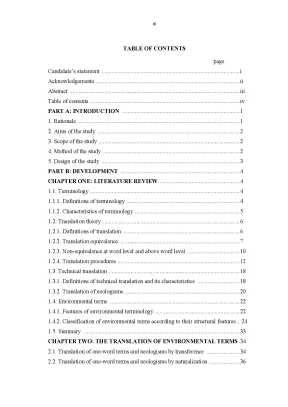
iv TABLE OF CONTENTS page Candidate’s statement. iii Table of contents. iv PART A: INTRODUCTION. Aims of the study.
Scope of the study. Method of the study. Design of the study. 4 CHAPTER ONE: LITERATURE REVIEW.
Definitions of terminology. Characteristics of terminology. Definitions of translation. Non-equivalence at word level and above word level.
Definitions of technical translation and its characteristics. Translation of neologisms. Features of environmental terminology. Classification of environmental terms according to their structural features.
33 CHAPTER TWO: THE TRANSLATION OF ENVIRONMENTAL TERMS 34 2. Translation of one-word terms and neologisms by transference. Translation of one-word terms and neologisms by naturalization. 36 TIEU LUAN MOI download : skknchat@gmail.
Translation of above-word-level terms by transposition. Translation by omission. Translation by paraphrase. The appropriate strategies and procedures in translating English environmental terms.
Problems in the translation of environmental terms. Suggestions for the translation strategies and procedures. Implications for the translation of environmental terms. Suggestions for further studies.
62 Appendixes TIEU LUAN MOI download : skknchat@gmail.com 1 PART A: INTRODUCTION 1. Rationale The environment has become a burning issue on a world scale as well as in each country, especially after a series of recent serious disasters such as tsunami, earthquake, volcanic eruption, storm and flood. Accordingly, environmental science has developed, a number of people have taken courses on this field, a variety of research and international, regional as well as national conferences have been carried out. Several matters arise from the translation of environment terms in such kinds of courses and meetings.
First, when teaching English for environmental science, the teacher may be confused about whether he should explain one English environmental term in other words or he should translate it into Vietnamese so that students are able to understand it completely. Experience shows that explaining a new technical term in a longer group of words, the teacher unavoidably utilizes words which are new or more complicated to his students. Meanwhile, translating that term is more time-saving and more comprehensible. However, translation is not always pleasant and easy to the teacher due to inadequate knowledge of environmental science.
This could lead to different ways of translation of the same term by different teachers. In addition, there are some English - Vietnamese dictionaries of environmental science now, however, for one English term, a dictionary may offer various Vietnamese meanings and it might not be able to provide all meanings of environmental terms. Therefore, it causes difficulties in translating as well as in selecting appropriate meanings. Furthermore, translators or interpreters also face challenges of translating environmental terms because they do not have enough knowledge of environment and Vietnamese language has not had precise equivalences for certain English words.
It is time the translators and interpreters needed to study the theory of translation so that they can find suitable strategies to translate environmental terms. Given the hindrances behind the translation of environmental terms, the research question is raised: “What are the common strategies and procedures for the translation of English environmental terms into Vietnamese?”. TIEU LUAN MOI download : skknchat@gmail. Aims of the study The study is aimed at: • Investigating characteristics of English environmental terms and their compositions in the light of functional grammar proposed by Halliday.
• Identifying the procedures and strategies commonly used by teachers in the lessons on English for Environmental Science and translators for rendering environmental terms. It is expected that the research partly contributes to English for Specific Purposes in general and English for Environmental Science in particular in terms of the translating, teaching and learning as well. Scope of the study Since the research serves the need of the teaching of English for Environmental Science and rendering English enviromental terms, it mainly focuses on environmental terms derived from materials currently used in well-known universities of science and technology which offer environmental English as a subject. However, the study cannot cover all terms which appear in these sources, only typical terms with high frequency of occurrence are chosen.
Because of the characteristics of texts and the language in the materials of environmental field, most of the terms are one word and above-word-level terms. It is the author‟s purpose to conduct a study on the translation of environmental terms at word-level and above-word-level terms based on the grammatical and semantic features of the terms investigated. Method of the study This is a descriptive research as this kind of research is aimed at answering “what?” questions, but not “why?” questions. As Wisker (2001: 118) points out, the purpose of descriptive study is to “find out more about a phenomenon and to capture it with detailed information”.
Often the capturing and description is only true for that moment in time, hence, ideally, the description should be repeated several times so that stability or change could be noted. However, in the framework of a thesis, the study proposes to focus on the present condition of English environmental terms and their common translation strategies TIEU LUAN MOI download : skknchat@gmail.com 3 and procedures into Vietnamese, which still helps us to understand and know more about the phenomenon under investigation. Descriptive data is collected by observing and noting only aspects which are of interest for the research because descriptive research, as stated by Seliger and Shohamy (2000: 127) begins with a premise about what to look for in the observation, that is to say the research question. In a more detailed way, English environmental terms belonging to two categories: one-word and above-word-level terms are collected from the study corpus.
Afterwards, the translation of these two groups and their subgoups are analyzed to identify appropriate transalation procedures and strategies. The steps of the study on the translation of environmental terminology are as follows. Step 1: Reviewing environment materials from different reliable sources Step 2: Collecting English environmental terms from these materials Step 3: Classifying collected terms into two groups: one-word terms and above-word-level terms. Step 4: Analyzing the translation of typical examples of the above-mentioned groups in order to find out the significant strategies and procedures for the translation of environmental terms.
Step 5: Suggesting some implications for the translation of environmental terms. Design of the study The thesis consists of three main parts: Introduction, Development and Conclusion. The first part, Introduction outlines rationale, scope, aims, method and design of the research. The second part entitled Development is divided into two chapters.
Chapter One refers to theories which serve as the foundation for this study and presents the typical features of environmental terms and their structural patterns. Chapter Two, The translation of environmental terms offers common procedures and strategies for the translation of the terms. Finally, Conclusion summarizes all the research findings. Ultimately, references, data sources and appendixes are indispensable parts of the study.
TIEU LUAN MOI download : skknchat@gmail.com 4 PART B: DEVELOPMENT CHAPTER ONE LITERATURE REVIEW 1. Definitions of terminology Terminology is a fascinating subject to researchers in the world as well as in Vietnam. A large number of definitions of terminology have been proposed. In the words of Valeontis and Mantzari (2006: 1), “terminology has a twofold meaning: (1) it is the discipline concerned with the principles and methods governing the study of concepts and their designations (terms, names, symbols) in any subject field, and the job of collecting, processing, and mangaging relevant data and (2) the set of terms belonging to the special language of an individual subject field”.
In practice, it is more familiar with the second meaning of the term terminology, which is further clarified by Russian authors in “Russian Encyclopedia” (1976), “terminology is words or combinations of words that denote the concept precisely and its relationship with other concepts in a specific area. Terminology is a specialized and restricted expression on things, phenomena, characteristics and the relationships in specific profession” (quoted in Nguyen Thi Mai, 2003: 16). This definition shares some common features in content with the definition given by Nguyen Van Tu (1960: 176): “terminology is words or combinations of words that are used in science, technology, politics, art, etc. And it has a specific meaning, precisely denotes concepts and names of the above-mentioned scientific areas”.
Similarly, Nguyen Thien Giap (1981: 308-309) claims that terminology, which is understood as a special linguistic unit of a language, consists of words and phrases which are accurate names of concepts and subjects belonging to different specialized fields of human beings. Through the above-mentioned definitions, it is clear that terminology is a special lexicon of a language. The particularity is that terminology is words and phrases which accurately denote concepts of a specialized field. TIEU LUAN MOI download : skknchat@gmail.
Characteristics of terminology Many linguists including Do Huu Chau (1981), Nguyen Thien Giap (1981) and Luu Van Lang (1998) share the idea that terminology possesses three important characteristics, namely accurateness, systematism and internationalism. Accurateness A term needs to be accurate and clear because basically it reflects an exact concept of a science. If a term is of absolute accuracy, people never mistake one concept for another. For example, precipitation cannot be translated as mưa as in a dictionary for general language.
Precipitation means water in rain, snow, etc. that falls, therefore it should be giáng thủy. Once a word has become a term, it no longer has connotational and emotional meanings; it also loses its polysemousness and antonymousness. In short, terminology necessarily works on the principle that “one concept has only one term for it and one term indicates only one concept”.
Systematism Any field of science has its own limited system of concepts, which is named by a system of terms. Therefore, each term has its own position in the system of concepts and belongs to a terminological system. The value of each term is determined by its relationships with other terms in the same system. As a result, a term loses its value when isolated from its system.
For instance, if warming is not put in the environmental terminology, it is normally understoood as làm ấm, but not ấm lên toàn cầu as it is in the field of environment. In short, a term has to be a dependent member of its system. Internationalism Terms are used internationally because they are special words expressing common scientific concepts to people of different languages. Therefore, it is useful to agree on terms to be used among languages in order to push up the development of science.
The international links in sciences result in a number of terms which are present in many different languages. For example, gradient, arsenic, gel, front, etc. are found in English and Vietnamese with little difference in form. TIEU LUAN MOI download : skknchat@gmail.com 6 In a word, these are the important characteristics of terminology in their common use.
Based on the criteria of terminology, each language may require other principles in accordance with its culture. Accordingly, terminology in Vietnamese also has its typical features including nationalism and popularity. Nationalism Although terms are special words used in specialized fields, they are undoubtely part of the national language. They, therefore, possess the colours and the characteristics of the national language.
Put differently, they should be made from the the materials of the national language in terms of lexicology and grammatical composition. Popularity Terminology needs to be popular or close to the language of the masses. Science is to serve the masses, to make the masses involved in scientific fields and at the same time, to bring the knowledge and benefit to them. The language, especially terminology, used in scientific materials should not be complicated or comprehensible to a limited group of upper or intellectual class.
In fact, terminology ought to be popular, i. easy to understand, easy to remember and easy to use. In a nutshell, terminology needs to possess five characteristics: accurateness, systematism, internationalism, nationalism and popularity. These characteristics are key elements or principles in the creation and standardization of terminology.