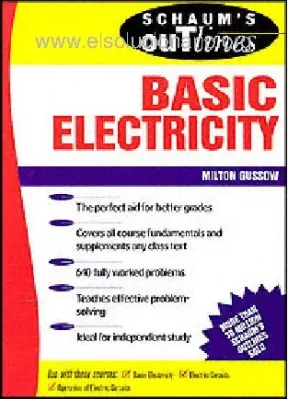
Sổ tay Lý thuyết và Bài tập Điện Cơ Bản của Milton Gussow, Đại học Johns Hopkins

Chuyên ngành

Kỹ thuật điện

Người đăng

Ẩn danh

Thể loại

Sách tham khảo

1983

465
0
0

Phí lưu trữ

75 Point

Tóm tắt

I. Tổng quan về Basic Electricity Milton Gussow

Basic Electricity của Milton Gussow là giáo trình nền tảng thuộc bộ Schaum's Outline, được xuất bản bởi McGraw-Hill vào năm 1983. Tác giả giữ vị trí kỹ sư cấp cao tại Phòng thí nghiệm Vật lý Ứng dụng thuộc Đại học Johns Hopkins. Ông có bằng cử nhân từ Học viện Hải quân Hoa Kỳ và bằng thạc sĩ từ Viện Công nghệ Massachusetts. Cuốn sách được thiết kế cho người mới bắt đầu tại các trường trung học, viện kỹ thuật và cao đẳng. Nội dung bắt đầu từ vật lý dòng điện cơ bản. Sau đó phân tích cả mạch điện một chiều và xoay chiều. Sách đề cập đến máy phát, động cơ, biến áp và thiết bị đo điện. Mỗi chương trình bày lý thuyết kèm theo nhiều bài tập có lời giải chi tiết. Phương pháp trình bày từng bước giúp người đọc hiểu rõ quy trình giải quyết vấn đề. Cuốn sách sử dụng Hệ đo lường quốc tế SI xuyên suốt toàn bộ nội dung. Điều này đảm bảo tính nhất quán với tiêu chuẩn kỹ thuật hiện đại. Kiến thức đại số và lượng giác cơ bản là điều kiện tiên quyết để theo dõi nội dung.

1.1. Đôi nét về tác giả Milton Gussow

Milton Gussow là kỹ sư cấp cao tại Phòng thí nghiệm Vật lý Ứng dụng thuộc Đại học Johns Hopkins. Ông tốt nghiệp Học viện Hải quân Hoa Kỳ, Trường Sau đại học Hải quân và Viện Công nghệ Massachusetts. Ông là Giáo sư thỉnh giảng tại Đại học American và Đại học George Washington. Tại đây, ông giảng dạy các môn toán học và kỹ thuật điện. Gussow từng giữ chức Phó Chủ tịch cấp cao phụ trách Giáo dục tại Trung tâm Giáo dục Thường xuyên McGraw-Hill. Ông là tác giả của hơn năm mươi bài báo kỹ thuật chuyên ngành. Kinh nghiệm giảng dạy và nghiên cứu phong phú giúp ông viết nên cuốn sách có giá trị thực tiễn cao.

1.2. Mục đích và đối tượng sử dụng sách

Cuốn sách được thiết kế như giáo trình cơ bản về nền tảng điện học và mạch điện. Đối tượng chính là sinh viên mới bắt đầu tại trường trung học, viện kỹ thuật và cao đẳng. Những người chưa có kinh nghiệm về điện vẫn có thể tiếp cận nội dung dễ dàng. Giải thích và lời giải từng bước được trình bày chi tiết để sách có thể sử dụng độc lập. Cuốn sách cũng phù hợp cho việc tự học tại nhà hoặc làm tài liệu tham khảo chuyên ngành. Kiến thức đại số và lượng giác cơ bản là yêu cầu duy nhất để bắt đầu học cuốn sách này.

II. Phân tích nội dung chính trong Basic Electricity

Basic Electricity của Milton Gussow phân tích nhiều chủ đề cốt lõi trong lĩnh vực điện học. Chương đầu tiên giới thiệu bản chất của điện thông qua cấu trúc nguyên tử. Khái niệm điện áp, dòng điện và điện trở được giải thích rõ ràng. Chương tiếp theo đề cập đến các chuẩn điện và quy ước. Hệ đơn vị SI bao gồm bảy đơn vị cơ bản: chiều dài, khối lượng, thời gian, dòng điện, nhiệt độ, cường độ sáng và lượng chất. Điện trở là một chủ đề quan trọng được phân tích kỹ lưỡng. Sách phân loại điện trở thành hai loại chính: điện trở cố định carbon và điện trở quấn dây. Điện trở carbon thường có dung sai phần trăm xác định. Điện trở quấn dây sử dụng dây niken-chrom trên lõi sứ. Các mạch điện một chiều và xoay chiều cũng được phân tích chi tiết. Người học cách áp dụng định luật Ohm và Kirchhoff vào bài toán thực tế. Hệ thống đánh số phương trình phong phú hỗ trợ tra cứu hiệu quả.

2.1. Bản chất của điện và cấu trúc nguyên tử

Chương đầu tiên khám phá bản chất vật lý của điện trong Basic Electricity. Nguyên tử silicon được sử dụng làm ví dụ minh họa điển hình. Khi nguyên tử silicon mất tất cả electron ở lớp vỏ ngoài cùng, nó trở thành ion âm với điện tích ròng âm bốn. Điện tích được đo bằng đơn vị culông. Một vật cách điện tích có thể chứa số lượng lớn electron dư thừa. Dòng điện hình thành khi các electron di chuyển qua một điểm xác định trong khoảng thời gian nhất định. Công thức tính dòng điện dựa trên tỷ lệ giữa điện tích và thời gian.

2.2. Phân loại điện trở và thông số kỹ thuật

Sách phân loại điện trở thành hai loại chính: cố định và có thể điều chỉnh. Điện trở cố định carbon sử dụng graphite hoặc các dạng carbon rắn làm phần tử điện trở. Giá trị điện trở dao động từ vài ohm đến hàng triệu ohm. Điện trở quấn dây sử dụng dây niken-chrom trên lõi sứ, phủ men hoặc gốm bảo vệ. Giá trị từ 1 ohm đến 100 kilo-ohm. Dung sai là giới hạn sai lệch giữa giá trị thực và giá trị danh nghĩa. Điện trở carbon có dung sai phổ biến là năm, mười hoặc hai mươi phần trăm. Điện trở quấn dây thường có dung sai năm phần trăm.

III. Phương pháp học tập hiệu quả với Basic Electricity

Phương pháp giảng dạy trong Basic Electricity dựa trên nguyên tắc học đi đôi với hành. Mỗi khái niệm lý thuyết đều đi kèm với ví dụ minh họa cụ thể và dễ hiểu. Lời giải được trình bày chi tiết từng bước một. Cách tiếp cận này cho phép cuốn sách hoạt động độc lập mà không cần thêm tài liệu tham khảo khác. Hệ thống đánh số phương trình được sử dụng rộng rãi trong sách. Điều này tạo thuận lợi cho việc tra cứu và tham chiếu chéo giữa các phần nội dung. Các sơ đồ mạch điện minh họa rõ ràng cách các thành phần kết nối với nhau. Người học có thể tự kiểm tra kiến thức thông qua bài tập ở cuối mỗi chương. Các vấn đề được trình bày theo mức độ khó tăng dần. Điện áp và dòng điện sử dụng trong bài tập phản ánh giá trị thực tế trong hệ thống điện hiện đại. Sách cũng cung cấp bảng tra cứu và công thức tóm tắt ở phần phụ lục.

3.1. Hệ thống đánh số phương trình và tham chiếu

Một đặc điểm nổi bật của cuốn sách là hệ thống đánh số phương trình phong phú. Mỗi phương trình được đánh số thứ tự rõ ràng để dễ dàng tra cứu. Người học có thể tham chiếu chéo giữa các phần khác nhau trong cùng cuốn sách. Cách tổ chức này giúp tiết kiệm thời gian khi giải quyết bài tập phức tạp. Các công thức quan trọng được tập hợp trong bảng tóm tắt tiện lợi. Hệ thống này cũng phản ánh phong cách viết kỹ thuật chuyên nghiệp. Người đọc dần quen với cách trình bày chuẩn mực trong tài liệu kỹ thuật. Đây là kỹ năng quan trọng cho công việc kỹ thuật sau này.

3.2. Bài tập thực hành và lời giải chi tiết

Cuốn sách cung cấp số lượng lớn bài tập thực hành đa dạng về nội dung. Các vấn đề được thiết kế dựa trên điện áp và dòng điện phổ biến trong thực tế đời sống. Lời giải trình bày từng bước rõ ràng, không bỏ sót bất kỳ quy trình nào. Phương pháp này giúp người học hiểu rõ logic đằng sau mỗi phép tính. Bài tập bắt đầu từ mức độ đơn giản và tăng dần độ phức tạp. Người đọc có thể tự kiểm tra đáp án được cung cấp ở cuối sách. Cách tiếp cận này xây dựng sự tự tin và kỹ năng giải quyết vấn đề độc lập. Thực hành thường xuyên là chìa khóa để nắm vững kiến thức điện cơ bản.

IV. Ứng dụng thực tế của kiến thức Basic Electricity

Kiến thức từ Basic Electricity có ứng dụng rộng rãi trong nhiều lĩnh vực kỹ thuật khác nhau. Nền tảng về mạch điện một chiều phục vụ cho thiết kế hệ thống điện tử cơ bản và thiết bị cầm tay. Kiến thức mạch xoay chiều áp dụng trong hệ thống điện dân dụng và công nghiệp quy mô lớn. Hiểu biết về máy phát và động cơ giúp kỹ sư vận hành thiết bị công nghiệp hiệu quả. Biến áp đóng vai trò quan trọng trong truyền tải và phân phối điện năng trên toàn quốc. Các thiết bị đo điện cho phép kiểm tra và giám sát hệ thống điện an toàn. Cuốn sách cũng chuẩn bị nền tảng vững chắc cho các môn học nâng cao hơn. Điện tử công suất, hệ thống điều khiển và viễn thông đều yêu cầu kiến thức điện cơ bản. Milton Gussow đã tích hợp lý thuyết và thực hành một cách hiệu quả. Phương pháp này tạo điều kiện thuận lợi cho việc ứng dụng kiến thức vào công việc thực tế hàng ngày.

4.1. Ứng dụng trong hệ thống điện hiện đại

Kiến thức từ cuốn sách áp dụng trực tiếp vào hệ thống điện dân dụng và công nghiệp. Mạch điện một chiều phục vụ thiết kế pin, bộ sạc và hệ thống điện tử cầm tay di động. Mạch xoay chiều là nền tảng cho lưới điện quốc gia và các thiết bị gia dụng phổ biến. Hiểu biết về biến áp giúp kỹ sư thiết kế hệ thống truyền tải điện hiệu quả và an toàn. Máy phát và động cơ điện ứng dụng rộng rãi trong sản xuất công nghiệp hiện đại. Thiết bị đo điện đảm bảo an toàn và giám sát hệ thống vận hành liên tục. Nền tảng này mở đường cho các lĩnh vực chuyên sâu hơn như điện tử công suất.

4.2. Giá trị lâu dài của giáo trình Basic Electricity

Cuốn sách đã tồn tại và được sử dụng rộng rãi qua nhiều thập kỷ liên tục. Nội dung dựa trên nguyên lý vật lý cơ bản không thay đổi theo thời gian và công nghệ. Việc áp dụng hệ đo lường SI đảm bảo tính nhất quán với tiêu chuẩn quốc tế hiện hành. Giáo trình vẫn được nhiều trường đại học và viện kỹ thuật sử dụng làm tài liệu tham khảo chính. Phương pháp trình bày rõ ràng, logic phù hợp với nhiều phong cách học tập khác nhau. Đây là khoản đầu tư tri thức có giá trị bền vững cho bất kỳ ai quan tâm đến lĩnh vực điện. Cuốn sách chứng minh rằng kiến thức nền tảng luôn có giá trị vượt thời gian.
21/04/2026

Trích đoạn nội dung tài liệu

- w SCHAUM’S OUTLZNE OF THEORY AND PROBLEMS OF BASIC ELECTRICITY MILTON GUSSOW, M. Senior Engineer Applied Physics Laboratory The Johns Hopkins University McGraw-Hill New York San Francisco Washington, D. Auckland Bogota Caracas Lisbon London Madrid Mexico City Milan Montreal New Delhi San Juan Singapore Sydney Tokyo Toronto To Libbie, Myra, and Susan MILTON GUSSOW is a senior engineer at Johns Hopkins University Applied Physics Laboratory. He received his B. Naval Academy, his B. Navy Postgraduate School, and his M. (1957) from Massachusetts Institute of Technology. He is an Adjunct Professor at American University and George Washington University where he teaches courses in mathematics and elkctrical engineering. Gussow was formerly Senior Vice President for Education at the McGraw-Hill Continuing Education Center. He is the author of over fifty technical papers. Schaum’s Outline of Theory and Problems of BASIC ELECTRICITY Copyright 0 1983 by The McGraw-Hill Companies, Inc. All rights reserved. Printed in the United States of America. Except as permitted under the Copyright Act of 1976, no part of this publication may be reproduced or distributed in any form or by any means, or stored in a data base or retrieval system, without the prior written permission of the publisher. 16 17 18 19 20 BAW 9 9 I S B N 0-03-025240-8 Sponsoring Editor, John Aliano Consulting Editor, Gordon Rockmaker Editing Supervisor, Marthe Grice Production Manager, Nick Monti Library of Congress Catalogjng in Publication Data Gussow, Milton. Schaum’s outline of theory and problems of basic electricity.3‘02‘02 82-467 1 ISBN 0-07-025240-8 McGraw-Hill E A Division of 7-kMc#uw.Ha Companies www.org Preface This book is intended as a basic text to cover the fundamentals of electricity and electric circuits. It may be used by beginning students in high schools, technical institutes, and colleges who have no experience in electricity. Explanations and step-by-step solutions are deliberately detailed so that the text can stand alone. Thus it also may be used as a home-study or reference book. A knowledge of basic algebra and trigonometry is assumed. Designed to provide a broad and deep background in the nature of electricity and the opera- tion and application of electric circuits, the text uses numerous and easy-to- follow examples accompanied by diagrams. Starting with the physics of electric current flow, the book describes and analyzes both direct-current and alterna- ting-current electric circuits, generators and motors, transformers, and measuring instruments. To assure correlation to modern practice and design, illustrative problems are presented in terms of commonly used voltages and current ratings, covering circuits and equipments typical of those found in today’s electrical systems. There are several special features of this book. One is the use of the International System of Units (SI) throughout. A second is the prolific use of equation numbers for reference so that the reader will always know the source of each equation used. Other features include simplified ways to solve problems on three-phase transformer windings, series and parallel resonance, and RL and RC circuit waveforms. I wish to thank John Aliano, Gordon Rockmaker, and Marthe Grice of the McGraw-Hill Book Company for their many constructive criticisms and con- tinuing efforts to get this book published. MILTON Gussow This page intentionally left blank CONTENTS Chapter 20 ELECTRICAL MEASUREMENTS . 411 Basic Measuring Instruments . 419 Alternating-Current Meters . 419 Wattmeters and Watthour Meters . 425 Analog Electronic Meters .org Contents Chapter 1 THE NATURE OF ELECTRICITY . 1 Structure of the Atom . 1 The Electric Charge . 4 The Electrostatic Field . 6 Sources of Electricity . 7 Direct and Alternating Currents and Voltages . 8 Chapter 2 ELECTRICAL STANDARDS AND CONVENTIONS . 20 Rounding Off Numbers . 20 Graphical Symbols and Electrical Diagrams Schematic Diagram . 27 One-Line Diagram . 31 Chapter 3 OHM’S LAW AND POWER . 38 The Electric Circuit . 44 Chapter 4 DIRECT-CURRENT SERIES CIRCUITS . and Resistance in Series Circuits . 50 Polarity of Voltage Drops . 53 Total Power in a Series Circuit . 57 Voltage Drop by Proportional Parts . 58 CONTENTS Chapter 5 DIRECT-CURRENT PARALLEL CIRCUITS . 69 Voltage and Current in a Parallel Circuit . 69 Resistances in Parallel . 71 Open and Short Circuits . 74 Division of Current in Two Parallel Branches . 75 Conductances in Parallel . 75 Power in Parallel Circuits . 88 The Voltaic Cell . 88 Series and Parallel Cells . 89 Primary and Secondary Cells . 90 Types of Batteries . 94 Chapter 7 KIRCHHOFF’S LAWS . 101 Kirchhoff’s Voltage Law (KVL) . 101 Kirchhoff’s Current Law (KCL) . 106 Chapter 8 NETWORK CALCULATIONS . 116 Y and Delta Networks . 124 Series-Parallel Circuits . 126 Wheatstone Bridge Circuit . 128 Maximum Power Transfer . 129 Line-Drop Calculations . 130 Three-Wire Distribution Systems . 131 Chapter 9 MAGNETISM AND ELECTROMAGNETISM . 162 The Nature of Magnetism . 167 BH Magnetization Curve . 172 International System of Units . 174 CONTENTS Chapter 10 DIRECT-CURRENT GENERATORS AND MOTORS . 184 Motors and Generators . 184 Simple DC Generator . 187 DC Generator Equivalent Circuit . 188 Generator Voltage Equations and Voltage Regulation . 189 Losses and Efficiency of a DC Machine . 189 Direct-Current Motor . 191 DC Motor Equivalent Circuit . 192 Speed of a Motor . 194 Starting Requirements for Motors . 1% Chapter 11 PRINCIPLES OF ALTERNATING CURRENT . 205 Generating an Alternating Voltage . 207 Frequency and Period . 209 Characteristic Values of Voltage and Current . 211 Resistance in AC Circuits . AND INDUCTIVE CIRCUITS . 225 Characteristics of Coils . 227 Inductors in Series or Parallel . 237 Power in RL Circuits . AND CAPACITIVE CIRCUITS . 252 Types of Capacitors . 254 Capacitors in Series and Parallel . 257 Power in RC Circuits .org CONTENTS Chapter 14 SINGLE-PHASE CIRCUITS . 275 The General RLC Circuit . 275 RLC in Series . 275 RLC in Parallel . 278 R L and RC Branches in Parallel . 280 Power and Power Factor . 282 Chapter 15 ALTERNATING-CURRENT GENERATORS AND MOTORS . 303 Losses and Efficiency . 303 Polyphase Induction Motors . 306 Single-Phase Motors . 322 Ideal Transformer Characteristics . 326 Transformer Losses and Efficiency . 327 No-Load Condition . 329 Chapter 17 THREE-PHASE SYSTEMS . 339 Characteristics of Three-Phase Systems . 339 Three-Phase Transformer Connections . 340 Power in Balanced Three-Phase Loads . 342 Unbalanced Three-Phase Loads . 346 Chapter 16 SERIES AND PARALLEL RESONANCE . 362 Q of Series Circuit . 366 Q of Parallel Circuit . 369 Bandwidth and Power of Resonant Circuit . 370 Chapter 19 WAVEFORMS AND TIME CONSTANTS . 384 RL Series Circuit Waveforms . 384 RL Time Constants . 388 RC Series Circuit Waveforms . 390 RC Time Constants . 393 Calculation for Time r . 394 This page intentionally left blank Chapter 1 The Nature of Electricity STRUCTURE OF THE ATOM Matter is anything that has mass and occupies space. Matter is composed of very small particles called atoms. All matter can be classified into either one of two groups: elements or compounds. In an element, all the atoms are the same. Examples of elements are aluminum, copper, carbon, germanium, and silicon. A compound is a combination of elements. Water, for example, is a compound consisting of the elements hydrogen and oxygen. The smallest particle of any compound that retains the original characteristics of that compound is called a molecule. Atoms are composed of subatomic particles of electrons, protons, and neutrons in various combinations. The electron is the fundamental negative charge (-) of electricity. Electrons revolve about the nucleus or center of the atom in paths of concentric “shells,” or orbits (Fig. The proton is the fundamental positive (+) charge of electricity. Protons are found in the nucleus. The number of protons within the nucleus of any particular atom specifies the atomic number of that atom. For example, the silicon atom has 14 protons in its nucleus so the atomic number of silicon is 14. The neutron, which is the fundamental neutral charge of electricity, is also found in the nucleus. Electrons Nucleus Fig. 1-1 Electrons and nucleus of an atom Atoms of different elements differ from one another in the number of electrons and protons they contain (Fig. In its natural state, an atom of any element contains an equal number of electrons and protons. Since the negative (-) charge of each electron is equal in magnitude to the positive (+) charge of each proton, the two opposite charges cancel. An atom in this condition is electrically neutral, or in balance (Fig.1 Describe the two simplest atoms. The simplest atom is the hydrogen atom, which contains 1 proton in its nucleus balanced by 1 electron orbiting the nucleus (Fig. The next simplest atom is helium, which has 2 protons in its nucleus balanced by 2 electrons orbiting the nucleus (Fig. A stable (neutral) atom has a certain amount of energy, which is equal to the sum of the energies of its electrons. Electrons, in turn, have different energies called energy levels. The energy level of an electron is proportional to its distance from the nucleus. Therefore, the energy levels of electrons in shells farther from the nucleus are higher than those of electrons in shells 1 www.org 2 THE NATURE OF ELECTRICITY [CHAP. 1 Nucleus Number of orbiting electrons (2 Protons, 2 Neutrons) 1 / Orbiting electron I/ / / @; ; ;: : ;) / / / I I I \ \ \ \ / \ / / ‘-/ / (a) Hydrogen atom, 1 orbiting electron (6)Helium atom, 2 orbiting electrons Second shell Second shell Third shell I I. / \ I / / Nucleus (14 protons, 14 neutrons) (c) Silicon atom, 14 orbiting electrons (d)Copper atom, 29 orbiting electrons Fig. 1-2 Atomic structure of four common elements nearer the nucleus. The electrons in the outermost shell are called valence electrons. When external energy such as heat, light, or electric energy is applied to certain materials, the electrons gain energy. This may cause the electrons to move to a higher energy level. An atom in which this has occurred is said to be in an excited state. An atom in an excited state is unstable. When an electron has moved to the outermost shell of its atom, it is least attracted by the positive charges of the protons within the nucleus of its atom. If enough energy is then applied to the atom, some of the outermost shell or valence electrons will leave the atom. These electrons are called free electrons. It is the movement of free electrons that provides electric current in a metal conductor. Each shell of an atom can contain only a certain maximum number of electrons. This number is called the quota of a shell. The orbiting electrons are in successive shells designated K,L, M, N, 0, P, and Q at increasing distances outward from the nucleus. Each shell has a maximum number of electrons for stability (Fig. After the K shell has been filled with 2 electrons, the L CHAP. I] THE NATURE OF ELECTRICITY 3 0 N M K or 32 Nucleus Fig. 1-3 Energy shells and the quota of electrons for each shell shell can take up to 8 electrons. The maximum number of electrons in the remaining shells can be 8, 18, or 32 for different elements. The maximum for an outermost shell, though, is always 8.2 Structure the copper atom by identifying its energy shells (Fig. In the copper atom there are 29 protons in the nucleus balanced by 29 orbiting electrons. The 29 electrons fill the K shell with 2 electrons and the L shell with 8 electrons. The remaining 19 electrons then fill the M shell with 18 electrons, and the net result is 1 electron in the outermost N shell. If the quota is filled in the outermost shell of an atom, an element made up of such atoms is said to be inert. When the K shell is filled with 2 electrons, we have the inert gas helium (Fig.

Nội dung được bảo vệ bản quyền — Tải xuống đầy đủ