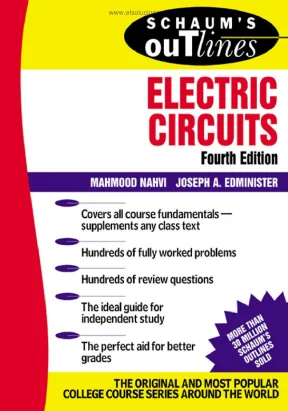
Mạch Điện: Lý Thuyết và Bài Tập (Electric Circuits) - Ấn bản lần 4, Schaum's Outline

Chuyên ngành

Kỹ thuật điện

Người đăng

Ẩn danh

Thể loại

Sách giáo khoa

2003

481
0
0

Phí lưu trữ

75 Point

Tóm tắt

I. Tổng quan về Schaum s Outline Electric Circuits 4th Edition

Schaum's Outline Electric Circuits Fourth Edition là giáo trình chuyên sâu về lý thuyết mạch điện, được biên soạn bởi hai giáo sư hàng đầu trong lĩnh vực kỹ thuật điện. Mahmood Nahvi công tác tại California Polytechnic State University và Joseph A. Edminister là Giáo sư Danh dự tại The University of Akron. Cuốn sách thuộc series Schaum's Outline danh tiếng của nhà xuất bản McGraw-Hill, ấn bản năm 2003. Nội dung bao quát toàn diện các chủ đề từ mạch DC cơ bản đến mạch AC phức tạp. Mỗi chương trình bày lý thuyết cô đọng, kèm theo hàng trăm bài toán mẫu có giải pháp chi tiết. Phương pháp trình bày theo kiểu đề bài-giải pháp giúp người học nắm vững kỹ năng giải quyết vấn đề. Ấn bản thứ tư đã được cập nhật phù hợp với xu hướng giảng dạy hiện đại. Cuốn sách là tài liệu tham khảo không thể thiếu cho sinh viên kỹ thuật điện, kỹ sư hành nghề và người ôn thi chuyên ngành. Nội dung bao gồm phân tích nút, phân tích mắt, nguyên lý superposition, định lý Thevenin-Norton cùng nhiều phương pháp nâng cao khác.

1.1. Giới thiệu tác giả và nhà xuất bản McGraw Hill

Mahmood Nahvi là Giáo sư Kỹ thuật Electrical Engineering tại California Polytechnic State University, có nhiều năm kinh nghiệm giảng dạy và nghiên cứu trong lĩnh vực mạch điện. Joseph A. Edminister là Giáo sư Emeritus tại University of Akron, nổi tiếng với các công trình giáo dục kỹ thuật. Cả hai tác giả đều có đóng góp lớn trong việc phổ biến kiến thức mạch điện đến sinh viên toàn cầu. McGraw-Hill là nhà xuất bản hàng đầu thế giới về sách khoa học kỹ thuật. Series Schaum's Outline đã trở thành thương hiệu uy tín trong giới học thuật suốt nhiều thập kỷ. Cuốn sách được bảo vệ bản quyền bởi The McGraw-Hill Companies, Inc., đảm bảo chất lượng và tính chính xác nội dung cao nhất.

1.2. Cấu trúc nội dung và phương pháp trình bày

Cuốn sách được tổ chức theo từng chương, mỗi chương tập trung vào một chủ đề cụ thể trong lý thuyết mạch điện. Các phần nội dung chính bao gồm mạch DC, mạch AC, tụ điện và năng lượng điện trường, cuộn cảm và từ trường, phương pháp phân tích nút và mắt, ma trận và định thức. Mỗi chương bắt đầu bằng phần lý thuyết ngắn gọn, tiếp theo là các bài toán mẫu có giải pháp chi tiết từng bước. Phương pháp trình bày này giúp người học tự kiểm tra kiến thức, rèn luyện kỹ năng giải bài tập và củng cố hiểu biết lý thuyết một cách hệ thống.

II. Phân tích nội dung học thuật về mạch điện trong Schaum s Outline

Nội dung học thuật của Schaum's Outline Electric Circuits 4th Edition được xây dựng trên nền tảng lý thuyết mạch điện vững chắc. Cuốn sách trình bày các khái niệm cốt lõi như định luật Kirchhoff, phân tích mạch DC và AC, cùng các phương pháp giải bài tập chuyên sâu. Phần lý thuyết về tụ điện giải thích chi tiết cơ chế tích trữ năng lượng trong điện trường. Công thức tính điện tích q bằng Cv, công suất p bằng vi và năng lượng wC bằng một nửa Cv bình phương được trình bày rõ ràng. Cuốn sách sử dụng ví dụ cụ thể minh họa, chẳng hạn bài toán về tụ điện 20 microfarad với điện áp hình sin để tính điện tích, công suất và năng lượng. Kết quả cho thấy năng lượng tăng đến 25 millijoule rồi giảm về không khi phóng điện. Nội dung cũng đề cập đến sơ đồ mạch điện và tầm quan trọng của việc vẽ lại mạch để tìm phương pháp giải tối ưu. Các bài toán thực tế giúp người học hiểu sâu bản chất lý thuyết và ứng dụng vào thực hành.

2.1. Định luật Kirchhoff và phân tích mạch cơ bản

Định luật Kirchhoff đóng vai trò nền tảng trong mọi phương pháp phân tích mạch điện. Định luật dòng điện KCL phát biểu rằng tổng dòng điện vào một nút bằng tổng dòng điện ra khỏi nút đó. Định luật điện áp KVL phát biểu rằng tổng điện áp rơi quanh một vòng kín bằng không. Cuốn sách trình bày cách áp dụng KCL và KVL để thiết lập hệ phương trình đồng thời cho mạch nhiều nút và nhiều mắt. Các khái niệm về điện trở, nguồn điện áp và nguồn dòng được giải thích chi tiết. Phương pháp phân tích bao gồm phép biến đổi Delta-Wye, nguyên lý superposition và định lý Thevenin-Norton.

2.2. Phân tích tụ điện và năng lượng điện trường

Tụ điện là phần tử lưu trữ năng lượng trong điện trường của chất điện môi. Khi ngắt nguồn, tụ điện giữ nguyên điện tích cho đến khi có đường phóng điện. Công thức năng lượng wC bằng một nửa nhân C với v bình phương cho thấy năng lượng tỷ lệ với bình phương điện áp. Trong ví dụ về tụ điện 20 microfarad, điện áp hình sin 50sin200t volt tạo ra điện tích 1000sin200t microcoulomb. Công suất p bằng 5sin400t watt dao động theo thời gian. Năng lượng tăng đến 25 millijoule rồi giảm về không khi phóng điện hoàn toàn.

III. Phương pháp giải bài tập mạch điện hiệu quả trong Schaum s Outline

Schaum's Outline Electric Circuits 4th Edition giới thiệu nhiều phương pháp giải bài tập mạch điện hiệu quả và hệ thống. Phương pháp dòng mắt là kỹ thuật quan trọng nhất, sử dụng định luật Kirchhoff về điện áp cho từng mắt mạch. Quy trình bao gồm gán dòng mắt cho mỗi vòng kín, viết phương trình KVL cho mỗi mắt, rồi giải hệ phương trình đồng thời. Ví dụ trong sách cho thấy với mạch hai mắt, hệ phương trình gồm hai ẩn số cho kết quả dòng điện chính xác. Dòng điện phân nhánh giữa được tính bằng hiệu hai dòng mắt. Cuốn sách cũng trình bày cách áp dụng phương pháp cho mạch ba mắt trở lên. Phương pháp dòng nút sử dụng KCL tại các nút để thiết lập hệ phương trình điện áp nút. Nguyên lý superposition cho phép phân tích mạch có nhiều nguồn bằng cách xét từng nguồn độc lập. Định lý Thevenin và Norton giúp đơn giản hóa mạch phức tạp thành mạch tương đương đơn giản hơn. Mỗi phương pháp đều được minh họa bằng nhiều bài toán mẫu có lời giải chi tiết từng bước.

3.1. Phương pháp dòng mắt và áp dụng KVL

Phương pháp dòng mắt áp dụng KVL cho mỗi vòng kín trong mạch điện. Dòng mắt được gán cho từng cửa sổ của sơ đồ mạch. Mỗi phần tử trong mạch phải mang một dòng điện hoặc tổ hợp dòng điện cụ thể. Không hai phần tử ở nhánh khác nhau được gán cùng một dòng điện. Quy tắc này đảm bảo tính hợp lệ của hệ phương trình. Khi áp dụng cho mạch ba mắt, ta thu được ba phương trình đồng thời dạng R₁₁I₁ cộng R₁₂I₂ cộng R₁₃I₃ bằng V₁. Các hệ số là điện trở tương tác giữa các mắt. Phương trình được giải bằng phương pháp ma trận và định thức.

3.2. Sử dụng ma trận và định thức để giải hệ phương trình

Hệ phương trình đồng thời của mạch n mắt được viết dưới dạng ma trận phương trình RI bằng V. Ma trận điện trở R chứa các hệ số, vector dòng I chứa các ẩn số và vector điện áp V chứa các nguồn. Định thức ma trận cho biết hệ phương trình có nghiệm duy nhất hay không. Công thức Cramer sử dụng định thức để tìm từng dòng điện một cách chính xác. Phần phụ lục B của cuốn sách cung cấp kiến thức nền tảng về ma trận và định thức. Phương pháp này đặc biệt hiệu quả cho mạch phức tạp nhiều mắt, giúp giảm sai sót tính toán đáng kể.

IV. Ứng dụng và giá trị thực tiễn của Schaum s Outline Electric Circuits

Schaum's Outline Electric Circuits 4th Edition có giá trị ứng dụng rộng rãi trong cả giáo dục và thực hành kỹ thuật điện. Cuốn sách phục vụ như tài liệu tham khảo chính cho các khóa học mạch điện cơ bản và nâng cao tại nhiều trường đại học trên toàn thế giới. Sinh viên sử dụng sách để ôn tập, chuẩn bị thi và hiểu sâu các khái niệm lý thuyết phức tạp. Kỹ sư tham khảo sách khi cần giải quyết vấn đề thực tế trong thiết kế và phân tích mạch điện công nghiệp. Phương pháp bài toán-giải pháp giúp rút ngắn thời gian học tập đáng kể so với các giáo trình thuần lý thuyết. Cuốn sách bao gồm hơn bốn trăm bài tập có lời giải chi tiết, phủ sóng đầy đủ các chủ đề từ cơ bản đến nâng cao. Nội dung được cập nhật đến năm 2003, phản ánh phương pháp giảng dạy hiện đại và tiến bộ công nghệ. Giá trị cốt lõi nằm ở cách trình bày logic, rõ ràng và tính thực tiễn cao. Cuốn sách là cầu nối hiệu quả giữa lý thuyết sách vở và ứng dụng kỹ thuật thực tế.

4.1. Ứng dụng trong đào tạo kỹ thuật điện đại học

Cuốn sách được sử dụng rộng rãi trong các chương trình đào tạo kỹ thuật điện tại các trường đại học. Giáo viên dùng làm tài liệu bổ trợ cho bài giảng chính khóa trên lớp. Sinh viên sử dụng để tự học, luyện giải bài tập và chuẩn bị cho các kỳ thi giữa kỳ và cuối kỳ. Phương pháp trình bày từng bước giúp người học nắm vững kỹ năng phân tích mạch từ đơn giản đến phức tạp. Các bài toán được sắp xếp theo mức độ khó tăng dần, tạo lộ trình học tập hợp lý và hiệu quả cho mọi trình độ.

4.2. Giá trị thực tiễn cho kỹ sư hành nghề

Kỹ sư điện sử dụng cuốn sách như cẩm nang tra cứu nhanh khi gặp vấn đề trong công việc. Các công thức và phương pháp được trình bày súc tích, dễ dàng áp dụng vào tình huống thực tế. Nội dung về phân tích mạch AC và DC đáp ứng nhu cầu trong thiết kế hệ thống điện công nghiệp và dân dụng. Phương pháp ma trận và định thức giúp giải quyết mạch phức tạp trong điều khiển tự động hóa. Cuốn sách là tài liệu tham khảo đáng tin cậy cho mọi kỹ sư hành nghề trong lĩnh vực điện.
21/04/2026

Trích đoạn nội dung tài liệu

net Theory and Problems of ELECTRIC CIRCUITS Fourth Edition MAHMOOD NAHVI, Ph. Professor of Electrical Engineering California Polytechnic State University JOSEPH A. EDMINISTER Professor Emeritus of Electrical Engineering The University of Akron Schaum’s Outline Series McGRAW-HILL New York Chicago San Francisco Lisbon London Madrid Mexico City Milan New Dehli San Juan Seoul Singapore Sydney Toronto www.net Copyright © 2003, 1997, 1986, 1965] by The McGraw-Hill Companies, Inc. All rights reserved. Manufactured in the United States of America. Except as permitted under the United States Copyright Act of 1976, no part of this publication may be repro- duced or distributed in any form or by any means, or stored in a database or retrieval system, without the prior written permis- sion of the publisher. 0-07-142582-9 The material in this eBook also appears in the print version of this title: 0-07-139307-2. All trademarks are trademarks of their respective owners. Rather than put a trademark symbol after every occurrence of a trademarked name, we use names in an editorial fashion only, and to the benefit of the trademark owner, with no intention of infringement of the trademark. Where such designations appear in this book, they have been printed with initial caps. McGraw-Hill eBooks are available at special quantity discounts to use as premiums and sales promotions, or for use in cor- porate training programs. For more information, please contact George Hoare, Special Sales, at george_hoare@mcgraw- hill. TERMS OF USE This is a copyrighted work and The McGraw-Hill Companies, Inc. (“McGraw-Hill”) and its licensors reserve all rights in and to the work. Use of this work is subject to these terms. Except as permitted under the Copyright Act of 1976 and the right to store and retrieve one copy of the work, you may not decompile, disassemble, reverse engineer, reproduce, modify, create derivative works based upon, transmit, distribute, disseminate, sell, publish or sublicense the work or any part of it without McGraw-Hill’s prior consent. You may use the work for your own noncommercial and personal use; any other use of the work is strictly prohibited. Your right to use the work may be terminated if you fail to comply with these terms. THE WORK IS PROVIDED “AS IS”. McGRAW-HILL AND ITS LICENSORS MAKE NO GUARANTEES OR WAR- RANTIES AS TO THE ACCURACY, ADEQUACY OR COMPLETENESS OF OR RESULTS TO BE OBTAINED FROM USING THE WORK, INCLUDING ANY INFORMATION THAT CAN BE ACCESSED THROUGH THE WORK VIA HYPERLINK OR OTHERWISE, AND EXPRESSLY DISCLAIM ANY WARRANTY, EXPRESS OR IMPLIED, INCLUDING BUT NOT LIMITED TO IMPLIED WARRANTIES OF MERCHANTABILITY OR FITNESS FOR A PAR- TICULAR PURPOSE. McGraw-Hill and its licensors do not warrant or guarantee that the functions contained in the work will meet your requirements or that its operation will be uninterrupted or error free. Neither McGraw-Hill nor its licensors shall be liable to you or anyone else for any inaccuracy, error or omission, regardless of cause, in the work or for any dam- ages resulting therefrom. McGraw-Hill has no responsibility for the content of any information accessed through the work. Under no circumstances shall McGraw-Hill and/or its licensors be liable for any indirect, incidental, special, punitive, con- sequential or similar damages that result from the use of or inability to use the work, even if any of them has been advised of the possibility of such damages. This limitation of liability shall apply to any claim or cause whatsoever whether such claim or cause arises in contract, tort or otherwise.net This book is designed for use as a textbook for a first course in circuit analysis or as a supplement to standard texts and can be used by electrical engineering students as well as other engineereing and technology students. Emphasis is placed on the basic laws, theorems, and problem-solving techniques which are common to most courses. The subject matter is divided into 17 chapters covering duly-recognized areas of theory and study. The chapters begin with statements of pertinent definitions, principles, and theorems together with illustrative examples. This is followed by sets of solved and supplementary problems. The problems cover a range of levels of difficulty. Some problems focus on fine points, which helps the student to better apply the basic principles correctly and confidently. The supplementary problems are generally more numerous and give the reader an opportunity to practice problem-solving skills. Answers are provided with each supplementary problem. The book begins with fundamental definitions, circuit elements including dependent sources, circuit laws and theorems, and analysis techniques such as node voltage and mesh current methods. These theorems and methods are initially applied to DC-resistive circuits and then extended to RLC circuits by the use of impedance and complex frequency. Chapter 5 on amplifiers and op amp circuits is new. The op amp examples and problems are selected carefully to illustrate simple but practical cases which are of interest and importance in the student’s future courses. The subject of waveforms and signals is also treated in a new chapter to increase the student’s awareness of commonly used signal models. Circuit behavior such as the steady state and transient response to steps, pulses, impulses, and exponential inputs is discussed for first-order circuits in Chapter 7 and then extended to circuits of higher order in Chapter 8, where the concept of complex frequency is introduced. Phasor analysis, sinuosidal steady state, power, power factor, and polyphase circuits are thoroughly covered. Network functions, frequency response, filters, series and parallel resonance, two-port networks, mutual induc- tance, and transformers are covered in detail. Application of Spice and PSpice in circuit analysis is introduced in Chapter 15. Circuit equations are solved using classical differential equations and the Laplace transform, which permits a convenient comparison. Fourier series and Fourier transforms and their use in circuit analysis are covered in Chapter 17. Finally, two appendixes provide a useful summary of the complex number system, and matrices and determinants. This book is dedicated to our students from whom we have learned to teach well. To a large degree it is they who have made possible our satisfying and rewarding teaching careers. And finally, we wish to thank our wives, Zahra Nahvi and Nina Edminister for their continuing support, and for whom all these efforts were happily made. MAHMOOD NAHVI JOSEPH A.net This page intentionally left blank. For more information about this title, click here.net CHAPTER 1 Introduction 1 1.1 Electrical Quantities and SI Units 1 1.2 Force, Work, and Power 1 1.3 Electric Charge and Current 2 1.5 Energy and Electrical Power 4 1.6 Constant and Variable Functions 4 CHAPTER 2 Circuit Concepts 7 2.1 Passive and Active Elements 7 2.3 Voltage-Current Relations 9 2.8 Nonlinear Resistors 13 CHAPTER 3 Circuit Laws 24 3.2 Kirchhoff’s Voltage Law 24 3.3 Kirchhoff’s Current Law 25 3.4 Circuit Elements in Series 25 3.5 Circuit Elements in Parallel 26 3.7 Current Division 28 CHAPTER 4 Analysis Methods 37 4.1 The Branch Current Method 37 4.2 The Mesh Current Method 38 4.3 Matrices and Determinants 38 4.4 The Node Voltage Method 40 4.5 Input and Output Resistance 41 4.9 Thévenin’s and Norton’s Theorems 45 Copyright 2003, 1997, 1986, 1965 by The McGraw-Hill Companies, Inc. Click Here for Terms of Use.net vi Contents 4.10 Maximum Power Transfer Theorem 47 CHAPTER 5 Amplifiers and Operational Amplifier Circuits 64 5.1 Amplifier Model 64 5.2 Feedback in Amplifier Circuits 65 5.3 Operational Amplifiers 66 5.4 Analysis of Circuits Containing Ideal Op Amps 70 5.9 Differental and Difference Amplifiers 75 5.10 Circuits Containing Several Op Amps 76 5.11 Integrator and Differentiator Circuits 77 5.13 Low-Pass Filter 81 5.14 Comparator 82 CHAPTER 6 Waveforms and Signals 101 6.4 Time Shift and Phase Shift 103 6.5 Combinations of Periodic Functions 106 6.6 The Average and Effective (RMS) Values 107 6.8 The Unit Step Function 109 6.9 The Unit Impulse Function 110 6.10 The Exponential Function 112 6.12 Random Signals 115 CHAPTER 7 First-Order Circuits 127 7.2 Capacitor Discharge in a Resistor 127 7.3 Establishing a DC Voltage Across a Capacitor 129 7.4 The Source-Free RL Circuit 130 7.5 Establishing a DC Current in an Inductor 132 7.6 The Exponential Function Revisited 132 7.7 Complex First-Order RL and RC Circuits 134 7.8 DC Steady State in Inductors and Capacitors 136 7.9 Transitions at Switching Time 136 7.10 Response of First-Order Circuits to a Pulse 139 7.11 Impulse Response of RC and RL Circuits 140 7.12 Summary of Step and Impulse Responses in RC and RL Circuits 141 7.13 Response of RC and RL Circuits to Sudden Exponential Excitations 141 7.14 Response of RC and RL Circuits to Sudden Sinusoidal Excitations 143 7.15 Summary of Forced Response in First-Order Circuits 143 7.16 First-Order Active Circuits 143 CHAPTER 8 Higher-Order Circuits and Complex Frequency 161 8.net Contents vii 8.2 Series RLC Circuit 161 8.3 Parallel RLC Circuit 164 8.4 Two-Mesh Circuit 167 8.6 Generalized Impedance ðR; L; CÞ in s-Domain 169 8.7 Network Function and Pole-Zero Plots 170 8.8 The Forced Response 172 8.9 The Natural Response 173 8.10 Magnitude and Frequency Scaling 174 8.11 Higher-Order Active Circuits 175 CHAPTER 9 Sinusoidal Steady-State Circuit Analysis 191 9.4 Impedance and Admittance 196 9.5 Voltage and Current Division in the Frequency Domain 198 9.6 The Mesh Current Method 198 9.7 The Node Voltage Method 201 9.8 Thévenin’s and Norton’s Theorems 201 9.9 Superposition of AC Sources 202 CHAPTER 10 AC Power 219 10.1 Power in the Time Domain 219 10.2 Power in Sinusoudal Steady State 220 10.3 Average or Real Power 221 10.5 Summary of AC Power in R, L, and C 223 10.6 Exchange of Energy Between an Inductor and a Capacitor 224 10.7 Complex Power, Apparent Power, and Power Triangle 226 10.8 Parallel-Connected Networks 230 10.9 Power Factor Improvement 231 10.10 Maximum Power Transfer 233 10.11 Superposition of Average Powers 234 CHAPTER 11 Polyphase Circuits 248 11.2 Two-Phase Systems 248 11.3 Three-Phase Systems 249 11.4 Wye and Delta Systems 251 11.6 Balanced Delta-Connected Load 252 11.7 Balanced Four-Wire, Wye-Connected Load 253 11.8 Equivalent Y and -Connections 254 11.9 Single-Line Equivalent Circuit for Balanced Three-Phase Loads 255 11.10 Unbalanced Delta-Connected Load 255 11.11 Unbalanced Wye-Connected Load 256 11.12 Three-Phase Power 258 11.13 Power Measurement and the Two-Wattmeter Method 259 CHAPTER 12 Frequency Response, Filters, and Resonance 273 12.1 Frequency Response 273 www.net viii Contents 12.2 High-Pass and Low-Pass Networks 274 12.3 Half-Power Frequencies 278 12.4 Generalized Two-Port, Two-Element Networks 278 12.5 The Frequency Response and Network Functions 279 12.6 Frequency Response from Pole-Zero Location 280 12.7 Ideal and Practical Filters 280 12.8 Passive and Active Filters 282 12.9 Bandpass Filters and Resonance 283 12.10 Natural Frequency and Damping Ratio 284 12.11 RLC Series Circuit; Series Resonance 284 12.13 RLC Parallel Circuit; Parallel Resonance 287 12.14 Practical LC Parallel Circuit 288 12.15 Series-Parallel Conversions 289 12.17 Scaling the Frequency Response of Filters 292 CHAPTER 13 Two-port Networks 310 13.1 Terminals and Ports 310 13.3 T-Equivalent of Reciprocal Networks 312 13.5 Pi-Equivalent of Reciprocal Networks 314 13.6 Application of Terminal Characteristics 314 13.7 Conversion Between Z- and Y-Parameters 315 13.11 Interconnecting Two-Port Networks 318 13.12 Choice of Parameter Type 320 13.13 Summary of Terminal Parameters and Conversion 320 CHAPTER 14 Mutual Inductance and Transformers 334 14.2 Coupling Coefficient 335 14.3 Analysis of Coupled Coils 336 14.5 Energy in a Pair of Coupled Coils 338 14.6 Conductively Coupled Equivalent Circuits 339 14.10 Reflected Impedance 344 CHAPTER 15 Circuit Analysis Using Spice and Pspice 362 15.1 Spice and PSpice 362 15.3 Dissecting a Spice Source File 363 15.4 Data Statements and DC Analysis 364 15.5 Control and Output Statements in DC Analysis 367 15.6 Thévenin Equivalent 370 15.7 Op Amp Circuits 370 www.net Contents ix 15.8 AC Steady State and Frequency Response 373 15.9 Mutual Inductance and Transformers 375 15.10 Modeling Devices with Varying Parameters 375 15.11 Time Response and Transient Analysis 378 15.12 Specifying Other Types of Sources 379 15.13 Summary 382 CHAPTER 16 The Laplace Transform Method 398 16.2 The Laplace Transform 398 16.3 Selected Laplace Transforms 399 16.4 Convergence of the Integral 401 16.5 Initial-Value and Final-Value Theorems 401 16.6 Partial-Fractions Expansions 402 16.

Nội dung được bảo vệ bản quyền — Tải xuống đầy đủ