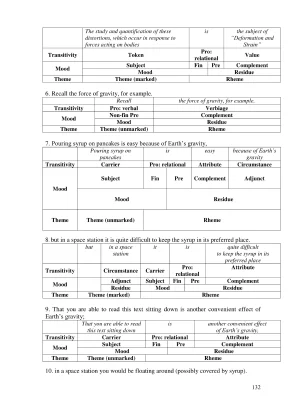
The study and quantification of these is the subject of distortions, which occur in response to “Deformation and forces acting on bodies Strain” Transitivity Token Pro: relational Value Subject Fin | Pre Complement Mood Mood Residue Theme Theme (marked) Rheme 6. Recall the force of gravity, for example. Recall the force of gravity, for example. Transitivity Pro: verbal Verbiage Non-fin Pre Complement Mood Mood Residue Theme Theme (unmarked) Rheme 7.
Pouring syrup on pancakes is easy because of Earth’s gravity, Pouring syrup on is easy because of Earth’s pancakes gravity Transitivity Carrier Pro: relational Attribute Circumstance Subject Fin Pre Complement Adjunct Mood Mood Residue Theme Theme (unmarked) Rheme 8. but in a space station it is quite difficult to keep the syrup in its preferred place. but in a space it is quite difficult station to keep the syrup in its preferred place Transitivity Circumstance | Carrier Pro: relational Attribute Mood Adjunct Subject | Fin | Pre Complement Residue Mood Residue Theme Theme (marked) Rheme 9. That you are able to read this text sitting down is another convenient effect of Earth’s gravity; That you are able to read is another convenient effect this text sitting down of Earth’s gravity, Transitivity Carrier Pro: relational Attribute Subject Fin Pre Complement Mood Mood Residue Theme Theme (unmarked) Rheme 10.
in a space station you would be floating around (possibly covered by syrup). 132 In a space station you would be floating around Transitivity Circumstance Actor Pro: material Adjunct Subject Fin Pre Mood Residue Mood Theme Theme (marked) Rheme 11. consider a more controlled experiment to analyze the response of materials to an applied force. Let us consider a more controlled experiment to analyze the response of materials to applied force Transitivity | Pro: mental | Senser Pro: mental Phenomenon Mood Non-fin Pre | Subject | Fin | Pre Complement Mood Residue Theme Theme (unmarked) Rheme 13.
We can change the shape of a block of clay or plasticine by the action of, say, your hands or a vise. We can change the shape ofa | by action of, or say, your block of clay or hands or a vise plasticine Transitivity Actor Pro: material Goal Circumstance Subject Fin Pre Complement Adjunct Mood Mood Residue Theme Theme (unmarked) Rheme 14. When forces affect the spatial geometry of a body (syrup, you, plasticine, or rocks) 15. we enter the realm of deformation.
When | forces affect the spatial enter | the realm of geometry of deformation a body Tran Cir. Pro: material Goal Actor. Pro: material Goal 1 Adj. 1 Fin Pre Comp.
2 Theme Theme (marked) Rheme 16. Most simple stated: deformation of a body occurs in response to forces. Most simple stated: occurs in response to forces deformation of a body Transitivity Existent Pro: existential Circumstance Subject Fin Pre Adjunct Mood Mood Residue Theme Theme (unmarked) Rheme 133 17. We will see later 18.
that deformation affects stress (force acting on an area), We will see later | that | deformation | affects stress Pro: Tran Senser Pro: mental Cir. Actor materi Goal al. R Fi | Pr Mood Sub. 1 Fin Pre Adj.
2 Theme Theme (unmarked) Rheme 19. so there is no simple stress — deformation relationship. SO there is no simple — deformation relationship Transitivity Pro: existential Existent Subject Fin Pre Complement Mood Mood Residue Theme Theme (unmarked) Rheme 20. The response of a body to forces may have many faces.
The response of may have many faces body to forces Attribut Transitivity Carrier Pro: relational mu Subject Fin Pre Complement Mood Mood Residue Theme Theme (unmarked) Rheme 21. In some cases, the body is merely displaced or rotated, such as when you get up from the chair and move around the room. In some the is displaced, or rotated such as when you get up cases, body | merely from the chair and move around the room Tran Cir.1 Goal Pro: material Pro: material Cir. 1 Sub Fin Pre Fin Pre Adj.
Mood Residue Theme markeđ) Rheme 134 22. In other cases, the body becomes distorted, as in the clay block experiment or with the flow of syrup. In other the becomes distorted as in the clay block experiment cases, body or with the flow of syrup Transitivity Cir. 1 Carrier Pro: relational Attribute Cir.
1 Subject | Fin | Pre Complement Adj. 2 Mood Mood Residue Theme Theme (marked) Rheme 23. In this chapter, we will examine these responses both qualitatively and quantitatively. In this we will | examine these both qualitatively and chapter, responses quantitatively Transitivity Cir.
1 Actor Pro: material Range Cir. 1 Subject | Fin Pre Complement Adj. Residue Theme Theme (marked) Rheme 6. INTRODUCTION PART 3 Folds and Folding 1.
Ask a structural geologist, or any other geologist for that matter, about their favorite structure 2. and chances are that they will choose folds. Ask a structural for that matter and chances are that geologist, about their they or any other | favorite structure will geologist choose folds. : Pro: Tran | Pro: verbal Receiver Verbiage Carrier R Attr.
Non-fin Pre Comple ment Complement. 2 Subject " Pre 3 Mood Mood Mood Residue Theme Theme (unmarked) Rheme 3. If you have seen a fold in the field 4. you will have marveled at its appearance.
If you have | seen a fold in you will | marveled at its the have appearance. 135 field Tran Senser. Pro: mental Pheno. 1 cr Senser- Pro: mental Pheno.
1 Fin Pre Comp. 2 | Fin Pre Comp. 2 Mood Mood Residue Mood Theme Theme (marked) Rheme 5. Let’s face it, 6.
it is pretty unbelievable Let’s face it, it is pretty unbelievable Tran | Pro: mental Pro: material Range | Carrier Pro: relational Attribute Non-fin Pre | Fin Pre conp. Subject | Fin Pre Comp. 2 Mood Mood Residue Mood Theme Theme (unmarked) Rheme 7. that hard rocks are able to change shape in such a dramatic way.
that hard are able to change shape rocks in such a dramatic way. Transitivity Carrier Pro: relational Attribute Subject Fin Pre Complement Mood Mood Residue Theme Theme (unmarked) Rheme 8. In simple terms, a fold is a structural feature that is formed when planar surfaces are bent or curved. In simple | a fold is a structural feature that is formed terms, when planar surfaces are Transitivity Cir.
Carrier | Pro: relational Attribute Adj. Subject | Fin Pre Complement Mood Mood Residue Theme Theme (marked) Rheme 9. If such surfaces (like bedding, cleavage, inclusions) are not available 10. you will not see a fold even through the rock was deformed.
I such are available you will not | see afold | even ƒ surfaces not through (like bedding the rock , cleavage, was inclusions) deformed Pro: Tran Carrier relatio Attribute Senser Pro: mental Pheno. nal Mood Sub 1 B TP n | re Comp. 1 Sub 2 Fin Pre Comp. 2 Theme Theme (marked) Rheme 1 36 11.
Folding is a manifestation of ductile deformation 12. because it can develop without fracturing, Folding is a because it can | develop without manifestation fracturing, of ductile deformation Tran Token Pro: relational Value Actor Pro: material Cir. 1 Fin | Pre Comp. Fin| Pre Adj.
Mood Mood Residue Mood Theme Theme (unmarked) Rheme 13. and the deformation is (heterogeneously) distributed over the entire structure. and the deformation is distributed | over the entire structure. Transitivity Goal Pro: material Circumstance Subject Fin Pre Adjunct Mood Mood Residue Theme Theme (unmarked) Rheme 14.
Rather than fracturing, processes, such as grain sliding, kinking, dissolution, and crystal plasticity dominate. Rather than processes, such as grain Sliding, kinking, dominate fracturing, dissolution, and crystal plasticity Transitivity Cir. Actor Pro: material Adj. Subject Fin Pre Mood Mood Residue Theme Theme (marked) Rheme 15.
Looking at a fold from a kinematic perspective, 16. you realize that strain in this structure cannot be the same everywhere. Looking a fold froma you realize that strain can be the same at kinematic in this not everywher perspective structure e Pheno Tran Pro: mental meno n Cir.1 Sen sor Pro: mental Carrier Pro: relational Attribute Now fin Comp ' Adj. 1 Sub Fin | Pre Sub.
2 Fin | Pre | Comp. 2 137 Theme Theme (marked) Rheme 17. We recognize distinct segments in a fold, such as the hinge area and the limbs, the inner and the outer arc, each of which reflect different strain histories, regardless of scale. We recognize | distinct segments in a fold such as the hinge area and the limbs, the inner and the outer arc each of which reflect different strain histories, regardless of scales Tran Senser Pro: mental Phenomenon Subject Fin Pre | Complement Mood 3J P : Mood Residue Theme Them Rhem eme (unmarked) eme 18.
Why do folds exist, 19. how do rocks do it, Why do, exist folds how do, do rocks it Tran Cir. existential Existent Cir. 2 Pro: material Actor Goal Adj.
1 Fin Pre Sub. 2 Fin Pre Sub. Moo : Resid Mood a1 Res. and what does folding mean for regional analysis? and what does.mean folding for regional analysis? Tran Phenomenon Pro: mental Senser Cir.
Complement Fin Pre Subject Adj. Mood : Mood : Mood : Residue Residue Residue Theme Theme (unmarked) Rheme 21. These and other questions were first asked quite some time ago 22. and much of what we know today about folds and folding was well established before the 1980’s.
These and | were | asked | quite | and much of what | was | established | before other first some | we know today well the questions time | about folds and 1980 % ago | folding Tran | Verbiage | Pro: verbal | Cir. 1 Actor Pro: material Cir. 1 Fin Pre | Adj. 2 Fin Pre Adj.
The geometry of folds tells us something about, for example, the degree and orientation of strain, which in turn provides critical information about the deformation history of a region. The tells us something about, for example, the degree geometry of and orientation of strain, which in turns folds provides critical information about the deformation history of a region Tran Sayer Pro: verbal | Receiver Verbiage Subject Fin | Pre Complement Mood Mood Residue Theme Theme (unmarked) Rheme 24. Much of the work in recent years represents refinements of some of the earlier work; 25. we can apply increasingly sophisticated numerical and experimental approaches.
Much of the | represents | refinements | we can | apply increasingly work in of some of sophisticated recent years the earlier numerical and work; experimental approaches Transitivity Actor 1 Pro: material Goal. 1 Actor 2 Pro: material Goal. Mood Subject 1 | Fin | Pre | Comp.1 2 Fin | Pre Comp. 2 Theme Theme (unmarked) Rheme 26.
Yet, the fundamental observations remain essentially intact. Yet the fundamental remains essentially intact observations Transitivity Carrier Pro: relational Attribute Subject Fin Pre Complement Mood Mood Residue Theme Theme (unmarked) Rheme 27. Therefore, in this chapter we will mainly look at some of the first principles of folding and their application of structural analysis. Therefore, |in this | we will mainly | look at | some of the first chapter principles offolding and their application of structural analysis Transitivity Cir.
2 | Senser Pro: mental Cir. 3 Pro: mental Phenomenon Adj.3 | Pre Complement Mood Mood Residue Theme Theme (marked) Rheme 139 28. First, however, we discuss the basic vocabulary needed to communicate about folds and fold systems. First, however, we discuss the basis vocabulary needed to communicate about folds and fold systems Transitivity | Circumstance | Sayer | Pro: verbal Phenomenon Adjunct Subject | Fin | Pre Complement Mood Mood Residue Theme markeđ Rheme 6.
INTRODUCTION PART 4 Metamorphism, Metamorphic rocks, and hydrothermal rocks 1. This chapter on metamorphic rocks, the third major category of rocks in the rock cycle, completes our description of earth materials (rocks and minerals).