Tương Tác Người-Máy: Nghiên Cứu và Ứng Dụng trong Công Nghệ

Chuyên khảo phân tích Luận văn visualization of time oriented data, đánh giá các khía cạnh quan trọng, đề xuất hướng nghiên cứu tiếp theo.

Trường đại học

Vienna University of Technology

Chuyên ngành

Computer Science

Người đăng

Ẩn danh

Thể loại

Book

2011

296
2
0

Phí lưu trữ

55 Point

Mục lục chi tiết

Foreword

Preface

About the Authors

1. Introduction to Visualization

1.1. Classic Ways of Graphing Time

1.2. Time in Visual Storytelling & Arts

2. Time & Time-Oriented Data

2.1. Granularities & Time Primitives

2.2. Relating Data & Time

2.3. Characterization of the Visualization Problem

2.4. What? – Time & Data

3. Why? – User Tasks

4. How? – Visual Representation

4.1. Visualization Design Examples

4.2. Motivation & User Intents

4.3. Integrating Interactive and Automatic Methods

5. Temporal Analysis Tasks

6. Temporal Data Abstraction

6.1. Principal Component Analysis

7. Survey of Visualization Techniques

Tóm tắt

I. Tương Tác Người Máy Tổng Quan Nghiên Cứu và Định Nghĩa

Tương tác người-máy (Human-Computer Interaction - HCI) là một lĩnh vực đa ngành, tập trung vào khía cạnh con người trong quá trình phát triển công nghệ máy tính. Khi công nghệ ngày càng phổ biến trên toàn thế giới, việc áp dụng phương pháp tiếp cận lấy con người làm trung tâm trong thiết kế và phát triển công nghệ trở nên quan trọng hơn bao giờ hết. Trong khoảng 30 năm qua, các nhà nghiên cứu và chuyên gia trong lĩnh vực khoa học máy tính và khoa học hành vi đã nỗ lực xác định lý thuyết và thực tiễn có ảnh hưởng đến hướng đi của các công nghệ này. Nghiên cứu này bao gồm việc nghiên cứu những gì công nghệ có thể làm cho con người và cách con người có thể tương tác với công nghệ. Loạt bài này trình bày công trình nhằm thúc đẩy khoa học và công nghệ phát triển các hệ thống vừa hiệu quả vừa thỏa mãn cho mọi người trong nhiều bối cảnh khác nhau. Một định nghĩa quan trọng cần lưu ý, HCI bao gồm nghiên cứu về những gì công nghệ có thể làm cho con người và cách họ tương tác với công nghệ.

1.1. Lịch Sử Phát Triển Ngành Tương Tác Người Máy HCI

Ngành HCI đã trải qua một quá trình phát triển lâu dài, bắt nguồn từ những năm 1980, khi giao diện người dùng đồ họa bắt đầu trở nên phổ biến. Từ đó đến nay, HCI đã mở rộng phạm vi để bao gồm nhiều lĩnh vực khác nhau, từ thiết kế giao diện người dùng đến phát triển các hệ thống trí tuệ nhân tạo có khả năng tương tác tự nhiên với con người. Các cột mốc quan trọng bao gồm sự ra đời của web, điện thoại thông minh và các thiết bị đeo thông minh. Lịch sử hình thành ngành tập trung vào các yếu tố như: Giao diện người dùng (UI), Trải nghiệm người dùng (UX), Khả năng sử dụng (Usability).

1.2. Các Lĩnh Vực Nghiên Cứu Chính trong Tương Tác Người Máy

HCI bao gồm nhiều lĩnh vực nghiên cứu khác nhau, bao gồm: Thiết kế giao diện người dùng, đánh giá khả năng sử dụng, phát triển các hệ thống tương tác tự nhiên, và nghiên cứu về tác động của công nghệ đối với xã hội. Các lĩnh vực này không chỉ tập trung vào việc tạo ra các giao diện thân thiện và dễ sử dụng, mà còn xem xét các khía cạnh xã hội, văn hóa và đạo đức của công nghệ. Nghiên cứu này cần giải quyết các yếu tố như: Tính hữu ích (Utility), Khả năng sử dụng (Usability), và Tính chấp nhận (Acceptability).

II. Vấn Đề Thách Thức Trong Thiết Kế Tương Tác Người Máy Hiện Đại

Thiết kế tương tác người-máy đối mặt với nhiều thách thức trong bối cảnh công nghệ hiện đại. Sự đa dạng của người dùng, với các kỹ năng, kinh nghiệm và nhu cầu khác nhau, đòi hỏi các nhà thiết kế phải tạo ra các giao diện có thể tùy chỉnh và thích ứng. Bên cạnh đó, sự phát triển nhanh chóng của công nghệ, như thực tế ảo (VR), thực tế tăng cường (AR)trí tuệ nhân tạo (AI), đặt ra những yêu cầu mới về thiết kế và đánh giá. Một thách thức khác là đảm bảo tính bảo mật và quyền riêng tư của người dùng trong các hệ thống tương tác. Theo tài liệu, việc tích hợp nhu cầu của người dùng vào phát triển hệ thống là một khía cạnh thực tế quan trọng.

2.1. Đảm Bảo Khả Năng Tiếp Cận Cho Mọi Đối Tượng Người Dùng

Khả năng tiếp cận là một yếu tố quan trọng trong thiết kế HCI. Các giao diện cần được thiết kế sao cho dễ sử dụng cho tất cả mọi người, bao gồm cả những người khuyết tật, người lớn tuổi và người dùng từ các nền văn hóa khác nhau. Điều này đòi hỏi các nhà thiết kế phải tuân thủ các tiêu chuẩn về khả năng tiếp cận và sử dụng các kỹ thuật thiết kế phù hợp, xem xét các yếu tố thiết kế toàn diện.

2.2. Ứng Phó Với Sự Phát Triển Nhanh Chóng Của Công Nghệ Mới

Sự phát triển nhanh chóng của công nghệ mới đòi hỏi các nhà thiết kế HCI phải liên tục cập nhật kiến thức và kỹ năng của mình. Họ cần phải hiểu rõ về các công nghệ mới như AI, VRAR, và tìm cách tích hợp chúng vào các giao diện người dùng một cách hiệu quả. Hơn nữa, họ cần phải phát triển các phương pháp đánh giá mới để đảm bảo rằng các giao diện này đáp ứng được nhu cầu của người dùng.

2.3. Bảo Vệ Quyền Riêng Tư và Bảo Mật Thông Tin Người Dùng

Trong bối cảnh số hóa ngày càng tăng, việc bảo vệ quyền riêng tư và bảo mật thông tin của người dùng trở nên vô cùng quan trọng. Các hệ thống HCI cần được thiết kế sao cho bảo vệ được thông tin cá nhân của người dùng và ngăn chặn các hành vi xâm phạm quyền riêng tư. Điều này đòi hỏi các nhà thiết kế phải áp dụng các biện pháp bảo mật mạnh mẽ và tuân thủ các quy định về bảo vệ dữ liệu.

III. Phương Pháp Kỹ Thuật Nghiên Cứu Tương Tác Người Máy Hiệu Quả

Nghiên cứu HCI sử dụng nhiều phương pháp và kỹ thuật khác nhau để hiểu rõ hơn về cách con người tương tác với công nghệ. Các phương pháp định tính, như phỏng vấn và quan sát, được sử dụng để thu thập dữ liệu về trải nghiệm và nhu cầu của người dùng. Các phương pháp định lượng, như khảo sát và thử nghiệm, được sử dụng để đo lường hiệu quả và khả năng sử dụng của các giao diện. Theo tài liệu gốc, việc xác định lý thuyết và thực hành ảnh hưởng đến hướng đi của công nghệ là một phần quan trọng của lĩnh vực này.

3.1. Phương Pháp Nghiên Cứu Định Tính trong Tương Tác Người Máy

Các phương pháp định tính, như phỏng vấn người dùng, quan sát tự nhiên và phân tích nội dung, cung cấp thông tin sâu sắc về trải nghiệm và nhu cầu của người dùng. Phỏng vấn cho phép các nhà nghiên cứu thu thập ý kiến chủ quan của người dùng về các sản phẩm và dịch vụ. Quan sát tự nhiên giúp các nhà nghiên cứu hiểu rõ hơn về cách người dùng sử dụng công nghệ trong môi trường thực tế. Phân tích nội dung được sử dụng để phân tích các tài liệu và dữ liệu văn bản, chẳng hạn như phản hồi của người dùng trên mạng xã hội.

3.2. Phương Pháp Nghiên Cứu Định Lượng để Đo Lường Hiệu Quả Sử Dụng

Các phương pháp định lượng, như khảo sát, thử nghiệm và phân tích dữ liệu nhật ký, cung cấp dữ liệu khách quan về hiệu quả và khả năng sử dụng của các giao diện. Khảo sát cho phép các nhà nghiên cứu thu thập dữ liệu từ một lượng lớn người dùng. Thử nghiệm được sử dụng để so sánh hiệu quả của các giao diện khác nhau. Phân tích dữ liệu nhật ký cung cấp thông tin về cách người dùng sử dụng công nghệ trong thời gian thực. Các chỉ số chính được sử dụng bao gồm: Thời gian hoàn thành tác vụ, Tỷ lệ lỗi, Mức độ hài lòng.

IV. Ứng Dụng Tương Tác Người Máy Từ Y Tế đến Giáo Dục Thông Minh

HCI có nhiều ứng dụng trong các lĩnh vực khác nhau, từ y tế đến giáo dục. Trong y tế, HCI được sử dụng để phát triển các hệ thống hỗ trợ chẩn đoán và điều trị bệnh, cũng như các thiết bị theo dõi sức khỏe cá nhân. Trong giáo dục, HCI được sử dụng để tạo ra các môi trường học tập tương tác và cá nhân hóa. Theo tài liệu, HCI hướng đến việc phát triển các hệ thống hiệu quả và thỏa mãn người dùng trong nhiều bối cảnh khác nhau.

4.1. Tương Tác Người Máy trong Lĩnh Vực Y Tế và Chăm Sóc Sức Khỏe

Trong y tế, HCI đóng vai trò quan trọng trong việc cải thiện chất lượng dịch vụ và trải nghiệm của bệnh nhân. Các ứng dụng bao gồm: Hệ thống hỗ trợ ra quyết định lâm sàng, Thiết bị theo dõi sức khỏe từ xa, và Giao diện người dùng cho thiết bị y tế. Thiết kế tốt có thể giảm thiểu sai sót y tế, tăng cường sự tham gia của bệnh nhân và cải thiện hiệu quả làm việc của nhân viên y tế.

4.2. Tương Tác Người Máy trong Giáo Dục và Đào Tạo Trực Tuyến

Trong giáo dục, HCI được sử dụng để tạo ra các môi trường học tập tương tác, hấp dẫn và phù hợp với nhu cầu của từng học sinh. Các ứng dụng bao gồm: Phần mềm học tập trực tuyến, Hệ thống quản lý học tập (LMS), và Công cụ cộng tác trực tuyến. Thiết kế HCI tốt có thể giúp học sinh học tập hiệu quả hơn, tăng cường sự hứng thú và động lực học tập, và tạo ra một môi trường học tập cá nhân hóa.

V. Tương Lai Tương Tác Người Máy Xu Hướng Triển Vọng Phát Triển

Tương lai của HCI hứa hẹn nhiều điều thú vị với sự phát triển của các công nghệ mới như AI, VR, ARInternet of Things (IoT). Các giao diện sẽ trở nên thông minh hơn, trực quan hơn và cá nhân hóa hơn. Bên cạnh đó, HCI sẽ đóng vai trò quan trọng trong việc giải quyết các vấn đề xã hội, như biến đổi khí hậu, bất bình đẳng và già hóa dân số. Theo tài liệu, HCI không chỉ tập trung vào các khía cạnh kỹ thuật mà còn xem xét các vấn đề xã hội, như tác động của công nghệ đối với xã hội.

5.1. Trí Tuệ Nhân Tạo AI và Tương Tác Người Máy Thông Minh

AI đang cách mạng hóa lĩnh vực HCI bằng cách cho phép tạo ra các giao diện thông minh có khả năng học hỏi và thích ứng với nhu cầu của người dùng. Các ứng dụng bao gồm: Trợ lý ảo, Hệ thống đề xuất, và Giao diện người dùng tự động điều chỉnh. AI có thể giúp tạo ra các giao diện trực quan, dễ sử dụng và cá nhân hóa hơn bao giờ hết.

5.2. Thực Tế Ảo VR và Thực Tế Tăng Cường AR trong Tương Tác

VRAR đang mở ra những khả năng mới cho tương tác người-máy. VR cho phép người dùng đắm mình trong các môi trường ảo, trong khi AR cho phép người dùng tương tác với các đối tượng ảo trong thế giới thực. Các ứng dụng bao gồm: Trò chơi điện tử, Đào tạo mô phỏng, và Hỗ trợ điều khiển từ xa. VR và AR có thể tạo ra các trải nghiệm tương tác sống động, chân thực và hấp dẫn.

28/05/2025

Trích đoạn nội dung tài liệu

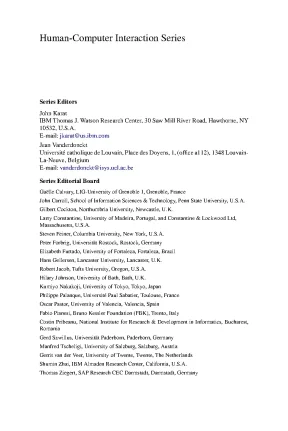
Human-Computer Interaction Series Series Editors John Karat IBM Thomas J. Watson Research Center, 30 Saw Mill River Road, Hawthorne, NY 10532, U. E-mail: jkarat@us.com Jean Vanderdonckt Université catholique de Louvain, Place des Doyens, 1, (office a112), 1348 Louvain- La-Neuve, Belgium E-mail: vanderdonckt@isys.be Series Editorial Board Gaëlle Calvary, LIG-University of Grenoble 1, Grenoble, France John Carroll, School of Information Sciences & Technology, Penn State University, U. Gilbert Cockton, Northumbria University, Newcastle, U.

Larry Constantine, University of Madeira, Portugal, and Constantine & Lockwood Ltd, Massachusetts, U. Steven Feiner, Columbia University, New York, U. Peter Forbrig, Universität Rostock, Rostock, Germany Elizabeth Furtado, University of Fortaleza, Fortaleza, Brazil Hans Gellersen, Lancaster University, Lancaster, U. Robert Jacob, Tufts University, Oregon, U.

Hilary Johnson, University of Bath, Bath, U. Kumiyo Nakakoji, University of Tokyo, Tokyo, Japan Philippe Palanque, Université Paul Sabatier, Toulouse, France Oscar Pastor, University of Valencia, Valencia, Spain Fabio Pianesi, Bruno Kessler Foundation (FBK), Trento, Italy Costin Pribeanu, National Institute for Research & Development in Informatics, Bucharest, Romania Gerd Szwillus, Universität Paderborn, Paderborn, Germany Manfred Tscheligi, University of Salzburg, Salzburg, Austria Gerrit van der Veer, University of Twente, Twente, The Netherlands Shumin Zhai, IBM Almaden Research Center, California, U. Thomas Ziegert, SAP Research CEC Darmstadt, Darmstadt, Germany Human-computer interaction is a multidisciplinary field focused on human aspects of the development of computer technology. As computer-based technology becomes increasingly pervasive – not just in developed countries, but worldwide – the need to take a human- centered approach in the design and development of this technology becomes ever more important.

For roughly 30 years now, researchers and practitioners in computational and be- havioral sciences have worked to identify theory and practice that influences the direction of these technologies, and this diverse work makes up the field of human-computer interaction. Broadly speaking it includes the study of what technology might be able to do for people and how people might interact with the technology. In this series we present work which advances the science and technology of developing systems which are both effective and satisfying for people in a wide variety of contexts. The Human-Computer Interaction series will focus on theoretical perspectives (such as formal approaches drawn from a variety of behavioral sciences), practical approaches (such as the techniques for effectively integrating user needs in system development), and social issues (such as the determinants of utility, usability and acceptability).

For further volumes: www.com/series/6033 Wolfgang Aigner r Silvia Miksch r Heidrun Schumann r Christian Tominski Visualization of Time-Oriented Data Wolfgang Aigner Heidrun Schumann Vienna University of Technology University of Rostock Vienna Rostock Austria Germany Silvia Miksch Christian Tominski Vienna University of Technology University of Rostock Vienna Rostock Austria Germany ISSN 1571-5035 ISBN 978-0-85729-078-6 e-ISBN 978-0-85729-079-3 DOI 10.1007/978-0-85729-079-3 Springer London Dordrecht Heidelberg New York British Library Cataloguing in Publication Data A catalogue record for this book is available from the British Library Library of Congress Control Number: 2011929628 © Springer-Verlag London Limited 2011 Apart from any fair dealing for the purposes of research or private study, or criticism or review, as per- mitted under the Copyright, Designs and Patents Act 1988, this publication may only be reproduced, stored or transmitted, in any form or by any means, with the prior permission in writing of the publish- ers, or in the case of reprographic reproduction in accordance with the terms of licenses issued by the Copyright Licensing Agency. Enquiries concerning reproduction outside those terms should be sent to the publishers. The use of registered names, trademarks, etc., in this publication does not imply, even in the absence of a specific statement, that such names are exempt from the relevant laws and regulations and therefore free for general use. The publisher makes no representation, express or implied, with regard to the accuracy of the information contained in this book and cannot accept any legal responsibility or liability for any errors or omissions that may be made.

Cover design: VTeX UAB, Lithuania Printed on acid-free paper Springer is part of Springer Science+Business Media (www.com) To our families. Foreword Time is central to life. We are aware of time slipping away, being used well or poorly, or of having a great time. Thinking about time causes us to reflect on the biological evolution over millennia, our cultural heritage, and the biographies of great personalities.

It also causes us to think personally about our early life or the business of the past week. But thinking about time is also a call to action, since inevitably we must think about the future – the small decisions about daily meetings, our plans for the next year, or our aspirations for the next decades. Reflections on time for an individual can be facilitated by visual representations such as medical histories, vacation plans for a summer trip, or plans for five years of university study to obtain an advanced degree. These personal reflections are enough justification for research on temporal visualizations, but the history and plans of or- ganizations, communities, and nations are also dramatically facilitated by powerful temporal visual tools that enable exploration and presentation.

Even more complex problems emerge when researchers attempt to understand biological evolution, ge- ological change, and cosmic scale events. For the past 500 years circular clock faces have been the prime representation for time data. These emphasize the twelve or 24-hour cycles of days, but some clocks include week-day, month or year indicators as well. For longer time periods, time lines are the most widely used, by historians as well as geologists and cosmologists.

The rise of computer display screens opened up new opportunities for time dis- plays, challenging but not displacing the elegant circular clock face. Digital time displays are neatly discrete, clear and compact, but make time intervals harder to understand and compare. Increased use of linear time displays on computers has come with new opportunities for showing multiple time points, intervals, and future events. However, a big benefit of using computer displays is that multiple temporal variables can be shown above or below, or on the same time line.

These kinds of overviews pack far more information in a compact space than was previously possi- ble, while affording interactive exploration by zooming and filtering. Users can then see if the variables move in the same or opposite directions, or if one movement consistently precedes the other, suggesting causality. vii viii Foreword These rich possibilities have payoffs in many domains including medical histo- ries, financial or economic trends, and scientific analyses of many kinds. However, the design of interfaces to present and manipulate these increasingly complex and large temporal datasets has a dramatic impact on the users’ efficacy in making dis- coveries, confirming hypotheses, and presenting results to others.

This book on Visualization of Time-Oriented Data by Aigner, Miksch, Schumann and Tominski represents an important contribution for researchers, practitioners, de- signers, and developers of temporal interfaces as it focuses attention on this topic, drawing together results from many sources, describing inspirational prototypes, and providing thoughtful insights about existing designs. While I was charmed by the historical review, especially the inclusion of Duchamp and Picasso’s work, the numerous examples throughout the book showed the range of possibilities that have been tried – successes as well as failures. The analysis of the user tasks and inter- action widgets made for valuable reading, provoking many thoughts about the work that remains to be done. In summary, this book is not only about work that has been done, but it is also a call to action, to build better systems, to help decision makers, and to make a better world.

University of Maryland, Ben Shneiderman February 2011 Preface Time is an exceptional dimension. We recognize this every day: when we are waiting for a train, time seems to run at a snail’s pace, but the hours we spend in a bar with a good friend pass by so quickly. There are times when one can wait endlessly for something to happen, and there are times when one is overwhelmed by events oc- curring in quick succession. Or it can happen that the weather forecast has predicted a nice and sunny summer day, but our barbecue has to be canceled due to a sudden heavy thunderstorm.

Our perception of the world around us and our understanding of relations and models that drive our everyday life are profoundly dependent on the notion of time. As visualization researchers, we are intrigued by the question of how this impor- tant dimension can be represented visually in order to help people understand the temporal trends, correlations, and patterns that lie hidden in data. Most data are re- lated to a temporal context; time is often inherent in the space in which the data have been collected or in the model with which the data have been generated. Seen from the data perspective, the importance of time is reflected in established self-contained research fields around temporal databases or temporal data mining.

However, there is no such sub-field in visualization, although generating expressive visual represen- tations of time-oriented data is hardly possible without appropriately accounting for the dimension of time. When we first met, we had all already collected experience in visualizing time and time-oriented data, be it from participating in corresponding research projects or from developing visualization techniques and software tools. And the literature had already included a number of research papers on this topic at that time. Yet despite our experience and the many papers written, we recognized quite early in our col- laboration that neither we nor the literature spoke a common (scientific) language.

So there was a need for a systematic and structured view of this important aspect of visualization. We present such a view in this book – for scientists conducting related research as well as for practitioners seeking information on how their time-oriented data can be visualized in order to achieve the bigger goal of understanding the data and gaining valuable insights. We arrived at the systematic view upon which this book is based ix x Preface in the course of many discussions, and we admit that agreeing on it was not such an easy process. Naturally, there is still room for arguments to be made and for extensions of the view to be proposed.

Nonetheless, we think that we have managed to lay the structural foundation of this area. The practitioner will hopefully find the many examples that we give throughout the book useful. On top of this, the book offers a substantial survey of visualization techniques for time and time-oriented data. Our goal was to provide a review of existing work structured along the lines of our systematic view for easy visual ref- erence.

Each technique in the survey is accompanied by a short description, a visual impression of the technique, and corresponding categorization tags. But visual rep- resentations of time and time-oriented data are not an invention of the computer age. In fact, they have ancient roots, which will also be showcased in this book. A dis- cussion of the closely related aspects of user interaction with visual representations and analytical methods for time-oriented data rounds off the book.

We now invite you to join us on a journey through time – or more specifically on a journey into the visual world of time and time-oriented data. Vienna University of Technology & Wolfgang Aigner University of Rostock, Silvia Miksch February 2011 Heidrun Schumann Christian Tominski About the Authors Wolfgang Aigner is assistant professor at the Institute of Software Technology & Interactive Systems at Vienna University of Technology, Austria. He received his PhD in computer science in 2006 for his work on “Visualization of Time and Time-Oriented Information: Challenges and Conceptual Design”. From 2006 to 2010 he was research associate and deputy head of the Department of Informa- tion and Knowledge Engineering at Danube University Krems, Austria.

Wolfgang has authored and co-authored several dozens of peer-reviewed articles and served as reviewer and program committee member for various scientific conferences, sym- posia, and workshops.

Nội dung được bảo vệ bản quyền — Tải xuống đầy đủ

Tài liệu "Tương Tác Người-Máy: Nghiên Cứu và Ứng Dụng" cung cấp cái nhìn sâu sắc về mối quan hệ giữa con người và máy móc, nhấn mạnh tầm quan trọng của việc phát triển các hệ thống tương tác hiệu quả. Tài liệu này không chỉ khám phá các khía cạnh lý thuyết mà còn đưa ra những ứng dụng thực tiễn, giúp người đọc hiểu rõ hơn về cách mà công nghệ có thể cải thiện cuộc sống hàng ngày. Những lợi ích mà tài liệu mang lại bao gồm việc nâng cao nhận thức về công nghệ, khuyến khích sự sáng tạo trong thiết kế sản phẩm và mở ra cơ hội cho các ứng dụng mới trong lĩnh vực tự động hóa.

Để mở rộng thêm kiến thức của bạn về các ứng dụng công nghệ trong cuộc sống, bạn có thể tham khảo tài liệu Báo cáo internet of thingsiot và ứng dụng, nơi bạn sẽ tìm thấy thông tin về Internet of Things và cách nó đang thay đổi cách chúng ta tương tác với thiết bị. Ngoài ra, tài liệu Đồ án hcmute điều khiển xe thu gom rác thải từ xa bằng smartphone sẽ cho bạn cái nhìn về việc ứng dụng công nghệ trong quản lý môi trường. Cuối cùng, tài liệu Đồ án hcmute hệ thống điều khiển các thiết bị dùng smartwatch sẽ giúp bạn hiểu rõ hơn về việc sử dụng smartwatch trong việc điều khiển thiết bị thông minh, mở ra nhiều khả năng mới cho tương lai.