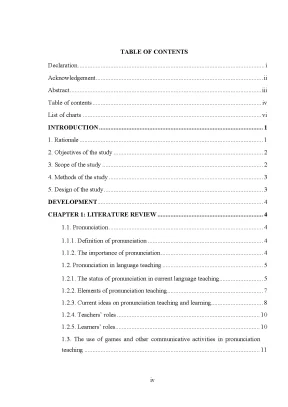
TABLE OF CONTENTS Declaration. iii Table of contents. iv List of charts. Objectives of the study.
Scope of the study. Methods of the study. Design of the study. 4 CHAPTER 1: LITERATURE REVIEW.
Definition of pronunciation. The importance of pronunciation. Pronunciation in language teaching. The status of pronunciation in current language teaching.
Elements of pronunciation teaching. Current ideas on pronunciation teaching and learning. The use of games and other communicative activities in pronunciation teaching. 11 iv TIEU LUAN MOI download : skknchat@gmail.com CHAPTER 2: METHODOLOGY.
Context of the study. Participants of the study. Activities applied in the course. Final oral examination.
20 CHAPTER 3: DATA PRESENTATION, ANALYSIS AND DISCUSSION. Scores in diagnostic test and final oral exam. Responses to the questionnaire. Qualitative results - Teacher‟s notes and observations.
Diagnostic Test Analysis. The researcher‟s observations during class time throughout the course. The effectiveness of games and other stimulating activities. Some disadvantages of the use of games and other stimulating activities.
Limitations of the study and suggestions for further study. 40 APPENDICES v TIEU LUAN MOI download : skknchat@gmail.com LIST OF CHARTS Chart 1: Students‟ scores in diagnostic test and final test Chart 2: The role of pronunciation in language learning Chart 3: The influence of pronunciation on speaking and listening Chart 4: Students‟ evaluation of their own pronunciation Chart 5: Students‟ evaluation of the difficulty of pronunciation Chart 6: Students‟ interest in learning pronunciation Chart 7: Students‟ effort in learning pronunciation Chart 8: Students‟ self-studying time Chart 9: Students‟ evaluation of pronunciation lessons Chart 10: Students‟ evaluation of the effectiveness of pronunciation lessons Chart 11: Students‟ evaluation of class activities Chart 12: Students‟ preference of activities inside class Chart 13: Students‟ preference of activities outside class vi TIEU LUAN MOI download : skknchat@gmail. Rationale It is undeniable that English has become a language of global communication thanks to its contribution to different fields of our life such as: science, technology, aviation, diplomacy and so on. No one can deny that the rapid expansion of information technologies and the spread of globalization have led to an explosion in the demand for English worldwide.
English is now taught throughout of Vietnam in different levels of education from primary schools to universities because it serves as an international language and as a mean to promote mutual understanding and cooperation between Vietnam and other countries. In fact, more and more people desire to know and master English in order to keep them up-to-date with the global development. As a result, English is taught not only at schools and universities but also at many foreign language centres, on radio, television and even via the internet. However, both teaching and learning of English are still far from being satisfaction.
One main problem is that most Vietnamese learners are rather good at English writtenly but not orally. Many of them have a good command of grammar and vocabulary, which promises very high marks in written tests, but cannot communicate successfully with foreigners. The reason lies in the imbalanced development of four language skills. In most schools and universities (except those whose major is English), teachers focus too much on reading and writing rather than speaking and listening of which pronunciation is a good foundation.
Thus, students do not often have English competence, especially in oral communication. In the present context of teaching and learning English at English Department, HANU, speaking and listening are very important for first year students because they establish a firm base for students‟ further development, especially in interpreting skills. In recent years, the department has taken teaching and learning pronunciation into consideration because it is a paramount feature of speaking and listening. Being a teacher of English in general, and pronunciation in particular at English Department, HANU, I am well aware of the importance of pronunciation to 1 TIEU LUAN MOI download : skknchat@gmail.com help my students improve these skills, but like other teachers, I have faced many difficulties in creating motivation so that students are eager to practise in and out of their classes.
After two years teaching pronunciation separately from speaking to first year students, we have realized that the class time is not enough for our students to have great improvement. However, just few students are motivated and spend time self-studying. Thus, even though we have tried our best in class, our students still have a lot of problems in pronunciation, which badly affects their speaking and listening skills. We have questioned ourselves about how to motivate our students to maximize their time of practising in class and even outside class, which leads to the use of games and other stimulating activities.
We have tried activities collected from different sources, which seems to bring about great effect. However, we just have the feeling but not a specific study on how effective they are. Therefore, I have conducted an action research on the application of games and other activities in teaching pronunciation to first year students at English Department, HANU in order to investigate the effectiveness and to help other teachers choose suitable activities for their classes. Objectives of the study The study is aimed at: Finding out their advantages and disadvantages.
Helping pronunciation teachers choose suitable activities for their classes. Thus, this thesis is to answer two research questions: How effective is the use of games and some other stimulating activities? What are students‟ attitude towards the use of games and some other stimulating activities? 3. Scope of the study To create motivation for students in pronunciation classes, teachers at English Department, HANU, have applied a lot of games and activities. However, the researcher in this study only focuses on and analyzes some typical ones (which will be presented in the following parts) and then suggests some effective activities that teachers can introduce to students so that they have more practice outside class.
2 TIEU LUAN MOI download : skknchat@gmail.com There are 10 first year classes which consist of 250 students who have to take pronunciation as a compulsory subject; however, this action research was carried out in only two classes of which the researcher was in charge. Thus, the questionnaire was delivered to only 50 participants. Additionally, the study was conducted in only 12 of the total 32 weeks of pronunciation teaching. Methods of the study Action research is the method employed in this study.
To achieve the aims mentioned above, the researcher has used a number of instruments to collect data for analysis which include a questionnaire distributed before the term started and after it ended, teachers‟ observation and notes, an oral diagnostic test, and end-of- term test. Design of the study This minor thesis is composed of three parts. Part 1, INTRODUCTION, presents the rationale, aims, scope, methods and design of the study. Part 2, DEVELOPMENT, is divided into three chapters.
Chapter 1, Literature Review, presents relevant concepts to pronunciation and pronunciation teaching. Chapter 2, Methodology, involves the information about context, participants and instruments of the study. Chapter 3: Data Presentation, Analysis and Discussion, focuses on data analysis to show students‟ point of view towards pronunciation and the effectiveness of different activities. Part 3, CONLUSION, summarizes some major findings, provide implications for pronunciation teaching, limitation of the study and suggestions for further research.
3 TIEU LUAN MOI download : skknchat@gmail.com DEVELOPMENT CHAPTER 1: LITERATURE REVIEW 1. Definition of pronunciation There are various ways to define pronunciation. Macmillan Dictionary gives an easy-to-understand definition, that is “the way in which a word or language is pronounced”. Similarly, Oxford Advanced Learner‟s Dictionary defines pronunciation as the way in which a language or a particular word or sound is pronounced or the way in which a particular person pronounces the words of a language.
More specifically, pronunciation can be understood as one of the three explanations given in the http://www.com: The act or manner of pronouncing words; utterance of speech. A way of speaking a word, especially a way that is accepted or generally understood. A graphic representation of the way a word is spoken, using phonetic symbols. According to Adult Migrant English Program Research Centre, pronunciation refers to the production of sounds that we use to make meaning.
It includes attention to the particular sounds of a language (segments), aspects of speech beyond the level of the individual sound, such as intonation, phrasing, stress, timing, rhythm (suprasegmental aspects), how the voice is projected (voice quality) and, in its broadest definition, attention to gestures and expressions that are closely related to the way we speak a language. It is obvious that the four sources above do not have the same way to define pronunciation but they share a common knowledge that pronunciation is how words or sentences are spoken. The importance of pronunciation Nowadays, no one can deny the significant role of pronunciation in language teaching and learning. Pronunciation is one of the most important aspects of language.
We may be proficient at grammar and have a huge store of vocabulary, 4 TIEU LUAN MOI download : skknchat@gmail.com but if we pronounce words wrongly, we just will not get understood. Wong (1993) argues that the importance of pronunciation is even more distinct when the connection between pronunciation and listening comprehension is considered. As listeners expect spoken English to follow certain patterns of rhythm and intonation, speakers need to employ these patterns to communicate effectively. If the rhythm and intonation are different, listeners simply can‟t get the meaning.
Similarly, listeners need to know how speech is organized and what patterns of intonation mean in order to interpret speech accurately. Thus, learning about pronunciation develops learners‟ abilities to comprehend spoken English. Furthermore, Wong demonstrated that a lack of knowledge of pronunciation could even affect students‟ reading and spelling. Varonis and Gass (1982) examined the factors affecting listening comprehension in native speakers of English exposed to foreign or second language accents.
They concluded that grammar and pronunciation interact to influence overall intelligibility. As indicated above, it is surely that pronunciation plays a very important role in communicative competence because successful communication can not take place without correct pronunciation (Celce-Murcia, Briton and Goodwin, 1996). Pronunciation in language teaching 1. The status of pronunciation in current language teaching The status of pronunciation teaching in different schools of language teaching has varied widely.
According to Castillo (1990), pronunciation teaching has no role at all in the grammar-translation method, but it is the main focus in the audio-lingual method. The audio-lingual view of the pronunciation class was also mirrored in situational language teaching, developed in Britain (Richards and Rodgers, 1986). During the late 1960's and the 1970's questions were asked about the role of pronunciation in the ESL/EFL curriculum, whether the focus of the programmes and the instructional methods were effective or not. Pronunciation programmes until then were 'viewed as meaningless non-communicative drill-and- exercise gambits' (Morley, 1991).
Purcell and Suter (1980) claimed that the teaching of pronunciation was pushed aside in many language programmes and 5 TIEU LUAN MOI download : skknchat@gmail.com many studies concluded that little relationship exists between teaching pronunciation in the classroom and attained proficiency in pronunciation. They also found out that the strongest factors that affect pronunciation seem to have little to do with classroom activities' Nowadays, teachers and learners have realized the importance of pronunciation in English teaching and learning, however, it still has not received enough attention. In fact, pronunciation tends to be de-emphasized in most English courses because many teachers believe that pronunciation cannot be taught effectively and it is not worth spending time on this field because it should be allowed to develop naturally by students. Although Morley (1991) insisted that it is necessary to teach English pronunciation in the ESL or EFL classroom, this important area is still neglected at many universities and colleges around the world.