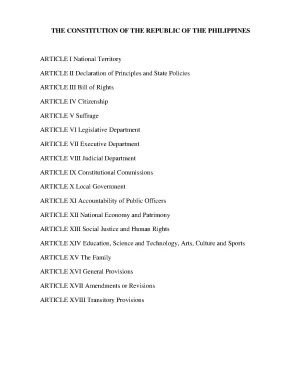
THE CONSTITUTION OF THE REPUBLIC OF THE PHILIPPINES ARTICLE I National Territory ARTICLE II Declaration of Principles and State Policies ARTICLE III Bill of Rights ARTICLE IV Citizenship ARTICLE V Suffrage ARTICLE VI Legislative Department ARTICLE VII Executive Department ARTICLE VIII Judicial Department ARTICLE IX Constitutional Commissions ARTICLE X Local Government ARTICLE XI Accountability of Public Officers ARTICLE XII National Economy and Patrimony ARTICLE XIII Social Justice and Human Rights ARTICLE XIV Education, Science and Technology, Arts, Culture and Sports ARTICLE XV The Family ARTICLE XVI General Provisions ARTICLE XVII Amendments or Revisions ARTICLE XVIII Transitory Provisions Principles PREAMBLE We, the sovereign Filipino people, imploring the aid of Almighty God, in order to build a just and humane society and establish a Government that shall embody our ideals and aspirations, promote the common good, conserve and develop our patrimony, and secure to ourselves and our posterity the blessings of independence and democracy under the rule of law and a regime of truth, justice, freedom, love, equality, and peace, do ordain and promulgate this Constitution. ARTICLE I National Territory The national territory comprises the Philippine archipelago, with all the islands and waters embraced therein, and all other territories over which the Philippines has sovereignty or jurisdiction, consisting of its terrestrial, fluvial, and aerial domains, including its territorial sea, the seabed, the subsoil, the insular shelves, and other submarine areas. The waters around, between, and connecting the islands of the archipelago, regardless of their breadth and dimensions, form part of the internal waters of the Philippines. ARTICLE II Declaration of Principles and State Policies Principles SECTION 1.
The Philippines is a democratic and republican State. Sovereignty resides in the people and all government authority emanates from them. The Philippines renounces war as an instrument of national policy, adopts the generally accepted principles of international law as part of the law of the land and adheres to the policy of peace, equality, justice, freedom, cooperation, and amity with all nations. Civilian authority is, at all times, supreme over the military.
The Armed Forces of the Philippines is the protector of the people and the State. Its goal is to secure the sovereignty of the State and the integrity of the national territory. The prime duty of the Government is to serve and protect the people. The Government may call upon the people to defend the State and, in the fulfillment thereof, all citizens may be required, under conditions provided by law, to render personal military or civil service.
The maintenance of peace and order, the protection of life, liberty, and property, and the promotion of the general welfare are essential for the enjoyment by all the people of the blessings of democracy. The separation of Church and State shall be inviolable. State Policies SECTION 7. The State shall pursue an independent foreign policy.
In its relations with other states the paramount consideration shall be national sovereignty, territorial integrity, national interest, and the right to self-determination. The Philippines, consistent with the national interest, adopts and pursues a policy of freedom from nuclear weapons in its territory. The State shall promote a just and dynamic social order that will ensure the prosperity and independence of the nation and free the people from poverty through policies that provide adequate social services, promote full employment, a rising standard of living, and an improved quality of life for all. The State shall promote social justice in all phases of national development.
The State values the dignity of every human person and guarantees full respect for human rights. The State recognizes the sanctity of family life and shall protect and strengthen the family as a basic autonomous social institution. It shall equally protect the life of the mother and the life of the unborn from conception. The natural and primary right and duty of parents in the rearing of the youth for civic efficiency and the development of moral character shall receive the support of the Government.
The State recognizes the vital role of the youth in nation-building and shall promote and protect their physical, moral, spiritual, intellectual, and social well-being. It shall inculcate in the youth patriotism and nationalism, and encourage their involvement in public and civic affairs. The State recognizes the role of women in nation-building, and shall ensure the fundamental equality before the law of women and men. The State shall protect and promote the right to health of the people and instill health consciousness among them.
The State shall protect and advance the right of the people to a balanced and healthful ecology in accord with the rhythm and harmony of nature. The State shall give priority to education, science and technology, arts, culture, and sports to foster patriotism and nationalism, accelerate social progress, and promote total human liberation and development. The State affirms labor as a primary social economic force. It shall protect the rights of workers and promote their welfare.
The State shall develop a self-reliant and independent national economy effectively controlled by Filipinos. The State recognizes the indispensable role of the private sector, encourages private enterprise, and provides incentives to needed investments. The State shall promote comprehensive rural development and agrarian reform. The State recognizes and promotes the rights of indigenous cultural communities within the framework of national unity and development.
The State shall encourage non-governmental, community-based, or sectoral organizations that promote the welfare of the nation. The State recognizes the vital role of communication and information in nation-building. The State shall ensure the autonomy of local governments. The State shall guarantee equal access to opportunities for public service, and prohibit political dynasties as may be defined by law.
The State shall maintain honesty and integrity in the public service and take positive and effective measures against graft and corruption. Subject to reasonable conditions prescribed by law, the State adopts and implements a policy of full public disclosure of all its transactions involving public interest. ARTICLE III Bill of Rights SECTION 1. No person shall be deprived of life, liberty, or property without due process of law, nor shall any person be denied the equal protection of the laws.
The right of the people to be secure in their persons, houses, papers, and effects against unreasonable searches and seizures of whatever nature and for any purpose shall be inviolable, and no search warrant or warrant of arrest shall issue except upon probable cause to be determined personally by the judge after examination under oath or affirmation of the complainant and the witnesses he may produce, and particularly describing the place to be searched and the persons or things to be seized. (1) The privacy of communication and correspondence shall be inviolable except upon lawful order of the court, or when public safety or order requires otherwise as prescribed by law. (2) Any evidence obtained in violation of this or the preceding section shall be inadmissible for any purpose in any proceeding. No law shall be passed abridging the freedom of speech, of expression, or of the press, or the right of the people peaceably to assemble and petition the government for redress of grievances.
No law shall be made respecting an establishment of religion, or prohibiting the free exercise thereof. The free exercise and enjoyment of religious profession and worship, without discrimination or preference, shall forever be allowed. No religious test shall be required for the exercise of civil or political rights. The liberty of abode and of changing the same within the limits prescribed by law shall not be impaired except upon lawful order of the court.
Neither shall the right to travel be impaired except in the interest of national security, public safety, or public health, as may be provided by law. The right of the people to information on matters of public concern shall be recognized. Access to official records, and to documents, and papers pertaining to official acts, transactions, or decisions, as well as to government research data used as basis for policy development, shall be afforded the citizen, subject to such limitations as may be provided by law. The right of the people, including those employed in the public and private sectors, to form unions, associations, or societies for purposes not contrary to law shall not be abridged.
Private property shall not be taken for public use without just compensation. No law impairing the obligation of contracts shall be passed. Free access to the courts and quasi-judicial bodies and adequate legal assistance shall not be denied to any person by reason of poverty. (1) Any person under investigation for the commission of an offense shall have the right to be informed of his right to remain silent and to have competent and independent counsel preferably of his own choice.
If the person cannot afford the services of counsel, he must be provided with one. These rights cannot be waived except in writing and in the presence of counsel. (2) No torture, force, violence, threat, intimidation, or any other means which vitiate the free will shall be used against him. Secret detention places, solitary, incommunicado, or other similar forms of detention are prohibited.
(3) Any confession or admission obtained in violation of this or Section 17 hereof shall be inadmissible in evidence against him. (4) The law shall provide for penal and civil sanctions for violations of this section as well as compensation to and rehabilitation of victims of torture or similar practices, and their families. All persons, except those charged with offenses punishable by reclusion perpetua when evidence of guilt is strong, shall, before conviction, be bailable by sufficient sureties, or be released on recognizance as may be provided by law. The right to bail shall not be impaired even when the privilege of the writ of habeas corpus is suspended.
Excessive bail shall not be required. (1) No person shall be held to answer for a criminal offense without due process of law. (2) In all criminal prosecutions, the accused shall be presumed innocent until the contrary is proved, and shall enjoy the right to be heard by himself and counsel, to be informed of the nature and cause of the accusation against him, to have a speedy, impartial, and public trial, to meet the witnesses face to face, and to have compulsory process to secure the attendance of witnesses and the production of evidence in his behalf. However, after arraignment, trial may proceed notwithstanding the absence of the accused provided that he has been duly notified and his failure to appear is unjustifiable.
The privilege of the writ of habeas corpus shall not be suspended except in cases of invasion or rebellion when the public safety requires it. All persons shall have the right to a speedy disposition of their cases before all judicial, quasi-judicial, or administrative bodies. No person shall be compelled to be a witness against himself. (1) No person shall be detained solely by reason of his political beliefs and aspirations.
(2) No involuntary servitude in any form shall exist except as a punishment for a crime whereof the party shall have been duly convicted. (1) Excessive fines shall not be imposed, nor cruel, degrading or inhuman punishment inflicted. Neither shall death penalty be imposed, unless, for compelling reasons involving heinous crimes, the Congress hereafter provides for it. Any death penalty already imposed shall be reduced to reclusion perpetua.
(2) The employment of physical, psychological, or degrading punishment against any prisoner or detainee or the use of substandard or inadequate penal facilities under subhuman conditions shall be dealt with by law. No person shall be imprisoned for debt or non-payment of a poll tax. No person shall be twice put in jeopardy of punishment for the same offense. If an act is punished by a law and an ordinance, conviction or acquittal under either shall constitute a bar to another prosecution for the same act.
No ex post facto law or bill of attainder shall be enacted. ARTICLE IV Citizenship SECTION 1.