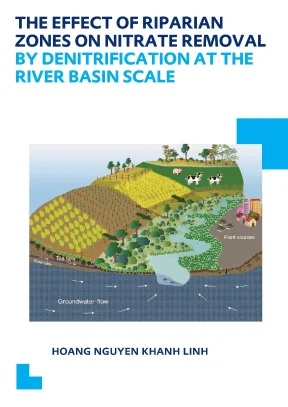
THE EFFECT OF RIPARIAN ZONES ON NITRATE REMOVAL BY DENITRIFICATION AT THE RIVER BASIN SCALE hoang nguyen khanh linh THE EFFECT OF RIPARIAN ZONES ON NITRATE REMOVAL BY DENITRIFICATION AT THE RIVER BASIN SCALE by HOANG NGUYEN KHANH LINH THE EFFECT OF RIPARIAN ZONES ON NITRATE REMOVAL BY DENITRIFICATION AT THE RIVER BASIN SCALE DISSERTATION Submitted in fulfillment of the requirements of the Board for Doctorates of Delft University of Technology and of the Academic Board of the UNESCO-IHE Institute for Water Education for the Degree of DOCTOR to be defended in public on Wednesday, 4 December, 2013 at 10:00 hours in Delft, The Netherlands by HOANG Nguyen Khanh Linh born in Ho Chi Minh city, Vietnam Master of Science in Hydroinformatics (with distinction) UNESCO-IHE, Delft, The Netherlands This dissertation has been approved by the supervisors: Prof. van Griensven Members of the Awarding Committee: Chairman Rector Magnificus, Delft University of Technology Vice-chairman Rector, UNESCO-IHE Prof. Mynett UNESCO-IHE/Delft University of Technology, supervisor Prof. van Griensven UNESCO-IHE/VU Brussel, supervisor Prof.
Savenije Delft University of Technology Prof. McClain UNESCO-IHE/Delft University of Technology Prof. Rousseau Ghent University, Belgium Prof. Fohrer University of Kiel, Germany Prof.
van de Giesen Delft University of Technology, reserve member CRC Press/Balkema is an imprint of the Taylor & Francis Group, an informa business ©2013, Linh Hoang All rights reserved. No part of this publication or the information contained herein may be reproduced, stored in a retrieval system, or transmitted in any form or by any means, electronic, mechanical, by photocopying, recording or otherwise, without written prior permission from the publishers. Although all care is taken to ensure the integrity and quality of this publication and the information herein, no responsibility is assumed by the publishers or the author for any damage to property or persons as a result of the operation or use of this publication and/or the information contained herein. Published by: CRC Press/Balkema PO Box 11320, 2301 EH Leiden, The Netherlands e-mail: Pub.com ISBN: 978-1-138-02405-2 To my dear family ACKNOWLEDGEMENT Delft has been my second home for the past 6 years while I worked towards my MSc and PhD degrees.
Undoubtedly, this is the most important and meaningful chapter of my life when I learned the most, enjoyed the most, fell down sometimes but then grew up more and more. This is the chapter that I will treasure and remember for my whole life. Before closing this chapter, I would like to express my sincere gratitude to all the people, related or not related to my PhD work, who gave me help and support to finish my research. First of all, I would like to convey my sincere gratitude to my promoter, Prof.
Arthur Mynett, who played the most important role to make this PhD finalisation come true. Thank you very much not only for your continuous support but also for your push at the final stages. Although I felt really stressed and exhausted sometimes by the pressure, I know I could not have finished my PhD without it. I thank you for always believing in me and encouraging me by saying ‘Linh, you can do it’, and then I also told myself ‘Yes, I will try as much as I can’.
I am really grateful to you for giving me the chance to attend the IAHR World Congress 2013 in Chengdu, China with you and present our paper. And finally, thank you for all the discussions with you that helped me to find some light in the darkness of this PhD road and feel more confident. Secondly, I would like to express my gratitude to my co-promoter, Prof. Ann van Griensven, who was my supervisor in both Master and PhD theses.
I am truly grateful to you for giving me a chance to continue my PhD following the AQUAREHAB project. Thank you for your guidance, suggestions and help throughout my PhD, especially on SWAT as the main tool for my PhD. I would like to send my deep appreciation to Prof. Jens Christian Refgaards who always gave me very useful suggestions and ideas for my PhD research.
It was my great pleasure to work with you and have very long discussions with you every time I came to Copenhagen. Although it is really a pity that you cannot be present in my defence, I would like to send my great gratitude for your warm welcome, your kind help and your precious time spent with me. I also give my sincere gratitude to Mr. Bertel Nilsson for his great help during my time in GEUS and in Copenhagen.
Thanks for finding a very good accommodation for me, arranging me an office, arranging the key, coming to say hello every morning and helping me with all the data and connections. Your gentle care made me feel warm and welcomed in GEUS and I really enjoyed that time a lot. I also thank Dr. Lars Troldborg for providing me data, Ms.
Heidi Barlebo for your warm welcome to the Hydrology group and my friends in Copenhagen: Xin, Xiulan, Kinza for spending enjoyable time with me during lunch and after working hours. vii Acknowledgement I want to send my special thanks to my landlords Inger and Hans Ole Hansen for providing me such a wonderful accommodation that made me feel like home in Copenhagen. Inger, I cannot express enough my thanks to you for always caring about me in everything I did and your comfort in one of the most terrible moments of my life. I really appreciate your kindness to let me stay in your lovely house the second time when I really needed a private place to work.
My genuine thanks are sent to Sha, my best friend during my PhD. It is such a pleasure to have you beside me in the last 3 years. Thanks for spending enjoyable time with me, considering me as ‘automatically invited guest’ for all your special dinners, helping me every time I need, and being available for me to disturb whenever I have problems. Without you, my PhD life would have been very boring.
I would like to thank my closest colleague Girma, who went along with me for the whole 4- year PhD period. Being in the same project and having the same supervisors brought us close to each other although we are from different countries. Thanks for sharing with me all the difficulties and hard times in this PhD life and having a talk with me everyday. I will not forget the many weekends that we had to spend in TU library to finish our PhD drafts.
Thanks for accompanying me during this difficult and stressful time. My thanks also go to my international friends: Fiona, Yuli, Anuar, Isnaeni, Yos, Sony, Leo for creating such a friendly atmosphere for me to join your Indonesian-Malaysian community. Thanks to Off, Pim, Nat, and Alida to welcome me to your Thai group. Thanks to Dr Suryadi for your support in my life and my PhD, your gentle care during my time in Delft and the time when we were in Chengdu, and countless number of your dinner invitations.
I genuinely feel pleasure to have met and spent such lovely time with all of you. Thanks to my Vietnamese friends in Delft: be Tam, Truong, Khai, Trang, Minh, Vinh, Thang, anh Tu, anh Ngan for sharing good times with me during our gathering which made my life in Delft more lively. Thanks anh Tu and Thang for joining me for skating practice which helped to reduce my stress in the final time of my thesis writing. And thanks to all my friends in Vietnam: my cousin Dao Chi, Phong, Duy, Chau, co Le for all your support and sharing.
Then, I would like to send my deepest and greatest gratitude to the most important persons in my life. First, thanks to my Osin for always being beside me for such a long time and sharing with me everything happening in our lives. Although we live far from each other, I feel that you are always there whenever I need you. Thanks for being such an important part of my life that I would like to treasure it for my whole life.
Your support, encouragement and funny conversations never failed to make me laugh when I was in difficult times. Whatever happens, you are always the most special person in my life. Secondly, thanks to Thuy Phuong for being my best friend for 15 years. Sorry for being away from you for such a long time although you asked me to come back soon.
I cannot express how grateful I am to have you in my life. Although we are not in close contact, our viii Acknowledgements friendship has never changed. Thanks for always being available for me whenever I need you to lift me up. Finally, I would like to send my greatest gratitude to my family: my parents and my younger brother for their unconditional love and endless belief and support for me during my whole life.
I am really grateful to have such good family who wish me the best for my life, always welcome me to return anytime I want and support me in everything I want to do. Thanks to my younger brother to be beside my parents to take care and entertain my parents during my absence. This thesis is dedicated to my family as my most genuine gratefulness to their love and support. Delft, October 2013 Linh Hoang ix SUMMARY The riparian zone, the interface between terrestrial and aquatic ecosystems, plays an important role in nitrogen removal in spite of the minor proportion of the land area that it covers.
This is verified in a large number of studies related to the effect of wetlands/riparian zones on the discharge of nutrients. The nitrogen removal in riparian zones is mostly caused by denitrification, which is favoured by anaerobic condition created by high water level in riparian zones. Most of the studies related to the effect of riparian zones on nitrogen removal are limited to small scales and field work. Very limited research has been carried out in modelling their effects at large scales or river basin scales.
Nowadays, there are many river-basin-scale models available that are able to deal with predictions of pollutant loading from diffuse sources. Several wetland/riparian models are available for simulating hydrological and chemical processes in wetlands/riparian zones. However, there are limited studies on integrating wetland/riparian zone models in river basin modelling for evaluating the effect of wetlands/riparian zones at river basin scales. The SWAT model is a well-known and broadly used model to simulate hydrological and nutrient transport processes.
In terms of riparian zone modelling, there are very few studies in this field, although SWAT does have a sub-module to estimate flow and pollutant retention in buffer strips based on empirical equations which are derived from observations. The main objective of this thesis is to evaluate the effect of riparian zones on nitrate removal at the river basin scale using the SWAT model. This thesis focused on modifying the SWAT model by (i) adding the landscape routing concept across different landscape units and (ii) adding the Riparian Nitrogen Model (RNM) in SWAT to simulate the denitrification process in riparian zones. The first modification aims at taking into account the landscape position of a Hydrological Response Unit (HRU) and creating a relationship between HRUs in upland and in lowland landscape units which is considered important for flow and pollutant transport processes.
Based on the first modification, the second modification introduces a conceptual model called Riparian Nitrogen Model into SWAT for representing denitrification process in HRUs that belong to riparian zones. In this model, the denitrification rate is assumed to decline with depth and the denitrification process is activated below the groundwater table.