Vietnam Taxation Textbook: Theory, Law & Administration (Academy of Finance)

Nghiên cứu sâu về thuế, chương 1 và 2 của giáo trình thuế cung cấp kiến thức nền tảng về khái niệm, nguyên tắc và hệ thống thuế hiện hành.

Trường đại học

Học viện Tài chính Việt Nam

Chuyên ngành

Thuế

Người đăng

Ẩn danh

Thể loại

Giáo trình

2019

66
0
0

Phí lưu trữ

30 Point

Tóm tắt

I. Tổng quan về sách giáo khoa thuế Việt Nam

Cuốn sách 'Taxation Textbook for Vietnam: Theory, Law & Administration' là một tài liệu giảng dạy và học tập bằng tiếng Anh về thuế tại Việt Nam. Được xuất bản lần đầu năm 2013 và cập nhật lần hai năm 2019, cuốn sách cung cấp kiến thức có hệ thống về lý thuyết thuế, các nội dung và vấn đề cốt lõi của pháp luật thuế, cũng như quản lý thuế hiện hành. Mục tiêu chính là nâng cao trình độ tiếng Anh chuyên ngành cho sinh viên kinh tế và cung cấp nguồn tham khảo chất lượng cho người nghiên cứu, làm việc liên quan đến thuế. Nội dung sách phản ánh những thay đổi quan trọng trong luật thuế Việt Nam và các vấn đề thuế quốc tế mới phát sinh, đặc biệt trong bối cảnh kinh tế số và cách mạng công nghiệp lần thứ tư. Sách được thiết kế với các bài tập và minh họa thực tế, giúp người học nắm vững kiến thức lý thuyết và áp dụng vào thực tiễn quản lý thuế một cách hiệu quả.

1.1. Mục tiêu và đối tượng của sách giáo khoa

Cuốn sách đặt ra hai mục tiêu chính: trang bị kiến thức nền tảng về thuế và phát triển năng lực tiếng Anh chuyên ngành cho người học. Đối tượng hướng đến là sinh viên đại học chuyên ngành kinh tế có trình độ tiếng Anh trung cấp trở lên. Ngoài ra, sách cũng phục vụ các nhà nghiên cứu, giảng viên và chuyên gia thuế cần tham khảo tài liệu bằng tiếng Anh về hệ thống thuế Việt Nam. Nội dung được biên soạn để đảm bảo tính logic, từ tổng quan lý thuyết đến chi tiết pháp luật và ứng dụng quản lý, giúp người học tiếp cận chủ đề phức tạp này một cách có hệ thống và hiệu quả.

1.2. Quá trình soạn thảo và cập nhật

Quá trình soạn thảo cuốn sách bắt nguồn từ nhu cầu cấp thiết về tài liệu giảng dạy bằng tiếng Anh tại Học viện Tài chính Việt Nam. Lần xuất bản đầu tiên năm 2013 đánh dấu bước khởi đầu quan trọng. Sau 5 năm sử dụng, nhiều nội dung trở nên lỗi thời do những sửa đổi lớn trong luật thuế Việt Nam và sự xuất hiện các vấn đề thuế quốc tế mới. Vì vậy, phiên bản năm 2019 đã được cập nhật toàn diện, bổ sung các thay đổi then chốt trong pháp luật thuế và hiện đại hóa nội dung quản lý thuế. Các bài tập cũng được sửa đổi và bổ sung thêm, đảm bảo tính thực tiễn và phù hợp với bối cảnh mới.

II. Phân tích các vấn đề và thách thức trong giáo dục thuế Việt Nam

Giáo dục thuế tại Việt Nam đối mặt với nhiều thách thức do bản chất phức tạp và liên tục biến đổi của hệ thống thuế. Thứ nhất, pháp luật thuế thường xuyên được sửa đổi, bổ sung để thích ứng với sự phát triển kinh tế, đòi hỏi tài liệu giảng dạy phải được cập nhật liên tục. Thứ hai, việc giảng dạy các chủ đề thuế bằng tiếng Anh gặp khó khăn do sự khác biệt về thuật ngữ và khung pháp lý giữa các quốc gia. Thứ ba, người học cần không chỉ lý thuyết mà còn kỹ năng thực hành để xử lý các tình huống thuế thực tế. Cuốn sách giáo khoa thuế ra đời nhằm giải quyết những vấn đề này bằng cách cung cấp kiến thức cập nhật, kết hợp lý thuyết và thực hành, đồng thời xây dựng vốn từ vựng chuyên ngành tiếng Anh cho người học một cách có hệ thống.

2.1. Sự phức tạp và thay đổi của luật thuế

Hệ thống thuế Việt Nam đã trải qua ba giai đoạn cải cách lớn kể từ những năm 1990, từ việc hình thành nền tảng thuế cho kinh tế đa thành phần đến việc cải cách toàn diện và hiện đại hóa thủ tục thuế. Mỗi giai đoạn đều mang đến những thay đổi đáng kể trong luật giá trị gia tăng, thuế thu nhập doanh nghiệp, thuế tiêu thụ đặc biệt và thuế xuất nhập khẩu. Sự thay đổi nhanh chóng này tạo ra khoảng cách giữa tài liệu giảng dạy và thực tiễn, đặt ra yêu cầu cấp bách phải có sách giáo khoa cập nhật. Cuốn sách giải quyết vấn đề này bằng việc tích hợp các sửa đổi luật mới nhất và phân tích các xu hướng thuế quốc tế hiện đại.

2.2. Thách thức trong giảng dạy thuế bằng tiếng Anh

Giảng dạy thuế bằng tiếng Anh tại Việt Nam gặp một số trở ngại. Sự khác biệt về hệ thống pháp luật và thuật ngữ thuế giữa tiếng Việt và tiếng Anh có thể gây nhầm lẫn cho người học. Ngoài ra, nhiều khái niệm thuế Việt Nam không có tương đương trực tiếp trong tiếng Anh, đòi hỏi cách giải thích và dịch thuật chuyên sâu. Cuốn sách giáo khoa thuế được biên soạn để vượt qua thách thức này bằng cách cung định nghĩa rõ ràng, giải thích ngữ cảnh pháp lý Việt Nam và sử dụng ví dụ minh họa cụ thể. Điều này giúp sinh viên xây dựng vốn từ vựng chuyên ngành vững chắc và hiểu sâu sắc các quy định thuế trong bối cảnh quốc tế.

III. Giải pháp và phương pháp tiếp cận trong sách giáo khoa thuế

Cuốn sách giáo khoa thuế áp dụng nhiều giải pháp và phương pháp tiếp cận hiệu quả để giải quyết các vấn đề trong giáo dục thuế. Giải pháp đầu tiên là việc cập nhật thường xuyên nội dung để phản ánh kịp thời những sửa đổi pháp luật và xu hướng quản lý thuế hiện đại. Phương pháp thứ hai là kết hợp lý thuyết thuế nền tảng với phân tích pháp luật chi tiết và ví dụ thực tiễn từ quản lý thuế Việt Nam. Sách cũng chú trọng phát triển kỹ năng thực hành thông qua các bài tập được thiết kế lại và bổ sung, giúp người học áp dụng kiến thức vào giải quyết tình huống thực tế. Cách trình bày logic, từ tổng quan đến chi tiết, giúp người học tiếp cận chủ đề phức tạp một cách có hệ thống, xây dựng nền tảng vững chắc cả về kiến thức chuyên môn lẫn năng lực tiếng Anh chuyên ngành.

3.1. Cập nhật pháp luật và thực tiễn quản lý thuế

Một giải pháp cốt lõi của cuốn sách là việc cập nhật liên tục các thay đổi trong pháp luật thuế Việt Nam. Phiên bản 2019 đã tích hợp những sửa đổi quan trọng trong luật thuế giá trị gia tăng, thuế thu nhập doanh nghiệp và các sắc thuế khác. Nội dung cũng được mở rộng để đề cập đến các vấn đề thuế mới nổi trong nền kinh tế số và cuộc cách mạng công nghiệp lần thứ tư. Phần quản lý thuế được hiện đại hóa, phản ánh những cải cách trong thủ tục hành chính thuế, khai thuế điện tử và quản lý rủi ro. Điều này đảm bảo người học tiếp cận kiến thức mới nhất, phù hợp với thực tiễn quản lý thuế tại Việt Nam hiện nay.

3.2. Phương pháp học tập và bài tập thực hành

Cuốn sách áp dụng phương pháp học tập lấy người học làm trung tâm, kết hợp giữa lý thuyết và thực hành. Hệ thống bài tập đã được sửa đổi và bổ sung để tăng tính tương tác và ứng dụng. Các bài tập bao gồm câu hỏi thảo luận, bài tập tính toán và tình huống thực tế, giúp người học rèn luyện kỹ năng phân tích và giải quyết vấn đề thuế. Cách trình bày nội dung rõ ràng, với các ví dụ minh họa cụ thể về quy định thuế và thủ tục quản lý, hỗ trợ việc hiểu và ghi nhớ kiến thức. Phương pháp này giúp sinh viên không chỉ nắm vững lý thuyết mà còn phát triển năng lực thực hành cần thiết cho công việc liên quan đến thuế.

IV. Kết luận và ứng dụng thực tiễn của sách giáo khoa thuế

Cuốn sách giáo khoa thuế đóng vai trò quan trọng trong việc nâng cao chất lượng giáo dục thuế tại Việt Nam, đặc biệt trong bối cảnh hội nhập quốc tế. Nó cung cấp một nguồn tài liệu học tập và tham khảo toàn diện, kết hợp giữa lý thuyết thuế, pháp luật thuế hiện hành và quản lý thuế thực tiễn. Giá trị của sách thể hiện ở khả năng đáp ứng nhu cầu học tập đa dạng của sinh viên, nhà nghiên cứu và người làm nghề thuế. Ứng dụng thực tiễn của cuốn sách rất rộng rãi: từ giảng dạy đại học, tự học, nghiên cứu khoa học đến tham khảo chuyên môn trong công tác thuế. Sự cập nhật liên tục đảm bảo kiến thức luôn phù hợp với thực tiễn, giúp người học và người làm nghề thuế thích ứng với những thay đổi nhanh chóng của hệ thống thuế.

4.1. Giá trị đối với sinh viên và người học

Đối với sinh viên, cuốn sách là công cụ học tập hữu ích giúp tiếp cận kiến thức thuế một cách có hệ thống bằng tiếng Anh. Nội dung từ tổng quan đến chi tiết, với các ví dụ và bài tập thực hành, hỗ trợ việc nắm vững lý thuyết và áp dụng vào thực tế. Sách cũng giúp xây dựng vốn từ vựng chuyên ngành tiếng Anh phong phú, nâng cao năng lực cạnh tranh trong môi trường làm việc quốc tế. Đối với người tự học, sách cung cấp lộ trình học tập rõ ràng, từ cơ bản đến nâng cao, giúp tiếp cận chủ đề phức tạp một cách dễ hiểu và hiệu quả.

4.2. Ứng dụng trong nghiên cứu và thực hành thuế

Trong lĩnh vực nghiên cứu, cuốn sách là nguồn tham khảo giá trị về hệ thống thuế Việt Nam, cung cấp nền tảng lý thuyết và pháp luật cho các công trình khoa học. Các chuyên gia thuế và nhà nghiên cứu có thể sử dụng sách để hiểu sâu sắc các quy định thuế, so sánh với thông lệ quốc tế và phân tích xu hướng phát triển. Trong thực hành, cuốn sách giúp người làm nghề thuế cập nhật kiến thức mới, hiểu rõ quy trình quản lý thuế và áp dụng vào công tác tư vấn, khai thuế và tuân thủ pháp luật. Giá trị ứng dụng thực tiễn cao là ưu điểm nổi bật của cuốn sách.
Tóm tắt và mô tả trên trang này được tạo với sự hỗ trợ của AI từ nội dung tài liệu gốc; tài liệu do người dùng đóng góp và được kiểm duyệt trước khi xuất bản. Báo lỗi nội dung.

28/05/2026
Taxation textbook chapter 1 2

Trích đoạn nội dung tài liệu

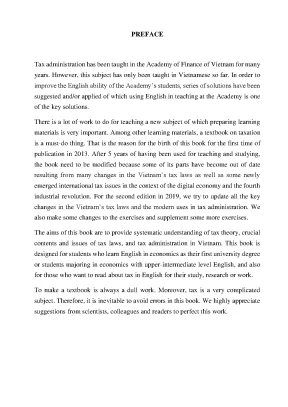
PREFACE Tax administration has been taught in the Academy of Finance of Vietnam for many years. However, this subject has only been taught in Vietnamese so far. In order to improve the English ability of the Academy’s students, series of solutions have been suggested and/or applied of which using English in teaching at the Academy is one of the key solutions. There is a lot of work to do for teaching a new subject of which preparing learning materials is very important.

Among other learning materials, a textbook on taxation is a must-do thing. That is the reason for the birth of this book for the first time of publication in 2013. After 5 years of having been used for teaching and studying, the book need to be modified because some of its parts have become out of date resulting from many changes in the Vietnam’s tax laws as well as some newly emerged international tax issues in the context of the digital economy and the fourth industrial revolution. For the second edition in 2019, we try to update all the key changes in the Vietnam’s tax laws and the modern uses in tax administration.

We also make some changes to the exercises and supplement some more exercises. The aims of this book are to provide systematic understanding of tax theory, crucial contents and issues of tax laws, and tax administration in Vietnam. This book is designed for students who learn English in economics as their first university degree or students majoring in economics with upper-intermediate level English, and also for those who want to read about tax in English for their study, research or work. To make a textbook is always a dull work.

Moreover, tax is a very complicated subject. Therefore, it is inevitable to avoid errors in this book. We highly appreciate suggestions from scientists, colleagues and readers to perfect this work. ACKNOWLEGEMENTS We at first wish to thank Associate Prof.

Nguyen Trong Co, Chairman of the Academy of Finance and Prof. Ngo The Chi, Ex-Chairman of the Academy of Finance for their encouragement and special help. We owe a special thanks to the following colleagues for their valuable comments and suggestions: Pham Van Lien, Associate Prof, PhD, Ex-Vice Chairman of the Academy of Finance; Dang Duc Son, Associate Prof, PhD, Head of Department of Accounting, School of Economics, National University of Vietnam in Hanoi; Do Van Anh, MBA, Head of Department of Auditing, Hanoi University; Vuong Thi Thu Hien, Prof, PhD, Vice head of Department of Taxation, Faculty of Taxation and Customs, Academy of Finance; Mai Ngoc Anh, Prof, PhD, Dean of Faculty of Accounting, Academy of Finance. Special thanks also to our colleagues in the Department of Scientific Management for their efficient coordination and their help in editing and publishing this book.

Many thanks also to our colleagues in the Faculty of Taxation and Customs, Academy of Finance for their encouragement and good advice. THE AUTHORS Le Xuan Truong, Associate Professor, Doctor of Philosophy in Economics, BA in English, Dean of Faculty of Taxation and Customs, Academy of Finance of Vietnam: Co-chief Author, writer of chapter 3 and 5, co-writer of chapter 1 and 7 Nguyen Thi Thanh Hoai, Doctor of Philosophy in Economics, Vice Dean of Faculty of Taxation and Customs, Head of Department of Taxation, Academy of Finance of Vietnam: Co-chief Author, writer of chapter 2 and 8, co-writer of chapter 9 Nguyen Van Hieu, Associate Professor, Doctor of Philosophy in Economics, MBA (Aus), Head of Department of Finance, School of Economics, National University in Hanoi: Writer of chapter 4 Ly Phuong Duyen, Associate Professor, Doctor of Philosophy in Economics, Lecturer of Faculty of Taxation and Customs, Academy of Finance of Vietnam: Writer of chapter 6 Truong Thi Minh Hanh, MA (Aus), Vice Head of Department of Financial English, Faculty of Foreign languages, Academy of Finance of Vietnam, co-writer of chapter 1 and 9 Truong Ba Tuan, MBA (Aus), Vice Director of National Institute for Finance: Co writer of chapter 7 CHAPTER 1 AN OVERVIEW OF TAXATION LEARNING OBJECTIVES After reading this chapter, you should be able to: 1. Define terms related to taxes and tax policy. Distinguish tax revenues from other revenues of the government.

Give reasons why we have taxes. Explain the principles of taxation. Describe the major types of taxes. Describe the standards of a modern tax system.

Describe the basic elements of a tax law. CONCEPTS AND CHARACTERISTICS OF TAX To many people, tax is considered to be something they have to pay to the government but for which they receive nothing directly in return. So tax is just understood as whatever (money or assets) a person or an entity has to pay compulsorily to the government in order to finance the government’s activities. This perception derives from the fact that people only see the act of tax payment from the citizens to the government both in cash and by other assets such as rice or wheat etc.

According to the Mc Milan Dictionary of Accounting, “Taxes are compulsory levies made by public authorities for which nothing is received directly in return. They are used in part to provide public goods”.1 The Longman Dictionary of Business English defines tax as “A payment of money legally demanded by a government authority to meet public expenses”.2 In our opinion, tax is a part of income which is legally stipulated and compulsorily paid by citizens to the government in order to finance the public expenditures. From the concepts of tax mentioned above, the following characteristics can be seen: Firstly, tax is a compulsory payment. This compulsory nature is attached to the power of the government.

The way to tax is very different from the way to get many other revenues of the government which can be got voluntarily such as the sale of government’s properties, loans, grants or donations, etc. If taxes were paid voluntarily, very few people would pay because they would get no direct benefits in exchange for paying taxes. But unlike fines, taxes are not paid as punishment for breaking a law or rule. The payment of taxes is not accompanied with the law violations but the apparent responsibility of the citizens to the state.

Secondly, tax is an indirect compensation payment. Taxpayers get nothing directly in exchange for paying taxes. Although taxpayers can eventually benefit from the public goods and services provided by the government such as security, national defense and roads. They get no immediate benefits in return for their tax payment.

Parker (2002): Mc Milan Dictionary of Accounting, second edition, page 279. Adam: Longman Dictionary of Business English, page 433 They cannot demand the government to provide public services before they pay taxes or right after they pay taxes. Also, the public services and the amount of taxes are not positively related. THE ROLES OF TAX 1.

MAIN REVENUES OF THE GOVERNMENT’S BUDGET This is the primary role of tax. In order to get the money for public expenditures as well as to finance for the governments’ activities, the governments look for many revenue sources such as the sale of the state’s property (natural resources, for example), fees, voluntary donations, loans, etc., among which tax is the most important source. Tax revenue is the core part of the government’s budget because tax is compulsory and made by a wide range of payers whose incomes are produced by their economic activities. Human beings cannot exist without economic activities which people do to earn a living such as farming, fishing, mining, tourism and manufacturing.

Thus, as long as men exist, the sources of tax are available. Tax has an important advantage concerning to its compulsoriness. With voluntary donation, governments cannot be sure of how much they can get. Loans are not only dependent on the willingness of the lender but also must be repaid at maturity date.

With its compulsoriness, tax revenue will be firmly paid to the government’s budget. The wide range of payers makes tax superior to some other budget’s sources. While natural resources and some other budget’s sources are limited, tax is endless. Even though in some Gulf countries where crude oil, but not tax, is the main part of the budget of the governments, these governments cannot rely forever on crude oil since it may be abundant but not unlimited.

Crude oil one day will become exhausted. Fees can only apply to non-pure public goods and services such as roads and bridges. In order to bring into full play of this tax’s role, the government has to deliberately consider the elements of each tax among which tax base and rate count most. If the base is not clear and sufficient, it can be eroded, and of course, the tax amount paid to the budget reduces.

Some may think that the higher the tax rate is, the higher the tax revenue will flow into the state budget. Unfortunately, this is not always true. To some extent, as the tax rate increases (up to a certain level), the tax revenue brought in goes up. When the tax rate continues to rise, the tax amount brought in falls.

This law is known as Laffer curve which was named after an American economist who drew the curve to illustrate his concept while he argued against President Gerald Ford’s tax increase in 1974 although Laffer has never claimed to have invented the concept, explaining that he has learned it from Ibn Khaldun and John Maynard Keynes. Laffer curve can be seen as follows: Tax revenue 0 100% Tax rate The importance of tax to the state budget can be seen in the following example: EXAMPLE 1.1: State budget revenue structures of EU and OECD (1998) Group of Tax Revenues from compulsory Others Total countries revenue social contributions OECD 70.1% 100% [Source: Herve Dutel, The socio-economic context of public finance, Lecture of FSP, Hanoi 2003] The above example shows that in 1998 tax revenue percentage is the largest part of the total budget revenue of OECD and EU countries, reaching nearly three quarter of the total state budget. MACRO ECONOMIC ACTIVITIES ADJUSTMENT As tax affects the income of enterprises and citizens, it can impact the motive of labor and investment; therefore, it can adjust some major factors of the economy such as the supply of labor, the demand of labor and capital, and the aggregate demand and supply of the economy as a whole. We will discuss how tax can help adjust the economic activities in the following section.

Firstly, tax helps to regulate the economic cycle. As many economists have proven, the global economy as well as each economy all over the world goes up and down cyclically through four stages including recession, crisis, recovery, and prosperity. Crisis, of course, does harm to the development of the economy but too fast economic growth is also harmful to the development of the economy. Too fast economic growth may cause some unbalances to the normal trend.

For example, too fast economic growth may cause lack of the labor supply or the exhaust of the natural resources and so on. Therefore, to maintain an appropriate economic growth is of great significance to every economy. One of the functions of the government is to make the economy develop stably. In order to fulfill this function, the government uses some tools such as public expenditure policy, monetary policy, and tax policy.

How can tax help to regulate economic cycle? This is a very complicated issue but here in this basic chapter of a textbook on taxation, we introduce two of the simplest ways as below: (i) If the economy shows a sign of too fast growing, the government can increase the corporate income tax. An increase in the corporate income tax can force firms to charge a higher price in order to shift tax burden to consumers if possible or bear the tax themselves.

Nội dung được bảo vệ bản quyền — Tải xuống đầy đủ