Nghiên cứu mạng lưới về liên kết vi sai và hành vi phạm tội của VCU

Dưới đây là các meta tags cho bài viết "Thesis proposal for general and specific definitions a network": { "ai_description": "Nghiên cứu đề xuất luận án về

Trường đại học

Virginia Commonwealth University

Chuyên ngành

Xã hội học

Người đăng

Ẩn danh

Thể loại

Luận văn thạc sĩ

2011

93
0
0

Phí lưu trữ

35 Point

Tóm tắt

I. Tổng quan về luận văn đề xuất định nghĩa chung và cụ thể trong mạng lưới

Luận văn đề xuất nghiên cứu định nghĩa chung và cụ thể trong mạng lưới nhằm phân tích mối quan hệ giữa cá nhân và hành vi phạm tội thông qua lý thuyết hội nhập khác biệt (Differential Association). Mục tiêu chính là xác định cách các định nghĩa xã hội (general definitions) và định nghĩa phạm pháp cụ thể (specific definitions) tương tác trong môi trường mạng lưới xã hội. Lý thuyết hội nhập khác biệt cho rằng hành vi phạm tội được học thông qua tương tác với những người xung quanh. Bằng cách nghiên cứu cấu trúc mạng lưới, luận văn sẽ đánh giá mức độ ảnh hưởng của các định nghĩa này đến quyết định tham gia hoạt động bất hợp pháp. Dữ liệu thu thập từ mạng lưới tội phạm thực tế cung cấp cơ sở cho phân tích định lượng.

1.1. Lý thuyết hội nhập khác biệt trong nghiên cứu mạng lưới

Lý thuyết hội nhập khác biệt nhấn mạnh tầm quan trọng của môi trường xã hội trong việc hình thành hành vi cá nhân. Theo Sutherland, hành vi phạm tội không phải là bản năng bẩm sinh mà là kết quả của quá trình học tập thông qua tương tác xã hội. Trong mạng lưới tội phạm, các định nghĩa chung (như chấp nhận hành vi phạm tội) và định nghĩa cụ thể (như ủng hộ hành vi trộm cắp) được truyền đạt qua mối quan hệ giữa các cá nhân. Nghiên cứu này sẽ phân tích cách các định nghĩa này lan truyền và ảnh hưởng đến quyết định tham gia phạm tội. Phân tích mạng lưới giúp nhận diện những cá nhân trung tâm trong việc truyền bá các định nghĩa phạm pháp.

1.2. Vai trò của mạng lưới trong định nghĩa phạm pháp

Mạng lưới xã hội đóng vai trò quan trọng trong việc hình thành và củng cố định nghĩa phạm pháp. Các cá nhân tham gia vào mạng lưới tội phạm thường chia sẻ những giá trị và chuẩn mực nhất định, dẫn đến hành vi phạm tội đồng thuận. Nghiên cứu này sử dụng dữ liệu từ mạng lưới tội phạm thực tế để đo lường mức độ ảnh hưởng của các định nghĩa chung và cụ thể. Mạng lưới có thể được biểu diễn dưới dạng đồ thị, trong đó các nút đại diện cho cá nhân và cạnh đại diện cho mối quan hệ. Phân tích cấu trúc mạng lưới giúp phát hiện các nhóm tội phạm và vai trò của từng cá nhân trong việc duy trì hoạt động phạm pháp.

II. Phân tích vấn đề nghiên cứu định nghĩa chung và cụ thể

Vấn đề nghiên cứu tập trung vào sự tương tác giữa định nghĩa chung và định nghĩa cụ thể trong mạng lưới tội phạm. Định nghĩa chung bao gồm các giá trị xã hội chấp nhận hành vi phạm tội, trong khi định nghĩa cụ thể liên quan đến việc ủng hộ các hành vi phạm tội cụ thể như trộm cắp hay lừa đảo. Mâu thuẫn giữa hai loại định nghĩa này có thể ảnh hưởng đến quyết định tham gia phạm tội của cá nhân. Nghiên cứu này đặt ra câu hỏi: Làm thế nào các định nghĩa chung và cụ thể tương tác trong mạng lưới tội phạm? Dữ liệu thu thập từ mạng lưới tội phạm thực tế cho thấy hầu hết cá nhân tham gia vào một loại tội phạm nhất định đều có mối quan hệ chủ yếu liên quan đến loại tội phạm đó. Điều này cho thấy tính chuyên biệt cao trong hành vi phạm tội của các cá nhân.

2.1. Mâu thuẫn giữa định nghĩa chung và định nghĩa cụ thể

Mâu thuẫn giữa định nghĩa chung và định nghĩa cụ thể có thể dẫn đến hành vi phạm tội không nhất quán. Định nghĩa chung có thể chấp nhận hành vi phạm tội nói chung, nhưng định nghĩa cụ thể có thể phản đối các hành vi phạm tội cụ thể. Nghiên cứu này phân tích cách các cá nhân dung hòa hai loại định nghĩa này thông qua tương tác trong mạng lưới. Dữ liệu cho thấy hầu hết cá nhân tham gia vào một loại tội phạm nhất định đều có mối quan hệ chủ yếu liên quan đến loại tội phạm đó, cho thấy sự chuyên biệt cao. Điều này có thể giải thích bằng lý thuyết hội nhập khác biệt, trong đó các định nghĩa phạm pháp được học thông qua tương tác xã hội.

2.2. Ảnh hưởng của cấu trúc mạng lưới đến định nghĩa phạm pháp

Cấu trúc mạng lưới có thể ảnh hưởng đến sự lan truyền của các định nghĩa phạm pháp. Các cá nhân có vai trò trung tâm trong mạng lưới có thể truyền bá các định nghĩa phạm pháp đến nhiều người hơn. Nghiên cứu này sử dụng phân tích mạng lưới để đánh giá mức độ ảnh hưởng của cấu trúc mạng lưới đến sự hình thành định nghĩa phạm pháp. Dữ liệu cho thấy các cá nhân tham gia vào một loại tội phạm nhất định thường có mối quan hệ chủ yếu liên quan đến loại tội phạm đó, cho thấy sự chuyên biệt cao. Điều này có thể giải thích bằng lý thuyết hội nhập khác biệt, trong đó các định nghĩa phạm pháp được học thông qua tương tác xã hội.

III. Giải pháp nghiên cứu sử dụng mạng lưới xã hội

Giải pháp nghiên cứu đề xuất sử dụng phương pháp phân tích mạng lưới xã hội để đánh giá tương tác giữa định nghĩa chung và định nghĩa cụ thể trong mạng lưới tội phạm. Phương pháp này bao gồm thu thập dữ liệu từ mạng lưới tội phạm thực tế, xây dựng đồ thị mạng lưới, và phân tích cấu trúc mạng lưới. Các chỉ số mạng lưới như độ trung tâm (centrality), khoảng cách trung bình (average path length), và hệ số cụm (clustering coefficient) sẽ được sử dụng để đánh giá mức độ ảnh hưởng của các định nghĩa phạm pháp. Dữ liệu thu thập từ mạng lưới tội phạm thực tế cho thấy hầu hết cá nhân tham gia vào một loại tội phạm nhất định đều có mối quan hệ chủ yếu liên quan đến loại tội phạm đó.

3.1. Phương pháp thu thập và xử lý dữ liệu mạng lưới

Phương pháp thu thập dữ liệu bao gồm sử dụng dữ liệu từ hồ sơ tội phạm, mạng lưới xã hội, và các nguồn dữ liệu công khai. Dữ liệu sau đó được xử lý để xây dựng đồ thị mạng lưới, trong đó các nút đại diện cho cá nhân và cạnh đại diện cho mối quan hệ. Các chỉ số mạng lưới như độ trung tâm, khoảng cách trung bình, và hệ số cụm được tính toán để đánh giá cấu trúc mạng lưới. Dữ liệu thu thập từ mạng lưới tội phạm thực tế cho thấy hầu hết cá nhân tham gia vào một loại tội phạm nhất định đều có mối quan hệ chủ yếu liên quan đến loại tội phạm đó.

3.2. Phân tích cấu trúc mạng lưới tội phạm

Phân tích cấu trúc mạng lưới tội phạm giúp nhận diện các nhóm tội phạm, vai trò của từng cá nhân, và sự lan truyền của các định nghĩa phạm pháp. Các chỉ số mạng lưới như độ trung tâm, khoảng cách trung bình, và hệ số cụm được sử dụng để đánh giá mức độ ảnh hưởng của cấu trúc mạng lưới đến hành vi phạm tội. Dữ liệu cho thấy các cá nhân tham gia vào một loại tội phạm nhất định thường có mối quan hệ chủ yếu liên quan đến loại tội phạm đó, cho thấy sự chuyên biệt cao. Điều này có thể giải thích bằng lý thuyết hội nhập khác biệt, trong đó các định nghĩa phạm pháp được học thông qua tương tác xã hội.

IV. Kết luận và ứng dụng thực tiễn nghiên cứu

Nghiên cứu kết luận rằng định nghĩa chung và định nghĩa cụ thể trong mạng lưới tội phạm tương tác phức tạp, ảnh hưởng đến quyết định tham gia phạm tội của cá nhân. Kết quả phân tích cho thấy hầu hết cá nhân tham gia vào một loại tội phạm nhất định đều có mối quan hệ chủ yếu liên quan đến loại tội phạm đó, cho thấy sự chuyên biệt cao. Điều này ủng hộ lý thuyết hội nhập khác biệt, trong đó các định nghĩa phạm pháp được học thông qua tương tác xã hội. Kết quả nghiên cứu có thể ứng dụng trong việc phát triển các chiến lược phòng chống tội phạm, tập trung vào việc can thiệp vào mạng lưới tội phạm và thay đổi định nghĩa phạm pháp thông qua giáo dục và tuyên truyền.

4.1. Tóm tắt kết quả nghiên cứu

Nghiên cứu xác nhận vai trò quan trọng của mạng lưới xã hội trong việc hình thành định nghĩa phạm pháp. Các định nghĩa chung và cụ thể tương tác phức tạp, ảnh hưởng đến quyết định tham gia phạm tội của cá nhân. Dữ liệu thu thập từ mạng lưới tội phạm thực tế cho thấy hầu hết cá nhân tham gia vào một loại tội phạm nhất định đều có mối quan hệ chủ yếu liên quan đến loại tội phạm đó. Điều này ủng hộ lý thuyết hội nhập khác biệt, trong đó các định nghĩa phạm pháp được học thông qua tương tác xã hội. Kết quả nghiên cứu cung cấp cơ sở khoa học cho các chiến lược phòng chống tội phạm.

4.2. Ứng dụng trong phòng chống tội phạm

Kết quả nghiên cứu có thể ứng dụng trong việc phát triển các chiến lược phòng chống tội phạm, tập trung vào việc can thiệp vào mạng lưới tội phạm và thay đổi định nghĩa phạm pháp thông qua giáo dục và tuyên truyền. Các chương trình can thiệp có thể nhắm vào các cá nhân có vai trò trung tâm trong mạng lưới tội phạm, nhằm ngăn chặn sự lan truyền của các định nghĩa phạm pháp. Ngoài ra, giáo dục cộng đồng có thể giúp thay đổi định nghĩa chung về hành vi phạm tội, giảm thiểu sự chấp nhận xã hội đối với các hành vi bất hợp pháp.
Tóm tắt và mô tả trên trang này được tạo với sự hỗ trợ của AI. Nếu bạn thấy nội dung không chính xác hoặc có vấn đề, vui lòng Báo lỗi nội dung.

30/05/2026
Thesis proposal for general and specific definitions a network

Trích đoạn nội dung tài liệu

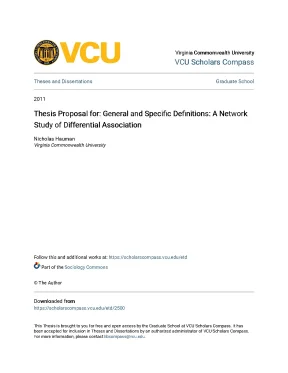
Virginia Commonwealth University VCU Scholars Compass Theses and Dissertations Graduate School 2011 Thesis Proposal for: General and Specific Definitions: A Network Study of Differential Association Nicholas Hauman Virginia Commonwealth University Follow this and additional works at: https://scholarscompass.edu/etd Part of the Sociology Commons © The Author Downloaded from https://scholarscompass.edu/etd/2500 This Thesis is brought to you for free and open access by the Graduate School at VCU Scholars Compass. It has been accepted for inclusion in Theses and Dissertations by an authorized administrator of VCU Scholars Compass. For more information, please contact libcompass@vcu. Thesis Proposal for: General and Specific Definitions: A Network Study of Differential Association A thesis submitted in partial fulfillment of the requirements of the degree of Masters of Science at Virginia Commonwealth University.

Hauman Bachelor of Arts, Saginaw Valley State University, 2008 Director: Dr. Jennifer Johnson, Assistant Professor, Sociology Virginia Commonwealth University Richmond, Virginia June, 2011 ii Acknowledgement I‟ve often said to friends and family when they ask me about my thesis that I cannot really call it “my” thesis because it is as much a creation of others labor as it is my own. I am sure that this can be said not only about my thesis but also any other accomplishments. I would like to use this opportunity to thank many people.

I would like to thank the teachers from whom I have learned, the family who has raised and socialized me, and all the countless people who have made my life possible without me even realizing it. There are two people I would like to thank above all others though. One is my wife. Not only is she the love of my life but also the best work partner a man could ask for.

Our relationship has made me a better person largely because her wonderful qualities make up for my many shortfalls. Second is that I would like to thank God from whom all blessings flow. His kindness, grace, and patience for me have never ended despite my endless mistakes. With this much help, how can any product of my labor truly ever be called mine? iii Table of Contents List of Tables…………………………………………………………………………………….v List of Figures…………………………………………………………………………………….vii Introduction………………………………………………………………………………………1 Literature Review………………………………………………………………………………….4 Overview of Differential Association…………………………………………………….4 Current Work on Differential Association……………………………………………….6 The Need to Study the Interplay of General/Specific……………………………………15 Network Analysis and Differential Association…………………………………………21 Network Structure and General/Specific Definitions……………………………………25 Summary of the literature……………………………………………………………….30 Data………………………………………………………………………………………30 Data Manipulations………………………………………………………………………31 Measures…………………………………………………………………………………33 iv Results……………………………………………………………………………………………36 Conclusions………………………………………………………………………………………47 Conclusion for Hypothesis 1…………………………………………………………….49 Conclusions for Control Variables for Hypothesis 1…………………………………….54 Conclusions for Hypothesis 2……………………………………………………………58 Conclusions for Differential Association and SNA Research in General……………….70 Appendix…………………………………………………………………………………………81 Appendix A………………………………………………………………………………81 Appendix B………………………………………………………………………………84 v List of Tables Page Table 1.

Descriptive Statistics for all Interval Level Variables. Frequency Distributions for Ego and Alter Involvement Types. Correlation for Ego‟s Involvement and the Involvement of Ego‟s Alters. Correlation for Ego‟s Involvement and the Involvement of Ego‟s Alters by Gender.

Correlation for Ego‟s Involvement and the Involvement of Ego‟s Alters by Age. 43 Table 6 Commonality of Crime and Centrality. 46 vi List of Figures Page Figure I. 7 vii Abstract GENERAL AND SPECIFIC DEFINITIONS: A NETWORK STUDY OF DIFFERENTIAL ASSOCITION By Nicholas J.

A thesis submitted in partial fulfillment of the requirements of the degree of Master of Science at Virginia Commonwealth University Virginia Commonwealth University, 2011 Major Director: Jennifer Johnson, Assistant Professor, Sociology This study examines a largely unexplored aspect of Sutherland‟s (1974) model of differential association: the interplay of general and crime specific definitions favorable towards crime. Do individuals learn the specific techniques of a type of crime through interactions or do social interactions produce a general disposition towards all types of criminal behavior? Little prior research has been done on the influence of these definitions. Instead studies focus on only one or another, which leaves the details of general/specific definitions unexplored. With the aid of a mixed methodology of statistical and network analysis, this study explores general/specific definitions simultaneously by focusing on relationships between egos and alters.

If alters commit similar crimes, it is likely that crime specific definitions are being learned; if crimes are dissimilar then general definitions are more likely. Using police data on a known criminal network located in an urban capital, I test the relationship between the criminal behaviors of egos and alters. The study also compares the centrality of the node to the commonality of crime they commit. This provides an understanding of how key nodes in the network affect the viii dissemination of criminal definitions.

Overall, while variations exist for criminal types, the study finds that crime specific definitions dominate the network and, therefore, have greater influence over respondents‟ criminal behavior. Conversely, I found no clear pattern which indicates that high centrality nodes commit more common crimes. This may indicate that high centrality nodes are responsible for disseminating general definitions of crime while most nodes communicate crime specific definition. Introduction The current study is a part of differential association‟s long history of trying to further understand mechanisms left unexplained by the theory‟s progenitor: Edwin R.

This need for further exploration into mechanisms, partly as a result of Sutherland‟s (1974) vague outlining of the theory (Kubrin, 2009; Matsueda, 1988), was realized early on by differential association theorists and researchers (Akers, 1966; Cressey, 1965; Cohen, 1955; Sykes, 1957; Sykes, 1961). Both the ambiguous areas of Sutherland‟s model and the alteration of other authors will be examined in depth below. The mechanism explored in this study is the influence which general or crime specific definitions favorable towards crime have on offending behavior. Both types of definitions are discussed by Sutherland (1974) but he gives no indication to which type of definition is more important or in what situations each type is likely to determine criminality (Sutherland, 1974; Sutherland, 1937).

Most research into differential association focuses on either crime specific (Deng, 1998; Jackson, 1983; Kandel, 1991; Kissner, 2009; McCarthy, 1996; Przemieniecki, 2005; Weerman, 2007) or general (Church, 2008; Costello, 1999; Cressey, 1965; Hirschi, 1965; Matsueda, 1982) definitions with little work being done comparing the two. This lack of focus on the interplay of general/specific definitions leads to gaps in the sociological knowledge of criminal learning. Crime specific studies only examine half of the variables involved in determining crime while general studies of criminal definitions suffer from a lack of detail and specificity concerning the influence that associations between people committing the same types of crime may have. This leads researches to miss information helpful for understanding the effect that definitions have on criminal learning.

Both of these gaps in current knowledge can be mended by research analyzing the interplay between general/specific definitions and cataloging their influence in different 1 circumstances. This study utilizes a mixed methodology approach that includes both statistical and social network techniques. It also examines data collected on a criminal network by the Richmond Police Department (RPD), which consisted of all known links between offenders known by the police department. The ego-networks were extracted for nodes in the network.

By comparing the criminal involvement type of an individual ego to the criminal involvement types of their alters it is possible to analyze who the individual ego is learning definitions from and whether they are more likely to commit similar or dissimilar crimes. The stronger the correlation between the ego‟s involvement and their alter‟s involvement the greater the impact of crime specific definitions. This type of analysis will be performed for multiple types of criminal involvement allowing for an assessment of which crimes crime-specific definitions hold a larger impact for criminality. In addition to this analysis, the study will look at the relationship between the centrality of nodes in the network and the commonality of the crime they commit in order to understand the impact that key nodes play in the network in distributing general/specific definitions.

Overall, crime specific definitions were found to dominate the network and a relationship was found between an ego‟s criminal involvement and the involvement of their alters for each type of crime analyzed. While crime specific definitions dominated each of the criminal types, some crimes were more impacted by crime specific definitions then others. Fraud, drug offenses, violent crime and theft displayed the strongest relationship with weaker relationships being found for vandalism and gang involvement. Reasons for these differences will be explored.

In analyzing key nodes in the network no clear pattern was found which indicated that highly central nodes were involved in common crimes in the network. This means that these nodes are unlikely to be communicating crime specific definitions through the network and may, 2 instead, be communicating general definitions. This seems to suggest that the learning of definitions may mirror Granovetter‟s (1973) study on the learning of job opportunities. In other words, different types of information may be communicated through weak ties then through strong ties.

In this case, general definitions may pass through nodes not adjacent to egos in the network, represented by central nodes, where crime specific definitions may pass through the members of their ego network. These findings help in understanding the influence of general/specific definition by offering a view of how for this network learning is occurring. The network under study is dominated by crime specific definitions as a result of criminals‟ likelihood to enter into relationships with similar criminals. But these findings also indicate that central nodes in the network do not commit common crimes.

This means that general definitions are in play in the network, but they are learned in different ways and through different people than crime specific definitions. If similar analysis is performed on other networks, a picture of the influence of general/specific definitions that is generalizable to criminal associations will become possible. Only then can sociology gain an understanding of whether this network‟s pattern of the dominance of crime specific definitions persists for other networks. 3 Literature Review In this section the need to study the interplay between general and specific definitions in differential association will be illustrated.

This will be done by first looking at the insightful but vague model for differential association offered by Edwin R. Then the essay will look at various authors who combat Sutherland‟s (1974) ambiguity by altering his model. This analysis will include Sykes and Matza (1957), Gongaware and Dotter (2005), McCarthy (1996), Burgess and Akers (1966), and Cressey (1955, 1965). All of the above authors contribute to Sutherland's (1974) model either by furthering one of Sutherland‟s major variables (associations, definitions, and criminal behavior) or by suggesting the processes through which one variable relates to another.

The following discussion will illustrate one unspecified aspect of Sutherland‟s (1974) model which none of the above authors have dealt with: the interplay between crime specific definitions and general attitudes towards crime. The literature review will then illustrate the need for further inquiry into this interplay and the potential problems of leaving this interplay under explored. Finally, the review will discuss the hidden network assumptions inherent in differential association and assesses the current SNA literature on differential association in order to demonstrate the need for a network analysis of general/specific definitions. This will illustrate how the current analysis could add to network research on differential association.

The SNA literature largely resembles the greater literature in failing to address the learning of general/specific definitions. Overview of Differential Association Differential association theory traces its origins to Sutherland (1974), who first proposed that criminal behavior is learned socially. He suggests that, as we interact with those around us, 4 that we gain what he calls definitions. These definitions are any type of information which could affect our orientation toward crime and could include anything from concepts, attitudes, and justification to the technical knowledge necessary for committing a crime.

As an individual gains these definitions, the balance between favorable and unfavorable definitions towards crime determines the likelihood of criminality. Two aspects of the definitions determine this balance. One is quantitative. The more definitions one holds in favor of crime, the higher the likelihood of criminal behavior.

Nội dung được bảo vệ bản quyền — Tải xuống đầy đủ