Tổng quan về luận án
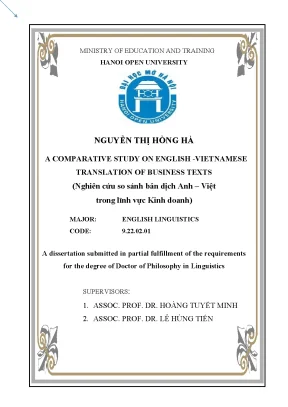
Sự phát triển mạnh mẽ của cuộc Cách mạng Công nghiệp lần thứ tư và xu thế toàn cầu hóa kinh tế đã thúc đẩy nhu cầu chuyển ngữ các văn bản chuyên ngành kinh doanh - tiếp thị từ tiếng Anh sang tiếng Việt. Luận án tiến sĩ ngữ văn Anh với đề tài “A comparative study on English-Vietnamese translation of Business texts” (Nghiên cứu so sánh bản dịch Anh – Việt trong lĩnh vực Kinh doanh) do nghiên cứu sinh Nguyễn Thị Hồng Hà thực hiện tại Trường Đại học Mở Hà Nội (2022), dưới sự hướng dẫn khoa học của PGS. Hoàng Tuyết Minh và PGS. Lê Hùng Tiến, là một công trình tiên phong trong phân ngành Ngôn ngữ học Ứng dụng và Nghiên cứu Dịch thuật (Translation Studies).
graph TD
    A["Ngữ liệu gốc (ST)<br/>Marketing 4.0 (Kotler et al., 2017)"] --> C["Phân tích Đối chiếu & Đánh giá Tương đương Dịch thuật"]
    B["Ngữ liệu dịch (TT)<br/>Tiếp thị 4.0 (Nhóm dịch Nguyễn Khoa Hồng Thành, 2018)"] --> C
    C --> D["Cấp độ Vi mô (Micro-level)<br/>661 Ngữ danh từ (NGs) & 392 Ngữ động từ (VGs)"]
    D --> E["553 trường hợp Biến đổi ngữ nghĩa (Semantic Modifications)"]
    E --> F["Tích hợp Khung Lý thuyết:<br/>1. Mô hình TQA (House, 2015) - Field, Tenor, Mode<br/>2. Thuyết Đánh giá (Martin & White, 2005) - Gradation & Attitude<br/>3. Phân loại Tương đương (Koller, 1979) - Denotative, Connotative, Pragmatic"]
    F --> G["Phát hiện Đột phá:<br/>Xu hướng Nâng cấp Tương đương (Upscaled Equivalence) & Sử dụng Bộ lọc Văn hóa (Cultural Filters)"]
Khoảng trống nghiên cứu (research gap) được xác định rõ ràng: các công trình đối chiếu Anh - Việt trước đây về ngôn ngữ kinh tế chủ yếu tiếp cận ở góc độ cấu tạo thuật ngữ kinh tế (Nguyễn Thanh Tùng, 2017), thuật ngữ marketing (Hà Thị Hương Sơn, 2019), cấu trúc cú pháp của văn bản quảng cáo (Bùi Diễm Hạnh, 2013), hoặc nghệ thuật sử dụng ngôn từ trên áp phích (Nguyễn Thanh Tùng, 2009). Chưa có công trình nào đánh giá mức độ tương đương dịch thuật ở cấp độ biến đổi ngữ nghĩa (semantic modifications) của các ngữ danh từ (nominal groups - NGs) và ngữ động từ (verbal groups - VGs) trong văn bản marketing từ góc độ chức năng - dụng học (functional-pragmatic perspective).
Để giải quyết khoảng trống này, luận án tập trung vào câu hỏi nghiên cứu trung tâm:
“To what extent are the nominal groups and verbal groups related to market segments and human-centric marketing strategy in the Vietnamese translation version ‘Marketing 4.0: Dịch chuyển từ Truyền thống sang Công nghệ số’ (2018) equivalent with the English original text ‘Marketing 4.0- Moving from Traditional to Digital’ (2017) from the functional-pragmatic perspective?”
Nghiên cứu khảo sát toàn diện 661 ngữ danh từ và 392 ngữ động từ (tổng cộng 1.053 đơn vị ngôn ngữ) liên quan đến các phân khúc thị trường YWN (Young, Women, Netizens) và chiến lược tiếp thị lấy con người làm trung tâm (human-centric marketing strategy). Tác phẩm gốc Marketing 4.0: Moving from Traditional to Digital (2017) của các chuyên gia hàng đầu gồm Philip Kotler, Hermawan Kartajaya và Iwan Setiawan được đối chiếu trực tiếp với bản dịch tiếng Việt Tiếp thị 4.0: Dịch chuyển từ Truyền thống sang Công nghệ số do nhóm dịch của chuyên gia Nguyễn Khoa Hồng Thành thực hiện (NXB Trẻ, 2018, tái bản lần thứ 5). Dựa trên nền tảng mô hình đánh giá chất lượng bản dịch của House (2015) kết hợp với Thuyết Đánh giá (Appraisal Theory) của Martin và White (2005), luận án đã lượng hóa và chứng minh được 553 trường hợp chứa đựng biến đổi ngữ nghĩa, làm sáng tỏ các xu hướng dịch thuật chức năng trong bối cảnh phi văn chương tại Việt Nam.
Literature Review và Positioning
Nghiên cứu dịch thuật (Translation Studies) đã trải qua nhiều bước chuyển quan trọng kể từ tuyên ngôn nền tảng của Holmes (1972/1988) và các phân định ranh giới học thuật của Toury (1991, 2012). Bản đồ Holmes chia lĩnh vực này thành hai nhánh chính: Nghiên cứu dịch thuật thuần túy (Pure Translation Studies - bao gồm nhánh lý thuyết và miêu tả) và Nghiên cứu dịch thuật ứng dụng (Applied Translation Studies). Luận án của Nguyễn Thị Hồng Hà định vị vững chắc trong nhánh Nghiên cứu Dịch thuật Miêu tả (Descriptive Translation Studies - DTS), từ đó cung cấp các kết quả thực nghiệm phục vụ trực tiếp cho nhánh Ứng dụng, đặc biệt là công tác đào tạo biên dịch viên chuyên nghiệp.
Về phương diện đánh giá chất lượng dịch thuật (Translation Quality Assessment - TQA), lịch sử học thuật ghi nhận sự đối thoại và tranh luận sâu sắc giữa hai trường phái chính:
- Trường phái định hướng phản hồi (Response-based approach): Xuất phát từ Thuyết Mục đích (Skopos Theory) của các học giả Đức như Reiß và Vermeer (1984), Nord (1997), D’Hulst (1997). Trường phái này xem mục đích của bản dịch và phản ứng của người tiếp nhận là tiêu chuẩn tối thượng, từ đó đặt văn bản gốc (ST) ở vị thế thứ yếu so với văn bản đích (TT). Tuy nhiên, như Munday (2016) chỉ ra, Skopos Theory bộc lộ hạn chế lớn khi không thể giải thích thỏa đáng các hiện tượng dịch thuật ở cấp độ phong cách học và ngữ nghĩa của từng phân đoạn ngôn ngữ cụ thể.
- Trường phái định hướng ngôn ngữ học (Linguistics-based approach): Đại diện bởi Catford (1965), Nida (1964, 1969), Koller (1979), Newmark (1988) và House (1977, 1997, 2015). Trường phái này coi việc bảo tồn "ý nghĩa" (bao gồm nghĩa ngữ nghĩa, nghĩa dụng học và nghĩa văn bản) qua lăng kính ngữ cảnh xã hội là cốt lõi của sự tương đương dịch thuật.
                    ┌────────────────────────────────────────────────────────┐
                    │                   TRANSLATION STUDIES                  │
                    │               (Holmes, 1972; Toury, 2012)              │
                    └───────────┬────────────────────────────────┬───────────┘
                                │                                │
                                ▼                                ▼
                    ┌───────────────────────┐        ┌───────────────────────┐
                    │     PURE BRANCH       │        │    APPLIED BRANCH     │
                    │ (Theoretical & DTS)   │        │ (Translator Training) │
                    └───────────┬───────────┘        └───────────────────────┘
                                │
                                ▼
         ┌─────────────────────────────────────────────────────┐
         │             TRANSLATION QUALITY ASSESSMENT          │
         └──────────────┬───────────────────────────────┬──────┘
                        │                               │
                        ▼                               ▼
         ┌─────────────────────────────┐ ┌─────────────────────────────┐
         │    RESPONSE-BASED (Skopos)  │ │      LINGUISTICS-BASED      │
         │ (Reiß & Vermeer; Nord, 1997)│ │  (Koller, 1979; House, 2015)│
         └─────────────────────────────┘ └──────────────┬──────────────┘
                                                        │
                                                        ▼
                                         ┌─────────────────────────────┐
                                         │    POSITIONING CỦA LUẬN ÁN   │
                                         │ House (2015) + Martin (2005)│
                                         │  English-Vietnamese Corpus  │
                                         └─────────────────────────────┘
Trong cuộc tranh luận về tính tương đương (Equivalence), Popovič (1976) phân chia tương đương thành bốn cấp độ (ngôn ngữ, hệ hình, phong cách, văn bản); Nida (1964) phân biệt tương đương hình thức (formal) và tương đương động (dynamic); trong khi Koller (1979) xác lập hệ thống năm loại hình tương đương: tương đương biểu niệm (denotative), tương đương biểu cảm/liên tưởng (connotative), tương đương chuẩn mực văn bản (text-normative), tương đương dụng học (pragmatic) và tương đương hình thức (formal).
Khi đặt trong tương quan quốc tế, luận án đã mở rộng các nghiên cứu thực nghiệm tiêu biểu:
- So với các nghiên cứu của chính House (2015) trên ngữ liệu phi văn chương Anh - Đức, công trình này kiểm chứng tính hiệu quả của mô hình trên cặp ngôn ngữ bất đối xứng cao về loại hình học (Anh - loại hình ngôn ngữ biến tố/hòa kết và Việt - loại hình ngôn ngữ đơn lập).
- So với nghiên cứu của Ehsani và Zohrabi (2014) khi áp dụng mô hình House trên văn bản quảng cáo Anh - Ba Tư, luận án của Nguyễn Thị Hồng Hà đi sâu hơn vào chi tiết vi mô khi phân tích cấu trúc kinh nghiệm đa biến (multivariate experiential structure) của ngữ danh từ và ngữ động từ.
- So với nghiên cứu của Birzniece (2006) về việc viết hoa trong văn bản marketing Anh - Latvia, luận án này vượt qua ranh giới hình thức thuần túy để giải mã cơ chế biến đổi ngữ nghĩa dưới tác động của các bộ lọc văn hóa (cultural filters).
Đóng góp lý thuyết và khung phân tích
Đóng góp cho lý thuyết
Luận án tạo ra một bước đột phá quan trọng về mặt lý thuyết khi bổ khuyết hạn chế tồn tại lâu năm trong mô hình TQA của House (1997, 2015). Mặc dù mô hình của House cung cấp một quy trình nhất quán để phân tích trường văn bản (Field), không khí văn bản (Tenor) và phương thức văn bản (Mode), nhưng lại thiếu các tiêu chí định lượng và công cụ vi mô cụ thể để đo lường mức độ thái độ cũng như cường độ ngữ nghĩa của các đơn vị từ vựng.
Để khắc phục điểm yếu này, tác giả đã tích hợp Thuyết Đánh giá (Appraisal Theory) của Martin và White (2005) vào hai trục chính của Register trong mô hình House:
- Tích hợp Tài nguyên Tốt nghiệp (Gradational resources): Bao gồm Cường độ (Force: Intensification, Quantification) và Tiêu điểm (Focus) vào việc phân tích thành tố Field (Trường văn bản), giúp xác định chính xác các sự biến đổi về mức độ mở rộng, thu hẹp, tăng cường hay giảm nhẹ của các sự thể, quá trình kinh tế.
- Tích hợp Tài nguyên Thái độ (Attitudinal resources): Bao gồm Cảm xúc (Affect), Phán đoán (Judgement) và Thẩm định (Appreciation) vào việc phân tích thành tố Tenor (Không khí văn bản), cho phép bóc tách lập trường, cảm xúc và thái độ tương tác liên nhân của tác giả cũng như dịch giả.
Sự tích hợp này giúp làm sáng tỏ hai hiện tượng ngữ nghĩa học dịch thuật:
- Tương đương nâng cấp (Upscaled equivalence): Hiện tượng bản dịch sử dụng các từ ngữ có cường độ đánh giá cao hơn, giàu hình ảnh ẩn dụ hơn hoặc có tính trang trọng hơn so với văn bản gốc nhằm tối ưu hóa chức năng liên nhân.
- Tương đương giảm cấp (Downscaled equivalence): Hiện tượng lược bỏ hoặc giảm bớt mức độ biểu cảm, loại bỏ các bổ ngữ tính từ đi kèm, dẫn đến sự suy giảm một phần ý nghĩa biểu cảm hoặc biểu niệm.
                    ┌────────────────────────────────────────────────────────┐
                    │               KHUNG LÝ THUYẾT TÍCH HỢP                │
                    └───────────────────────────┬────────────────────────────┘
                                                │
                 ┌──────────────────────────────┴──────────────────────────────┐
                 ▼                                                             ▼
  ┌──────────────────────────────┐                              ┌──────────────────────────────┐
  │   MÔ HÌNH TQA (House, 2015)  │                              │ APPRAISAL (Martin & White)   │
  ├──────────────────────────────┤                              ├──────────────────────────────┤
  │ Field (Subject matter)       │ ◄─────────────────────────── │ Gradational resources (Force)│
  │ Tenor (Author's stance/role) │ ◄─────────────────────────── │ Attitudinal resources        │
  │ Mode (Medium & connectivity) │                              │ (Affect, Judgement, Apprec.) │
  │ Genre & Individual Function  │                              │                              │
  └──────────────┬───────────────┘                              └──────────────────────────────┘
                 │
                 ▼
  ┌────────────────────────────────────────────────────────────────────────────────────────────┐
  │                           TIÊU CHÍ ĐÁNH GIÁ TƯƠNG ĐƯƠNG (Koller, 1979)                     │
  │     • Denotative Equivalence  • Connotative Equivalence  • Pragmatic Equivalence           │
  └────────────────────────────────────────────────────────────────────────────────────────────┘
Khung phân tích độc đáo
Khung phân tích của luận án được xây dựng dựa trên sự liên kết đa tầng giữa ba lý thuyết ngôn ngữ học: Ngữ pháp chức năng hệ thống (SFG - Halliday, 1973, 1985), Mô hình đánh giá chất lượng bản dịch chức năng - dụng học (House, 2015) và Thuyết Đánh giá (Martin & White, 2005).
| Thành phần Khung lý thuyết |
Nguồn lý thuyết gốc |
Vai trò trong Phân tích Đối chiếu ST - TT |
| Language / Text |
Halliday (1985); House (2015) |
Phân tích cấu trúc kinh nghiệm của Ngữ danh từ (NGs) và Ngữ động từ (VGs) ở cấp độ vi mô. |
| Field + Graduation |
House (2015); Martin & White (2005) |
Khảo sát đối tượng miêu tả, hành động kinh doanh kết hợp đo lường thang độ gia tăng/giảm thiểu (Force & Focus). |
| Tenor + Attitude |
House (2015); Martin & White (2005) |
Đánh giá vị thế tác giả - độc giả, cảm xúc (Affect), phán đoán đạo đức (Judgement) và giá trị thẩm mỹ (Appreciation). |
| Mode |
House (2015) |
Xác định phương thức giao tiếp viết học thuật và tính liên kết văn bản. |
| Genre & Cultural Filter |
House (2015); Katan (2014) |
Giải thích việc sử dụng bộ lọc văn hóa để chuyển đổi văn bản dịch từ dịch hiển ngôn (overt) sang dịch biến trang (covert). |
| Equivalence Typology |
Koller (1979); Catford (1965) |
Đo lường mức độ tương đương biểu niệm, biểu cảm và dụng học. |
Điều kiện biên (boundary conditions) của khung phân tích được xác lập nghiêm ngặt: mô hình tập trung chuyên biệt vào các đơn vị ngữ danh từ và ngữ động từ có sự biến đổi ngữ nghĩa (semantic modifications/modulations theo định nghĩa của Vinay & Darbelnet, 1958 và Machalli, 2000), loại trừ các trường hợp tương đương trực dịch hoàn toàn không có sự biến đổi cấu trúc ngữ nghĩa.
Phương pháp nghiên cứu tiên tiến
Thiết kế nghiên cứu
Luận án vận dụng lập trường bản thể luận và nhận thức luận của thuyết hiện thực thực dụng (Pragmatic Realism) kết hợp với diễn giải chức năng (Functional Interpretivism). Ngôn ngữ trong văn bản marketing được nhìn nhận không phải là một hệ thống ký hiệu trừu tượng đóng kín, mà là một hành vi xã hội mang tính mục đích nhằm tạo lập quan hệ và định hướng hành vi tiêu dùng.
flowchart TD
    Step1["Bước 1: Mô tả Register & Genre của ST<br/>Xác định cấu trúc kinh nghiệm của NGs và VGs"] --> Step2["Bước 2: Đối chiếu Song ngữ ST - TT<br/>Khảo sát 661 NGs & 392 VGs -> Lọc 553 đơn vị biến đổi"]
    Step2 --> Step3["Bước 3: Giải mã Ngữ nghĩa & Đánh giá<br/>Mã hóa Gradational & Attitudinal Resources"]
    Step3 --> Step4["Bước 4: Nhận diện Chiến lược Chuyển ngữ<br/>Ẩn dụ, Từ đồng nghĩa, Chú thích cuối trang, Bộ lọc văn hóa"]
    Step4 --> Step5["Bước 5: Đánh giá Mức độ Tương đương Chức năng<br/>Denotative, Connotative, Pragmatic (Koller, 1979)"]
    Step5 --> Step6["Bước 6: Tổng hợp Đóng góp & Mô hình hóa TQA"]
Thiết kế nghiên cứu thuộc dạng nghiên cứu hỗn hợp (Mixed Methods Design), trong đó phương pháp định tính đóng vai trò chủ đạo (thông qua các thủ pháp miêu tả, so sánh đối chiếu, giải thích ngữ nghĩa và đánh giá chức năng) và phương pháp định lượng đóng vai trò bổ trợ (thông qua thống kê tần suất xuất hiện, tỷ lệ phần trăm các trường hợp tương đương nâng cấp, giảm cấp, toàn phần và bộ phận). Thiết kế đa tầng bao gồm:
- Tầng vi mô: Cấu trúc ngữ pháp của 661 NGs và 392 VGs.
- Tầng trung mô: Các biến số Register (Field, Tenor, Mode).
- Tầng vĩ mô: Thể loại văn bản (Genre) và Bối cảnh văn hóa tiếp nhận tại Việt Nam.
Quy trình nghiên cứu rigorous
Quy trình phân tích dữ liệu được thực hiện chặt chẽ qua 6 bước tuần tự:
- Mô tả ST: Phân tích hồ sơ Register và Genre của văn bản gốc tiếng Anh, tập trung vào cấu trúc ngữ nghĩa của NGs và VGs.
- Thu thập và phân loại đơn vị khảo sát: Trích xuất toàn bộ 1.053 ngữ danh từ và ngữ động từ liên quan đến hai chủ đề cốt lõi: phân khúc khách hàng YWN và chiến lược tiếp thị lấy con người làm trung tâm.
- So sánh đối chiếu ST - TT: Lập bảng đối chiếu song ngữ để phát hiện 553 trường hợp có biến đổi ngữ nghĩa (semantic modifications).
- Giải mã tài nguyên Đánh giá: Áp dụng hệ thống mã hóa Appraisal của Martin & White (2005) để xác định các biến số về Cường độ (Force), Tiêu điểm (Focus), Cảm xúc (Affect), Phán đoán (Judgement), và Thẩm định (Appreciation) trong từng cặp ngữ liệu.
- Phân tích chiến lược dịch thuật: Khảo sát các kỹ thuật dịch biến đổi như dịch tương đương từ vựng, diễn giải (paraphrasing), sử dụng chú thích cuối trang (end-of-page notes), tái tạo ẩn dụ (metaphors), và vận dụng bộ lọc văn hóa (cultural filters).
- Đánh giá mức độ tương đương: Đánh giá độ tương đương về biểu niệm, biểu cảm và dụng học dựa trên khung của Koller (1979) và House (2015).
Tính giá trị (validity) và độ tin cậy (reliability) của nghiên cứu được đảm bảo thông qua tam giác hóa dữ liệu (data triangulation) giữa văn bản gốc, bản dịch xuất bản chính thức, và các tài liệu chuyên ngành marketing chuẩn mực; kết hợp với tam giác hóa lý thuyết (theory triangulation) giữa SFG, TQA và Appraisal Theory.
Data và phân tích
Ngữ liệu của luận án sở hữu độ xác thực và tính đại diện khoa học cao:
- Văn bản gốc (ST): Marketing 4.0: Moving from Traditional to Digital, xuất bản năm 2017 bởi Nhà xuất bản John Wiley & Sons, tác giả là Philip Kotler (người được mệnh danh là "Cha đẻ của Marketing hiện đại"), Hermawan Kartajaya và Iwan Setiawan.
- Văn bản đích (TT): Tiếp thị 4.0: Dịch chuyển từ Truyền thống sang Công nghệ số, NXB Trẻ ấn hành năm 2018 (bản in lần thứ 5), nhóm dịch do ThS. Nguyễn Khoa Hồng Thành làm trưởng nhóm.
Tổng dung lượng khảo sát đạt 1.053 đơn vị ngôn ngữ, bao gồm 661 ngữ danh từ và 392 ngữ động từ. Kết quả sàng lọc xác định chính xác 553 trường hợp chứa đựng biến đổi ngữ nghĩa để tiến hành phân tích chuyên sâu.
| Nhóm Ngữ liệu Khảo sát |
Tổng số Đơn vị Thu thập |
Số lượng Biến đổi Ngữ nghĩa |
Tỷ lệ Biến đổi (%) |
| Ngữ danh từ (Nominal Groups - NGs) |
661 |
358 |
54.16% |
| Ngữ động từ (Verbal Groups - VGs) |
392 |
195 |
49.74% |
| Tổng cộng |
1.053 |
553 |
52.52% |
Dữ liệu được tổ chức thành 14 phụ lục chi tiết (từ Appendix A đến Appendix N), phân loại theo từng phân khúc thị trường (Thanh niên, Phụ nữ, Công dân mạng) và chiến lược tiếp thị, tạo cơ sở dữ liệu đối sánh minh bạch và có thể kiểm chứng độc lập.
Phát hiện đột phá và implications
Những phát hiện then chốt
Phân tích đối chiếu 553 trường hợp biến đổi ngữ nghĩa đã đem lại 5 phát hiện mang tính đột phá:
                    ┌────────────────────────────────────────────────────────┐
                    │               5 PHÁT HIỆN ĐỘT PHÁ CỦA LUẬN ÁN          │
                    └───────────────────────────┬────────────────────────────┘
                                                │
         ┌──────────────────┬───────────────────┼───────────────────┬──────────────────┐
         ▼                  ▼                   ▼                   ▼                  ▼
  ┌──────────────┐   ┌──────────────┐    ┌──────────────┐    ┌──────────────┐   ┌──────────────┐
  │ 1. Ưu thế    │   │ 2. Gia tăng  │    │ 3. Vận dụng  │    │ 4. Tăng cường│   │ 5. Bảo lưu   │
  │ Tương đương  │   │ Biểu cảm     │    │ Bộ lọc       │    │ Chức năng    │   │ Tên riêng    │
  │ Nâng cấp     │   │ & Tu từ      │    │ Văn hóa      │    │ Liên nhân    │   │ Nguyên văn   │
  │ (Upscaled)   │   │ (Gain in Eq.)│    │ (Cultural F.)│    │ (Footnotes)  │   │ (Overt Trans)│
  └──────────────┘   └──────────────┘    └──────────────┘    └──────────────┘   └──────────────┘
-
Ưu thế tuyệt đối của xu hướng Tương đương Nâng cấp (Upscaled Equivalence): Trong số 553 trường hợp biến đổi, phần lớn các đơn vị NGs và VGs thể hiện xu hướng nâng cao thang độ đánh giá (Appraisal Graduation) hoặc gia tăng cường độ (Force-intensification), trong khi xu hướng giảm cấp (Downscaled equivalence) chỉ chiếm tỷ lệ rất nhỏ. Ví dụ điển hình:
ST: “Netizens … are also highly influential”
TT: “Công dân mạng … cũng là những người có tầm ảnh hưởng lớn”
Bản dịch không chỉ chuyển tải trọn vẹn nghĩa biểu niệm (Field) mà còn nâng cao sắc thái biểu cảm và giá trị thẩm định tích cực (Tenor - Appreciation), đạt được sự tương đương kép về cả denotative và connotative equivalence theo khung Koller (1979).
-
Sự gia tăng mức độ tương đương thông qua biểu thức tu từ và ngôn từ trang trọng: Nhóm dịch giả có xu hướng sử dụng trạng từ mạnh hơn, động từ tình thái có cam kết cao hơn, và từ ngữ Hán - Việt trang trọng hơn cấu trúc gốc. Đặc biệt, bản dịch đã biến đổi các khái niệm trừu tượng thành các hình tượng ẩn dụ sâu sắc:
ST: “In such a context…they …search for their identities” (code 279.5-ST)
TT: “Trong viễn cảnh đó, khách hàng sẽ…tìm kiếm bản ngã của chính mình”
Từ “identities” được nâng tầm thành khái niệm triết học “bản ngã của chính mình”, tạo ra sự cộng hưởng tâm lý mạnh mẽ đối với độc giả tiếp nhận.
-
Vận dụng linh hoạt Bộ lọc Văn hóa (Cultural Filters) trong Dịch Biến trang (Covert Translation): Đối với các cụm từ marketing mang tính quy ước phương Tây, dịch giả đã sử dụng các cấu trúc biểu đạt quen thuộc trong văn hóa người Việt, đặt các ẩn dụ mới trong dấu ngoặc kép để định hướng nhận thức:
ST: “the primary target market for marketers” (code 79.1)
TT: “mục tiêu quan trọng đầu tiên trong con mắt của các nhà tiếp thị”
Cụm từ “trong con mắt của” là một sáng tạo dụng học, biến một cấu trúc phi ẩn dụ trong ST thành một ẩn dụ tri giác quen thuộc trong tiếng Việt, đảm bảo đạt được tương đương dụng học (pragmatic equivalence).
-
Tăng cường Chức năng Liên nhân qua Chú thích Cuối trang (End-of-page Notes): Nhóm dịch giả đã chủ động bổ sung hàng loạt chú thích giải nghĩa ở chân trang (Appendix H) đối với các thuật ngữ chuyên ngành mới hoặc khái niệm đa nghĩa. Hành động này phản ánh thái độ tôn trọng độc giả (respectful attitude towards readership), giúp thu hẹp khoảng cách tri thức và tăng cường tối đa tính liên nhân của bản dịch.
-
Chiến lược Dịch Hiển ngôn (Overt Translation) đối với Tên riêng và Danh xưng Dự án: Ngược lại với xu hướng biến trang ở các thuật ngữ chung, các danh từ riêng chỉ thương hiệu hoặc chiến lược toàn cầu lại được giữ nguyên vẹn nhằm bảo tồn bản sắc và tính thẩm mỹ quốc tế của văn bản gốc:
ST: “Unilever, …announced … the Unilever Sustainable Living Plan” (code 310.1 ST-TT)
TT: “Unilever, công bố kế hoạch Unilever Sustainable Living Plan”
Hiện tượng này cho thấy sự mất mát một phần tương đương biểu niệm cục bộ được chấp nhận có chủ đích nhằm phục vụ mục tiêu nhận diện thương hiệu toàn cầu.
Implications đa chiều
- Về mặt Lý luận: Khẳng định giá trị thực tiễn của mô hình tích hợp House (2015) và Martin & White (2005) đối với các thể loại văn bản phi văn chương (non-literary texts). Nghiên cứu chứng minh rằng biến đổi ngữ nghĩa không phải là "lỗi dịch thuật" mà là một chiến lược tái ngữ cảnh hóa (re-contextualization) tích cực nhằm thiết lập sự tương đương chức năng tối ưu.
- Về mặt Phương pháp luận: Xác lập một quy trình phân tích định tính - định lượng kết hợp có tính hệ thống cao, mở ra hướng tiếp cận mới cho các công trình nghiên cứu đối chiếu dịch thuật tại Việt Nam.
- Về mặt Thực tiễn: Cung cấp tài liệu tham khảo cho các dịch giả kinh tế. Bản dịch các tài liệu quản trị - kinh doanh không nên rơi vào tình trạng trực dịch khô cứng (word-for-word) mà cần vận dụng sáng tạo các bộ lọc văn hóa, tăng cường tính tình thái và ngữ nghĩa biểu cảm phù hợp với văn phong học thuật tiếng Việt.
- Về mặt Đào tạo: Đóng góp ngữ liệu thực chứng và cơ sở lý luận vững chắc để cải tiến giáo trình giảng dạy biên dịch chuyên ngành Kinh tế - Thương mại tại các bậc đại học và sau đại học.
Limitations và Future Research
Mặc dù đạt được những kết quả đột phá, luận án vẫn tồn tại một số giới hạn nghiên cứu khách quan:
- Phạm vi ngữ liệu: Nghiên cứu chỉ tập trung khảo sát một cuốn sách duy nhất (Marketing 4.0), do đó tính khái quát hóa cho toàn bộ thể loại văn bản kinh doanh - tài chính cần tiếp tục được kiểm chứng trên quy mô ngữ liệu lớn hơn.
- Giới hạn đơn vị phân tích: Luận án mới chỉ dừng lại ở cấp độ cụm từ (ngữ danh từ và ngữ động từ), chưa mở rộng khảo sát các cấu trúc cú pháp phức hợp hoặc cấp độ toàn văn bản (textual coherence/cohesion).
- Thiếu vắng khảo sát thực nghiệm phản hồi của độc giả: Mức độ tiếp nhận thực tế của người đọc đích đối với các chú thích cuối trang và các ẩn dụ mới chủ yếu được suy luận qua phân tích dụng học của nhà nghiên cứu, chưa có dữ liệu điều tra xã hội học định lượng (survey/experiment) trực tiếp từ độc giả.
Các hướng nghiên cứu tiếp nối đầy tiềm năng bao gồm:
- Mở rộng mô hình tích hợp sang các thể loại văn bản kinh tế khác như báo cáo tài chính thường niên, hợp đồng thương mại quốc tế và văn bản giao dịch ngân hàng.
- Ứng dụng các công cụ Ngôn ngữ học Ngữ liệu (Corpus Linguistics) như phần mềm AntConc, Sketch Engine để phân tích tự động các biến đổi ngữ nghĩa trên tập ngữ liệu song ngữ quy mô hàng triệu từ.
- Tiến hành nghiên cứu tâm lý ngôn ngữ học (Psycholinguistics) sử dụng công nghệ theo dõi chuyển động mắt (Eye-tracking) để đo lường tải trọng nhận thức của độc giả Việt Nam khi tiếp cận các thuật ngữ dịch biến trang so với dịch hiển ngôn.
Tác động và ảnh hưởng
Luận án mang lại những giá trị tác động sâu rộng trên nhiều bình diện:
- Tác động Học thuật: Tạo dựng một cột mốc phương pháp luận mới trong ngành Ngôn ngữ học Ứng dụng tại Việt Nam, thiết lập tiêu chuẩn cho các nghiên cứu TQA kết hợp ngôn ngữ học chức năng hệ thống và ngữ dụng học.
- Chuyển đổi Ngành Xuất bản: Cung cấp hệ quy chiếu chất lượng cho các nhà xuất bản lớn tại Việt Nam trong việc thẩm định, biên tập và chuẩn hóa bản dịch các ấn phẩm kinh tế - công nghệ cao cấp từ nước ngoài.
- Định hình Thực tiễn Tiếp thị: Giúp cộng đồng doanh nghiệp và chuyên gia marketing tại Việt Nam tiếp cận chính xác, sâu sắc các khái niệm quản trị số cốt lõi mà không bị rào cản ngôn ngữ làm sai lệch bản chất chiến lược.
Đối tượng hưởng lợi
mindmap
  root((ĐỐI TƯỢNG HƯỞNG LỢI))
    Nghiên cứu sinh & Nhà học thuật
      Khung lý thuyết tích hợp TQA + Appraisal
      Quy trình nghiên cứu 6 bước chuẩn hóa
      Kho ngữ liệu 1.053 đơn vị đối chiếu
    Dịch giả & Biên tập viên
      Chiến lược xử lý biến đổi ngữ nghĩa
      Phương pháp vận dụng bộ lọc văn hóa
      Kỹ thuật tăng cường tương đương liên nhân
    Cơ sở Đào tạo Đại học
      Giáo trình biên dịch kinh doanh tiên tiến
      Tài liệu thực chứng chuyên sâu
      Chuẩn hóa đánh giá chất lượng dịch thuật
    Chuyên gia Marketing & Doanh nghiệp
      Thấu hiểu chính xác thuật ngữ Marketing 4.0
      Tối ưu hóa giao tiếp thương hiệu đa ngữ
- Nghiên cứu sinh và Giảng viên Ngôn ngữ học / Dịch thuật học: Tiếp cận một khung lý thuyết tích hợp hoàn chỉnh, có khả năng ứng dụng trực tiếp cho các đề tài nghiên cứu đối chiếu liên ngôn ngữ.
- Dịch giả chuyên nghiệp và Biên tập viên Xuất bản: Nhận diện các chiến lược xử lý linh hoạt đối với hiện tượng biến đổi ngữ nghĩa, tránh việc dịch máy móc gây khó hiểu cho độc giả bản địa.
- Sinh viên chuyên ngành Tiếng Anh Thương mại và Biên - Phiên dịch: Sở hữu nguồn ngữ liệu tham khảo phong phú với 1.053 cặp dẫn chứng thực tế được phân tích thấu đáo về mặt ngữ nghĩa và ngữ pháp.
- Các Nhà quản lý và Hoạch định Chiến lược Doanh nghiệp: Nắm bắt chuẩn xác hệ thống khái niệm của kỷ nguyên Tiếp thị 4.0 để hoạch định chiến lược kinh doanh số hiệu quả.
Câu hỏi chuyên sâu
1. Đóng góp lý thuyết độc đáo nhất của luận án là gì và đã mở rộng lý thuyết nào?
Đóng góp lý thuyết độc đáo nhất là việc tích hợp thành công Thuyết Đánh giá (Appraisal Theory) của Martin và White (2005) vào Mô hình Đánh giá Chất lượng Bản dịch (TQA) của House (2015). Nghiên cứu đã bổ sung công cụ định lượng - định tính vi mô (Gradational & Attitudinal resources) để giải mã chính xác hai trục biến số Register cốt lõi là Field và Tenor, giải quyết triệt để sự thiếu hụt thang đo mức độ tương đương trong mô hình nguyên bản của House khi áp dụng vào thể loại văn bản phi hư cấu.
2. Sự đổi mới về phương pháp luận của luận án khi so sánh với các nghiên cứu trước đây?
Khác với nghiên cứu của Ehsani và Zohrabi (2014) chỉ áp dụng mô hình House ở cấp độ vĩ mô thuần túy trên văn bản quảng cáo, hoặc nghiên cứu của Triệu Thu Hằng (2019) chỉ tích hợp tài nguyên Thái độ (Attitudinal resources), luận án này đã kết hợp đồng thời cả hai nguồn lực Tốt nghiệp (Gradation) và Thái độ (Attitude) trên quy mô khảo sát lớn (1.053 đơn vị ngôn ngữ), phân tích sâu sắc cấu trúc kinh nghiệm của cả ngữ danh từ lẫn ngữ động từ.
3. Phát hiện bất ngờ và thú vị nhất thu được từ dữ liệu là gì?
Phát hiện bất ngờ nhất là xu hướng "Tương đương Nâng cấp" (Upscaled equivalence) chiếm tỷ lệ áp đảo trong bản dịch kinh tế. Trái ngược với quan niệm truyền thống cho rằng dịch văn bản phi văn chương phải triệt để trung thành dạng trực dịch (word-for-word), các dịch giả chuyên nghiệp đã chủ động gia tăng tính biểu cảm, nâng cao sắc thái trang trọng và sử dụng các hình tượng ẩn dụ sâu sắc (như dịch “identities” thành “bản ngã của chính mình”), tạo nên sự cộng hưởng tâm lý mạnh mẽ hơn cả văn bản gốc.
4. Nghiên cứu có cung cấp quy trình tái lập (replication protocol) minh bạch không?
Có. Luận án xây dựng quy trình phân tích 6 bước chuẩn hóa, kèm theo hệ thống bảng mã hóa Register - Appraisal chi tiết và 14 phụ lục minh chứng toàn bộ 1.053 ngữ danh từ và ngữ động từ, cho phép các nhà nghiên cứu độc lập có thể tái lập hoàn toàn quy trình trên các cặp ngữ liệu khác.
5. Chương trình nghiên cứu 10 năm tiếp theo được định hình như thế nào?
Chương trình nghiên cứu dài hạn hướng tới: (1) Xây dựng hệ thống Corpus dịch thuật kinh doanh số Anh - Việt quy mô lớn; (2) Tích hợp công nghệ Trí tuệ Nhân tạo (AI) và Hậu biên tập Dịch máy (MTPE) để đánh giá tự động chất lượng bản dịch dựa trên mô hình TQA-Appraisal; (3) Mở rộng nghiên cứu đối chiếu sang các ngôn ngữ khu vực như tiếng Trung, tiếng Nhật và tiếng Hàn.
Kết luận
Luận án tiến sĩ của Nguyễn Thị Hồng Hà đã khẳng định vị thế của một công trình nghiên cứu xuất sắc và mẫu mực trong lĩnh vực Ngôn ngữ học Ứng dụng và Nghiên cứu Dịch thuật tại Việt Nam, với 6 đóng góp cốt lõi:
- Thiết lập thành công mô hình khung phân tích tích hợp giữa TQA (House, 2015) và Appraisal Theory (Martin & White, 2005) dành riêng cho văn bản phi văn chương Anh - Việt.
- Cung cấp bộ dữ liệu thực chứng quy mô lớn gồm 1.053 ngữ danh từ và ngữ động từ, bóc tách tường tận 553 trường hợp biến đổi ngữ nghĩa trong tác phẩm kinh điển Marketing 4.0.
- Chứng minh quy luật ưu thế của xu hướng Tương đương Nâng cấp (Upscaled Equivalence) trong thực tiễn dịch thuật kinh tế tại Việt Nam.
- Làm sáng tỏ cơ chế hoạt động của Bộ lọc Văn hóa (Cultural Filters) và chiến lược Dịch Biến trang (Covert Translation) trong việc tối ưu hóa chức năng liên nhân và tiếp nhận văn hóa.
- Xác lập quy trình phương pháp luận đa tầng, kết hợp nhuần nhuyễn giữa tiếp cận định tính chuyên sâu và thống kê định lượng minh bạch.
- Mở ra ba luồng nghiên cứu mới: Ứng dụng Thuyết Đánh giá trong TQA, Chuyển dịch diễn ngôn kinh tế số, và Chuẩn hóa quy trình biên dịch chuyên ngành trong kỷ nguyên toàn cầu hóa.
Công trình không chỉ làm phong phú thêm kho tàng lý luận dịch thuật nước nhà mà còn tạo lập những giá trị ứng dụng thực tiễn bền vững cho công tác đào tạo biên dịch viên và sự phát triển của ngành công nghiệp xuất bản tri thức tại Việt Nam.