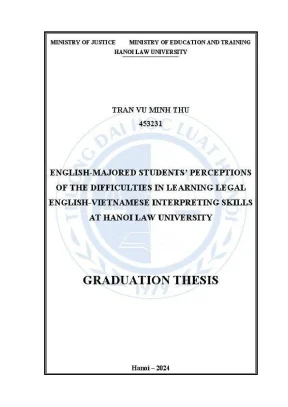
Bối cảnh và vấn đề nghiên cứu
Trong bối cảnh toàn cầu hóa và hội nhập kinh tế quốc tế, nhu cầu nhân lực có năng lực ngoại ngữ chuyên biệt ngày càng gia tăng nhằm đáp ứng các môi trường làm việc đặc thù. Giảng dạy tiếng Anh cho mục đích chuyên biệt (English for Specific Purposes - ESP), đặc biệt là Tiếng Anh pháp lý (English for Legal Purposes - ELP), đóng vai trò quan trọng trong việc đào tạo nguồn nhân lực làm cầu nối pháp lý giữa các doanh nghiệp đa quốc gia và hệ thống pháp luật sở tại. Tại Việt Nam, nhiều cơ sở đào tạo đã triển khai giảng dạy phiên dịch chuyên ngành, trong đó Trường Đại học Luật Hà Nội (HLU) đã đưa kỹ năng phiên dịch pháp lý vào chương trình đào tạo cử nhân ngành Ngôn ngữ Anh từ năm 2014.
Tuy nhiên, phiên dịch pháp lý Anh - Việt là một phân môn phức tạp đòi hỏi sự kết hợp đồng thời giữa năng lực ngôn ngữ, kỹ năng nghiệp vụ phiên dịch, kiến thức pháp luật chuyên sâu và khả năng xử lý tâm lý dưới áp lực thời gian. Qua quan sát thực tế và tổng quan nghiên cứu trước đó, người học thường gặp phải nhiều rào cản nhưng các công trình nghiên cứu chuyên biệt về khó khăn trong học phiên dịch pháp lý tại các trường đại học ở Việt Nam còn khá hạn chế. Khóa luận tốt nghiệp của tác giả Trần Vũ Minh Thư (2024) được thực hiện nhằm lấp đầy khoảng trống này.
Mục tiêu nghiên cứu của khóa luận được xác định cụ thể gồm hai nhiệm vụ:
- Điều tra các khó khăn mà sinh viên chuyên ngành Tiếng Anh pháp lý tại Trường Đại học Luật Hà Nội gặp phải trong quá trình học kỹ năng phiên dịch pháp lý Anh - Việt.
- Đề xuất các khuyến nghị thực tiễn cho sinh viên, giảng viên giảng dạy phiên dịch pháp lý và nhà trường nhằm hỗ trợ khắc phục các trở ngại, nâng cao chất lượng dạy và học học phần này.
Để đạt được các mục tiêu trên, tác giả đặt ra hai câu hỏi nghiên cứu chính:
- Những khó khăn trong việc học kỹ năng phiên dịch Anh - Việt mà sinh viên ngành Ngôn ngữ Anh gặp phải là gì?
- Những giải pháp nào có thể giúp giảm bớt các trở ngại mà sinh viên gặp phải?
Từ hai câu hỏi chính, nghiên cứu triển khai chi tiết thành 7 câu hỏi cụ thể nhằm làm rõ: động lực học tập của sinh viên; các yếu tố tâm lý; các khía cạnh năng lực ngôn ngữ; các kỹ năng nghiệp vụ phiên dịch; các rào cản kiến thức nền tảng; các đặc điểm ngôn ngữ học pháp lý; và các yếu tố khách quan khác tác động đến quá trình học tập.
Phạm vi nghiên cứu được giới hạn về không gian tại Trường Đại học Luật Hà Nội, với đối tượng nghiên cứu là nhận thức của sinh viên ngành Ngôn ngữ Anh thuộc hai khóa K45 và K46. Thời gian thu thập dữ liệu diễn ra từ tháng 01 đến tháng 03 năm 2024. Các khía cạnh liên quan đến quan điểm của giảng viên, phiên dịch viên chuyên nghiệp hoặc các nhóm sinh viên ngoài phạm vi nêu trên không thuộc phạm vi khảo sát của đề tài.
Cơ sở lý thuyết và phương pháp
Khóa luận xây dựng khung lý thuyết dựa trên các khái niệm nền tảng về phiên dịch học và đặc điểm ngôn ngữ học pháp lý:
- Khái niệm phiên dịch: Tổng hợp định nghĩa từ Kade (1968), Nolan (2005), Cerezo (2015), Murtiningsih & Aridfilah (2021), Suryasa (2016), Jones (2002) và Đặng & Bùi (1997). Tác giả định nghĩa kỹ năng phiên dịch pháp lý Anh - Việt là loại hình phiên dịch do các bên sử dụng hai ngôn ngữ tiếng Anh (ngôn ngữ nguồn) và tiếng Việt (ngôn ngữ đích) thực hiện trong các bối cảnh pháp lý hoặc bán pháp lý.
- Phân loại và bối cảnh phiên dịch: Dựa theo lý thuyết của Đặng & Bùi (1997) và The Routledge Handbook of Interpreting (2019), nghiên cứu phân loại phiên dịch thành phiên dịch nối tiếp/đuổi (Consecutive interpreting: đơn phương và song phương/liaison) và phiên dịch song song/đồng thời (Simultaneous interpreting: dịch thị giác/sight interpreting, dịch thầm/chuchotage, dịch qua buồng điện tử/electronic hook-up) trong các bối cảnh hội nghị, tòa án, thủ tục tị nạn, y tế, giáo dục, truyền thông và vùng xung đột.
- Mô hình quy trình phiên dịch: Áp dụng mô hình của Đặng & Bùi (1997) gồm các giai đoạn: Đầu vào (Input) $\rightarrow$ Hiểu (Understanding - U) $\rightarrow$ Giải mã (Deciphering - D) $\rightarrow$ Chuyển dịch (Transference - T) gắn liền với xử lý Ngữ cảnh và Văn hóa (Context and Culture - C+C) $\rightarrow$ Đầu ra (Output 1 & 2 - O1, O2).
- Đặc điểm tiếng Anh pháp lý: Tổng thuật theo Veretina-Chiriac (2012), Nhạc (2021), Supardi (2013), Goga-Vigaru (2015) trên hai bình diện:
- Từ vựng: Từ cổ (archaic words: pursuant, hereinafter, aforesaid, therein); Thuật ngữ chuyên môn và từ thông dụng mang nghĩa pháp lý chuyên biệt (terms of art, common words with uncommon meanings: consideration, party, execute, attachment); Từ mượn gốc Latin và tiếng Pháp (bona fide, casus fortuitus, plaintiff, defendant); Hiện tượng đồng nghĩa và các cặp/bộ ba từ (binomials, trinomials: breaking and entering, goods and chattels, act and deed).
- Cú pháp: Độ dài câu và cấu trúc phức tạp; Danh từ hóa (nominalization: give consideration instead of consider); Lối viết phi cá thể (impersonal style: sử dụng đại từ ngôi thứ ba và thể bị động).
Về phương pháp nghiên cứu, tác giả sử dụng thiết kế nghiên cứu mô tả định lượng (descriptive quantitative research design) theo hướng dẫn của Kumar (2011) và Jain (2023).
- Công cụ thu thập dữ liệu: Bảng hỏi khảo sát tự thiết kế dựa trên nghiên cứu của Nhạc (2021), sử dụng thang đo Likert 5 điểm (1: Chưa bao giờ gặp / $1.00 - 1.80$; 2: Hiếm khi gặp / $1.81 - 2.60$; 3: Đôi khi gặp / $2.61 - 3.40$; 4: Thường xuyên gặp / $3.41 - 4.20$; 5: Luôn luôn gặp / $4.21 - 5.00$). Bảng hỏi gồm 3 phần: Thông tin nhân khẩu học; Động lực học tập; và 43 nhận định đánh giá khó khăn phân chia thành 6 nhóm yếu tố.
- Kiểm định độ tin cậy: Hệ số Cronbach's Alpha của bảng hỏi đạt $\alpha = 0.922$, thể hiện độ tin cậy nội hàm rất cao.
- Mẫu khảo sát: $n = 84$ sinh viên chuyên ngành Tiếng Anh pháp lý tại HLU (khóa K45: 51 sinh viên, chiếm 60.7%; khóa K46: 33 sinh viên, chiếm 39.3%). Về giới tính: 72 nữ (85.7%), 9 nam (10.7%), 3 người không tiết lộ (3.6%). Về trình độ tiếng Anh: B1 có 12 sinh viên (14.3%), B2 có 51 sinh viên (60.7%), C1 có 21 sinh viên (25.0%), không có sinh viên đạt trình độ C2.
- Xử lý dữ liệu: Dữ liệu thu thập qua Google Forms trong tháng 02/2024 được tổng hợp và phân tích bằng phần mềm IBM SPSS phiên bản 25 và Microsoft Excel, tính toán điểm trung bình (Mean - M) và độ lệch chuẩn (Standard Deviation - SD).
Nội dung chính theo từng chương
Khóa luận được cấu trúc thành 3 phần chính, trong đó Phần Nội dung (Part II: Development) gồm 4 chương cụ thể:
Chapter 1. Literature review (Tổng quan nghiên cứu)
Chương 1 hệ thống hóa các vấn đề lý luận về phiên dịch học, quy trình phiên dịch và đặc trưng của tiếng Anh pháp lý. Đồng thời, chương này mô tả thực trạng chương trình đào tạo kỹ năng phiên dịch pháp lý tại HLU: đối với K45, kỹ năng dịch nằm trong 2 học phần tích hợp Biên - Phiên dịch bắt buộc (6 tín chỉ) và 1 học phần tự chọn (3 tín chỉ), gồm các chủ đề: hệ thống pháp luật, nguồn luật, luật hiến pháp, luật hình sự, luật công ty và luật hợp đồng; đối với K46, chương trình được điều chỉnh thành học phần Phiên dịch độc lập (2 tín chỉ), bổ sung nội dung dịch và tái dịch thuật. Chương này cũng tổng hợp các nghiên cứu quốc tế (Bontempo & Napier, 2011; Arnaiz-Castro & Diez, 2016; Zhao et al., 2023; Pratiwi, 2016; Bahrami & Movahed, 2021; Gafiyatova & Pomortseva, 2016; Sumarni, 2017; Ribas, 2012) và nghiên cứu tại Việt Nam (Phạm & Bùi, 2013; Nguyễn & Nguyễn, 2021; Nguyễn & Thạch, 2023; Nhạc, 2021, 2023).
Chapter 2. Methodology (Phương pháp nghiên cứu)
Chương 2 trình bày chi tiết về thiết kế nghiên cứu mô tả định lượng, nhắc lại các câu hỏi nghiên cứu, phân tích đặc điểm nhân khẩu học của mẫu nghiên cứu ($n = 84$), cấu trúc bảng câu hỏi 43 mục, quy trình thu thập dữ liệu trực tuyến qua Zalo và Facebook trong kỳ nghỉ Tết Nguyên đán 2024, cùng các công thức quy đổi thang đo điểm trung bình và phương pháp xử lý số liệu trên phần mềm SPSS v.25.
Chapter 3. Results and discussion (Kết quả và thảo luận)
Chương 3 trình bày toàn bộ kết quả phân tích thống kê và đối thoại học thuật với các nghiên cứu trước đây:
- Động lực học tập: 69.0% sinh viên chọn lý do môn học bắt buộc; 58.3% cho rằng môn học giúp mở rộng cơ hội việc làm; 53.6% học để nâng cao vốn tiếng Anh pháp lý; 46.4% học để mở rộng kiến thức pháp luật; 41.7% coi đây là môn thiết yếu cho công việc tương lai; chỉ 25.0% sinh viên cảm thấy đây là môn học thú vị.
- Khó khăn về tâm lý: Điểm trung bình chung $M = 3.37$. Trở ngại lớn nhất là cảm giác lo lắng khiến sinh viên không thể chuyển tải đầy đủ, chính xác ý nghĩa phát biểu ($M = 3.64; SD = 0.940$), sợ quên thuật ngữ và cụm từ pháp lý ($M = 3.57; SD = 0.973$), sợ bị giảng viên và bạn bè đánh giá ($M = 3.50; SD = 0.976$).
- Khó khăn về năng lực ngôn ngữ: Điểm trung bình chung $M = 3.63$. Sinh viên gặp rào cản lớn nhất ở vốn thuật ngữ pháp lý hạn chế ($M = 3.94; SD = 0.883$), cấu trúc ngữ pháp phức tạp ($M = 3.83; SD = 0.725$), hạn chế thuật ngữ pháp lý theo chủ đề ($M = 3.80; SD = 0.915$). Kỹ năng nghe thuần túy có điểm trung bình thấp nhất trong nhóm ($M = 3.27; SD = 1.045$).
- Khó khăn về kỹ năng nghiệp vụ phiên dịch: Điểm trung bình chung $M = 3.74$. Khó khăn nổi bật là không ghi chép (note-taking) kịp tốc độ của người nói ($M = 3.79; SD = 0.729$) và không thể đa nhiệm cùng lúc nghe, ghi nhớ và ghi chép ($M = 3.79; SD = 0.822$), tiếp theo là hạn chế của trí nhớ ngắn hạn ($M = 3.75; SD = 0.790$) và khó tập trung hoàn toàn ($M = 3.74; SD = 0.778$).
- Khó khăn về kiến thức nền tảng: Điểm trung bình chung $M = 3.87$ (nhóm cao nhất). Yếu tố gây trở ngại lớn nhất là thiếu kiến thức nền về truyền thống Thông luật / Common Law ($M = 3.98; SD = 0.891$), không quen thuộc với lĩnh vực pháp lý được dịch ($M = 3.88; SD = 0.701$), thiếu kiến thức pháp luật Việt Nam ($M = 3.85; SD = 0.912$) và khác biệt văn hóa pháp lý ($M = 3.85; SD = 0.784$).
- Khó khăn về đặc điểm ngôn ngữ học: Điểm trung bình chung $M = 3.66$. Khó khăn lớn nhất trong toàn bộ bảng hỏi là tìm từ tương đương cho các cặp và bộ ba từ đồng nghĩa (binomials & trinomials: debts and liabilities, each and every, act and deed, goods and chattels) với $M = 4.05; SD = 1.017$. Tiếp đến là từ đồng âm ($M = 3.89$), từ cổ ($M = 3.88$), từ mượn tiếng Pháp và thuật ngữ Latin ($M = 3.83$), cấu trúc câu dài phức tạp ($M = 3.81$) và bố cục văn bản pháp lý ($M = 3.81$).
- Khó khăn từ các vấn đề khác: Điểm trung bình chung $M = 3.37$. Nổi bật là tài liệu học tập còn hạn chế ($M = 3.73; SD = 0.841$), phòng học chưa trang bị đầy đủ thiết bị ($M = 3.71; SD = 0.669$), thời lượng học tập hạn chế ($M = 3.61; SD = 0.775$). Phương pháp giảng dạy của giảng viên có điểm ảnh hưởng thấp nhất ($M = 2.64; SD = 0.816$).
Chapter 4. Recommendations (Khuyến nghị)
Chương 4 tổng hợp các giải pháp dựa trên kết quả khảo sát:
- Đối với sinh viên: Nâng cao kỹ năng ghi chép thông qua ký hiệu viết tắt, rèn luyện trí nhớ ngắn hạn và năng lực xử lý đa nhiệm; chủ động trau dồi thuật ngữ pháp lý và đọc thêm tài liệu về hệ thống Thông luật; tập luyện kiểm soát căng thẳng và tăng cường thực hành theo nhóm.
- Đối với giảng viên: Điều chỉnh phương pháp giảng dạy, bổ sung tài liệu thực tế chuẩn xác, hướng dẫn cụ thể cách xử lý các đặc trưng ngôn ngữ phức tạp (từ cổ, từ Latin/Pháp, cặp từ đồng nghĩa); tạo môi trường lớp học giảm áp lực tâm lý cho sinh viên.
- Đối với nhà trường: Nâng cấp cơ sở vật chất phòng thực hành phiên dịch (tai nghe, máy tính, buồng dịch/cabin cho dịch song song); bổ sung nguồn học liệu chuyên ngành; phân bổ thêm thời lượng môn học và tạo cơ hội cho sinh viên giao lưu, học tập cùng các chuyên gia phiên dịch pháp lý.
Kết quả và đóng góp
Nghiên cứu đã định lượng hóa mức độ ảnh hưởng của 6 nhóm nhân tố tác động đến quá trình học kỹ năng phiên dịch pháp lý Anh - Việt của sinh viên ngành Ngôn ngữ Anh tại Trường Đại học Luật Hà Nội.
| Nhóm yếu tố gây khó khăn |
Điểm trung bình chung (Overall Mean) |
Mức độ nhận thức của sinh viên |
| Kiến thức nền tảng (Background knowledge) |
3.87 |
Thường xuyên gặp (Usually true) |
| Kỹ năng nghiệp vụ phiên dịch (Interpreting skills) |
3.74 |
Thường xuyên gặp (Usually true) |
| Đặc điểm ngôn ngữ học (Linguistic factors) |
3.66 |
Thường xuyên gặp (Usually true) |
| Năng lực tiếng Anh (English competence) |
3.63 |
Thường xuyên gặp (Usually true) |
| Yếu tố tâm lý (Psychology) |
3.37 |
Đôi khi gặp (Somewhat true) |
| Các yếu tố liên quan khác (Other problems) |
3.37 |
Đôi khi gặp (Somewhat true) |
Khóa luận chỉ ra rằng thiếu hụt kiến thức nền tảng, đặc biệt là kiến thức về truyền thống Thông luật (Common Law, $M = 3.98$), là rào cản lớn nhất đối với sinh viên. Xét theo từng khía cạnh cụ thể, việc xử lý các cặp/bộ ba từ đồng nghĩa chuyên ngành (binomials/trinomials, $M = 4.05$) và sự hạn chế về vốn thuật ngữ pháp lý ($M = 3.94$) là những khó khăn có điểm trung bình cao nhất.
Về mặt đóng góp khoa học, khóa luận đã bổ sung dữ liệu thực nghiệm về việc dạy và học phiên dịch ESP/ELP tại Việt Nam, làm rõ các khó khăn đặc thù của sinh viên chuyên ngữ trong môi trường đại học luật. Các khuyến nghị ba bên (sinh viên - giảng viên - nhà trường) đưa ra các định hướng cụ thể nhằm tối ưu hóa chương trình đào tạo cử nhân Ngôn ngữ Anh định hướng Tiếng Anh pháp lý.
Hạn chế và hướng nghiên cứu tiếp
Khóa luận tự xác định một số hạn chế gắn liền với phạm vi nghiên cứu:
- Cỡ mẫu nghiên cứu còn ở quy mô vừa phải ($n = 84$ sinh viên), chỉ khảo sát tại một cơ sở đào tạo duy nhất là Trường Đại học Luật Hà Nội, do đó mức độ khái quát hóa cho toàn bộ sinh viên học tiếng Anh pháp lý tại Việt Nam cần được xem xét cẩn trọng.
- Nghiên cứu chỉ sử dụng phương pháp định lượng qua bảng hỏi khảo sát tự đánh giá của người học, chưa kết hợp phương pháp định tính như phỏng vấn sâu (in-depth interview) hoặc quan sát lớp học thực tế.
- Khảo sát chỉ mới tiếp cận từ góc nhìn đơn chiều của sinh viên, chưa đối chiếu với nhận định của giảng viên trực tiếp giảng dạy hoặc các chuyên gia, phiên dịch viên pháp lý hành nghề thực tế.
Hướng nghiên cứu tiếp theo được đề xuất bao gồm: mở rộng quy mô mẫu và địa bàn khảo sát sang các trường đại học khác có giảng dạy tiếng Anh pháp lý hoặc biên phiên dịch chuyên ngành; áp dụng phương pháp nghiên cứu hỗn hợp (mixed-methods) kết hợp kiểm tra năng lực dịch thực tế; khảo sát đa chiều quan điểm của giảng viên và nhà tuyển dụng để hoàn thiện khung đánh giá năng lực phiên dịch pháp lý.
Giá trị tham khảo
Tài liệu là nguồn tham khảo hữu ích cho:
- Sinh viên ngành Ngôn ngữ Anh, Tiếng Anh pháp lý và sinh viên ngành Luật: Giúp người học nhận diện rõ các bẫy ngôn ngữ đặc thù (từ cổ, cặp từ đồng nghĩa, từ mượn Latin/Pháp, lối viết phi cá thể) và các kỹ năng nghiệp vụ cần rèn luyện (ghi chép nhanh, tăng cường trí nhớ ngắn hạn, kiểm soát căng thẳng).
- Giảng viên giảng dạy Biên - Phiên dịch chuyên ngành: Cung cấp cơ sở thực chứng về những rào cản nhận thức của người học, từ đó hỗ trợ điều chỉnh giáo trình, thiết kế bài tập thực hành theo chủ đề và tối ưu hóa phương pháp hướng dẫn kỹ năng ghi chú và tra cứu thuật ngữ.
- Các nhà nghiên cứu giáo dục ngôn ngữ và dịch thuật học: Bảng hỏi khảo sát chuẩn hóa với hệ số $\alpha = 0.922$ và mô hình phân tích 6 nhóm nhân tố là tài liệu tham khảo tốt cho các nghiên cứu tiếp theo về giảng dạy ESP và phiên dịch chuyên ngành.
Câu hỏi thường gặp
1. Mẫu khảo sát của khóa luận gồm những đối tượng nào và có đặc điểm nhân khẩu học ra sao?
Mẫu nghiên cứu gồm 84 sinh viên chuyên ngành Tiếng Anh pháp lý tại Trường Đại học Luật Hà Nội, thuộc hai khóa K45 (51 sinh viên, chiếm 60.7%) và K46 (33 sinh viên, chiếm 39.3%). Về giới tính, nữ giới chiếm đa số với 85.7% ($n = 72$), nam giới chiếm 10.7% ($n = 9$), và 3.6% ($n = 3$) không tiết lộ giới tính. Về trình độ tiếng Anh tự đánh giá hoặc theo kết quả thi: trình độ B2 chiếm tỷ lệ cao nhất với 60.7% ($n = 51$), trình độ C1 chiếm 25.0% ($n = 21$), trình độ B1 chiếm 14.3% ($n = 12$) và không có sinh viên ở trình độ C2.
2. Nhóm yếu tố nào được sinh viên đánh giá là gây khó khăn lớn nhất trong quá trình học phiên dịch pháp lý?
Nhóm yếu tố Kiến thức nền tảng (Background knowledge) có điểm trung bình cao nhất ($M = 3.87$), nằm trong khoảng "thường xuyên gặp khó khăn" (Usually true). Trong nhóm này, sự thiếu hụt kiến thức về truyền thống Thông luật (Common Law) là rào cản lớn nhất với điểm trung bình $M = 3.98$.
3. Khó khăn ngôn ngữ học cụ thể nào có điểm đánh giá cao nhất trong toàn bộ bảng hỏi khảo sát?
Khó khăn ngôn ngữ có điểm trung bình cao nhất toàn bài là việc tìm từ tương đương trong tiếng Việt để dịch các cặp và bộ ba từ đồng nghĩa (double and triple synonyms / binomials & trinomials, ví dụ: debts and liabilities, each and every, act and deed, goods and chattels), đạt điểm trung bình $M = 4.05$ ($SD = 1.017$).
4. Kỹ năng nghiệp vụ phiên dịch nào khiến sinh viên gặp nhiều trở ngại nhất?
Hai kỹ năng nghiệp vụ có điểm trung bình cao nhất và bằng nhau ($M = 3.79$) là: không ghi chép (note-taking) đủ nhanh để theo kịp tốc độ nói của người nói ($SD = 0.729$) và khó khăn trong việc thực hiện đa nhiệm cùng lúc vừa nghe, ghi nhớ vừa ghi chú ($SD = 0.822$). Tiếp sau đó là sự hạn chế của trí nhớ ngắn hạn ($M = 3.75$).
5. Trong nhóm các yếu tố liên quan khác (Other problems), yếu tố nào gây trở ngại nhiều nhất và yếu tố nào ít ảnh hưởng nhất?
Yếu tố gây trở ngại nhiều nhất là nguồn tài liệu học tập còn hạn chế ($M = 3.73; SD = 0.841$) và phòng học chưa được trang bị đầy đủ thiết bị phục vụ dạy học phiên dịch ($M = 3.71; SD = 0.669$). Ngược lại, phương pháp giảng dạy của giảng viên là yếu tố có điểm trung bình thấp nhất ($M = 2.64; SD = 0.816$), cho thấy phương pháp dạy ít gây cản trở cho sinh viên nhất so với các yếu tố cơ sở vật chất và tài liệu.
Kết luận
Khóa luận tốt nghiệp của tác giả Trần Vũ Minh Thư đã phân tích toàn diện thực trạng nhận thức của sinh viên ngành Ngôn ngữ Anh tại Trường Đại học Luật Hà Nội về những khó khăn khi học kỹ năng phiên dịch pháp lý Anh - Việt. Thông qua khảo sát định lượng trên 84 sinh viên K45 và K46 với công cụ bảng hỏi có độ tin cậy cao, nghiên cứu xác định kiến thức nền tảng pháp lý (đặc biệt là Thông luật), kỹ năng nghiệp vụ (ghi chú, xử lý đa nhiệm) và các đặc trưng ngôn ngữ chuyên biệt (cặp từ đồng nghĩa, thuật ngữ pháp lý) là những trở ngại chủ yếu. Công trình cung cấp hệ thống số liệu thực nghiệm minh bạch, đồng thời đưa ra các đề xuất thiết thực giúp nâng cao chất lượng đào tạo phiên dịch pháp lý tại cơ sở đào tạo.