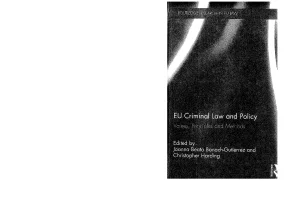
EU Criminal Law and Policy Values, Principles and Methods The EU now possesses a clear legal basis for taking action on criminal law matters and steering the policy and practice of Member States in relation to crime and criminal law. However, for what is now an important area of law, there remains a striking absence or uncertainty regarding its theoretical basis, its legitimacy and its conceptual vocabulary. This book offers a review of the significance of EU criminal law and crime policy as a rapidly emerging phenomenon in European law and governance. Bringing together an international set of contributors, the book questions the nature, role and objectives of such ‘criminal law’, its relationship with other areas of EU policy and law, and the established rules of criminal law and criminal jus- “tice at the Member State level.
Taking up such subjects as the application of criminal law across national! ~ boundaries and in the broader European context, effective enforcement, and the “working out ofa new European policy, the book helps to structure an increas- ~ ingly significant subject in law which is still finding its direction. The book will be ’ of great use and interest to researchers and students of EU taw, criminal justice, ~ and criminology. - Joanna Beata Banach-Gutierrez is Associate Professor at the Faculty of Law and Administration, University of Warmia and Mazury in Olsztyn. Her research inter- ests are focused especially on international criminal law and procedure, European criminal justice, comparative criminology and crime policy.
Christopher Harding is Professor at the Department of Law and Criminology ~ at Aberystwyth University. His research spans European and international law, > criminal jurisprudence, penal theory, the history of crime and the penal system, ~ and the protection of human rights. Routledge Research in HU Law Available titles in this series include: Towards a System of European Kadi on Trial Criminal Justice A Multifaceted Analysis of the Kadi The Problem of Admissibility of Trial Evidence Matej Avbely, Filippo Fontanelli and Andrea Ryan Ginseppe Martinico The Legal Order of the European The Judge and the Proportionate Union Use of Discretion The Institutional Role of the European A Comparative Administrative Law Court of Justice Study Timothy Moorhead Sofia Ranchordas & Boudewijn de Waard The Greening of European Business under EU Law European Agencies and Risk Taking Article 11 TFEU Seriously Governance in EU Financial Market Beate Sjafjell & Anja Wiesbrock Law Paul Weismann The Habitats Directive in its EU Environmental Context EU Health Systems and Distributive European Nature’s Best Hope? Justice Charles-Hubert Born, An Cliquet, Towards New Paradigms for the Hendrik Schoukens, Delphine Misonne, Provision of Health Care Services? and Geert Van Hoorick Danielle Da Costa Lette Borges Global Data Protection in the Field of Law Enforcement An EU Perspective Cristina Blasi Casagran Values, Principles and | Methods Edited by Joanna Beata Banach-Gutierrez and Christopher Hard: TRUNG TAM THONG TIN) THU VI EN TRƯỜNG BẠi ĐẠI HỌG LUẬT HÀ ï Nội | Routledge Taylor & Francis Group LONDON AND NEW YORK First published 2017 by Routledge 2 Park Square, Milton Park, Abingdon, Oxon OX 14 4RN and by Routledge 711 Third Avenue, New York, NY 10017 Routledge is an imprint af the Tawor & Francis Group, an informa business © 2017 selection and editorial matter, Joanna Beara Banach-Gutierrez and Christopher Harding; individual chapters, the contributors The right of Joanna Beata Banach-Gutierrez and Christopher Harding to be identified as the authors of the editorial material, and of the authors for their individual chapters, has been asserted In accordance with sections 77 and 78 of the Copyright, Designs and Patents Act 1988. All rights reserved.
No part of this book may be reprinted or reproduced or utilised in any form or by any electronic, mechanical, or other means, now known or hereafter invented, including photocopying and recording, or in any information storage or retrieval system, without permission in writing from the publishers. Trademark notice: Product or corporate names may be trademarks or registered trademarks, and are used only for identification and explanation without intent to infringe. British Library Cataloguing in Publication Data A catalogue record for this book is available.from the British Library Library of Congress Cataloging in Publication Data Names: Banach-Gutierrez, Joanna Beata, editor, author. | Harding, Christopher, 1951- editor, author, Tithe: EU criminal law and policy : values, principles, and methods / édited by Joanna Beata Banach-Gutierrez and Christopher Harding.
Other titles: European Union criminal law and policy Description: Milton Park, Abingdon, Oxon ; New York, NY : Routledge, 2016. | Series: Routledge research in EU law | Includes bibliographical references and index. Identifiers: LCCN 2016009836] ISBN 9781138914889 (hbk) | ISBN 9781315690605 (ebk) Subjects: LCSH: Criminal law--European Union countries. | Criminal justice, Administration of--Buropean Union countries.
| International and municipal law--Europe Union countries, Classification: LCC KJE7975 .24--de23 LC record available at http: //lecn loc, gov/2016009836 ISBN: 978-1-138-91488-9 (hbk) ISBN: 978-1-315-69060-5 (ebk) Typeset in TTC Galliard by Servis Filmsetting Ltd, Stockport, Cheshire Contents Notes on contributors Pit Preface 1. EU criminal law as an emergent regime: editorial introduction JOANNA BEATA BANACH-GUTIERREZ AND CHRISTOPHER HARDING PART I The search for principle, direction and coherence 2. Supranational integration in criminal matters within the European Union: what could the future bring? 11 JOANNA BEATA BANACH-GUTIERREZ. The effects of the civilising process on penal developments in the oN European Union 21 JAROSLAW UTRAT-MILECKI BU criminal law: national boundaries and the European penal rainbow 37 JOANNA BEATA BANACH-GUTIERREZ AND CHRISTOPHER HARDING Towards a principled European criminal policy: some lessons from the Nordic countries 56 RAIMO LAHTI Toward marginalisation of European criminal law: proportionality, subsidiarity and principled public policy priorities in protecting human life and rights 70 HENDRIK KAPTEIN vị Cotents 7.
EU criminal iaw and effet utile: a critical examination of the union’s use of criminal law to achieve effective enforcement 84 VANESSA FRANSSEN 8. Tasks for criminology in the field of EU criminal law and crime policy 131 CHRISTOPHER HARDING PART If Stocktaking progress, achievements and prospects 125 9. Reflections on the prospects for regional criminal courts: Burope and Africa compared 127 HARMEN VAN DER WILT 10. The practice of plea bargaining in the Nordic context 134 PATRICK S.
The EU Criminal Intelligence Model - problems and issues 149 ARTUR GRUSZCZAK 12. Victims as individuals with rights in the Ruropean Union: their protection and. their legal standing 168 BEGONA VIDAL FERNANDEZ 13. Exploring the impact of legal culture in shaping the role of the European Public Prosecutor: the prospects for penal moderation 187 CONSTANTINA SAMPANI 14 Exploring the case for criminalisation of business cartels + in Europe 212 PATRICK §.
The EU legislation on protection of financial markets against market manipulation and its implementation in Polish law 233 ANNA BLACHNIO-PARZYCH | 16 Transposing EU Framework Decisions into the United. Kingdom’s criminal law: the trials and tribulations of a researcher 245 JENNIFER EDWARDS Index 259 Notes on contributors Joanna Beata Banach-Gutierrez is an Associate Professor at the Faculty of Law and Administration, University of Warmia and Mazury in Olsztyn. She obtained her LL. Diploma with a major in Comparative and International Criminal Law and Criminal Justice and a minor in Comparative and European Law at the Faculty of Law, University of Helsinki.
She received the degree of Drjur. from University of Wroclaw, Her research interests are focused espe- cially on international criminal law and procedure, European criminal justice, comparative criminology and crime policy. Anna Blachnio-Parzych is Assistant Professor at the Institute of Law Studies of the Polish Academy of Science, Warsaw, Poland. She also works at the Research and Analysis Office of the Polish Supreme Court.
She has received scholarships from Max-Planck-Institut fiir ausléndisches und internation- ales Strafrecht in Freiburg. She was also a Herbert Smith Freehills Visitor at the University of Cambridge. Her research interests mainly concern crimi- nalisation, economic criminal law, human rights, quasi-criminal measures and comparative criminal law. Jennifer Edwards is a post-doctoral researcher in the field of criminal law, criminal justice, medico-legal issues and EU criminal law.
She was researcher on the project Explaining and Understanding Cartel Collusion at Aberystwyth University (2012-14) and co-author with Christopher Harding of Cartel Criminality (Ashgate, 2015). Vanessa Franssen is Assistant Professor in the Faculty of Law at the University of Ligge, Affiliated Senior Researcher at the Institute of Criminal Law at KU Leuven, and a member of the Brussels Bar. She is a graduate in both law and Romance languages (KU Leuven and Paris 1) and was a Fulbright Fellow at the University of Michigan. Her research interests embrace EU criminal law, _ economic and financial criminal law, the interplay between criminal law and ~ administrative law in Europe, and EU competition law.
Artur Gruszezak is an Associate Professor at the Faculty of International and Political Studies, Jagiellonian University in Krakow. His principal research areas include EU internal security, cross-border police and customs cooperation and vit Noates ar contributors EU intelligence cooperation. Recently he has published Exropean Intelligence Community: Law — Procedures — Mechanisms (in Polish). His forthcoming work is Jutelligence Security in the European Union: Building a Strategie Intelligence Community (Palgrave Macmillan).
Giinsberg practises law in Helsinki and holds a doctorate in law from the University of Helsinki. His special area of research relates to the criminalisation of business cartels and the study of economic crime and crimi- nal justice in that field. Christopher Harding is Professor of Law at the Department of Law and Criminology, Aberystwyth University, Wales, UK. His research spans European and international law, criminal jurisprudence, penal theory, the history of crime and the penal system, and the protection of human rights.
His recent research and publications have focused on the criminalisation of business cartels and the development of EU criminal law. Hendrik Kaptein is Associate Professor of Jurisprudence at Leiden University. He obtained his doctorate at the University of Amsterdam. His special fields of interest are: legal and general argumentation, criminal law and criminai procedure, and legal ethics.
Raimo Lahti is Professor of Law in the Faculty of Law at the University of Helsinki. He was a member of the Task Force on Finnish Criminal Law Reform between 1980 and 1999. His publications have been predominantly in the fields of criminal science (criminal law, criminology and criminal policy), and his recent research interests focus especially on Europeanised and interna- tionalised criminal justice. * Constantina Sampani is a Lecturer in Law at Aberystwyth University.
A gradu- ate of Athens University, the University of Kent and Queen Mary University of London, she has also been in legal practice in Athens and London. Her research interests combine commercial law, criminal justice and criminology and in those fields she has also carried out professional training for Lioyds Maritime Academy. Jarostaw Utrat-Milecki is Professor of Criminal Law and Penology at the Faculty of Applied Social Sciences and Resocialisation at the University of Warsaw, founder and Director of the Division of Culturally Integrated Legal and Social Studies at Institute of Social Prevention and Resocialization and founder and Director of the Prof. Rejman European Centre for Penological Studies.
His research interests mainly concern penal theory and penology. His principal recent Monographs, published in Polish, are Principles of Penology. Theory of Punishment (Warsaw University Press, 2006) and Punishment, Theory and Penal Culture: A Culturally Integrated Perspective (Warsaw University Press, 2010). Recently, he has combined his academic career with work in the Polish justice system.
l Notes am costviduters 1x Begotia Vidal Fernandez is Titular Professor of Procedural Law at the University of Valladolid and a full member of the Institute of European Studies (of the University of Valladolid), She has developed her line of research in the field of BU procedural law and judicial civil and criminal co-operation in the European Union, including judicial protection of fundamental Rights, Harmen van der Wilt is Professor of International Criminal Law at the University of Amsterdam and has served as a judge ad 2 in the Netherlands.