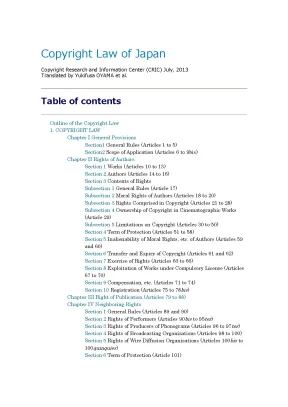
Copyright Law of Japan Copyright Research and Information Center (CRIC) July, 2013 Translated by Yukifusa OYAMA et al. Table of contents Outline of the Copyright Law 1. COPYRIGHT LAW Chapter I General Provisions Section1 General Rules (Articles 1 to 5) Section2 Scope of Application (Articles 6 to 9bis) Chapter II Rights of Authors Section 1 Works (Articles 10 to 13) Section 2 Authors (Articles 14 to 16) Section 3 Contents of Rights Subsection 1 General Rules (Article 17) Subsection 2 Moral Rights of Authors (Articles 18 to 20) Subsection 3 Rights Comprised in Copyright (Articles 21 to 28) Subsection 4 Ownership of Copyright in Cinematographic Works (Article 29) Subsection 5 Limitations on Copyright (Articles 30 to 50) Section 4 Term of Protection (Articles 51 to 58) Section 5 Inalienability of Moral Rights, etc. of Authors (Articles 59 and 60) Section 6 Transfer and Expiry of Copyright (Articles 61 and 62) Section 7 Exercise of Rights (Articles 63 to 66) Section 8 Exploitation of Works under Compulsory License (Articles 67 to 70) Section 9 Compensation, etc.
(Articles 71 to 74) Section 10 Registration (Articles 75 to 78bis) Chapter III Right of Publication (Articles 79 to 88) Chapter IV Neighboring Rights Section 1 General Rules (Articles 89 and 90) Section 2 Rights of Performers (Articles 90bis to 95ter) Section 3 Rights of Producers of Phonograms (Articles 96 to 97ter) Section 4 Rights of Broadcasting Organizations (Articles 98 to 100) Section 5 Rights of Wire Diffusion Organizations (Articles 100bis to 100quinquies) Section 6 Term of Protection (Article 101) Section 7 Inalienability of Moral Rights, etc. of Performers (Articles 101bis and 101ter) Section 8 Limitations, Transfer, Exercise and Registration of the Rights (Articles 102 to 104) Chapter V Compensation for Private Recording (Articles 104bis to 104decies) Chapter VI Settlement of Disputes (Articles 105 to 111) Chapter VII Infringements (Articles 112 to 118) Chapter VIII Penal Provisions (Articles 119 to 124) Supplementary Provisions 1-2. Old Copyright Law (Extract) 2. Law concerning the Exceptional Provisions to the Copyright Law required in consequence of the Enforcement of the Universal Copyright Convention 3.
Law concerning Exceptional Provisions for Copyrights Owned by the Allied Powers and the Allied Nationals 4. Law on Exceptional Provisions for the Registration of Program Works 5. Law for the Prevention of Stealthy Recording of Films 6. Law on Management Business of Copyright and Neighboring Rights 7.
Law on Intermediary Business concerning Copyrights (Repealed) Outline of the Copyright Law 1. Works "Work" means a production in which thoughts or sentiments are expressed in a creative way and which falls within the literary, scientific, artistic or musical domain (Art. • Classification of works (Art.1): Literary, musical, artistic, figurative, cinematographic, photographic, program and database works, etc. Authors "Author" means a person who creates a work (Art.
• Authorship of a work made by an employee in the course of his duties (Art. • Authorship of a cinematographic work (Art. Rights of Authors (Copyright) • Moral rights and copyright (Art. • Non-formality (Art.2): The enjoyment of moral rights and copyright shall not be subject to any formality.
Right of making the work public (Art.18) Right of determining the indication of the Moral rights author's name (Art.19) Right of preserving the integrity (Art.20) Right of reproduction (Art.21) Right of performance (Art.22) Right of presentation (Art.22bis) Rights of public transmission, etc.23) Rights of authors (Copyright) Right of recitation (Art.24) Right of exhibition (Art.25) Copyright (Economic rights) Rights of distribution(Art.26) Rights of transfer of ownership(Art.26bis) Right of lending (Art.26ter) Rights of translation, adaptation, etc.27) Right of the original author in the exploitation of a derivative work (Art. Limitations on Copyright • Reproduction for private use (Art.30); reproduction in libraries, etc.32); reproduction in school textbooks, etc.33); reproduction in school textbooks for preparing a textbook in large print (Art.33bis); broadcasting, etc.in school education programs (Art. in schools and other educational institutions, etc. in examination questions (Art.
in for visually handicapped, etc. for aurally handicapped, etc.37bis); performance, etc. not for profit-making (Art. of articles on current topics (Art.39); exploitation of political speeches, etc.40); reporting of current events (Art.41); reproduction for submitting documents in legal proceedings, patent examination procedure and pharmaceutical approval procedure (Art.42); exploitation for Disclosure by the Government Organizations Information Disclosure Law, etc.42bis); exploitation for preservation etc.
by the Public Records Management Law, etc.); reproduction for collecting internet materials under the National Diet Library Law (Art.42quater); ephemeral recordings by broadcasting organizations, etc. required for an offer of a transfer of ownership, etc. of an artistic work, etc.47bis); reproduction etc. by the owner of a copy of a program work (Art.47ter); temporary reproduction for maintain or repair of machine (Art.47quater) reproduction for the prevention, etc.
of a difficulty in transmission (Art.47quinquies); reproduction, etc. for retrieval, etc. of a transmitter identification code of information which has been made transmittable (Art.47sexies); reproduction etc. for analyzing information (Art.47septies); reproduction for exploitation of works where is used on a computer (Art.
Term of Protection • The term of copyright shall begin with the creation of the work; copyright shall continue to subsist, in principle, until the end of a period of fifty years following the death of the author (Art. • Copyright in anonymous and pseudonymous works and works bearing the name of a corporate body shall continue to subsist until the end of a period of fifty years following the making public of the work (Art. • Copyright in cinematographic works shall continue to subsist until the end of a period of seventy years following the making public of the work (Art. Registration • Registration of the true name (Art.75); registration of the date of the first publication, etc.76); registration of the date of creation (Art.76bis); registration of copyright (Art.
• Procedures for registration (Art.78); exceptional provision for the registration of program works (Art. Right of Publication 8. Neighboring Rights • Rights of performers, producers of phonograms, broadcasting organizations and wire diffusion organizations (Art. • Term of protection: fifty years from the time of performance, fixations of sounds on phonograms, broadcasting (Art.
Right of determining the indication of the performer's Moral rights of performers name (Art.90bis) Right of preserving the integrity (Art.90ter) Rights of performers Right of making sound or visual recordings (Art.91) Economic Rights of Right of broadcasting and wire rights authorization diffusion (Art.92) Right of making transmittable (Art.92bis) Right of transfer of ownership (Art.95bis) Right of lending (Art.95ter) Right to secondary use fees of commercial phonograms (Art.95) Right to remuneration for Rights to lending commercial remuneration phonograms (Art.95ter) Right to remuneration for simultaneous transmission of wire diffusion (Art.94bis) Right of reproduction (Art.96) Rights of Right of making transmittable (Art.96bis) authorization Right of lending (Art.97ter) Rights of producers of Right to secondary use fees of commercial phonograms phonograms (Art.97) Rights to Right to remuneration for lending remuneration commercial phonograms (Art.97ter) Right to remuneration for simultaneous transmission of wire diffusion (Art.97) Right of reproduction (Art.98) Rights of rebroadcasting and wire Rights of diffusion (Art.99) Rights of broadcasting authorization Right of making transmittable(Art.99bis) organizations Right of communication of television broadcasts (Art.100) Right of reproduction (Art.100bis) Right of broadcasting and wire rediffusion Rights of wire (Art.100ter) Rights of diffusion Right of making transmittable authorization organizations (Art.100quater) Right of communication of wire television diffusions (Art. Measures against Infringement on Copyright, etc. • Civil measures: Right of demanding cessation (Art.112); measures for recovery of honor, etc.115); compensation for damages; recovery of the undue profit; etc. • Criminal measures: Any person who infringes copyrights, right of publication or neighboring rights shall be punishable by imprisonment for a term not exceeding ten years or a fine not exceeding ten million Yen, or both (Art.
Any person who infringes moral rights of authors or moral rights of performers or who does an act considered to constitutes an infringement under Art. shall be punishable by imprisonment for a term not exceeding five years or a five not exceeding five million Yen (Art. Any person who, for the purpose of private use, infringes copyright or neighboring rights by making a digital sound or visual recording with knowing that such recording is made upon reception of an interactive transmission which infringes copyright or neighboring rights of works for value etc. shall be punishable by imprisonment for a term not exceeding two years or a fine not exceeding two million Yen, or both (Art.+ Any person who does acts of manufacture, distribution, etc.
of a device, etc. for the circumvention of technological protection measures shall be punishable by imprisonment for a term not exceeding three years or a fine not exceeding three million Yen, or both (Art. A legal person who infringes rights shall be punishable by a fine not exceeding three hundred million Yen (Art. • Acts considered to be infringements (Art.113): The importation into this country, for distribution, of objects made by an act which would constitute an infringement on moral rights, copyright, right of publication or neighboring rights if they were made in this country at the time of such importation.
The distribution, the possession for distribution or the making of an offer of distribution, or the exportation by trade or the possession for exportation by trade, of objects made by an act infringing moral rights, copyright, right of publication or neighboring rights, by a person who is aware of such infringement (Art. The intentional alteration, etc. of rights management information (Art. The underlined part has amended in 2009.
It will be enforced from 1st January 2010.] International Conventions (Status as of August 2012) • Berne Convention for the Protection of Literary and Artistic Works (1886, Berne) --- WIPO: 165 countries (Japan, U., France, Germany, China, etc.) • Universal Copyright Convention (1952, Geneva) --- UNESCO: 100 countries (Japan, U., France, Germany, etc.) • Convention for the Protection of Producers of Phonograms Against Unauthorized Duplication of Their Phonograms (1971, Geneva) --- WIPO, UNESCO: 77 countries (Japan, U., France, Germany, etc.) • International Convention for the Protection of Performers, Producers of Phonograms and Broadcasting Organizations (1961, Rome) --- WIPO, UNESCO, ILO: 91 countries (Japan, U., France, Germany, etc.) • Agreement on Trade - Related Aspects of Intellectual Property Rights (1994, Marrakesh) --- Marrakesh Agreement Establishing the World Trade Organization (WTO): 157 countries (Japan, U., France, Germany, etc.) • WIPO Copyright Treaty (WCT) (1996, Geneva) --- WIPO: 89 countries (Japan, U.) • WIPO Performances and Phonograms Treaty (WPPT) (1996, Geneva) --- WIPO: 89 countries (Japan, U. COPYRIGHT LAW (As amended by : Law No.49, of May 18, 1978, Law No.45, of May 19, 1981, Law No.78, of December 2, 1983, Law No.23, of May 1, 1984, Law No.46, of May 25, 1984, Law No.62, of June 14, 1985, Law No.64, of May 23, 1986, Law No.65, of May 23, 1986, Law No.87, of November 1, 1988, Law No.43, of June 28, 1989, Law No.63, of May 2, 1991, Law No.106, of December 16, 1992, Law No.89, of November 12, 1993, Law No.112, of December 14, 1994, Law No.91, of May 12, 1995, Law No.117, of December 26, 1996, Law No.86, of June 18, 1997, Law No.101, of June 12, 1998, Law No.43, of May 14, 1999, Law No.77, of June 15, 1999, Law No.160, of December 22, 1999, Law No.220, of December 22, 1999, Law No.56, of May 8, 2000, Law No.131, of November 29, 2000, Law No.140, of December 5, 2001, Law No.72, of June 29, 2002, Law No.61, of May 30, 2003, Law No.85, of June 18, 2003, Law No.119, of July 2, 2003, Law No.84, of June 9, 2004, Law No.92, of June 9, 2004, Law No.120, of June 18, 2004, Law No.147, of December 1, 2004, Law No.75, of June 29, 2005, Law No.50, of June 29, 2006, Law No.121, of December 22, 2006, Law No.81, of June 18, 2008, Law No.53, of June 19, 2009, Law No.73, of July 10, 2009, Law No.65, of December 3, 2010, Law No.32, of June 22, 2012, and Law No.43, of June 27, 2012) Chapter I General Provisions Section 1 General Rules (Purpose) Article 1.