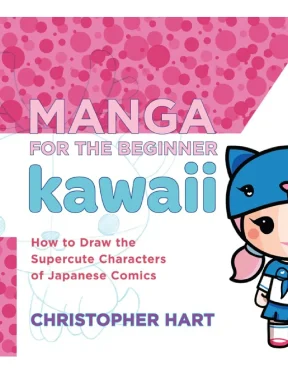
2 3 Copyright © 2012 by Cartoon Craft LLC All rights reserved. Published in the United States by Watson-Guptill Publications, an imprint of the Crown Publishing Group, a division of Random House, Inc.com WATSON-GUPTILL is a registered trademark, and the WG and Horse designs are trademarks of Random House, Inc. Library of Congress Cataloging-in-Publication Data Hart, Christopher, 1957- Manga for the beginner kawaii : everything you need to draw the supercute characters of Japanese comics / Christopher Hart. Comic books, strips, etc.
Comic strip characters—Japan. Figure drawing—Technique. Title: Everything you need to draw the supercute characters of Japanese comics.5′1—dc23 2011038160 eISBN: 978-0-8230-0663-2 Cover design by Jess Morphew Cover art by Novi Huans, Michele Liza Pelayre, Tesha Beaudry Okolowsky v3.1 Contributing Artists Akemi Kobayashi Novi Huang Rayteda Adetyar PH Tabby Kink Morgan Long Michele Liza Pelayre Tesha Beaudry Carol and Coutrney Regli and Bored, Inc. Aurora Tejado Additional material by Christopher Hart 4 The four basic necessities are shelter, food, water, and manga.
How can anyone not get that? —Christopher Hart, pondering the meaning of life, high atop Mount Everest 5 contents Cover Title Page Copyright INTRODUCTION THE BASICS How Regular Chibis Compare to Kawaii Style Cute Proportions Drawing the Head Eye Types Silly Expressions The Full Figure Positioning Your Characters at Different Angles 6 Color Variations Beginner vs. Pro ESSENTIAL KAWAII CHARACTER TYPES Cute Girls Cat Girls and Anthros Animal Cuties Fantasy Creatures and Pets Food and Treats with Personality Gothic Cuties ADORABLE ANTHROS Hamster Boy Hamster Girl Tiger Boy Tiger Girl Wolf Boy Wolf Girl Panda Tyke Humorous Panda Deer Boy Deer Girl Trendy Rabbit Pirate Rabbit Goth with Bat Wings Goth with Cat Ears THE DARK SIDE OF KAWAII 7 Evil Dolls Bad Girls Grim Reapers Skeletons Skeleton Critters CUTE ANIMALS & FANTASY CREATURES Irresistible Animals Fantasy Creatures GOOD MOOD FOOD Sugary Snacks More Junk Food Happy Fruit Japanese Food 8 MOE STYLE Drawing the Moe Head Moe Hairstyles Drawing the Body Essential Moe Characters PUTTING IT ALL TOGETHER Drawing Supercute Scenes Supercute Greeting Cards Turning Your Kawaii Passion into a Business INDEX 9 10 introduction 11 The term kawaii means “cute” in Japanese. But to manga fans, it means much more than that. It’s a pop-art style that’s so hypercharming, so excruciatingly adorable that it has swept Japan, Europe, and is now exploding all across the United States.
And look! It has landed in your hands, right here, in this profusely illustrated book that teaches the secrets to drawing this massively appealing art form. Kawaii became an instant hit in the United States with the megafranchise Hello Kitty. Other supercute characters soon grew in popularity, including San-X, Pucca, and Domo. Kawaii characters show up everywhere, from manga to anime, and on all kinds of licensed products, such as clothing, bags, watches, and even wallpaper.
You name it, Kawaii is on it. In this book, you’ll find a wide variety of character tutorials and clear, step-by- step illustrations. The book begins with an overview of the Kawaii style and its essential techniques, followed by chapters on Kawaii-based cat girls and anthros, evil cuties, adorable animals, fantasy creatures, cheerful foodies, and more. You’ll learn the specific techniques that will enable you to take an ordinary character and, with a few short strokes of the pencil, totally transform it into a supercute character.
In addition, the book covers a very popular subgenre of Kawaii. Some would even call it a genre in itself, because it’s virtually everywhere in Japan. That style is called moe (pronounced MOE-aye). In Japan, Kawaii not only refers to supercute characters but also to a genre of beautiful, elegantly drawn older teen girls.
Moe characters are drawn at a superheightened level of femininity. They will dazzle you with their delicate prettiness and grace. They also feature perhaps the most amazing, and largest, eyes in all of manga—and that’s saying something! Finally, there is a section on creating Kawaii-style scenes and backgrounds, as well as how to draw your own irresistibly cute Kawaii greeting cards. Many professional manga artists got their start by drawing Kawaii characters for private commissions.
This book features a valuable and exclusive interview with a two- artist team who started selling their Kawaii artwork modestly. Then step by step, they built their passion into a full-time business, which now licenses its many creations to major, name-brand retailers. They’ll show you how they did it and how you can, too! You won’t want to miss this. If you’re a manga artist, or want to be, then the Kawaii style is a great place to get started.
It’s easy to draw and vastly appealing. Getting good at drawing has never been this much fun. 12 13 Kawaii characters are in cute overdrive. Some are cheerful and agonizingly adorable.
Others may be dark but with an adorable evil quality. Still others, including fantasy animals and anthros, are quirky and weird but just as mind-numbingly cute. But whatever form Kawaii takes, people always find it irresistible. 14 how regular chibis compare to kawaii style Most manga fans are familiar with chibis—the popular minipeople of Japanese graphic novels.
You may think that Kawaii characters are the same as chibis. That’s a common misconception. Kawaii-style chibis have a distinct, younger, and more stylized look—a look all their own. 15 regular chibis * Head is more complex than a single shape, like a circle.
* Eyes feature “shines” as an important part of their characteristics. * Individual strands of hair are articulated. * Thin ink line is used. * Costume contains details, such as folds and lapels.
* Hands are drawn with individual fingers. * Colors are generally realistic. 16 17 18 kawaii style * Head is usually based on a simple shape (a circle or an oval). * Eyes are most often black dots without shines.
* Hair is simplified. * Outline is usually thick. * Costume is bold but streamlined. * Hands are simplified to eliminate fingers, although sometimes thumbs are still shown.
* Colors are bolder, splashier, and unrealistic. 19 20 21 cute proportions Drawing supercute means more than simply drawing supersmall. The proportions have to be cute, too. Now, you might be thinking, “Cute proportions? No one can create proportions that convey cuteness! It simply can’t be done.” You can draw a wonderful character, with cute features and an adorable costume—but if the proportions are off from Kawaii standards, then there is no way it will ever be supercute.
22 classic kawaii proportions To be supercute, the head must be bigger. It must be drawn much bigger than it would be on normal characters. How much bigger? Way, way, way, way bigger— until the head is bigger than the entire body. 1 1/2 HEADS TALL This is the “it can’t miss” gold standard of cute proportions.
How cute is that? 23 2 HEADS TALL Hmmm. The character is getting a little on the tall side. Although this is pushing it a bit, it still makes it under the limbo stick. 24 3 HEADS TALL Whoa! This doesn’t work.
The added height gives the character a huge “cuteness deficit.” 25 drawing the head In manga, as in comic art, cartoons, and even realistic figure drawing, artists typically make small adjustments to the outline of the head, refining it as they create the character. But not so in Kawaii. The shapes that serve as the foundation of the head remain unchanged from beginning to end. This has a profound effect on the drawing.
It creates the look of a graphic—a flat image, based on shapes executed in ultrastylized simplicity. At first glance, Kawaii appears so easy to draw. And, yes, it can be. But you have to understand the concepts that go into it.
Many professional manga artists draw fantastic shoujo but have difficulty with the Kawaii style because they don’t know how to add the right style to the basic foundation shapes. Let’s start with a typical, popular, Kawaii girl character as our example. She’s cute, bubbly, with dot-style eyes, no nose, and a small smile. She wears her hair short and has a thing covering her head.
Wait a minute—what the heck is that, anyway? That, my friends, is an anthro-hat (anthro refers to animals). It’s an adorably drawn, animal-shaped hat (often a hood). Why is she wearing it? Because it exponentially increases the charm factor by 3. Begin with a circle for the head.
Place the eyes low on the head, and space them wide apart. This is important for cute characters! 26 1. Make the line of the hat curved—not flat. The curve emphasizes the roundness of the head.
Omit the nose entirely. The character will never even know it’s gone. Unlike mouths on regular chibi characters, the mouth on Kawaii characters is almost always tiny. Draw the bangs on a diagonal.
This gives her a haircut a lively look. 27 Notice the thick linework in this step. Although not every Kawaii character is drawn with extrathick lines, many are. A thicker line makes the character look flatter, which, in turn, makes it look more stylish.
It also pushes the needle a few notches higher on the Cute-O-Meter. This approach further carves out the unique identity of Kawaii. Apply the initial colors. Color themes vary according to the genre.
This happy girl gets cheery colors, whereas a gothic girl would get a whole different color treatment. 28 Adding highlights and shadows to the colors is optional but effective. For information on how to create highlights and shadows, see this page. QUICK TIP You don’t need to draw a perfect circle.
Lots of artists draw them freehand. But if you want to try drawing characters with perfect circles, then I suggest purchasing something called a template at any art store or from an online art store. They’re really inexpensive, because each one is just a piece of plastic. Templates come in all different sizes of circles that you can trace.
29 eye types The most common eye type for Kawaii characters—humans, animals, or fantasy creatures—are dots; that is, black circles. However, they’re not the only type used. Some artists use variations to create unique characters. But don’t stray too far from the classic type.
Drawing a small pupil surrounded by the white of the eye, for example, would not give your character a Kawaii look. Only draw the black pupil. OVALS 30 FANCIFUL INTERIOR SYMBOL (HEARTS) 31 SMALL ALMOND LARGE ALMOND 32 SIMPLE CURVED LINE 33 silly expressions Kawaii is about communicating joy, fun, and good feelings. Appealing character design is essential.
But character design itself isn’t enough. If your character’s expression is understated or, equally problematic, if it’s too broad, you’ll find yourself out of Charmingland without a map. Although Kawaii expressions may be somewhat subdued, they’re not subtle. It’s always crystal clear what the character is feeling.
Try to do more with less. The fewer lines you use to create an expression, the cuter it will look. That’s the key to this style. HAPPY 34 PLAYFUL SAD 35 AMUSED SLEEPY 36 ANGRY SURPRISED 37 DISPLEASED 38 the full figure The head is the focal point of every Kawaii character design.
It’s what creates the basic cute appeal. To that end, keep the size of the body small in comparison, so as not to divert attention from the adorableness. This approach requires us to pack a lot of visual information into a small package—the body. Keep in mind two important things: First, it’s cuter if your character appears to be slightly on the pudgy side.
And second, since the body is so truncated, don’t try to do too much with the pose. Dynamic or action poses subtract from the overall cuteness. Draw the basic head and body shapes. Don’t define fingers and feet; imply them.
Draw the clothes over your figure; then erase the unwanted lines. A symmetrical pose is cute, funny, and charming. Thicken the line (optional). 41 “Checkerboard” the blue colors with the white colors.