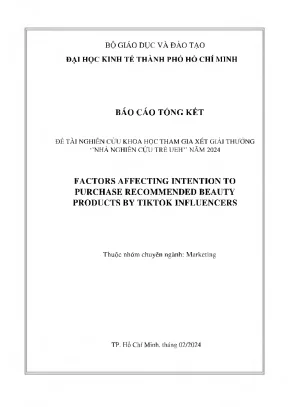
Nghiên Cứu Các Yếu Tố Ảnh Hưởng Đến Ý Định Mua Mỹ Phẩm Qua Gợi Ý Của TikTok Influencer: Tiếp Cận Dưới Góc Nhìn Lý Thuyết Hai Nhân Tố (Dual Factor Theory)
Tóm tắt nghiên cứu (Research Summary)
- Câu hỏi nghiên cứu chính: Những nhân tố nào đóng vai trò thúc đẩy (enablers) và rào cản kìm hãm (inhibitors) tác động trực tiếp đến ý định mua mỹ phẩm của người tiêu dùng trẻ tuổi dựa trên đề xuất của các Influencer trên nền tảng TikTok?
- Phương pháp nghiên cứu: Đề tài áp dụng phương pháp nghiên cứu hỗn hợp (mixed methods), kết hợp nghiên cứu định tính hiệu chỉnh thang đo và nghiên cứu định lượng khảo sát thực nghiệm $n = 245$ người dùng TikTok (18–34 tuổi). Mô hình phương trình cấu trúc bình phương bé nhất từng phần (PLS-SEM) trên phần mềm SmartPLS được sử dụng để phân tích dữ liệu.
- Kết quả cốt lõi: Mô hình nghiên cứu giải thích được 79.6% biến thiên của Ý định mua sắm ($R^2_{\text{adj}} = 0.796$). Các yếu tố thúc đẩy mang ý nghĩa thống kê bao gồm: Chuẩn chủ quan (tác động mạnh nhất, $f^2 = 0.347$), Trải nghiệm hưởng thụ ($f^2 = 0.236$), Tính chuyên môn của Influencer và Giá trị kỳ vọng thương hiệu. Ngược lại, Sự hoài nghi quảng cáo và Rủi ro tâm lý kìm hãm đáng kể ý định mua. Đặc biệt, nghiên cứu phát hiện Hành vi bầy đàn tạo ra tác động tiêu cực nghịch chiều – người dùng có xu hướng dè chừng trước các sản phẩm bị "seeding" quá ồ ạt.
- Hàm ý: Cung cấp cơ sở khoa học để các nhãn hàng mỹ phẩm và nhà sáng tạo nội dung tối ưu hóa chiến dịch Influencer Marketing, chuyển từ quảng bá đại trà sang xây dựng nội dung chân thực, có chiều sâu chuyên môn.
Bối cảnh và tầm quan trọng (Background & Significance)
Thực trạng phát triển của Social Commerce và TikTok tại Việt Nam
Việt Nam hiện đứng thứ 6 trong top 10 quốc gia có số lượng người dùng TikTok lớn nhất thế giới, với hơn 64% người dùng Internet thường xuyên truy cập nền tảng này. Sự ra đời của tính năng thương mại điện tử TikTok Shop vào cuối năm 2022 đã nhanh chóng đưa nền tảng này vươn lên vị trí top 3 sàn thương mại điện tử có doanh thu bán lẻ lớn nhất cả nước. Trong các ngành hàng mua sắm trực tuyến, mỹ phẩm và sản phẩm chăm sóc cá nhân chiếm tỷ trọng áp đảo lên tới 76%.
Khoảng trống nghiên cứu (Research Gap)
Mặc dù hình thức tiếp thị qua người có tầm ảnh hưởng (Influencer Marketing) bùng nổ mạnh mẽ, các báo cáo thương mại điện tử gần đây chỉ ra rằng tỷ lệ quyết định mua hàng dựa trên gợi ý của KOLs đang có xu hướng chững lại do tâm lý e ngại chất lượng, khó kiểm chứng thông tin và sự thiếu minh bạch. Phần lớn các nghiên cứu trước đây tại Việt Nam chỉ tập trung khai thác các khía cạnh tích cực một chiều (Enablers) hoặc phân tích chung trên Facebook/YouTube mà chưa đặt trong hệ sinh thái video ngắn chuyên biệt của TikTok dưới lăng kính lý thuyết đa chiều.
Tính cấp thiết và giá trị thực tiễn
Nghiên cứu được thực hiện nhằm lấp đầy khoảng trống học thuật bằng cách kết hợp đồng thời cả yếu tố thúc đẩy (Enablers) lẫn yếu tố kìm hãm (Inhibitors) theo Lý thuyết Hai nhân tố (Dual Factor Theory - DFT). Kết quả đề tài không chỉ cung cấp khung tham chiếu học thuật cập nhật cho lĩnh vực Tiếp thị Kỹ thuật số (Digital Marketing) mà còn đưa ra giải pháp chiến lược giúp doanh nghiệp mỹ phẩm tối ưu hóa ngân sách và giảm thiểu sự hoài nghi từ khách hàng mục tiêu thế hệ Gen Z.
Phương pháp luận và cách tiếp cận nghiên cứu (Methodology & Approach)
Khung lý thuyết nền tảng
Nghiên cứu ứng dụng Lý thuyết Hai nhân tố (Dual Factor Theory - DFT) do Cenfetelli (2004) phát triển. Khác với quan điểm truyền thống xem yếu tố tiêu cực chỉ là mặt đối lập của tích cực, DFT khẳng định các rào cản kìm hãm (inhibitors) và động lực thúc đẩy (enablers) tồn tại độc lập, đồng thời cùng chi phối hành vi ra quyết định. Mô hình còn tích hợp:
- Thuyết Hành động Hợp lý (TRA) & Chuẩn chủ quan (Subjective Norm).
- Mô hình Tri thức Thuyết phục (Persuasion Knowledge Model - PKM).
- Thuyết Tác động Xã hội (Social Impact Theory) & Hiệu ứng FOMO.
Thiết kế nghiên cứu và quy trình thu thập dữ liệu
- Nghiên cứu sơ bộ định tính: Thảo luận chuyên gia và giảng viên hướng dẫn để hiệu chỉnh hệ thống thang đo 41 biến quan sát phù hợp với bối cảnh thương mại mạng xã hội tại Việt Nam.
- Kích thích thực nghiệm (Stimulus Material): Nhóm nghiên cứu tích hợp một video clip đánh giá mỹ phẩm thực tế kéo dài 3 phút của beauty creator nổi tiếng (Call Me Duy) vào đầu bảng hỏi trực tuyến để người tham gia có trải nghiệm trực quan trước khi trả lời.
- Mẫu nghiên cứu: Áp dụng phương pháp lấy mẫu phi xác suất (kết hợp chọn mẫu thuận tiện và mẫu quả cầu tuyết - Snowball Sampling) qua Google Forms trong tháng 07 - 08/2023. Thu thập được 245 mẫu hợp lệ từ sinh viên đại học (18–34 tuổi, trong đó 89% là nữ giới; 65.9% sử dụng TikTok từ 1–3 giờ/ngày).
Kỹ thuật xử lý và kiểm định dữ liệu
- Phân tích mô hình đo lường (CCA): Đánh giá độ tin cậy nhất quán nội tại qua hệ số Cronbach's Alpha ($> 0.7$) và Độ tin cậy tổng hợp CR ($> 0.7$). Đánh giá giá trị hội tụ qua Phương sai trích trung bình $\text{AVE} > 0.5$. Kiểm tra giá trị phân biệt qua tỷ số $\text{HTMT} < 0.85$. Hai biến có outer loading thấp ($\text{PR3} = 0.174$ và $\text{PS1}$) đã được loại bỏ để tối ưu hóa mô hình.
- Phân tích mô hình cấu trúc (PLS-SEM): Kiểm định đa cộng tuyến thông qua hệ số phóng đại phương sai $\text{VIF} < 3.3$, thực hiện kỹ thuật Bootstrapping để kiểm định mức ý nghĩa thống kê ($p < 0.05$) và tính toán hệ số quy mô tác động ($f^2$).
Phát hiện chính từ nghiên cứu (Major Findings)
| Giả thuyết |
Mối quan hệ tác động |
Trọng số đường dẫn ($\beta$) |
Mức ý nghĩa ($p$-value) |
Quy mô tác động ($f^2$) |
Kết luận kiểm định |
| H1 |
Trải nghiệm hưởng thụ (HE) $\rightarrow$ Ý định mua (PI) |
Dương ($+$) |
$0.000$ |
$0.236$ (Lớn) |
Chấp nhận |
| H2 |
Giá trị kỳ vọng thương hiệu (BV) $\rightarrow$ Ý định mua (PI) |
Dương ($+$) |
$0.000$ |
$0.123$ (Trung bình) |
Chấp nhận |
| H3 |
Chuẩn chủ quan (SN) $\rightarrow$ Ý định mua (PI) |
Dương ($+$) |
$0.000$ |
$0.347$ (Rất lớn) |
Chấp nhận |
| H4 |
Hành vi bầy đàn (HB) $\rightarrow$ Ý định mua (PI) |
Âm ($-0.032$) |
$0.032$ |
$0.028$ (Nhỏ) |
Bác bỏ giả thuyết gốc (Tác động âm ngược chiều) |
| H5 |
Tính chuyên môn Influencer (IP) $\rightarrow$ Ý định mua (PI) |
Dương ($+$) |
$0.019$ |
$0.037$ (Nhỏ) |
Chấp nhận |
| H6 |
Nhận biết quảng cáo (PC) $\rightarrow$ Ý định mua (PI) |
Âm ($-$) |
$0.831$ |
$0.000$ (Không tác động) |
Bác bỏ |
| H7 |
Rủi ro sản phẩm (PR) $\rightarrow$ Ý định mua (PI) |
Âm ($-$) |
$0.649$ |
$0.002$ (Không tác động) |
Bác bỏ |
| H8 |
Rủi ro tâm lý (PS) $\rightarrow$ Ý định mua (PI) |
Âm ($-$) |
$0.046$ |
$0.038$ (Nhỏ) |
Chấp nhận |
| H9 |
Hoài nghi quảng cáo (AS) $\rightarrow$ Ý định mua (PI) |
Âm ($-$) |
$0.001$ |
$0.082$ (Trung bình) |
Chấp nhận |
1. Chuẩn chủ quan và Trải nghiệm hưởng thụ là 2 động lực dẫn dắt hàng đầu
Chuẩn chủ quan tác động mạnh nhất ($f^2 = 0.347$), khẳng định quyết định mua của giới trẻ chịu ảnh hưởng sâu sắc từ sự đồng thuận của bạn bè, gia đình và nhóm tham chiếu tin cậy. Bên cạnh đó, trải nghiệm hưởng thụ ($f^2 = 0.236$) chứng minh người dùng TikTok ưu tiên tính giải trí, cảm giác thư giãn và tính thẩm mỹ thị giác của video trước khi tiếp nhận thông tin sản phẩm.
2. Phát hiện bất ngờ: Hiệu ứng bầy đàn (Herd Behavior) tạo ra lực cản tiêu cực
Khác với các nghiên cứu thương mại truyền thống vốn cho rằng "càng đông người mua thì càng kích thích mua", kết quả tại nghiên cứu này chỉ ra hệ số đường dẫn mang giá trị âm có ý nghĩa thống kê ($\beta = -0.032, p = 0.032$). Nguyên nhân xuất phát từ việc người dùng trẻ ngày càng nhạy cảm với tình trạng "seeding bẩn" và bình luận ảo. Khi một sản phẩm xuất hiện ồ ạt một cách bất thường, người tiêu dùng có xu hướng nghi ngờ đây là chiến dịch truyền thông dàn dựng và chủ động hủy bỏ ý định mua.
3. Tác động triệt tiêu từ Hoài nghi quảng cáo và Rủi ro tâm lý
Sự hoài nghi quảng cáo ($p = 0.001, f^2 = 0.082$) kích hoạt cơ chế phòng vệ của người xem khi họ nhận thấy video có tính thương mại lộ liễu, thổi phồng công dụng. Đồng thời, rủi ro tâm lý ($p = 0.046$) – nỗi sợ thất vọng sau mua, sợ bị lừa hoặc căng thẳng khi giao dịch online – là rào cản kìm hãm trực tiếp hành vi chuyển đổi.
4. Nhận biết trả phí và Rủi ro sản phẩm không có tác động trực tiếp
Việc người xem biết video có gắn nhãn tài trợ (Paid Communication) không trực tiếp làm giảm ý định mua ($p = 0.831$). Gen Z sẵn sàng chấp nhận nội dung quảng cáo trả phí miễn là thông tin được truyền tải trung thực, có chuyên môn và mang lại giá trị giải trí.
Đóng góp khoa học và giá trị học thuật (Scientific Contributions)
Đóng góp về mặt lý luận (Theoretical Contributions)
- Mở rộng phạm vi của Dual Factor Theory: Khẳng định tính ưu việt của mô hình DFT trong nghiên cứu thương mại xã hội dạng video ngắn (Short-form Video Social Commerce), chứng minh tính độc lập và tác động đồng thời của hai nhóm biến Enablers – Inhibitors.
- Tái định nghĩa tác động của Hành vi bầy đàn: Cung cấp góc nhìn thực nghiệm mới làm phong phú thêm Thuyết Tác động Xã hội, chỉ ra rằng hiệu ứng bầy đàn có thể biến đổi thành phản ứng tiêu cực khi niềm tin thị trường bị xói mòn bởi tình trạng lạm dụng truyền thông kỹ thuật số.
Đổi mới về phương pháp luận (Methodological Innovations)
- Tích hợp video trải nghiệm thực tế (Video Stimulus) trực tiếp vào quy trình khảo sát định lượng, giúp chuẩn hóa bối cảnh đánh giá và giảm thiểu sai lệch nhận thức (perceptual bias) so với các câu hỏi khảo sát trừu tượng truyền thống.
Hàm ý quản trị cho doanh nghiệp và Influencer
- Đối với Thương hiệu Mỹ phẩm:
- Cắt giảm chiến lược "spam seeding" hàng loạt; chuyển dịch ngân sách sang hợp tác dài hạn với các KOC có chuyên môn sâu (dược sĩ, chuyên viên trang điểm, skin-care reviewer uy tín).
- Tôn trọng quyền đánh giá khách quan của Influencer (nêu cả ưu điểm lẫn nhược điểm sản phẩm) để giảm thiểu Hoài nghi quảng cáo.
- Đối với Nhà sáng tạo nội dung (TikTok Creators):
- Đầu tư vào chất lượng hình ảnh, kịch bản giải trí tự nhiên (Hedonic Experience) thay vì chỉ đọc thông số kỹ thuật khô khan.
- Giữ vững tính chuyên môn (Influencer Professionalism), minh bạch hóa nội dung tài trợ một cách văn minh.
Đối tượng quan tâm và giá trị ứng dụng (Target Audience)
Câu hỏi thường gặp (FAQ)
1. Phát hiện quan trọng và bất ngờ nhất của nghiên cứu này là gì?
Phát hiện đột phá nhất là tác động nghịch chiều của Hành vi bầy đàn (Herd Behavior). Trong khi các lý thuyết truyền thống khẳng định số đông thúc đẩy mua sắm, trên TikTok, việc một sản phẩm được quảng bá quá dày đặc lại kích hoạt tâm lý đề phòng "seeding giả mạo", khiến giới trẻ Gen Z từ chối mua hàng.
2. Phương pháp nghiên cứu của đề tài có điểm gì đặc biệt?
Nghiên cứu sử dụng kỹ thuật kích thích thực nghiệm bằng video (Video-based Survey): người tham gia khảo sát được xem một video review thực tế 3 phút của nhà sáng tạo nội dung trước khi trả lời bảng hỏi, đảm bảo dữ liệu đo lường phản ánh chính xác trạng thái tâm lý và hành vi thực tế.
3. Kết quả nghiên cứu có thể tổng quát hóa (generalize) cho toàn bộ người tiêu dùng không?
Mẫu khảo sát ($n = 245$) tập trung vào phân khúc sinh viên và người trẻ tuổi (18–34 tuổi, 89% nữ) tại khu vực đô thị. Kết quả có tính đại diện cao cho đối tượng khách hàng mục tiêu của ngành mỹ phẩm trên TikTok Shop, nhưng cần thận trọng khi suy rộng cho các nhóm tuổi lớn hơn hoặc các ngành hàng có giá trị cao khác.
4. Những bước nghiên cứu tiếp theo (Next Steps) có thể mở rộng là gì?
Các nghiên cứu tương lai có thể:
- Mở rộng mẫu khảo sát đa dạng hơn về giới tính và vùng miền.
- Phân tích so sánh đa nhóm (Multi-Group Analysis - MGA) giữa Nano/Micro Influencer và Mega Influencer.
- Đo lường hành vi mua hàng thực tế (Actual Purchase Behavior) thông qua dữ liệu đơn hàng thay vì chỉ dừng lại ở Ý định mua (Purchase Intention).
5. Doanh nghiệp mỹ phẩm nên thay đổi chiến lược tiếp thị như thế nào từ kết quả này?
Doanh nghiệp cần tập trung vào chất lượng nội dung: ưu tiên hợp tác với Influencer có kiến thức chuyên môn thực thụ, xây dựng video có tính giải trí cao, cho phép người review chia sẻ chân thực điểm hạn chế của sản phẩm và dừng ngay các hoạt động seeding bình luận ảo tràn lan.
Kết luận (Conclusion)
Báo cáo nghiên cứu khoa học tham gia xét giải thưởng "Nhà nghiên cứu trẻ UEH 2024" đã chứng minh thành công sự kết hợp hiệu quả giữa Lý thuyết Hai nhân tố (DFT) và mô hình PLS-SEM trong việc giải mã hành vi mua sắm mỹ phẩm trên TikTok. Nghiên cứu khẳng định rằng thành công của một chiến dịch Influencer Marketing không chỉ nằm ở việc khuếch đại các động lực hưởng thụ và chuẩn mực xã hội, mà quan trọng hơn là phải chủ động triệt tiêu các rào cản về sự hoài nghi và hiệu ứng bầy đàn tiêu cực. Đây là tài liệu tham khảo giá trị cho cả giới học thuật lẫn các nhà thực hành tiếp thị trong kỷ nguyên thương mại số chuyển dịch không ngừng.