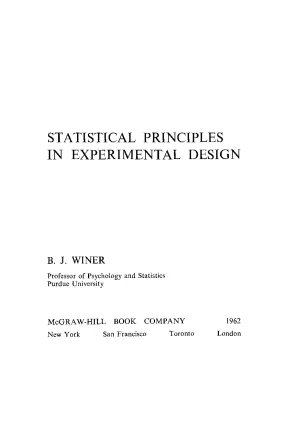
Tổng quan về giáo trình
Giáo trình Statistical Principles in Experimental Design (tạm dịch: Nguyên Tắc Thống Kê Trong Thiết Kế Thí Nghiệm) do Giáo sư B. J. Winer (Đại học Purdue) biên soạn, được Nhà xuất bản McGraw-Hill phát hành năm 1962. Trong chương trình đào tạo bậc đại học và sau đại học, tài liệu này giữ vị trí giáo trình chuyên môn phục vụ các học phần về thiết kế thí nghiệm, phân tích phương sai và phương pháp nghiên cứu định lượng, đặc biệt trong các ngành khoa học hành vi (tâm lý học, giáo dục học, xã hội học), kinh tế học và kỹ thuật công nghiệp.
Mục tiêu học tập của giáo trình bao gồm:
- Trang bị hệ thống nguyên lý logic làm nền tảng cho việc lập kế hoạch và triển khai các mô hình thí nghiệm khoa học.
- Giúp người học hiểu rõ bản chất của ước lượng tham số, khoảng tin cậy, kiểm định giả thuyết thống kê, sự tương quan giữa sai số loại 1 ($\alpha$), sai số loại 2 ($\beta$) và lực kiểm định (power).
- Phát triển năng lực tính toán, phân tích và diễn giải kết quả từ các mô hình thí nghiệm đơn yếu tố, đa yếu tố, đo lường lặp lại, thiết kế khối ngẫu nhiên và phân tích hiệp phương sai.
Về cấu trúc và cách tiếp cận, tác giả xây dựng giáo trình theo hướng ưu tiên cơ sở logic của phương pháp luận khoa học hơn là việc chứng minh toán học thuần túy về các phân phối mẫu. Giáo trình liên kết chặt chẽ giữa mô hình cấu trúc lý thuyết (structural models), công thức tính toán số học nhằm hạn chế sai số làm tròn và hệ thống bảng tra phân phối thống kê chuyên dụng.
Điểm đặc thù của tài liệu là tính linh hoạt trong đào tạo: nội dung được chia thành các phân đoạn phục vụ cho khóa học cơ sở một học kỳ (one-semester course) hoặc khóa học chuyên sâu thứ hai (second course), đồng thời cấu trúc các chương từ 8 đến 11 tương đối độc lập nhằm tạo điều kiện tra cứu cho các nhà nghiên cứu.
Nội dung kiến thức cốt lõi
Các chương và chủ đề chính
Cấu trúc giáo trình gồm 11 chương chính và 2 phần phụ lục, phát triển theo tiến trình từ cơ bản đến phức tạp:
- Chương 1 – Khái niệm cơ bản trong suy luận thống kê (Basic Concepts in Statistical Inference): Định nghĩa tổng thể, mẫu ngẫu nhiên, phân phối mẫu của trung bình và phương sai; định lý giới hạn trung tâm; tiêu chuẩn đánh giá ước lượng (không chệch, hiệu quả, nhất quán, tiệm cận); phương pháp ước lượng hợp lý cực đại (maximum likelihood); bản chất của kiểm định giả thuyết $H_1$, giả thuyết đối $H_2$, sai số loại 1, sai số loại 2 và đường cong lực kiểm định.
- Chương 2 – Kiểm định giả thuyết về trung bình và phương sai (Testing Hypotheses about Means and Variances): Kiểm định một phía và hai phía khi biết hoặc chưa biết $\sigma$; thống kê Student's $t$; kiểm định tính đồng nhất phương sai qua thống kê $F$; xử lý bài toán phương sai không đồng nhất (Behrens-Fisher, xấp xỉ Satterthwaite, xấp xỉ Welch); kiểm định mẫu phụ thuộc trong thiết kế đo lường lặp lại (correlated observations).
- Chương 3 & 4 – Thiết kế và phân tích thí nghiệm đơn yếu tố (Single-factor Experiments): Mô hình cấu trúc I (yếu tố cố định - fixed effects) và Mô hình II (thành phần phương sai - variance components); so sánh bội giữa các trung bình điều trị (kiểm định hậu định, phân tích thành phần xu hướng trực giao, kiểm định khoảng Studentized, so sánh với nhóm đối chứng theo phương pháp Dunnett); mở rộng sang thí nghiệm đo lường lặp lại trên cùng phần tử (repeated measures), đánh giá độ tin cậy của phép đo và phân tích phương sai cho dữ liệu xếp hạng.
- Chương 5 & 6 – Thiết kế và phân tích thí nghiệm đa yếu tố (Factorial Experiments): Định nghĩa hiệu ứng chính (main effects) và hiệu ứng tương tác (interaction effects); nguyên tắc lập tỉ số $F$ và tính giá trị kỳ vọng của bình phương trung bình (expected mean squares); thiết kế ô chia (split-plot designs); kiểm định tính phi cộng tính (nonadditivity); kỹ thuật biến đổi thang đo; quy trình bình phương tối thiểu khi tần số ô không bằng nhau (unequal cell frequencies); thiết kế đa yếu tố $2^k$.
- Chương 7 & 8 – Thí nghiệm đa yếu tố lặp lại và thiết kế kiểm soát tương tác lồng ghép (Multifactor Repeated Measures & Confounded Factorials): Phân tích thí nghiệm hai và ba yếu tố có đo lường lặp lại; kiểm định tính đối xứng và bằng nhau của ma trận hiệp phương sai; kỹ thuật làm lẫn/lồng ghép tương tác (confounding) trong các khối kích thước nhỏ cho thiết kế $2 \times 2 \times 2$, $3 \times 3$, $3 \times 2 \times 2$.
- Chương 9, 10 & 11 – Các mô hình khối cân bằng, ô vuông Latin và phân tích hiệp phương sai: Phân tích thiết kế mạng lưới cân bằng (Balanced Lattice), khối không hoàn toàn cân bằng (BIBD), ô vuông Youden; thiết kế ô vuông Latin, Greco-Latin; kỹ thuật phân tích hiệp phương sai (ANCOVA) cho mô hình đơn yếu tố, đa yếu tố và đa biến đồng biến (multiple covariates).
Kiến thức nền tảng được xây dựng
- Hệ thống mô hình cấu trúc toán học: Biểu diễn giá trị quan sát dưới dạng tổng các thành phần hiệu ứng thực nghiệm và sai số ngẫu nhiên:
- Mô hình hai mẫu độc lập: $X_{ij} = \tau_j + \epsilon_{ij}$
- Mô hình đo lường lặp lại: $X_{ia} = \tau_a + \pi_i + \epsilon_{ia}$ (trong đó $\pi_i$ là hiệu ứng đặc thù của cá thể $i$, được tách biệt khỏi sai số thực nghiệm $\epsilon_{ia}$).
- Lý thuyết kiểm định và ước lượng: Khái niệm hàm hợp lý cực đại theo R. A. Fisher; xác lập khoảng tin cậy một phía và hai phía tương ứng với miền bác bỏ của giả thuyết kiểm định.
- Tính vững của kiểm định thống kê (Robustness): Dựa trên các nghiên cứu của G. E. P. Box (1954), giáo trình xây dựng luận điểm về mức độ ảnh hưởng của việc vi phạm giả định chuẩn và tính đồng nhất phương sai đối với độ chính xác của kiểm định $t$ và $F$.
Kỹ năng phát triển
- Kỹ năng kỹ thuật (Technical skills): Lập công thức tính toán tổng bình phương, ma trận hiệp phương sai, tính giá trị thống kê $t, F, \chi^2$, xử lý bảng số liệu ANOVA và ANCOVA nhiều chiều.
- Kỹ năng phân tích (Analytical skills): Phân tích tương tác bậc cao bằng hình học; phân tách hiệu ứng chính thành các thành phần xu hướng đa thức trực giao (orthogonal polynomials); nhận diện tác động của thứ tự thực hiện thí nghiệm (treatment by order interaction).
- Năng lực thực hành thực nghiệm (Practical competencies): Đánh giá tương quan giữa chi phí thí nghiệm và độ chính xác (precision); xác định kích thước mẫu cần thiết trước khi thu thập dữ liệu; lựa chọn cấu trúc thí nghiệm phù hợp với điều kiện nghiên cứu cụ thể.
Phương pháp giảng dạy và học tập
Phương pháp tiếp cận sư phạm (Pedagogical Approach)
Giáo trình kết hợp đồng thời ba cấu phần trong từng chủ đề:
- Trình bày cơ sở logic và mô hình toán học của thiết kế.
- Diễn giải các ví dụ thực nghiệm cụ thể.
- Hướng dẫn quy trình tính toán số học chi tiết.
Để phục vụ mục đích tra cứu và giảng dạy, các chương lý thuyết phức tạp được tách biệt với chương tính toán ứng dụng (chẳng hạn, Chương 5 trình bày lý thuyết thí nghiệm đa yếu tố, trong khi Chương 6 tập trung toàn bộ vào quy trình tính toán và ví dụ số liệu).
Bài tập, bài toán thực hành và phương pháp tự học
Tài liệu cung cấp chuỗi dữ liệu thực nghiệm mẫu hoàn chỉnh với các bước tính toán trung gian:
- Bảng tính toán kiểm định $t$ cho hai mẫu độc lập và hai mẫu phụ thuộc, thể hiện rõ cách gộp phương sai ($s_p^2$) và xử lý sai số làm tròn qua các ký hiệu tổng bình phương ($L_a, L_b$).
- Bài toán xử lý phương sai không đồng nhất bằng phương pháp tính bậc tự do điều chỉnh theo Welch ($f$) và Cochran-Cox.
- Ví dụ số liệu chi tiết cho các thiết kế khối $2 \times 2 \times 2$, $3 \times 3$, thiết kế ô vuông Latin và phân tích hiệp phương sai có biến kiểm soát.
Về phương pháp tự học và đánh giá, người học có thể tự kiểm tra kết quả tính toán thông qua hệ thống bảng tra phân phối mẫu đầy đủ tại Phụ lục B:
- Bảng phân phối chuẩn tắc $N(0,1)$ và phân phối Khi bình phương ($\chi^2$).
- Phân phối Studentized range ($q$) và phân phối $t$ so sánh với đối chứng theo Dunnett.
- Bảng giá trị tới hạn cho kiểm định tính đồng nhất phương sai của Cochran và thống kê $F_{max}$.
- Bảng hệ số đa thức trực giao và các đường cong lực kiểm định chuẩn hóa (curves of constant power).
Điểm nổi bật và tài liệu đối chiếu
Sự kế thừa và tích hợp các nghiên cứu nền tảng
Giáo trình kế thừa trực tiếp các nguyên lý thiết kế thí nghiệm kinh điển từ tác phẩm The Design of Experiments của R. A. Fisher và Experimental Designs của W. G. Cochran & G. M. Cox. Tác giả đã chuyển hóa các phương pháp vốn được áp dụng chủ yếu trong nông nghiệp sang bối cảnh nghiên cứu của các ngành khoa học xã hội và hành vi.
Tích hợp các giải pháp đối chuẩn thống kê
Tài liệu cập nhật và đối chiếu các công trình nghiên cứu chuyên sâu về mặt lý thuyết và thực nghiệm:
- Vấn đề Behrens-Fisher: So sánh các cách tiếp cận khác nhau trong việc xử lý hai mẫu có phương sai không bằng nhau, bao gồm bảng phân phối Behrens-Fisher (Fisher & Yates, 1953), phương pháp xấp xỉ của Cochran & Cox (1957), công thức xấp xỉ của F. E. Satterthwaite (1946) và nghiệm giải tích chính xác của B. L. Welch (1947) cùng bảng số liệu của A. A. Aspin (1949).
- Kiểm định tính vững: Trích dẫn các kết luận thực nghiệm của G. E. P. Box (1954) để chứng minh rằng kiểm định $t$ và $F$ ít bị sai lệch mức ý nghĩa khi phân phối dữ liệu thực tế có độ lệch vừa phải so với phân phối chuẩn.
- Hệ thống bảng biểu tiêu chuẩn: Tích hợp dữ liệu bảng tra từ các nguồn học thuật uy tín đương thời như bảng phân phối của E. Pearson (Biometrika Tables for Statisticians), bảng kiểm định Dunnett (Journal of the American Statistical Association), bảng thống kê của C. Wallis (Techniques of Statistical Analysis, 1947), báo cáo kỹ thuật WADC của H. Guthrie (1958) và bảng số liệu của L. Mahmoud (Psychometrika).
Đối tượng sử dụng giáo trình
Phân loại người học và điều kiện tiên quyết
- Sinh viên đại học năm cuối và học viên cao học: Thuộc các ngành Tâm lý học, Khoa học Giáo dục, Xã hội học, Kinh tế học, Thống kê ứng dụng và Kỹ thuật Công nghiệp.
- Kiến thức nền tảng yêu cầu (Prerequisites):
- Trình độ toán học tương đương đại số đại học năm nhất (freshman college algebra).
- Đã hoàn thành học phần cơ sở về suy luận thống kê (basic course in statistical inference), bao gồm ước lượng điểm, khoảng tin cậy và kiểm định tham số cơ bản.
Ứng dụng trong giảng dạy và nghiên cứu
- Đối với giảng viên:
- Cung cấp khung chương trình cho khóa học một học kỳ tập trung vào các thiết kế cơ bản: Chương 1, 2, 3, 4, cùng các phần chọn lọc từ Chương 5, 6, 7, 10 và 11.
- Xây dựng khóa học chuyên sâu thứ hai về thiết kế thí nghiệm nâng cao dựa trên các chủ đề chọn lọc từ Chương 7 đến Chương 11.
- Đối với nhà nghiên cứu: Đóng vai trò là tài liệu tham khảo độc lập. Các chương về thiết kế lồng ghép (Chương 8), khối không hoàn toàn cân bằng (Chương 9), ô vuông Latin (Chương 10) và phân tích hiệp phương sai (Chương 11) được biên soạn độc lập, cho phép tra cứu trực tiếp từng mô hình mà không bắt buộc phải đọc tuần tự toàn bộ văn bản.
Câu hỏi thường gặp
1. Giáo trình này phù hợp với đối tượng nào?
Tài liệu được biên soạn phục vụ sinh viên đại học, học viên sau đại học và các nhà nghiên cứu trong lĩnh vực khoa học hành vi (tâm lý học, giáo dục học, xã hội học), kinh tế học và kỹ thuật công nghiệp cần thiết kế và xử lý dữ liệu thí nghiệm.
2. Cần kiến thức nền tảng nào trước khi học giáo trình này?
Người học cần có trình độ đại số đại học năm nhất và đã hoàn thành học phần cơ sở về suy luận thống kê. Chương 1 và Chương 2 của sách chỉ tóm tắt lại thuật ngữ và ký hiệu chứ không thay thế cho học phần suy luận thống kê nhập môn.
3. Giáo trình này có điểm gì khác biệt so với các sách toán thống kê lý thuyết?
Khác với các tài liệu thuần toán học tập trung vào việc chứng minh các định lý phân phối mẫu, giáo trình của B. J. Winer tập trung vào cấu trúc logic của các mô hình thí nghiệm, cách thiết lập giả thuyết khoa học, kiểm soát sai số thực nghiệm và quy trình tính toán số học trên dữ liệu thực tế.
4. Làm thế nào để tự học và tra cứu hiệu quả các chương nâng cao?
Các chương từ 8 đến 11 được thiết kế có tính độc lập cao. Người học sau khi nắm vững nguyên lý phân tích phương sai ở Chương 3 và Chương 5 có thể đọc trực tiếp vào các mô hình thiết kế khối cân bằng, ô vuông Latin hoặc phân tích hiệp phương sai tùy theo nhu cầu nghiên cứu cụ thể.
5. Giáo trình có cung cấp các bảng tra số liệu bổ trợ không?
Phụ lục B của sách cung cấp hệ thống bảng phân phối mẫu đầy đủ, bao gồm phân phối chuẩn, Studentized range, bảng Dunnett so sánh với đối chứng, bảng Cochran kiểm định phương sai, bảng đa thức trực giao và các họ đường cong xác định lực kiểm định.
Kết luận
Giáo trình Statistical Principles in Experimental Design của B. J. Winer xác lập hệ thống phương pháp luận hoàn chỉnh về thiết kế thí nghiệm và phân tích phương sai cho khối ngành khoa học hành vi và kỹ thuật ứng dụng.
Lộ trình học tập đề xuất:
- Hoàn thành việc củng cố thuật ngữ và nguyên lý kiểm định tại Chương 1 và Chương 2.
- Nắm vững kỹ thuật phân tích đơn yếu tố và đo lường lặp lại ở Chương 3 và Chương 4.
- Chuyển tiếp sang các mô hình đa yếu tố (Chương 5, 6, 7) và các thiết kế khối chuyên biệt (Chương 8, 9, 10, 11).
Trong quá trình học tập và xử lý số liệu, người học kết hợp sử dụng các chủ đề nâng cao tại Phụ lục A cùng hệ thống bảng phân phối xác suất tại Phụ lục B để hoàn thiện các quy trình kiểm định thống kê.