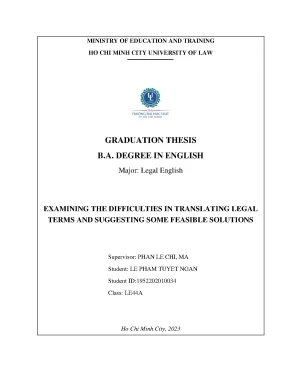
Khó Khăn Trong Việc Dịch Thuật Thuật Ngữ Pháp Lý Và Giải Pháp Khả Thi

Tài liệu nghiên cứu Examining the difficulties in translating legal terms and suggesting some feasible solutions, tổng hợp lý thuyết và thực hành, cung cấp kiến thức chuyên sâu về

Trường đại học

Ho Chi Minh City University of Law

Chuyên ngành

Legal English

Người đăng

Ẩn danh

Thể loại

graduation thesis

2023

63
6
0

Phí lưu trữ

30 Point

Mục lục chi tiết

ACKNOWLEDGMENT

LIST OF ABBREVIATIONS

LIST OF DIAGRAMS

1. CHƯƠNG 1: INTRODUCTION

1.1. Background to the research

1.2. Aim of the research

1.3. The scope of the research

1.4. The significance of the research

1.5. Data collections and data analysis

1.6. Subject of the research

1.7. Outline of the thesis

2. CHƯƠNG 2: LITERATURE REVIEW

2.1. Overview of translation

2.1.1. What is translation?

2.1.2. The translation history

2.1.2.1. History of European translation
2.1.2.2. History of Vietnamese translation

2.1.3. Process of translation

2.1.4. Factors of translation

2.1.4.1. Word-for-word translation

2.1.5. What is legal translation?

2.1.6. The difference between Legal translation and General translation

2.1.7. What makes translating legal terms difficult?

2.2. Description of methodology

2.2.1. Difficulties in translating legal terms

2.2.1.1. Factors directly related to the terms
2.2.1.1.1. Not mastering technical terms
2.2.1.1.2. Polysemy of legal terms
2.2.1.1.3. Synonymy of legal terms
2.2.1.1.4. Collocations, legal phrases, and phrasal verbs
2.2.1.1.5. A combination of synonyms or near-meanings words
2.2.1.1.7. Legal illogical expressions
2.2.1.2. Other factors affecting the translation of legal terms
2.2.1.2.1. Knowledge of Legal Background
2.2.1.2.2. Differences in the legal system
2.2.1.2.3. Differences in the language system
2.2.1.2.4. Cultural differences and context
2.2.1.2.5. Complex sentence structure and grammar
2.2.1.3. The common difficulties encountered when translating legal terms

2.2.2. Useful methods for making term translation more straightforward and more accurate

2.2.2.1. Enhance and broaden understanding of both language and law
2.2.2.3. Choose the most appropriate translation method
2.2.2.4. Discover and comprehend the culture of both languages
2.2.2.5. Apply translation process
2.2.2.6. Solutions for equivalent words

2.2.3. Findings and recommendations

2.2.4. Tips for translation legal terms

2.3. Limitations of the study

Tóm tắt

I. Tổng Quan Về Dịch Thuật Pháp Lý Tầm Quan Trọng Hiện Nay

Trong bối cảnh toàn cầu hóa, khả năng giao tiếp đa văn hóa, kinh tế, chính trị và xã hội có ảnh hưởng lớn đến sự phát triển của một quốc gia. Dịch thuật đóng vai trò cầu nối, giúp quá trình hợp tác và giao tiếp trở nên nhanh chóng, dễ dàng hơn. Mặc dù tiếng Anh được sử dụng rộng rãi, việc hiểu các tài liệu chuyên ngành, đặc biệt là văn bản pháp luật, đòi hỏi kiến thức chuyên sâu về cả ngôn ngữ và luật pháp. Vì vậy, dịch thuật pháp lý vẫn vô cùng quan trọng trong kỷ nguyên hiện nay. Việt Nam đang phát triển và hội nhập, kéo theo sự gia tăng đáng kể về số lượng tài liệu và hợp đồng trong các hoạt động hành chính, thương mại và hợp tác quốc tế. Ngành dịch thuật văn bản pháp luật ngày càng trở nên quan trọng, đặc biệt khi nhu cầu hợp tác quốc tế và am hiểu luật pháp nước ngoài ngày càng tăng cao. Theo Duraner (2014), thế giới ngày nay chứng kiến sự gia tăng các cuộc đàm phán, thỏa thuận và tranh chấp giữa các quốc gia và cá nhân.

1.1. Vai Trò Của Dịch Thuật Pháp Lý Trong Hội Nhập Quốc Tế

Dịch thuật pháp lý đóng vai trò then chốt trong việc đảm bảo sự hiểu biết lẫn nhau giữa các quốc gia và tổ chức, đặc biệt trong các lĩnh vực thương mại, đầu tư, và giải quyết tranh chấp. Sự chính xác trong dịch thuật các văn bản pháp quy, hợp đồng, và các tài liệu pháp lý khác là yếu tố then chốt để tránh những hiểu lầm và tranh chấp pháp lý tiềm ẩn. Các văn bản được dịch chính xác, rõ ràng giúp các bên liên quan nắm bắt thông tin, chủ động thực hiện quyền và nghĩa vụ của mình.

1.2. Thách Thức Về Nhu Cầu Dịch Thuật Chuyên Ngành Pháp Lý

Nhu cầu dịch thuật chuyên ngành pháp lý đang tăng lên đáng kể, đặc biệt là trong bối cảnh Việt Nam hội nhập sâu rộng vào nền kinh tế thế giới. Các doanh nghiệp và cá nhân tham gia vào các hoạt động kinh doanh quốc tế cần phải hiểu rõ các quy định pháp luật của các quốc gia khác nhau. Điều này tạo ra một áp lực lớn đối với các dịch giả và các công ty dịch thuật trong việc cung cấp các dịch vụ dịch thuật chất lượng cao, đảm bảo tính chính xác và tuân thủ các tiêu chuẩn pháp lý quốc tế.

II. Top 5 Khó Khăn Dịch Thuật Thuật Ngữ Pháp Lý Phân Tích Sâu

Dịch thuật pháp lý khác biệt so với dịch thuật thông thường, đòi hỏi độ chính xác tuyệt đối. Một sai sót nhỏ có thể dẫn đến hậu quả pháp lý nghiêm trọng, ảnh hưởng đến quyền lợi của các bên liên quan. Thuật ngữ pháp lý mang tính chuyên môn cao, đòi hỏi người dịch phải có kiến thức sâu rộng về cả ngôn ngữ và luật pháp. Sự khác biệt giữa các hệ thống pháp luật, văn hóa và ngôn ngữ cũng là những thách thức lớn đối với người dịch. Việc dịch sát nghĩa đôi khi không đủ để truyền tải chính xác ý nghĩa của tác giả. Willow Wilson cho rằng ngôn ngữ khác nhau có lý do, không thể chuyển đổi ý tưởng mà không mất mát. Để dịch chính xác, người dịch cần am hiểu cả ngôn ngữ nguồn và ngôn ngữ đích.

2.1. Sự Khác Biệt Giữa Các Hệ Thống Pháp Luật Vấn Đề Dịch Thuật

Sự khác biệt giữa các hệ thống pháp luật, như Common Law và Civil Law, tạo ra nhiều khó khăn trong việc dịch thuật. Mỗi hệ thống có những khái niệm, nguyên tắc và quy trình pháp lý riêng biệt, điều này đòi hỏi người dịch phải hiểu rõ bản chất của từng hệ thống để có thể chuyển ngữ một cách chính xác và phù hợp. Ví dụ, các khái niệm trong Common Law có thể không có từ tương đương trong Civil Law, và ngược lại.

2.2. Tính Đa Nghĩa Của Thuật Ngữ Pháp Lý Rào Cản Lớn

Một trong những khó khăn lớn nhất trong dịch thuật pháp lý là tính đa nghĩa của thuật ngữ. Một từ hoặc cụm từ có thể mang nhiều ý nghĩa khác nhau tùy thuộc vào ngữ cảnh và hệ thống pháp luật áp dụng. Người dịch cần phải có khả năng phân tích và hiểu rõ ngữ cảnh cụ thể để chọn được từ hoặc cụm từ tương đương chính xác nhất trong ngôn ngữ đích, tránh gây hiểu lầm hoặc sai lệch ý nghĩa.

2.3. Thiếu Hiểu Biết Về Bối Cảnh Pháp Lý Thách Thức Dịch Thuật

Người dịch cần phải có kiến thức nền tảng vững chắc về bối cảnh pháp lý liên quan đến văn bản cần dịch. Việc thiếu hiểu biết về các quy định, thủ tục, và nguyên tắc pháp lý có thể dẫn đến sai sót trong dịch thuật, làm thay đổi ý nghĩa và gây ra những hậu quả pháp lý không mong muốn. Điều này đặc biệt quan trọng đối với các văn bản pháp lý phức tạp hoặc liên quan đến các lĩnh vực pháp luật chuyên sâu.

III. Hướng Dẫn Chi Tiết Phương Pháp Dịch Thuật Thuật Ngữ Pháp Lý Hiệu Quả

Để dịch thuật pháp lý hiệu quả, cần kết hợp kiến thức ngôn ngữ, luật pháp và kỹ năng nghiên cứu. Việc nắm vững thuật ngữ pháp lý, hiểu rõ ngữ cảnh và sử dụng các công cụ hỗ trợ dịch thuật là rất quan trọng. Ngoài ra, cần chú ý đến sự khác biệt về văn hóa và hệ thống pháp luật giữa các quốc gia. Dịch thuật pháp lý không chỉ là chuyển ngữ mà còn là truyền tải chính xác ý nghĩa và mục đích của văn bản gốc. Việc tham khảo các tài liệu tham khảo, từ điển chuyên ngành và ý kiến của các chuyên gia pháp lý là rất hữu ích.

3.1. Nâng Cao Hiểu Biết Về Ngôn Ngữ và Luật Pháp Bí Quyết Dịch Thuật

Để cải thiện chất lượng dịch thuật, người dịch cần liên tục trau dồi kiến thức về cả ngôn ngữ và luật pháp. Việc đọc sách, báo, tạp chí chuyên ngành, tham gia các khóa học và hội thảo liên quan đến dịch thuật pháp lý là rất quan trọng. Bên cạnh đó, cần thường xuyên cập nhật các thay đổi trong hệ thống pháp luật để đảm bảo tính chính xác và cập nhật của các bản dịch.

3.2. Sử Dụng Phương Pháp Dịch Thuật Phù Hợp Tối Ưu Hóa Bản Dịch

Việc lựa chọn phương pháp dịch thuật phù hợp là yếu tố quan trọng để đảm bảo chất lượng bản dịch. Các phương pháp dịch thuật phổ biến bao gồm dịch sát nghĩa, dịch tự do, và dịch thích ứng. Người dịch cần phải cân nhắc ngữ cảnh, mục đích và đối tượng của văn bản để chọn phương pháp dịch thuật phù hợp nhất, đảm bảo truyền tải chính xác ý nghĩa và mục đích của văn bản gốc.

3.3. Áp Dụng Quy Trình Dịch Thuật Chuẩn Đảm Bảo Chất Lượng

Để đạt hiệu quả tối ưu, cần có một quy trình dịch thuật chuẩn, bao gồm các bước: Nghiên cứu tài liệu, lựa chọn thuật ngữ phù hợp, dịch thô, chỉnh sửa, kiểm tra chất lượng, và hiệu đính. Mỗi giai đoạn cần được thực hiện cẩn thận để đảm bảo tính chính xác và nhất quán của bản dịch. Nên có sự tham gia của các chuyên gia pháp lý để kiểm tra tính chính xác về mặt pháp lý.

IV. Top 3 Giải Pháp Khả Thi Vượt Qua Khó Khăn Dịch Thuật Pháp Lý

Đối mặt với những khó khăn trong dịch thuật pháp lý, cần có những giải pháp cụ thể và hiệu quả. Việc xây dựng hệ thống thuật ngữ pháp lý chuẩn hóa, đào tạo đội ngũ dịch giả pháp lý chuyên nghiệp và sử dụng các công cụ hỗ trợ dịch thuật hiện đại là những giải pháp quan trọng. Đồng thời, cần tăng cường hợp tác giữa các trường đại học, viện nghiên cứu và các tổ chức pháp lý để nâng cao chất lượng đào tạo và nghiên cứu trong lĩnh vực dịch thuật pháp lý.

4.1. Xây Dựng Hệ Thống Thuật Ngữ Pháp Lý Chuẩn Hóa Giải Pháp Cốt Lõi

Một trong những giải pháp quan trọng nhất để cải thiện chất lượng dịch thuật pháp lý là xây dựng hệ thống thuật ngữ chuẩn hóa. Hệ thống này cần bao gồm các định nghĩa rõ ràng, chính xác và cập nhật về các thuật ngữ pháp lý phổ biến, đồng thời cung cấp các từ tương đương trong các ngôn ngữ khác nhau. Điều này sẽ giúp người dịch dễ dàng tìm kiếm và lựa chọn được thuật ngữ phù hợp, tránh gây hiểu lầm hoặc sai lệch ý nghĩa.

4.2. Đào Tạo Chuyên Gia Dịch Thuật Pháp Lý Đầu Tư Vào Nguồn Nhân Lực

Việc đào tạo đội ngũ chuyên gia dịch thuật pháp lý chuyên nghiệp là yếu tố then chốt để đảm bảo chất lượng dịch vụ dịch thuật. Các chương trình đào tạo cần tập trung vào việc cung cấp kiến thức chuyên sâu về luật pháp, ngôn ngữ và kỹ năng dịch thuật. Ngoài ra, cần khuyến khích các dịch giả tham gia các khóa đào tạo nâng cao, hội thảo chuyên ngành và các hoạt động giao lưu học hỏi kinh nghiệm để nâng cao trình độ chuyên môn.

4.3. Ứng Dụng Công Cụ Dịch Thuật Pháp Lý Tối Ưu Hiệu Suất

Sử dụng các công cụ hỗ trợ dịch thuật hiện đại, như từ điển điện tử, phần mềm quản lý thuật ngữ, và các nền tảng dịch thuật trực tuyến, có thể giúp người dịch tiết kiệm thời gian và nâng cao hiệu quả công việc. Tuy nhiên, cần lưu ý rằng các công cụ này chỉ là công cụ hỗ trợ, người dịch vẫn cần phải có kiến thức và kỹ năng chuyên môn để đảm bảo tính chính xác và phù hợp của bản dịch.

V. Ứng Dụng Thực Tiễn Kiểm Tra Chính Xác Pháp Lý Trong Dịch Thuật

Việc kiểm tra chính xác là một bước không thể thiếu trong quy trình dịch thuật pháp lý. Bản dịch cần được kiểm tra bởi các chuyên gia pháp lý để đảm bảo tính chính xác về mặt pháp lý và sự phù hợp với hệ thống pháp luật áp dụng. Cần chú ý đến các chi tiết nhỏ, như dấu chấm câu, cách diễn đạt và cấu trúc câu, để tránh gây hiểu lầm hoặc sai lệch ý nghĩa. Việc kiểm tra chính xác cần được thực hiện một cách khách quan và cẩn thận, dựa trên kiến thức và kinh nghiệm chuyên môn.

5.1. Vai Trò Của Chuyên Gia Pháp Lý Trong Kiểm Định Chất Lượng

Chuyên gia pháp lý đóng vai trò quan trọng trong việc kiểm tra chất lượng bản dịch pháp lý. Họ có kiến thức chuyên sâu về luật pháp và có thể đánh giá tính chính xác và phù hợp của bản dịch với hệ thống pháp luật áp dụng. Việc tham khảo ý kiến của chuyên gia pháp lý là cần thiết để đảm bảo rằng bản dịch không gây ra những hậu quả pháp lý không mong muốn.

5.2. Các Tiêu Chí Đánh Giá Chính Xác Pháp Lý Hướng Dẫn Chi Tiết

Để đánh giá chính xác pháp lý của một bản dịch, cần xem xét các tiêu chí sau: Tính chính xác của thuật ngữ, sự phù hợp với hệ thống pháp luật áp dụng, tính nhất quán của bản dịch, và sự rõ ràng và dễ hiểu của ngôn ngữ. Ngoài ra, cần kiểm tra xem bản dịch có tuân thủ các quy định về hình thức và nội dung của văn bản gốc hay không.

VI. Kết Luận Nâng Cao Chất Lượng Dịch Thuật Pháp Lý Trong Tương Lai

Dịch thuật pháp lý đóng vai trò quan trọng trong bối cảnh hội nhập quốc tế ngày càng sâu rộng. Để nâng cao chất lượng dịch thuật, cần tập trung vào việc xây dựng hệ thống thuật ngữ chuẩn hóa, đào tạo đội ngũ dịch giả chuyên nghiệp và ứng dụng các công cụ hỗ trợ dịch thuật hiện đại. Đồng thời, cần tăng cường hợp tác giữa các trường đại học, viện nghiên cứu và các tổ chức pháp lý để nâng cao chất lượng đào tạo và nghiên cứu trong lĩnh vực dịch thuật pháp lý. Việc đầu tư vào dịch thuật pháp lý là đầu tư vào sự phát triển bền vững của quốc gia.

6.1. Tầm Quan Trọng Của Dịch Thuật Pháp Lý Trong Bối Cảnh Mới

Dịch thuật pháp lý ngày càng trở nên quan trọng trong bối cảnh hội nhập kinh tế quốc tế và toàn cầu hóa. Việc dịch thuật chính xác các văn bản pháp luật là yếu tố cần thiết để đảm bảo sự công bằng, minh bạch và hiệu quả trong các hoạt động thương mại, đầu tư và hợp tác quốc tế.

6.2. Hướng Phát Triển Dịch Thuật Pháp Lý Đón Đầu Cơ Hội

Để đáp ứng nhu cầu ngày càng tăng về dịch thuật pháp lý, cần có những chính sách và giải pháp hỗ trợ sự phát triển của ngành. Điều này bao gồm việc đầu tư vào đào tạo nguồn nhân lực, xây dựng cơ sở hạ tầng công nghệ thông tin và thúc đẩy hợp tác quốc tế trong lĩnh vực dịch thuật.

24/05/2025
Examining the difficulties in translating legal terms and suggesting some feasible solutions

Trích đoạn nội dung tài liệu

MINISTRY OF EDUCATION AND TRAINING HO CHI MINH CITY UNIVERSITY OF LAW GRADUATION THESIS B. DEGREE IN ENGLISH Major: Legal English EXAMINING THE DIFFICULTIES IN TRANSLATING LEGAL TERMS AND SUGGESTING SOME FEASIBLE SOLUTIONS Supervisor: PHAN LE CHI, MA Student: LE PHAM TUYET NGAN Student ID:1952202010034 Class: LE44A Ho Chi Minh City, 2023 ACKNOWLEDGMENT The thesis “Examining the difficulties in translating legal terms and suggesting some feasible solutions” results from my continuous research and efforts over 4 months. Having said that, I could not have completed such a comprehensive thesis without the assistance of my instructors, teachers, friends, and family. Now that, it is nearly finished my four-year experience of learning and cultivating at Ho Chi Minh City University of Law.

A really dynamic environment with a faculty of devoted, motivated, and qualified people who play a vital part in my educational studies. With all of that thankfulness, I would like to convey my deepest appreciation to Mrs. Phan Le Chi, a dedicated person who was always there to guide and assist me throughout the research and implementation processes. Once again I sincerely say thanks to you again and wish you good health.

Following that, allow me to express my heartfelt gratitude to my class advisor, Mr. Luong Minh Hieu, who has been tutoring my class for the last four years, Ms. Le Nguyen Thao Thy, who provided me with guidance and orientation on the topic, and many other lecturers who have always assisted and given me the greatest advice. I'd like to thank all of the faculty and lecturers who have guided us and patiently transmitted useful knowledge as well as always creating the best conditions for us to complete the course.

I'd also want to take this opportunity to thank my friends for always sharing and encouraging me when I was stuck. Last but not least, I like to express my gratitude to my family members for constantly accompanying, encouraging, and supporting me during this long journey. Thank you for everyone's assistance, lessons, experiences, support, and trust. Thank you so much for everything.

Sincerely thanks! LIST OF ABBREVIATIONS Terms Abbreviations Source language SL Target language TL LIST OF DIAGRAMS Title Page Process of translation 14 TABLE OF CONTENTS CHAPTER 1: INTRODUCTION .1 Background to the research .3 Aim of the research .5 The scope of the research .6 The significance of the research .2 Data collections and data analysis .3 Subject of the research .8 Outline of the thesis. 9 CHAPTER 2: LITERATURE REVIEW .1 Overview of translation .1 What is translation? .2 The translation history .1 History of European translation .2 History of Vietnamese translation .3 Process of translation .4 Factors of translation .1 Word-for-word translation .5 What is legal translation? .6 The difference between Legal translation and General translation .7 What makes translating legal terms difficult?.1 Description of methodology.1 Difficulties in translating legal terms .1 Factors directly related to the terms.1 Not mastering technical terms.2 Polysemy of legal terms .3 Synonymy of legal terms.4 Collocations, legal phrases, and phrasal verbs .5 A combination of synonyms or near-meanings words .7 Legal illogical expressions .2 Other factors affecting the translation of legal terms .1 Knowledge of Legal Background .2 Differences in the legal system .3 Differences in the language system .4 Cultural differences and context .5 Complex sentence structure and grammar .1 The common difficulties encountered when translating legal terms .2 Useful methods for making term translation more straightforward and more accurate .1 Enhance and broaden understanding of both language and law .3 Choose the most appropriate translation method .4 Discover and comprehend the culture of both languages .5 Apply translation process .6 Solutions for equivalent words .3 Findings and recommendations .4 Tips for translation legal terms .2 Limitations of the study .1 Background to the research In this day and age of globalization, a nation's growth is substantially impacted by its capacity to interrelate culturally, financially, politically, and socially with the world. Nevertheless, the exchange between countries is often complicated due to the language barrier. Therefore, translation is the bridge that smoothens the process of collaboration and communication with the world, making it faster, easier, and more convenient.

It is a tool for achieving effective communication between different cultures, and also the means that can help people to know various works and broaden their knowledge of the world. According to Statistics and data research on the most spoken languages in 2022. As regards the number of native speakers, English is not the most universally spoken language worldwide. It just ranks third with about 372.9 million speakers as a mother tongue, but it is a language used by more than 1080 billion people as a second language.

Because of this reason, it naturally becomes the preferred language of choice in all aspects, which are mainly in the fields related to international, commercial, and legal fields. Many people may wonder whether it is necessary to translate English documents anymore when almost everyone is using English today. Although English is spoken by a significant number of people worldwide, not all people speak it, and their English proficiency varies. They may not have much trouble answering, communicating in English.

Having said that, truly comprehending the problems in a specialized document or a contract is another matter. Not to mention the fact that different fields involve different terms, especially those in the legal field which necessitates understanding of both the law and the language. Consequently, numerous individuals may find it difficult to read and understand specialized papers without the assistance of translation. As a result, translation will always have its place in this era.

Viet Nam is continually evolving and becoming more innovative. As a result, the amount of documents, contracts in administrative operations, trade, and international collaboration has expanded dramatically, just like (Duraner, 2014) comments, today's world involves an 1 increasing number of negotiations, agreements, and disputes between nations and individuals. The text translation industry can be found in a variety of fields, but the translation of legal papers is becoming more popular than ever as the demand for international collaboration and understanding of foreign laws develops. The legal English text is far more difficult to translate than general English text since legal English translation involves not only transferring meaning but also identifying appropriate legal terms in TL (Karjo, 2015).

Indeed, legal document translation has tougher requirements when it comes to accuracy, even 100% accuracy. This complicates legal document translation, particularly in a country like Viet Nam where rules and regulations are continuously changing. Translating legal documents is the most challenging task because literal translations will not suffice to communicate the author's intended message accurately. Moreover, losing a small piece of information or even a single mistranslation can also lead to misunderstandings and, as a result, bring about profound legal implications that potentially affect parties' rights and privileges.

Given its significance, translators have to be responsible for the accuracy of their translations without changing the concepts and information that the source content communicates, he must be sworn in the language he is translated into (Khaydarova, 2019). Willow Wilson from Alif the Unseen believes that there is a reason why languages differ, you can't switch ideas without losing something. Hence getting a translation that conveys exactly what the author wants is extremely difficult. To achieve precise translations that accurately express the author's intent, translators must have an extraordinary comprehension of both the SL and the TL.

The legal translator relies on his experience and knowledge of the subject to translate (Khaydarova, 2019). Therefore, if a legal document needs to be translated, it is essential to employ someone who is well-versed in legal language and practices. Legal translation goes beyond any conventional issues and it necessitates a high level of precision, which frequently leads to the translation process (Karjo, 2015). In addition to providing a high-quality translation, having a general understanding of legal background is not enough.

Legal documents include specific 2 morphological, grammatical, terminological, semantic, abbreviations, pragmatic, and stylistic elements that make translation difficult (Hargitt 2013). Therefore translators in the legal field have to be professionals who are highly skilled in language and understand the implications of legal terminology to guarantee that the legal translations are carried out with the utmost precision. Due to an array of transactions, legal documents are becoming increasingly important, which makes legal translation crucial and even indispensable (Duranner, 2014). The most obvious evidence is that domestic businesses and individuals have a high demand for legal translation of a wide range of documents.

As a result, inaccurate translations of these documents will cause serious legal consequences, creating misunderstandings between corporations and individuals. Even though the quality of legal translations is critical, many legal translations in Viet Nam do not satisfy the standards. In reality, when dealing with legal translation, there will be multiple obstructions. One of the most common mistakes which is deemed one of the most common blunders is the mistranslating legal terminology.

This hindrance originates from numerous elements, such as different points of view and judgments, the translator’s experience, an absence of comprehension of the term, cultural differences, lawful frameworks, and numerous other reasons. Because of this reason, many translations today have been “distorted”, even going against the author's intentions. Acknowledging the seriousness and urgency of this issue, it is extremely essential to comprehend and clear up these issues. Because doing so benefits not only the translator but also the client, who is the primary beneficiary of the translation.

Solving these concerns will enable the translator to enhance the quality of the translation and avoid rehashing those blunders.2 Rationale There are numerous reasons why this research should be conducted, below are the primary and most pressing ones: First and foremost, corporations are emerging in modern society as a result of the economic restructuring trend and so the demand for foreign commerce is also increasing 3 rapidly. This means that legal documents are critical in today's world since they can convey legal information to guide behavior and at the same time also settle issues arising from international relationships. Nonetheless, each country will have its own set of rules to govern and manage behavior, as well as to defend its citizens' rights. Therefore, the need for translation is increasing because it assists the parties in understanding the terms and information in the contract.

Today, legal documents occur in nearly every industry and it allows customers to take advantage of resources to protect their legitimate rights and interests. Mistranslation of a term or information, on the other hand, will certainly result in distinct legal implications. Cross-border transactions are occasionally threatened due to terminological inconsistency and incoherence (Gotti and Williams 2010). A translation that does not convey the correct meaning of terminologies can easily lead to misunderstandings and thus cause unnecessary damage like causing disputes later, in the worst case, the consequences can affect the property, and reputation of the customer.

Another driving factor is, due to the nature of the legal profession, legal language poses a unique set of obstacles, as even native speakers, who are laypersons, also struggle to comprehend the meaning of these specialist words. Not to mention that English is not the mother tongue of Vietnamese people, making it much more difficult to translate legal terms from English to Vietnamese and vice versa. Moreover, due to the complexity of legal systems, legal phrases can have various meanings and nuances. To be specific, common law and civil law are two systems with significant differences, for instance, the principal legal source of common law systems is case law, whereas the major legal source in the civil law system is a highly codified legal text with the presence of many legal documents, such as laws and codes.

However, in Viet Nam, the majority of the papers that need to be translated are from the common law system, which will be difficult for us to interpret (following the civil law system).

Nội dung được bảo vệ bản quyền — Tải xuống đầy đủ

Tài liệu có tiêu đề Khó Khăn Trong Việc Dịch Thuật Thuật Ngữ Pháp Lý Và Giải Pháp Khả Thi khám phá những thách thức mà các dịch giả gặp phải khi làm việc với các thuật ngữ pháp lý, một lĩnh vực đòi hỏi sự chính xác và hiểu biết sâu sắc về ngữ cảnh. Tài liệu không chỉ nêu rõ các vấn đề phổ biến trong việc dịch thuật mà còn đề xuất những giải pháp khả thi để cải thiện chất lượng dịch thuật. Độc giả sẽ tìm thấy những lợi ích thiết thực từ việc nắm vững các chiến lược dịch thuật, giúp họ nâng cao kỹ năng và hiệu quả công việc.

Để mở rộng thêm kiến thức về lĩnh vực này, bạn có thể tham khảo tài liệu Luận văn thạc sĩ the translation strategies of footwear industrial terminology between english and vietnames, nơi cung cấp cái nhìn sâu sắc về các chiến lược dịch thuật trong ngành giày dép, một lĩnh vực có nhiều điểm tương đồng với thuật ngữ pháp lý. Những tài liệu này sẽ giúp bạn có thêm góc nhìn và kiến thức phong phú hơn về dịch thuật chuyên ngành.