Luận án dạy kỹ năng tự quyết cho học sinh khuyết tật - Cynthia Kenyon

Tìm hiểu cách chỉnh sửa và nhúng luận văn vào các tài liệu khác nhau. Hướng dẫn chi tiết về quy trình và công cụ hỗ trợ.

Trường đại học

Kent State University

Chuyên ngành

Khoa học Giáo dục và Phát triển Suốt đời

Người đăng

Ẩn danh

Thể loại

Luận án tiến sĩ

2018

86
0
0

Phí lưu trữ

30 Point

Tóm tắt

I. Tổng quan về luận án đã chỉnh sửa nhúng

Luận án đã chỉnh sửa nhúng là phiên bản luận án tiến sĩ được điều chỉnh và tích hợp vào hệ thống học thuật dưới dạng nhúng số hóa. Quá trình này bao gồm việc cập nhật nội dung nghiên cứu mới nhất, điều chỉnh cấu trúc theo tiêu chuẩn học thuật hiện hành và tối ưu hóa khả năng truy cập. Đối tượng hướng đến thường là cộng đồng nghiên cứu, sinh viên sau đại học hoặc các bên quan tâm đến lĩnh vực nghiên cứu cụ thể. Ưu điểm nổi bật của hình thức nhúng bao gồm khả năng liên kết trực tiếp với dữ liệu nguồn, hỗ trợ tương tác đa phương tiện và đảm bảo tính toàn vẹn học thuật. Việc áp dụng công nghệ nhúng giúp giảm thiểu rủi ro sai sót trong quá trình trích dẫn hoặc tham khảo, đồng thời tăng cường khả năng khám phá nội dung thông qua hệ thống siêu liên kết. Đây là xu hướng tất yếu trong kỷ nguyên số hóa giáo dục đại học.

1.1. Khái niệm và đặc điểm

Luận án nhúng là phiên bản số hóa được nhúng trực tiếp vào nền tảng học thuật hoặc thư viện số, cho phép người dùng truy cập toàn bộ nội dung mà không cần rời khỏi giao diện chính. Đặc điểm chính bao gồm tính tương tác cao, khả năng cập nhật liên tục và tích hợp đa dạng phương tiện truyền thông. Điểm khác biệt so với phiên bản truyền thống nằm ở khả năng nhúng siêu dữ liệu, hỗ trợ tìm kiếm nâng cao và tương thích với các hệ thống quản lý học tập. Đối với sinh viên, hình thức nhúng tạo điều kiện thuận lợi cho việc tham khảo và nghiên cứu chuyên sâu, trong khi đối với nhà nghiên cứu, nó đảm bảo tính minh bạch và khả năng tái sử dụng dữ liệu.

1.2. Lợi ích trong lĩnh vực giáo dục

Trong lĩnh vực giáo dục, luận án nhúng đóng vai trò quan trọng trong việc nâng cao chất lượng giảng dạy và nghiên cứu. Nó cho phép giảng viên cập nhật nội dung giảng dạy theo xu hướng mới nhất mà không cần tái in ấn tài liệu. Đối với sinh viên, khả năng truy cập trực tuyến mọi lúc mọi nơi thúc đẩy quá trình học tập suốt đời. Hơn nữa, hình thức nhúng còn hỗ trợ đánh giá năng lực nghiên cứu thông qua hệ thống theo dõi tương tác, từ đó cải thiện chất lượng đào tạo. Đối với các trường đại học, đây là công cụ hữu hiệu để nâng cao uy tín học thuật và thu hút sinh viên quốc tế.

II. Phân tích vấn đề khi chỉnh sửa luận án nhúng

Quá trình chỉnh sửa luận án nhúng đối mặt với nhiều thách thức kỹ thuật và học thuật. Vấn đề đầu tiên là đảm bảo tính nhất quán giữa phiên bản nhúng và phiên bản gốc, đặc biệt khi có những cập nhật nội dung quan trọng. Thách thức tiếp theo là tối ưu hóa trải nghiệm người dùng trên các thiết bị đa dạng, từ máy tính để bàn đến thiết bị di động. Ngoài ra, vấn đề quản lý quyền truy cập và bản quyền cũng đòi hỏi sự chú trọng đặc biệt, đặc biệt trong bối cảnh chia sẻ tài liệu học thuật toàn cầu. Một thách thức khác là tích hợp các hệ thống quản lý học tập (LMS) khác nhau, đòi hỏi sự tương thích đa nền tảng. Cuối cùng, việc bảo mật dữ liệu nghiên cứu nhạy cảm trong quá trình nhúng cũng là mối quan tâm hàng đầu của các cơ sở giáo dục.

2.1. Rủi ro về tính toàn vẹn học thuật

Rủi ro lớn nhất khi chỉnh sửa luận án nhúng là nguy cơ làm sai lệch nội dung nghiên cứu gốc do quá trình biên tập không chính xác. Điều này có thể xảy ra khi người chỉnh sửa không nắm vững kiến thức chuyên môn trong lĩnh vực nghiên cứu. Ngoài ra, việc cắt ghép nội dung mà không có sự tham khảo đầy đủ cũng có thể dẫn đến hiểu lầm hoặc sai sót trong trích dẫn. Đối với các luận án liên ngành, nguy cơ xung đột giữa các quan điểm học thuật cũng tăng cao. Do đó, quy trình biên tập cần có sự tham gia của chuyên gia trong lĩnh vực tương ứng để đảm bảo tính chính xác tuyệt đối.

2.2. Thách thức kỹ thuật trong triển khai

Triển khai luận án nhúng đòi hỏi nền tảng công nghệ đáng tin cậy với khả năng xử lý lưu lượng truy cập lớn. Vấn đề phổ biến bao gồm tốc độ tải trang chậm do dung lượng dữ liệu lớn, đặc biệt khi tích hợp đa phương tiện. Ngoài ra, vấn đề tương thích giữa các trình duyệt web và hệ điều hành cũng gây khó khăn trong việc đảm bảo trải nghiệm người dùng nhất quán. Đối với các tổ chức giáo dục có nguồn lực hạn chế, chi phí triển khai hệ thống nhúng có thể là rào cản đáng kể. Hơn nữa, việc bảo trì và cập nhật thường xuyên cũng đòi hỏi nguồn lực liên tục.

III. Phương pháp chỉnh sửa luận án nhúng hiệu quả

Để chỉnh sửa luận án nhúng đạt hiệu quả tối ưu, cần áp dụng quy trình có hệ thống với sự kết hợp giữa chuyên môn học thuật và kỹ thuật số. Bước đầu tiên là thiết lập nhóm biên tập gồm chuyên gia nội dung và chuyên gia công nghệ. Nội dung sau khi chỉnh sửa phải được kiểm định bởi hội đồng khoa học trước khi đưa vào nhúng. Về mặt kỹ thuật, việc lựa chọn nền tảng nhúng phù hợp là yếu tố quyết định, với ưu tiên hàng đầu là khả năng tương thích và bảo mật. Quá trình triển khai cần được theo dõi chặt chẽ thông qua các chỉ số hiệu suất chính. Cuối cùng, việc đào tạo người dùng cuối đóng vai trò quan trọng trong việc đảm bảo thành công của dự án nhúng.

3.1. Quy trình biên tập chuyên nghiệp

Quy trình biên tập chuyên nghiệp bao gồm bốn giai đoạn chính: đánh giá ban đầu, chỉnh sửa nội dung, kiểm định học thuật và tối ưu hóa kỹ thuật. Giai đoạn đánh giá ban đầu xác định phạm vi chỉnh sửa dựa trên mục tiêu nghiên cứu. Giai đoạn chỉnh sửa tập trung vào việc làm rõ các khái niệm phức tạp, cập nhật dữ liệu mới nhất và đảm bảo tính nhất quán trong thuật ngữ. Kiểm định học thuật do hội đồng chuyên gia thực hiện nhằm xác nhận tính chính xác của nội dung chỉnh sửa. Giai đoạn cuối cùng là tối ưu hóa kỹ thuật, bao gồm định dạng lại nội dung, tích hợp siêu liên kết và tối ưu hóa đa phương tiện.

3.2. Lựa chọn công nghệ nhúng phù hợp

Việc lựa chọn công nghệ nhúng phụ thuộc vào nhiều yếu tố như quy mô dự án, ngân sách và mục tiêu sử dụng. Các nền tảng phổ biến bao gồm hệ thống quản lý nội dung (CMS) chuyên dụng, thư viện số mã nguồn mở và giải pháp thương mại. Đối với các tổ chức giáo dục, ưu tiên lựa chọn nền tảng hỗ trợ tiêu chuẩn học thuật quốc tế. Khả năng tùy chỉnh giao diện và tích hợp với hệ thống quản lý học tập hiện có cũng là yếu tố quan trọng. Ngoài ra, nền tảng phải đáp ứng các tiêu chuẩn bảo mật dữ liệu nghiên cứu nhạy cảm. Việc đào tạo đội ngũ kỹ thuật trước khi triển khai cũng quyết định đến sự thành công của dự án.

IV. Kết luận và ứng dụng thực tiễn

Luận án đã chỉnh sửa nhúng đại diện cho bước tiến quan trọng trong việc số hóa giáo dục đại học, mang lại lợi ích vượt trội cho cả người học và người dạy. Kết quả nghiên cứu cho thấy phương pháp này không chỉ nâng cao chất lượng tài liệu học thuật mà còn tạo điều kiện thuận lợi cho quá trình nghiên cứu chuyên sâu. Đối với các cơ sở giáo dục, đây là giải pháp hiệu quả để nâng cao uy tín học thuật và thu hút sinh viên quốc tế. Trong tương lai, xu hướng nhúng sẽ ngày càng phổ biến khi công nghệ phát triển và nhu cầu truy cập tài liệu học thuật trực tuyến tăng cao. Việc áp dụng rộng rãi phương pháp này sẽ góp phần hiện đại hóa hệ thống giáo dục đại học toàn cầu.

4.1. Tác động đến hệ thống giáo dục

Sự ra đời của luận án nhúng đã thay đổi cơ bản cách thức chia sẻ và tiếp cận kiến thức trong giáo dục đại học. Nó tạo điều kiện cho quá trình học tập suốt đời thông qua khả năng truy cập không giới hạn. Đối với các trường đại học, đây là công cụ hữu hiệu để nâng cao vị thế trong bảng xếp hạng quốc tế thông qua việc tăng cường khả năng truy cập tài liệu nghiên cứu. Hơn nữa, nó thúc đẩy sự hợp tác giữa các viện nghiên cứu thông qua việc chia sẻ tài liệu một cách có hệ thống. Đối với sinh viên, khả năng truy cập tức thời vào các nguồn tài liệu uy tín nâng cao chất lượng nghiên cứu cá nhân.

4.2. Triển vọng tương lai

Tương lai của luận án nhúng sẽ tiếp tục phát triển với sự tích hợp trí tuệ nhân tạo và học máy. Các hệ thống nhúng thông minh có thể phân tích hành vi người dùng để đề xuất nội dung phù hợp, tối ưu hóa trải nghiệm học tập. Ngoài ra, khả năng tương tác thời gian thực thông qua công nghệ thực tế ảo sẽ mở ra những khả năng mới trong giảng dạy. Đối với lĩnh vực nghiên cứu, việc nhúng dữ liệu nguyên thủy sẽ cho phép tái sử dụng dữ liệu một cách hiệu quả hơn. Cuối cùng, xu hướng này sẽ góp phần hình thành hệ sinh thái học thuật toàn cầu kết nối mọi người học và nhà nghiên cứu trên toàn thế giới.
Tóm tắt và mô tả trên trang này được tạo với sự hỗ trợ của AI. Nếu bạn thấy nội dung không chính xác hoặc có vấn đề, vui lòng Báo lỗi nội dung.

30/05/2026
Edited dissertation embedded

Trích đoạn nội dung tài liệu

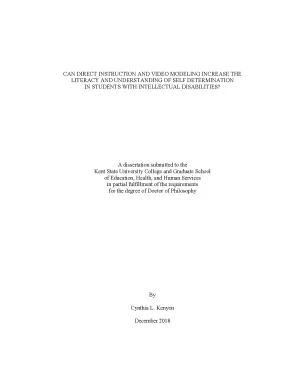
CAN DIRECT INSTRUCTION AND VIDEO MODELING INCREASE THE LITERACY AND UNDERSTANDING OF SELF DETERMINATION IN STUDENTS WITH INTELLECTUAL DISABILITIES? A dissertation submitted to the Kent State University College and Graduate School of Education, Health, and Human Services in partial fulfillment of the requirements for the degree of Doctor of Philosophy By Cynthia L. Kenyon December 2018 © Copyright, 2018 by Cynthia L. Kenyon All Rights Reserved ii A dissertation written by Cynthia L., University of Akron, 1986 M., Kent State University, 2010 Ph., Kent State University, 2018 Approved by ________________________________, Director, Doctoral Dissertation Committee Lyle Barton ________________________________, Member, Doctoral Dissertation Committee Joanne Caniglia ________________________________, Member, Doctoral Dissertation Committee Darlene Unger Accepted by ________________________________, Director, School of Lifespan Development and Mary Dellmann-Jenkins Educational Sciences ________________________________, Dean, College and Graduate School of James C. Hannon Education, Health, and Human Services iii KENYON, CYNTHIA L., DECEMBER 2018 LIFESPAN DEVELOPMENT AND EDUCATION SCIENCES INCREASING THE LITERACY OF SELF-DETERMINATION IN STUDENTS WITH INTELLECTUAL DISABILITIES (75 pp.) Director of Dissertation: Lyle Barton, Ed.

The main purpose of this study was to develop and implement strategies to teach self-determination literacy to lay a strong foundation upon which a student could then advance skills. The current study examined the differences in pre- and posttest scores in literacy and understanding of self-determination skills in students with intellectual disabilities. The research question that guided the study was: Can direct instruction and video modeling increase the literacy and understanding of self-determination in students with intellectual disabilities? To assess the effects of the intervention, a quasi-experimental design of pretest-posttest of the experimental group was used. According to the findings, the study found that the experimental group did not demonstrate a significant difference across literacy pre-and posttest scores.

Likewise, there was not a significant difference when looking at the pre- and posttest scores related to individual skills of self-determination. Although the comparison between the pre- and posttest did not show significant change, a descriptive analysis of the literacy indicated that there was noticeable growth in student ability to define problem-solving, goal setting, self-regulation, and self-advocacy. When analyzing comparison of data of video pre- and posttest, there was significant change in participant usage of correct literacy to capture the skills of self-awareness, approaching significance for self-efficacy, and no significant change for self-advocacy. A descriptive examination found that the remaining six skills of problem-solving, choice making, decision-making, goal setting, self-regulation, and goal attainment showed a noteworthy percentage change in participant ability to reflect understanding of observations of skills used in the videos.

DEDICATION To Him who determines deadlines. iv ACKNOWLEDGMENTS I had no idea where this journey was going to take me, but without my dear friend and colleague Vonnie Michali keeping her hand in the middle of my back, sometimes patting, sometimes pushing, I could not have finished. God may ask me to do things that seem larger than life and this was one of them. He prepared my way with Vonnie at my side.

I would like to thank my dissertation committee who tolerated me during the ups and downs of my progress. Barton, my advisor and chair of my dissertation committee, you never gave up on me. You not only served as my support through the doctoral program but remained a constant in a sea of change since my arrival to Kent State in 2009. You were always available to me and never with judgment.

For that I am truly grateful. Caniglia who has been on this journey from the first year of the pilot. I am blessed to have you by my side and was encouraged by your belief in me that one day I would be called Dr. And yes, you were the first to call me that.

Darlene Ungar who was gracious to join me at the end of my journey at a time when I needed the wisdom and critique to put in the final touches. Your expedience to get me to the end was very much appreciated. I would be remiss if I did not address Dr. He is the reason I accepted this journey and he is the reason I have the passion I have today for preparing students for life after high school.

I did not understand the meaning of transition until I read his book. v To the incredible students I have been blessed to work with in the pilot and the years after taught me that it can be difficult to get out your comfort zone, but with the right supports, and lack of them, it is possible. Nobody has been more important to me in this pursuit than the members of my family. I would like to thank my husband Steve, whose love and guidance has always been with me in whatever I pursue.

During this long journey he knew when to ask, when not to ask, and more importantly when to hush inquisitors. I wish to thank my loving and supportive children, Jack, Mak and Amy, who provided me with unending inspiration. “You got this Mom” was a statement from each of them that got me through to the end. God bless all of you for being willing to be His resource to me.

vi TABLE OF CONTENTS Page DEDICATION .v LIST OF TABLES. 1 Intellectual Disabilities Defined. 3 Importance of Self-Determination. 6 Evolution of Self-Determination.

8 Self-Determination Defined. 21 Setting and Participants. 23 Inter-Observer Agreement. 27 Statistical Analyses Related to the Research Questions.

27 Demographic Information of Participants. 27 Participants and gender. 28 Participant residential status. 29 Participant employment status.

30 Pre- and Posttest Analysis. 30 Paired Sample t-Test Across Experimental Group. 30 Individual Skills Analyses. 31 McNemar Pre- and Posttest Analysis of Video Observations.

35 Summary of the Findings. 35 Discussion of Findings. 37 Discussion on Videos. 40 Limitations of the Study.

42 Implication and Recommendation for Practice. 43 Students With IDD Should Receive Self-Determination Instruction. 44 Video Modeling to Increase Understanding of the Literacy of Self- Determination. 44 Using Combinations of Strategies to Make Abstract Concepts More Concrete.

45 Implications for Future Research. SAMPLE VOCABULARY TEST: PRETEST AND POSTTEST. SAMPLE DATA RECORDING SHEET TO RECORD SKILLS OF SELF-DETERMINATION. PROJECT OVERVIEWS AND LESSON MATRIX.

62 viii LIST OF TABLES Table Page 1. Frequency and Percentage of the Participants by Gender. Frequency and Percentage of the Participants by Residency Status. Frequency and Percentage of the Participants by Employment Status.

Across Group t-Test Analysis of Literacy. McNemar Test Between Pre- and Posttest for Literacy of Each Skill. Percentage Change Between Pre- and Posttest for Each Video. 34 ix 1 CHAPTER I INTRODUCTION Over the past decade transition-age students with intellectual disabilities (ID) have become a critical and growing concern for rehabilitation services and local education agencies (LEAs) in Ohio and nationally.

According to the Second Longitudinal Study of Transition, the number of students with ID in regular education settings increased 29% in the past decade, coming mainly from separate special education schools which saw a 31% drop in enrollment (Wagner, Newman, Cameto, Garza, & Levine, 2005). Typically, LEAs have responded to this influx of students with ID by creating self-contained classrooms and transition programs outside of the general curriculum (Wagner et al. The outcomes of these programs, like the programs themselves, have commonly been segregated environments with little opportunity for life-long learning, careers, independent living (Baer, Daviso, Flexer, McMahan Queen, & Meindl, 2011), and community inclusion. The lack of inclusive educational environments is evident in the Thirty-Sixth Report to Congress (2015), which identifies that over half of transition-aged students with ID (51.3) and those with multiple disabilities (53.8) continue to spend over 60% of the day in separate learning environments.

Even though the Rehabilitation Act of 1973, the 1990 Americans with Disabilities Act (U. Congress, 1990), and the 2008 Amendments Act (Madaus, Kowitt, & Lalor, 2012), in conjunction with the 1999 Olmstead Decision (Rosenbaum, 2000), have led to significant improvements in the community inclusion of individuals with intellectual and 2 other disabilities, progress in terms of higher education and labor market participation has been modest at best. Despite President Obama’s commitment to increase participation in employment among people with disabilities, employment rates for those with disabilities still lag far behind those of non-disabled workers (Arc, 2016). The Bureau of Labor Statistics (2016) identified that 82.1% of persons with disabilities were unemployed compared to that of 34.7% of persons without disabilities.

For students with ID employment rates are even bleaker. A recent survey of 11,599 adults with ID in 16 states found that only 14.7% were competitively employed (Human Service Research Institute [HSRI], 2012), with most students leaving high school and entering into a lifetime of sheltered employment where they earn subminimum wage, or in day habilitation (Siperstein, Parker, & Drascher, 2013). Likewise, The Arc of the United States (2015), a national organization that promotes, protects, and supports the rights of persons with intellectual and developmental disabilities (IDD), finds that the majority of adults with IDD are either unemployed or underemployed, despite their ability, desire, and willingness to work in the community. However, despite decades of investment in special education through legislation such as the Individual with Disabilities Education Act (IDEA), little has changed in transition and adult life outcomes for those with ID (Grigal, Hart, & Weir, 2013).

Of all disability groups, persons with ID have the lowest rates of education, employment, or preparation for work after secondary education of all disability groups (Siperstein et al. Moreover, Grigal, Hart, and Migliore (2011) reported that students with ID have the least inclusive educational experiences and the lowest levels of academic 3 achievement with only 11% of high-school students with ID indicating postsecondary goals in their transition plans of attending a two-year or four-year college in their education plan. These dismal outcomes invoke questions concerning what types of barriers might impede greater success and adult outcomes for persons with ID. According to the U.

Bureau of Labor Statistics (Handcock, 2013), the lack of education or training, lack of transportation, lack of effective accommodations, and a person’s own disability were among the barriers reportedly inhibiting persons with ID. Other considerations that greatly limit adult outcomes are low expectations and minimal access to postsecondary education, a need for greater understanding and implementation of self-determined behaviors that improve self-efficacy, self-advocacy, and self-awareness levels, and promoting greater social involvement in order to prepare persons with ID for competitively paid employment and greater quality of life (Think College, 2014). Evidence points to the difficulties experienced by students with ID in realizing better life outcomes. In pondering what barrier has the greatest impact on success in all other areas, it became a great interest for this researcher to examine the barriers related to self-determined behaviors in students with ID; what interventions and strategies are currently in place; and finally the identification of an approach that may lead to improvement of self-determination in this population.

Intellectual Disabilities Defined Before delving in to the topic of self-determination in persons with ID, there is a need to define what an intellectual disability is and its prevalence. ID is identified as the 4 most common developmental disability by the National Center on Birth Defects and Developmental Disabilities (2005) and is the diagnosis for approximately 6.5 million people in the United States (The ARC, 2015). Department of Education reports that more than 400,000 children (ages 6–21) receive special education services in public schools under this category according to IDEA statistics (2015). Department of Education (2010a) reports that 6 in every 100 children who need special education have some form of ID.

Founded in 1876, The American Association on Intellectual and Developmental Disabilities (AAIDD, 2010) is credited as the world’s largest and oldest organization in advancing the evolution of ideas and approaches with regards to ID.

Nội dung được bảo vệ bản quyền — Tải xuống đầy đủ