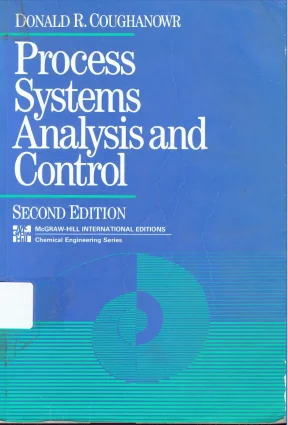
Process Systems Analysis and Control by Donald R. Coughanowr (2nd Ed.) - Chemical Engineering Textbook

Trường đại học

Drexel University

Chuyên ngành

Kỹ thuật hóa học

Người đăng

Ẩn danh

Thể loại

Giáo trình

1991

584
0
0

Phí lưu trữ

135 Point

Tóm tắt

I. Tổng quan về Process Systems Analysis and Control Coughanowr

Process Systems Analysis and Control của Donald R. Coughanowr là giáo trình kinh điển thuộc McGraw-Hill Chemical Engineering Series. Ấn bản thứ hai cung cấp nền tảng toàn diện về phân tích và điều khiển hệ thống quá trình hóa học. Cuốn sách được xây dựng dựa trên truyền thống xuất bản học thuật lâu đời của McGraw-Hill, bắt đầu từ năm 1925 khi mười lăm kỹ sư hóa học hàng đầu tập hợp để xây dựng nền văn học chuyên ngành. Nội dung sách bao gồm các phương pháp toán học cần thiết cho việc mô tả hành vi động của hệ thống quá trình. Công cụ chính bao gồm biến đổi Laplace, hàm truyền, và phân tích ổn định. Sách trình bày cách áp dụng các nguyên lý điều khiển tự động vào thực tế sản xuất công nghiệp. Phương pháp giảng dạy kết hợp lý thuyết với ví dụ minh họa cụ thể, giúp người học nắm vững cách xây dựng mô hình toán học cho các quá trình như điều khiển mức bể chứa, nhiệt độ lò phản ứng, và lưu lượng dòng chảy.

1.1. Bối cảnh lịch sử của McGraw Hill Chemical Engineering Series

McGraw-Hill Chemical Engineering Series ra đời năm 1925 từ sáng kiến của mười lăm kỹ sư hóa học tiên phong. Ủy ban biên tập ban đầu bao gồm những nhà giáo dục lỗi lạc như William H. Lewis và biên tập viên Harry A. Parmelee. Báo cáo đệ trình McGraw-Hill Book Company vào tháng 9 năm 1925 đã chi tiết hóa thông số kỹ thuật cho chuỗi hơn chục cuốn sách tham khảo. Chuỗi sách này trở thành nền tảng của chương trình giảng dạy kỹ thuật hóa học. Process Systems Analysis and Control của Coughanowr nằm trong danh sách các tác phẩm tiêu biểu của series, bên cạnh những cuốn kinh điển khác về vận chuyển hiện tượng, thiết kế quá trình, và tối ưu hóa.

1.2. Phạm vi nội dung và đối tượng độc giả

Giáo trình hướng đến sinh viên kỹ thuật hóa học và kỹ sư hành nghề cần hiểu sâu về điều khiển quá trình. Nội dung trải dài từ cơ sở toán học đến ứng dụng thực tiễn trong nhà máy. Các chủ đề chính bao gồm phương trình vi phân thường, biến đổi Laplace, hàm truyền, và các cấu trúc điều khiển PID. Sách cũng đề cập đến vấn đề ổn định hệ thống, một yếu tố then chốt quyết định hiệu suất vận hành. Người đọc được trang bị khả năng xây dựng mô hình toán học, phân tích đáp ứng động, và thiết kế bộ điều khiển phù hợp cho nhiều loại quá trình công nghiệp khác nhau.

II. Phân tích vấn đề điều khiển hệ thống quá trình

Một trong những vấn đề trọng tâm trong Process Systems Analysis and Control là tính ổn định của hệ thống phản hồi. Coughanowr minh họa rõ ràng qua ví dụ về điều khiển nhiệt độ bể chứa sử dụng cặp nhiệt điện. Khi giá trị khuếch đại KR tăng vượt ngưỡng cho phép, đáp ứng hệ thống dao động với biên độ tăng dần cho đến khi đạt giới hạn vật lý của hệ thống gia nhiệt. Đây là hiện tượng bất ổn nghiêm trọng khiến hệ thống điều khiển hoạt động kém hơn cả khi không điều khiển. Sách nhấn mạnh rằng cần thận trọng tối đa khi xác định thông số hệ thống điều khiển. Bộ điều khiển tỷ lệ-tích phân mô tả bằng phương trình truyền đạt hiệu quả tốt chỉ khi KR được giữ dưới một giá trị cụ thể. Việc xác định giới hạn này đòi hỏi phân tích toán học chặt chẽ sử dụng hàm truyền và tiêu chuẩn ổn định Routh-Hurwitz. Ngoài ra, độ trễ đo lường từ cặp nhiệt điện cũng ảnh hưởng đáng kể đến chất lượng điều khiển.

2.1. Bài toán đo lường trễ và ảnh hưởng đến điều khiển

Đo lường trễ là vấn đề phổ biến trong hệ thống điều khiển thực tế. Cặp nhiệt điện có độ trễ truyền nhiệt riêng, gây ra sai số giữa nhiệt độ thực tế và giá trị đo được. Khi tín hiệu đo bị trễ, bộ điều khiển nhận thông tin không chính xác về trạng thái hiện tại của quá trình. Điều này dẫn đến các hành động điều khiển sai thời điểm. Giải pháp hệ phương trình vi phân đồng thời với điều kiện ban đầu T(0) cho thấy đáp ứng dao động mạnh hơn so với trường hợp không có trễ. Thiết kế hệ thống phải tính đến yếu tố này để tránh bất ổn.

2.2. Phân tích hàm truyền và nghiệm đặc trưng

Hàm truyền X(s) được biểu diễn dưới dạng tỷ số đa thức. Mẫu số chứa các nghiệm quyết định tính chất định tính của nghiệm x(t). Phương pháp phân tích phần dư với các nghiệm trùng sử dụng hằng số C1, C2 đến Cn. Khi nghiệm là số phức dạng -1±j, nghiệm thời gian chứa thành phần e⁻ᵗ(C₁cos t + C₂sin t). Với hệ có hệ số giảm dần theo hàm mũ, các thành phần tuần hoàn biến mất khi t tiến đến vô cùng. Xác định vị trí nghiệm trên mặt phẳng phức giúp đánh giá nhanh tính ổn định và đáp ứng của hệ thống.

III. Giải pháp và phương pháp điều khiển quá trình hiệu quả

Coughanowr trình bày nhiều phương pháp thiết kế hệ thống điều khiển hiệu quả trong giáo trình. Phương pháp biến đổi Laplace chuyển đổi phương trình vi phân thường thành đại số, giúp đơn giản hóa đáng kể quá trình giải. Bảng biến đổi cung cấp các cặp tương ứng phổ biến, cho phép kỹ sư nhanh chóng tìm ngược Laplace. Bộ điều khiển PID kết hợp ba thành phần tỷ lệ, vi phân, và tích phân để đạt đáp ứng tối ưu. Phần tỷ lệ phản ứng nhanh với sai lệch, phần tích phân loại bỏ sai số tĩnh, phần vi phân dự đoán xu hướng thay đổi. Việc chọn đúng thông số Kc, τI, τD quyết định hiệu suất toàn bộ hệ thống. Sách cũng giới thiệu phương pháp Ziegler-Nichols để điều chỉnh tham số dựa trên thử nghiệm thực tế. Phân tích đáp ứng bậc và đáp ứng xung cung cấp thông tin trực quan về hành vi hệ thống. Thiết kế bộ lọc và bộ bù cũng được đề cập để cải thiện chất lượng điều khiển trong các tình huống phức tạp.

3.1. Ứng dụng biến đổi Laplace trong phân tích hệ thống

Biến đổi Laplace là công cụ toán học cốt lõi được sử dụng xuyên suốt giáo trình. Phương pháp này chuyển bài toán giải phương trình vi phân thành bài toán giải phương trình đại số. Với điều kiện ban đầu T(0)=Tm(0)=TR, biến đổi cho phép xử lý hệ phương trình đồng thời một cách có hệ thống. Các hàm truyền được xây dựng trực tiếp từ biến đổi Laplace của phương trình mô tả quá trình. Bảng tra cứu giúp tìm ngược nhanh chóng. Phương pháp phân tích phần dư xử lý cả trường hợp nghiệm đơn và nghiệm trùng. Kỹ thuật này đặc biệt hữu ích khi phân tích hệ thống phức tạp với nhiều biến số tương tác.

3.2. Thiết kế bộ điều khiển tỷ lệ tích phân vi phân

Bộ điều khiển PID là cấu trúc phổ biến nhất trong công nghiệp. Thành phần tỷ lệ tạo hành động điều khiển tỷ lệ với sai lệch hiện tại. Thành phần tích phân tích lũy sai lệch theo thời gian, loại bỏ sai số tĩnh nhưng có thể gây overshoot. Thành phần vi phân phản ứng với tốc độ thay đổi sai lệch, giúp giảm dao động và cải thiện đáp ứng tạm thời. Việc cân bằng ba thành phần này đòi hỏi hiểu biết sâu sắc về đặc tính quá trình. Coughanowr trình bày phương pháp điều chỉnh dựa trên các tiêu chí như sai lệch cực đại, thời gian thiết lập, và độ dao động dư.

IV. Kết luận và ứng dụng thực tế của lý thuyết điều khiển

Process Systems Analysis and Control của Coughanowr cung cấp nền tảng vững chắc cho việc áp dụng lý thuyết điều khiển vào thực tế công nghiệp. Các nguyên lý phân tích hệ thống được trình bày có tính ứng dụng cao trong nhiều lĩnh vực từ sản xuất hóa chất, chế biến dầu khí, đến công nghiệp thực phẩm. Việc hiểu rõ mối quan hệ giữa tham số điều khiển và đáp ứng hệ thống giúp kỹ sư tối ưu hóa vận hành nhà máy. Giáo trình nhấn mạnh tầm quan trọng của phân tích ổn định trước khi triển khai bất kỳ hệ thống điều khiển nào. Bài học từ ví dụ nhiệt độ bể chứa cho thấy hậu quả nghiêm trọng khi bỏ qua yếu tố này. Phương pháp mô hình hóa toán học kết hợp với công cụ tính toán hiện đại tạo điều kiện thiết kế hệ thống phức tạp hơn. Kiến thức từ cuốn sách này là hành trang thiết yếu cho mọi kỹ sư hóa học muốn làm chủ nghệ thuật điều khiển quá trình công nghiệp.

4.1. Ứng dụng trong ngành công nghiệp hóa chất

Ngành công nghiệp hóa chất áp dụng rộng rãi các nguyên lý từ giáo trình Coughanowr. Điều khiển nhiệt độ lò phản ứng, áp suất thiết bị chưng cất, và thành phần sản phẩm đòi hỏi hiểu biết sâu về đáp ứng động. Hệ thống điều khiển phân tán DCS trong nhà máy hóa chất hiện đại sử dụng các thuật toán PID dựa trên nguyên lý cơ bản được trình bày trong sách. Việc mô hình hóa quá trình trước khi thiết kế điều khiển giúp tiết kiệm chi phí vận hành và nâng cao chất lượng sản phẩm. An toàn quy trình cũng phụ thuộc vào hệ thống bảo vệ liên quan đến lý thuyết ổn định.

4.2. Hướng phát triển và tích hợp công nghệ mới

Lý thuyết điều khiển cổ điển từ giáo trình Coughanowr là nền tảng cho các phương pháp tiên tiến hơn. Điều khiển mô hình dự đoán MPC mở rộng nguyên lý hàm truyền để xử lý hệ đa biến. Trí tuệ nhân tạo và học máy tích hợp với điều khiển truyền thống tạo ra hệ thống thích ứng thông minh. Internet vạn vật công nghiệp IIoT thu thập dữ liệu thời gian thực phục vụ điều khiển tối ưu. Tuy nhiên, nguyên tắc cơ bản về ổn định, đáp ứng tạm thời, và sai số tĩnh vẫn không thay đổi. Nắm vững nền tảng từ giáo trình này giúp kỹ sư dễ dàng tiếp cận công nghệ mới.
21/04/2026

Trích đoạn nội dung tài liệu

org PROCESS SYSTEMS ANALYSIS AND CONTROL Pi McGraw-Hill Chemical Engineering Series Editorial Advisory Board James J. Carherry, Professor of Chemical Engineering, University of Notre Dame James R. Fair, Professor of Chemical Engineering, University of Texas, Austin William P. Schowalter, Dean, School of Engineering, University of Illinois Matthew llrrell, Professor of Chemical Engineering, University of Minnesota James Wei, Professop of Chemical Engineering, Massachusetts Institute of Technology Max S. Peters, Emeritus, Professor of Chemical Engineering, University of Colorado Building the Literature of a Profession Fifteen prominent chemical engineers first met in New York more than 60 years ago to plan a continuing literature for their rapidly growing profession. From Industry came such pioneer practitioners as Leo H. From the universities came such eminent educators as William H. Lewis, and Harry A. Parmelee, then editor of Chemical und Metullurgical Engineering, served as chairman and was joined subsequently by S. Kirkpatrick as consulting editor. After several meetings, this committee submitted its report to the McGraw- Hill Book Company in September 1925. In the report were detailed specifications for a correlated series of more than a dozen texts and reference books which have since become the McGraw-Hill Series in Chemical Engineering and which became the cornerstone of the chemical engineering curriculum. From this beginning there has evolved a series of texts surpassing by far the scope and longevity envisioned by the founding Editorial Board. The McGraw- Hill Series in Chemical Engineering stands as a unique historical record of the development of chemical engineering education and practice. In the series one finds the milestones of the subject’s evolution: industrial chemistry, stoichiometry, unit operations and processes, thermodynamics, kinetics, process control, and transfer operations. Chemical engineering is a dynamic profession, and its literature continues to evolve. McGraw-Hill, with its editor, B. Clark and its consulting editors, remains committed to a publishing policy that will serve, and indeed lead, the needs of the chemical engineering profession during the years to come. The Series www.org Bailey and Ollis: Biochemical Engineering Fundamentals Bennett and Myers: Momentum, Heat, and Mass Transfer Brodkey and Hershey: Transport Phenomena: A Unified App Carberry: Chemical and Catalytic Reaction Engineering Constantinides: Applied Numerical Methods with Personal C o Coughanowr: Process Systems Analysis and Control Douglas: Conceptual Design of Chemical Processes Edgar and Himmelblau: Optimization of Chemical Processes Gates, Katzer, and Schuit: Chemistry of Catalytic Processes Holland: Fundamentals of Multicomponent Distillation Holland and Liapis: Computer Methods for Solving Dynamic Separation Problems Katz and Lee: Natural Gas Engineering: Production and Storage King: Separation Processes Lee: Fundamentals of Microelectronics Processing Luyben: Process Modeling, Simulation, and Control for Chemical Engineers McCabe, Smith, J., and Harriott: Unit Operations of Chemical Engineering Mickley, Sherwood, and Reed: Applied Mathematics in Chemical Engineering Nelson: Petroleum ReJinery Engineering Perry and Chilton (Editors): Perry’s Chemical Engineers’ Handbook Peters: Elementary Chemical Engineering Peters and ‘Dmmerhaus: Plant Design and Economics for Chemical Engineers Reid, Prausnitz, and Rolling: Properties of Gases and Liquids Smith, J.: Chemical Engineering Kinetics Smith, J., and Van Ness: Introduction to Chemical Engineering Thermodynamics ‘Deybal: Mass Transfer Operations Valle-Riestra: Project Evaluation in the Chemical Process Industries Wei, Russell, and Swartzlander: The Structure of the Chemical Processing Industries Wentz: Hazardous Waste Management PROCESS SYSTEMS ANALYSIS Second Edition Donald R. Coughanowr Department of Chemical Engineering Drexel University McGraw-Hill, Inc. New York St. Louis San Francisco Auckland Bogota Caracas Hamburg Lisbon London Madrid Mexico Milan Montreal New Delhi Paris San Juan S2o Paul0 Singapore Sydney Tokyo Toronto www.org PROCESS SYSTEMS ANALYSIS AND CONTROL International Edition 1991 Exclusive rights by McGraw-Hill Book Co.- Singapore for manufacture and export. This book cannot be re-exported from the country to which it is consigned by McGraw-Hill. Copyright @ 1991, 1965 by McGraw-Hill, Inc. All rights reserved. Except as permitted under the United States Copyright Act of 1976, no part of this publication may be reproduced or distributed in any form or by any means, or stored in a data base or retrieval system, without the prior written permission of the publisher. 34167890BJEFC965432 This book was set in Times Roman by Publication Services. The editors were B. Clark and John M. The production supervisor was Louise Karam. The cover was designed by Rafael Hernandez. Project supervision was done by Publication Services. Library of Congress Cataloging in Publication Data Coughanowr, Donald R. Process systems analysis and control / by Donald Ft. Chemical process control.02815-dc20 90-41740 When ordering this title use ISBN 0-07-l 00807-l ABOUTTHEAUTHOR Donald R. Coughanowr is the Fletcher Professor of Chemical Engineering at Drexel University. He received a Ph. in chemical engineering from the Uni- versity of Illinois in 1956, an MS. degree in chemical engineering from the University of Pennsylvania in 195 1, and a B . degree in chemical engineering from the Rose-Hulman Institute of Technology in 1949. He joined the faculty at Drexel University in 1967 as department head, a position he held until 1988. Before going to Drexel, he was a faculty member of the School of Chemical Engineering at Purdue University for eleven years. At Drexel and Purdue he has taught a wide variety of courses, which in- clude material and energy balances, thermodynamics, unit operations, transport phenomena, petroleum refinery engineering, environmental engineering, chemical engineering laboratory, applied mathematics, and process dynamics and control. At Purdue, he developed a new course and laboratory in process control and col- laborated with Dr. Koppel on the writing of the first edition of Process Systems Analysis and Control. His research interests include environmental engineering, diffusion with chemical reaction, and process dynamics ,and control; Much. of his research in control has emphasized the development and evaluation of new.control algorithms for processes that cannot be controlled easily by ,cpnventional control; some of the areas investigated are time%p~inkl control, adaptive pH control, direct digital control, and batch control of fermentors. He has reported on his research in nu- merous publications and has received support for research projects from, the N. He has spent sabbatical leaves teaching and writing at Case-Western Reserve University, the Swiss, Federal Institute, the University of Canterbury, the University of New South Wales, the University of Queensland, and Lehigh Uni- versity. Coughanowr’s industrial experience includes process design and pilot plant at Standard Oil Co. (Indiana) and summer employment at Electronic Asso- ciates and Dow Chemical Company.org Vlll ABOUT THE AUTHOR He is a member of the American Institute of Chemical Engineers, the Instru- ment Society of America, and the American Society for Engineering Education. He is also a delegate to the Council for Chemical Research. He has served the AIChE by participating in accreditation visits to departments of chemical engi- neering for. ABET and by chairing sessions of the Department Heads Forum at the annual meetings of AIChE. To Effie, Corinne, Christine, and David www.org CONTENTS Preface xv 1 An Introductory Example 1 Part I The Laplace Transform 2 The Laplace Transform 13 3 Inversion by Partial Fractions 22 4 Further Properties of Transforms 37 Part II Linear Open-Loop Systems 5 Response of First-Order Systems 49 6 Physical Examples of First-Order Systems 64 7 Response of First-Order Systems in Series 80 8 Higher-Order Systems: Second-Order and Transportation Lag 90 Part III Linear Closed-Loop Systems 9 The Control System 111 10 Controllers and Final Control Elements 123 11 Block Diagram of a Chemical-Reactor Control System 135 xi x i i CONTENTS www.org 12 Closed-Loop Transfer Functions 143 1 3 Transient Response of Simple Control Systems 151 1 4 Stability 164 1 5 Root Locus 177 Part IV Frequency Response 16 Introduction to Frequency Response 201 1 7 Control System Design by Frequency Response 224 Part V Process Applications 18 Advanced Control Strategies 249 19 Controller Tuning and Process Identification 282 20 Control Valves 303 21 Theoretical Analysis of Complex Processes 318 . Part VI Sampled-Data Control Systems 22 Sampling and Z-Transforms 349 23 Open-Loop and Closed-Loop Response 360 24 Stability 376 25 Modified Z-Transforms 384 26 Sampled-Data Control of a First-Order Process with Transport Lag -393 27 Design of Sampled-Data Controllers 405 Part VII State-Space Methods 28 State-Space Representation o f Physical Systems 431 29 Transfer Function Matrix 446 30 Multivariable Control 453 . CONTENTS xl11 Part VIII Nonlinear Control 31 Examples of Nonlinear Systems 471 32 Methods of Phase-Plane Analysis 484 33 The Describing Function Technique 506 Part IX Computers in Process Control 34 Digital Computer Simulation of Control Systems 517 35 Microprocessor-Based Controllers and Distributed Control 543 Bibliography 559 Index 561 www.org PREFACE Since the first edition of this book was published in 1965, many changes have taken place in process control. Nearly all undergraduate students in chemical engineering are now required to take a course‘in process dynamics and control. The purpose of this book is to take the student from the basic mathematics to a variety of design applications in a clear, concise manner. The most significant change since the first edition is the use of the digital computer in complex problem-solving and in process control instrumentation. However, the fundamentals of process control, which remain the same, must be acquired before one can appreciate the advanced topics of control. In its present form, this book represents a major revision of the first edition. The material for this book evolved from courses taught at Purdue University and Drexel University. The first 17 chapters on fundamentals are quite close to the first 20 chapters of the first . The remaining 18 chapters contain many new topics, which were considered very advanced when the first edition was published. A knowledge of calculus, unit operations, and complex numbers is presumed on the part of the student. In certain later chapters, more advanced mathematical preparation is useful. Some examples would include partial differential equations in Chap. 21, linear algebra in Chaps. 28-30, and Fourier series in Chap. Analog computation and pneumatic controllers in the first edition have been replaced by digital computation and microprocessor-based controllers in Chaps. The student should be assigned material from these chapters at the appropriate time in the development of the fundamentals. For example, obtaining the transient response for a system containing a transport lag can be obtained easily only with the use of computer simulation of transport lag. Some of the software now available for solving control problems should be available to the student; such software is described in Chap. To understand the operation of modem microprocessor-based controllers, the student should have hands-on experience with these instruments in a laboratory. XV Xvi PREFACE www.org Chapter 1 is intended to meet one of the problems consistently faced in pre- senting this material to chemical engineering students, that is, one of perspective. The methods of analysis used in the control area are so different from the previous experiences of students that the material comes to be regarded as a sequence of special mathematical techniques, rather than an integrated design approach to a class of real and practically significant industrial problems. Therefore, this chap- ter presents an overall, albeit superficial, look at a simple control-system design problem. The body of the text covers the following topics: 1 . Laplace transforms, Chaps 2 to 4. Transfer functions and responses of open-loop systems, Chaps. Basic techniques of closed-loop control, Chaps. Root-locus methods, Chap. Frequency-response methods and design, Chaps. Advanced control strategies (cascade, feedforward, Smith predictor, internal model control), Chap. Controller tuning and process identification, Chap. Control valves, Chap. Sampled-data control, Chaps. State-space methods and multivariable control, Chaps. Nonlinear control, Chaps. Digital computer simulation, Chap. Microprocessor-based controllers, Chap. It has been my experience that the book covers sufficient material for a one- semester (15-week) undergraduate course and an elective undergraduate course or part of a graduate course. In a lecture course meeting three hours per week during a lo-week term, I have covered the following Chapters: 1 to 10, 12 to 14, 16, 17, 20, 34, and 35. After the first 14 chapters, the instructor may select the remaining chapters to fit a course of particular duration and scope. The chapters on the more advanced topics are written in a logical order; however, some can be skipped without creating a gap in understanding.

Nội dung được bảo vệ bản quyền — Tải xuống đầy đủ