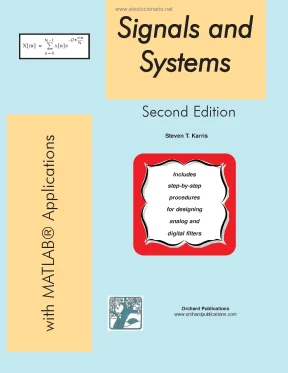
Signals and Systems with MATLAB Applications, Second Edition by Steven T. Karris

Trường đại học

San Jose State University

Chuyên ngành

Kỹ thuật điện

Người đăng

Ẩn danh

Thể loại

Sách giáo khoa

2003

599
0
0

Phí lưu trữ

135 Point

Tóm tắt

I. Tổng quan về sách Signals and Systems Steven T

Cuốn sách Signals and Systems with MATLAB Applications, Second Edition của Steven T. Karris là tài liệu học thuật quan trọng về xử lý tín hiệu analog và số. Được xuất bản bởi Orchard Publications, ấn bản này cung cấp giải thích chi tiết về các khái niệm cốt lõi trong xử lý tín hiệu. Nội dung bao gồm các chủ đề từ tín hiệu cơ bản, biến đổi Laplace, chuỗi Fourier đến biến đổi Z và DFT/FFT. Điểm nổi bật của cuốn sách là sự tích hợp MATLAB trong mỗi chương, cho phép người học áp dụng lý thuyết vào thực hành. Cuốn sách cũng trình bày phương pháp thiết kế bộ lọc analog và số với hướng dẫn từng bước. Với hơn 30 năm kinh nghiệm kỹ sư và 25 năm giảng dạy, Karris mang đến cách tiếp cận dễ hiểu và thực tiễn. Cuốn sách này là tài liệu tham khảo thiết yếu cho sinh viên và chuyên gia trong lĩnh vực kỹ thuật điện tử và xử lý tín hiệu số.

1.1. Cấu trúc nội dung của cuốn sách Signals and Systems

Cuốn sách Signals and Systems Steven T. Karris 2ed được tổ chức thành các chương logic, bắt đầu từ tín hiệu cơ bản và tiến dần đến các chủ đề nâng cao. Các chương chính bao gồm biến đổi Laplace, biến đổi nghịch đảo Laplace, phân tích mạch với biến đổi Laplace, biến số trạng thái, đáp ứng xung và tích chập. Tiếp theo là chuỗi Fourier, biến đổi Fourier, hệ thống thời gian rời rạc với biến đổi Z, DFT và FFT. Phần thiết kế bộ lọc analog và số là nội dung quan trọng cuối cùng. Cuốn sách còn bao gồm phụ lục về MATLAB, ôn tập số phức và ma trận. Cách tổ chức này giúp người học xây dựng kiến thức từ cơ bản đến nâng cao một cách hệ thống.

1.2. Đặc điểm nổi bật của ấn bản thứ hai

II. Phân tích các vấn đề trong học tập Signals and Systems

Học tập tín hiệu và hệ thống đặt ra nhiều thách thức cho sinh viên và người mới bắt đầu. Lượng kiến thức rất rộng, từ tín hiệu cơ bản đến biến đổi Laplace, Fourier, DFT và FFT. Mỗi chủ đề đòi hỏi nền tảng toán học vững chắc, đặc biệt là giải tích và đại số tuyến tính. Tính trừu tượng của các biến đổi như Laplace và Z khiến nhiều người khó hình dung ý nghĩa thực tế. Biến đổi Laplace chuyển đổi tín hiệu từ miền thời gian sang miền tần số phức, trong khi biến đổi Z áp dụng cho hệ thống thời gian rời rạc. Việc hiểu mối liên hệ giữa các miền là thách thức lớn. Ngoài ra, áp dụng lý thuyết vào bài toán thực tế cũng khó khăn. Nhiều cuốn sách chỉ trình bày lý thuyết mà thiếu ví dụ cụ thể, khiến người học không biết cách áp dụng kiến thức vào thực hành.

2.1. Khó khăn trong việc hiểu biến đổi Laplace và Fourier

2.2. Thách thức trong thiết kế bộ lọc analog và số

III. Giải pháp học hiệu quả từ cuốn sách Signals and Systems Karris

Cuốn sách Signals and Systems của Karris cung cấp nhiều giải pháp để vượt qua các thách thức trong học tập. Trước tiên, sự tích hợp MATLAB cho phép người học mô phỏng tín hiệu và kiểm chứng kết quả tính toán. Mỗi chương đều có hướng dẫn MATLAB chi tiết, giúp áp dụng lý thuyết vào thực hành. Thứ hai, cấu trúc sách từ cơ bản đến nâng cao giúp xây dựng kiến thức dần dần. Người học bắt đầu với tín hiệu cơ bản trước khi tiến đến các biến đổi phức tạp. Phụ lục về MATLAB, số phức và ma trận cung cấp nền tảng cần thiết cho người mới bắt đầu. Thứ ba, phương pháp tiếp cận từng bước trong thiết kế bộ lọc giúp người học hiểu rõ quy trình từ đặc tả kỹ thuật đến mạch thực tế. Cuốn sách cũng cung cấp bảng tổng hợp biến đổi Laplace và các tính chất quan trọng, trở thành công cụ tham khảo nhanh khi giải bài tập.

3.1. Sử dụng MATLAB để mô phỏng và thực hành

3.2. Xây dựng nền tảng toán học vững chắc

IV. Kết luận và ứng dụng thực tế của Signals and Systems 2ed

Cuốn sách Signals and Systems with MATLAB Applications, Second Edition là tài liệu toàn diện và thực tiễn về xử lý tín hiệu. Nội dung bao gồm đầy đủ các chủ đề từ cơ bản đến nâng cao, từ tín hiệu cơ bản đến thiết kế bộ lọc hiện đại. Sự tích hợp MATLAB giúp người học áp dụng lý thuyết vào thực hành một cách hiệu quả. Cấu trúc sách logic, từ đơn giản đến phức tạp, phù hợp cho cả sinh viên mới bắt đầu và chuyên gia muốn nâng cao kiến thức. Phụ lục phong phú cung cấp kiến thức nền tảng cần thiết. Cuốn sách này không chỉ phục vụ học tập mà còn là tài liệu tham khảo quý giá trong công việc chuyên môn. Kiến thức từ cuốn sách được ứng dụng rộng rãi trong nhiều lĩnh vực kỹ thuật hiện đại, từ viễn thông, xử lý âm thanh hình ảnh đến hệ thống nhúng và IoT.
4.1. Ứng dụng trong ngành viễn thông và xử lý tín hiệu số

4.2. Ứng dụng trong hệ thống nhúng và IoT

21/04/2026

Trích đoạn nội dung tài liệu

net X[ m ] = N –1 ∑ x [n ]e mn – j2π ------- N Signals and Systems n=0 Second Edition Steven T. Karris with MATLAB® Applications Includes step-by-step procedures for designing analog and digital filters Orchard Publications www.net Students and working professionals will find Signals and Systems Signals and Systems with MATLAB® Applications, Second Edition, to be a concise and easy-to-learn with MATLAB® Applications text. It provides complete, clear, and detailed expla- Second Edition nations of the principal analog and digital signal Steven T. Karris processing concepts and analog and digital filter design illustrated with numerous practical examples. This text includes the following chapters and appendices: • Elementary Signals • The Laplace Transformation • The Inverse Laplace Transformation • Circuit Analysis with Laplace Transforms • State Variables and State Equations • The Impulse Response and Convolution • Fourier Series • The Fourier Transform • Discrete Time Systems and the Z Transform • The DFT and The FFT Algorithm • Analog and Digital Filters • Introduction to MATLAB • Review of Complex Numbers • Review of Matrices and Determinants Each chapter contains numerous practical applications supplemented with detailed instructions for using MATLAB to obtain quick solutions. Karris is the president and founder of Orchard Publications. He earned a bachelors degree in electrical engineering at Christian Brothers University, Memphis, Tennessee, a mas- ters degree in electrical engineering at Florida Institute of Technology, Melbourne, Florida, and has done post-master work at the latter. He is a registered professional engineer in California and Florida. He has over 30 years of professional engineering experience in industry. In addi- tion, he has over 25 years of teaching experience that he acquired at several educational insti- tutions as an adjunct professor. He is currently with UC Berkeley Extension. Orchard Publications, Fremont, California Visit us on the Internet www.com or email us: info@orchardpublications.net Signals and Systems with MATLAB® Applications Second Edition Steven T. Karris Orchard Publications www.net Signals and Systems with MATLAB Applications, Second Edition Copyright © 2003 Orchard Publications. All rights reserved. Printed in the United States of America. No part of this publication may be reproduced or distributed in any form or by any means, or stored in a data base or retrieval system, without the prior written permission of the publisher. Direct all inquiries to Orchard Publications, 39510 Paseo Padre Parkway, Fremont, California 94538 Product and corporate names are trademarks or registered trademarks of the Microsoft™ Corporation and The MathWorks™ Inc. They are used only for identification and explanation, without intent to infringe. Library of Congress Cataloging-in-Publication Data Library of Congress Control Number: 2003091595 ISBN 0-9709511-8-3 Copyright TX 5-471-562 www.net Preface This text contains a comprehensive discussion on continuous and discrete time signals and systems with many MATLAB® examples. It is written for junior and senior electrical engineering students, and for self-study by working professionals. The prerequisites are a basic course in differential and integral calculus, and basic electric circuit theory. This book can be used in a two-quarter, or one semester course. This author has taught the subject material for many years at San Jose State University, San Jose, California, and was able to cover all material in 16 weeks, with 2½ lecture hours per week. To get the most out of this text, it is highly recommended that Appendix A is thoroughly reviewed. This appendix serves as an introduction to MATLAB, and is intended for those who are not familiar with it. The Student Edition of MATLAB is an inexpensive, and yet a very powerful software package; it can be found in many college bookstores, or can be obtained directly from The MathWorks™ Inc., 3 Apple Hill Drive , Natick, MA 01760-2098 Phone: 508 647-7000, Fax: 508 647-7001 http://www.com e-mail: info@mathwork.com The elementary signals are reviewed in Chapter 1 and several examples are presented. The intent of this chapter is to enable the reader to express any waveform in terms of the unit step function, and subsequently the derivation of the Laplace transform of it. Chapters 2 through 4 are devoted to Laplace transformation and circuit analysis using this transform. Chapter 5 discusses the state variable method, and Chapter 6 the impulse response. Chapters 7 and 8 are devoted to Fourier series and transform respectively. Chapter 9 introduces discrete-time signals and the Z transform. Considerable time was spent on Chapter 10 to present the Discrete Fourier transform and FFT with the simplest possible explanations. Chapter 11 contains a thorough discussion to analog and digital filters analysis and design procedures. As mentioned above, Appendix A is an introduction to MATLAB. Appendix B contains a review of complex numbers, and Appendix C discusses matrices. New to the Second Edition This is an refined revision of the first edition. The most notable changes are chapter-end summaries, and detailed solutions to all exercises. The latter is in response to many students and working professionals who expressed a desire to obtain the author’s solutions for comparison with their own. The author has prepared more exercises and they are available with their solutions to those instructors who adopt this text for their class. The chapter-end summaries will undoubtedly be a valuable aid to instructors for the preparation of presentation material.net The last major change is the improvement of the plots generated by the latest revisions of the MATLAB® Student Version, Release 13. Orchard Publications Fremont, California www.com info@orchardpublications.net Table of Contents Chapter 1 Elementary Signals Signals Described in Math Form .1-1 The Unit Step Function .1-2 The Unit Ramp Function .1-10 The Delta Function .1-12 Sampling Property of the Delta Function.1-12 Sifting Property of the Delta Function.1-13 Higher Order Delta Functions.1-20 Solutions to Exercises .1-21 Chapter 2 The Laplace Transformation Definition of the Laplace Transformation. 2-1 Properties of the Laplace Transform. 2-2 The Laplace Transform of Common Functions of Time .2-12 The Laplace Transform of Common Waveforms.2-34 Solutions to Exercises .2-37 Chapter 3 The Inverse Laplace Transformation The Inverse Laplace Transform Integral.3-1 Partial Fraction Expansion . 3-13 Alternate Method of Partial Fraction Expansion. 3-18 Signals and Systems with MATLAB Applications, Second Edition i Orchard Publications www.3-20 Solutions to Exercises .3-22 Chapter 4 Circuit Analysis with Laplace Transforms Circuit Transformation from Time to Complex Frequency .4-18 Solutions to Exercises .4-21 Chapter 5 State Variables and State Equations Expressing Differential Equations in State Equation Form. 5-1 Solution of Single State Equations. 5-7 The State Transition Matrix . 5-9 Computation of the State Transition Matrix .5-18 Circuit Analysis with State Variables .5-22 Relationship between State Equations and Laplace Transform.5-39 Solutions to Exercises .5-41 Chapter 6 The Impulse Response and Convolution The Impulse Response in Time Domain. 6-1 Even and Odd Functions of Time. 6-7 Graphical Evaluation of the Convolution Integral .6-8 Circuit Analysis with the Convolution Integral. 6-20 ii Signals and Systems with MATLAB Applications, Second Edition Orchard Publications www. 6-22 Solutions to Exercises . 6-24 Chapter 7 Fourier Series Wave Analysis.7-1 Evaluation of the Coefficients .7-7 Waveforms in Trigonometric Form of Fourier Series . 7-24 Alternate Forms of the Trigonometric Fourier Series . 7-25 Circuit Analysis with Trigonometric Fourier Series . 7-29 The Exponential Form of the Fourier Series . 7-35 Computation of RMS Values from Fourier Series . 7-40 Computation of Average Power from Fourier Series . 7-42 Numerical Evaluation of Fourier Coefficients. 7-51 Solutions to Exercises . 7-53 Chapter 8 The Fourier Transform Definition and Special Forms . 8-1 Special Forms of the Fourier Transform . 8-2 Properties and Theorems of the Fourier Transform. 8-9 Fourier Transform Pairs of Common Functions .8-17 Finding the Fourier Transform from Laplace Transform.8-25 Fourier Transforms of Common Waveforms.8-27 Using MATLAB to Compute the Fourier Transform .8-33 The System Function and Applications to Circuit Analysis.8-47 Solutions to Exercises .8-49 Signals and Systems with MATLAB Applications, Second Edition iii Orchard Publications www.net Chapter 9 Discrete Time Systems and the Z Transform Definition and Special Forms . 9-1 Properties and Theorems of the Z Tranform . 9-3 The Z Transform of Common Discrete Time Functions.9-11 Computation of the Z transform with Contour Integration .9-20 Transformation Between s and z Domains.9-22 The Inverse Z Transform.9-24 The Transfer Function of Discrete Time Systems .9-38 State Equations for Discrete Time Systems .9-52 Solutions to Exercises .9-54 Chapter 10 The DFT and the FFT Algorithm The Discrete Fourier Transform (DFT) .10-1 Even and Odd Properties of the DFT.10-8 Properties and Theorems of the DFT. 10-10 The Sampling Theorem . 10-13 Number of Operations Required to Compute the DFT. 10-16 The Fast Fourier Transform (FFT) . 10-31 Solutions to Exercises . 10-33 Chapter 11 Analog and Digital Filters Filter Types and Classifications . 11-1 Basic Analog Filters. 11-2 Low-Pass Analog Filters. 11-7 Design of Butterworth Analog Low-Pass Filters . 11-11 Design of Type I Chebyshev Analog Low-Pass Filters. 11-22 Other Low-Pass Filter Approximations. 11-34 High-Pass, Band-Pass, and Band-Elimination Filters. 11-39 iv Signals and Systems with MATLAB Applications, Second Edition Orchard Publications www.net Digital Filters . 11-73 Solutions to Exercises . 11-79 Appendix A Introduction to MATLAB® MATLAB® and Simulink® .A-1 Roots of Polynomials .A-3 Polynomial Construction from Known Roots.A-4 Evaluation of a Polynomial at Specified Values.A-8 Using MATLAB to Make Plots .A-18 Multiplication, Division and Exponentiation .A-18 Script and Function Files.A-30 Appendix B Review of Complex Numbers Definition of a Complex Number. B-1 Addition and Subtraction of Complex Numbers. B-2 Multiplication of Complex Numbers. B-3 Division of Complex Numbers . B-4 Exponential and Polar Forms of Complex Numbers . B-4 Appendix C Matrices and Determinants Matrix Definition . C-2 Special Forms of Matrices . C-9 Minors and Cofactors.C-12 Signals and Systems with MATLAB Applications, Second Edition v Orchard Publications www.net Cramer’s Rule .C-16 Gaussian Elimination Method.C-19 The Adjoint of a Matrix.C-20 Singular and Non-Singular Matrices .C-21 The Inverse of a Matrix .C-21 Solution of Simultaneous Equations with Matrices .C-30 vi Signals and Systems with MATLAB Applications, Second Edition Orchard Publications www.net Chapter 1 Elementary Signals his chapter begins with a discussion of elementary signals that may be applied to electric net- T works. The unit step, unit ramp, and delta functions are introduced. The sampling and sifting properties of the delta function are defined and derived. Several examples for expressing a vari- ety of waveforms in terms of these elementary signals are provided.1 Signals Described in Math Form Consider the network of Figure 1.1 where the switch is closed at time t = 0 . R vS t = 0 + + v out open terminals − − Figure 1. A switched network with open terminals. We wish to describe v out in a math form for the time interval – ∞ < t < +∞ . To do this, it is conve- nient to divide the time interval into two parts, – ∞ < t < 0 , and 0 < t < ∞ . For the time interval – ∞ < t < 0 , the switch is open and therefore, the output voltage v out is zero. In other words, v out = 0 for – ∞ < t < 0 (1.1) For the time interval 0 < t < ∞ , the switch is closed. Then, the input voltage v S appears at the output, i.2) into a single relationship, we get ⎧ 0 –∞ < t < 0 v out = ⎨ (1.3) ⎩ vS 0 < t < ∞ We can express (1.3) by the waveform shown in Figure 1. Signals and Systems with MATLAB Applications, Second Edition 1-1 Orchard Publications www.net Chapter 1 Elementary Signals v out vS 0 t Figure 1. Waveform for v out as defined in relation (1.3) The waveform of Figure 1.2 is an example of a discontinuous function. A function is said to be dis- continuous if it exhibits points of discontinuity, that is, the function jumps from one value to another without taking on any intermediate values.2 The Unit Step Function u 0 ( t ) A well-known discontinuous function is the unit step function u 0 ( t ) * that is defined as ⎧0 t<0 u0 ( t ) = ⎨ (1.

Nội dung được bảo vệ bản quyền — Tải xuống đầy đủ