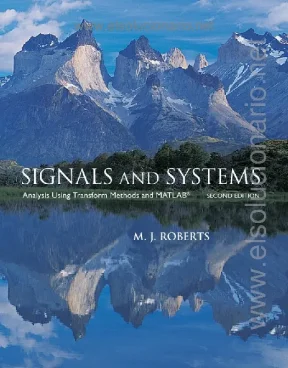
Phân tích hệ thống tín hiệu - Phương pháp biến đổi và ứng dụng MATLAB (Ấn bản 2)

Trường đại học

University of Tennessee

Người đăng

Ẩn danh

Thể loại

Giáo trình

2012

826
0
0

Phí lưu trữ

135 Point

Tóm tắt

I. Tổng quan về sách Signals and Systems Analysis Using Transform Methods

Signals and Systems Analysis Using Transform Methods and MATLAB là giáo trình kinh điển của tác giả Michael J. Roberts, giảng viên tại Khoa Kỹ thuật Điện và Máy tính thuộc Đại học Tennessee. Ấn bản thứ hai do McGraw-Hill xuất bản năm 2012 với mã ISBN 978-0-07-338068-1. Cuốn sách trình bày toàn diện lý thuyết về tín hiệu và hệ thống, tập trung vào các phương pháp biến đổi toán học. Nội dung bao gồm định nghĩa tín hiệu và hệ thống, phân loại các loại tín hiệu khác nhau, và giới thiệu về năng lượng tín hiệu. MATLAB được tích hợp xuyên suốt như công cụ mô phỏng và tính toán thiết yếu. Cuốn sách hướng đến sinh viên kỹ thuật điện tử, viễn thông và các ngành liên quan. Tài liệu in trên giấy tái chế, không chứa axit với 10% vật liệu tái chế sau tiêu dùng. Đây là nguồn tài liệu tham khảo không thể thiếu cho người học xử lý tín hiệu số.

1.1. Định nghĩa tín hiệu và hệ thống

Tín hiệu được định nghĩa là bất kỳ hiện tượng vật lý thay đổi theo thời gian nhằm truyền đạt thông tin. Các ví dụ điển hình bao gồm giọng nói con người, ngôn ngữ ký hiệu, mã Morse, đèn giao thông, điện áp trên đường dây điện thoại, trường điện từ phát ra từ máy phát sóng vô tuyến hoặc truyền hình, và sự biến đổi cường độ ánh sáng. Hệ thống là tập hợp các phần tử hoặc quy trình xử lý tín hiệu đầu vào để tạo ra tín hiệu đầu ra. Sự tương tác giữa tín hiệu và hệ thống là nền tảng của kỹ thuật xử lý tín hiệu hiện đại.

1.2. Các loại tín hiệu cơ bản

Sách phân loại tín hiệu thành nhiều loại dựa trên tính chất toán học và vật lý. Tín hiệu liên tục tồn tại ở mọi thời điểm trong khi tín hiệu rời rạc chỉ xác định tại các thời điểm cụ thể. Tín hiệu có thể là tuần hoàn hoặc không tuần hoàn, chẵn hoặc lẻ. Các phép toán cơ bản trên tín hiệu bao gồm dịch thời gian, co giãn thời gian, vi phân và tích phân. Năng lượng tín hiệu và công suất tín hiệu là hai đại lượng quan trọng đánh giá mức độ năng lượng chứa trong tín hiệu. Việc hiểu rõ phân loại tín hiệu giúp xây dựng mô hình toán học chính xác.

II. Phân tích phương pháp biến đổi trong xử lý tín hiệu

Phương pháp biến đổi là công cụ toán học mạnh mẽ chuyển đổi bài toán từ miền thời gian sang miền tần số hoặc miền biến đổi phức. Biến đổi Fourier phân tích tín hiệu thành tổng các thành phần tần số hài hòa. Biến đổi Laplace mở rộng khái niệm cho tín hiệu liên tục với biến phức s. Biến đổi Z áp dụng cho tín hiệu rời rạc với biến phức z. Oliver Heaviside, kỹ sư điện người Anh tự học, đã thích ứng số phức vào nghiên cứu mạch điện và phát minh kỹ thuật toán học giải phương trình vi phân. Ông cũng đơn giản hóa phương trình trường Maxwell. Phương pháp biến đổi giúp chuyển phương trình vi phân phức tạp thành đại số đơn giản hơn. Việc áp dụng đúng phép biến đổi quyết định độ chính xác của kết quả phân tích hệ thống.

2.1. Biến đổi Fourier và ứng dụng

Biến đổi Fourier chuyển đổi tín hiệu từ miền thời gian sang miền tần số, cho phép phân tích phổ tần số của tín hiệu. Biến đổi Fourier rời rạc xử lý tín hiệu số hóa trong thực tế kỹ thuật. Biến đổi Fourier nhanh FFT giảm đáng kể thời gian tính toán bằng cách chia nhỏ bài toán đệ quy. Ứng dụng phổ biến bao gồm lọc tín hiệu, nén dữ liệu âm thanh và hình ảnh, phân tích rung động cơ khí. MATLAB cung cấp hàm fft và ifft thực hiện biến đổi Fourier hiệu quả trên máy tính. Kết quả phân tích tần số giúp thiết kế bộ lọc chính xác.

2.2. Biến đổi Laplace và biến đổi Z

Biến đổi Laplace áp dụng cho hệ thống liên tục thời gian, biến đổi phương trình vi phân thành phương trình đại số trong miền s. Hàm truyền H(s) đặc trưng hoàn toàn hành vi của hệ thống tuyến tính không đổi theo thời gian. Biến đổi Z là phiên bản rời rạc tương ứng, xử lý tín hiệu mẫu và hệ thống số. Mối quan hệ giữa hai biến đổi thể hiện qua hàm truyền hàm. Phân tích cực và zero trong mặt phẳng phức đánh giá tính ổn định của hệ thống. MATLAB hỗ trợ tính toán biến đổi Laplace và Z thông qua Symbolic Math Toolbox.

III. Giải pháp sử dụng MATLAB trong phân tích tín hiệu hệ thống

MATLAB là công cụ tính toán số hàng đầu được tích hợp sâu trong giáo trình Roberts. Phần mềm cho phép mô phỏng, trực quan hóa và tính toán các phép biến đổi phức tạp. Hàm trong MATLAB được định nghĩa qua tệp m với phần mở rộng .m. Ví dụ, hàm tính cạnh huyền tam giác vuông sử dụng công thức c = sqrt(a^2 + b^2). Chín dòng đầu tiên là dòng chú thích bắt đầu bằng ký hiệu %, mô tả cách sử dụng hàm. Dòng thực thi đầu tiên phải bắt đầu bằng từ khóa function với cú pháp result = name(arg1, arg2). MATLAB cung cấp các hàm tích phân sẵn như cos, sin, exp cùng hàm biến đổi Fourier, Laplace. Việc viết hàm tùy chỉnh mở rộng khả năng tính toán theo nhu cầu cụ thể. Môi trường MATLAB giúp sinh viên thực hành lý thuyết trực quan và hiệu quả.

3.1. Xây dựng hàm và tệp m trong MATLAB

Tệp m trong MATLAB là đơn vị cơ bản để xây dựng chương trình và hàm tính toán. Cú pháp khai báo hàm bao gồm từ khóa function, tên hàm và danh sách tham số đầu vào. Phần chú thích sử dụng ký hiệu % ở đầu dòng, giúp tài liệu hóa cách sử dụng hàm rõ ràng. Các hàm tích hợp sẵn như sqrt, cos, sin, exp được gọi trực tiếp trong thân hàm. MATLAB cho phép tạo thư viện hàm tùy chỉnh phục vụ tính toán đặc thù trong xử lý tín hiệu. Kiến trúc hàm mô-đun giúp code tái sử dụng và bảo trì dễ dàng trong dự án lớn.

3.2. Mô phỏng hệ thống tín hiệu bằng MATLAB

MATLAB cung cấp công cụ mô phỏng mạnh mẽ cho phân tích hệ thống tín hiệu thời gian thực. Công cụ Simulink mở rộng khả năng mô phỏng hệ thống động với giao diện kéo thả trực quan. Sinh viên có thể vẽ đồ thị tín hiệu, tính phổ tần số và kiểm tra đáp ứng hệ thống ngay lập tức. Hàm plot, stem, freqz hiển thị kết quả phân tích dưới dạng đồ họa sinh động. Môi trường tương tác giúp hiểu sâu bản chất toán học thông qua thực hành. Khả năng xử lý mảng ma trận của MATLAB phù hợp tính toán tín hiệu số quy mô lớn.

IV. Kết luận và ứng dụng thực tiễn của giáo trình Roberts

Giáo trình Signals and Systems Analysis Using Transform Methods and MATLAB của Roberts là tài liệu học thuật chuẩn mực cho ngành kỹ thuật điện tử và viễn thông. Ấn bản thứ hai cập nhật nội dung phù hợp xu hướng công nghệ hiện đại. Sự kết hợp giữa lý thuyết biến đổi toán học và thực hành MATLAB tạo nền tảng vững chắc cho người học. Nội dung sách được trình bày logic từ cơ bản đến nâng cao, phù hợp chương trình đại học. McGraw-Hill cung cấp bản sao điện tử qua nền tảng Create và tích hợp với hệ thống Blackboard. Nền tảng Blackboard cho phép sinh viên truy cập tài liệu trực tuyến 24 giờ mỗi ngày. Quan hệ đối tác McGraw-Hill và Blackboard mang lại công nghệ và nội dung hàng đầu cho giảng dạy. Kiến thức từ giáo trình áp dụng rộng rãi trong xử lý tín hiệu số, truyền thông, điều khiển tự động và trí tuệ nhân tạo.

4.1. Ứng dụng trong kỹ thuật truyền thông

4.2. Phát triển kỹ năng nghề nghiệp kỹ sư xử lý tín hiệu

Giáo trình Roberts trang bị kỹ năng thiết thực cho nghề nghiệp kỹ sư xử lý tín hiệu số. Khả năng sử dụng MATLAB thành thạo là yêu cầu tuyển dụng phổ biến trong ngành công nghiệp. Hiểu biết phương pháp biến đổi giúp giải quyết bài toán thực tế trong thiết kế mạch, robot và xe tự lái. Kỹ năng phân tích hệ thống áp dụng trong kiểm soát chất lượng và đo lường công nghiệp. Nền tảng toán học vững chắc hỗ trợ học tập nâng cao ở bậc thạc sĩ và tiến sĩ. Ngành trí tuệ nhân tạo và học sâu sử dụng khái niệm tín hiệu trong mạng nơ-ron tích chập CNN. Kết hợp lý thuyết và thực hành tạo lợi thế cạnh tranh mạnh mẽ trên thị trường lao động.
21/04/2026

Trích đoạn nội dung tài liệu

net This page intentionally left blank www.indd 1 12/8/10 1:55:29 PM ISBN: 0073380681 Front Inside Cover Author: Roberts Color: 1 Title: Signals & System, Second Pages: 1,2 Edition www.indd 1 12/8/10 1:55:29 PM ISBN: 0073380681 Front Inside Cover Author: Roberts Color: 1 Title: Signals & System, Second Pages: 1,2 Edition www.net Signals and Systems Analysis Using Transform Methods and MATLAB® Second Edition www. Roberts Professor, Department of Electrical and Computer Engineering University of Tennessee rob80687_fm_i-xx.indd i 1/3/11 4:12:46 PM www.net SIGNALS AND SYSTEMS: ANALYSIS USING TRANSFORM METHODS AND MATLAB®, SECOND EDITION Published by McGraw-Hill, a business unit of The McGraw-Hill Companies, Inc., 1221 Avenue of the Americas, New York, NY 10020. Copyright © 2012 by The McGraw-Hill Companies, Inc. All rights reserved. No part of this publication may be reproduced or distributed in any form or by any means, or stored in a database or retrieval system, without the prior written consent of The McGraw-Hill Companies, Inc., including, but not limited to, in any network or other electronic storage or transmission, or broadcast for distance learning. Some ancillaries, including electronic and print components, may not be available to customers outside the United States. This book is printed on recycled, acid-free paper containing 10% postconsumer waste.net 1 2 3 4 5 6 7 8 9 0 QDQ/QDQ 1 0 9 8 7 6 5 4 3 2 1 ISBN 978-0-07-338068-1 MHID 0-07-338068-7 Vice President & Editor-in-Chief: Marty Lange Vice President EDP/Central Publishing Services: Kimberly Meriwether David Publisher: Raghothaman Srinivasan Senior Sponsoring Editor: Peter E. Massar Senior Marketing Manager: Curt Reynolds Development Editor: Darlene M. Schueller Project Manager: Melissa M. Leick Cover Credit: © Digital Vision/Getty Images Buyer: Sandy Ludovissy Design Coordinator: Margarite Reynolds Media Project Manager: Balaji Sundararaman Compositor: Glyph International Typeface: 10.5/12 Times Roman Printer: Quad/Graphics Library of Congress Cataloging-in-Publication Data Roberts, Michael J. Signals and systems: analysis using transform methods and MATLAB / Michael J. Includes bibliographical references and index. paper) ISBN-10: 0-07-338068-7 (alk.com rob80687_fm_i-xx.indd ii 1/3/11 5:29:41 PM www.net To my wife Barbara for giving me the time and space to complete this effort and to the memory of my parents, Bertie Ellen Pinkerton and Jesse Watts Roberts, for their early emphasis on the importance of education.net rob80687_fm_i-xx.indd iii 1/3/11 4:12:47 PM www.net CONTENTS Preface, xii Time Scaling, 39 Simultaneous Shifting and Scaling, 43 Chapter 1 2.6 Differentiation and Integration, 47 Introduction, 1 2.7 Even and Odd Signals, 49 Combinations of Even and Odd Signals, 51 1.1 Signals and Systems Defined, 1 Derivatives and Integrals of Even and Odd Signals, 53 1.2 Types of Signals, 3 2.3 Examples of Systems, 8 www.9 Signal Energy and Power, 56 A Mechanical System, 9 Signal Energy, 56 A Fluid System, 9 Signal Power, 57 A Discrete-Time System, 11 2.10 Summary of Important Points, 60 Feedback Systems, 12 Exercises, 60 1.4 A Familiar Signal and System Example, 14 Exercises with Answers, 60 1.5 Use of MATLAB®, 18 Signal Functions, 60 Scaling and Shifting, 61 Chapter 2 Derivatives and Integrals, 65 Mathematical Description of Continuous-Time Even and Odd Signals, 66 Signals, 19 Periodic Signals, 68 Signal Energy and Power, 69 2.1 Introduction and Goals, 19 Exercises without Answers, 70 2.2 Functional Notation, 20 Signal Functions, 70 2.3 Continuous-Time Signal Functions, 20 Scaling and Shifting, 71 Complex Exponentials and Sinusoids, 21 Generalized Derivative, 74 Functions with Discontinuities, 23 Derivatives and Integrals, 74 The Signum Function, 24 Even and Odd Signals, 75 The Unit-Step Function, 24 Periodic Signals, 75 The Unit-Ramp Function, 26 Signal Energy and Power, 76 The Unit Impulse, 27 The Impulse, the Unit Step and Generalized Derivatives, 29 Chapter 3 The Equivalence Property of the Impulse, 30 Discrete-Time Signal Description, 77 The Sampling Property of the Impulse, 31 The Scaling Property of the Impulse, 31 3.1 Introduction and Goals, 77 The Unit Periodic Impulse or Impulse Train, 32 3.2 Sampling and Discrete Time, 78 A Coordinated Notation for Singularity 3.3 Sinusoids and Exponentials, 80 Functions, 33 Sinusoids, 80 The Unit-Rectangle Function, 33 Exponentials, 83 2.4 Combinations of Functions, 34 3.5 Shifting and Scaling, 36 The Unit-Impulse Function, 84 Amplitude Scaling, 36 The Unit-Sequence Function, 85 Time Shifting, 37 The Signum Function, 85 iv rob80687_fm_i-xx.indd iv 1/3/11 4:12:47 PM www.net Contents v The Unit-Ramp Function, 86 Additivity, 128 The Unit Periodic Impulse Function or Impulse Linearity and Superposition, 129 Train, 86 LTI Systems, 129 3.5 Shifting and Scaling, 87 Stability, 133 Amplitude Scaling, 87 Causality, 134 Time Shifting, 87 Memory, 134 Time Scaling, 87 Static Nonlinearity, 135 Time Compression, 88 Invertibility, 137 Time Expansion, 88 Dynamics of Second-Order Systems, 138 3.6 Differencing and Accumulation, 92 Complex Sinusoid Excitation, 140 3.7 Even and Odd Signals, 96 4.3 Discrete-Time Systems, 140 Combinations of Even and Odd Signals, 97 System Modeling, 140 Symmetrical Finite Summation of Even and Odd Block Diagrams, 140 www.net Signals, 97 Difference Equations, 141 3.8 Periodic Signals, 98 System Properties, 147 3.9 Signal Energy and Power, 99 4.4 Summary of Important Points, 150 Signal Energy, 99 Exercises, 151 Signal Power, 100 Exercises with Answers, 151 3.10 Summary of Important Points, 102 System Models, 151 Exercises, 102 System Properties, 153 Exercises with Answers, 102 Exercises without Answers, 155 Signal Functions, 102 System Models, 155 Scaling and Shifting, 104 System Properties, 157 Differencing and Accumulation, 105 Even and Odd Signals, 106 Periodic Signals, 107 Chapter 5 Signal Energy and Power, 108 Time-Domain System Analysis, 159 Exercises without Answers, 108 5.1 Introduction and Goals, 159 Signal Functions, 108 5.2 Continuous Time, 159 Shifting and Scaling, 109 Impulse Response, 159 Differencing and Accumulation, 111 Continuous-Time Convolution, 164 Even and Odd Signals, 111 Derivation, 164 Periodic Signals, 112 Graphical and Analytical Examples of Signal Energy and Power, 112 Convolution, 168 Convolution Properties, 173 Chapter 4 System Connections, 176 Description of Systems, 113 Step Response and Impulse Response, 176 Stability and Impulse Response, 176 4.1 Introduction and Goals, 113 Complex Exponential Excitation and the Transfer 4.2 Continuous-Time Systems, 114 Function, 177 System Modeling, 114 Frequency Response, 179 Differential Equations, 115 5.3 Discrete Time, 181 Block Diagrams, 119 Impulse Response, 181 System Properties, 122 Discrete-Time Convolution, 184 Introductory Example, 122 Derivation, 184 Homogeneity, 126 Graphical and Analytical Examples of Time Invariance, 127 Convolution, 187 rob80687_fm_i-xx.indd v 1/3/11 4:12:47 PM www.net vi Contents Convolution Properties, 191 6.3 The Continuous-Time Fourier Transform, 241 Numerical Convolution, 191 Extending the Fourier Series to Aperiodic Signals, 241 Discrete-Time Numerical Convolution, 191 The Generalized Fourier Transform, 246 Continuous-Time Numerical Convolution, 193 Fourier Transform Properties, 250 Stability and Impulse Response, 195 Numerical Computation of the Fourier Transform, 259 System Connections, 195 6.4 Summary of Important Points, 267 Unit-Sequence Response and Impulse Response, 196 Exercises, 267 Complex Exponential Excitation and the Exercises with Answers, 267 Transfer Function, 198 Fourier Series, 267 Frequency Response, 199 Orthogonality, 268 5.4 Summary of Important Points, 201 CTFS Harmonic Functions, 268 Exercises, 201 System Response to Periodic Excitation, 271 Exercises with Answers, 201 Forward and Inverse Fourier Transforms, 271 www.net Continuous Time, 201 Relation of CTFS to CTFT, 280 Impulse Response, 201 Numerical CTFT, 281 Convolution, 201 System Response , 282 Stability, 204 Exercises without Answers, 282 Discrete Time, 205 Fourier Series, 282 Impulse Response, 205 Orthogonality, 283 Convolution, 205 Forward and Inverse Fourier Transforms, 283 Stability, 208 Exercises without Answers, 208 Continuous Time, 208 Chapter 7 Impulse Response, 208 Discrete-Time Fourier Methods, 290 Convolution, 209 7.1 Introduction and Goals, 290 Stability, 210 7.2 The Discrete-Time Fourier Series and the Discrete Discrete Time, 212 Fourier Transform, 290 Impulse Response, 212 Linearity and Complex-Exponential Excitation, 290 Convolution, 212 Orthogonality and the Harmonic Function, 294 Stability, 214 Discrete Fourier Transform Properties, 298 The Fast Fourier Transform, 302 Chapter 6 7.3 The Discrete-Time Fourier Transform, 304 Continuous-Time Fourier Methods, 215 Extending the Discrete Fourier Transform to Aperiodic Signals, 304 6.1 Introduction and Goals, 215 Derivation and Definition, 305 6.2 The Continuous-Time Fourier Series, 216 The Generalized DTFT, 307 Conceptual Basis, 216 Convergence of the Discrete-Time Fourier Orthogonality and the Harmonic Function, 220 Transform, 308 The Compact Trigonometric Fourier Series, 223 DTFT Properties, 309 Convergence, 225 Numerical Computation of the Discrete-Time Fourier Continuous Signals, 225 Transform, 315 Discontinuous Signals, 226 7.4 Fourier Method Comparisons, 321 Minimum Error of Fourier-Series Partial Sums, 228 7.5 Summary of Important Points, 323 The Fourier Series of Even and Odd Periodic Exercises, 323 Functions, 229 Exercises with Answers, 323 Fourier-Series Tables and Properties, 230 Orthogonality, 323 Numerical Computation of the Fourier Series, 234 Discrete Fourier Transform, 324 rob80687_fm_i-xx.indd vi 1/3/11 4:12:47 PM www.net Contents vii Discrete-Time Fourier Transform Definition, 324 Existence of the Laplace Transform, 378 Forward and Inverse Discrete-Time Fourier Direct Form II System Realization, 378 Transforms, 325 Forward and Inverse Laplace Transforms, 378 Exercises without Answers, 328 Solution of Differential Equations, 379 Discrete Fourier Transform, 328 Pole-Zero Diagrams and Frequency Response, 380 Forward and Inverse Discrete-Time Fourier Transforms, 328 Chapter 9 The z Transform, 382 Chapter 8 9.1 Introduction and Goals, 382 The Laplace Transform, 331 9.2 Generalizing the Discrete-Time Fourier 8.1 Introduction and Goals, 331 Transform, 383 8.2 Development of the Laplace Transform, 332 9.3 Complex Exponential Excitation and www.net Generalizing the Fourier Transform, 332 Response, 384 Complex Exponential Excitation and Response, 334 9.4 The Transfer Function, 384 8.3 The Transfer Function, 335 9.5 Cascade-Connected Systems, 384 8.4 Cascade-Connected Systems, 335 9.6 Direct Form II System Realization, 385 8.5 Direct Form II Realization, 336 9.7 The Inverse z Transform, 386 8.6 The Inverse Laplace Transform, 337 9.8 Existence of the z Transform, 386 Time-Limited Signals, 386 8.7 Existence of the Laplace Transform, 337 Right- and Left-Sided Signals, 387 Time-Limited Signals, 338 Right- and Left-Sided Signals, 338 9.8 Laplace Transform Pairs, 339 9.9 Partial-Fraction Expansion, 344 9.11 Inverse z-Transform Methods, 393 Synthetic Division, 393 8.10 Laplace Transform Properties, 354 Partial-Fraction Expansion, 394 8.11 The Unilateral Laplace Transform, 356 Examples of Forward and Inverse z Transforms, 394 Definition, 356 Properties Unique to the Unilateral Laplace 9.12 The Unilateral z Transform, 399 Transform, 358 Properties Unique to the Unilateral z Transform, 399 Solution of Differential Equations with Initial Solution of Difference Equations, 400 Conditions, 360 9.13 Pole-Zero Diagrams and Frequency 8.12 Pole-Zero Diagrams and Frequency Response, 401 Response, 362 9.14 MATLAB System Objects, 404 8.13 MATLAB System Objects, 370 9.15 Transform Method Comparisons, 406 8.14 Summary of Important Points, 372 9.16 Summary of Important Points, 410 Exercises, 372 Exercises, 411 Exercises with Answers, 372 Exercises with Answers, 411 Laplace Transform Definition, 372 Direct Form II System Realization, 411 Existence of the Laplace Transform, 373 Existence of the z Transform, 411 Direct Form II System Realization, 373 Forward and Inverse z Transforms, 411 Forward and Inverse Laplace Transforms, 373 Unilateral z-Transform Properties, 413 Unilateral Laplace Transform Integral, 375 Solution of Difference Equations, 414 Solving Differential Equations, 376 Pole-Zero Diagrams and Frequency Response, 415 Pole-Zero Diagrams and Frequency Response, 377 Exercises without Answers, 416 Exercises without Answers, 378 Direct Form II System Realization, 416 Laplace Transform Definition, 378 Existence of the z Transform, 416 rob80687_fm_i-xx.indd vii 1/3/11 4:12:47 PM www.net viii Contents Forward and Inverse z Transforms, 416 Exercises, 461 Pole-Zero Diagrams and Frequency Exercises with Answers, 461 Response, 417 Pulse Amplitude Modulation, 461 Sampling, 461 Impulse Sampling, 462 Chapter 10 Nyquist Rates, 465 Sampling and Signal Processing, 420 Time-Limited and Bandlimited Signals, 465 10.1 Introduction and Goals, 420 Interpolation, 466 10.2 Continuous-Time Sampling, 421 Aliasing, 467 Sampling Methods, 421 Bandlimited Periodic Signals, 468 The Sampling Theorem, 423 CTFT-CTFS-DFT Relationships, 468 Qualitative Concepts, 423 Windows, 470 Sampling Theorem Derivation, 425 DFT, 471 www.net Aliasing, 428 Exercises without Answers, 475 Time-Limited and Bandlimited Signals, 431 Sampling, 475 Interpolation, 432 Impulse Sampling, 476 Ideal Interpolation, 432 Nyquist Rates, 477 Practical Interpolation, 433 Aliasing, 477 Zero-Order Hold, 434 Practical Sampling, 477 First-Order Hold, 434 Bandlimited Periodic Signals, 478 Sampling Bandpass Signals, 435 DFT, 478 Sampling a Sinusoid, 438 Band-Limited Periodic Signals, 441 Chapter 11 Signal Processing Using the DFT, 444 Frequency Response Analysis, 481 CTFT-DFT Relationship, 444 11.1 Introduction and Goals, 481 CTFT-DTFT Relationship, 445 11.2 Frequency Response, 481 Sampling and Periodic-Repetition Relationship, 448 11.

Nội dung được bảo vệ bản quyền — Tải xuống đầy đủ