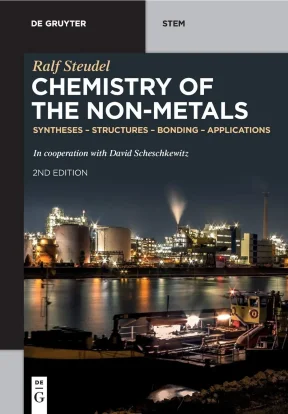
Chemistry of the Nonmetals by Ralf Steudel: Syntheses Structures Bonding

Giới thiệu tổng quan cuốn sách giáo khoa Hóa học phi kim: Tổng hợp, Cấu trúc, Liên kết và Ứng dụng. Tài liệu cập nhật mới nhất về các nguyên tố phi kim và ứng

Trường đại học

Saarland University

Chuyên ngành

Hóa học vô cơ

Người đăng

Ẩn danh

Thể loại

Giáo trình

2020

170
0
0

Phí lưu trữ

45 Point

Tóm tắt

I. Tổng quan về sách Chemistry of the Nonmetals của Ralf Steudel

Cuốn sách Chemistry of the Non-Metals: Syntheses – Structures – Bonding – Applications của giáo sư Ralf Steudel là tác phẩm chuyên khảo hàng đầu về hóa học các nguyên tố phi kim. Được xuất bản bởi nhà xuất bản De Gruyter vào năm 2020, cuốn sách là phiên bản quốc tế cập nhật từ ấn bản tiếng Đức mới nhất. Tác phẩm này đánh dấu hơn bốn thập kỷ nghiên cứu và giảng dạy của tác giả tại Đại học Kỹ thuật Berlin, một trung tâm nghiên cứu hóa học phi kim nổi tiếng thế giới. Cuốn sách bao gồm tổng hợp, cấu trúc, liên kết hóa học và ứng dụng của các nguyên tố phi kim. David Scheschkewitz từ Đại học Saarland hợp tác thực hiện phiên bản này. Tác phẩm hướng đến sinh viên đại học, nghiên cứu sinh và nhà nghiên cứu trong lĩnh vực hóa học vô cơ. Nội dung phản ánh những phát triển mới nhất trong nghiên cứu cơ bản và công nghiệp.

1.1. Bối cảnh và lịch sử xuất bản

Cuốn sách bắt nguồn từ bài giảng của Ralf Steudel tại Đại học Kỹ thuật Berlin. Ấn bản tiếng Đức đầu tiên được viết khi tác giả còn ở giai đoạn đầu sự nghiệp học thuật. Qua năm phiên bản, mỗi lần đều được hiện đại hóa và mở rộng toàn diện. De Gruyter, Berlin/Boston là nhà xuất bản chịu trách nhiệm phát hành tất cả các phiên bản. Phiên bản quốc tế năm 2020 là bản dịch cập nhật từ ấn bản tiếng Đức mới nhất, đảm bảo nội dung phản ánh tiến bộ khoa học hiện đại.

1.2. Đối tượng và phạm vi nội dung

Cuốn sách phục vụ nhiều đối tượng độc giả khác nhau trong lĩnh vực hóa học. Sinh viên đại học tìm thấy tài liệu học tập toàn diện về hóa học vô cơ. Nghiên cứu sinh sử dụng sách như nguồn tham khảo chuyên sâu về liên kết và cấu trúc phi kim. Nhà nghiên cứu trong ngành công nghiệp khai thác kiến thức về ứng dụng thực tiễn. Phạm vi nội dung trải rộng từ hóa học cơ bản đến các ứng dụng công nghiệp tiên tiến, bao gồm cả phân tích vết và hóa học sinh học vô cơ.

II. Phân tích cấu trúc nội dung và phương pháp trình bày

Cuốn sách được tổ chức theo bốn chủ đề cốt lõi: tổng hợp, cấu trúc, liên kết hóa học và ứng dụng. Cách tiếp cận này giúp người đọc hiểu mối liên hệ giữa lý thuyết và thực hành. Phần liên kết hóa học trình bày chi tiết về cách các nguyên tử kết hợp thành phân tử và tinh thể. Tác giả giải thích tại sao nguyên tử kết hợp theo tỷ lệ nhất định và thường có nhiều tỷ lệ khác nhau. Ví dụ điển hình là các oxide của nitơ: NO, NO₂, N₂O, N₂O₃, N₂O₄ và N₂O₅. Phần cấu trúc giới thiệu các phương pháp thực nghiệm như nhiễu xạ tia X và quang phổ. Mô hình VSEPR (lý thuyết Gillespie-Nyholm) được trình bày như công cụ dự đoán hình học phân tử. Nội dung phản ánh sự phát triển của lý thuyết liên kết từ mô hình Bohr đến cơ học lượng tử hiện đại.

2.1. Phương pháp xác định cấu trúc phân tử

Sách trình bày nhiều phương pháp xác định cấu trúc phân tử phi kim. Nhiễu xạ electron và tia X cung cấp vị trí nguyên tử chính xác cho phân tử khí. Tính toán hóa học lượng tử cho vị trí nguyên tử tại cực tiểu của bề mặt năng lượng. Phương pháp thực nghiệm cung cấp vị trí nguyên tử trung bình dao động. Quang phổ IR, Raman và NMR giúp xác định cách kết nối nguyên tử trong hợp chất mới. Ví dụ phân tử SOF₄ có thể là thionyl tetrafluoride hoặc sulfur trifluoride hypofluorite.

2.2. Lý thuyết liên kết hóa học phi kim

Phần liên kết hóa học giải thích hiện tượng tích lũy mật độ điện tích âm giữa hai hạt nhân. Tích lũy đủ lớn để cân bằng lực đẩy tĩnh điện giữa các hạt nhân mang điện dương. Tác giả trình bày nhiều mức độ chính xác khác nhau tùy theo câu hỏi cần trả lời. Lý thuyết hóa học phải giải thích tại sao nguyên tử kết hợp, theo tỷ lệ nào, và hình dạng phân tử ra sao. Mô hình orbital nguyên tử và orbital phân tử là công cụ cơ bản trong phân tích liên kết. Các phép tính hóa học lượng tử cung cấp dữ liệu về năng lượng, mô men lưỡng cực và điện tích nguyên tử.

III. Phương pháp tiếp cận hóa học phi kim trong giáo dục

Hóa học phi kim chiếm vị trí quan trọng trong chương trình giáo dục hóa học mọi cấp độ. Không có nguyên tố phi kim, Trái Đất sẽ không có nước, không khí và sự sống. Oxy và silic chiếm 72,7% khối lượng vỏ Trái Đất. Cơ thể con người gồm 96,6% oxy, carbon, hydro và nitơ. Cuốn sách của Steudel cung cấp nền tảng vững chắc cho việc giảng dạy hóa học vô cơ. Phương pháp tiếp cận tích hợp giữa lý thuyết và thực nghiệm giúp sinh viên hiểu sâu sắc bản chất liên kết. Các ví dụ thực tiễn từ công nghiệp và đời sống hàng ngày làm tăng tính hấp dẫn nội dung. Tác giả nhấn mạnh tầm quan trọng của hóa học phi kim trong nghiên cứu và sản xuất công nghiệp.

3.1. Tích hợp lý thuyết và thực nghiệm

Phương pháp giảng dạy trong sách kết hợp lý thuyết liên kết với dữ liệu thực nghiệm. Sinh viên học cách sử dụng mô hình VSEPR để dự đoán hình học phân tử. Phân tích quang phổ IR và Raman giúp xác nhận cấu trúc dự đoán. Phép tính hóa học lượng tử bổ sung cho kết quả thực nghiệm, tạo cái nhìn toàn diện. Cách tiếp cận này rèn luyện tư duy khoa học và kỹ năng phân tích cho người học. Người đọc được hướng dẫn từ đơn giản đến phức tạp, phù hợp nhiều trình độ khác nhau.

3.2. Ứng dụng công nghiệp và đời sống

Cuốn sách nhấn mạnh vai trò thiết yếu của hợp chất phi kim trong đời sống hàng ngày. Công nghiệp sử dụng rộng rãi các hợp chất phi kim trong sản xuất và chế biến. Lĩnh vực hóa học vô cơ công nghiệp khai thác nguyên tố phi kim cho nhiều ứng dụng. Phân tích vết và hóa học sinh học vô cơ là hai nhánh phát triển mạnh mẽ. Sách cũng giới thiệu các ấn phẩm liên quan của De Gruyter về hóa học vô cơ ứng dụng. Người đọc hiểu được mối liên hệ giữa nghiên cứu cơ bản và ứng dụng thực tiễn trong công nghiệp.

IV. Kết luận và giá trị của cuốn sách Chemistry of the Nonmetals

Cuốn Chemistry of the Non-Metals của Ralf Steudel là tài liệu không thể thiếu cho người học và nghiên cứu hóa học vô cơ. Tác phẩm tích hợp kiến thức từ hơn 40 năm nghiên cứu và giảng dạy của tác giả. Năm phiên bản liên tục được cập nhật chứng minh giá trị bền vững của nội dung. Sự hợp tác với David Scheschkewitz đảm bảo chất lượng phiên bản quốc tế. Cuốn sách nằm trong hệ sinh thái xuất bản phong phú của De Gruyter về hóa học vô cơ. Các ấn phẩm liên quan bao gồm Bioinorganic Chemistry, Inorganic Trace Analytics và Industrial Inorganic Chemistry. Giá trị thực tiễn của sách thể hiện qua khả năng ứng dụng trong nghiên cứu và sản xuất công nghiệp. Đây là nguồn tài liệu tham khảo chuẩn mực cho sinh viên, giảng viên và nhà nghiên cứu toàn cầu.

4.1. Hệ sinh thái xuất bản De Gruyter về hóa học vô cơ

De Gruyter phát hành nhiều ấn phẩm hóa học vô cơ chất lượng cao bên cạnh cuốn sách chính. Bioinorganic Chemistry của Rabinovich (2020) mở rộng sang lĩnh vực hóa học sinh học vô cơ. Inorganic Trace Analytics do Matusiewicz và Bulska biên tập (2017) phục vụ phân tích vết nguyên tố. Inorganic Pigments của Pfaff (2017) tập trung vào sắc tố vô cơ công nghiệp. Industrial Inorganic Chemistry của Benvenuto (2015) cung cấp kiến thức hóa học vô cơ ứng dụng. Tập san Reviews in Inorganic Chemistry do Schulz và Axel chủ biên tổng hợp nghiên cứu mới nhất.

4.2. Hướng phát triển và tiềm năng nghiên cứu

Hóa học phi kim tiếp tục phát triển mạnh mẽ với nhiều hướng nghiên cứu mới. Tính toán hóa học lượng tử ngày càng chính xác, hỗ trợ dự đoán cấu trúc và tính chất. Nghiên cứu vật liệu mới dựa trên nguyên tố phi kim mở ra ứng dụng trong năng lượng và y tế. Hóa học sinh học vô cơ khám phá vai trò của nguyên tố phi kim trong hệ thống sống. Phân tích vết nguyên tố trở nên quan trọng trong kiểm soát chất lượng và môi trường. Cuốn sách của Steudel cung cấp nền tảng vững chắc cho các hướng nghiên cứu tương lai.
21/04/2026

Trích đoạn nội dung tài liệu

Ralf Steudel Chemistry of the Non-Metals Also of interest Bioinorganic Chemistry. Rabinovich,  ISBN ----, e-ISBN ---- Inorganic Trace Analytics. Trace Element Analysis and Speciation Matusiewicz, Bulska (Eds.),  ISBN ----, e-ISBN ---- Inorganic Pigments. Pfaff,  ISBN ----, e-ISBN ---- Industrial Inorganic Chemistry. Benvenuto,  ISBN ----, e-ISBN ---- Reviews in Inorganic Chemistry. Editor-in-Chief: Schulz, Axel ISSN -, e-ISSN - Ralf Steudel Chemistry of the Non-Metals Syntheses – Structures – Bonding – Applications In cooperation with David Scheschkewitz Authors Prof. Ralf Steudel Grethe-Weiser-Weg 11 D-14055 Berlin, Germany steudel@sulfur-research. David Scheschkewitz Saarland University Krupp-Chair of General and Inorganic Chemistry D-66123 Saarbrücken, Germany scheschkewitz@mx.de ISBN 978-3-11-057805-8 e-ISBN (PDF) 978-3-11-057806-5 e-ISBN (EPUB) 978-3-11-057831-7 Library of Congress Control Number: 2019947567 Bibliographic information published by the Deutsche Nationalbibliothek The Deutsche Nationalbibliothek lists this publication in the Deutsche Nationalbibliografie; detailed bibliographic data are available on the Internet at http://dnb. © 2020 Walter de Gruyter GmbH, Berlin/Boston Cover image: Philiphotographer / E+ / getty images Typesetting: Integra Software Services Pvt. Printing and binding: CPI books GmbH, Leck www.com Preface How would our planet Earth look like without nonmetals? No water, no air, no life! Not even rocks and sand since oxygen and silicon are responsible for 72.7% of the mass of crustal rocks on the Earth. The human body consists of 96.6% of oxygen, carbon, hydrogen and nitrogen. If all the other nonmetallic elements are added, we end up with 98. Nonmetal compounds play a crucial role in our daily life and in industry as you will see in this book. It is therefore obvious that the chemistry of the nonmetals is a major part of the chemical education at all levels, from high school to university. The book you are holding in your hands is very special to me. I wrote the first German edition at the very early stage of my academic career, shortly ahead of my one-year sabbatical leave at M. It originated from my lectures at the Technical University Berlin, the place known as a hotspot of nonmetal chemistry research. With the years, the book became my lifetime project. I was fortunate enough to share my passion and interest in the chemistry of the nonmetals (and the yellow element in particular) with many friends and colleagues in academia and industry all over the world. Thus, the book was al- ways nourished with the modern developments in fundamental and industrial research. Five editions of this monograph have been published by de Gruyter, Berlin/ Boston, each time completely modernized and extended. This newest interna- tional edition is an updated translation of the latest German edition of 2013. I am grateful to my two younger colleagues who share the same passion – Prof. David Scheschkewitz at Saarland University (Germany) who contributed in translating and updating half of the present edition; and Prof. Ingo Krossing at the University of Freiburg (Germany) whose know-how enriched several chapters of a previous German edition. The book presents an infinite variety and marvelous chemical subtlety of the 22 elements occupying the upper-right section of the Periodic Table and of hydro- gen, which was at the origin of the universe when it started 13.8 billion years ago and from which all other elements were formed by nuclear reactions. The work is organized in two parts: Part I explains the basic theoretical concepts needed to understand the structures and reactions of (nonmetallic) molecules and crystals. The larger Part II presents the syntheses, structures and applications of the corre- sponding compounds and materials. We also address their significance in daily life, chemical industry, environment, material science and farming wherever possible. Numerous review articles and original publications are cited in footnotes and encourage the readers to study certain topics more extensively. To keep the size of the footnotes with nearly 1000 references under control, however, only one author is given if there are more than three. In addition, well-established handbooks of https://doi.1515/9783110578065-202 VI Preface inorganic chemistry (e., GMELIN1) and chemical technology (e., ULLMANN2 WINNACKER-KÜCHLER3 BÜCHEL-MORETTO-WODITSCH4and KIRK-OTHMER5) may be consulted as a useful source of information. Literature closing date was spring 2019. In recommending the book to its readers, I like to acknowledge the advice by Profs. Sebastian Hasenstab-Riedel and Christian Müller of the Free University Berlin and the help by Dr. Anja Wiesner who assisted with the graphics. Furthermore, I am most grateful to my wife Dr. Yana Steudel for many years of support and cooper- ation on the various editions of this book. De Gruyter Publisher in Berlin supported this project from day 1, so that many people who worked with me all these years should be acknowledged. Many colleagues, coworkers and students contributed to the success of this book with their comments and suggestions and I will be happy to hear from the readers of this edition too. Berlin-Charlottenburg, June 2019 Ralf Steudel 1 Gmelin Handbook of Inorganic and Organometallic Chemistry – 8th edition, Springer, book series with 185 volumes (partly in English), published in 1936–1995. 2 Ullmann’s Encyclopedia of Industrial Chemistry, Wiley-VCH, Weinheim, 2006; many volumes and online edition. 3 Winnacker-Küchler: Chemische Technik, Vol. 3: Anorganische Grundstoffe, 5th ed., Wiley-VCH, Weinheim, 2005.), Industrial Inorganic Chemistry, 2nd ed., Wiley-VCH, Weinheim, 2008. 5 Kirk-Othmer (eds.), Encyclopedia of Chemical Technology, 5th ed., Wiley, New York, 2004; book series with 27 volumes. Contents Preface V Part I: Chemical Bonds and Properties of Molecules 1 Introduction 3 2 The Chemical Bond 11 2.1 The Ionic Bond 13 2.2 The Ionization Energy Ei 13 2.3 The Electron Affinity Eea 15 2.4 Ionic Crystals and Ionic Radii 17 2.5 Lattice Energy and Lattice Enthalpy 19 2.6 Determination of Lattice Energies and Enthalpies 21 2.7 Significance of the Lattice Enthalpy 23 2.1 Complex Formation of Metal Halides 26 2.2 Weakly Coordinating Anions 27 2.8 Polarization of Anions by Cations 27 2.2 The VSEPR Model for Estimation of Molecular Geometries 32 2.1 Lone Electron Pairs 38 2.2 Single Electron Domains 40 2.3 Substituents of Differing Electronegativity 40 2.5 Final Remarks on the VSEPR Model 41 2.3 Molecular Symmetry and Point Group Symbols 43 2.4 The Covalent Bond 48 2.1 The Molecular Ion [H2]+ 49 2.1 The LCAO Approximation 50 2.2 The Role of Antibonding Molecular Orbitals 59 2.3 Homonuclear Diatomic Molecules 60 2.4 Photoelectron Spectroscopy of Small Molecules 68 2.5 Heteronuclear Diatomic Molecules 70 2.1 General Rules for the Construction of MOs 72 2.6 Three-Atomic Molecules of D∞h Symmetry 73 2.1 The Molecule BeH2 75 VIII Contents 2.2 The Molecule CO2 76 2.7 Three-Atomic Molecules of C2v Symmetry 77 2.8 Four-Atomic Molecules of D3h Symmetry 80 2.9 Four-Atomic Molecules of C3v Symmetry 83 2.10 Five-Atomic Molecules 87 2.5 The Coordinate Bond 89 2.6 Hypercoordinate Molecules 93 3 VAN DER WAALS Interaction 101 3.1 The Dipole Effect 101 3.2 Induced Dipole Effect 104 3.3 The Dispersion Effect 104 3.4 VAN DER WAALS Radii 107 3.5 VAN DER WAALS Molecules 109 4 Bond Properties 113 4.2 Bond Enthalpy and Dissociation Enthalpy 114 4.3 Why Is Oxygen a Gas and Sulfur a Solid? 122 4.3 The Internuclear Distance 124 4.4 The Valence Force Constant 127 4.3 Three-Atomic Molecules 129 4.5 Relationships Between Different Bond Properties 132 4.6 Polarity of Covalent Bonds and Electronegativity 134 4.1 Thermodynamic Electronegativities by PAULING 136 4.2 Electronegativities according to ALLRED and ROCHOW 138 4.3 Spectroscopic electronegativities according to ALLEN 141 4.3 The Dipole Moment 143 4.7 Electron Density Distribution in Molecules and Crystals 147 4.1 Promolecule and Deformation Density 147 4.2 Halogen Bonding 149 Contents IX Part II: Chemistry of the Non-Metals 5 Hydrogen 157 5.1 Production and Uses 157 5.2 Isotopes of Hydrogen 161 5.3 Properties of Hydrogen 164 5.3 Anhydrous Sulfuric Acid 172 5.5 The Relative Strength of Acids and Bases 174 5.1 Binary Covalent Hydrides 175 5.2 Concentrated and Nonaqueous Acids 177 5.2 General Properties of Hydrogen Bonds 182 5.3 Experimental Detection of Hydrogen Bonds 183 5.4 Examples of Special Hydrogen Bonds 187 5.2 Ice and Water 188 5.3 Gas Hydrates and Clathrate Hydrates 194 5.4 Ammonia and Amines 195 5.5 Theory of Hydrogen Bond Formation 198 5.1 Activation of H2 Molecules 203 5.3 H2 as Ligand in Coordination Compounds 204 5.4 Salt-Like Hydrides 206 5.5 Metal- and Alloy-Like Hydrides (Insertion Hydrides) 209 5.1 Bonding of Hydrogen in Alloy-Like Hydrides 211 X Contents 6 Boron 215 6.1 LEWIS Acidity and Adduct Formation 216 6.2 Coordination Numbers and Multiple Bonds 219 6.3 Similarities and Differences to Other Non-Metals 221 6.1 Preparation of Elemental Boron 223 6.2 Solid-State Structures of Elemental Boron 224 6.3 Bonding in Elemental Boron 226 6.4 Borides and Boron Carbides 228 6.5 Boranes and Hydroborates 231 6.9 Boron–Oxygen Species 250 6.2 Boron Trioxide and Boric Acids 251 6.10 Boron–Nitrogen Compounds 256 6.2 Bonding Situation in Group 14 266 7.1 Graphite and Graphene 272 7.1 Graphene 274 Contents XI 7.1 Covalent Graphite Compounds 285 7.2 Ionic Graphite Compounds 288 7.5 Carbon Black, Coal and Coke 291 7.3 Other Carbon Oxides 298 7.2 Sulfides, Selenides and Tellurides 299 7.3 Carbonic Acid and Carbonates 301 7.1 Hydrogen Cyanide and Cyanides 305 7.2 Binary Carbon–Nitrogen Species 307 8 Silicon and Germanium 309 8.3 The Elements Silicon and Germanium 318 8.4 Silicides and Germanides 322 8.5 Hydrides of Silicon and Germanium 325 8.1 Preparation of Hydrides 326 8.2 Reactions of Silanes and Germanes 328 8.6 Halides of Silicon and Germanium 329 8.3 Other Silicon Halides 333 8.7 Oxides of Silicon and Germanium 334 8.8 Oxoacids, Silicates and Germanates 338 XII Contents 8.1 Silicic Acid and Siloxanes 338 8.10 Silicon–Nitrogen Compounds 351 8.2 Unsaturated Organosilicon and Organogermanium Compounds 357 8.12 Other Silicon Compounds 363 8.3 Silicon Sulfides 365 9 Nitrogen 367 9.2 N2 as Complex Ligand 369 9.3 Bonding in Nitrogen Compounds 372 9.1 Bond Enthalpies and Formation Enthalpies 376 9.5 Hydrogen Azide (HN3) and Azides 387 9.8 Water-Like Solvents 392 9.1 Solubilities in Liquid Ammonia 393 9.2 Autodissociation of Liquid Ammonia 393 9.4 Solvated Electrons in Liquid Ammonia 394 9.5 Reactions of Solvated Electrons in Liquid Ammonia 398 9.6 Solvated Electrons in Water 399 9.5 Halides and Oxohalides of Nitrogen 402 9.2 Oxohalides of Nitrogen 405 9.6 Oxides of Nitrogen 406 9.3 Nitrogen Monoxide (NO) and Dinitrogen Dioxide (N2O2) 408 Contents XIII 9.7 Oxoacids of Nitrogen 415 9.6 Hyponitrous Acid (HON)2 and Nitramide (H2NNO2) 422 10 Phosphorus and Arsenic 425 10.2 Bonding Situation in P and As Compounds 425 10.3 Phosphorus and Arsenic as Elements 429 10.1 Production of the Elements 430 10.2 Modifications of Phosphorus and Arsenic 431 10.1 Structures of P and As Modifications 432 10.4 Hydrides of Phosphorus and Arsenic 437 10.1 Phosphane and Arsane 438 10.7 Diphosphenes and Phosphaalkynes 445 10.8 Halides of Phosphorus and Arsenic 447 10.4 Strong LEWIS Acids 453 10.9 Phosphoranes and Arsoranes 455 10.10 Oxides of Phosphorus and Arsenic 458 10.11 Sulfides of Phosphorus and Arsenic 463 10.12 Oxoacids of Phosphorus and Arsenic and Their Derivatives 465 10.1 Oxoacids with One P Atom 465 10.1 Orthophosphoric Acid and Orthophosphates 467 10.3 Phosphinic or Hypophosphorous Acid (H3PO2) 470 10.4 Phosphinous Acid (H3PO) and Hydroxophosphane (H2POH) 470 XIV Contents 10.2 Condensed Phosphoric Acids 470 10.5 Halogeno- and Amidophosphoric Acids 473 10.6 Oxo- and Thioacids of Arsenic and Their Salts 473 10.13 Phosphorus(V) Nitrides and Nitridophosphates 474 10.2 Complexes with O2 as a Ligand 485 11.2 Ionic and Covalent Oxygen Compounds 497 11.6 Bond Properties of the Ions [O2]•+, [O2]•− and [O2]2− 505 11.3 Hydrides of Oxygen and Peroxo Compounds 506 11.2 Properties and Structure of H2O2 510 11.5 Hydroxyl Radical, OH• 514 11.4 Fluorides of Oxygen 516 11.2 Oxygen Difluoride, OF2 517 11.5 Bonding Situation in Oxygen Hydrides and Fluorides 518 Contents XV 12 Sulfur, Selenium and Tellurium 521 12.2 Bonding Situations and Tendencies in Group 16 522 12.3 Preparation of the Elements 525 12.1 Production of Sulfur 525 12.2 Production and Uses of Selenium and Tellurium 528 12.4 Allotropes of the Chalcogens 529 12.1 Thermal Behavior of Sulfur 530 12.2 Monotropic Sulfur Allotropes 534 12.2 Allotropes of Selenium and Tellurium 538 12.5 Homoatomic Chalcogen Cations 541 12.6 Chain Growth and Degradation Reactions 543 12.1 Synthesis of Polysulfanes 548 12.

Nội dung được bảo vệ bản quyền — Tải xuống đầy đủ