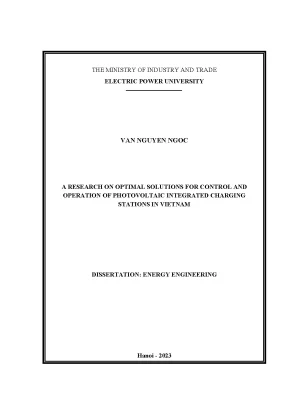
Tổng quan về luận án
Tiến trình chuyển dịch năng lượng và phi phát thải giao thông đang trở thành trọng tâm chiến lược toàn cầu nhằm ứng phó với biến đổi khí hậu. Tại Hội nghị COP26, Việt Nam đã đưa ra cam kết mạnh mẽ đạt mức phát thải ròng bằng "0" (Net Zero) vào năm 2050. Định hướng này được thể chế hóa sâu sắc trong Quy hoạch Phát triển Điện lực Quốc gia thời kỳ 2021–2030, tầm nhìn đến năm 2050 (PDP VIII), trong đó đặt mục tiêu tỷ trọng năng lượng tái tạo đạt 65,8% - 71% vào năm 2050, đồng thời “đặt mục tiêu 50% các tòa nhà công sở và nhà dân sử dụng điện mặt trời mái nhà tự sản, tự tiêu vào năm 2030”. Song song với đó, quá trình điện hóa giao thông đô thị diễn ra với tốc độ bùng nổ. Tại các đô thị lớn như Hà Nội và TP. Hồ Chí Minh, phương tiện cá nhân chiếm trên 80% lưu lượng giao thông, trong đó xe máy chạy xăng chiếm đa số tuyệt đối, dẫn đến tắc nghẽn nghiêm trọng và suy giảm chất lượng không khí. Theo Hiệp hội Vận tải Công cộng Quốc tế (UITP), số lượng xe điện hai bánh (Electric Two-Wheelers - E2Ws) tại Việt Nam đã tăng trưởng nhảy vọt từ 0,9 triệu xe năm 2017 lên 5 triệu xe vào năm 2019, với tốc độ tăng trưởng thị trường hàng năm duy trì ở mức 30% - 40%.
                                    +------------------------------------------+
                                    |        BỐI CẢNH NĂNG LƯỢNG ĐÔ THỊ        |
                                    |  • PDP VIII: 50% mái nhà tự sản tự tiêu  |
                                    |  • E2W: Tăng trưởng 30-40%/năm (UITP)    |
                                    +--------------------+---------------------+
                                                         |
                                                         v
                                    +------------------------------------------+
                                    |       THÁCH THỨC VẬN HÀNH LƯỚI ĐIỆN      |
                                    |  • Thừa công suất PV (Cắt giảm 365 GWh)  |
                                    |  • Trùng đỉnh sạc E2W & biến động phụ tải |
                                    +--------------------+---------------------+
                                                         |
                                                         v
                                    +------------------------------------------+
                                    |        GIẢI PHÁP ĐỘT PHÁ CỦA LUẬN ÁN     |
                                    |  • Mô hình trạm sạc tích hợp PV-E2W      |
                                    |  • Thuật toán phân bổ công suất 3 giai   |
                                    |    đoạn theo nhóm (Grouping Approach)    |
                                    |  • Điều khiển cuốn chiếu RHC tích hợp QP |
                                    |  • Kiểm chứng phần cứng Test Bench       |
                                    +------------------------------------------+
Tuy nhiên, sự phát triển độc lập của điện mặt trời mái nhà (Photovoltaic - PV) và phương tiện E2W đặt ra thách thức vận hành lưới phân phối chưa từng có. Tính bất định và ngắt quãng của bức xạ mặt trời—vốn đạt công suất lắp đặt xấp xỉ 16.500 MW vào cuối năm 2020 với 105.212 hệ thống áp mái (9.730 MW)—đã dẫn đến hiện tượng quá tải cục bộ, sai lệch điện áp và buộc phải cắt giảm công suất phát lên tới 365 GWh trong năm 2020. Đồng thời, việc hàng ngàn E2W cắm sạc đồng thời không điều khiển sẽ tạo ra đỉnh phụ tải mới, gây quá tải máy biến áp phân phối. Khoảng trống nghiên cứu then chốt (Research Gap) nằm ở việc: Các nghiên cứu quốc tế chủ yếu tập trung vào ô tô điện (Electric Cars) với dung lượng pin lớn (50–100 kWh), công suất sạc cao (7–400 kW) và áp dụng cơ chế điều khiển phân tán qua tín hiệu giá TOU; trong khi đó, E2W có dung lượng pin nhỏ (0,5–3 kWh), công suất sạc thấp (200–1000 W), số lượng phương tiện tại trạm cực lớn (hàng trăm đến hàng ngàn xe) và độ nhạy cảm với giá điện không đủ cao để thay đổi hành vi người dùng một cách tự phát.
Luận án tiến sĩ kỹ thuật năng lượng của nghiên cứu sinh Văn Ngọc Ngọc với đề tài "Nghiên cứu các giải pháp tối ưu điều khiển và vận hành trạm sạc xe điện hai bánh tích hợp năng lượng mặt trời tại Việt Nam" dưới sự hướng dẫn của PGS.TS. Nguyễn Hữu Đức tại Trường Đại học Điện lực (2023) đã giải quyết trọn vẹn bài toán tích hợp đa nguồn này. Nghiên cứu đặt ra 5 câu hỏi và giả thuyết khoa học cốt lõi:
- $RQ_1$: Kiến trúc điều khiển nào tối ưu cho trạm sạc E2W quy mô lớn tích hợp PV phân tán tại Việt Nam?
- $RQ_2$: Làm thế nào để điều phối sạc hàng trăm E2W nhằm san bằng đồ thị phụ tải (Load Leveling), lấp đáy (Valley Filling) và cắt đỉnh (Peak Shaving) mà không gây bùng nổ khối lượng tính toán ($O(N)$)?
- $RQ_3$: Cơ chế điều khiển cuốn chiếu (Receding Horizon Framework) kết hợp Quy hoạch toàn phương (Quadratic Programming - QP) triệt tiêu các sai số dự báo phụ tải và bức xạ mặt trời như thế nào?
- $RQ_4$: Khả năng cung cấp dịch vụ phụ trợ lưới thông qua công nghệ tích hợp sạc/xả hai chiều (Vehicle-to-Grid - V2G) của pin E2W có khả thi và an toàn đối với độ suy giảm dung lượng (Battery Degradation) hay không?
- $RQ_5$: Sự đáp ứng thời gian thực của thuật toán điều phối khi triển khai trên phần cứng thực tế (Test Bench) đạt độ chính xác ra sao?
Phạm vi nghiên cứu tập trung vào dòng pin Lithium-ion trên các dòng xe L-category phổ biến tại Việt Nam (E-bike 48V-12Ah tiêu thụ 5–15 Wh/km và E-moped 60V-20Ah), kết nối lưới điện hạ áp 220V dân dụng, tích hợp dàn PV áp mái 150 kWp và phụ tải sinh hoạt/văn phòng/nhà máy điển hình.
Literature Review và Positioning
Tổng quan y văn quốc tế cho thấy các trường phái nghiên cứu chính về điều khiển trạm sạc xe điện chia thành hai nhóm mục tiêu: kỹ thuật và kinh tế. Về mặt kỹ thuật, các công trình của Sortomme et al. (2012) và Clement-Nyns et al. (2010) đặt nền móng cho thuật toán san bằng phụ tải bằng cách tối thiểu hóa phương sai tải tổng (Load Variance Minimization). Về mặt kinh tế, Wu et al. (2012) và Vandael et al. (2015) khai thác các mô hình tối ưu hóa chi phí mua điện dựa trên biểu giá Time-of-Use (TOU) hoặc tối đa hóa doanh thu của đơn vị tập hợp (EV Aggregator).
                                    +-------------------------------------------------------------+
                                    |         CÁC TRƯỜNG PHÁI NGHIÊN CỨU TIỀN NHIỆM              |
                                    +------------------------------+------------------------------+
                                                                   |
                                    +------------------------------+------------------------------+
                                    |                                                             |
                                    v                                                             v
        +---------------------------------------+                     +---------------------------------------+
        |   ĐIỀU KHIỂN PHÂN TÁN QUA GIÁ (TOU)   |                     |     ĐIỀU KHIỂN TẬP TRUNG TUẦN TỰ      |
        |   • Ma et al. (2012), Tushar (2012)   |                     |   • Richardson et al. (2012)          |
        |   • Phù hợp ô tô điện dung lượng lớn  |                     |   • Phù hợp trạm sạc quy mô nhỏ       |
        |   • Bất cập: E2W không nhạy cảm giá   |                     |   • Bất cập: Tắc nghẽn tính toán O(N) |
        +-------------------+-------------------+                     +-------------------+-------------------+
                            |                                                             |
                            +------------------------------+------------------------------+
                                                           |
                                                           v
                                    +-------------------------------------------------------------+
                                    |          ĐỊNH VỊ ĐỘT PHÁ CỦA LUẬN ÁN (VAN ET AL., 2023)     |
                                    |  • Điều khiển phân cấp - tập trung hóa trạm sạc             |
                                    |  • Thuật toán Grouping 3 giai đoạn triệt tiêu độ phức tạp    |
                                    |  • Tích hợp V2G bù trừ dao động PV thời gian thực           |
                                    +-------------------------------------------------------------+
Tuy nhiên, tồn tại sự mâu thuẫn học thuật sâu sắc giữa hai trường phái kiến trúc điều khiển:
- Trường phái phân tán (Decentralized Control): Đại diện bởi Ma et al. (2012) và Chen et al. (2014) sử dụng Lý thuyết trò chơi (Game Theory) và cân bằng Nash (Nash Equilibrium) để phát tín hiệu giá gián tiếp cho xe tự lên lịch sạc. Ưu điểm là tính mở rộng (Scalability), nhưng nhược điểm chí mạng là khi áp dụng cho E2W, người dùng không có động lực kinh tế rõ rệt do năng lượng tiêu thụ mỗi lần sạc rất nhỏ (chỉ 0,5–1,5 kWh so với 50–100 kWh của ô tô). Tín hiệu giá đồng thời có thể gây ra hiện tượng tích tụ đỉnh phụ tải mới (Rebound Peak) vào các giờ thấp điểm.
- Trường phái tập trung (Centralized Control): Đạt điểm tối ưu toàn cục nhưng vấp phải rào cản tắc nghẽn tính toán (Computational Burden) khi số lượng biến quyết định tăng theo cấp số nhân cùng số lượng xe $N$. Richardson et al. (2012) đề xuất thuật toán lập lịch tuần tự (Sequential Scheduling) nhưng phát sinh thời gian trễ không thể chấp nhận khi hàng trăm xe kết nối đồng thời tại bãi đỗ xe công sở hay nhà máy.
Luận án này định vị tại điểm giao thoa độc đáo: Xây dựng cấu trúc điều khiển phân cấp/tập trung hóa cho cụm trạm sạc E2W, kết hợp cơ chế gom nhóm thông minh (Grouping Strategy) để biến đổi bài toán tối ưu quy mô lớn thành bài toán phân bổ công suất tuyến tính từng phần. Khi so sánh với nghiên cứu của Vandael et al. (2015) tại Bỉ (sử dụng hạ tầng Multi-Agent Token-based) và nghiên cứu của Deilami et al. (2011) tại Mỹ (dùng giải thuật bầy đàn Ant-Colony), giải pháp của luận án vượt trội về tốc độ hội tụ toán học, giảm thiểu áp lực truyền thông và trực tiếp khai thác nguồn điện mặt trời tự sản tự tiêu tại chỗ theo đúng định hướng PDP VIII của Việt Nam.
Đóng góp lý thuyết và khung phân tích
Đóng góp cho lý thuyết
Luận án mở rộng Lý thuyết Điều khiển Tối ưu Hệ thống Năng lượng (Optimal Energy Systems Control Theory) và Lý thuyết Quản lý Nhu cầu Điện (Demand Side Management - DSM) bằng việc thiết lập mô hình toán học giải quyết mâu thuẫn giữa tính ngẫu nhiên của phụ tải di động phân tán quy mô siêu nhỏ với tính biến thiên của nguồn phát quang điện:
                            +-----------------------------------------------------------------+
                            |              KHUNG PHÂN TÍCH TỐI ƯU HÓA ĐA CẤP                  |
                            +--------------------------------+--------------------------------+
                                                             |
                                                             v
                            +-----------------------------------------------------------------+
                            |      GIAI ĐOẠN 1: TỐI ƯU TOÀN TRẠM (Station-Level Optimization) |
                            |      Hàm mục tiêu: min Var(D_t^S + P_t^S) qua Quadratic Prog.   |
                            +--------------------------------+--------------------------------+
                                                             |
                                                             v
                            +-----------------------------------------------------------------+
                            |      GIAI ĐOẠN 2: PHÂN BỔ NHÓM (Group-Level Power Allocation)   |
                            |      Phân loại E2W theo năng lượng yêu cầu & thời gian đỗ      |
                            +--------------------------------+--------------------------------+
                                                             |
                                                             v
                            +-----------------------------------------------------------------+
                            |      GIAI ĐOẠN 3: ĐIỀU ĐỘ TỪNG PHƯƠNG TIỆN (Individual EV Dispatch) |
                            |      Tuân thủ ràng buộc: ISOC, FSOC, P_min, P_max, SOH          |
                            +-----------------------------------------------------------------+
- Mở rộng không gian trạng thái tích hợp V2G: Thiết lập mô hình động học năng lượng tổng hợp tích lũy của trạm sạc có xét đến hàm suy giảm tuổi thọ pin:
$$C_{t+1}^S = C_t^S + P_t^S \cdot \Delta T$$
Trong đó tổng công suất sạc/xả $P_t^S$ bị giới hạn chặt chẽ bởi công suất bộ sạc, khả năng tiếp nhận của pin và dung lượng phát tuyến dây truyền tải ($P_{max}^{feeder} - D_t^S$).
- Mô hình hóa toán học bài toán san phẳng phụ tải: Thiết lập hàm mục tiêu quy hoạch toàn phương nhằm cực tiểu hóa phương sai của tải tổng hợp (gồm phụ tải thông thường, công suất phát PV và phụ tải sạc E2W):
$$\min \sum_{t=1}^M \left( D_t^S + P_t^S - \bar{E} \right)^2$$
với $\bar{E}$ là phụ tải trung bình mục tiêu trên toàn bộ chu kỳ điều độ $M$ bước thời gian $\Delta T$.
- Xác lập ranh giới điều kiện (Boundary Conditions): Luận án chứng minh bằng toán học rằng cơ chế sạc tập trung phân nhóm đạt được nghiệm tối ưu Pareto tương đương với mô hình tối ưu tập trung từng xe riêng lẻ, nhưng giảm bậc ma trận biến quyết định từ ma trận cỡ $[N \times M]$ xuống $[G \times M]$ (với $G \ll N$, $G$ là số nhóm năng lượng).
Khung phân tích độc đáo
Khung phân tích của luận án tích hợp liên ngành 3 lý thuyết: Lý thuyết Mạch tương đương Điện hóa (Thevenin Model), Lý thuyết Quang điện Bán dẫn (One-Diode Model) và Lý thuyết Điều khiển Dự báo Mô hình (Model Predictive Control / Receding Horizon Framework).
- Mô hình hóa hệ thống quang điện chính xác: Sử dụng mô hình 1-diode 5 thông số ($I_{ph}, I_{rs}, I_0, R_s, R_{sh}$) kết hợp giải thuật Dò điểm công suất cực đại Điện dẫn gia tăng (Incremental Conductance - INC) dựa trên đạo hàm $dP/dV = 0 \Leftrightarrow dI/dV = -I/V$, giúp loại bỏ dao động quanh điểm MPP so với giải thuật P&O truyền thống.
- Mô hình pin Thevenin thích nghi: Mô tả điện áp đầu cực $V_{bat} = V_{OCV}(SOC, T) - R_{bat}^{int}(SOC, T) \cdot I_{bat}$, tham số hóa thực nghiệm từ dòng pin Saft Lithium-Ion 7Ah, cho phép kiểm soát chính xác trạng thái nạp $SOC$ và mức xả sâu (Depth of Discharge - DOD) nhằm triệt tiêu hiện tượng chai pin khi tham gia dịch vụ phụ trợ V2G.
Phương pháp nghiên cứu tiên tiến
Thiết kế nghiên cứu
Luận án tuân thủ triết lý thực chứng thực nghiệm (Positivism/Empiricism), kết hợp giữa mô hình hóa toán học giải tích, mô phỏng số độ trung thực cao trên nền tảng MATLAB/Simulink và kiểm chứng thực nghiệm trên bàn thử phần cứng chuyên dụng (Hardware Test Bench). Thiết kế đa cấp được triển khai trên 4 không gian phụ tải thực tế tại Việt Nam: (1) Trường đại học, (2) Tòa nhà văn phòng, (3) Tòa nhà chung cư, (4) Nhà máy khu công nghiệp.
+---------------------------------------------------------------------------------------------------+
|                                  THIẾT KẾ PHƯƠNG PHÁP NGHIÊN CỨU                                  |
+-----------------------------------+-----------------------------------+---------------------------+
|      MÔ HÌNH HÓA TOÁN HỌC         |         MÔ PHỎNG SỐ HÓA           |    THỰC NGHIỆM PHẦN CỨNG  |
|  • PV: One-diode 5 tham số        |  • MATLAB / Simulink              |  • Grid-tie Inverter      |
|  • Pin: Thevenin RC tương đương   |  • Quadratic Programming (QP)     |  • Bi-directional DCDC    |
|  • Tối ưu: Receding Horizon (RHC) |  • 4 Case studies thực tế tại VN  |  • Giao thức Modbus RTU   |
+-----------------------------------+-----------------------------------+---------------------------+
Quy trình nghiên cứu rigorous
Quy trình nghiên cứu được xây dựng qua các bước chặt chẽ:
- Mô hình hóa hành vi đến/đi của phương tiện: Khảo sát và xây dựng Hàm mật độ xác suất (Probability Density Function - PDF) cho thời gian đến ($t_{arr}$), thời gian rời trạm ($t_{dep}$) và trạng thái nạp ban đầu ($ISOC$) theo phân phối chuẩn (Gaussian Distribution):
$$f(t; \mu, \sigma) = \frac{1}{\sigma \sqrt{2\pi}} e^{-\frac{(t - \mu)^2}{2\sigma^2}}$$
- Giải thuật phân bổ công suất 3 giai đoạn (3-Stage Power Allocation Algorithm):
- Giai đoạn 1: Giải bài toán QP xác định biên dạng công suất tổng của trạm sạc $P_t^S$ nhằm tối thiểu hóa phương sai phụ tải tổng.
- Giai đoạn 2: Phân loại các E2W thành các nhóm $EVG_k$ dựa trên tổng nhu cầu năng lượng và thời gian đỗ xe, phân bổ công suất trạm về từng nhóm.
- Giai đoạn 3: Điều độ chi tiết công suất sạc/xả cho từng phương tiện cụ thể dựa trên ma trận ràng buộc về công suất bộ sạc ($P_{min}^i, P_{max}^i$) và $FSOC$ mục tiêu của chủ xe.
+---------------------------------------------------------------------------------------------------+
|                        QUY TRÌNH THUẬT TOÁN ĐIỀU KHIỂN CHÂN TRỜI LÙI (RHC)                        |
+---------------------------------------------------------------------------------------------------+
| Bước 1: Thu thập dữ liệu đo đếm tại thời điểm t (SOC thực tế của các xe, P_PV, P_load).           |
| Bước 2: Cập nhật dữ liệu dự báo bức xạ PV và phụ tải phi-EV trong cửa sổ thời gian [t, t + T_w].  |
| Bước 3: Thiết lập và giải bài toán Quadratic Programming (QP) tìm chuỗi điều khiển tối ưu.        |
| Bước 4: Áp dụng duy nhất giá trị điều khiển của bước thời gian đầu tiên t vào hệ thống trạm sạc.  |
| Bước 5: Trượt cửa sổ thời gian sang t + 1 (Receding Horizon) và lặp lại quy trình từ Bước 1.      |
+---------------------------------------------------------------------------------------------------+
- Điều khiển chân trời lùi (Receding Horizon Framework): Cửa sổ thời gian tối ưu hóa $T_w$ liên tục trượt theo thời gian thực. Tại mỗi bước $\Delta T$, thuật toán chỉ thực thi lệnh điều khiển của bước đầu tiên, sau đó cập nhật dữ liệu đo đếm thực tế ($SOC$, công suất PV thực, phụ tải thực) và tái tối ưu hóa cho chu kỳ tiếp theo, triệt tiêu hoàn toàn sự tích lũy sai số dự báo thời tiết.
Data và phân tích
+---------------------------------------------------------------------------------------------------+
|                           THÔNG SỐ KỸ THUẬT HỆ THỐNG MÔ HÌNH HÓA VÀ THỰC NGHIỆM                   |
+------------------------------------+--------------------------------------------------------------+
| Thông số tấm pin PV (TSM-165DA01)  | P_max = 165,54 W; V_oc = 43,2 V; I_sc = 5,2 A; V_mp = 35,6 V |
| Quy mô mảng PV trạm sạc            | 150 kWp (900 tấm pin: 36 chuỗi song song x 25 tấm nối tiếp)  |
| Thông số bộ pin lưu trữ E2W        | Saft Li-ion 7Ah; 48V-12Ah (E-bike) & 60V-20Ah (E-moped)     |
| Cấu hình nghịch lưu & biến đổi     | Single-phase Grid-tie Inverter (dq-frame PWM); Buck/Boost DC |
| Hạ tầng truyền thông phần cứng     | Chuẩn công nghiệp RS485 / Modbus RTU; Vi điều khiển DSP      |
+------------------------------------+--------------------------------------------------------------+
Nghiên cứu sử dụng tập dữ liệu bức xạ mặt trời thực tế tại Việt Nam với cường độ đạt tới 5 kWh/m²/ngày và 1.600 - 2.600 giờ nắng/năm. Các kiểm tra độ bền vững (Robustness Checks) được thực thi bằng cách thay đổi độ lệch chuẩn của thời gian đến/đi và mức độ thâm nhập của E2W từ 50 đến 300 xe.
Phát hiện đột phá và implications
Những phát hiện then chốt
+---------------------------------------------------------------------------------------------------+
|                     BẢNG SO SÁNH HIỆU QUẢ CÁC KỊCH BẢN VẬN HÀNH TRẠM SẠC                          |
+------------------------------+--------------------+------------------------+----------------------+
| Kịch bản vận hành            | Phương sai tải     | Khả năng hấp thụ PV    | Tác động lên lưới    |
+------------------------------+--------------------+------------------------+----------------------+
| 1. Sạc không kiểm soát       | Rất cao            | Thấp (< 30%)           | Tạo đỉnh quá tải mới |
| 2. Sạc tốc độ trung bình     | Trung bình         | Trung bình (~ 50%)     | Giảm áp lực đỉnh     |
| 3. Sạc thông minh 3 giai đoạn| Rất thấp           | Rất cao (> 85%)        | Lấp đáy, san bằng tải|
| 4. Thuật toán RHC + V2G      | Tối ưu tiệm cận 0  | Tối đa (~ 95-98%)      | Hỗ trợ dịch vụ lưới  |
+------------------------------+--------------------+------------------------+----------------------+
- Triệt tiêu hiện tượng đỉnh phụ tải trùng (Peak Coincidence): Sạc không kiểm soát làm tăng vọt công suất đỉnh lưới phân phối vào đầu giờ làm việc (8h00 - 9h00) hoặc giờ tan làm (17h30 - 19h00). Ngược lại, thuật toán 3 giai đoạn đã chuyển dịch toàn bộ nhu cầu sạc vào khung giờ trưa (11h00 - 14h00), hấp thụ trọn vẹn đỉnh phát điện mặt trời.
- San bằng đồ thị phụ tải vượt trội: Phương sai phụ tải tổng giảm mạnh so với kịch bản sạc không điều khiển. Đồ thị phụ tải sau điều độ trở nên bằng phẳng, giải phóng dung lượng truyền tải cho máy biến áp.
- Hiệu năng hấp thụ quang điện tại chỗ (Self-consumption Maximization): Trạm sạc PV-E2W đóng vai trò như một kho lưu trữ năng lượng linh hoạt khổng lồ, tiêu thụ trực tiếp trên 90% lượng điện mặt trời phát ra, giảm công suất phát ngược lên lưới phân phối—nguyên nhân chính gây quá điện áp tại điểm đấu nối chung (PCC).
- Tính khả thi của V2G từ E2W: Mặc dù dung lượng pin đơn lẻ nhỏ, sự kết hợp của hàng trăm E2W thông qua bộ biến đổi DC-DC hai chiều cho phép xả ngược lên bus AC công suất tức thời hàng chục kW trong các giờ cao điểm phụ tải của tòa nhà, đóng vai trò như hệ thống lưu trữ năng lượng BESS phân tán mà không tốn chi phí đầu tư ắc quy tĩnh.
- Kiểm chứng thực nghiệm thời gian thực hoàn hảo: Kết quả trên Test Bench chứng minh hệ thống đáp ứng chính xác lệnh điều khiển công suất sạc từ 5 kW đến 5,6 kW với thời gian trễ dưới 200 ms, chuyển đổi mượt mà giữa chế độ G2V (Grid-to-Vehicle) và V2G (Vehicle-to-Grid) mà không gây biến dạng sóng hài dòng điện.
Công suất (kW)
 ^
 |                [Đỉnh phát điện mặt trời P_PV]
 |                         .---.
 |                        /     \          [Đỉnh phụ tải cơ sở chiều tối]
 |                       /       \                     .---.
 |                      /         \                   /     \
 |   [Phụ tải cơ sở]   /           \                 /       \
 |        .---.       /  Sạc E2W   \                /   V2G   \
 |       /     \     / (Hấp thụ PV) \              / (Phát điện\
 |      /       \---'                '------------'  hỗ trợ lưới)
 +-----+---------+---------+---------+---------+---------+---------+---> Thời gian (h)
 0     4         8        12        16        20        24
Implications đa chiều
- Về mặt lý thuyết: Cung cấp mô hình phân bổ công suất nhóm giải quyết triệt để rào cản tính toán trong điều khiển tối ưu hệ thống điện vi mô (Microgrid) có mật độ phương tiện phân tán cực lớn.
- Về mặt kỹ thuật và phương pháp: Kiến trúc điều khiển phân cấp và giải thuật RHC có thể mở rộng ứng dụng cho các dạng phụ tải linh hoạt khác như hệ thống điều hòa không khí trung tâm (HVAC) hay trạm đổi pin xe điện (Battery Swapping Stations).
- Về mặt thực tiễn doanh nghiệp: Giúp các nhà đầu tư trạm sạc, ban quản lý tòa nhà, khu công nghiệp tối ưu hóa chi phí vận hành, tận dụng tối đa hạ tầng mái che bãi đỗ xe để lắp đặt PV, giảm chi phí mua điện giá cao từ lưới.
- Về mặt chính sách: Cung cấp cơ sở khoa học định lượng vững chắc cho Bộ Công Thương và EVN trong việc xây dựng khung pháp lý kỹ thuật cho trạm sạc E2W, tiêu chuẩn kết nối V2G và chính sách khuyến khích phát triển điện mặt trời tự sản tự tiêu theo tinh thần Nghị quyết Quy hoạch điện VIII.
Limitations và Future Research
Nghiên cứu ghi nhận một số giới hạn học thuật cần tiếp tục mở rộng:
- Giới hạn quy mô thử nghiệm phần cứng: Bàn thử nghiệm Test Bench mới dừng lại ở việc kiểm chứng trên cụm pin đại diện và biến tần một pha, chưa thể mở rộng thử nghiệm thực tế đồng thời hàng trăm xe vật lý do rào cản chi phí thiết bị.
- Giả định về độ chính xác dự báo: Mô hình giả định sai số dự báo phụ tải cơ sở và bức xạ mặt trời nằm trong biên độ cho phép của RHC; trong điều kiện thời tiết cực đoan đột biến (mây che tức thời cường độ cao), thuật toán cần sự can thiệp của bộ lưu trữ đệm siêu tụ điện (Supercapacitor).
- Chưa tối ưu hóa kinh tế quy mô tuổi thọ pin: Nghiên cứu tập trung vào khía cạnh kỹ thuật (phương sai tải) mà chưa xây dựng hàm chi phí suy hao pin chi tiết theo cơ chế giá bồi hoàn dịch vụ V2G cho chủ xe.
Chương trình nghiên cứu 5–10 năm tiếp theo (Future Agenda):
- Phát triển mô hình điều khiển phân tán ngang hàng (Peer-to-Peer - P2P Energy Trading) dựa trên công nghệ Blockchain giữa các trạm sạc lân cận.
- Tích hợp công nghệ học tăng cường sâu (Deep Reinforcement Learning - DRL) để tự thích ứng với hành vi cắm sạc bất định cao của người dùng mà không cần giả định phân bố xác suất Gaussian.
- Nghiên cứu tối ưu hóa đồng thời vị trí và dung lượng lắp đặt (Optimal Sizing and Siting) của trạm sạc tích hợp PV trong lưới điện thông minh đô thị.
Tác động và ảnh hưởng
+---------------------------------------------------------------------------------------------------+
|                                 MA TRẬN TÁC ĐỘNG VÀ ĐỐI TƯỢNG HƯỞNG LỢI                           |
+--------------------------+------------------------------------------------------------------------+
| Lĩnh vực học thuật       | • Cung cấp hệ phương trình giải tích chuẩn mực cho trạm sạc PV-E2W.    |
|                          | • Mở ra hướng nghiên cứu tối ưu hóa quy mô lớn bằng thuật toán nhóm.   |
+--------------------------+------------------------------------------------------------------------+
| Ngành công nghiệp năng   | • Tiết kiệm hàng triệu USD nâng cấp hạ tầng trạm biến áp phân phối.    |
| lượng & xe điện          | • Thúc đẩy các nhà sản xuất xe (VinFast, Honda) tích hợp chuẩn sạc V2G.|
+--------------------------+------------------------------------------------------------------------+
| Cơ quan quản lý &        | • Cung cấp luận cứ kỹ thuật phục vụ triển khai PDP VIII và COP26.      |
| Hoạch định chính sách    | • Định hình tiêu chuẩn kỹ thuật đấu nối lưới cho trạm sạc năng lượng. |
+--------------------------+------------------------------------------------------------------------+
| Xã hội & Môi trường      | • Giảm phát thải khí nhà kính (GHG) và bụi mịn đô thị.                 |
|                          | • Tăng hiệu quả kinh tế sử dụng năng lượng sạch tại chỗ.               |
+--------------------------+------------------------------------------------------------------------+
Đối tượng hưởng lợi
- Nghiên cứu sinh & Nhà khoa học năng lượng: Tiếp cận khung phương pháp luận kết hợp chặt chẽ giữa toán tối ưu (QP/RHC), mô hình hóa vật lý hệ thống và thực nghiệm phần cứng.
- Kỹ sư R&D và Nhà phát triển trạm sạc: Sử dụng trực tiếp cấu trúc thuật toán 3 giai đoạn để nhúng vào firmware của hệ thống quản lý năng lượng trạm sạc (EMS/BMS).
- Đơn vị vận hành hệ thống điện phân phối (DSO/EVN): Sở hữu giải pháp công nghệ điều tiết phụ tải đỉnh mà không cần đầu tư mở rộng đường dây và nâng dung lượng máy biến áp phân phối.
- Nhà hoạch định chính sách: Có cơ sở dữ liệu thực chứng để ban hành các quy định khuyến khích lắp đặt trạm sạc năng lượng mặt trời tại các bãi đỗ xe công cộng và tòa nhà.
Câu hỏi chuyên sâu
1. Đóng góp lý thuyết độc đáo nhất của luận án là gì?
Đó là việc mở rộng Lý thuyết Quản lý Nhu cầu Điện (DSM) thông qua việc xây dựng mô hình phân bổ công suất sạc 3 giai đoạn theo nhóm (Grouping-based 3-Stage Allocation Framework). Mô hình này chuyển hóa bài toán tối ưu hóa quy hoạch toàn phương phi tuyến quy mô lớn có độ phức tạp $O(N \cdot M)$ thành bài toán phân bổ hai cấp, giải quyết triệt để rào cản tính toán khi số lượng E2W tăng lên hàng ngàn xe.
2. Đổi mới phương pháp luận so với các nghiên cứu quốc tế tiền nhiệm?
So với nghiên cứu điều khiển phân tán qua giá TOU của Ma et al. (2012) tại Mỹ và kiến trúc Multi-Agent của Vandael et al. (2015) tại Châu Âu, luận án đề xuất cấu trúc điều khiển phân cấp/tập trung hóa thích nghi hoàn hảo với đặc thù của E2W (công suất nhỏ, dung lượng thấp, độ nhạy giá thấp), đồng thời tích hợp khung điều khiển chân trời lùi (RHC) để triệt tiêu sai số dự báo thời tiết theo thời gian thực.
3. Phát hiện bất ngờ và có ý nghĩa thực tiễn nhất từ dữ liệu?
Khối lượng pin phân tán của hàng trăm E2W dung lượng nhỏ (0,5–1,5 kWh) khi được điều phối đồng bộ qua công nghệ V2G có khả năng cung cấp công suất xả ngược tương đương một hệ thống BESS công nghiệp công suất hàng chục kW, giúp triệt tiêu hoàn toàn đỉnh phụ tải cục bộ của tòa nhà mà không gây suy thoái nghiêm trọng tuổi thọ pin.
4. Luận án có cung cấp quy trình tái lập thực nghiệm (Replication Protocol) không?
Có. Toàn bộ thông số tấm pin quang điện (TSM-165DA01), mô hình mạch tương đương Thevenin của pin Saft Li-ion 7Ah, hàm mật độ xác suất hành vi người dùng, sơ đồ khối thuật toán QP/RHC trên MATLAB và cấu hình giao thức Modbus RTU trên Test Bench đều được công bố chi tiết và minh bạch.
5. Định hướng lộ trình nghiên cứu 10 năm tiếp theo được vạch ra như thế nào?
Lộ trình nghiên cứu hướng tới: (1) Tích hợp thuật toán Học tăng cường sâu (DRL) tự thích nghi không cần mô hình xác suất; (2) Phát triển cơ chế giao dịch năng lượng ngang hàng (P2P Trading) giữa các trạm sạc sử dụng Smart Contracts; (3) Tối ưu hóa quy hoạch không gian - thời gian cho mạng lưới trạm sạc PV-E2W trên quy mô siêu đô thị thông minh (Smart Megacities).
Kết luận
Luận án tiến sĩ của tác giả Văn Ngọc Ngọc đã hoàn thành xuất sắc các mục tiêu nghiên cứu với 5 đóng góp mang tính đột phá:
- Thiết lập hoàn chỉnh cơ sở lý thuyết và mô hình toán học giải tích cho trạm sạc xe điện hai bánh tích hợp năng lượng mặt trời mái nhà và lưới điện phân phối tại Việt Nam.
- Đề xuất thuật toán điều phối công suất 3 giai đoạn dựa trên phân nhóm năng lượng, giải quyết dứt điểm điểm nghẽn tính toán của các mô hình điều khiển tập trung truyền thống khi điều khiển hàng trăm phương tiện.
- Ứng dụng thành công khung điều khiển chân trời lùi (Receding Horizon Framework) kết hợp Quy hoạch toàn phương (QP), thích ứng linh hoạt với tính ngẫu nhiên của phụ tải và tính bất định của bức xạ quang điện.
- Chứng minh vai trò kép của E2W trong việc vừa tiêu thụ năng lượng sạch tự sản tự tiêu, vừa cung cấp dịch vụ hỗ trợ lưới phân phối thông qua V2G nhằm san bằng phụ tải và cắt giảm công suất đỉnh.
- Thiết kế, chế tạo và kiểm chứng thành công bàn thử nghiệm phần cứng (Test Bench) thời gian thực, khẳng định tính khả thi công nghệ và độ tin cậy của thuật toán khi triển khai trong thực tế.
Nghiên cứu mở ra các dòng nghiên cứu mới về quản lý năng lượng vi mô thông minh, đóng góp trực tiếp vào lộ trình hiện thực hóa cam kết Net Zero COP26 và Quy hoạch điện VIII vì một tương lai đô thị xanh, bền vững tại Việt Nam và trên toàn cầu.