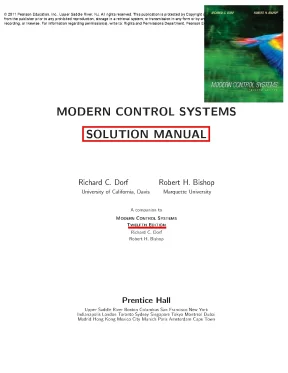
Giải pháp Bài tập Hệ thống Điều khiển Hiện đại - Dorf & Bishop (Xuất bản 2011)

Người đăng

Ẩn danh

2011

753
0
0

Phí lưu trữ

135 Point

Tóm tắt

I. Tổng quan về Modern Control Systems 12th Edition

Modern Control Systems 12th Edition là giáo trình hàng đầu về lý thuyết điều khiển tự động, do Richard C. Dorf và Robert H. Bishop biên soạn. Sách được xuất bản bởi Pearson Education, Prentice Hall vào năm 2011. Đây là ấn bản thứ mười hai, phản ánh nhiều thập kỷ phát triển và cải tiến nội dung. Cuốn sách phục vụ sinh viên kỹ thuật điện, kỹ thuật cơ khí và các ngành liên quan đến tự động hóa. Nội dung bao gồm các mô hình toán học của hệ thống, phân tích đáp ứng tần số, thiết kế bộ điều khiển và nhiều chủ đề nâng cao khác. Mỗi chương chứa năm loại bài tập: Exercises, Problems, Advanced Problems, Design Problems và Computer Problems. Tổng cộng có hơn 1000 bài tập với độ phức tạp tăng dần. Sách yêu cầu người học sử dụng MATLAB và Control System Toolbox hoặc LabVIEW với MathScript RT Module để giải bài tập máy tính. Cuốn sách đã trở thành tài liệu tham khảo chuẩn trong giảng dạy kỹ thuật điều khiển trên toàn thế giới.

1.1. Tác giả và lịch sử xuất bản

Richard C. Dorf là giáo sư danh dự tại Đại học California, Davis, nổi tiếng với các công trình nghiên cứu về hệ thống điều khiển và kỹ thuật điện tử. Robert H. Bishop là giáo sư tại Đại học Marquette, chuyên gia trong lĩnh vực điều khiển và robot. Hai tác giả đã hợp tác qua nhiều phiên bản, mỗi lần cập nhật đều bổ sung kiến thức mới phù hợp với sự phát triển công nghệ. Ấn bản thứ mười hai được phát hành năm 2011, giữ vững vị trí giáo trình tiêu chuẩn quốc tế. Pearson Education đảm bảo phân phối sách rộng rãi qua hệ thống Prentice Hall đến các trường đại học trên toàn cầu.

1.2. Cấu trúc tổng thể của sách

Sách được chia thành nhiều chương, mỗi chương tập trung vào một khía cạnh cụ thể của lý thuyết điều khiển. Phần đầu giới thiệu khái niệm cơ bản về hệ thống điều khiển và mô hình toán học. Các chương giữa trình bày phân tích trạng thái, đáp ứng tần số và độ ổn định. Phần cuối đi sâu vào thiết kế bộ điều khiển và các kỹ thuật nâng cao. Mỗi chương kết thúc bằng hệ thống bài tập phong phú với năm cấp độ khó khác nhau. Solution Manual đi kèm cung cấp lời giải chi tiết cho tất cả bài tập, hỗ trợ cả giảng viên và sinh viên trong quá trình học tập.

II. Phân tích nội dung và vấn đề cốt lõi

Modern Control Systems 12th Edition đề cập đến nhiều vấn đề cốt lõi trong kỹ thuật điều khiển tự động. Vấn đề đầu tiên là xây dựng mô hình toán học chính xác cho các hệ thống vật lý thực. Sách trình bày phương pháp sử dụng phương trình vi phân, biến đổi Laplace và biểu đồ dòng tín hiệu để mô tả hành vi hệ thống. Vấn đề thứ hai là phân tích độ ổn định. Người đọc học cách áp dụng tiêu chí Routh-Hurwitz, biểu đồ Bode và biểu đồ Nyquist để đánh giá hệ thống có ổn định hay không. Vấn đề thứ ba liên quan đến thiết kế bộ điều khiển tối ưu. Sách hướng dẫn cách chọn bộ điều khiển PID, bộ bù dẫn trước và các cấu trúc phản hồi để đạt hiệu suất mong muốn. Ngoài ra, cuốn sách còn thảo luận về điều khiển số, hệ thống phi tuyến và điều khiển trạng thái. Mỗi vấn đề được minh họa bằng ví dụ thực tế như hệ thống điều khiển hành trình ô tô, hệ thống định vị máy công cụ và hệ thống chống ồn chủ động.

2.1. Mô hình toán học của hệ thống điều khiển

Xây dựng mô hình toán học là bước nền tảng trong phân tích hệ thống điều khiển. Sách giới thiệu phương pháp sử dụng định luật Newton để lập phương trình lực cho hệ cơ, và định luật Kirchhoff cho hệ điện. Biến đổi Laplace chuyển phương trình vi phân miền thời gian sang miền tần số, giúp đơn giản hóa quá trình giải. Hàm truyền được xác định bằng tỷ số giữa biến đổi Laplace của tín hiệu đầu ra và đầu vào. Biểu đồ khối và biểu đồ dòng tín hiệu trực quan hóa luồng tín hiệu trong hệ thống. Các ví dụ như hệ thống lò xo-khối lượng-damping minh họa rõ ràng quy trình xây dựng mô hình từ vật lý thực tế.

2.2. Bài toán ổn định và đáp ứng hệ thống

Độ ổn định là yêu cầu quan trọng nhất của mọi hệ thống điều khiển. Một hệ thống ổn định khi tín hiệu đầu ra có hạn khi đầu vào có hạn. Sách trình bày tiêu chí Routh để kiểm tra ổn định từ đa thức đặc trưng mà không cần tính nghiệm. Biểu đồ Bode đánh giá biên độ và pha của hàm truyền qua tần số, xác định dải tần hoạt động và biên độ dự trữ. Biểu đồ Nyquist sử dụng đường cong đóng trong mặt phẳng phức để kiểm tra ổn định vòng hở và vòng kín. Tiêu chuẩn ổn định cận giới giúp thiết kế hệ thống có độ ổn định thỏa mãn với sai số mô hình thực tế.

III. Giải pháp và phương pháp học tập hiệu quả

Để học hiệu quả Modern Control Systems 12th Edition, sinh viên cần áp dụng phương pháp có hệ thống. Bước đầu tiên là đọc kỹ lý thuyết trong sách giáo trình và ghi chú các khái niệm chính. Bước thứ hai là giải các bài tập Exercises để nắm vững kiến thức cơ bản. Tiếp theo, chuyển sang Problems và Advanced Problems để nâng cao kỹ năng phân tích. Bước thứ tư là thực hành Design Problems, yêu cầu tư duy sáng tạo trong thiết kế hệ thống thực tế. Cuối cùng, sử dụng MATLAB hoặc LabVIEW để giải Computer Problems, kiểm chứng kết quả lý thuyết bằng mô phỏng số. Solution Manual cung cấp lời giải chi tiết cho tất cả bài tập, giúp người học tự kiểm tra và sửa lỗi. Việc kết hợp giữa lý thuyết, bài tập giấy và mô phỏng máy tính tạo nên quy trình học toàn diện. Người học nên lập nhóm thảo luận để hiểu sâu các khái niệm phức tạp. Thực hành thường xuyên với các phần mềm điều khiển giúp củng cố kiến thức và phát triển kỹ năng nghề nghiệp.

3.1. Sử dụng MATLAB và Control System Toolbox

MATLAB là công cụ không thể thiếu khi học Modern Control Systems. Control System Toolbox cung cấp các hàm chuyên dụng để xây dựng mô hình hàm truyền, không gian trạng thái. Các lệnh như tf, ss, bode, nyquist giúp vẽ đồ thị phân tích nhanh chóng. Hàm rlocus vẽ quỹ đạo nghiệm, hỗ trợ thiết kế bộ điều khiển phản hồi. Simulink cho phép mô phỏng hệ thống động với các khối chức năng kéo thả. Tất cả giải pháp máy tính trong Solution Manual được phát triển trên MATLAB 7.6 Release 2008a. Sinh viên nên cài đặt phiên bản tương thích để chạy đúng các script có sẵn trong sách.

3.2. Chiến lược giải bài tập theo cấp độ

Hệ thống bài tập trong sách được thiết kế theo năm cấp độ tăng dần. Exercises là bài tập cơ bản, củng cố công thức và khái niệm vừa học. Problems yêu cầu áp dụng nhiều bước giải quyết, phát triển tư duy logic. Advanced Problems đặt ra thách thức lớn hơn, đòi hỏi kết hợp nhiều kiến thức từ các chương khác nhau. Design Problems mô phỏng tình huống thực tế, yêu cầu sinh viên đưa ra giải pháp thiết kế cụ thể. Computer Problems bắt buộc sử dụng phần mềm mô phỏng để kiểm chứng kết quả. Sinh viên nên bắt đầu từ cấp thấp nhất và tăng dần độ khó. Giải từng bước giúp xây dựng nền tảng vững chắc trước khi tiến tới các bài phức tạp.

IV. Kết luận và ứng dụng thực tế Modern Control Systems

Modern Control Systems 12th Edition là tài liệu học thuật giá trị, kết hợp lý thuyết điều khiển cổ điển và hiện đại. Nội dung sách bao quát toàn diện từ mô hình toán học, phân tích đáp ứng, đánh giá ổn định đến thiết kế bộ điều khiển. Các ứng dụng thực tế được đề cập xuyên suốt cuốn sách. Hệ thống điều khiển hành trình ô tô là ví dụ điển hình, sử dụng bộ điều khiển để duy trì tốc độ đặt trước. Hệ thống định vị máy công cụ áp dụng phản hồi vị trí để đạt độ chính xác cao. Hệ thống chống ồn chủ động sử dụng kỹ thuật triệt tiêu nhiễu bằng tín hiệu pha ngược 180 độ. Kiến thức từ sách áp dụng rộng rãi trong công nghiệp sản xuất, hàng không vũ trụ, robotics và năng lượng tái tạo. Solution Manual đi kèm hỗ trợ giảng viên đánh giá và sinh viên tự học. Cuốn sách tiếp tục là nguồn tham khảo uy tín cho sinh viên và kỹ sư điều khiển trên toàn thế giới.

4.1. Ứng dụng trong công nghiệp và hàng không

4.2. Giá trị lâu dài của cuốn sách

Modern Control Systems đã tồn tại qua mười hai phiên bản, chứng minh giá trị bền vững của nó. Nội dung được cập nhật liên tục để phản ánh tiến bộ công nghệ mới. Ấn bản thứ mười hai tích hợp công cụ tính toán hiện đại như MATLAB và LabVIEW. Hơn 1000 bài tập cung cấp tài liệu thực hành phong phú cho nhiều thế hệ sinh viên. Solution Manual giúp giảng viên tiết kiệm thời gian chuẩn bị và đánh giá bài tập. Cuốn sách xây dựng nền tảng vững chắc cho nghiên cứu sau đại học và hoạt động nghề nghiệp. Sinh viên tốt nghiệp sử dụng kiến thức này để giải quyết vấn đề thực tế trong sự nghiệp kỹ sư. Giá trị của cuốn sách nằm ở khả năng kết hợp lý thuyết sâu sắc với ứng dụng thực tiễn.
21/04/2026

Trích đoạn nội dung tài liệu

© 2011 Pearson Education, Inc., Upper Saddle River, NJ. All rights reserved. This publication is protected by Copyright and written permission should be obtained from the publisher prior to any prohibited reproduction, storage in a retrieval system, or transmission in any form or by any means, electronic, mechanical, photocopying, recording, or likewise. For information regarding permission(s), write to: Rights and Permissions Department, Pearson Education, Inc., Upper Saddle River, NJ 07458. MODERN CONTROL SYSTEMS SOLUTION MANUAL Richard C. Bishop University of California, Davis Marquette University A companion to MODERN CONTROL SYSTEMS TWELFTH EDITION Richard C. Bishop Prentice Hall Upper Saddle River Boston Columbus San Francisco New York Indianapolis London Toronto Sydney Singapore Tokyo Montreal Dubai Madrid Hong Kong Mexico City Munich Paris Amsterdam Cape Town © 2011 Pearson Education, Inc., Upper Saddle River, NJ. All rights reserved. This publication is protected by Copyright and written permission should be obtained from the publisher prior to any prohibited reproduction, storage in a retrieval system, or transmission in any form or by any means, electronic, mechanical, photocopying, recording, or likewise. For information regarding permission(s), write to: Rights and Permissions Department, Pearson Education, Inc., Upper Saddle River, NJ 07458. P R E F A C E In each chapter, there are five problem types: Exercises Problems Advanced Problems Design Problems/Continuous Design Problem Computer Problems In total, there are over 1000 problems. The abundance of problems of in- creasing complexity gives students confidence in their problem-solving ability as they work their way from the exercises to the design and computer-based problems. It is assumed that instructors (and students) have access to MATLAB www.org and the Control System Toolbox or to LabVIEW and the MathScript RT Module. All of the computer solutions in this Solution Manual were devel- oped and tested on an Apple MacBook Pro platform using MATLAB 7.6 Release 2008a and the Control System Toolbox Version 8. It is not possible to verify each solution on all the available computer platforms that are compatible with MATLAB and LabVIEW MathScript RT Module. Please forward any incompatibilities you encounter with the scripts to Prof. Bishop at the email address given below. The authors and the staff at Prentice Hall would like to establish an open line of communication with the instructors using Modern Control Systems. We encourage you to contact Prentice Hall with comments and suggestions for this and future editions. Bishop rhbishop@marquette.edu iii © 2011 Pearson Education, Inc., Upper Saddle River, NJ. All rights reserved. This publication is protected by Copyright and written permission should be obtained from the publisher prior to any prohibited reproduction, storage in a retrieval system, or transmission in any form or by any means, electronic, mechanical, photocopying, recording, or likewise. For information regarding permission(s), write to: Rights and Permissions Department, Pearson Education, Inc., Upper Saddle River, NJ 07458. Introduction to Control Systems . Mathematical Models of Systems . State Variable Models . Feedback Control System Characteristics . The Performance of Feedback Control Systems . The Stability of Linear Feedback Systems . The Root Locus Method . Frequency Response Methods . Stability in the Frequency Domain . The Design of Feedback Control Systems . The Design of State Variable Feedback Systems . Robust Control Systems . Digital Control Systems . 714 iv © 2011 Pearson Education, Inc., Upper Saddle River, NJ. All rights reserved. This publication is protected by Copyright and written permission should be obtained from the publisher prior to any prohibited reproduction, storage in a retrieval system, or transmission in any form or by any means, electronic, mechanical, photocopying, recording, or likewise. For information regarding permission(s), write to: Rights and Permissions Department, Pearson Education, Inc., Upper Saddle River, NJ 07458. C H A P T E R 1 Introduction to Control Systems There are, in general, no unique solutions to the following exercises and problems. Other equally valid block diagrams may be submitted by the student.1 A microprocessor controlled laser system: Controller Process www.org Desired power output - Error Micro- processor Current i(t) Measurement Laser Power out Measured Power power Sensor E1.2 A driver controlled cruise control system: Controller Process Foot pedal Car and Desired Actual Driver speed - Engine auto speed Measurement Visual indication of speed Speedometer E1.3 Although the principle of conservation of momentum explains much of the process of fly-casting, there does not exist a comprehensive scientific explanation of how a fly-fisher uses the small backward and forward mo- tion of the fly rod to cast an almost weightless fly lure long distances (the 1 © 2011 Pearson Education, Inc., Upper Saddle River, NJ. All rights reserved. This publication is protected by Copyright and written permission should be obtained from the publisher prior to any prohibited reproduction, storage in a retrieval system, or transmission in any form or by any means, electronic, mechanical, photocopying, recording, or likewise. For information regarding permission(s), write to: Rights and Permissions Department, Pearson Education, Inc., Upper Saddle River, NJ 07458. 2 CHAPTER 1 Introduction to Control Systems current world-record is 236 ft). The fly lure is attached to a short invisible leader about 15-ft long, which is in turn attached to a longer and thicker Dacron line. The objective is cast the fly lure to a distant spot with dead- eye accuracy so that the thicker part of the line touches the water first and then the fly gently settles on the water just as an insect might. Wind Fly-fisher Controller disturbance Process Desired Mind and Rod, line, Actual position of - body of the and cast position of the fly the fly fly-fisher Measurement Vision of Visual indication the fly-fisher of the position of the fly E1.4 An autofocus camera control system: One-way trip time for the beam Conversion factor K1 (speed of light or sound) Beam Emitter/ Distance to subject Receiver Beam return Subject Lens focusing motor Lens © 2011 Pearson Education, Inc., Upper Saddle River, NJ. All rights reserved. This publication is protected by Copyright and written permission should be obtained from the publisher prior to any prohibited reproduction, storage in a retrieval system, or transmission in any form or by any means, electronic, mechanical, photocopying, recording, or likewise. For information regarding permission(s), write to: Rights and Permissions Department, Pearson Education, Inc., Upper Saddle River, NJ 07458.5 Tacking a sailboat as the wind shifts: Wind Controller Actuators Process Error Desired Sailor Rudder and Sailboat Actual sailboat - sail adjustment sailboat direction direction Measurement Measured sailboat direction Gyro compass E1.6 An automated highway control system merging two lanes of traffic: Controller Actuators Process Error Embedded Desired Active Actual Brakes, gas or gap - computer steering vehicle gap Measurement www.org Measured gap Radar E1.7 Using the speedometer, the driver calculates the difference between the measured speed and the desired speed. The driver throotle knob or the brakes as necessary to adjust the speed. If the current speed is not too much over the desired speed, the driver may let friction and gravity slow the motorcycle down. Controller Actuators Process Error Desired Driver Actual Throttle or Motorcycle speed - brakes motorcycle speed Measurement Visual indication of speed Speedometer © 2011 Pearson Education, Inc., Upper Saddle River, NJ. All rights reserved. This publication is protected by Copyright and written permission should be obtained from the publisher prior to any prohibited reproduction, storage in a retrieval system, or transmission in any form or by any means, electronic, mechanical, photocopying, recording, or likewise. For information regarding permission(s), write to: Rights and Permissions Department, Pearson Education, Inc., Upper Saddle River, NJ 07458. 4 CHAPTER 1 Introduction to Control Systems E1.8 Human biofeedback control system: Controller Process Message to blood vessels Desired Hypothalumus Human body Actual body - body temp temp Measurement Visual indication of body temperature TV display Body sensor E1.9 E-enabled aircraft with ground-based flight path control: Corrections to the Controller Aircraft flight path Desired Flight Flight - Gc(s) G(s) Path Path Health Meteorological Location data Parameters and speed Optimal flight path Ground-Based Computer Network Optimal flight path Location and speed Meteorological Health - data Parameters Desired Gc(s) G(s) Flight Corrections to the Flight flight path Path Path Controller Aircraft E1.10 Unmanned aerial vehicle used for crop monitoring in an autonomous mode: Trajectory Controller UAV error Specified Gc(s) G(s) Flight Flight - Trajectory Trajectory Sensor Location with Map Ground respect to the ground photo Correlation Camera Algorithm © 2011 Pearson Education, Inc., Upper Saddle River, NJ. All rights reserved. This publication is protected by Copyright and written permission should be obtained from the publisher prior to any prohibited reproduction, storage in a retrieval system, or transmission in any form or by any means, electronic, mechanical, photocopying, recording, or likewise. For information regarding permission(s), write to: Rights and Permissions Department, Pearson Education, Inc., Upper Saddle River, NJ 07458.11 An inverted pendulum control system using an optical encoder to measure the angle of the pendulum and a motor producing a control torque: Actuator Process Error Voltage Torque Desired Controller Pendulum Angle Motor angle - Measurement Measured Optical angle encoder E1.12 In the video game, the player can serve as both the controller and the sen- sor. The objective of the game might be to drive a car along a prescribed path. The player controls the car trajectory using the joystick using the visual queues from the game displayed on the computer monitor. Controller Actuator Process www.org Error Desired Player Joystick Video game Game game objective - objective Measurement Player (eyesight, tactile, etc.) © 2011 Pearson Education, Inc., Upper Saddle River, NJ. All rights reserved. This publication is protected by Copyright and written permission should be obtained from the publisher prior to any prohibited reproduction, storage in a retrieval system, or transmission in any form or by any means, electronic, mechanical, photocopying, recording, or likewise. For information regarding permission(s), write to: Rights and Permissions Department, Pearson Education, Inc., Upper Saddle River, NJ 07458. 6 CHAPTER 1 Introduction to Control Systems Problems P1.1 An automobile interior cabin temperature control system block diagram: Controller Process Error Automobile Desired Thermostat and Automobile temperature set by the - air conditioning cabin cabin temperature driver unit Measurement Measured temperature Temperature sensor P1.2 A human operator controlled valve system: Controller Process Error * Desired Fluid Tank fluid output * - Valve output Measurement Visual indication of fluid output * Meter * = operator functions P1.3 A chemical composition control block diagram: Controller Process Error Desired Chemical Mixer tube chemical composition - Valve composition Measurement Measured chemical composition Infrared analyzer © 2011 Pearson Education, Inc., Upper Saddle River, NJ. All rights reserved. This publication is protected by Copyright and written permission should be obtained from the publisher prior to any prohibited reproduction, storage in a retrieval system, or transmission in any form or by any means, electronic, mechanical, photocopying, recording, or likewise. For information regarding permission(s), write to: Rights and Permissions Department, Pearson Education, Inc., Upper Saddle River, NJ 07458.4 A nuclear reactor control block diagram: Controller Process Error Desired Motor and Reactor Output power level - amplifier and rods power level Measurement Measured chemical composition Ionization chamber P1.5 A light seeking control system to track the sun: Measurement Controller Desired Controller Process Ligh carriage Motor Dual intensity Trajectory position Error inputs Motor, Light Photocell source Photocells Planner - K carriage, carriage and gears position www.6 If you assume that increasing worker’s wages results in increased prices, then by delaying or falsifying cost-of-living data you could reduce or elim- inate the pressure to increase worker’s wages, thus stabilizing prices. This would work only if there were no other factors forcing the cost-of-living up. Government price and wage economic guidelines would take the place of additional “controllers” in the block diagram, as shown in the block diagram. Process Controller Market-based prices Initial Government Prices wages - Industry price guidelines Controller Government K1 Wage increases Cost-of-living wage guidelines © 2011 Pearson Education, Inc., Upper Saddle River, NJ. All rights reserved.

Nội dung được bảo vệ bản quyền — Tải xuống đầy đủ