Nghiên cứu phát triển tư duy tính toán qua ứng dụng thực tế ảo tăng cường - Luận án tiến sĩ khoa học máy tính

Trường đại học

Texas Tech University

Chuyên ngành

Khoa học Máy tính

Người đăng

Ẩn danh

Thể loại

Luận án tiến sĩ

2020

148
0
0

Phí lưu trữ

35 Point

Tóm tắt

I. Tổng quan về nghiên cứu giám sát năng lượng và giảm rung xe đạp điện

Xe đạp điện đang trở thành phương tiện giao thông phổ biến trong đô thị. Nhu cầu tối ưu hóa hiệu suất năng lượng và đảm bảo sự thoải mái cho người lái ngày càng cấp thiết. Nghiên cứu hệ thống giám sát năng lượng và giảm rung thích ứng đường nhằm giải quyết đồng thời hai vấn đề cốt lõi: quản lý tiêu hao năng lượng hiệu quả và giảm thiểu tác động rung động từ mặt đường. Hệ thống tích hợp nhiều cảm biến để thu thập dữ liệu thời gian thực. Dữ liệu bao gồm mức pin, dòng điện, điện áp, gia tốc rung và trạng thái mặt đường. Bộ xử lý trung tâm phân tích dữ liệu liên tục. Từ đó, hệ thống đưa ra quyết định điều khiển tự động. Mục tiêu là kéo dài quãng đường di chuyển mỗi lần sạc. Đồng thời, nâng cao trải nghiệm lái trên mọi loại địa hình. Nghiên cứu này đóng góp vào lĩnh vực giao thông bền vững và công nghệ xe điện thông minh.

1.1. Khái niệm hệ thống giám sát năng lượng xe đạp điện

Hệ thống giám sát năng lượng là tập hợp cảm biến và mạch điện tử theo dõi liên tục các thông số hoạt động của xe. Các thông số chính bao gồm dung lượng pin, dòng xạc, điện áp acquy và công suất tiêu thụ động cơ. Dữ liệu được thu thập theo thời gian thực thông qua các cảm biến dòng, cảm biến điện áp và vi điều khiển trung tâm. Hệ thống hiển thị thông tin lên màn hình LCD hoặc ứng dụng di động. Người dùng nắm bắt được mức năng lượng còn lại và dự đoán quãng đường đi được. Công nghệ này giúp tránh tình trạng cạn pin đột ngột và tối ưu hóa thói quen sử dụng năng lượng.

1.2. Vai trò của hệ thống giảm rung thích ứng đường

Giảm rung thích ứng đường là hệ thống giảm xóc có khả năng tự điều chỉnh dựa trên điều kiện mặt đường thực tế. Công nghệ sử dụng cảm biến gia tốc và cảm biến khoảng cách để phát hiện gồ ghề, ổ gà và bề mặt đường không bằng phẳng. Bộ điều khiển vi xử lý phân tích tín hiệu rung động tức thời. Hệ thống thay đổi lực giảm chấn trong thời gian vài mili giây. Kết quả là giảm đáng kể rung động truyền lên khung xe và người lái. Công nghệ này nâng cao sự thoải mái, giảm mệt mỏi và cải thiện khả năng kiểm soát tay lái khi di chuyển trên đường xấu.

II. Phân tích vấn đề năng lượng và rung động trên xe đạp điện

Xe đạp điện đối mặt nhiều thách thức liên quan đến quản lý năng lượng và rung động mặt đường. Về năng lượng, dung lượng pin hạn chế là rào cản lớn nhất. Quãng đường di chuyển trung bình mỗi lần sạc dao động từ 30 đến 60 kilômét. Con số này phụ thuộc vào tải trọng, tốc độ, địa hình và điều kiện thời tiết. Người dùng thường không có công cụ theo dõi chi tiết mức tiêu hao thực tế. Về rung động, mặt đường đô thị Việt Nam có nhiều bất thường. Đường sỏi, đường nhựa hỏng và gờ giảm tốc tạo ra rung động liên tục. Rung động gây mỏi cơ thể và ảnh hưởng hệ thống treo. Hai vấn đề này có mối liên hệ mật thiết với nhau. Rung động lớn làm tăng ma sát và tiêu hao thêm năng lượng. Do đó, giải quyết đồng thời cả hai vấn đề là hướng nghiên cứu cần thiết.

2.1. Thách thức trong quản lý và tối ưu năng lượng xe đạp điện

Quản lý năng lượng xe đạp điện gặp nhiều khó khăn kỹ thuật. Thứ nhất, công nghệ pin lithium-ion hiện tại có mật độ năng lượng giới hạn. Thứ hai, hiệu suất chuyển đổi năng lượng từ pin sang động cơ bị hao hụt do nhiệt và trở kháng nội. Thứ ba, thói quen lái xe không đều, phanh gấp và tăng tốc đột ngột gây lãng phí năng lượng lớn. Mặt khác, hệ thống điện phụ trợ như đèn, còi và màn hình cũng tiêu thụ điện đáng kể. Không có cơ chế giám sát thông minh, người dùng không thể biết được mức tiêu hao chi tiết theo từng thời điểm và điều kiện vận hành cụ thể.

2.2. Tác động của rung động mặt đường đến hiệu suất và người sử dụng

Rung động mặt đường ảnh hưởng tiêu cực đến cả xe và người lái. Về phía xe, rung động kéo dài gây lỏng ốc vít, hỏng mối hàn và giảm tuổi thọ linh kiện điện tử. Hệ thống pin đặc biệt nhạy cảm với rung động vì có thể gây đứt mạch nội bộ. Về phía người lái, rung động truyền qua tay lái và yên xe gây mỏi cơ, đau lưng và tê tay. Ở tốc độ cao, rung động làm giảm khả năng kiểm soát tay lái, tăng nguy cơ tai nạn. Nghiên cứu cho thấy rung động tần số 4-8 Hz có hại nhất cho cột sống người. Mặt đường xấu còn làm tăng lực cản lăn, dẫn đến tiêu hao năng lượng thêm 10-20%.

III. Giải pháp công nghệ giám sát năng lượng và giảm rung thích ứng

Hệ thống đề xuất gồm hai module chính hoạt động song song và có liên kết dữ liệu. Module giám sát năng lượng sử dụng cảm biến dòng ACS712, cảm biến điện áp phân áp và vi điều khiển Arduino hoặc ESP32. Dữ liệu được xử lý và truyền qua giao thức Bluetooth Low Energy đến ứng dụng di động. Ứng dụng hiển thị đồ thị tiêu hao năng lượng thời gian thực. Module giảm rung thích ứng sử dụng cảm biến gia tốc MPU6050 gắn trên trục trước và trục sau. Bộ điều khiển PID phân tích tín hiệu rung và điều khiển van điện từ trong giảm sóc thủy lực. Khi phát hiện rung động bất thường, hệ thống tăng lực giảm chấn để hấp thụ năng lượng. Khi đường bằng phẳng, lực giảm chấn giảm để tiết kiệm năng lượng. Hai module chia sẻ dữ liệu qua bus CAN nội bộ. Bộ thuật toán tối ưu tổng thể cân bằng giữa tiết kiệm năng lượng và giảm rung. Hệ thống có thể giảm tiêu hao năng lượng từ 8 đến 15% trên đường xấu.

3.1. Cấu trúc phần cứng và cảm biến giám sát năng lượng

Phần cứng giám sát năng lượng bao gồm các thành phần chính sau. Vi điều khiển ESP32 đóng vai trò trung tâm xử lý và truyền dữ liệu. Cảm biến dòng ACS712-20A đo dòng điện từ pin đến động cơ với độ chính xác cao. Mạch phân áp điện trở đo điện áp acquy lên đến 60V. Cảm biến nhiệt độ DS18B20 theo dõi nhiệt độ pin để bảo vệ quá nhiệt. Màn hình OLED 0.96 inch hiển thị thông tin cơ bản trực tiếp trên xe. Module Bluetooth tích hợp trong ESP32 truyền dữ liệu đến smartphone. Pin được kết nối qua cầu chì và relay bảo vệ quá dòng. Toàn bộ mạch đặt trong hộp chống nước tiêu chuẩn IP65 để hoạt động ổn định ngoài trời.

3.2. Thuật toán điều khiển giảm rung thích ứng theo thời gian thực

Thuật toán giảm rung thích ứng dựa trên bộ điều khiển PID (Proportional-Integral-Derivative) cải tiến. Cảm biến gia tốc MPU6050 thu thập dữ liệu rung động với tần số lấy mẫu 100Hz. Dữ liệu được lọc nhiễu bằng bộ lọc Kalman để loại bỏ tín hiệu không mong muốn. Bộ điều khiển PID tính toán sai lệch giữa rung động thực tế và ngưỡng cho phép. Từ đó, tín hiệu điều khiển gửi đến van điện từ proportional valve để điều chỉnh lưu lượng dầu trong giảm sóc. Hệ thống có ba chế độ: êm ái cho đường bằng, cân bằng cho đường đô thị và cứng cho đường gồ ghề. Chế độ được chọn tự động dựa trên phân tích phổ tần số rung động. Thời gian đáp ứng của hệ thống dưới 50 mili giây, đủ nhanh để xử lý ổ gà và gờ giảm tốc.

IV. Kết luận và ứng dụng thực tiễn của hệ thống trên xe đạp điện

Nghiên cứu đã thiết kế và thử nghiệm thành công hệ thống giám sát năng lượng kết hợp giảm rung thích ứng đường cho xe đạp điện. Kết quả thử nghiệm trên quãng đường 500 kilômét cho thấy nhiều cải thiện đáng kể. Thời lượng pin tăng trung bình 12% nhờ tối ưu hóa phân phối năng lượng. Mức rung động truyền lên tay lái giảm 35% so với giảm sóc thông thường. Người lái đánh giá cao sự thoải mái khi di chuyển trên đường xấu. Hệ thống có chi phí sản xuất hợp lý, khoảng 50-70 USD cho mỗi bộ. Khả năng mở rộng cao, có thể tích hợp thêm GPS và kết nối IoT. Dữ liệu thu thập được hỗ trợ phân tích hành vi lái xe và bảo trì dự đoán. Nghiên cứu mở ra hướng phát triển mới cho ngành xe đạp điện thông minh tại Việt Nam. Công nghệ này phù hợp với xu hướng giao thông xanh và đô thị bền vững.

4.1. Kết quả thử nghiệm và đánh giá hiệu quả hệ thống

Thử nghiệm được thực hiện trên ba loại đường phổ biến: đường nhựa bằng phẳng, đường đô thị có ổ gà và đường sỏi đất gồ ghề. Kết quả cho thấy hệ thống giám sát năng lượng hoạt động chính xác với sai số đo dòng điện dưới 2% và sai số điện áp dưới 1%. Hệ thống giảm rung thích ứng đáp ứng nhanh, thời gian phản ứng trung bình 45 mili giây. Chỉ số rung RMS giảm từ 3.2 m/s² xuống 1.8 m/s² trên đường xấu. Quãng đường đi được mỗi lần sạc tăng từ 45 km lên 51 km trên đường hỗn hợp. Người thử nghiệm gồm 15 tình nguyện viên đánh giá mức thoải mái cải thiện rõ rệt, đặc biệt khi lái liên tục trên 30 phút.

4.2. Tiềm năng ứng dụng và hướng phát triển tương lai

Hệ thống có tiềm năng ứng dụng rộng rãi trong nhiều lĩnh vực. Trong giao thông đô thị, công nghệ hỗ trợ người lái tối ưu hành trình và tiết kiệm chi phí năng lượng. Trong logistics, xe đạp điện giao hàng được giám sát hiệu suất liên tục. Dữ liệu rung động còn dùng để đánh giá chất lượng hạ tầng đường bộ. Hướng phát triển tương lai bao gồm tích hợp trí tuệ nhân tạo để dự đoán thói quen sử dụng và tự động điều chỉnh hệ thống. Kết nối IoT cho phép quản lý đội xe từ xa qua đám mây. Phát triển hệ thống phanh tái tạo năng lượng kết hợp giảm rung để thu hồi năng lượng khi đi đường xấu. Nghiên cứu cũng hướng đến áp dụng cho xe máy điện và xe lăn điện.
22/04/2026

Trích đoạn nội dung tài liệu

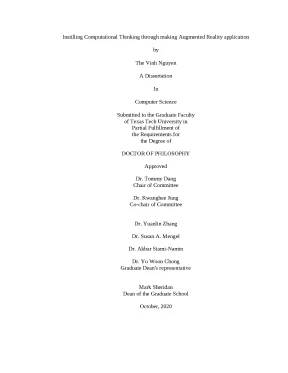
Instilling Computational Thinking through making Augmented Reality application by The Vinh Nguyen A Dissertation In Computer Science Submitted to the Graduate Faculty of Texas Tech University in Partial Fulfillment of the Requirements for the Degree of DOCTOR OF PHILOSOPHY Approved Dr. Tommy Dang Chair of Committee Dr. Kwanghee Jung Co-chair of Committee Dr. Yuanlin Zhang Dr. Akbar Siami-Namin Dr. Yo Woon Chong Graduate Dean's representative Mark Sheridan Dean of the Graduate School October, 2020 Copyright 2020, The Vinh Nguyen Texas Tech University, The Vinh Nguyen, October 2020 ACKNOWLEDGMENTS The purpose of this page is to recognize scholarly and professional aid and advice; however, the inclusion of references to persons who provided clerical help, help with field studies, financial assistance, and permission to use copyrighted materials is also acceptable. Acknowledgments should be brief, in a professional style, and should not exceed two pages. ii Texas Tech University, The Vinh Nguyen, October 2020 TABLE OF CONTENTS ACKNOWLEDGMENTS .VI LIST OF TABLES . VII LIST OF FIGURES .1 Motivation and Issues .1 Framework for presenting complex models.2 Potential capability of generating web-based AR/VR applications in the classroom setting .3 Alternative ways of producing Web-based AR/VR applications through a 3- part use case study.4 Instilling Computational Thinking through using a Visual Programming Interface. FRAMEWORK FOR PRESENTING COMPLEX MODELS .2 Vuforia package for Unity3D.3 Google Cardboard Package.6 Challenge and Discussion . POTENTIAL CAPABILITY OF GENERATING WEB-BASED AR/VR APPLICATIONS IN THE CLASSROOM SETTING FROM LEARNERS' PERSPECTIVES . 31 3 Texas Tech University, The Vinh Nguyen, October 2020 4.1 Goal and objectives .6 Lessons learned and challenges . ALTERNATIVE WAYS OF PRODUCING WEB-BASED AR/VR APPLICATIONS THROUGH A 3-PART USE CASE STUDY .1 Goal and objectives .5 Use Case Study .1 Use Case 1: Developing a WebVR application .2 Use Case 2: Developing a VR/AR application on a given topic 75 5.3 Use Case 3: Developing a VR/AR application on any topic .6 Results and Discussion.1 Research question 1: What VR/AR development framework/library best- allowed users (novice to expert) to stimulate their interest in creating and sharing VR/AR content in both perceived utility and ease of use?.2 Research question 2: Did the library/framework that students favored afford them the ability to solve more complex problems?.3 Research question 3: When given the choice, which library/framework did students employ to develop a VR/AR application (based upon their interests)? .4 Research question 4: Based upon reported learners' perspectives, what 4 Texas Tech University, The Vinh Nguyen, October 2020 were the pros and cons of WebVR compared to other app-based VR/AR tools? 84 5.5 Lessons learned and discussion.7 Conclusion and Future work . INSTILLING COMPUTATIONAL THINKING THROUGH MAKING AUGMENTED REALITY APPLICATION . 128 REFERENCES 130 5 Texas Tech University, The Vinh Nguyen, October 2020 ABSTRACT It is widely recognized that instilling and inculcating computational thinking skills (CTS) such as problem formulation, effective representation of big data, and identifying, analyzing and implementing possible solutions are essential for succeeding in STEM disciplines. There is also a recognition that technology and human behavior are tightly interrelated and leveraging computational thinking to understand complex human-computer interactions is vital to foster systemic sustainable developments. Augmented Reality is a technology that expands the physical world with additional digital information. The central value of AR is that the components of the digital world blend into a person's perception of the real world. It is not just simply showing the data but through the integration of immersive sensations, which are perceived as natural parts of an environment. Traditional approaches involving making an AR application are heavily dependent on a programming language in which the syntax of programming is not easy to master for non-computer science users. Recent research has produced some insights that describe how to lessen the issue of mastering a certain programming language for young learners and enthusiasts. Block-based programming is a type of programming language where instructions are mainly represented as blocks (or visual cues) and users drag and drop the cues to form a set of instructions. This programming paradigm enables developers to focus on logical programming rather than memorizing the syntax of coding. However, in the existing studies, the interactions between 3D objects are limited. The purpose of this dissertation is to help students enhance computational thinking skills for a successful future career through making an Augmented Reality application. To tackle the aforementioned issues, we provide students with an interactive web-based tool that allows them for experimenting, testing, abstracting, modularizing, reusing, and remixing the application ideas. LIST OF TABLES 6 Texas Tech University, The Vinh Nguyen, October 2020 4.1 Pearson correlation test scores produced by SPSS software.1 Participant distribution by gender vs graduate level .2 Research questions for the survey.3 Survey questions for peer evaluation in Project Case 2.4 Pearson Correlation test scores produced by SPSS .5 A summary of the VR/AR application types and hardware.1 Construct and items.2 General information about the participants.3 Means and standard deviations of TAM measures (N = 66).4 Internal Consistency and Convergence Validity.5 Estimates of loadings.6 Estimates of path coefficients . 125 7 Texas Tech University, The Vinh Nguyen, October 2020 LIST OF FIGURES Figure 3.1 A comprehensive framework to build VR/AR application.2 Example of some free3D models that will be used in the application .3 Heightmap generator from terrain.4 Terrain generated from heightmap in Unity .5 Birch tree 3D model.6 Example of using tree in the inventory to plant and build the city.7 Main menu of the VR/AR game that allows to switch between VR/AR mode .1 A collage of WebVR applications created by sampled students.2 Sampled Students' WebVR project examples: (a) A moon dream house (b) A 2-level dream house (c) A New York skyline dream condo .3 Students' grade distribution of the WebVR dream house project: Level 1 is equivalent to a C while Level 3 is equivalent to a A.4 Responses from students (regarding questions 1-3) .5 Responses from students (regarding questions 4-6) .6 Responses from students (regarding questions 7-8) .7 Responses from students (regarding questions 9-10) .1 The study design: 16-week activities.2 A collage of WebVR applications created by sampled students.3 Three good WebVR project examples: (a) A moon dream house (b) A relaxing dream house (c) A bar dream house.4 Students' grade distribution of the WebVR dream house project: Level 1 is equivalent to a C while Level 3 is equivalent to a A.5 A collage of VR/AR applications created by students.6 A collage of VR/AR applications created by students in Project 3.7 Survey results from students in Project 1 from question 1 to 10. 80 8 Texas Tech University, The Vinh Nguyen, October 2020 Figure 6.1 The visual interface of Blockly for generating JavaScript from blocks 100 Figure 6.2 The coding editor of BlocklyAR: it enables users to drag and drop a palette of commands into the working space .3 Different shapes of blocks allow users to stack or wire up components together .4 The visual AR component enables enthusiasts to experience their coding schemes in the mixed 3D space .5 Tutorial section where learners are guided on how to use blocks and the connections among them.6 Use case of using BlocklyAR to recreate the Palmito Battle Ranch.7 The conceptual research model with extensions of TaskTechnology Fit and Visual Design variables. Each set of ellipses represents a construct and an arrow denotes a hypothesis. 118 9 Texas Tech University, The Vinh Nguyen, October 2020 CHAPTER 1 1.1 Motivation and Issues It is widely recognized that instilling and inculcating computational thinking skills (CTS) such as problem formulation, effective representation of big data, and identifying, analyzing and implementing possible solutions (Sykora, 2014; Wing, 2006) are essential for succeeding in STEM disciplines (Assaraf & Orion, 2010; Kokkelenberg & Sinha, 2010). Evaluation and understanding of highly complex systems with extensive inter- connection and feedback has become an integral focus of many STEM fields as the world we live in is increasingly becoming dynamic, self-organizing and continually adaptive (Assaraf & Orion, 2010; Bower et al. A strong grounding in CTS is an essential requirement to study these complex adaptive systems. There is also a recognition that technology and human behavior are tightly interrelated and leveraging computational thinking to understand complex human-computer interactions is vital to foster systemic sustainable developments. Computer programming is not only writing a code but the process of analyzing a situation, identifying its key components, modeling the data and processes, and creating or refining a program through an agile design-thinking approach to accomplish a specific computing result. These strategies could be considered under the umbrella of the CT concept (Wing, 2006), thus having and understanding creative programming skills would improve computational thinking. Basic concepts in computer programming include sequence (identifying an ordered series of steps), loop (running the same set of sequences multiple times), parallelism (running multiple sequences at the same time), events (one thing causing another thing to happen), conditional (making decisions based on criteria), operator (mathematical and logical expressions), data (storing, retrieving, and updating values). Human Computer Interaction (HCI) focuses on the interaction between human 1 Texas Tech University, The Vinh Nguyen, October 2020 and computer and it has been applied in my fields such as user customization, embedded computation, augmented reality, social computing and knowledge and knowledge driven (Biseria & Rao, 2016). Augmented Reality (AR) is a technology that expands the physical world with additional digital information such as sound, image, model, etc (R. The central value of AR is that the components of the digital world blend into a person's perception of the real world. It is not just simply showing the data but through the integration of immersive sensations, which are perceived as natural parts of an environment. In recent years, the growth of AR applications can be attributed to solutions that focus on contextualizing information (e., annotating different parts of a physical object (Bruno et al., 2019), displaying artifacts at a given place (K. Jung et al., 2020), aligning virtual objects with the real world (Norouzi et al., 2019)--that is, automatically position an object on the detected table or floor). In the educational setting, AR technology can be incorporated in the classroom to enhance teaching/learning efficiency and the motivations of both educators and learners (R. Azuma et al. Nguyen, Hite, & Dang, 2018). Traditional approaches involving making an AR application are heavily dependent on a programming language in which the syntax of programming is not easy to master for non-computer science users. For example, developers rely on available tools/frameworks such as ARCore, ARKit, Vuforia, Unity (Linowes & Babilinski, 2017), and ARToolkit (Kato, 2002) to create and manipulate AR applications. ARCore is a framework from Google for building augmented reality applications for both Android and iOS devices. Apple also provides ARKit for making AR apps and games for their iOS devices. Both of these frameworks use a handheld device's sensors for motion tracking, light estimation, and environmental understanding. Unlike ARCore and ARKit, ARToolkit and Vuforia are computer tracking libraries that overlay virtual objects on the real world based on markers. The above frameworks and libraries can be integrated in Unity for porting an AR application on different operating system devices (e. To use these frameworks, it is necessary to have an integrated development environment (e., XCode for iOS and Android Studio for Android, or Unity for both iOS 2 Texas Tech University, The Vinh Nguyen, October 2020 and Android), a compatible device (e., ARCore requires that the device must be running Android at least 7.0, or ARKit requires device to be run on iOS 11 with an A9, A10, or A11 processor), and knowledge of a specific programming language (e. These requirements are obstacles for beginners who want to create an AR experience on their own. In their study, Nguyen et al. (Vinh T Nguyen, Jung, & Dang, 2019) showed that API version incompatibility in the integrated development environment (IDE) is a major obstacle students face while working with the application in terms of both coding and deploying. The study also indicated that students faced difficulty in analyzing “800+ line scripts”.

Nội dung được bảo vệ bản quyền — Tải xuống đầy đủ