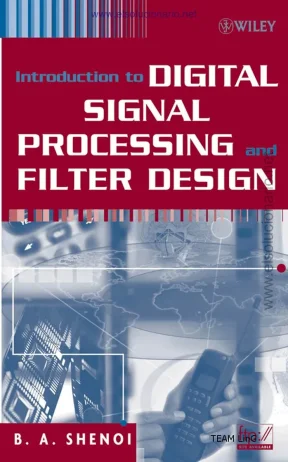
Sách: Giới thiệu xử lý tín hiệu số và thiết kế bộ lọc - A. J. Shenoi

Chuyên ngành

Xử lý tín hiệu số

Người đăng

Ẩn danh

Thể loại

Giáo trình

2006

441
0
0

Phí lưu trữ

75 Point

Tóm tắt

I. Tổng quan về Introduction to Digital Signal Processing and Filter Design 2006

Cuốn sách "Introduction to Digital Signal Processing and Filter Design" của tác giả B.A. Shenoi được xuất bản năm 2006 bởi nhà xuất bản John Wiley & Sons. Đây là tài liệu học thuật quan trọng trong lĩnh vực xử lý tín hiệu số và thiết kế bộ lọc. Sách cung cấp nền tảng vững chắc về lý thuyết và ứng dụng của xử lý tín hiệu số. Nội dung bao gồm các khái niệm cơ bản về tín hiệu thời gian rời rạc, hàm xung đơn vị, hàm bước đơn vị. Ngoài ra, sách trình bày lịch sử phát triển của thiết kế bộ lọc. Tác giả Shenoi đã xây dựng nội dung theo hướng từ cơ bản đến nâng cao. Phương pháp tiếp cận giúp người đọc dễ dàng tiếp cận kiến thức phức tạp. Cuốn sách phù hợp cho sinh viên kỹ thuật điện tử và nghiên cứu sinh. Ấn phẩm năm 2006 này vẫn được sử dụng rộng rãi trong đào tạo đại học. Nội dung sách kết hợp lý thuyết với ví dụ thực tế minh họa.

1.1. Giới thiệu về tác giả B.A. Shenoi và bối cảnh xuất bản

B.A. Shenoi là chuyên gia hàng đầu trong lĩnh vực xử lý tín hiệu số. Tác giả có nhiều năm kinh nghiệm giảng dạy và nghiên cứu tại các trường đại học danh tiếng. Cuốn sách được xuất bản năm 2006 bởi John Wiley & Sons, một trong những nhà xuất bản uy tín về sách kỹ thuật. Ấn phẩm thuộc bộ sưu tập sách học thuật chất lượng cao. ISBN-13 là 978-0-471-46482-2 và ISBN-10 là 0-471-46482-1. Sách được in tại Hoa Kỳ với tiêu chuẩn chất lượng cao. Nội dung được biên soạn dựa trên nhiều năm giảng dạy của tác giả. Cuốn sách đã trở thành tài liệu tham khảo chính trong nhiều chương trình đào tạo kỹ thuật.

1.2. Cấu trúc tổng thể và phạm vi nội dung sách

Cuốn sách được tổ chức thành nhiều chương logic, bắt đầu từ giới thiệu chung. Chương 1 trình bày tổng quan về xử lý tín hiệu số và các ứng dụng thực tế. Nội dung bao gồm mô hình hóa tín hiệu thời gian rời rạc và các tính chất cơ bản. Sách giới thiệu hàm xung đơn vị, hàm bước đơn vị, hàm mũ thực và hàm mũ phức. Chương tiếp theo phân tích miền thời gian của các hệ thống xử lý tín hiệu. Phạm vi mở rộng đến thiết kế bộ lọc số với nhiều phương pháp khác nhau. Mỗi chương đều có phần bài tập và tài liệu tham khảo. Cấu trúc này đảm bảo người học tiến bộ từ cơ bản đến nâng cao một cách có hệ thống.

II. Phân tích tín hiệu thời gian rời rạc và các hàm cơ bản trong DSP

Tín hiệu thời gian rời rạc là nền tảng của xử lý tín hiệu số. Chúng được biểu diễn dưới dạng chuỗi các mẫu có giá trị tại các thời điểm rời rạc. Hàm xung đơn vị δ(n) có giá trị bằng 1 tại n=0 và bằng 0 tại mọi thời điểm khác. Hàm này đóng vai trò quan trọng trong phân tích hệ thống tuyến tính. Hàm bước đơn vị u(n) có giá trị bằng 1 cho n≥0 và bằng 0 cho n<0. Hàm mũ thực và hàm mũ phức là các hàm cơ bản khác trong DSP. Các hàm này có tính chất đặc biệt hữu ích cho phân tích tín hiệu. Hàm cos(ω₀n) thể hiện tính chất tuần hoàn quan trọng. Việc hiểu rõ các hàm cơ bản là điều kiện tiên quyết để học nâng cao. Cuốn sách của Shenoi trình bày các khái niệm này một cách chi tiết và dễ hiểu.

2.1. Hàm xung đơn vị và vai trò trong xử lý tín hiệu số

Hàm xung đơn vị δ(n) được định nghĩa với giá trị 1 tại n=0 và 0 tại các thời điểm khác. Hàm này còn được gọi là hàm mẫu đơn vị hoặc hàm xung lực đơn vị. Khi hàm xung đơn vị bị trễ k mẫu, ta được δ(n-k). Giá trị hữu hạn của δ(n) khác biệt hoàn toàn so với hàm xung lực liên tục δ(t). Hàm δ(n) là công cụ cơ bản để phân tích đáp ứng xung của hệ thống. Mọi tín hiệu rời rạc đều có thể biểu diễn dưới dạng tổng có trọng số của các hàm xung đơn vị. Tính chất này cho phép phân tích hệ thống tuyến tính một cách có hệ thống. Hàm xung đơn vị là khối xây dựng cơ bản trong lý thuyết xử lý tín hiệu số.

2.2. Hàm bước đơn vị và hàm mũ trong tín hiệu rời rạc

Hàm bước đơn vị u(n) được định nghĩa bằng 1 khi n≥0 và bằng 0 khi n<0. Hàm này hữu ích để mô tả tín hiệu bắt đầu tại một thời điểm cụ thể. Hàm mũ thực có dạng a^n, trong đó a là hằng số thực. Hàm mũ phức có dạng e^(jωn), kết hợp phần thực và phần ảo. Các hàm mũ phức liên quan mật thiết đến biến đổi Fourier. Tính chất của hàm cos(ω₀n) được phân tích chi tiết trong cuốn sách. Hàm cos có tính tuần hoàn với chu kỳ 2π/ω₀. Các hàm này tạo thành cơ sở toán học cho toàn bộ lý thuyết xử lý tín hiệu số hiện đại.

III. Phương pháp thiết kế bộ lọc số và phân tích hệ thống tuyến tính

Thiết kế bộ lọc số là mục tiêu chính của xử lý tín hiệu số. Cuốn sách trình bày nhiều phương pháp thiết kế bộ lọc từ đơn giản đến phức tạp. Hệ thống tuyến tính phải thỏa mãn tính chất đồng nhất và tính chất chồng chập. Tính chất đồng nhất yêu cầu đầu vào Kx(n) tạo ra đầu ra Ky(n). Tính chất chồng chập phát biểu rằng tổng đầu vào tạo ra tổng đầu ra tương ứng. Hệ thống bất biến thời gian có đặc điểm đầu ra trễ M mẫu khi đầu vào trễ M mẫu. Các tính chất này cho phép sử dụng biến đổi Z để phân tích hệ thống. Đa thức trong z⁻¹ là công cụ toán học quan trọng để biểu diễn hàm truyền. Thiết kế bộ lọc bao gồm bộ lọc thông thấp, thông cao, thông dải và loại dải. Phương pháp thiết kế sử dụng các kỹ thuật như phương pháp cửa sổ và biến đổi song song.

3.1. Tính chất hệ thống tuyến tính và bất biến thời gian

Hệ thống tuyến tính thỏa mãn hai điều kiện cơ bản: tính đồng nhất và tính chồng chập. Tính đồng nhất phát biểu rằng nếu đầu vào nhân với hằng số K thì đầu ra cũng nhân với K. Tính chồng chập yêu cầu tổng các đầu vào riêng lẻ tạo ra tổng các đầu ra tương ứng. Hệ thống bất biến thời gian có đáp ứng không phụ thuộc vào thời điểm bắt đầu. Nếu đầu vào x(n) cho đầu ra y(n), thì đầu vào x(n-M) cho đầu ra y(n-M). Các tính chất này là nền tảng để áp dụng biến đổi Z và biến đổi Fourier. Hệ thống tuyến tính bất biến thời gian được đặc trưng hoàn toàn bởi đáp ứng xung. Đáp ứng xung này xác định hành vi của hệ thống với mọi đầu vào.

3.2. Kỹ thuật thiết kế bộ lọc và biểu diễn hàm truyền

Hàm truyền của hệ thống được biểu diễn dưới dạng tỷ số đa thức trong z⁻¹. Tử số thể hiện các phần tử đầu vào còn mẫu số thể hiện các phần tử hồi tiếp. Bộ lọc FIR có hàm truyền chỉ chứa các phần tử tử số. Bộ lọc IIR chứa cả phần tử tử số và mẫu số. Thiết kế bộ lọc thông thấp là bước cơ bản trước khi thiết kế các loại khác. Phương pháp biến đổi tần số双 tuyến cho phép chuyển đổi bộ lọc tương tự sang số. Cuốn sách trình bày chi tiết từng bước trong quy trình thiết kế. Bài tập cuối chương giúp củng cố kiến thức thực hành thiết kế bộ lọc.

IV. Kết luận và ứng dụng thực tiễn của cuốn sách DSP Shenoi 2006

Cuốn sách "Introduction to Digital Signal Processing and Filter Design" là tài liệu giá trị cho lĩnh vực DSP. Nội dung bao quát từ lý thuyết cơ bản đến kỹ thuật thiết kế nâng cao. Ứng dụng của xử lý tín hiệu số rất đa dạng trong đời sống hiện đại. Hệ thống mạng điện thoại di động sử dụng nhiều kỹ thuật xử lý tín hiệu số. Các ứng dụng bao gồm xử lý âm thanh, hình ảnh, truyền thông và điều khiển. Cuốn sách cung cấp kiến thức nền tảng để hiểu và phát triển các ứng dụng này. Phương pháp trình bày của Shenoi giúp người học xây dựng tư duy hệ thống. Bài tập thực hành trong sách rèn luyện kỹ năng giải quyết vấn đề thực tế. Ấn phẩm năm 2006 vẫn giữ nguyên giá trị trong thời đại công nghệ phát triển. Cuốn sách là khoản đầu tư tri thức lâu dài cho sinh viên kỹ thuật điện tử.

4.1. Ứng dụng xử lý tín hiệu số trong thực tế hiện đại

Xử lý tín hiệu số có mặt trong hầu hết thiết bị điện tử hiện đại. Điện thoại di động sử dụng DSP để mã hóa, giải mã và lọc nhiễu tín hiệu. Hệ thống âm thanh áp dụng kỹ thuật lọc để cải thiện chất lượng âm thanh. Xử lý hình ảnh y tế sử dụng biến đổi Fourier để phân tích ảnh MRI. Radar và sonar áp dụng các kỹ thuật xử lý tín hiệu phức tạp. Hệ thống điều khiển tự động sử dụng bộ lọc số để ổn định hoạt động. Truyền thông kỹ thuật số phụ thuộc vào xử lý tín hiệu để tối ưu băng thông. Các ứng dụng trí tuệ nhân tạo cũng sử dụng kỹ thuật DSP trong tiền xử lý dữ liệu. Kiến thức từ cuốn sách của Shenoi là nền tảng cho tất cả ứng dụng này.

4.2. Giá trị học thuật và thực tiễn của cuốn sách năm 2006

Cuốn sách của Shenoi có giá trị học thuật cao nhờ cấu trúc logic và nội dung toàn diện. Phương pháp tiếp cận từ cơ bản đến nâng cao phù hợp cho tự học. Nội dung vẫn còn liên quan vì các nguyên lý DSP không thay đổi theo thời gian. Sách được sử dụng làm tài liệu giảng dạy tại nhiều trường đại học trên thế giới. Phần bài tập phong phú giúp sinh viên kiểm tra kiến thức và phát triển kỹ năng. Tài liệu tham khảo cuối mỗi chương mở rộng khả năng nghiên cứu sâu hơn. Cuốn sách là cầu nối giữa lý thuyết toán học và ứng dụng kỹ thuật thực tế. Giá trị của ấn phẩm nằm ở cách tác giả giải thích khái niệm phức tạp một cách đơn giản. Đây là cuốn sách không thể thiếu cho bất kỳ ai theo đuổi lĩnh vực xử lý tín hiệu số.
21/04/2026

Trích đoạn nội dung tài liệu

net TEAM LinG www.net INTRODUCTION TO DIGITAL SIGNAL PROCESSING AND FILTER DESIGN www.net INTRODUCTION TO DIGITAL SIGNAL PROCESSING AND FILTER DESIGN www. Shenoi A JOHN WILEY & SONS, INC.net Copyright © 2006 by John Wiley & Sons, Inc. All rights reserved. Published by John Wiley & Sons, Inc., Hoboken, New Jersey. Published simultaneously in Canada.net No part of this publication may be reproduced, stored in a retrieval system, or transmitted in any form or by any means, electronic, mechanical, photocopying, recording, scanning, or otherwise, except as permitted under Section 107 or 108 of the 1976 United States Copyright Act, without either the prior written permission of the Publisher, or authorization through payment of the appropriate per-copy fee to the Copyright Clearance Center, Inc., 222 Rosewood Drive, Danvers, MA 01923, (978) 750-8400, fax (978) 750-4470, or on the web at www. Requests to the Publisher for permission should be addressed to the Permissions Department, John Wiley & Sons, Inc., 111 River Street, Hoboken, NJ 07030, (201) 748-6011, fax (201) 748-6008, or online at http://www.com/go/permission. Limit of Liability/Disclaimer of Warranty: While the publisher and author have used their best efforts in preparing this book, they make no representations or warranties with respect to the accuracy or completeness of the contents of this book and specifically disclaim any implied warranties of merchantability or fitness for a particular purpose. No warranty may be created or extended by sales representatives or written sales materials. The advice and strategies contained herein may not be suitable for your situation. You should consult with a professional where appropriate. Neither the publisher nor author shall be liable for any loss of profit or any other commercial damages, including but not limited to special, incidental, consequential, or other damages. For general information on our other products and services or for technical support, please contact our Customer Care Department within the United States at (800) 762-2974, outside the United States at (317) 572-3993 or fax (317) 572-4002. Wiley also publishes its books in a variety of electronic formats. Some content that appears in print may not be available in electronic formats. For more information about Wiley products, visit our web site at www. Library of Congress Cataloging-in-Publication Data: ISBN-13 978-0-471-46482-2 (cloth) ISBN-10 0-471- 46482-1 (cloth) Printed in the United States of America.net CONTENTS Preface xi 1 Introduction 1 1.2 Applications of DSP 1 www.3 Discrete-Time Signals 3 1.1 Modeling and Properties of Discrete-Time Signals 8 1.2 Unit Pulse Function 9 1.4 Unit Step Function 10 1.5 Real Exponential Function 12 1.6 Complex Exponential Function 12 1.7 Properties of cos(ω0 n) 14 1.4 History of Filter Design 19 1.5 Analog and Digital Signal Processing 23 1.1 Operation of a Mobile Phone Network 25 1.6 Summary 28 Problems 29 References 30 2 Time-Domain Analysis and z Transform 32 2.1 A Linear, Time-Invariant System 32 2.1 Models of the Discrete-Time System 33 2.2 Zero Input and Zero State Response 49 v www.net vi CONTENTS 2.3 Linearity of the System 50 2.4 Time-Invariant System 50 2.3 Using z Transform to Solve Difference Equations 51 2.1 More Applications of z Transform 56 2.2 Natural Response and Forced Response 58 2.4 Solving Difference Equations Using the Classical Method 59 2.1 Transient Response and Steady-State Response 63 2.5 z Transform Method Revisited 64 2.7 A Model from Other Models 70 2.1 Review of Model Generation 72 www.1 Jury–Marden Test 78 2.9 Solution Using MATLAB Functions 81 2.10 Summary 93 Problems 94 References 110 3 Frequency-Domain Analysis 112 3.2 Theory of Sampling 113 3.1 Sampling of Bandpass Signals 120 3.3 DTFT and IDTFT 122 3.1 Time-Domain Analysis of Noncausal Inputs 125 3.2 Time-Shifting Property 127 3.3 Frequency-Shifting Property 127 3.4 Time Reversal Property 128 3.4 DTFT of Unit Step Sequence 138 3.5 Use of MATLAB to Compute DTFT 147 3.6 DTFS and DFT 154 3.net CONTENTS vii 3.2 Discrete-Time Fourier Series 156 3.3 Discrete Fourier Transform 159 3.4 Reconstruction of DTFT from DFT 160 3.5 Properties of DTFS and DFT 161 3.7 Fast Fourier Transform 170 3.8 Use of MATLAB to Compute DFT and IDFT 172 3.9 Summary 177 Problems 178 References 185 4 Infinite Impulse Response Filters 186 4.2 Magnitude Approximation of Analog Filters 189 4.1 Maximally Flat and Butterworth Approximation 191 4.2 Design Theory of Butterworth Lowpass Filters 194 4.4 Properties of Chebyshev Polynomials 202 4.5 Design Theory of Chebyshev I Lowpass Filters 204 4.6 Chebyshev II Approximation 208 4.7 Design of Chebyshev II Lowpass Filters 210 4.8 Elliptic Function Approximation 212 4.3 Analog Frequency Transformations 212 4.5 Impulse-Invariant Transformation 219 4.7 Digital Spectral Transformation 226 4.9 IIR Filter Design Using MATLAB 231 4.10 Yule–Walker Approximation 238 4.11 Summary 240 Problems 240 References 247 www.net viii CONTENTS 5 Finite Impulse Response Filters 249 5.2 Linear Phase Fir Filters 251 5.1 Properties of Linear Phase FIR Filters 256 5.3 Fourier Series Method Modified by Windows 261 5.2 Use of Window Functions 266 5.3 FIR Filter Design Procedures 268 5.4 Design of Windowed FIR Filters Using MATLAB 273 5.1 Estimation of Filter Order 273 5.2 Design of the FIR Filter 275 www.5 Equiripple Linear Phase FIR Filters 280 5.6 Design of Equiripple FIR Filters Using MATLAB 285 5.1 Use of MATLAB Program to Design Equiripple FIR Filters 285 5.7 Frequency Sampling Method 289 5.8 Summary 292 Problems 294 References 301 6 Filter Realizations 303 6.2 FIR Filter Realizations 305 6.1 Lattice Structure for FIR Filters 309 6.2 Linear Phase FIR Filter Realizations 310 6.3 IIR Filter Realizations 312 6.4 Allpass Filters in Parallel 320 6.2 Lattice–Ladder Realization 326 6.5 Realization of FIR and IIR Filters Using MATLAB 327 6.1 MATLAB Program Used to Find Allpass Filters in Parallel 334 6.net CONTENTS ix Problems 347 References 353 7 Quantized Filter Analysis 354 7.2 Filter Design–Analysis Tool 355 7.3 Quantized Filter Analysis 360 7.4 Binary Numbers and Arithmetic 360 7.5 Quantization Analysis of IIR Filters 367 7.6 Quantization Analysis of FIR Filters 375 7.net Problems 379 References 379 8 Hardware Design Using DSP Chips 381 8.2 Simulink and Real-Time Workshop 381 8.5 Code Composer Studio 386 8.6 Simulator and Emulator 388 8.1 Embedded Target with Real-Time Workshop 389 8.7 Conclusion 389 References 390 9 MATLAB Primer 391 9.1 Vectors, Arrays, and Matrices 392 9.6 Numerical Format 401 www.8 Edit Window and M-file 403 9.2 Signal Processing Toolbox 405 9.1 List of Functions in Signal Processing Toolbox 406 References 414 Index 415 www.net PREFACE This preface is addressed to instructors as well as students at the junior–senior level for the following reasons. I have been teaching courses on digital signal processing, including its applications and digital filter design, at the undergraduate and the graduate levels for more than 25 years. One common complaint I have heard from undergraduate students in recent years is that there are not enough numerical problems worked out in the chapters of the book prescribed for the www. But some of the very well known textbooks on digital signal processing have more problems than do a few of the books published in earlier years. However, these books are written for students in the senior and graduate levels, and hence the junior-level students find that there is too much of mathematical theory in these books. They also have concerns about the advanced level of problems found at the end of chapters. I have not found a textbook on digital signal processing that meets these complaints and concerns from junior-level students. So here is a book that I have written to meet the junior students’ needs and written with a student-oriented approach, based on many years of teaching courses at the junior level. Network Analysis is an undergraduate textbook authored by my Ph. thesis advisor Professor M. Van Valkenburg (published by Prentice-Hall in 1964), which became a world-famous classic, not because it contained an abundance of all topics in network analysis discussed with the rigor and beauty of mathematical theory, but because it helped the students understand the basic ideas in their sim- plest form when they took the first course on network analysis. I have been highly influenced by that book, while writing this textbook for the first course on digital signal processing that the students take. But I also have had to remember that the generation of undergraduate students is different; the curriculum and the topic of digital signal processing is also different. This textbook does not contain many of the topics that are found in the senior–graduate-level textbooks mentioned above. One of its main features is that it uses a very large number of numerical problems as well as problems using functions from MATLAB® (MATLAB is a registered trademark of The MathWorks, Inc.) and Signal Processing Toolbox, worked out in every chapter, in order to highlight the fundamental concepts. These prob- lems are solved as examples after the theory is discussed or are worked out first and the theory is then presented. Either way, the thrust of the approach is that the students should understand the basic ideas, using the worked, out problems as an instrument to achieve that goal. In some cases, the presentation is more informal than in other cases. The students will find statements beginning with “Note that.,” or “It is pointed out,” and so on; they are meant xi www.net xii PREFACE to emphasize the important concepts and the results stated in those sentences. Many of the important results are mentioned more than once or summarized in order to emphasize their significance. The other attractive feature of this book is that all the problems given at the end of the chapters are problems that can be solved by using only the material discussed in the chapters, so that students would feel confident that they have an understanding of the material covered in the course when they succeed in solving the problems. Because of such considerations mentioned above, the author claims that the book is written with a student-oriented approach. Yet, the students should know that the ability to understand the solution to the problems is important but understanding the theory behind them is far more important. The following paragraphs are addressed to the instructors teaching a junior- level course on digital signal processing. The first seven chapters cover well- defined topics: (1) an introduction, (2) time-domain analysis and z-transform, (3) frequency-domain analysis, (4) infinite impulse response filters, (5) finite www.net impulse response filters, (6) realization of structures, and (7) quantization filter analysis. Chapter 8 discusses hardware design, and Chapter 9 covers MATLAB. The book treats the mainstream topics in digital signal processing with a well- defined focus on the fundamental concepts. Most of the senior–graduate-level textbooks treat the theory of finite wordlength in great detail, but the students get no help in analyzing the effect of finite word- length on the frequency response of a filter or designing a filter that meets a set of frequency response specifications with a given wordlength and quantization format. In Chapter 7, we discuss the use of a MATLAB tool known as the “FDA Tool” to thoroughly investigate the effect of finite wordlength and different formats of quantization. This is another attractive feature of the textbook, and the material included in this chapter is not found in any other textbook published so far. When the students have taken a course on digital signal processing, and join an industry that designs digital signal processing (DSP) systems using commercially available DSP chips, they have very little guidance on what they need to learn. It is with that concern that additional material in Chapter 8 has been added, leading them to the material that they have to learn in order to succeed in their professional development. It is very brief but important material presented to guide them in the right direction. The textbooks that are written on DSP hardly provide any guidance on this matter, although there are quite a few books on the hardware implementation of digital systems using commercially available DSP chips.

Nội dung được bảo vệ bản quyền — Tải xuống đầy đủ