Groundwater Modeling: Protocols and Numerical Methods - G. Oude Essink, Utrecht University

Mô hình hóa nước ngầm là phương pháp số hóa quá trình vận động, phân bố và chất lượng nước dưới lòng đất. Bài viết phân tích các phương pháp, phần mềm và ứng

Trường đại học

Utrecht University

Chuyên ngành

Thủy văn

Người đăng

Ẩn danh

Thể loại

Bài giảng

2000

201
0
0

Phí lưu trữ

55 Point

Tóm tắt

I. Tổng quan về mô hình hóa nước dưới đất

Mô hình hóa nước dưới đất (groundwater modeling) là quá trình sử dụng các mô hình toán học để mô phỏng và dự báo hành vi của nước trong các tầng chứa nước. Sự phát triển của lĩnh vực này gắn liền với bước đột phá trong công nghệ tính toán. Máy tính kỹ thuật số có khả năng lưu trữ, xử lý dữ liệu và thực hiện các phép tính phức tạp vượt xa năng lực vật lý của con người. Mô hình hóa giúp tích hợp lý thuyết hiện có với dữ liệu đo đạc thực tế. Quá trình xây dựng mô hình bao gồm nhiều bước: xác định mục đích, khái niệm hóa mô hình toán học, lựa chọn mã tính toán, chọn tham số và ứng suất thủy văn. Mỗi bước đòi hỏi sự hiểu biết sâu về hệ thống thủy văn nghiên cứu. Các mô hình được phân loại dựa trên thiết kế (một chiều, hai chiều, ba chiều), dựa trên quy trình trong chu trình thủy văn (dòng chảy, vận chuyển chất tan, vận chuyển nhiệt), và dựa trên ứng dụng thực tế. Sự kết hợp giữa lý thuyết vững chắc và dữ liệu chất lượng cao là yếu tố then chốt để xây dựng mô hình đáng tin cậy.

1.1. Lịch sử phát triển mô hình hóa thủy văn

Lịch sử mô hình hóa thủy văn bắt đầu từ nhu cầu tích hợp lý thuyết với dữ liệu đo đạc. Giai đoạn đầu, các phương pháp giải tích được sử dụng để giải các bài toán đơn giản. Sự ra đời của máy tính đánh dấu bước ngoặt quan trọng. Các nhà thủy văn có thể giải quyết bài toán phức tạp hơn với số lượng dữ liệu lớn. Từ thập niên 1960, các mã mô hình số đầu tiên xuất hiện. Phát triển phần cứng và phần mềm liên tục mở rộng khả năng ứng dụng. Ngày nay, mô hình hóa ba chiều và mô hình phân tán trở thành công cụ tiêu chuẩn trong quản lý tài nguyên nước.

1.2. Phân loại các mô hình toán học thủy văn

Mô hình toán học trong thủy văn được phân loại theo nhiều tiêu chí. Dựa trên thiết kế, mô hình chia thành một chiều, hai chiều và ba chiều. Mỗi loại phù hợp với bài toán cụ thể và mức độ phức tạp khác nhau. Dựa trên quy trình thủy văn, mô hình bao gồm mô hình dòng chảy, mô hình vận chuyển chất tan và mô hình vận chuyển nhiệt. Dựa trên ứng dụng, mô hình phục vụ quản lý tài nguyên nước, đánh giá ô nhiễm hoặc dự báo lũ lụt. Việc lựa chọn loại mô hình phù hợp là bước quan trọng đầu tiên trong quy trình mô hình hóa.

II. Thách thức trong mô hình hóa nước dưới đất

Mô hình hóa nước dưới đất đối mặt với nhiều thách thức phức tạp. Bài toán thu thập dữ liệu là rào cản lớn nhất. Thông tin về tham số nền đất như độ dẫn thủy lực, độ thấm, độ rỗng và hệ số trữ riêng thường không đầy đủ. Dữ liệu đầu vào và đầu ra bao gồm mưa, bốc hơi, dòng chảy bề mặt, thấm và dòng cơ sở cần được đo đạc chính xác. Điều kiện biên đặt ra vấn đề khác. Phần dưới mô hình thường dùng biên không thấm. Tuy nhiên, biên tự nhiên không phải lúc nào cũng có sẵn. Khi đó, biên nhân tạo phải được mô phỏng. Điều này có thể gây sai số đáng kể. Dữ liệu hóa địa chất cũng cần thiết: cation, anion, nhiệt độ, pH và đồng vị. Sai số trong dữ liệu đầu vào sẽ tích lũy qua quá trình tính toán. Hiệu chuẩn mô hình đòi hỏi dữ liệu quan trắc đủ dài và liên tục để đảm bảo độ tin cậy.

2.1. Bài toán thu thập và xử lý dữ liệu

Thu thập dữ liệu chất lượng cao là thách thức hàng đầu trong mô hình hóa nước dưới đất. Tham số nền đất phải được xác định qua quan trắc hiện trường và thí nghiệm. Độ dẫn thủy lực và độ thấm thay đổi không gian phức tạp. Dữ liệu thủy văn như lượng mưa, bốc hơi và thấm cần chuỗi thời gian dài. Hóa địa chất yêu cầu phân tích cation, anion, đồng vị và hợp chất hữu cơ. Dữ liệu không đầy đủ dẫn đến mô hình không đáng tin cậy. Phương pháp nội suy và ngoại suy được áp dụng để bổ sung dữ liệu thiếu.

2.2. Xác định điều kiện biên và ranh giới mô hình

Điều kiện biên quyết định độ chính xác của mô hình nước dưới đất. Ba loại biên chính được sử dụng: Dirichlet, Neumann và Cauchy. Biên tự nhiên như sông, núi hoặc tầng không thấm nên được ưu tiên sử dụng. Khi biên tự nhiên không có sẵn, biên nhân tạo phải được thiết lập cẩn thận. Ranh giới mô hình xác định kích thước và vùng quan tâm. Cần cân nhắc giữa diện tích mô phỏng và chi phí tính toán. Thiết lập biên sai lệch gây ra kết quả mô hình không phản ánh đúng thực tế hệ thống thủy địa chất.

III. Phương pháp mô hình hóa nước dưới đất hiệu quả

Phương pháp mô hình hóa nước dưới đất dựa trên các phương trình toán học mô tả quy trình thủy địa chất. Phương trình dòng chảy sử dụng định luật Darcy kết hợp với phương trình liên tục. Độ dẫn thủy lực và độ thấm là tham số vật lý cốt lõi. Phương trình vận chuyển chất tan mô tả quá trình đối lưu và phân tán. Phương trình vận chuyển nhiệt xem xét dẫn nhiệt và đối lưu nhiệt. Về mặt số, nhiều phương pháp được áp dụng. Phương pháp sai phân hữu hạn chia lưới đều đặn và giải phương trình tại các nút lưới. Phương pháp phần tử hữu hạn linh hoạt hơn với lưới không đều. Phương pháp giải tích phần tử kết hợp ưu điểm của cả hai cách tiếp cận. Phương pháp đặc trưng và phương pháp đi ngẫu nhiên phù hợp với bài toán vận chuyển chất tan. Mỗi phương pháp có ưu nhược điểm riêng. Lựa chọn phụ thuộc vào tính chất bài toán và tài nguyên tính toán hiện có.

3.1. Mô tả toán học quy trình thủy địa chất

Mô tả toán học quy trình thủy địa chất bắt đầu từ định luật Darcy. Định luật này liên hệ vận tốc dòng chảy với gradient thủy lực và độ dẫn thủy lực. Phương trình liên tục bảo toàn khối lượng chất lỏng trong hệ thống. Kết hợp hai phương trình tạo thành phương trình dòng chảy nước dưới đất. Phương trình vận chuyển chất tan (advection-dispersion) mô tả sự di chuyển của chất ô nhiễm trong tầng chứa nước. Phương trình vận chuyển nhiệt xem xét cả dẫn nhiệt và đối lưu. Các phương trình phi tuyến thường yêu cầu giải pháp số để xử lý.

3.2. Các phương pháp số phổ biến trong mô hình hóa

Phương pháp số là công cụ cốt lõi để giải các phương trình mô hình nước dưới đất. Phương pháp sai phân hữu hạn (FDM) xấp xỉ đạo hàm bằng hiệu phân tại các điểm lưới đều. Phương pháp phần tử hữu hạn (FEM) sử dụng lưới linh hoạt, phù hợp với hình học phức tạp. Phương pháp giải tích phần tử (AEM) kết hợp giải pháp giải tích và kỹ thuật số. Phương pháp đặc trưng (MOC) xử lý tốt bài toán vận chuyển chất tan. Phương pháp đi ngẫu nhiên mô tả phân tán bằng cách di chuyển các hạt. Mỗi phương pháp đòi hỏi cân nhắc về tính ổn định và sai số.

IV. Ứng dụng và triển vọng mô hình hóa nước dưới đất

Mô hình hóa nước dưới đất có ứng dụng rộng rãi trong quản lý tài nguyên nước và bảo vệ môi trường. Các mã mô hình phổ biến như MODFLOW, MOC và SEAWAT được sử dụng toàn cầu. MODFLOW mô phỏng dòng chảy nước dưới đất ba chiều với nhiều gói tính toán. MOC xử lý bài toán vận chuyển chất tan trong điều kiện mật độ khác nhau. SEAWAT kết hợp dòng chảy và vận chuyển trong môi trường nước mặn. Yêu cầu tính toán phụ thuộc vào tốc độ xử lý, kích thước mô hình và hiệu quả trình biên dịch. Hệ thống máy trạm UNIX với RAM lớn mở ra khả năng mô hình hóa ba chiều chi tiết. Các gói tính toán (packages) xử lý nguồn bên ngoài và điều kiện biên phức tạp. Tương lai của lĩnh vực hướng đến mô hình phân tán, tích hợp dữ liệu viễn thám và ứng dụng học máy. Mô hình hóa nước dưới đất tiếp tục là công cụ không thể thiếu trong quản lý bền vững tài nguyên nước ngầm toàn cầu.

4.1. Các mã mô hình nước dưới đất phổ biến

Nhiều mã mô hình nước dưới đất được phát triển và sử dụng rộng rãi trên toàn thế giới. MODFLOW là mã tiêu chuẩn mô phỏng dòng chảy ba chiều do USGS phát triển. MOC xử lý vận chuyển chất tan với khả năng thích ứng mật độ khác nhau. Các gói (packages) trong mã mô hình xử lý nguồn bên ngoài vào khối lưới hiệu quả. Gói SIP (Strongly Implicit Procedure) và SSOR (Slice-Successive Overrelaxation) giải hệ phương trình tuyến tính. Lựa chọn mã phù hợp phụ thuộc vào bài toán cụ thể và dữ liệu sẵn có.

4.2. Yêu cầu tính toán và triển vọng tương lai

Yêu cầu tính toán của mô hình nước dưới đất phụ thuộc vào nhiều yếu tố kỹ thuật. Tốc độ xử lý và dung lượng RAM ảnh hưởng trực tiếp đến thời gian thực thi. Kích thước mô hình quyết định dung lượng bộ nhớ cần thiết. Hệ thống máy tính hiện đại với RAM lớn cho phép mô hình hóa ba chiều chi tiết. Triển vọng tương lai bao gồm mô hình phân tán trên nền tảng đám mây. Tích hợp dữ liệu viễn thám và ứng dụng trí tuệ nhân tạo mở rộng khả năng dự báo. Công nghệ mới giúp giảm thời gian tính toán và tăng độ chính xác mô hình.
21/04/2026

Trích đoạn nội dung tài liệu

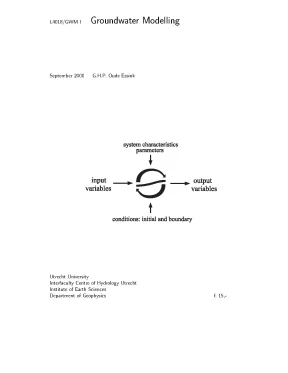
L4018/GWM I Groundwater Modelling September 2000 G. Oude Essink Utrecht University Interfaculty Centre of Hydrology Utrecht Institute of Earth Sciences Department of Geophysics f. 15,- Contents General introduction v I Modelling Protocol 1 1 Introduction 3 1.1 Historical developments towards hydrologic modelling .3 Some drawbacks in modelling . 6 2 Classification of mathematical models 9 2.2 Based on the design of the mathematical model .3 Based on the processes in the hydrologic cycle .4 Based on the application of the model . 15 3 Methodology of modelling 19 3.1 Define purpose of the modelling effort .2 Conceptualisation of a mathematical model .3 Selection of the computer code .5 Preliminary selection of parameters and hydrologic stresses .1 Evaluating the calibration .3 First model execution .6 Model verification .8 Presentation of results .10 Why can things go wrong ? . 53 i ii 4 Data gathering 55 II Groundwater Modelling 59 5 Introduction 61 5.1 Classification based on the design of the model . 68 6 Mathematical description of hydrogeologic processes 69 6.1 Fluid flow: equation of motion and continuity .1 Equation of motion: Darcy’s law .3 Hydraulic conductivity and permeability .4 Density of groundwater .6 Equation of continuity .7 Groundwater flow equation .8 Equation of state .2 Solute transport: advection-dispersion equation .1 Equation of solute transport .3 Heat transport: conduction-convection equation .1 Taylor series development .3 Steady state methods .4 Non-steady state methods .4 Gauss-Jordan elimination .5 Finite difference method .6 Finite element method .7 Analytic element method .8 Method of characteristics .9 Random walk method . 116 iii 8 Numerical aspects of groundwater models 119 8.1 Stability analysis of the advection-dispersion equation .3 Analysis of truncation and oscillation errors . 128 9 Some selected groundwater codes 133 9.1 External sources into a block: packages .4 Strongly Implicit Procedure package (SIP) .5 Slice-Successive Overrelaxation package (SSOR) .5 MOC, (2D) adapted for density differences .1 Theoretical background of the groundwater flow equation .2 Theoretical background of the solute transport equation . 164 Continuı̈teitsvergelijking: niet stationair 177 References 181 Consulted literature . 187 Some distributors of computer codes . 187 Formula sheet 189 Index 191 iv General introduction The development of models has been the direct outcome of the need to integrate our existing theories with all physical and measured data. The key factor in this development is the (still ongoing) breakthrough in computation technologies, because it is the digital computer which is capable to store, to manipulate data and to execute complex calculations beyond the physical ability of man, yet within his mental capacity. In order to avoid that you, as a hydrogeologist-in-spe, will get stranded in the fine art of modelling, these lecture notes1 are written to show you some ropes in the fantastic, tempting, and yet creepy world of groundwater modelling. The presence course, which comes under the ICHU2 , is called Groundwater Modelling I. The aim of this course is to gain more insight in the behaviour of groundwater processes, quantitatively as well as qualitatively, by means of numerical modelling. These lecture notes are divided into two parts: I. Modelling protocol in this part, the procedure of modelling hydrologic processes is described. A hydro- geologist should advance this procedure, from coping with a hydrological problem towards solving the problem by means of (numerical) modelling, while skipping all kinds of traps on the track; and II. Groundwater modelling in this part, features of groundwater flow and solute transport are considered and numerical solution techniques of partial differential equations are discussed. Moreover, some groundwater computer codes will be treated. During the computer practicals, attention will be paid to the modelling of standard problems by means of the codes MODFLOW and MOC(3D). Primarily knowledge should comprise basic knowledge on hydrogeologic processes such as the Darcy equation and stationary groundwater flow; as well as basic knowledge on discretisation techniques such as Taylor series and simple numerical solution techniques. For students of the Department of Physi- cal Geography, it is strongly recommended to have followed Groundwaterhydrology (HYDB). For all students, the lectures Hydrological Transport Processes (L3041/KHTP) are also rec- ommended. Gualbert Oude Essink, September 2000 g.nl 1 Parts of these lecture notes are based on the lecture notes Hydrological models (f15D) of the Delft University of Technology (Oude Essink, G. 2 The Interfacultair Centrum voor Hydrologie Utrecht (ICHU) is a centre which provides a so-called study- path Hydrologie to students from the Faculty of Earth Sciences and Department of Physical Geography. v vi Groundwater Modelling æ Part I Modelling Protocol 1 Chapter 1 Introduction 1.1 Historical developments towards hydrologic modelling The science of hydrology began with the conceptualisation of the hydrologic cycle. Much of the speculations of the Greek philosophers was scientifically unsound. Nonetheless, some of them correctly described some aspects of the hydrologic cycle. For example, Anaxagoras of Clazomenae (500-428 B.) formed a primitive version of the hydrologic cycle (e. the sun lifts water from the sea into the atmosphere). Another Greek philosopher, Theophrastus (circa 372-287 B.) gave a sound explanation of the formation of precipitation by conden- sation and freezing. Meanwhile, independent thinking occurred in ancient Chinese, Indian and Persian civilizations. During the Renaissance, a gradual change occurred from purely philosophical concepts of hydrology toward observational science, e. by Leonardo da Vinci (1452-1519). Hydraulic measurements and experiments flourished during the eighteenth century, when Bernoulli’s equation and Chezy’s formula were discovered. Hydrology advanced more rapidly during the nineteenth century, when Darcy developed his law of porous media flow in 1856 and Manning proposed his open-channel flow formula (1891). However, quantitative hydrology was still immature at the beginning of the twentieth century. Gradually, empiricism was replaced with rational analysis of observed data. For example, Sherman devised the unit hydrograph method to transform effective rainfall to direct runoff (1932) and Gumbel proposed the extreme value law for hydrological studies (1941). Like many sciences, hydrology was recognized only recently as a separate disci- pline (e. in 1965, the US Civil Service Commission recognized a hydrologist as a job classification). Over the last decades, the subject of interest from society to hydrology gradually changed. Some two decades ago, the main subject was of a quantitative nature: how much water is available, how much can be extracted, what are the effects on piezometric heads, etc. Nowadays, also the qualitative aspect of water becomes more and more important, such as pollution of surface water and groundwater by acid rain (e. due to agricultural and industrial activities). The spectacular boom in computer possibilities during recent times (viz. decades and especially the last years) makes hydrologic analysis possible on a larger scale.1 shows that the improvements of desktop computer systems are outstanding. As a result, hydrologists have analysed problems in more detail and with shorter computation intervals than before. Complex theories describing hydrologic processes have been applied using computer simulations. Also interactions between surface water systems and groundwater 3 4 Groundwater Modelling, Part I Figure 1.1: Relative performance improvements of a 6000 US$ computer as a function of three moments in time relative to 1987 (no parallel processing) [after Cutaia, 1990]. systems in terms of quality and quantity became within the reach of the hydrologist. Vast quantities of observed data have easily been processed for statistical analysis. Moreover, during the past decade, developments in electronics and data transmission have made pos- sible to retrieve instantaneous data from remote recorders (e. satellites), which lead to the development of real-time programmes for water management (e. flood forecasting for the river Maas).2 Why modelling ? Hydrology is a subject of great importance for people and their environment. Practi- cal applications of hydrology are found in tasks such as water supply (both surface and groundwater), wastewater treatment, irrigation, drainage, flood control, erosion and sedi- ment control, salinity control, pollution reduction, and flora and fauna protection. Mankind has always been anxious to comprehend and subsequently control the processes of the hydrologic cycle. Many hydrologic phenomena are extremely complex, and thus, they may never be fully understood. However, the one that knows the hydrologic processes best is you, the hydrogeologist. During the past, the processes of the hydrologic cycle were only conceptualised, and causes and effects were just described in relatively simple relations. For example, ancient Roman times, water courses were constructed without preceding sound (theoretical) sci- entific research, yet the construction lasted for ages. Nowadays, however, the state of technology makes it possible to even understand rather complex processes of the hydrologic cycle by means of executing a model on the computer. Some definitions of a model are given here: “a model is a simplified representation of a complex system.” or: “a model is any device that represents an approximation of a field situation ” [Anderson & Woessner, 1992]. Chapter 1: Introduction 5 or: “a model is a part of the reality for the benefit of a specific purpose.” or: “a model is a computer code filled up with variables and parameters of the specific system.” The purpose of a model is: ”to replace reality, enabling measuring and experimenting in a cheap and quick way, when real experiments are impossible, too expensive, or too time-consuming” [Eppink, 1993]. Modelling (also called simulation or imitation) of specific elements of the real world could help you, as a hydrologist, considerably in understanding the hydrological problem. It is an excellent way to help you organise and synthesize field data. Modelling should contribute to the perception of the reality, yet applied on the right way. In fact, hydrological models should ónly be applied to help the user with the analysis of a problem, nothing more, nothing less. Remember that it is only part of the way to understand or percept a hydrological process.3 Some drawbacks in modelling Microcomputers now provide many hydrologists new computational convenience and power. The evolution of hydrological knowledge and methods brings about continual improvement in the accuracy of solutions to hydrological problems. However, the continuous supply of hydrological models and their sophisticated graphical modules makes it very easy that the primary function of modelling (“only to help the user with the analysis of a problem”) might be in danger of being overlooked. Formulating of and simulating with a hydrological model can be accomplished rather easily, however, checking the correctness of the model description, the applied concept of the model, the applied schematisation of the process involved, the applied simplifications, the applied parameters and the accuracy of the results may be very complex. Therefore, a critical view upon the application of computers in hydrology is very useful, especially on relative new topics such as modelling of acid rain, nitrification and NAPL’s1 . Unfortunately, models have been applied by just anybody, sometimes without really awareness of its potentials and impossibilities. This might lead to serious errors in the conclusions. It is very tempting to overestimate the predictive and interpretive potential of models, in particular if sophisticated graphical modules make the simulations realistic and reliable. Note that even a wrong concept may well produce a reasonable prediction. Knowing this, it’s a logic phrase, that “models which reproduce results that exactly fits available historical records should be treated with suspicion.” Another reason for scepticism is the data availability. A well-known statement concern- ing data applied in models is: garbage in, garbage out ! 1 nonaqueous phase liquids (NAPL’s) are complex dissolved substances which contaminate porous media. 6 Groundwater Modelling, Part I It may occur that data are inadequate, e. due to poor quality, to support modelling results. Not taking into account the uncertainty of the model parameter during the calibration phase would inevitably lead to inaccurate results. Therefore, results and conclusions of modelling are rather disputable when the reliability of the results is not given at the same time. As today’s computer codes and graphics packages can easily produce impressive results, one might be misled to model anyway, while it should be ethically sound to advice against modelling. Hence, a responsibility rests upon the hydrologist to provide the best analysis that knowledge and data will permit. Yet, an element of risk is always present, e.

Nội dung được bảo vệ bản quyền — Tải xuống đầy đủ