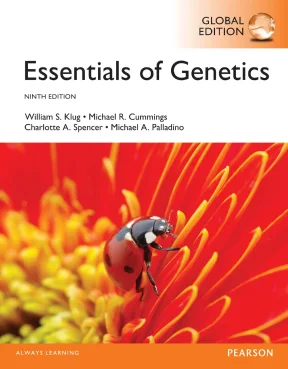
Giáo trình Essentials of Genetics 9th Edition Global - William S. Klug, Cummings

Chuyên ngành

Di truyền học

Người đăng

Ẩn danh

Thể loại

Giáo trình

2017

606
0
0

Phí lưu trữ

135 Point

Tóm tắt

I. Tổng quan về giáo trình Essentials of Genetics 9e Global Edition

Essentials of Genetics 9e Global Edition là giáo trình di truyền học hàng đầu thế giới, được biên soạn bởi William S. Klug, Michael R. Cummings, Charlotte A. Spencer và Michael A. Palladino. Sách được xuất bản bởi Pearson Education và được sử dụng rộng rãi tại các trường đại học trên toàn cầu. Giáo trình bao gồm 22 chương chính và 6 chủ đề đặc biệt trong di truyền học hiện đại. Nội dung trải dài từ di truyền Mendel cơ bản đến các lĩnh vực tiên tiến như hệ gen học, bioinformatics và liệu pháp gene. Phiên bản thứ 9 cập nhật các phát hiện mới nhất trong nghiên cứu di truyền phân tử. Sách phù hợp cho sinh viên đại học và sau đại học ngành sinh học, y khoa và công nghệ sinh học. Cấu trúc trình bày logic, từ nguyên lý cơ bản đến ứng dụng thực tiễn. Mỗi chương kết thúc bằng bài tập và câu hỏi thảo luận giúp củng cố kiến thức. Phần phụ lục cung cấp lời giải chi tiết cho các bài tập được chọn lọc. Đây là tài liệu tham khảo thiết yếu cho bất kỳ ai nghiên cứu khoa học sự sống.

1.1. Thông tin tác giả và nhà xuất bản giáo trình Klug

William S. Klug công tác tại The College of New Jersey, là chuyên gia di truyền học uy tín hàng đầu. Michael R. Cummings đến từ Illinois Institute of Technology, chuyên sâu về di truyền phân tử. Charlotte A. Spencer thuộc Đại học Alberta, Canada, đóng góp nội dung về sinh học tế bào. Michael A. Palladino từ Monmouth University bổ sung kiến thức ứng dụng. Darrell Killian tại Colorado College có đóng góp quan trọng trong các chủ đề chuyên biệt. Pearson Education xuất bản phiên bản Global Edition nhằm phục vụ sinh viên toàn thế giới với chi phí hợp lý hơn so với bản Mỹ.

1.2. Cấu trúc 22 chương và 6 chủ đề đặc biệt của sách

Giáo trình được chia thành hai phần lớn. Phần chính gồm 22 chương, bắt đầu từ giới thiệu di truyền học đến di truyền quần thể và tiến hóa. Phần đặc biệt gồm 6 chủ đề hiện đại: Epigenetics, vai trò mới của RNA, pháp y DNA, hệ gen học và y học cá nhân hóa, thực phẩm biến đổi gene, và liệu pháp gene. Mỗi chủ đề đặc biệt phản ánh xu hướng nghiên cứu đương đại. Cấu trúc này giúp sinh viên nắm vững nền tảng trước khi tiếp cận công nghệ tiên tiến. Phần Glossary và Index cuối sách hỗ trợ tra cứu thuật ngữ nhanh chóng.

II. Phân tích nội dung khoa học cốt lõi trong Essentials of Genetics 9e

Giáo trình xây dựng kiến thức theo trình tự logic chặt chẽ. Ba chương đầu thiết lập nền tảng với di truyền Mendel và phân bào. Chương 3 trình bày các thí nghiệm kinh điển của Mendel trên cây đậu Hà Lan, giải thích tỷ lệ phân ly 3:1 trong thế hệ F2. Từ chương 4 đến 8, giáo trình mở rộng sang biến đổi tỷ lệ Mendel, nhiễm sắc thể giới tính và lập bản đồ gene. Các chương từ 9 đến 14 đi sâu vào sinh học phân tử, bao gồm cấu trúc DNA, sao chép, phiên mã và dịch mã. Đây là phần cốt lõi giúp hiểu cơ chế hoạt động của vật chất di truyền. Chương 15 về điều hòa biểu hiện gene là nền tảng cho hiểu biết về ung thư và phát triển. Các chương cuối từ 17 đến 22 bao phủ công nghệ tái tổ hợp DNA, hệ gen học và di truyền quần thể. Mỗi phần được minh họa bằng hình ảnh chi tiết và số liệu thực nghiệm xác thực. Phong cách trình bày cân bằng giữa lý thuyết và bằng chứng thực nghiệm.

2.1. Di truyền Mendel và cơ chế phân bào trong các chương đầu

Chương 2 và 3 là nền tảng của toàn bộ giáo trình. Phân bào nguyên phân và giảm phân được giải thích rõ ràng với sơ đồ chi tiết. Thí nghiệm Mendel với đặc điểm chiều cao cây đậu cho thấy tỷ lệ 787 cây cao và 277 cây lùn trong thế hệ F2, tương đương 3:1. Khái niệm alen trội và lặn được giải thích thông qua các ví dụ thực tế. Chương 4 mở rộng sang các trường hợp ngoại lệ như trội không hoàn toàn và đồng trội. Việc hiểu chắc phần này là điều kiện tiên quyết để tiếp thu kiến thức phân tử ở các chương sau.

2.2. Sinh học phân tử và công nghệ DNA tái tổ hợp trong giáo trình

Chương 9 đến 11 phân tích cấu trúc DNA, mô hình xoắn kép Watson-Crick và tổ chức trình tự DNA trên nhiễm sắc thể. Chương 12 và 13 làm rõ mã di truyền, quá trình phiên mã ở nhân và bào tương, cũng như cơ chế dịch mã tại ribosome. Chương 17 giới thiệu công nghệ DNA tái tổ hợp, bao gồm cloning, PCR và thư viện genome. Công nghệ di truyền ngược được trình bày như phương pháp khám phá chức năng gene khi đã biết trình tự. Gene knockout trên sinh vật mô hình minh họa ứng dụng thực tiễn của phương pháp này trong nghiên cứu hiện đại.

III. Phương pháp sử dụng giáo trình Klug Genetics 9e hiệu quả nhất

Học hiệu quả với Essentials of Genetics 9e đòi hỏi chiến lược đọc có hệ thống. Mỗi chương nên đọc phần tóm tắt trước để nắm bức tranh tổng thể. Sau đó đọc kỹ nội dung chính, chú ý các hộp Essential Point ở cuối mỗi phần. Các hộp này tóm lược điểm quan trọng nhất cần ghi nhớ. Hình vẽ và sơ đồ trong sách được thiết kế để hiểu, không chỉ để nhìn. Nên vẽ lại sơ đồ theo cách hiểu của mình sau khi đọc. Bài tập cuối chương chia thành nhiều cấp độ từ cơ bản đến nâng cao. Phần Appendix cung cấp lời giải cho bài tập được chọn, dùng để kiểm tra sau khi tự làm. Sáu chủ đề đặc biệt nên đọc song song với chương tương ứng. Ví dụ, đọc chủ đề Epigenetics khi học chương về điều hòa biểu hiện gene. Tài nguyên trực tuyến đi kèm giáo trình bao gồm animation và quiz tương tác hỗ trợ học tập trực quan. Sinh viên nên khai thác tối đa các tài nguyên số này để củng cố kiến thức.

3.1. Kỹ thuật đọc và ghi chú tối ưu cho sinh viên đại học

Phương pháp SQ3R phù hợp với cấu trúc của giáo trình này. Survey là lướt qua tiêu đề và hình ảnh. Question là đặt câu hỏi từ các tiêu đề chương. Read là đọc kỹ để tìm câu trả lời. Recite là nhắc lại nội dung không nhìn sách. Review là ôn lại toàn bộ sau mỗi buổi học. Ghi chú theo phương pháp Cornell giúp tổ chức thông tin hiệu quả. Tạo bản đồ tư duy kết nối các khái niệm di truyền giúp nhớ lâu hơn. Thuật ngữ di truyền học nên học kèm định nghĩa và ví dụ cụ thể từ sách.

3.2. Sử dụng sinh vật mô hình và thí nghiệm kinh điển để hiểu sâu

Giáo trình nhấn mạnh vai trò của sinh vật mô hình trong nghiên cứu di truyền. Mendel chọn cây đậu Hà Lan vì dễ trồng, tự thụ phấn và có nhiều đặc điểm tương phản rõ ràng. Morgan dùng ruồi giấm Drosophila để phát hiện liên kết gene và lập bản đồ nhiễm sắc thể. Neurospora crassa giúp nghiên cứu di truyền sinh hóa. Mỗi sinh vật mô hình có ưu điểm riêng phù hợp với câu hỏi nghiên cứu cụ thể. Hiểu lý do lựa chọn sinh vật mô hình giúp đánh giá độ tin cậy của kết quả thực nghiệm và áp dụng suy luận tương tự sang trường hợp khác.

IV. Ứng dụng thực tiễn và giá trị học thuật của Essentials of Genetics 9e

Essentials of Genetics 9e không chỉ là sách giáo khoa mà còn là cầu nối giữa kiến thức cơ bản và ứng dụng hiện đại. Công nghệ hệ gen học được trình bày trong chương 18 phản ánh cuộc cách mạng sinh học phân tử sau Dự án Hệ Gen Người hoàn thành năm 2003. Chương 19 thảo luận về đạo đức kỹ thuật di truyền, chủ đề quan trọng trong thời đại CRISPR. Di truyền ung thư trong chương 16 cung cấp nền tảng cho hiểu biết về cơ chế bệnh lý cấp độ phân tử. Chủ đề đặc biệt về y học cá nhân hóa cho thấy ứng dụng trực tiếp của hệ gen học vào lâm sàng. Pháp y DNA và thực phẩm biến đổi gene là các ứng dụng xã hội quan trọng được phân tích đa chiều. Liệu pháp gene trình bày tiến bộ trong điều trị bệnh di truyền bằng can thiệp ở cấp độ DNA. Kiến thức từ giáo trình này chuẩn bị sinh viên cho nghiên cứu sau đại học và sự nghiệp trong ngành công nghệ sinh học, y tế và nông nghiệp. Đây là tài liệu được hàng trăm trường đại học trên thế giới tin tưởng sử dụng.

4.1. Dự án Hệ Gen Người và hệ gen học theo giáo trình Klug

Chương 18 trình bày hành trình từ thư viện genome đến giải trình tự toàn bộ hệ gen người. Dự án Hệ Gen Người khởi động năm 1990 như nỗ lực quốc tế, hoàn thành phần chứa gene năm 2003. Hệ gen học so sánh cho phép xác định gene bảo tồn qua tiến hóa. Bioinformatics cung cấp công cụ phân tích lượng dữ liệu khổng lồ từ giải trình tự thế hệ mới. Proteomics nghiên cứu toàn bộ protein được mã hóa trong genome. Các lĩnh vực này tạo ra nền tảng cho y học chính xác và phát hiện thuốc thế hệ mới dựa trên mục tiêu phân tử cụ thể.

4.2. Đạo đức sinh học và tương lai của kỹ thuật di truyền trong giáo trình

Chương 19 và các chủ đề đặc biệt đặt câu hỏi đạo đức song song với tiến bộ kỹ thuật. Thực phẩm biến đổi gene phân tích cả lợi ích năng suất lẫn lo ngại về an toàn sinh học. Liệu pháp gene soma khác với can thiệp dòng mầm về hệ quả đạo đức. Chỉnh sửa gene trên phôi người đặt ra câu hỏi về giới hạn khoa học và trách nhiệm xã hội. Giáo trình không đưa ra kết luận độc đoán mà trình bày nhiều quan điểm để người học tự suy xét. Cách tiếp cận này rèn luyện tư duy phê phán cần thiết cho nhà khoa học và công dân trong thế kỷ 21.
21/04/2026

Trích đoạn nội dung tài liệu

Brief Contents 1 Introduction to Genetics 17 2 Mitosis and Meiosis 28 3 Mendelian Genetics 47 4 Modification of Mendelian Ratios 69 5 Sex Determination and Sex Chromosomes 100 6 Chromosome Mutations: Variation in Number and Arrangement 115 7 Linkage and Chromosome Mapping in Eukaryotes 136 8 Genetic Analysis and Mapping in Bacteria and Bacteriophages 159 9 DNA Structure and Analysis 176 10 DNA Replication 196 11 Chromosome Structure and DNA Sequence Organization 215 12 The Genetic Code and Transcription 231 13 Translation and Proteins 254 14 Gene Mutation, DNA Repair, and Transposition 273 15 Regulation of Gene Expression 296 16 The Genetics of Cancer 323 17 Recombinant DNA Technology 338 18 Genomics, Bioinformatics, and Proteomics 361 19 Applications and Ethics of Genetic Engineering and Biotechnology 394 20 Developmental Genetics 419 21 Quantitative Genetics and Multifactorial Traits 438 22 Population and Evolutionary Genetics 457 Special Topics in modern Genetics 1 Epigenetics 480 2 Emerging Roles of RNA 490 3 DNA Forensics 503 4 Genomics and Personalized Medicine 513 5 Genetically Modified Foods 523 6 Gene Therapy 535 Appendix Solutions to Selected Problems and Discussion Questions A-1 Glossary G-1 Credits C-1 Index I-1 ESSENTIALS of GENETICS Ninth Edition Global Edition William S. Klug The College of New Jersey Michael R. Cummings Illinois Institute of Technology Charlotte A. Spencer University of Alberta Michael A. Palladino Monmouth University with contributions by Darrell Killian Colorado College www.com Senior Acquisitions Editor: Michael Gillespie Production Management: Rose Kernan, Cenveo® Publisher Services Project Manager: Margaret Young Design Manager: Mark Ong Program Manager: Anna Amato Interior Designer: Tani Hasegawa Development Editor: Dusty Friedman Cover Designer: Lumina Datamatics Ltd. Assistant Editor: Chloé Veylit Illustrators: Imagineering Executive Editorial Manager: Ginnie Simione Jutson Rights & Permissions Project Manager: Donna Kalal Program Management Team Lead: Mike Early Rights & Permissions Management: Rachel Youdelman Project Management Team Lead: David Zielonka Photo Researcher: QBS Learning Assistant Acquisitions Editor, Global Edition: Murchana Borthakur Senior Procurement Specialist: Stacey Weinberger Project Editor, Global Edition: Amrita Naskar Project Manager–Instructor Media: Chelsea Logan Manager, Media Production, Global Edition: Vikram Kumar Executive Marketing Manager: Lauren Harp Senior Manufacturing Controller, Production, Global Edition: Trudy Kimber Cover Photo Credit: irin-k /Shutterstock Acknowledgements of third party content appear on page C-1, which constitutes an extension of this ­copyright page. Pearson Education Limited Edinburgh Gate Harlow Essex CM20 2JE England and Associated Companies throughout the world Visit us on the World Wide Web at: www. Klug and Michael R. Cummings 2017 The rights of William S. Spencer, and Michael A. Palladino to be identified as the authors of this work have been asserted by them in accordance with the Copyright, Designs and Patents Act 1988. Authorized adaptation from the United States edition, entitled Essentials of Genetics, 9th edition, ISBN 978-0-134-04779-9, by William S. Spencer, and Michael A. Palladino, published by Pearson Education © 2016. All rights reserved. No part of this publication may be reproduced, stored in a retrieval system, or transmit- ted in any form or by any means, electronic, mechanical, photocopying, recording or otherwise, without either the prior written permission of the publisher or a license permitting restricted copying in the United Kingdom issued by the Copyright Licensing Agency Ltd, Saffron House, 6–10 Kirby Street, London EC 1N 8TS. All trademarks used herein are the property of their respective owners. The use of any trademark in this text does not vest in the author or publisher any trademark ownership rights in such trademarks, nor does the use of such trademarks imply any affiliation with or endorsement of this book by such owners. MasteringGenetics is a trademark in the U. and/or other countries, owned by Pearson Education, Inc. or its affiliates. Unless otherwise indicated herein, any third-party trademarks that may appear in this work are the prop- erty of their respective owners and any references to third-party trademarks, logos or other trade dress are for demonstrative or descriptive purposes only. Such references are not intended to imply any sponsorship, endorsement, authorization, or promotion of Pearson’s products by the owners of such marks, or any rela- tionship between the owner and Pearson Education, Inc. or its affiliates, authors, licensees or distributors. ISBN 10: 1-292-10886-X ISBN 13: 978-1-292-10886-5 British Library Cataloguing-in-Publication Data A catalogue record for this book is available from the British Library 10 9 8 7 6 5 4 3 2 1 Typeset by Cenveo Publisher Services Printed and bound by Vivar in Malaysia About the Authors William S. Klug is an Emeritus Professor of Biology at The Charlotte A. Spencer is a retired Associate Professor College of New Jersey (formerly Trenton State College) in Ewing, from the Department of Oncology at the University of Alberta New Jersey, where he served as Chair of the Biology Department in Edmonton, Alberta, Canada. She has also served as a facul- for 17 years. He received his B. degree in Biology from Wabash ty member in the Department of Biochemistry at the Univer- College in Crawfordsville, Indiana, and his Ph. from North- sity of Alberta. She received her B. in Microbiology from western University in Evanston, Illinois. Prior to coming to The the University of British Columbia and her Ph. in Genet- College of New Jersey, he was on the faculty of Wabash College ics from the University of Alberta, followed by postdoctoral as an Assistant Professor, where he first taught genetics, as well training at the Fred Hutchinson Cancer Research Center in as general biology and electron microscopy. His research inter- Seattle, Washington. Her research interests involve the regu- ests have involved ultrastructural and molecular genetic stud- lation of RNA polymerase II transcription in cancer cells, cells ies of development, utilizing oogenesis in Drosophila as a model infected with DNA viruses, and cells traversing the mitotic system. He has taught the genetics course as well as the senior phase of the cell cycle. She has taught courses in biochem- capstone seminar course in Human and Molecular Genetics to istry, genetics, molecular biology, and oncology, at both un- undergraduate biology majors for over four decades. He was the dergraduate and graduate levels. In addition, she has written recipient in 2001 of the first annual teaching award given at The booklets in the Prentice Hall Exploring Biology series, which College of New Jersey, granted to the faculty member who “most are aimed at the undergraduate nonmajor level. challenges students to achieve high standards.” He also received the 2004 Outstanding Professor Award from Sigma Pi Interna- Michael A. Palladino is Dean of the School of Sci- tional, and in the same year, he was nominated as the Educator ence and Professor of Biology at Monmouth University in of the Year, an award given by the Research and Development West Long Branch, New Jersey. He received his B. degree Council of New Jersey. in Biology from Trenton State College (now known as The College of New Jersey) and his Ph. in Anatomy and Cell Michael R. Cummings is Research Professor in the De- Biology from the University of Virginia. He directs an active partment of Biological, Chemical, and Physical Sciences at Illi- laboratory of undergraduate student researchers study- nois Institute of Technology, Chicago, Illinois. For more than 25 ing molecular mechanisms involved in innate immunity of years, he was a faculty member in the Department of Biological mammalian male reproductive organs and genes involved Sciences and in the Department of Molecular Genetics at the in oxygen homeostasis and ischemic injury of the testis. University of Illinois at Chicago. He has also served on the fac- He has taught a wide range of courses for both majors and ulties of Northwestern University and Florida State University. nonmajors and currently teaches genetics, biotechnol- He received his B. Mary’s College in Winona, Min- ogy, endocrinology, and laboratory in cell and molecular nesota, and his M. from Northwestern University biology. He has received several awards for research and in Evanston, Illinois. In addition to this text and its companion teaching, including the 2009 Young Investigator Award of volumes, he has also written textbooks in human genetics and the American Society of Andrology, the 2005 Distinguished general biology for nonmajors. His research interests center on Teacher Award from Monmouth University, and the 2005 the molecular organization and physical mapping of the hetero- Caring Heart Award from the New Jersey Association for chromatic regions of human acrocentric chromosomes. At the Biomedical Research. He is co-author of the undergradu- undergraduate level, he teaches courses in Mendelian and mo- ate textbook Introduction to Biotechnology, Series Editor for lecular genetics, human genetics, and general biology, and has the Benjamin Cummings Special Topics in Biology booklet received numerous awards for teaching excellence given by uni- series, and author of the first booklet in the series, Under- versity faculty, student organizations, and graduating seniors. standing the Human Genome Project.com This page intentionally left blank Contents 3.7 Laws of Probability Help to Explain Genetic Events 58 1 Introduction to Genetics 17 3.8 Chi-Square Analysis Evaluates the Influence of Chance on Genetic Data 59 1.1 Genetics Has a Rich and Interesting History 18 3.9 Pedigrees Reveal Patterns of Inheritance of Human 1.2 Genetics Progressed from Mendel to DNA in Less Than a Traits 62 Century 19 3.10 Tay–Sachs Disease: The Molecular Basis of a Recessive 1.3 Discovery of the Double Helix Launched the Era of Disorder in Humans 64 Molecular Genetics 21 EXPLORING GENOMICS 1.4 Development of Recombinant DNA Technology Began Online Mendelian Inheritance in Man 64 the Era of DNA Cloning 23 CASE STUDY:To test or not to test 65 1.5 The Impact of Biotechnology Is Continually Expanding 23 Insights and Solutions 65 1.6 Genomics, Proteomics, and Bioinformatics Are New and Expanding Fields 24 Problems and Discussion Questions 67 1.7 Genetic Studies Rely on the Use of Model Organisms 25 1.8 We Live in the Age of Genetics 26 4 Modification of Mendelian Ratios 69 Problems and Discussion Questions 27 4.1 Alleles Alter Phenotypes in Different Ways 70 4.2 Geneticists Use a Variety of Symbols for Alleles 70 2 Mitosis and Meiosis 28 4.3 Neither Allele Is Dominant in Incomplete, or Partial, Dominance 71 2.1 Cell Structure Is Closely Tied to Genetic Function 29 4.4 In Codominance, the Influence of Both Alleles in a 2.2 Chromosomes Exist in Homologous Pairs in Diploid Heterozygote Is Clearly Evident 72 Organisms 31 4.5 Multiple Alleles of a Gene May Exist in a Population 72 2.3 Mitosis Partitions Chromosomes into Dividing Cells 33 4.6 Lethal Alleles Represent Essential Genes 74 2.4 Meiosis Creates Haploid Gametes and Spores and Evolving Concept of the Gene 74 Enhances Genetic Variation in Species 37 4.7 Combinations of Two Gene Pairs with Two Modes of 2.5 The Development of Gametes Varies in Inheritance Modify the 9:3:3:1 Ratio 75 Spermatogenesis Compared to Oogenesis 40 4.8 Phenotypes Are Often Affected by More Than One Gene 76 2.6 Meiosis Is Critical to Sexual Reproduction 4.9 Complementation Analysis Can Determine If Two in All Diploid Organisms 42 Mutations Causing a Similar Phenotype Are Alleles 2.7 Electron Microscopy Has Revealed the Physical Structure of the Same Gene 80 of Mitotic and Meiotic Chromosomes 42 4.10 Expression of a Single Gene May Have Multiple Effects 82 EXPLORING GENOMICS 4.11 X-Linkage Describes Genes on the X Chromosome 82 PubMed: Exploring and Retrieving Biomedical Literature 43 4.12 In Sex-Limited and Sex-Influenced Inheritance, an CASE STUDY:Triggering meiotic maturation of oocytes 44 Individual’s Sex Influences the Phenotype 84 Insights and Solutions 44 4.13 Genetic Background and the Environment Affect Problems and Discussion Questions 45 Phenotypic Expression 86 4.14 Genomic (Parental) Imprinting and Gene Silencing 88 4.15 Extranuclear Inheritance Modifies Mendelian Patterns 89 3 Mendelian Genetics 47 GENETICS, TECHNOLOGY, AND SOCIET Y 3.1 Mendel Used a Model Experimental Approach to Study Improving the Genetic Fate of Purebred Dogs 92 Patterns of Inheritance 48 CASE STUDY: Sudden blindness 93 3.2 The Monohybrid Cross Reveals How One Trait Is Insights and Solutions 94 Transmitted from Generation to Generation 48 Problems and Discussion Questions 95 3.3 Mendel’s Dihybrid Cross Generated a Unique F2 Ratio 52 3.

Nội dung được bảo vệ bản quyền — Tải xuống đầy đủ