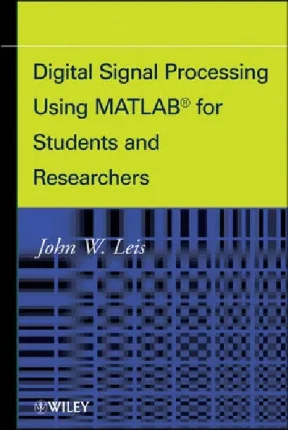
Xử lý tín hiệu số với MATLAB cho sinh viên và nhà nghiên cứu - John W. Leis

Trường đại học

University of Southern Queensland

Chuyên ngành

Xử lý tín hiệu số

Người đăng

Ẩn danh

Thể loại

Sách tham khảo

2011

388
0
0

Phí lưu trữ

75 Point

Tóm tắt

I. Tổng quan về Xử lý tín hiệu số sử dụng MATLAB của John W

Digital Signal Processing Using MATLAB for Students and Researchers là giáo trình do John W. Leis biên soạn, thuộc Đại học Southern Queensland, xuất bản bởi John Wiley & Sons năm 2011. Cuốn sách cung cấp nền tảng vững chắc về xử lý tín hiệu số (DSP) dành cho sinh viên và nhà nghiên cứu. Nội dung bao gồm các chủ đề cốt lõi như tín hiệu thời gian rời rạc, biến đổi Fourier, lọc số, tương quan và phân tích tần số. Điểm nổi bật của cuốn sách là sự kết hợp chặt chẽ giữa lý thuyết toán học và thực hành trên phần mềm MATLAB. Mỗi chương đều đi kèm ví dụ minh họa bằng mã MATLAB, giúp người học nắm bắt kiến thức một cách trực quan. Cuốn sách được thiết kế theo trình tự logic, từ cơ bản đến nâng cao, phù hợp cho người mới bắt đầu. Tài liệu cũng nhấn mạnh tầm quan trọng của vector hóa mã lệnh và phân bổ bộ nhớ trước trong MATLAB để tối ưu hiệu suất tính toán.

1.1. Mục tiêu và đối tượng độc giả của cuốn sách

Cuốn sách Digital Signal Processing Using MATLAB hướng đến hai nhóm đối tượng chính: sinh viên đại học và các nhà nghiên cứu trong lĩnh vực xử lý tín hiệu. Mục tiêu của tác giả là xây dựng cầu nối giữa lý thuyết toán học trừu tượng và ứng dụng thực tế thông qua MATLAB. Sinh viên có thể sử dụng cuốn sách như tài liệu học tập chính thức cho các môn DSP. Nhà nghiên cứu tìm thấy trong đây công cụ tham khảo nhanh với các thuật toán đã được kiểm chứng. Cuốn sách không yêu cầu kiến thức sâu về lập trình trước đó, chỉ cần hiểu biết cơ bản về đại số tuyến tính và giải tích.

1.2. Cấu trúc nội dung và phương pháp tiếp cận

Nội dung cuốn sách được tổ chức theo nguyên tắc từ đơn giản đến phức tạp. Phần đầu giới thiệu khái niệm tín hiệu và hệ thống thời gian rời rạc. Tiếp theo là các phép biến đổi như Fourier và cosine transform. Phần giữa tập trung vào kỹ thuật tương quan, ước lượng nhiễu và xử lý tín hiệu không gian. Phần cuối đề cập đến lọc số và các ứng dụng thực tiễn. Phương pháp tiếp cận dựa trên ví dụ thực tế, mỗi lý thuyết đều đi kèm đoạn mã MATLAB minh họa. Cách tiếp cận này giúp sinh viên hiểu sâu bản chất vấn đề thông qua thực hành.

II. Các vấn đề và thách thức trong học xử lý tín hiệu số

Học xử lý tín hiệu số đặt ra nhiều thách thức cho sinh viên và nhà nghiên cứu mới vào nghề. Vấn đề đầu tiên là khoảng cách giữa lý thuyết toán học phức tạp và hiểu biết trực quan về tín hiệu. Các khái niệm như biến đổi Fourier, hàm tương quan và hàm truyền thường khó hình dung nếu chỉ đọc lý thuyết thuần túy. Thứ hai, việc triển khai thuật toán DSP yêu cầu kỹ năng lập trình vững. Nhiều sinh viên gặp khó khăn khi chuyển đổi công thức toán học thành mã lệnh hiệu quả. Thứ ba, vấn đề tối ưu hóa hiệu suất tính toán trong MATLAB thường bị bỏ qua. Sử dụng vòng lặp for thay vì vector hóa có thể làm chậm chương trình hàng trăm lần. Thứ tư, nhiễu trong tín hiệu thực tế tạo ra sai lệch lớn so với mô hình lý tưởng. Việc đánh giá mức độ tương đồng giữa hai tín hiệu thực tế đòi hỏi kỹ thuật tương quan chuyên biệt.

2.1. Khoảng cách giữa lý thuyết và thực hành DSP

Một trong những rào cản lớn nhất trong học DSP là khoảng cách giữa công thức toán học và ứng dụng thực tế. Sinh viên thường hiểu lý thuyết trên giấy nhưng không biết cách lập trình. Ví dụ, phép biến đổi Fourier rời rạc (DFT) đòi hỏi kiến thức về số phức và tích chập. Khi triển khai trên MATLAB, người học phải xử lý vấn đề chỉ số mảng, phân bổ bộ nhớ và lựa chọn tham số phù hợp. Cuốn sách của Leis giải quyết vấn đề này bằng cách cung cấp đoạn mã MATLAB song song với mỗi lý thuyết. Cách tiếp cận này rút ngắn thời gian học tập đáng kể cho người mới bắt đầu.

2.2. Thách thức về tối ưu hiệu suất mã MATLAB

MATLAB xử lý biến dưới dạng ma trận, điều này tạo cơ hội tối ưu lớn nhưng cũng là nguồn lỗi phổ biến. Sử dụng vòng lặp for để gán giá trị từng phần tử mảng rất chậm. Cuốn sách chỉ ra rằng việc phân bổ bộ nhớ trước bằng hàm zeros có thể tăng tốc hàng chục lần. Hơn nữa, vector hóa mã lệnh tận dụng phép toán ma trận nội sẵn của MATLAB giúp tăng tốc lên hàng trăm lần. Đây là kỹ năng thiết yếu mà nhiều sinh viên bỏ qua khi mới học DSP. Việc hiểu rõ cơ chế tính toán của MATLAB giúp viết mã hiệu quả và chuyên nghiệp hơn.

III. Phương pháp học DSP hiệu quả với cuốn sách của Leis

Để học DSP hiệu quả với cuốn sách của John W. Leis, cần áp dụng phương pháp tiếp cận có hệ thống. Bắt đầu bằng cách đọc kỹ lý thuyết mỗi chương trước khi chạy mã MATLAB. Thực hành từng đoạn code ví dụ trên máy tính để quan sát kết quả trực tiếp. Thay đổi tham số đầu vào và ghi nhận sự thay đổi đầu ra để hiểu sâu thuật toán. Sử dụng hàm plot để trực quan hóa tín hiệu thời gian và phổ tần số. Áp dụng kỹ thuật vector hóa và phân bổ bộ nhớ trước để viết mã tối ưu. Thực hành với tín hiệu thực tế như âm thanh qua hàm sound để cảm nhận kết quả. Giải quyết bài tập cuối chương để củng cố kiến thức. Tham gia nhóm học tập để thảo luận và giải quyết khó khăn. Liên hệ các khái niệm DSP với ứng dụng thực tiễn như xử lý ảnh JPEG, nén âm thanh MP3 và truyền số liệu để tăng động lực học tập.

3.1. Kỹ thuật thực hành với MATLAB cho người mới

Người mới bắt đầu nên tập trung vào các kỹ năng MATLAB cơ bản trước khi học DSP. Làm quen với việc tạo vector và ma trận, sử dụng hàm linspace và colon operator. Thực hành vẽ đồ thị bằng hàm plot với nhiều tùy chọn khác nhau. Học cách sử dụng hàm sound để phát tín hiệu âm thanh và nghe kết quả. Bắt đầu với tín hiệu đơn giản như sine wave trước khi chuyển sang tín hiệu phức tạp hơn. Sử dụng MATLAB Editor để viết script có chú thích rõ ràng. Lưu và tổ chức code theo từng chủ đề để dễ dàng tham khảo lại sau này. Đây là nền tảng quan trọng để tiếp thu nội dung DSP một cách suôn sẻ.

3.2. Xây dựng nền tảng toán học cho xử lý tín hiệu

Nền tảng toán học vững chắc là điều kiện tiên quyết để hiểu DSP. Cần nắm vững đại số tuyến tính, đặc biệt là phép nhân ma trận và giá trị riêng. Giải tích phức với số phức, hàm mũ và hàm lượng giác là kiến thức không thể thiếu. Lý thuyết xác suất và thống kê hỗ trợ hiểu biết về nhiễu và ước lượng tín hiệu. Biến đổi Fourier, cả liên tục và rời rạc, là công cụ toán học trung tâm của DSP. Cuốn sách của Leis trình bày các khái niệm này ở mức vừa phải, không quá trừu tượng. Việc ôn tập song song toán học khi học DSP sẽ mang lại hiểu biết sâu sắc và bền vững.

IV. Ứng dụng thực tiễn và giá trị của cuốn sách DSP này

Cuốn sách Digital Signal Processing Using MATLAB có giá trị ứng dụng thực tiễn rộng rãi trong nhiều lĩnh vực kỹ thuật. Trong viễn thông, các kỹ thuật lọc số và biến đổi Fourier được sử dụng để truyền và giải mã tín hiệu số. Xử lý ảnh y tế như CT scan sử dụng kỹ thuật tương quan không gian và reconstruction mà cuốn sách đề cập. Ngành âm thanh áp dụng bộ lọc số để loại bỏ nhiễu và nâng cao chất lượng âm thanh. Nén dữ liệu đa phương tiện dựa trên biến đổi cosine (DCT) là nền tảng của định dạng JPEG và MP3. Cuốn sách cũng hữu ích cho nghiên cứu radar và sonar, nơi phân tích tín hiệu thời gian thực là then chốt. Đối với sinh viên kỹ thuật điện tử, viễn thông và tin học, đây là tài liệu tham khảo không thể thiếu. Kiến thức từ cuốn sách tạo nền tảng vững chắc để tiếp cận các lĩnh vực nâng cao như xử lý tín hiệu thích nghi và học máy.

4.1. Ứng dụng trong viễn thông và truyền số liệu

Lĩnh vực viễn thông áp dụng rộng rãi các kỹ thuật DSP từ cuốn sách của Leis. Bộ lọc số được sử dụng để tách tín hiệu hữu ích từ nhiễu trong kênh truyền. Biến đổi Fourier nhanh (FFT) là công cụ cốt lõi trong hệ thống OFDM của Wi-Fi và 4G/5G. Kỹ thuật tương quan giúp đồng bộ hóa và phát hiện tín hiệu trong môi trường nhiều nhiễu. Biến đổi cosine đóng vai trò quan trọng trong mã hóa nguồn và nén dữ liệu truyền hình số. Sinh viên nắm vững nội dung cuốn sách sẽ có nền tảng tốt để làm việc trong ngành viễn thông hiện đại. Các ví dụ MATLAB trong sách mô phỏng trực tiếp các kịch bản xử lý tín hiệu thực tế.

4.2. Giá trị học thuật và hướng phát triển tiếp theo

Cuốn sách của Leis có giá trị học thuật cao nhờ sự cân bằng giữa lý thuyết và thực hành. Cấu trúc nội dung logic giúp người học xây dựng kiến thức từng bước vững chắc. Sau khi hoàn thành cuốn sách, người học có thể tiếp cận các chủ đề nâng cao như xử lý tín hiệu thích nghi, lọc Kalman và xử lý tín hiệu số đa tỷ lệ. Kiến thức MATLAB thu được cũng là nền tảng để chuyển sang các công cụ như Python với thư viện NumPy và SciPy. Cuốn sách khuyến khích tư duy phân tích và giải quyết vấn đề, kỹ năng quan trọng cho mọi kỹ sư và nhà nghiên cứu. Đây là khoản đầu tư học thuật mang lại giá trị lâu dài cho sự nghiệp kỹ thuật.
21/04/2026

Trích đoạn nội dung tài liệu

com LIBROS UNIVERISTARIOS Y SOLUCIONARIOS DE MUCHOS DE ESTOS LIBROS LOS SOLUCIONARIOS CONTIENEN TODOS LOS EJERCICIOS DEL LIBRO RESUELTOS Y EXPLICADOS DE FORMA CLARA VISITANOS PARA DESARGALOS GRATIS. DIGITAL SIGNAL PROCESSING USING MATLAB FOR STUDENTS AND RESEARCHERS ffirs01.indd i 4/13/2011 5:25:59 PM DIGITAL SIGNAL PROCESSING USING MATLAB FOR STUDENTS AND RESEARCHERS JOHN W. LEIS University of Southern Queensland A JOHN WILEY & SONS, INC.indd iii 4/13/2011 5:52:42 PM Copyright © 2011 by John Wiley & Sons, Inc. All rights reserved. Published by John Wiley & Sons, Inc., Hoboken, New Jersey. Published simultaneously in Canada. No part of this publication may be reproduced, stored in a retrieval system, or transmitted in any form or by any means, electronic, mechanical, photocopying, recording, scanning, or otherwise, except as permitted under Section 107 or 108 of the 1976 United States Copyright Act, without either the prior written permission of the Publisher, or authorization through payment of the appropriate per-copy fee to the Copyright Clearance Center, Inc., 222 Rosewood Drive, Danvers, MA 01923, (978) 750-8400, fax (978) 646-8600, or on the web at www. Requests to the Publisher for permission should be addressed to the Permissions Department, John Wiley & Sons, Inc., 111 River Street, Hoboken, NJ 07030, (201) 748-6011, fax (201) 748-6008. Limit of Liability/Disclaimer of Warranty: While the publisher and author have used their best efforts in preparing this book, they make no representations or warranties with respect to the accuracy or completeness of the contents of this book and specifically disclaim any implied warranties of merchantability or fitness for a particular purpose. No warranty may be created ore extended by sales representatives or written sales materials. The advice and strategies contained herein may not be suitable for your situation. You should consult with a professional where appropriate. Neither the publisher nor author shall be liable for any loss of profit or any other commercial damages, including but not limited to special, incidental, consequential, or other damages. For general information on our other products and services please contact our Customer Care Department with the U. at 877-762-2974, outside the U. at 317-572-3993 or fax 317-572-4002. Wiley also publishes its books in a variety of electronic formats. Some content that appears in print, however, may not be available in electronic format. Library of Congress Cataloging-in-Publication Data: Leis, John W. (John William), 1966- Digital Signal Processsing Using MATLAB for Students and Researchers / John W. cm Includes bibliographical references and index. Signal processing–Digital techniques. Signal processing–Mathematics–Data processing.382′2–dc22 2010048285 Printed in Singapore.indd iv 4/13/2011 5:26:00 PM To Debbie, Amy, and Kate ffirs04.indd v 4/13/2011 5:26:01 PM CONTENTS PREFACE XI CHAPTER 1 WHAT IS SIGNAL PROCESSING? 1 1.4 DSP and ITS Applications 3 1.5 Application Case Studies Using DSP 4 1.6 Overview of Learning Objectives 12 1.7 Conventions Used in This Book 15 1.8 Chapter Summary 16 CHAPTER 2 MATLAB FOR SIGNAL PROCESSING 19 2.3 What Is MATLAB? 19 2.5 Everything Is a Matrix 20 2.7 Testing and Looping 23 2.8 Functions and Variables 25 2.9 Plotting and Graphing 30 2.10 Loading and Saving Data 31 2.14 Using MATLAB for Processing Signals 40 2.15 Chapter Summary 43 CHAPTER 3 SAMPLED SIGNALS AND DIGITAL PROCESSING 45 3.3 Processing Signals Using Computer Algorithms 45 3.4 Digital Representation of Numbers 47 3.10 Block Diagrams and Difference Equations 88 ftoc.indd vii 4/13/2011 5:26:03 PM viii CONTENTS 3.11 Linearity, Superposition, and Time Invariance 92 3.12 Practical Issues and Computational Efficiency 95 3.13 Chapter Summary 98 CHAPTER 4 RANDOM SIGNALS 103 4.3 Random and Deterministic Signals 103 4.4 Random Number Generation 105 4.8 Continuous and Discrete Variables 114 4.12 Chapter Summary 125 CHAPTER 5 REPRESENTING SIGNALS AND SYSTEMS 127 5.3 Discrete-Time Waveform Generation 127 5.6 Poles, Zeros, and Stability 146 5.7 Transfer Functions and Frequency Response 152 5.8 Vector Interpretation of Frequency Response 153 5.10 Chapter Summary 160 CHAPTER 6 TEMPORAL AND SPATIAL SIGNAL PROCESSING 165 6.5 Noise Estimation and Optimal Filtering 183 6.7 Chapter Summary 201 CHAPTER 7 FREQUENCY ANALYSIS OF SIGNALS 203 7.4 How Do the Fourier Series Coefficient Equations Come About? 209 7.5 Phase-Shifted Waveforms 211 7.6 The Fourier Transform 212 7.7 Aliasing in Discrete-Time Sampling 231 7.8 The FFT as a Sample Interpolator 233 ftoc.indd viii 4/13/2011 5:26:03 PM CONTENTS ix 7.9 Sampling a Signal over a Finite Time Window 236 7.10 Time-Frequency Distributions 240 7.11 Buffering and Windowing 241 7.14 Chapter Summary 266 CHAPTER 8 DISCRETE-TIME FILTERS 271 8.3 What Do We Mean by “Filtering”? 272 8.4 Filter Specification, Design, and Implementation 274 8.6 Nonrecursive Filter Design 285 8.7 Ideal Reconstruction Filter 293 8.8 Filters with Linear Phase 294 8.9 Fast Algorithms for Filtering, Convolution, and Correlation 298 8.10 Chapter Summary 311 CHAPTER 9 RECURSIVE FILTERS 315 9.3 Essential Analog System Theory 319 9.4 Continuous-Time Recursive Filters 326 9.5 Comparing Continuous-Time Filters 339 9.6 Converting Continuous-Time Filters to Discrete Filters 340 9.7 Scaling and Transformation of Continuous Filters 361 9.8 Summary of Digital Filter Design via Analog Approximation 371 9.9 Chapter Summary 372 BIBLIOGRAPHY 375 INDEX 379 ftoc.indd ix 4/13/2011 5:26:03 PM PREFACE I was once asked what signal processing is. The questioner thought it had something to do with traffic lights. It became clear to me at that moment that although the theory and practice of signal processing in an engineering context has made possible the massive advances of recent times in everything from consumer electronics to healthcare, the area is poorly understood by those not familiar with digital signal processing (DSP). Unfortunately, such lack of understanding sometimes extends to those embarking on higher education courses in engineering, computer science, and allied fields, and I believe it is our responsibility not simply to try to cover every possible theoretical aspect, but to endeavor to open the student’s eyes to the possible applications of signal processing, particularly in a multidisciplinary context. With that in mind, this book sets out to provide the necessary theoretical and practical underpinnings of signal processing, but in a way that can be readily under- stood by the newcomer to the field. The assumed audience is the practicing engineer, the engineering undergraduate or graduate student, or the researcher in an allied field who can make use of signal processing in a research context. The examples given to introduce the topics have been chosen to clearly introduce the motivation behind the topic and where it might be applied. Necessarily, a great deal of detail has to be sacrificed in order to meet the expectations of the audience. This is not to say that the theory or implementation has been trivialized. Far from it; the treatment given extends from the theoretical underpinnings of key algorithms and techniques to computational and numerical aspects. The text may be used in a one-term or longer course in signal processing, and the assumptions regarding background knowledge have been kept to a minimum. Shorter courses may not be able to cover all that is presented, and an instructor may have to sacrifice some breadth in order to ensure adequate depth of coverage of important topics. The sections on fast convolution and filtering, and medical image processing, may be omitted in that case. Likewise, recursive filter design via analog prototyping may be omitted or left to a second course if time does not permit coverage. A basic understanding of algebra, polynomials, calculus, matrices, and vectors would provide a solid background to studying the material, and a first course in linear systems theory is an advantage but is not essential. In addition to the aforementioned mathematical background, a good understanding of computational principles and coding, and a working knowledge of a structured programming language is desirable, as is prior study of numerical mathematics. Above all, these xi fpref.indd xi 4/13/2011 5:26:02 PM xii PREFACE should not be considered as a list of essential prerequisites; the reader who is lacking in some of these areas should not be deterred. It is hoped that the problems at the end of each chapter, in conjunction with the various case studies, will give rise to a sufficiently rich learning environment, and appropriately challenging term projects may be developed with those problems as starting points.indd xii 4/13/2011 5:26:02 PM CH A P T E R 1 WHAT IS SIGNAL PROCESSING? 1.1 CHAPTER OBJECTIVES On completion of this chapter, the reader should 1. be able to explain the broad concept of digital signal processing (DSP); 2. know some of the key terms associated with DSP; and 3. be familiar with the conventions used in the book, both mathematical and for code examples.2 INTRODUCTION Signals are time-varying quantities which carry information. They may be, for example, audio signals (speech, music), images or video signals, sonar signals or ultrasound, biological signals such as the electrical pulses from the heart, commu- nications signals, or many other types. With the emergence of high-speed, low-cost computing hardware, we now have the opportunity to analyze and process signals via computer algorithms. The basic idea is straightforward: Rather than design complex circuits to process signals, the signal is first converted into a sequence of numbers and pro- cessed via software. By its very nature, software is more easily extensible and more versatile as compared with hard-wired circuits, which are difficult to change. Furthermore, using software, we can build in more “intelligence” into the operation of our designs and thus develop more human-usable devices. A vitally important concept to master at the outset is that of an algorithm: the logical sequence of steps which must be followed in order to generate a useful result. Although this definition is applicable to general-purpose information processing, the key difference is in the nature of the data which are processed. In signal processing, the data sequence represents information which is not inherently digital and is usually imprecise. Digital Signal Processing Using MATLAB for Students and Researchers, First Edition. © 2011 John Wiley & Sons, Inc. Published 2011 by John Wiley & Sons, Inc.indd 1 4/13/2011 5:20:44 PM 2 CHAPTER 1 WHAT IS SIGNAL PROCESSING? For example, the algorithm for calculating the account balance in a person’s bank account after a transaction deals directly with numbers; the algorithm for determining whether a sample fingerprint matches that of a particular person must cope with the imperfect and partially specified nature of the input data. It follows that the designer of the processing algorithm must understand the nature of the underlying sampled data sequence or signal. Furthermore, many signal processing systems are what is termed real time; that is, the result of the processing must be available within certain time constraints for it to be of use. If the result is not available in time, it may be of no use. For example, in developing a system which records the heart signal and looks for abnor- malities, we may have a time frame of the order of seconds in which to react to any change in the signal pattern and to sound an alert. The order of steps in the algorithm, and any parameters applicable to each step, must be decided upon by the designer. This may be done via theoretical analy- sis, experimentation using typical signal data or, more often, a combination of the two. Furthermore, the processing time of the algorithm must often be taken into account: A speech recognition system which requires several minutes (or even seconds) to convert a simple spoken text into words may not find much practical application (even though it may be useful for theoretical studies). Signal processing technology relies on several fields, but the key ones are Analog electronics to capture the real-world quantity and to preprocess it into a form suitable for further digital computer manipulation Digital representations of the real world, which requires discrete sampling since the values of the real-world signal are sampled at predefined, discrete intervals, and furthermore can only take on predefined, discrete values Mathematical analysis in order to find ways of analyzing and understanding complex and time-varying signals; the mathematics helps define the pro- cessing algorithms required.

Nội dung được bảo vệ bản quyền — Tải xuống đầy đủ