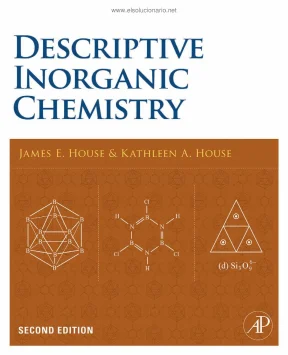
Giáo trình Hóa vô cơ mô tả (ấn bản lần 2) - James E. House - Đại học Illinois Wesleyan

Trường đại học

Illinois Wesleyan University

Chuyên ngành

Hóa học vô cơ

Người đăng

Ẩn danh

Thể loại

Sách giáo khoa

2010

586
0
0

Phí lưu trữ

135 Point

Tóm tắt

I. Tổng quan về Descriptive Inorganic Chemistry 2nd Edition của House

Descriptive Inorganic Chemistry Second Edition là giáo trình hóa học vô cơ mô tả do James E. House biên soạn, xuất bản bởi Academic Press (Elsevier) năm 2010. Cuốn sách phục vụ sinh viên đại học và sau đại học chuyên ngành hóa học, hóa lý và khoa học vật liệu. Giáo trình bao quát toàn bộ lĩnh vực hóa học vô cơ theo hướng mô tả, từ nguồn gốc các nguyên tố trong tự nhiên đến cấu trúc phân tử, liên kết ion, phản ứng hóa học và hệ acid-base. Điểm nổi bật là cách trình bày có hệ thống: mỗi chương kết nối lý thuyết với thực tiễn thông qua ví dụ cụ thể về khoáng vật, kim loại và hợp chất vô cơ quan trọng. Cuốn sách được tổ chức thành nhiều chương lớn, bao gồm cấu trúc nguyên tử, hình học phân tử, lực liên phân tử, nhiệt động học phản ứng và dung môi phi nước. Phiên bản thứ hai bổ sung website companion tại Elsevier cung cấp tài liệu phụ trợ cho giảng viên và sinh viên. Đây là tài liệu tham khảo chuẩn được nhiều trường đại học sử dụng trong chương trình đào tạo hóa học vô cơ nâng cao.

1.1. Cấu trúc nội dung và phạm vi của giáo trình

Giáo trình Descriptive Inorganic Chemistry 2nd Edition bao gồm nhiều chương trải dài từ nguồn gốc địa hóa học đến hóa học phối trí nâng cao. Chương 1 khảo sát thành phần vỏ Trái Đất, các loại đá, khoáng vật và kim loại thông dụng. Chương 2 đi sâu vào cấu trúc nguyên tử và phân tử, bao gồm orbital kiểu hydrogen và lý thuyết VSEPR. Chương 3 phân tích liên kết ion và lực liên phân tử gồm lực lưỡng cực, London và cảm ứng. Các chương tiếp theo xử lý nhiệt động học, acid-base và dung môi phi nước theo trật tự logic, giúp người học xây dựng nền tảng vững chắc.

1.2. Tác giả James E. House và Illinois Wesleyan University

James E. House là giáo sư hóa học tại Illinois Wesleyan University, Bloomington, Illinois, Hoa Kỳ. Ông có nhiều năm kinh nghiệm giảng dạy hóa học vô cơ và hóa lý ở bậc đại học. Cuốn Descriptive Inorganic Chemistry là công trình tiêu biểu phản ánh quan điểm sư phạm của ông: ưu tiên trình bày rõ ràng, có ví dụ thực tế và kết nối lý thuyết với ứng dụng. Phiên bản thứ hai được cập nhật dữ liệu, bổ sung hình minh họa và mở rộng phần bài tập. Giáo trình được xuất bản bởi Elsevier qua nhãn hiệu Academic Press, một trong những nhà xuất bản khoa học uy tín hàng đầu thế giới.

II. Phân tích cấu trúc nguyên tử và liên kết hóa học trong giáo trình

Phần trọng tâm của Descriptive Inorganic Chemistry 2nd Edition là các chương về cấu trúc nguyên tử, liên kết và hình học phân tử. Lý thuyết orbital phân tử được trình bày thông qua tổ hợp tuyến tính hàm sóng nguyên tử. Nếu hàm sóng nguyên tử là f1 và f2, hàm sóng phân tử liên kết và phản liên kết được xây dựng theo phương trình ψb = a1f1 + a2f2 và ψa = a1f1 − a2f2. Bình phương hàm sóng tương ứng với xác suất tìm thấy electron. Trong trạng thái liên kết, số hạng 2a1a2f1f2 biểu diễn xác suất tăng của electron nằm giữa hai nguyên tử, tạo ra liên kết cộng hóa trị. Ngược lại, trạng thái phản liên kết có số hạng âm, tạo mặt phẳng nút không có electron. Lý thuyết VSEPR giải thích hình học phân tử dựa trên sự đẩy nhau của các cặp electron hóa trị. Liên kết ion được phân tích qua năng lượng mạng lưới tinh thể, tỉ số bán kính ion và cấu trúc tinh thể. Các lực liên phân tử gồm lực lưỡng cực-lưỡng cực, lưỡng cực cảm ứng và London được phân tích kỹ trong chương 3.

2.1. Lý thuyết orbital phân tử và hàm sóng

Hàm sóng phân tử được xây dựng từ tổ hợp tuyến tính hàm sóng nguyên tử. Trạng thái liên kết ψb tương ứng với xác suất tăng của electron giữa hai nguyên tử, làm giảm năng lượng hệ thống và tạo liên kết bền. Trạng thái phản liên kết ψa có mặt phẳng nút giữa hai nguyên tử, làm tăng năng lượng. Giản đồ mức năng lượng cho thấy orbital phân tử liên kết có năng lượng thấp hơn orbital nguyên tử ban đầu. Nguyên tắc này là nền tảng để hiểu tính chất từ, quang phổ và phản ứng của hợp chất vô cơ.

2.2. Liên kết ion tinh thể và lực liên phân tử

Liên kết ion được phân tích qua năng lượng mạng lưới tinh thể, được tính theo phương trình Born-Landé. Tỉ số bán kính ion quyết định cấu trúc tinh thể: NaCl, CsCl hay ZnS. Lực lưỡng cực-lưỡng cực xuất hiện giữa các phân tử phân cực. Lực London hay khuếch tán có mặt trong mọi loại phân tử và tăng theo khối lượng phân tử. Lực lưỡng cực cảm ứng xuất hiện khi phân tử phân cực tương tác với phân tử không phân cực. Các lực này quyết định nhiệt độ sôi, độ tan và tính chất vật lý của hợp chất vô cơ.

III. Phương pháp tiếp cận acid base và phản ứng hóa học vô cơ

Chương 5 của Descriptive Inorganic Chemistry 2nd Edition là một trong những phần được đánh giá cao nhất trong giáo trình. House trình bày hệ thống acid-base một cách toàn diện, từ acid Brønsted-Lowry đến khái niệm HSAB (Hard-Soft Acid-Base) của Pearson. Nguyên tắc HSAB phân loại acid và base thành cứng và mềm dựa trên độ phân cực và kích thước. Acid cứng ưu tiên liên kết với base cứng; acid mềm ưu tiên base mềm. Nguyên tắc HSIP (Hard-Soft Interaction Principle) có ứng dụng rộng trong việc dự đoán sản phẩm phản ứng và tính bền của phức chất. Phần dung môi phi nước bao gồm amoniac lỏng, hydro fluoride lỏng và lưu huỳnh dioxit lỏng, mở rộng đáng kể phạm vi hóa học vô cơ vượt ra ngoài môi trường nước. Các phản ứng trong dung môi phi nước tuân theo mô hình dung môi và mô hình phối trí. Nhiệt động học phản ứng được phân tích qua luật phân bố Boltzmann và mối quan hệ giữa ΔG và nhiệt độ.

3.1. Nguyên tắc HSAB và ứng dụng trong hóa học vô cơ

Nguyên tắc HSAB của Pearson chia acid và base thành hai nhóm: cứng và mềm. Acid cứng có mật độ điện tích cao, kích thước nhỏ và khó phân cực như H+, Al3+, Fe3+. Acid mềm có kích thước lớn, mật độ điện tích thấp và dễ phân cực như Cu+, Hg2+, Pt2+. Tương tự, base cứng gồm F−, OH−, NH3; base mềm gồm I−, S2−, CO. Nguyên tắc này giải thích độ bền phức chất, tính tan khoáng vật và cơ chế phản ứng thế. Ứng dụng thực tế bao gồm dự đoán quặng khoáng vật nào tồn tại cùng nhau trong tự nhiên.

3.2. Hóa học trong dung môi phi nước

Dung môi phi nước mở rộng phạm vi hóa học vô cơ đáng kể. Amoniac lỏng (nhiệt độ sôi −33°C) là dung môi phân cực mạnh, hòa tan nhiều muối và kim loại kiềm. Phản ứng trong NH3 lỏng tương tự nước nhưng có tính base cao hơn. Hydro fluoride lỏng là acid mạnh, hòa tan nhiều hợp chất không tan trong nước. SO2 lỏng là dung môi thích hợp cho phản ứng trao đổi halide. Mô hình dung môi giải thích hành vi acid-base trong từng môi trường. Nghiên cứu dung môi phi nước có ý nghĩa quan trọng trong tổng hợp hợp chất vô cơ mới.

IV. Ứng dụng thực tiễn và tầm quan trọng của hóa học vô cơ mô tả

Descriptive Inorganic Chemistry 2nd Edition nhấn mạnh mối liên hệ giữa lý thuyết và ứng dụng công nghiệp. Chương 1 dẫn chứng các hợp chất vô cơ quan trọng nhất: axit sulfuric H2SO4 được sản xuất khoảng 81 tỷ pound mỗi năm, là hóa chất công nghiệp quan trọng nhất thế giới. Vôi CaO sản xuất khoảng 38 tỷ pound mỗi năm từ đá vôi CaCO3 qua phản ứng nhiệt phân. Vôi được dùng trong sản xuất thủy tinh, xi măng và bê tông — vật liệu được sử dụng với số lượng lớn nhất thế giới. Quá trình sản xuất H2SO4 qua SO3 cần platin làm xúc tác, liên kết hóa học với địa chính trị nguồn cung từ Nga và Nam Phi. Muối NaCl là khoáng vật vô cơ tự nhiên quan trọng, không chỉ dùng trực tiếp mà còn là nguyên liệu cho nhiều quy trình công nghiệp. Giáo trình giúp sinh viên thấy rõ hóa học vô cơ không chỉ là lý thuyết trừu tượng mà là nền tảng của toàn bộ nền công nghiệp hóa chất hiện đại.

4.1. Sản xuất hóa chất vô cơ công nghiệp quy mô lớn

Axit sulfuric được tổng hợp qua quá trình tiếp xúc: đốt lưu huỳnh tạo SO2, oxy hóa SO2 thành SO3 với xúc tác platin, rồi hydrat hóa SO3 thành H2SO4. Nguồn lưu huỳnh bổ sung là sulfide kim loại từ khai thác mỏ, khi nung trong không khí cho SO2 và oxit kim loại. Vôi sống CaO thu được từ nung đá vôi CaCO3, phản ứng đã được sử dụng hàng nghìn năm. Các quá trình này minh họa rõ ràng vai trò của xúc tác, nhiệt động học và cân bằng hóa học trong sản xuất công nghiệp quy mô lớn.

4.2. Tầm quan trọng của giáo trình trong đào tạo hóa học

Descriptive Inorganic Chemistry 2nd Edition là tài liệu tham khảo chuẩn cho các khóa học hóa học vô cơ nâng cao tại bậc đại học. Cách tiếp cận mô tả giúp sinh viên hiểu tính chất thực tế của hợp chất thay vì chỉ học công thức trừu tượng. Website companion cung cấp bài tập bổ sung, hình ảnh và dữ liệu phổ. Giáo trình thích hợp cho cả chương trình hóa học thuần túy lẫn các ngành liên quan như hóa vật liệu, địa hóa học và hóa môi trường. Bố cục từ cơ bản đến nâng cao giúp giảng viên linh hoạt trong thiết kế chương trình giảng dạy theo từng trình độ.
21/04/2026

Trích đoạn nội dung tài liệu

net Descriptive Inorganic Chemistry www.net Companion Web site Ancillary materials are available online at: www.com/companions/9780120887552 www.net Descriptive Inorganic Chemistry Second Edition James E. House Illinois Wesleyan University Bloomington, Illinois www.net AMSTERDAM • BOSTON • HEIDELBERG • LONDON NEW YORK • OXFORD • PARIS • SAN DIEGO SAN FRANCISCO • SINGAPORE • SYDNEY • TOKYO Academic Press is an imprint of Elsevier www.net Academic Press is an imprint of Elsevier 30 Corporate Drive, Suite 400, Burlington, MA 01803, USA 525 B Street, Suite 1900, San Diego, California 92101-4495, USA 84 Theobald’s Road, London WC1X 8RR, UK Copyright © 2010, Elsevier Inc. All rights reserved. No part of this publication may be reproduced or transmitted in any form or by any means, electronic or mechanical, including photocopy, recording, or any information storage and retrieval system, without permission in writing from the publisher. Permissions may be sought directly from Elsevier’s Science & Technology Rights Department in Oxford, UK: phone: (+44) 1865 843830, fax: (+44) 1865 853333, E-mail: permissions@elsevier. You may also complete your request online via the Elsevier homepage (http://elsevier.com), by selecting “Support & Contact” then “Copyright and Permission” and then “Obtaining Permissions.” Library of Congress Cataloging-in-Publication Data Application submitted British Library Cataloguing-in-Publication Data A catalogue record for this book is available from the British Library.net For information on all Academic Press publications visit our Web site at www.com Printed in the United States of America 10 11 12 9 8 7 6 5 4 3 2 1 www.net Contents Preface . xv Chapter 1: Where It All Comes From .1 The Structure of the Earth .2 Composition of the Earth’s Crust .3 Rocks and Minerals .6 Some Metals Today .7 Nonmetallic Inorganic Minerals . 12 References for Further Reading .net Chapter 2: Atomic and Molecular Structure .2 Hydrogen-Like Orbitals .2 Properties of Atoms .4 Geometry of Molecules Having Single Bonds .5 Valence Shell Electron Pair Repulsion (VSEPR) . 51 References for Further Reading . 57 Chapter 3: Ionic Bonding , Crystals, and Intermolecular Forces .1 Energetics of the Ionic Bond . 64 © 2010 by Elsevier Inc. All rights reserved.2 Radius Ratio Effects .1 Dipole-Dipole Forces .2 Dipole-Induced Dipole Forces .3 London Dispersion Forces . 85 References for Further Reading . 88 Chapter 4: Reactions and Energy Relationships .1 The Boltzmann Distribution Law .3 Relationship between ΔG and T . 112 References for Further Reading . 114 Chapter 5: Acids, Bases, and Nonaqueous Solvents .1 Acid-Base Chemistry .1 Factors Affecting Acid Strength .2 Factors Affecting Base Strength .3 Molten Salt Protonic Acids .5 Hard-Soft Acid-Base Principle (HSAB) .6 Applications of the Hard-Soft Interaction Principle (HSIP) .1 The Solvent Concept .2 The Coordination Model .4 Reactions in Liquid Ammonia .5 Liquid Hydrogen Fluoride .6 Liquid Sulfur Dioxide . 148 References for Further Reading . 149 © 2010 by Elsevier Inc. All rights reserved.net Contents Chapter 6: Hydrogen .1 Elemental and Positive Hydrogen .2 Occurrence and Properties . 163 References for Further Reading . 167 Chapter 7: The Group IA and IIA Metals .2 Oxides and Hydroxides .5 Nitrides and Phosphides .6 Carbides, Cyanides, Cyanamides, and Amides .7 Carbonates, Nitrates, Sulfates, and Phosphates . 183 References for Further Reading .net Chapter 8: Boron .2 Bonding in Boron Compounds . 199 References for Further Reading . 204 Chapter 9: Aluminum, Gallium, Indium, and Thallium . 219 References for Further Reading . 222 © 2010 by Elsevier Inc. All rights reserved.net Contents Chapter 10: Carbon .2 Industrial Uses of Carbon .3 Chemical Uses of Carbon .4 Oxides of Carbon . 242 References for Further Reading . 244 Chapter 11: Silicon, Germanium, Tin, and Lead .2 Hydrides of the Group IVA Elements .3 Oxides of the Group IVA Elements .6 Halides of the Group IVA Elements . 271 References for Further Reading .3 Ammonia and Aquo Compounds .4 Hydrogen Azide, HN3 . 284 © 2010 by Elsevier Inc. All rights reserved.2 Nitric Oxide, NO .4 Nitrogen Dioxide, NO2 and N2O4 .2 Nitrous Acid, HNO2 .3 Nitric Acid, HNO3 . 295 References for Further Reading . 297 Chapter 13: Phosphorus, Arsenic, Antimony, and Bismuth .2 Preparation and Properties of the Elements .1 Halides of the Type E2X4 .3 Pentahalides and Oxyhalides .8 Acids and Their Salts .1 Phosphorous Acid and Phosphites .2 Phosphoric Acids and Phosphates . 323 References for Further Reading .3 Preparation of Oxygen .4 Binary Compounds of Oxygen . 335 © 2010 by Elsevier Inc. All rights reserved.4 Peroxides and Superoxides . 338 References for Further Reading . 339 Chapter 15: Sulfur, Selenium, and Tellurium .1 Occurrence of Sulfur .2 Occurrence of Selenium and Tellurium .4 Elemental Selenium and Tellurium .5 Reactions of Elemental Selenium and Tellurium .7 Oxides of Sulfur, Selenium, and Tellurium .10 Oxyhalides of Sulfur and Selenium .11 Oxyacids of Sulfur, Selenium, and Tellurium .1 Sulfurous Acid and Sulfites .2 Dithionous Acid and Dithionites .3 Dithionic Acid and Dithionates .4 Peroxydisulfuric Acid and Peroxydisulfates .5 Oxyacids of Selenium and Tellurium .1 Preparation of Sulfuric Acid .2 Physical Properties of Sulfuric Acid .3 Chemical Properties of Sulfuric Acid .4 Uses of Sulfuric Acid . 371 References for Further Reading . 382 © 2010 by Elsevier Inc. All rights reserved.4 Polyatomic Cations and Anions .1 Polyatomic Halogen Cations .3 Polyatomic Halogen Anions .5 Oxyfluorides of the Heavier Halogens .7 Oxyacids and Oxyanions .1 Hypohalous Acids and Hypohalites .2 Halous Acids and Halites .3 Halic Acids and Halates .4 Perhalic Acids and Perhalates . 396 References for Further Reading . 398 Chapter 17: The Noble Gases .2 The Xenon Fluorides .3 Reactions of Xenon Fluorides .4 Oxyfluorides and Oxides . 409 References for Further Reading . 411 Chapter 18: The Transition Metals .1 Structures of Metals .3 Halides and Oxyhalides . 434 References for Further Reading . 437 Chapter 19: Structure and Bonding in Coordination Compounds .1 Types of Ligands and Complexes .2 Naming Coordination Compounds . 444 © 2010 by Elsevier Inc. All rights reserved.4 Factors Affecting the Stability of Complexes .1 The Nature of the Acid-Base Interaction .2 The Chelate Effect .3 Ring Size and Structure .5 A Valence Bond Approach to Bonding in Complexes .7 Ligand Field Theory .2 Tetrahedral, Tetragonal, and Square Planar Fields .4 Ligand Field Stabilization Energy .8 Jahn-Teller Distortion . 473 References for Further Reading .net Chapter 20: Synthesis and Reactions of Coordination Compounds .1 Synthesis of Coordination Compounds .1 Reaction of a Metal Salt with a Ligand .2 Ligand Replacement Reactions .3 Reaction of Two Metal Compounds .4 Oxidation-Reduction Reactions .6 Size and Solubility Relationships .7 Reactions of Metal Salts with Amine Salts .2 A Survey of Reaction Types .2 Oxidative Addition (Oxad) Reactions .4 Group Transfer Reactions .5 Electron Transfer Reactions .3 A Closer Look at Substitution Reactions .4 Substitution in Square Planar Complexes .2 The Trans Effect .3 Causes of the Trans Effect . 503 © 2010 by Elsevier Inc. All rights reserved.5 Substitution in Octahedral Complexes .1 Classification Based on Rates .2 The Effect of LFSE on Rate of Substitution .3 The SN1CB Mechanism . 509 References for Further Reading . 512 Chapter 21: Organometallic Compounds .1 Structure and Bonding in Metal Alkyls .2 Preparation of Organometallic Compounds .3 Reactions of Metal Alkyls .5 Metal Carbonyl Complexes .1 Binary Metal Carbonyls .2 Structures of Metal Carbonyls .3 Preparation of Metal Carbonyls .4 Reactions of Metal Carbonyls .6 Metal Olefin Complexes .1 Structure and Bonding .2 Preparation of Metal Olefin Complexes .7 Complexes of Benzene and Related Aromatics . 545 References for Further Reading . 547 Appendix A: Ground State Electron Configurations of Atoms . 551 Appendix B: Ionization Energies . 559 © 2010 by Elsevier Inc. All rights reserved.net This page intentionally left blank www.net Preface Inorganic chemistry is a broad and complex field. The underlying principles and theories are normally dealt with at a rather high level in a course that is normally taught at the senior level. With the emphasis on these topics, there is little time devoted to the descriptive chemistry of the elements. Recognition of this situation has led to the inclusion of a course earlier in the curriculum that deals primarily with the descriptive topics. That course is usually offered at the sophomore level, and it is this course for which this book is an intended text. Students in inorganic chemistry courses should have some appreciation of the naturally occurring materials that serve as sources of inorganic compounds. With that in mind, Chapter 1, “Where It All Comes From,” gives a unique introduction to inorganic chemistry www.net in nature. Throughout the book, reference is made to how inorganic substances are produced from the basic raw materials. Although theories of structure and bonding are covered in the advanced course, the concepts are so useful for predicting chemical properties and behavior that they must be included to some extent in the descriptive chemistry course. These topics are normally covered in the general chemistry courses, but based on our experience, some review and extension of these topics is essential in the sophomore course. As a result, Chapter 2 is devoted to the general topic of covalent bonding and symmetry of molecules. Chapter 3 is devoted to a discussion of ionic bonding and the intermolecular forces that are so important for predicting properties of inorganic materials. Much of descriptive inorganic chemistry deals with reactions, so Chapter 4 presents a survey of the most important reaction types and the predictive power of thermodynamics. The utility of acid-base chemistry in classifying chemical behavior is described in Chapter 5. The chemistry of the elements follows in Chapters 6–17 based on the periodic table. The remaining chapters are devoted to the transition metals, coordination chemistry, and organometallic compounds. Throughout the book, we have tried to make the text clear and easy to read. Our students who have used the book have persuaded us that this objective has been met. We have also xv www.net Preface tried to show how many aspects of inorganic chemistry can be predicted from important ideas such the hard-soft interaction principle. These are some of the issues that formed the basis our work as we attempted to produce a readable, coherent text. There is no end to the discussion of what should or should not be included in a text of this type. We believe that the content provides a sound basis for the study of descriptive inorganic chemistry given the extreme breadth of the field.net xvi www.net CHAPTER 1 Where It All Comes From Since the earliest times, humans have sought for better materials to use in fabricating the objects they needed. Early humans satisfied many requirements by gathering plants for food and fiber, and they used wood to make early tools and shelter. Stone and native metals, especially copper, were also used to make tools and weapons. The materials that represented the dominant technology employed to fabricate useful objects generally identify the ages of humans in history. The approximate time periods corresponding to these epochs are designated as follows: Early Late j Stone Age j Copper Age j Bronze Age j Iron Age j Iron Age j ? → 4500 BC → 3000 BC → 1200 BC → 900 BC → 600 BC www.net The biblical Old Testament period overlaps with the Copper, Bronze, and Iron Ages, so it is natural that these metals are mentioned frequently in the Bible and in other ancient manuscripts. For example, iron is mentioned about 100 times in the Old Testament, copper 8 times, and bronze more than 150 times. Other metals that were easily obtained (tin and lead) are also described numerous times. In fact, production of metals has been a significant factor in technology and chemistry for many centuries. Processes that are crude by modern standards were used many centuries ago to produce the desired metals and other materials, but the source of raw materials was the same then as it is now. In this chapter, we will present an overview of inorganic chemistry to show its importance in history and to relate it to modern industry.

Nội dung được bảo vệ bản quyền — Tải xuống đầy đủ