Điều khiển quá trình hóa học: Nhập môn với MATLAB - Pao C. Chau

Trường đại học

University of California, San Diego

Chuyên ngành

Kỹ thuật hóa học

Người đăng

Ẩn danh

Thể loại

Giáo trình

2001

255
0
0

Phí lưu trữ

55 Point

Tóm tắt

I. Tổng quan về Chemical Process Control Pao C Chau 1st Edition

Chemical Process Control: A First Course with MATLAB của tác giả Pao C. Chau (ấn bản đầu tiên, năm 2001) là giáo trình nền tảng dành cho sinh viên kỹ thuật hóa học. Cuốn sách trình bày các nguyên lý cơ bản của điều khiển quá trình hóa học, từ mô hình hóa phương trình vi phân đến phân tích và thiết kế hệ thống điều khiển. Nội dung bắt đầu với các mô hình vi phân đơn giản, sau đó giới thiệu biến đổi Laplace và hàm truyền. Người học được hướng dẫn cách xác định cực, điểm không và đặc tính tuyến tính hóa của hệ thống. Cuốn sách tích hợp MATLAB làm công cụ tính toán chính, giúp sinh viên mô phỏng đáp ứng thời gian, vẽ đồ thị và giải các bài toán phức tạp. Các chủ đề nâng cao bao gồm biểu diễn không gian trạng thái, phân tích ổn định, đáp ứng tần số và thiết kế bộ điều khiển PID. Đây là tài liệu không thể thiếu cho bất kỳ ai muốn nắm vững nền tảng điều khiển quá trình trong ngành kỹ thuật hóa học.

1.1. Cấu trúc nội dung chính của cuốn sách

Cuốn sách được tổ chức thành nhiều chương logic, bắt đầu từ mô hình phương trình vi phân đơn giản ở chương đầu tiên. Chương 2 tập trung vào biến đổi Laplace, phân tích hàm truyền, cực và điểm không. Chương 3 trình bày đáp ứng thời gian của các hệ bậc một, bậc hai và các quá trình có thời gian chết. Chương 4 giới thiệu biểu diễn không gian trạng thái. Chương 5 đến 7 đi sâu vào phân tích và thiết kế hệ thống điều khiển PID, phương pháp chỉnh tuning và phân tích ổn định. Chương 8 và 9 đề cập đến đáp ứng tần số và thiết kế không gian trạng thái. Mỗi chương đều có bài tập ôn tập để củng cố kiến thức.

1.2. Vai trò của MATLAB trong giáo trình

MATLAB đóng vai trò trung tâm trong cuốn sách này. Tác giả tích hợp các lệnh MATLAB cụ thể để giải quyết từng loại bài toán. Ví dụ, lệnh residue được sử dụng để phân tích phân số riêng cho biến đổi Laplace ngược. Công cụ poly giúp tạo đa thức từ các nghiệm cho trước. MATLAB cho phép sinh viên mô phỏng đáp ứng thời gian, vẽ đồ thị Bode, Nyquist và Root Locus một cách trực quan. Việc kết hợp lý thuyết với thực hành tính toán giúp người học hiểu sâu bản chất của các khái niệm điều khiển quá trình. Đây là điểm mạnh vượt trội so với các giáo trình thuần lý thuyết khác.

II. Phân tích các phương pháp mô hình hóa quá trình hóa học

Mô hình hóa là bước đầu tiên và quan trọng nhất trong điều khiển quá trình. Cuốn sách của Pao C. Chau trình bày nhiều phương pháp mô hình hóa khác nhau. Phương trình vi phân bậc nhất được sử dụng cho các hệ đơn giản như bồn khuấy có gia nhiệt. Phương trình vi phân bậc hai mô tả các hệ dao động có damping. Biến đổi Laplace chuyển đổi các phương trình vi phân từ miền thời gian sang miền tần số, tạo điều kiện thuận lợi cho việc phân tích. Hàm truyền G(s) là công cụ chính, biểu diễn mối quan hệ giữa đầu vào và đầu ra của hệ thống. Các đặc trưng quan trọng bao gồm cực (poles), điểm không (zeros) và hằng số thời gian. Việc hiểu rõ bản chất của cực giúp dự đoán hành vi đáp ứng quá trình. Các hệ overdamped, critically damped và underdamped có đặc điểm đáp ứng hoàn toàn khác nhau, phụ thuộc vào giá trị của hệ số damping ζ.

2.1. Biến đổi Laplace và ứng dụng trong điều khiển

Biến đổi Laplace là công cụ toán học cốt lõi trong cuốn sách này. Phép biến đổi chuyển phương trình vi phân thành đại số, giúp giải quyết bài toán dễ dàng hơn. Các tính chất quan trọng gồm định lý giá trị ban đầu và giá trị cuối cùng. Phân tích phân số riêng (partial fraction expansion) được áp dụng cho ba trường hợp: nghiệm thực phân biệt, nghiệm phức và nghiệm lặp lại. Cuốn sách cung cấp công thức tổng quát cho biến đổi ngược của nghiệm lặp. Lệnh MATLAB residue thực hiện tự động quá trình phân tích này, giúp tiết kiệm thời gian tính toán đáng kể cho người học.

2.2. Hàm truyền cực và điểm không của hệ thống

Hàm truyền G(s) là tỷ lệ giữa biến đổi Laplace của đầu ra và đầu vào, giả sử điều kiện ban đầu bằng không. Ví dụ kinh điển trong sách là hàm truyền G(s) = 1/(τs+1) của bồn khuấy. Cực của hàm truyền là nghiệm của mẫu số, quyết định tính ổn định và tốc độ đáp ứng. Điểm không là nghiệm của tử số, ảnh hưởng đến hình dạng đường đáp ứng. Cuốn sách tóm tắt đặc trưng chi tiết của cực: cực thực âm tạo đáp ứng suy giảm, cực phức tạo đáp ứng dao động. Việc xác định cực và điểm không là cơ sở cho thiết kế bộ điều khiển hiệu quả.

III. Giải pháp điều khiển PID và phương pháp chỉnh tuning

Bộ điều khiển PID (Proportional-Integral-Derivative) là giải pháp phổ biến nhất trong công nghiệp hóa chất. Cuốn sách trình bày chi tiết ba loại điều khiển: PI, PD và PID đầy đủ. Mỗi thành phần có vai trò riêng. Thành phần P giảm sai số nhưng không loại bỏ hoàn toàn sai số bền vững. Thành phần I loại bỏ sai số bền vững nhưng có thể gây dao động. Thành phần D cải thiện đáp ứng quá độ và giảm overshoot. Phương pháp chỉnh tuning bao gồm quan hệ thực nghiệm dựa trên đường cong đáp ứng quá trình, tiêu chí tích phân sai số tối thiểu và phương pháp Ziegler-Nichols ultimate-cycle. Ngoài ra, cuốn sách giới thiệu phương pháp tổng hợp trực tiếp và điều khiển mô hình nội (IMC). IMC dựa trên nguyên lý triệt tiêu cực-điểm không, cho phép thiết kế bộ điều khiển với độ ổn định và hiệu suất được kiểm soát chính xác.

3.1. Các phương pháp chỉnh tuning bộ điều khiển

Cuốn sách trình bày nhiều phương pháp chỉnh tuning thực tế. Phương pháp đường cong đáp ứng quá trình (process reaction curve) sử dụng dữ liệu thử nghiệm thực tế để tính toán các thông số đặt trước. Tiêu chí tích phân sai số tối thiểu bao gồm IAE, ISE và ITAE, mỗi tiêu chí phù hợp với mục tiêu thiết kế khác nhau. Phương pháp Ziegler-Nichols ultimate-cycle dựa trên thí nghiệm tăng gain cho đến khi hệ thống dao động biên độ không đổi. Mỗi phương pháp có ưu nhược điểm riêng. Phương pháp tổng hợp trực tiếp cho phép đặt trước đáp ứng mong muốn và tính toán trực tiếp thông số bộ điều khiển.

3.2. Điều khiển mô hình nội IMC và ứng dụng

Điều khiển mô hình nội (Internal Model Control - IMC) là phương pháp thiết kế tiên tiến được trình bày trong cuốn sách. IMC hoạt động dựa trên nguyên lý sử dụng mô hình quá trình bên trong cấu trúc điều khiển. Khi mô hình chính xác hoàn toàn, IMC có thể triệt tiêu cực không mong muốn và đạt đáp ứng tối ưu. Phương pháp pole-zero cancellation là cơ sở lý thuyết cho IMC. Ưu điểm lớn của IMC là chỉ có một thông số tuning duy nhất liên quan đến tốc độ đáp ứng mong muốn. Cuốn sách hướng dẫn cách áp dụng IMC cho các hệ thống bậc thấp và thảo luận về tính ổn định khi mô hình không chính xác.

IV. Kết luận và ứng dụng thực tế của cuốn sách

Chemical Process Control: A First Course with MATLAB là tài liệu học thuật giá trị cho ngành kỹ thuật hóa học. Cuốn sách cung cấp nền tảng vững chắc từ lý thuyết đến thực hành. Các phương pháp phân tích ổn định như Routh-Hurwitz, Root Locus và đáp ứng tần số (Bode, Nyquist) được trình bày rõ ràng. Thiết kế không gian trạng thái với các khái niệm controllability và observability mở rộng khả năng phân tích cho hệ thống đa biến. Ứng dụng thực tế bao gồm điều khiển nhiệt độ bồn phản ứng, kiểm soát nồng độ và lưu lượng dòng chảy. MATLAB giúp sinh viên mô phỏng và kiểm chứng kết quả thiết kế trước khi triển khai thực tế. Cuốn sách vẫn giữ nguyên giá trị sau hơn hai thập kỷ nhờ tính hệ thống, cách tiếp cận thực tiễn và sự kết hợp hoàn hảo giữa lý thuyết điều khiển với công cụ tính toán hiện đại.

4.1. Phân tích ổn định và đáp ứng tần số

Phân tích ổn định là nội dung trọng tâm của cuốn sách. Tiêu chuẩn Routh-Hurwitz cung cấp điều kiện cần và đủ để xác định tính ổn định mà không cần tính nghiệm. Phương pháp Root Locus vẽ đồ thị đường đi của cực khi thay đổi gain, giúp trực quan hóa ảnh hưởng của thông số điều khiển. Đáp ứng tần số với đồ thị Bode và Nyquist là công cụ phân tích mạnh mẽ cho thiết kế hệ thống điều khiển. Gain margin và phase margin đánh giá mức ổn định tương đối. Cuốn sách giải thích mối quan hệ giữa các phương pháp này và hướng dẫn lựa chọn phương pháp phù hợp cho từng bài toán cụ thể.

4.2. Thiết kế không gian trạng thái và ứng dụng MATLAB

Biểu diễn không gian trạng thái là phương pháp mô hình hóa hiện đại, phù hợp cho hệ thống đa biến đầu vào - đa biến đầu ra (MIMO). Cuốn sách giới thiệu hai dạng chuẩn quan trọng: controllable canonical form và diagonal canonical form. Khái niệm controllability xác định khả năng điều khiển trạng thái hệ thống thông qua đầu vào. Observability đánh giá khả năng suy luận trạng thái từ phép đo đầu ra. Phương pháp pole placement cho phép đặt cực hệ thống kín ở vị trí mong muốn. MATLAB cung cấp các hàm ss, tf, placeobsv để thực hiện các tính toán này một cách hiệu quả, giúp sinh viên tiếp cận thiết kế hệ thống hiện đại.
21/04/2026

Trích đoạn nội dung tài liệu

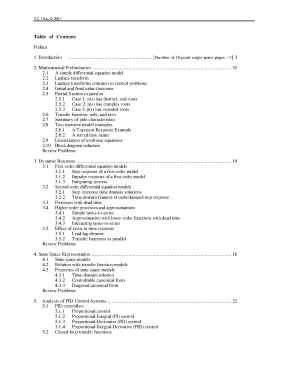
Chau © 2001 Table of Contents Preface 1.1 A simple differential equation model 2.3 Laplace transforms common to control problems 2.4 Initial and final value theorems 2.5 Partial fraction expansion 2.1 Case 1: p(s) has distinct, real roots 2.2 Case 2: p(s) has complex roots 2.3 Case 3: p(s) has repeated roots 2.6 Transfer function, pole, and zero 2.7 Summary of pole characteristics 2.8 Two transient model examples 2.1 A Transient Response Example 2.2 A stirred tank heater 2.9 Linearization of nonlinear equations 2.10 Block diagram reduction Review Problems 3.1 First order differential equation models 3.1 Step response of a first order model 3.2 Impulse response of a first order model 3.2 Second order differential equation models 3.1 Step response time domain solutions 3.2 Time-domain features of underdamped step response 3.3 Processes with dead time 3.4 Higher order processes and approximations 3.1 Simple tanks-in-series 3.2 Approximation with lower order functions with dead time 3.3 Interacting tanks-in-series 3.5 Effect of zeros in time response 3.1 Lead-lag element 3.2 Transfer functions in parallel Review Problems 4. State Space Representation .1 State space models 4.2 Relation with transfer function models 4.3 Properties of state space models 4.1 Time-domain solution 4.2 Controllable canonical form 4.3 Diagonal canonical form Review Problems 5. Analysis of PID Control Systems .2 Proportional-Integral (PI) control 5.3 Proportional-Derivative (PD) control 5.4 Proportional-Integral-Derivative (PID) control 5.2 Closed-loop transfer functions P.1 Closed-loop transfer functions and characteristic polynomials 5.2 How do we choose the controlled and manipulated variables? 5.3 Synthesis of a single-loop feedback system 5.3 Closed-loop system response 5.4 Selection and action of controllers 5.1 Brief comments on the choice of controllers Review Problems 6. Design and Tuning of Single-Loop Control Systems .1 Tuning controllers with empirical relations 6.1 Controller settings based on process reaction curve 6.2 Minimum error integral criteria 6.3 Ziegler-Nichols ultimate-cycle method 6.2 Direct synthesis and internal model control 6.2 Pole-zero cancellation 6.3 Internal model control (IMC) Review Problems 7. Stability of Closed-loop Systems .1 Definition of Stability 7.2 The Routh-Hurwitz Criterion 7.3 Direct Substitution Analysis 7.4 Root Locus Analysis 7.5 Root Locus Design 7.6 A final remark on root locus plots Review Problems 8. Frequency Response Analysis .1 Magnitude and Phase Lag 8.1 The general analysis 8.2 Some important properties 8.2 Graphical analysis tools 8.1 Magnitude and Phase Plots 8.2 Polar Coordinate Plots 8.3 Magnitude vs Phase Plot 8.1 Nyquist Stability criterion 8.2 Gain and Phase Margins 8.1 How do we calculate proportional gain without trial-and-error? 8.2 A final word: Can frequency response methods replace root locus? Review Problems 9. Design of State Space Systems .1 Controllability and Observability 9.2 Pole Placement Design 9.1 Pole placement and Ackermann's formula 9.3 Servo systems with integral control 9.3 State Estimation Design 9.2 Full-order state estimator system 9.4 Reduced-order estimator Review Problems P.3 Feedforward-feedback Control 10.5 Time delay compensation—the Smith predictor 10.6 Multiple-input Multiple-output control 10.1 MIMO Transfer functions 10.2 Process gain matrix 10.3 Relative gain array 10.7 Decoupling of interacting systems 10.1 Alternate definition of manipulated variables 10.3 “Feedforward” decoupling functions Review Problems MATLAB Tutorial Sessions Session 1. Important basic functions .1 Some basic MATLAB commands M1.2 Some simple plotting M1.3 Making M-files and saving the workspace Session 2 Partial fraction and transfer functions.2 Object-oriented transfer functions Session 3 Time response simulation.1 Step and impulse response simulations M3.2 LTI Viewer Session 4 State space functions.1 Conversion between transfer function and state space M4.2 Time response simulation M4.3 Transformations Session 5 Feedback simulation functions.2 Control toolbox functions Session 6 Root locus functions.1 Root locus plots M6.2 Root locus design graphics interface M6.3 Root locus plots of PID control systems Session 7 Frequency response functions.1 Nyquist and Nichols Plots M7.2 Magnitude and Phase Angle (Bode) Plots References. 31 Part I Basics problems Part II Intermediate problems Part III Extensive integrated problems The best approach to control is to think of it as applied mathematics. Virtually everything we do in this introductory course is related to the properties of first and second order differential equations, and with different techniques in visualizing the solutions. Chemical Process Control: A First Course with MATLAB Pao C. Chau University of California, San Diego Preface This is an introductory text written from the perspective of a student. The major concern is not how much material we cover, but rather, how to present the most important and basic concepts that one should grasp in a first course. If your instructor is using some other text that you are struggling to understand, we hope we can help you too. The material here is the result of a process of elimination. The writing and examples are succinct and self-explanatory, and the style is purposely unorthodox and conversational. To a great extent, the style, content, and the extensive use of footnotes are molded heavily by questions raised in class. I left out very few derivation steps. If they were, the missing steps are provided as hints in the Review Problems at the back of each chapter. I strive to eliminate those “easily obtained” results that baffle many of us. Most students should be able to read the material on their own. You just need basic knowledge in differential equations, and it helps if you have taken a course on writing material balances. With the exception of chapters 4, 9, and 10, which should be skipped in a quarter- long course, it also helps if you proceed chapter by chapter. The presentation of material is not intended for someone to just jump right in the middle of the text. We place a very strong emphasis on developing analytical skills. To keep pace with the modern computer era, we also take a coherent and integrated approach to using a computational tool. We believe in active learning. When you read the chapters, it is very important that you have MATLAB with its Control Toolbox to experiment and test the examples firsthand. Notes to Instructors There are probably more introductory texts in control than other engineering disciplines. It is arguable whether we need another control text. As we move into the era of hundred dollar textbooks, I believe we can lighten the economic burden, and with the Internet, assemble a new generation of modularized texts that soften the printing burden by off loading selected material to the Web. Still a key resolve is to scale back on the scope of a text to the most crucial basics. How much students can, or be enticed to, learn is inversely proportional to the number of pages that they have to read—akin to diminished magnitude and increased lag in frequency response. So as textbooks become thicker over the years in attempts to reach out to students and are excellent resources from the perspective of instructors, these texts are by no means more effective pedagogical tools. This project was started as a set of review notes when I found students having trouble identifying the key concepts in these expansive texts. I also found these texts in many circumstances deter students from active learning and experimenting on their own. At this point, the contents are scaled down to fit a one-semester course. On a quarter system, Chapters 4, 9, and 10 can be omitted. With the exception of two chapters (4 and 9) on state space models, the organization has “evolved” to become very classical. The syllabus is chosen such that students can get to tuning PID controllers before they lose interest. Furthermore, discrete-time analysis has been discarded. If there is to be one introductory course in the undergraduate curriculum, it is very important to provide an exposure to state space models as a bridge to a graduate level course. The last chapter on mutliloop systems is a collection of topics that are usually handled by several chapters in a formal text. This chapter is written such that only the most crucial concepts are illustrated and that it could be incorporated comfortably in a one-semester curriculum. For schools with the luxury of two control courses in the curriculum, this last chapter should provide a nice introductory transition. Because the material is so restricted, we emphasize that this is a "first course" textbook, lest a student might mistakenly ignore the immense expanse of the control field. We also have omitted appendices and extensive references. As a modularized tool, we use our Web Support to provide references, support material, and detailed MATLAB plots and results. Homework problems are also handled differently. At the end of each chapter are short, mostly derivation type, problems which we call Review Problems. Hints or solutions are provided for these exercises. To enhance the skill of problem solving, we take the extreme approach, more so than Stephanopoulos (1984), of collecting major homework problems at the back and not at the end of each chapter. Our aim is to emphasize the need to understand and integrate knowledge, a virtue that is endearing to ABET, the engineering accreditation body in the United States. These problems do not even specify the associated chapter as many of them involve different techniques. A student has to determine the appropriate route of attack. An instructor may find it aggravating to assign individual parts of a problem, but when all the parts are solved, we hope the exercise would provide a better perspective to how different ideas are integrated. To be an effective teaching tool, this text is intended for experienced instructors who may have a wealth of their own examples and material, but writing an introductory text is of no interest to them. The concise coverage conveniently provides a vehicle with which they can take a basic, minimalist set of chapters and add supplementary material that they deem appropriate. Even without supplementary material, however, this text contains the most crucial material and there should not be a need for an additional expensive, formal text. While the intended teaching style relies heavily on the use of MATLAB , the presentation is very different from texts which prepare elaborate M-files and even menu-driven interfaces. One of the reasons why MATLAB is such a great tool is that it does not have a steep learning curve. Students can quickly experiment on their own. Spoon-feeding with our misguided intention would only destroy the incentive to explore and learn on one's own. To counter this pitfall, strong emphasis is placed on what one can accomplish easily with only a few MATLAB statements. MATLAB is introduced as walk- through tutorials that encourage students to enter commands on their own. As strong advocates of active learning, we do not duplicate MATLAB results. Students, again, are encouraged to execute the commands themselves. In case help is needed, our Web Support, however, has the complete set of MATLAB results and plots. This organization provides a more coherent discourse on how one can make use of different features of MATLAB, not to mention saving significant printing costs. Finally, we can revise the tutorials easily to keep up with the continual upgrade of MATLAB. At this writing, the tutorials are based on MATLAB version 5.3, and the object-oriented functions in the Control Toolbox version 4.0 is also utilized, but its scope is limited to simulating more complex control systems. As a first course text, the development of models is limited to stirred-tanks, stirred tank heater, and a few other examples that are used extensively and repeatedly throughout the chapters. Our philosophy is one step back in time. The focus is the theory and the building of a foundation that may help to solve other problems. The design is also to be able to launch into the topic of tuning controllers before students may lose interest. The coverage of Laplace transform is not entirely a concession to remedial mathematics. The examples are tuned to illustrate immediately how pole positions may relate to time domain response. Furthermore, students tend to be confused by the many different design methods. As much as I can, especially in the controller design chapters, the same examples are used throughout.

Nội dung được bảo vệ bản quyền — Tải xuống đầy đủ