Tổng quan học thuật về giáo trình Biochemistry (Fifth Edition)
Tổng quan về giáo trình
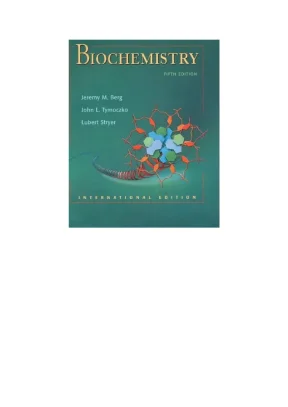
Biochemistry (Tái bản lần thứ 5) là giáo trình học thuật chuẩn mực được biên soạn bởi ba tác giả: Giáo sư Jeremy M. Berg (Trưởng khoa Lý sinh và Hóa lý sinh tại Đại học Y khoa Johns Hopkins), Giáo sư John L. Tymoczko (Giáo sư Sinh học tại Đại học Carleton) và Giáo sư Lubert Stryer (Giáo sư Danh dự tại Đại học Stanford, tác giả của ấn bản đầu tiên xuất bản năm 1975). Tác phẩm do Nhà xuất bản W. H. Freeman and Company phát hành.
+-------------------------------------------------------------------------+
|                      BIOCHEMISTRY (FIFTH EDITION)                       |
|           Jeremy M. Berg  |  John L. Tymoczko  |  Lubert Stryer         |
+-------------------------------------------------------------------------+
                                    |
       +----------------------------+----------------------------+
       |                            |                            |
+--------------+             +--------------+             +--------------+
|   PHẦN I     |             |   PHẦN II    |             |  PHẦN III    |
| Thiết kế     |             | Chuyển hóa & |             | Tổng hợp các |
| phân tử      |             | Lưu trữ      |             | phân tử      |
| của sự sống  |             | năng lượng   |             | của sự sống  |
| (Chương 1-13)|             | (Chương14-23)|             | (Chương24-31)|
+--------------+             +--------------+             +--------------+
                                    |
                             +--------------+
                             |   PHẦN IV    |
                             | Đáp ứng biến |
                             | đổi môi      |
                             | trường       |
                             | (Chương32-34)|
                             +--------------+
Trong chương trình đào tạo đại học và sau đại học, giáo trình giữ vị trí môn học cơ sở chuyên ngành cốt lõi thuộc các khối ngành Hóa học, Sinh học, Y đa khoa, Dược học và Công nghệ sinh học. Mục tiêu học tập (learning outcomes) của tài liệu bao gồm:
- Xây dựng hiểu biết về cấu trúc không gian ba chiều của các đại phân tử sinh học và mối liên hệ nhân quả giữa cấu trúc với chức năng sinh học.
- Nắm vững các quy luật nhiệt động học điều khiển phản ứng sinh hóa và các con đường biến dưỡng năng lượng trong tế bào.
- Giải thích cơ chế truyền đạt, biểu hiện thông tin di truyền ở cấp độ phân tử.
- Phân tích các con đường truyền tín hiệu và cơ chế thích ứng sinh hóa của cơ thể sống trước các biến đổi môi trường.
Cấu trúc giáo trình gồm 34 chương được tổ chức thành 4 phần chính:
- Phần I: The Molecular Design of Life (Thiết kế phân tử của sự sống, Chương 1–13)
- Phần II: Transducing and Storing Energy (Chuyển hóa và tích trữ năng lượng, Chương 14–23)
- Phần III: Synthesizing the Molecules of Life (Tổng hợp các phân tử của sự sống, Chương 24–31)
- Phần IV: Responding to Environmental Changes (Đáp ứng với các biến đổi môi trường, Chương 32–34)
Phần cuối sách tích hợp ba phụ lục chuyên khảo (Phụ lục A: Hằng số vật lý và chuyển đổi đơn vị; Phụ lục B: Hằng số acid; Phụ lục C: Chiều dài liên kết tiêu chuẩn), Bảng thuật ngữ các hợp chất (Glossary of Compounds) và Danh mục ký hiệu viết tắt trong Hóa sinh. Cách tiếp cận của giáo trình lấy thuyết tiến hóa sinh học và dữ liệu giải mã hệ gene (genomics) làm trục tư duy xuyên suốt, gắn liền cấu trúc phân tử với bệnh học lâm sàng ở người.
Nội dung kiến thức cốt lõi
Các chương và chủ đề chính
Giáo trình triển khai hệ thống kiến thức từ mức độ nguyên tử, phân tử đơn lẻ đến các con đường chuyển hóa phức tạp và hệ thống sinh học hoàn chỉnh:
- Chương 1: Prelude: Biochemistry and the Genomic Revolution: Đặt nền móng về mối quan hệ giữa cấu trúc và chức năng phân tử thông qua mô hình DNA; khái quát 3 miền sinh giới (Eukarya, Bacteria, Archaea) do Carl Woese phân loại; phân tích bản chất liên kết hóa học, nhiệt động học phản ứng và ảnh hưởng của môi trường nước.
- Chương 3–4: Protein Structure, Function, and Purification: Khảo sát 20 amino acid tiêu chuẩn; các bậc cấu trúc protein (bậc 1, bậc 2 dạng $\alpha$-helix và $\beta$-sheet, bậc 3 dạng cuộn nén và bậc 4 đa tiểu phần); nguyên lý thoái biến Edman tự động, tinh thể học tia X (X-ray crystallography) và phổ cộng hưởng từ hạt nhân (NMR) để xác định cấu trúc 3D.
- Chương 8–10: Enzymes and Regulatory Strategies: Phân tích cơ chế xúc tác phản ứng thông qua trạng thái chuyển tiếp (transition state); động học enzyme theo mô hình Michaelis-Menten; phương pháp đồ thị nghịch đảo kép xác định $V_{max}$ và $K_M$; các cơ chế điều hòa dị lập thể (allosteric) trên enzyme Aspartate Transcarbamoylase và phân tử Hemoglobin.
- Chương 14, 16–18: Metabolism, Glycolysis, Citric Acid Cycle, and Oxidative Phosphorylation: Trình bày mạng lưới các phản ứng ghép đôi và vai trò trung tâm của phân tử ATP; quy trình 10 bước đường phân (Glycolysis) và con đường tân tạo đường (Gluconeogenesis); chu trình acid citric oxy hóa đơn vị 2-carbon; chuỗi chuyền electron hô hấp gồm 4 phức hệ protein tại màng trong ty thể nhằm tạo gradient proton dẫn động tổng hợp ATP.
- Chương 19–20: Photosynthesis, Calvin Cycle, and Pentose Phosphate Pathway: Cơ chế hấp thụ ánh sáng của diệp lục; sự phối hợp giữa hai hệ quang hóa (Photosystem I và II) để tạo NADPH và chênh lệch proton qua màng thylakoid; chu trình Calvin tổng hợp hexose từ $\text{CO}_2$ và con đường pentose phosphate tạo NADPH cùng đường 5-carbon.
- Chương 27–29: DNA Replication, RNA Transcription, and Protein Synthesis: Cơ chế sao chép DNA bán bảo tồn nhờ DNA polymerase; quá trình phiên mã tạo mRNA và cắt nối intron/exon ở sinh vật nhân thực; cơ chế giải mã bộ ba trên ribosome $70\text{S}$ (gồm tiểu phần $30\text{S}$ và $50\text{S}$) với sự tham gia của aminoacyl-tRNA synthetase.
- Chương 32–34: Physiology and Environmental Responses: Khám phá cơ chế phân tử của hệ thống cảm giác (khứu giác, vị giác, thị giác qua phân tử quang thụ thể, thính giác, xúc giác); hệ miễn dịch (khung cấu trúc $\beta$-sandwich của kháng thể, phức hệ hòa hợp mô MHC và thụ thể tế bào T); các động cơ phân tử thuộc siêu họ P-loop NTPase gồm Myosin, Kinesin và Dynein.
[Nhiệt động học & Liên kết hóa học] (Chương 1)
[Cấu trúc Protein, Nucleic Acid, Lipid & Màng] (Chương 2–13)
[Chuyển hóa năng lượng: Đường phân, TCA, Chuỗi hô hấp, Quang hợp] (Chương 14–23)
[Sinh tổng hợp: Amino acid, Lipid màng, Nucleotide, DNA, RNA, Protein] (Chương 24–31)
[Đáp ứng sinh lý & Môi trường: Thần kinh cảm giác, Miễn dịch, Động cơ phân tử] (Chương 32–34)
Kiến thức nền tảng được xây dựng
Giáo trình thiết lập hệ thống lý thuyết và nguyên lý định lượng chặt chẽ:
- Nguyên lý nhiệt động sinh học (Bioenergetics): Định luật I bảo toàn năng lượng và Định luật II về biến thiên entropy ($\Delta S$). Công thức năng lượng tự do Gibbs:
$$\Delta G = \Delta H_{\text{system}} - T\Delta S_{\text{system}}$$
Một phản ứng sinh hóa chỉ xảy ra tự phát khi $\Delta G < 0$.
- Lý thuyết tương tác phân tử phi cộng hóa trị:
- Tương tác tĩnh điện tuân theo định luật Coulomb:
$$E = \frac{k \cdot q_1 \cdot q_2}{D \cdot r}$$
(trong đó hằng số điện môi của nước $D = 80$, $k = 332,\text{kcal}\cdot\text{\AA}/\text{mol}$ hoặc $1389,\text{kJ}\cdot\text{\AA}/\text{mol}$).
- Liên kết hydro có năng lượng $1\text{–}3,\text{kcal/mol}$ ($4\text{–}13,\text{kJ/mol}$) với khoảng cách liên kết $1.5\text{–}2.6,\text{\AA}$.
- Tương tác van der Waals với năng lượng $0.5\text{–}1.0,\text{kcal/mol}$ ($2\text{–}4,\text{kJ/mol}$) tại khoảng cách tiếp xúc.
- Hiệu ứng kỵ nước (hydrophobic effect) thúc đẩy quá trình cuộn gấp chuỗi polypeptide do sự giải phóng các phân tử nước có cấu trúc lồng solvate quanh các chuỗi bên không phân cực, làm tăng tổng entropy của hệ thống.
- Hóa sinh tiến hóa và thuyết nguồn gốc sinh học: Quá trình tổng hợp phân tử hữu cơ vô sinh (thí nghiệm Miller-Urey tạo ra glycine, alanine, acid glutamic, leucine từ hỗn hợp $\text{CH}_4, \text{NH}_3, \text{H}_2\text{O}, \text{H}_2$; phản ứng ngưng tụ $\text{HCN}$ tạo adenine); tiến hóa phân tử in vitro qua thí nghiệm của Sol Spiegelman (1967) với RNA của thực khuẩn thể $\text{Q}\beta$; vai trò xúc tác của enzyme RNA (ribozyme hammerhead) do Tom Cech và Sidney Altman phát hiện.
Kỹ năng phát triển
Người học được rèn luyện các nhóm năng lực kỹ thuật và phân tích:
- Kỹ năng phân tích cấu trúc hóa học: Khả năng đọc hiểu và chuyển đổi giữa các dạng biểu diễn phân tử, bao gồm công thức chiếu Fischer, mô hình không gian đầy đủ (space-filling), mô hình bi-que (ball-and-stick), mô hình khung xương (skeletal), sơ đồ ruy-băng (ribbon diagram biểu diễn $\alpha$-helix và $\beta$-strand) và mô hình bề mặt tích điện (surface representation).
- Kỹ năng phân tích định lượng: Khảo sát động học phản ứng enzyme; xác định các thông số $V_{max}, K_M$ qua đồ thị Lineweaver-Burk; tính toán cân bằng acid-base và hệ đệm sinh học dựa trên hằng số $pK_a$ (Phụ lục B).
- Năng lực biện giải cơ chế bệnh học phân tử: Khả năng truy xuất liên hệ giữa biến dị nucleotide và kiểu hình bệnh lý, ví dụ hiện tượng mất 3 cặp base dẫn đến khuyết thiếu 1 amino acid trong chuỗi 1480 amino acid của protein vận chuyển ion CFTR (nằm trên dải $q31.2$ của nhiễm sắc thể số 7), gây ra bệnh xơ nang (cystic fibrosis).
Phương pháp giảng dạy và học tập
Giáo trình sử dụng phương pháp sư phạm tiếp cận đa chiều, tích hợp lý thuyết cơ chế với phân tích đồ họa không gian:
+-------------------------------------------------------------------------+
|                  KHUNG PHƯƠNG PHÁP SƯ PHẠM VÀ HỌC TẬP                   |
+-------------------------------------------------------------------------+
- Cách tiếp cận sư phạm (Pedagogical approach): Triển khai nội dung theo trình tự logic diễn dịch: bắt đầu từ các nguyên lý hóa lý cơ bản (liên kết, nhiệt động học), tiến đến cấu trúc từng đại phân tử, sau đó tích hợp vào chuỗi phản ứng liên hoàn và mạng lưới điều hòa toàn diện. Các cơ chế phản ứng hóa học được minh họa chi tiết bằng quy ước mũi tên cong (arrow pushing) thể hiện sự dịch chuyển của các cặp electron.
- Hệ thống bài tập và nghiên cứu trường hợp (Problems & Case studies): Mỗi chương kết thúc bằng phần Tóm tắt nội dung (Summary), Hệ thống câu hỏi bài tập tự luận/tính toán (Problems) và Danh mục tài liệu tham khảo chọn lọc (Selected Readings). Các ca bệnh thực tế được đưa vào trực tiếp để kiểm chứng lý thuyết: cơ chế gây bệnh u xơ nang do khuyết tật kênh CFTR, nguyên nhân gây đột quỵ và nhồi máu cơ tim liên quan đến chuyển hóa lipoprotein tỷ trọng cao (HDL chứa apolipoprotein A-I), thiếu máu hồng cầu hình liềm hay ngộ độc chuyển hóa do cồn (ethanol) tại gan.
- Thực hành và đánh giá (Exercises & Assessments): Cung cấp bài toán xác định trình tự peptide, phân tích đồ thị ức chế enzyme cạnh tranh và không cạnh tranh, giải thích đột biến vị trí điểm (site-specific mutagenesis) và tái tổ hợp DNA.
- Tài nguyên tự học đa phương tiện: Hệ thống website đi kèm giáo trình (do Neil Clarke, Sonia DiVittorio và Mark Santee quản lý) tích hợp:
- Các mô-đun Conceptual Insights (do nhóm CADRE design phát triển) cung cấp hình ảnh động mô phỏng cơ chế động học.
- Các mô-đun Structural Insights (do Timothy Driscoll tại molvisions.com phát triển) cho phép người học xoay và trực quan hóa cấu trúc phân tử 3 chiều.
- Hệ thống câu hỏi kiểm tra trực tuyến (Online quizzes) do Davis (Đại học Arkansas) biên soạn.
Điểm nổi bật và cập nhật
Ấn bản thứ năm ghi nhận những bước chuyển đổi nội dung khoa học đáng chú ý:
| Danh mục cập nhật |
Nội dung chi tiết trong ấn bản thứ 5 |
| Dữ liệu hệ gene người |
Tích hợp dữ liệu giải trình tự hơn 3 tỷ cặp base của bộ gene người (Human Genome Project), xác định vị trí gen gây bệnh (như locus $q31.2$ trên nhiễm sắc thể 7). |
| Hóa sinh tiến hóa |
Đưa tiến hóa làm trục liên kết nội dung; phân tích cây phát sinh loài dựa trên so sánh trình tự chuỗi sinh học; áp dụng phân loại 3 miền của Carl Woese. |
| Cấu trúc phân tử 3D |
Bổ sung hàng trăm mô hình phân tử độ phân giải cao kết xuất từ dữ liệu nhiễu xạ tia X và phổ NMR; ứng dụng đồng thời sơ đồ dải ruy-băng và bản đồ bề mặt điện tích. |
| Y sinh & Công nghiệp |
Cơ chế thuốc ức chế protease kháng virus HIV; kỹ thuật protein tái tổ hợp tạo insulin; ứng dụng kiến thức hóa sinh phân tử trong phát triển hương liệu (như công ty Senomyx). |
- Tích hợp cuộc cách mạng hệ gene (Genomic Revolution): Toàn bộ cấu trúc giáo trình được cập nhật dựa trên thành tựu của dự án giải mã hệ gene người. Bản thảo kết nối trực tiếp các dữ liệu trình tự DNA với biểu hiện tính trạng và bệnh lý di truyền.
- Định hình tư duy qua lăng kính tiến hóa: Thay vì trình bày các phản ứng sinh hóa một cách cô lập, giáo trình phân tích lý do tại sao một con đường chuyển hóa lại được chọn lọc tự nhiên lưu giữ, chỉ ra tính thống nhất hóa sinh (Biochemical unity) bên dưới sự đa dạng sinh học (Biological diversity).
- Đột phá về đồ họa cấu trúc phân tử: Phối hợp với các chuyên gia nhiễu xạ tia X và đồ họa cấu trúc để tái hiện trực quan cấu trúc bậc ba, bậc bốn của các phức hệ lớn như ribosome $70\text{S}$, phức hệ thụ thể bắt cặp G-protein (7TM receptors), kênh ion xuyên màng và động cơ phân tử.
- Gắn kết thực tiễn y dược học và công nghệ sinh học: Trình bày cơ chế thiết kế thuốc hợp lý (rational drug design), liệu pháp can thiệp đích phân tử, ứng dụng DNA probe trong chẩn đoán lâm sàng và công nghệ tạo giống cây trồng chuyển gene trong nông nghiệp.
Đối tượng sử dụng giáo trình
Giáo trình Biochemistry (Fifth Edition) được thiết kế phục vụ các nhóm đối tượng trong môi trường học thuật:
                             ĐỐI TƯỢNG SỬ DỤNG
[Sinh viên đại học]          [Giảng viên đại học]         [Học viên Sau ĐH &]
- Ngành: Hóa học, Sinh học,  - Giảng dạy Hóa sinh cơ bản  [Nhà nghiên cứu]
  Y đa khoa, Dược học, CNSH. - Xây dựng đề cương chuyên sâu- Tra cứu hằng số hóa lý
- Cấp độ: Năm 2 đến năm 4.   - Thiết kế bài tập đánh giá  - Nghiên cứu cơ chế phân tử
- Sinh viên đại học: Sinh viên từ năm thứ hai đến năm thứ tư thuộc các chuyên ngành Khoa học Sự sống, Hóa học, Y học lâm sàng, Dược học, Công nghệ sinh học và Khoa học môi trường.
- Yêu cầu kiến thức tiên quyết (Prerequisites): Người học cần hoàn thành các học phần nền tảng gồm:
- Hóa học hữu cơ: Nắm vững các nhóm chức, danh pháp, hóa học lập thể (đồng phân quang học, cấu hình không gian) và cơ chế phản ứng hữu cơ.
- Sinh học đại cương: Cấu tạo tế bào nhân sơ (prokaryote) và nhân thực (eukaryote), các bào quan cơ bản.
- Vật lý & Hóa đại cương: Nguyên lý cơ bản về nhiệt động lực học, cân bằng hóa học, liên kết ion/cộng hóa trị và điện hóa học.
- Giảng viên: Tài liệu cung cấp khung chương trình chuẩn hóa 34 chương để thiết kế bài giảng cho học phần Hóa sinh học đại cương (từ 1 đến 2 học kỳ) hoặc các học phần chuyên sâu như Hóa sinh cấu trúc, Biến dưỡng trung gian, Sinh học phân tử của tế bào.
- Học viên sau đại học và nhà nghiên cứu: Tài liệu tham khảo chuẩn mực để tra cứu các hằng số phân ly acid ($pK_a$), thông số liên kết, cơ chế xúc tác của enzyme và các phương pháp tinh sạch đại phân tử sinh học.
Câu hỏi thường gặp (FAQ)
1. Giáo trình này phù hợp với đối tượng nào?
Tài liệu được biên soạn cho sinh viên đại học khối ngành Khoa học Tự nhiên, Y - Dược, Công nghệ sinh học, học viên cao học, nghiên cứu sinh và các chuyên gia nghiên cứu trong lĩnh vực Khoa học Sự sống.
2. Cần chuẩn bị những kiến thức nền tảng nào trước khi học?
Người học cần trang bị kiến thức về Hóa hữu cơ (cấu trúc phân tử, các nhóm chức năng, phản ứng chuyển dịch electron), Sinh học tế bào cơ bản và các nguyên lý Nhiệt động học đại cương (năng lượng, nhiệt độ, entropy).
3. Điểm khác biệt của giáo trình này so với các tài liệu Hóa sinh khác là gì?
Giáo trình sử dụng thuyết tiến hóa làm sợi dây liên kết toàn bộ nội dung, tích hợp sâu dữ liệu giải mã hệ gene người, đồng thời minh họa trực quan cấu trúc không gian 3 chiều của đại phân tử bằng 5 kỹ thuật đồ họa chuyên biệt.
4. Làm thế nào để tự học giáo trình này hiệu quả?
Người học nên kết hợp đọc hiểu lý thuyết cơ chế với việc quan sát mô hình cấu trúc 3D, tự giải quyết hệ thống bài tập (Problems) ở cuối mỗi chương và tra cứu các thông số định lượng trong hệ thống phụ lục A, B, C.
5. Giáo trình có những tài liệu và công cụ bổ trợ nào đi kèm?
Đi kèm giáo trình là hệ thống website trực tuyến với các hoạt họa Conceptual Insights, công cụ trực quan hóa phân tử 3 chiều Structural Insights, ngân hàng đề thi trắc nghiệm trực tuyến cùng danh mục tra cứu thuật ngữ hợp chất (Glossary of Compounds).
Kết luận
Giáo trình Biochemistry (Fifth Edition) của Jeremy M. Berg, John L. Tymoczko và Lubert Stryer cung cấp hệ thống tri thức hóa sinh học phân tử chặt chẽ, kết hợp hài hòa giữa nguyên lý hóa lý, dữ liệu cấu trúc không gian và cơ chế tiến hóa sinh học. Lộ trình học tập đề xuất:
[Phần I: Thiết kế phân tử & Động học Enzyme]
[Phần II: Biến dưỡng & Chuyển hóa Năng lượng]
[Phần III: Sinh tổng hợp & Truyền thông tin Di truyền]
[Phần IV: Hệ thống Cảm giác, Miễn dịch & Động cơ Phân tử]
Để tối ưu hóa quá trình tiếp thu, người học nên khai thác đồng thời các bảng tra cứu hằng số chuyên sâu ở phần phụ lục và các mô-đun mô phỏng kỹ thuật số đi kèm giáo trình.