Tổng quan luận án
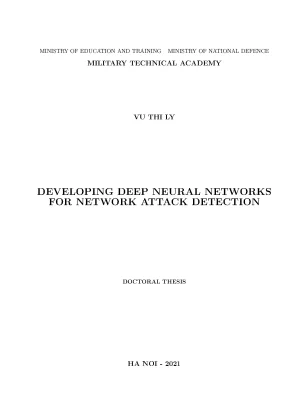
Luận án tiến sĩ với đề tài "Phát Triển Mạng Nơ-Ron Sâu Để Phát Hiện Tấn Công Mạng" (tên tiếng Anh: Developing Deep Neural Networks for Network Attack Detection) do nghiên cứu sinh Vũ Thị Ly thực hiện tại Học viện Kỹ thuật Quân sự, thuộc chuyên ngành Cơ sở Toán học cho Tin học (Mã số: 946 0110), dưới sự hướng dẫn khoa học của PGS. Nguyễn Quang Uy và GS. Eryk Dutkiewicz, bảo vệ năm 2021 tại Hà Nội.
Tính cấp thiết và khoảng trống nghiên cứu
Sự phát triển của hạ tầng truyền thông và công nghệ thông tin dẫn đến sự gia tăng lưu lượng dữ liệu mạng toàn cầu. Theo dự báo của Cisco được trích dẫn trong luận án, lưu lượng Giao thức Internet (IP) toàn cầu tăng gần gấp ba lần trong 5 năm và tăng 127 lần từ năm 2005 đến năm 2021, với tốc độ tăng trưởng kép hàng năm (CAGR) đạt 24% giai đoạn 2016–2021. Sự gia tăng này đi kèm với các nguy cơ an ninh mạng; thống kê chỉ ra rằng 53% các cuộc tấn công mạng gây thiệt hại tài chính vượt quá 500.000 USD. Việc phát hiện sớm các cuộc tấn công mạng đóng vai trò bảo đảm tính bí mật, toàn vẹn và sẵn sàng của hệ thống thông tin.
Mặc dù các kỹ thuật học máy và học sâu đã được áp dụng trong bài toán phát hiện tấn công mạng (Network Attack Detection - NAD), tác giả chỉ ra ba khoảng trống và thách thức kỹ thuật lớn chưa được giải quyết trọn vẹn:
- Tính không đồng nhất và phức tạp của lưu lượng mạng: Sự đa dạng của các môi trường mạng khiến việc biểu diễn dữ liệu lưu lượng mạng cho các thuật toán phân loại học máy gặp nhiều khó khăn.
- Sự mất cân bằng dữ liệu nghiêm trọng: Dữ liệu tấn công thường khó thu thập hơn nhiều so với dữ liệu lưu lượng bình thường. Khi huấn luyện trên các tập dữ liệu bị lệch (skewed/imbalanced datasets), các thuật toán học máy truyền thống thường bị thiên lệch và giảm độ chính xác.
- Sự thiếu hụt thông tin nhãn trong các miền mới: Trong môi trường như mạng Internet vạn vật (IoT), việc thu thập lưu lượng từ tất cả các thiết bị bị hạn chế bởi vấn đề quyền riêng tư. Khi mô hình được huấn luyện trên một thiết bị (miền nguồn) rồi áp dụng cho thiết bị khác (miền đích), sự khác biệt về phân phối dữ liệu làm suy giảm hiệu năng phát hiện.
Mục tiêu nghiên cứu
Luận án xác định mục tiêu tổng quát là phát triển các mô hình mạng nơ-ron sâu phục vụ phân tích dữ liệu an ninh mạng nhằm nâng cao độ chính xác của các hệ thống NAD, cụ thể giải quyết ba bài toán:
- Xây dựng kỹ thuật học biểu diễn (representation learning) nhằm chiếu dữ liệu bình thường và dữ liệu tấn công (gồm cả tấn công đã biết và chưa biết) vào hai vùng không gian phân tách.
- Xây dựng kỹ thuật sinh mẫu tấn công nhân tạo dựa trên các mô hình sinh sâu (Generative Adversarial Network - GAN và AutoEncoder - AE) để cân bằng dữ liệu huấn luyện.
- Xây dựng mô hình học chuyển giao sâu (Deep Transfer Learning - DTL) cho phép chuyển giao tri thức từ thiết bị có nhãn sang thiết bị không có nhãn nhằm nhận dạng tấn công mà không cần gán nhãn dữ liệu đích.
Đối tượng và phạm vi nghiên cứu
- Đối tượng nghiên cứu: Các cấu trúc và thuật toán mạng nơ-ron sâu (AutoEncoder, Denoising AutoEncoder, Variational AutoEncoder, Generative Adversarial Network, Auxiliary Classifier GAN, Adversarial AutoEncoder và Deep Transfer Learning) ứng dụng trong phát hiện tấn công mạng.
- Phạm vi dữ liệu thực nghiệm: Luận án thực nghiệm trên hơn 10 tập dữ liệu an ninh mạng, bao gồm 2 tập dữ liệu tấn công mạng máy tính (NSL-KDD, UNSW-NB15), 3 kịch bản mã độc từ hệ thống CTU-13 (Menti, NSIS.ay, Virus), và 9 tập dữ liệu tấn công trên thiết bị IoT thương mại (Bot-IoT) với hai họ botnet Mirai và BASHLITE (Gafgyt).
- Phạm vi tính toán và mô hình: Tập trung vào các biến thể dựa trên kiến trúc AE và GAN; các thực nghiệm được kiểm chứng thống nhất trên nền tảng phần cứng CPU Intel Core i5-5200U, RAM 4GB, hệ điều hành Ubuntu 16.04 (64-bit).
Tổng quan tài liệu và vị trí của luận án
Trong Chương 1, luận án hệ thống hóa các hướng tiếp cận chính trong bài toán phát hiện tấn công mạng, gồm ba nhóm phương pháp:
Các hướng nghiên cứu trước đây
- Phương pháp dựa trên tri thức (Knowledge-based methods): Sử dụng các luật hoặc chữ ký định trước để khớp với hành vi mạng. Các kỹ thuật điển hình gồm so khớp chuỗi chữ ký mẫu, sử dụng máy trạng thái hữu hạn để biểu diễn luồng thực thi, định nghĩa cú pháp luật hoặc kết hợp kỹ sư tri thức với chuyên gia miền. Nhóm này phát hiện nhanh và chính xác các tấn công đã biết nhưng đòi hỏi tri thức chuyên gia chất lượng cao và không có khả năng phát hiện tấn công mới (zero-day).
- Phương pháp dựa trên thống kê (Statistical-based methods): Xây dựng hồ sơ phân phối của lưu lượng bình thường và xác định các hành vi có xác suất thấp là tấn công thông qua các độ đo như trung bình, trung vị, độ lệch chuẩn, entropy thông tin, entropy có điều kiện, độ lợi thông tin, phân tích chuỗi thời gian. Nhóm này đơn giản nhưng độ chính xác chưa cao và phụ thuộc nhiều vào việc thiết lập ngưỡng cảnh báo.
- Phương pháp dựa trên học máy (Machine learning-based methods):
- Học không giám sát và bán giám sát: Sử dụng phân cụm K-means để giảm kích thước gói tin, thuật toán Mean Shift Clustering kết hợp Support Vector Machine (SVM) trên mạng cảm biến không dây, hoặc kết hợp Local Outlier Factor với One-Class SVM. Các phương pháp này phát hiện được tấn công chưa biết nhưng hiệu năng đối với tấn công đã biết thấp hơn và vẫn yêu cầu điều chỉnh ngưỡng phân loại thủ công.
- Học có giám sát: Ứng dụng SVM với các hàm nhân tuyến tính, bậc hai, Gaussian; các thuật toán cây quyết định như Random Forest (RF), Decision Stump, J48, Iterative Dichotomiser 3 (ID3); K-Nearest Neighbor (KNN). Các kỹ thuật này phát hiện tấn công đã biết tốt nhưng suy giảm hiệu năng rõ rệt khi dữ liệu huấn luyện bị mất cân bằng hoặc khi gặp dạng tấn công mới.
- Xử lý mất cân bằng dữ liệu:
- Cost-sensitive learning: Gán trọng số phạt cao hơn cho lớp thiểu số ở mức thuật toán hoặc trong hàm mất mát của mạng sâu.
- Re-sampling và Ensemble: Các kỹ thuật lấy mẫu như SMOTE, SMOTE-SVM, BalanceCascade, EasyEnsemble, Tomek Link. Hạn chế của việc lấy mẫu truyền thống là có thể làm mất thông tin của lớp đa số hoặc làm sai lệch phân phối dữ liệu gốc.
- Mô hình sinh sâu: Ứng dụng GAN, ACGAN, Supervised Adversarial AutoEncoder (SAAE), Conditional Variational AutoEncoder (CVAE) để sinh ảnh và dữ liệu đặc thù.
- Học biểu diễn và học chuyển giao sâu:
- Ứng dụng AE, Shrink AE (SAE), Dirac Delta VAE (DVAE), Deep Belief Network (DBN), Convolutional Neural Network (CNN) 1 chiều. Các mô hình SAE và DVAE trước đó chủ yếu hoạt động theo dạng bán giám sát từ dữ liệu bình thường, chưa tận dụng thông tin nhãn tấn công và chưa mở rộng cho bài toán đa lớp.
- Các kỹ thuật Deep Transfer Learning dựa trên độ đo khoảng cách như Maximum Mean Discrepancy (MMD) hoặc Kullback-Leibler (KL) divergence (ví dụ: SKL-AE, SMD-AE) trước đây chỉ thực hiện chuyển giao tri thức tại lớp cổ chai (bottleneck layer).
Khoảng trống luận án giải quyết
Luận án lấp đầy các khoảng trống nghiên cứu bằng cách:
- Đề xuất hàm mất mát có số hạng chính quy hóa cho mô hình AE/DAE/VAE để phân tách chủ động cả tấn công đã biết và chưa biết ra khỏi vùng dữ liệu bình thường trong không gian ẩn.
- Phát triển mô hình sinh có điều kiện kết hợp bộ phân loại và cơ chế lấy mẫu đường biên nhằm tạo ra các mẫu tấn công nhân tạo bám sát phân phối dữ liệu gốc.
- Thiết lập cơ chế thích ứng miền học chuyển giao sâu nhiều tầng (multi-layer encoding transfer) dựa trên độ đo MMD thay vì chỉ chuyển giao tại tầng cổ chai duy nhất.
Cơ sở lý thuyết và phương pháp nghiên cứu
Cơ sở lý thuyết và các khái niệm sử dụng
- Mạng nơ-ron sâu (Deep Neural Networks): Thiết lập ánh xạ phi tuyến $y = f(x, \theta)$ từ không gian đầu vào sang không gian đầu ra nhằm tối ưu hóa các tham số $\theta$ qua quá trình học có giám sát hoặc không giám sát.
- Kiến trúc AutoEncoder (AE) và các biến thể:
- AutoEncoder cơ bản: Gồm bộ mã hóa $q_\phi$ chuyển đổi đầu vào $x_i$ thành biểu diễn ẩn $z_i$, và bộ giải mã $p_\theta$ tái tạo đầu ra $\hat{x}_i$. Hàm mất mát tính theo sai số toàn phương trung bình (Mean Squared Error - MSE).
- Denoising AutoEncoder (DAE): Bổ sung nhiễu Gauss đẳng hướng $x_{noise} \sim \mathcal{N}(0, \sigma_{noise}^2)$ vào đầu vào $x$ tạo thành $\tilde{x} = x + x_{noise}$ nhằm ép mô hình học phân phối thực của dữ liệu thay vì học hàm đồng nhất.
- Variational AutoEncoder (VAE): Không gian ẩn được mô hình hóa thành hàm mật độ xác suất Gauss $q_\phi(z|x)$. Hàm mất mát gồm sai số tái tạo (Reconstruction Error) và phân kỳ Kullback-Leibler ($D_{KL}$) đo khoảng cách giữa $q_\phi(z|x)$ và phân phối tiên nghiệm chuẩn tắc $\mathcal{N}(0, I)$, áp dụng kỹ thuật tái tham số hóa (re-parameterization).
- Adversarial AutoEncoder (AAE): Thay thế phân kỳ KL bằng mạng đối kháng (Discriminator) để chuẩn hóa không gian ẩn theo phân phối bất kỳ. Quá trình huấn luyện chia thành hai pha: Pha tái tạo (Reconstruction Phase - RP) và Pha chính quy hóa (Regularization Phase - RG).
- Mô hình sinh đối kháng (GAN, ACGAN): GAN gồm mạng sinh (Generator - $Ge$) và mạng phân biệt (Discriminator - $Di$). ACGAN mở rộng GAN bằng cách đưa nhãn lớp $c$ cùng vector nhiễu $z$ vào đầu vào của $Ge$ ($X_{fake} = Ge(c, z)$), cho phép sinh mẫu dữ liệu theo nhãn chỉ định.
- Học chuyển giao và Maximum Mean Discrepancy (MMD): Chuyển giao tri thức từ miền nguồn $D_S = {(x_i^S, y_i^S)}{i=1}^{n_S}$ sang miền đích $D_T = {x_i^T}{i=1}^{n_T}$. MMD là độ đo phi tham số tính khoảng cách giữa hai phân phối xác suất dựa trên kỳ vọng của các hàm trong không gian Hilbert tái tạo hạt nhân (RKHS):
$$\text{MMD}^2(X_S, X_T) = \left| \frac{1}{n_S} \sum_{i=1}^{n_S} \xi(x_i^S) - \frac{1}{n_T} \sum_{i=1}^{n_T} \xi(x_i^T) \right|^2$$
Phương pháp nghiên cứu thực nghiệm
Luận án kết hợp nghiên cứu lý thuyết toán học (xây dựng hàm mục tiêu, tối ưu hóa phân phối) và thực nghiệm định lượng trên các tập dữ liệu thực tế:
- Kỹ thuật phân tích và phân loại: Sử dụng các thuật toán phân loại phổ biến gồm Support Vector Machine (SVM), Perceptron (PCT), Nearest Centroid (NCT), Linear Regression (LR), Random Forest (RF), Decision Tree (DT), K-Nearest Neighbor (KNN).
- Tiêu chí đánh giá hiệu năng:
- AUC (Area Under the ROC Curve): Đo diện tích dưới đường cong ROC xây dựng từ Tỷ lệ dương tính thật (TPR) và Tỷ lệ dương tính giả (FPR):
$$\text{TPR} = \frac{\text{TP}}{\text{TP} + \text{FN}}, \quad \text{FPR} = \frac{\text{FP}}{\text{TN} + \text{FP}}$$
- Độ phức tạp mô hình (Model Complexity): Đánh giá qua số lượng tham số có thể huấn luyện (trainable parameters) tính theo công thức $(n + 1) \times m$ cho các tầng liên kết đầy đủ, cùng với thời gian suy luận (testing/inference time) và thời gian huấn luyện.
- Chất lượng mẫu sinh: Đánh giá qua ước lượng Log-likelihood dựa trên cửa sổ Parzen (Parzen window-based log-likelihood).
Dữ liệu nghiên cứu
Luận án sử dụng các tập dữ liệu thực nghiệm tiêu chuẩn trong lĩnh vực an ninh mạng:
Bảng 1: Số lượng mẫu dữ liệu tấn công mạng máy tính (NSL-KDD và UNSW-NB15)
| Tập dữ liệu |
Lớp nhãn |
Số lượng mẫu huấn luyện |
Chi tiết phân loại tấn công |
| NSL-KDD |
Normal |
67.373 |
Lưu lượng bình thường |
|
Attack |
58.630 |
DoS (45.927), Probing (11.656), R2L (995), U2L (52) |
| UNSW-NB15 |
Normal |
37.000 |
Lưu lượng bình thường |
|
Attack |
45.332 |
Generic (18.871), Exploits (11.132), Fuzzers (6.062), DoS (4.089), Reconnaissance (3.496), Analysis (677), Backdoor (583), Shellcode (378), Worms (44) |
Bảng 2: Số lượng mẫu dữ liệu mã độc (CTU-13)
| Kịch bản mã độc |
Số mẫu Benign (Lành tính) |
Số mẫu Malware (Mã độc) |
| Menti |
518.904 |
230 |
| NSIS.ay |
292.485 |
1.420 |
| Virus |
37.000 |
37.000 |
Bảng 3: Thông số 9 tập dữ liệu tấn công mạng IoT (Bot-IoT)
| Ký hiệu |
Thiết bị IoT |
Tấn công trong tập huấn luyện |
Kích thước tập huấn luyện |
Kích thước tập kiểm tra |
| IoT-1 |
Danmini Doorbell |
combo, ack |
239.488 |
778.810 |
| IoT-2 |
Ecobee Thermostat |
combo, ack |
59.568 |
245.406 |
| IoT-3 |
Ennio Doorbell |
combo, tcp |
174.100 |
181.400 |
| IoT-4 |
Philips B120N10 Baby Monitor |
tcp, syn |
298.329 |
800.348 |
| IoT-5 |
Provision PT 737E Security Camera |
combo, ack |
153.011 |
675.249 |
| IoT-6 |
Provision PT 838 Security Camera |
ack, udp |
265.862 |
261.989 |
| IoT-7 |
Samsung SNH 1011 N Webcam |
combo, tcp |
182.527 |
192.695 |
| IoT-8 |
SimpleHome XCS7 1002 WHT Security Camera |
combo, ack |
189.055 |
674.001 |
| IoT-9 |
SimpleHome XCS7 1003 WHT Security Camera |
combo, ack |
176.349 |
674.477 |
Mỗi mẫu dữ liệu IoT sau khi tiền xử lý (mã hóa One-Hot và loại bỏ các trường định danh saddr, sport, daddr, dport) bao gồm 115 thuộc tính chia thành 3 nhóm: gom luồng (stream aggregation), khung thời gian (time-frame) và thuộc tính thống kê.
Nội dung chính theo từng chương
Chương 1: Backgrounds
Chương này thiết lập nền tảng lý thuyết tổng quan về an ninh mạng, các dòng dữ liệu kiểm thử và các mô hình mạng nơ-ron sâu. Bên cạnh việc hệ thống hóa các khái niệm, tác giả thực hiện nghiên cứu thực nghiệm ban đầu nhằm phân tích tính hiệu quả của các hàm kích hoạt khi học biểu diễn trong mô hình AE đối với dữ liệu bất thường IoT.
- Phân tích hàm kích hoạt: Tác giả phân tích hành vi của 3 hàm kích hoạt Sigmoid, Tanh và Rectified Linear Unit (ReLU) trên tập dữ liệu IoT-4. Do hiện tượng triệt tiêu gradient (vanishing gradient), mô hình AE thuần Sigmoid cho kết quả phân loại rất thấp với điểm số AUC xấp xỉ 0.5 (tương đương bộ phân loại ngẫu nhiên). Mô hình sử dụng Tanh đạt AUC gần 0.9, và mô hình sử dụng ReLU đạt AUC trên 0.9.
- Mô hình kết hợp Tanh-ReLU: Tác giả đề xuất cấu trúc kết hợp hai mô hình AE độc lập: một mô hình sử dụng Tanh (giúp giảm thiểu hiện tượng "dying ReLU") và một mô hình sử dụng ReLU (giúp tránh triệt tiêu gradient của Tanh). Biểu diễn ẩn kết hợp từ bộ mã hóa của hai mô hình ($z = [z_1, z_2]$) làm đầu vào cho bộ phân loại SVM giúp cải thiện điểm số AUC đạt mức tối ưu sau các epoch huấn luyện đầu tiên.
Chương 2: Learning Latent Representation for Network Attack Detection
Chương 2 tập trung giải quyết thách thức về tính phức tạp và không đồng nhất của lưu lượng mạng thông qua kỹ thuật học biểu diễn không gian ẩn có cấu trúc phân phối định sẵn.
                    Hàm mất mát kết hợp:     - Dữ liệu Normal  --> Vùng 1
                    MSE + Regularization     - Dữ liệu Attacks --> Vùng 2 (Đã biết + Chưa biết)
- Các mô hình đề xuất:
- Multi-distribution Variational AutoEncoder (MVAE)
- Multi-distribution AutoEncoder (MAE)
- Multi-distribution Denoising AutoEncoder (MDAE)
- Cơ chế hoạt động: Bổ sung số hạng chính quy hóa vào hàm mất mát chuẩn của AE/DAE/VAE nhằm ép buộc biểu diễn không gian ẩn $z$ của dữ liệu bình thường và dữ liệu tấn công phân tách thành các vùng phân phối riêng biệt. Vùng hoạt động không bão hòa của hàm kích hoạt được tận dụng để giữ cho cả tấn công đã biết và tấn công chưa biết (unknown attacks) nằm ngoài vùng của dữ liệu bình thường.
- Kết quả thực nghiệm chính:
- Đánh giá trên 9 tập dữ liệu IoT kết hợp với 4 bộ phân loại tuyến tính (SVM, Perceptron, Nearest Centroid, Linear Regression). Các biểu diễn trích xuất từ MVAE, MAE và MDAE giúp các bộ phân loại tuyến tính đạt điểm AUC vượt trội so với khi huấn luyện trên dữ liệu gốc (Standalone - STA) hoặc các mô hình biểu diễn cơ sở như DBN, CNN, AE, VAE, DAE.
- Khảo sát tham số nhiễu: Khảo sát độ lệch chuẩn của nhiễu Gaussian trong mô hình MDAE trên tập IoT-1 cho thấy giá trị $\sigma_{noise} = 0.01$ đem lại điểm AUC trung bình cao nhất, đồng thời đạt Tỷ lệ báo động giả (FAR) và Tỷ lệ bỏ sót (MDR) thấp nhất.
- Đánh giá chéo tập dữ liệu (Cross-datasets): Mô hình MDAE kết hợp NCT duy trì điểm AUC ổn định khi kiểm thử trên các tập dữ liệu thiết bị khác nhau, chứng minh tính tổng quát hóa của không gian ẩn được học.
Chương 3: Deep Generative Learning Models for Network Attack Detection
Chương 3 đề xuất giải pháp xử lý vấn đề mất cân bằng dữ liệu lưu lượng mạng thông qua các mô hình sinh học sâu.
                                                                             [ Đánh giá phân loại ]
                                                                             (SVM, DT, RF / Parzen)
- Các mô hình đề xuất:
- Auxiliary Classifier GAN - Support Vector Machine (ACGAN-SVM): Kết hợp ACGAN với bộ phân loại SVM nhằm hướng dẫn quá trình sinh mẫu tấn công bám sát ranh giới quyết định.
- Conditional Denoising Adversarial AutoEncoder (CDAAE): Tích hợp cơ chế khử nhiễu của DAE vào cấu trúc AAE có điều kiện nhãn lớp, giúp không gian biểu diễn ẩn mạnh mẽ trước nhiễu và sinh ra các mẫu tấn công chất lượng cao.
- Borderline Sampling với CDAAE-KNN (CDAAE-KNN): Kết hợp thuật toán K-Nearest Neighbor để xác định các mẫu nằm tại vùng biên phân chia giữa các lớp, sau đó sử dụng CDAAE để sinh bổ sung các mẫu tại khu vực ranh giới này.
- Kết quả thực nghiệm chính:
- Thực nghiệm trên các tập dữ liệu mất cân bằng NSL-KDD, UNSW-NB15 và 3 kịch bản mã độc CTU-13 cho thấy các bộ phân loại (SVM, Decision Tree, Random Forest) khi được huấn luyện trên tập dữ liệu tăng cường bởi CDAAE và CDAAE-KNN đạt độ chính xác và AUC cao hơn rõ rệt so với các phương pháp lấy mẫu truyền thống (SMOTE, SMOTE-SVM, BalanceCascade, EasyEnsemble).
- Đánh giá chất lượng mẫu sinh thông qua độ đo Parzen window-based log-likelihood khẳng định mẫu tạo ra từ CDAAE có phân phối tương quan chặt chẽ với phân phối của dữ liệu tấn công thực tế.
- Phân tích thời gian tính toán cho thấy CDAAE có tốc độ hội tụ và thời gian sinh mẫu nhanh hơn so với cấu trúc GAN tiêu chuẩn.
Chương 4: Deep Transfer Learning for Network Attack Detection
Chương 4 nghiên cứu giải pháp cho bài toán thiếu hụt dữ liệu nhãn trên các thiết bị mạng mới thông qua học chuyển giao sâu.
[ Dự đoán nhãn miền đích ]
- Mô hình đề xuất: Maximum Mean Discrepancy - AutoEncoder (MMD-AE).
- Cơ chế chuyển giao: Khác với các phương pháp DTL dựa trên AE trước đây (như SKL-AE sử dụng phân kỳ KL hoặc SMD-AE sử dụng MMD chỉ trên tầng nút cổ chai - bottleneck layer), mô hình MMD-AE thực hiện tối thiểu hóa khoảng cách MMD giữa miền nguồn và miền đích trên toàn bộ các tầng mã hóa (encoding layers) của mạng AE.
- Quy trình huấn luyện và dự đoán:
- Miền nguồn $D_S$ gồm dữ liệu có nhãn thu thập từ một thiết bị IoT (ví dụ: IoT-1 Danmini Doorbell).
- Miền đích $D_T$ gồm dữ liệu không có nhãn thu thập từ thiết bị IoT khác (ví dụ: IoT-2 Ecobee Thermostat).
- Quá trình tối ưu hóa đồng thời giảm thiểu sai số tái tạo của AE và khoảng cách phân phối MMD giữa các tầng ẩn, giúp ánh xạ dữ liệu của miền đích vào không gian đặc trưng chung đã được gán nhãn của miền nguồn.
- Kết quả thực nghiệm chính:
- Khoảng cách MMD giữa biểu diễn ẩn của miền nguồn và miền đích giảm dần khi thực hiện chuyển giao trên 1 lớp, 2 lớp và đạt mức tối ưu nhất khi chuyển giao trên cả 3 lớp mã hóa.
- Điểm số AUC của mô hình MMD-AE trên 9 tập dữ liệu IoT kiểm tra đạt kết quả vượt trội so với mô hình AE cơ sở, SKL-AE và SMD-AE.
- Phân tích độ phức tạp xác nhận mô hình MMD-AE không làm gia tăng đáng kể số lượng tham số có thể huấn luyện và thời gian xử lý so với các mô hình chuyển giao đơn tầng, đảm bảo tính khả thi trong triển khai thực tế.
Kết quả và những đóng góp mới
Đóng góp mới về mặt lý luận và khoa học
- Phương pháp học biểu diễn phân tách vùng phân phối (MVAE, MAE, MDAE): Đề xuất cơ chế bổ sung số hạng chính quy hóa vào hàm mất mát của mô hình AutoEncoder, cho phép ánh xạ dữ liệu bình thường và dữ liệu tấn công vào các vùng phân phối tách biệt. Phương pháp này hỗ trợ các bộ phân loại tuyến tính đơn giản đạt hiệu năng phát hiện cao đối với cả tấn công đã biết và tấn công chưa từng xuất hiện trong tập huấn luyện (unknown attacks).
- Khung sinh mẫu đối kháng khử nhiễu có điều kiện (CDAAE, CDAAE-KNN, ACGAN-SVM): Thiết lập phương pháp sinh dữ liệu tấn công nhân tạo dựa trên kiến trúc Denoising Adversarial AutoEncoder có điều kiện kết hợp lấy mẫu vùng biên KNN. Kỹ thuật này giúp tái tạo các mẫu dữ liệu thiểu số có độ tương quan phân phối cao với dữ liệu thực, khắc phục nhược điểm làm biến dạng phân phối của các giải pháp over-sampling truyền thống.
- Mô hình học chuyển giao sâu đa tầng mã hóa (MMD-AE): Đề xuất kỹ thuật thích ứng miền mạng sâu sử dụng độ đo MMD áp dụng đồng thời trên nhiều tầng mã hóa của AutoEncoder. Mô hình giải quyết hiệu quả bài toán phân loại lưu lượng tấn công trên các thiết bị mạng đích không có nhãn dữ liệu mà không đòi hỏi huấn luyện lại toàn bộ mô hình từ đầu.
Công bố khoa học từ luận án
Các kết quả nghiên cứu trong luận án đã được công bố và chấp nhận trong 7 công trình khoa học, bao gồm:
- 03 bài báo hội thảo quốc tế: Gồm 01 bài báo thuộc danh mục Rank B và 02 bài báo thuộc danh mục SCOPUS.
- 01 bài báo tạp chí khoa học trong nước.
- 02 bài báo tạp chí quốc tế: Thuộc danh mục SCIE Q1 và SCI Q1.
- 01 bài báo tạp chí quốc tế: Thuộc danh mục SCI Q1 (đang trong vòng phản biện thứ nhất tại thời điểm hoàn thành luận án).
Hạn chế và hướng nghiên cứu tiếp
Hạn chế được ghi nhận
- Phạm vi dạng dữ liệu: Luận án tập trung xử lý dữ liệu lưu lượng mạng và mã độc dạng bảng/vector thuộc tính 1 chiều (1-D tabular features). Các cấu trúc mạng nơ-ron như CNN ít được khai thác sâu do đặc thù chiều dữ liệu bảo mật không gian 1 chiều.
- Không gian tinh chỉnh siêu tham số: Do giới hạn tài nguyên tính toán, luận án chưa thực hiện quét và tối ưu hóa toàn bộ các không gian tổ hợp siêu tham số (phương pháp khởi tạo trọng số, số lượng tầng ẩn chi tiết, số lượng nơ-ron từng tầng, các chiến lược tối ưu hóa và tốc độ học khác nhau).
- Phạm vi tập dữ liệu: Mặc dù đã thực nghiệm trên hơn 10 bộ dữ liệu (NSL-KDD, UNSW-NB15, CTU-13 và 9 tập Bot-IoT), các mô hình cần được tiếp tục kiểm chứng trên các môi trường mạng quy mô lớn và đa dạng hơn.
Hướng phát triển tiếp theo
- Mở rộng thử nghiệm các mô hình đề xuất trên nhiều tập dữ liệu an ninh mạng mới và đa dạng hơn trong các môi trường điện toán đám mây và mạng không dây thế hệ mới.
- Nghiên cứu cơ chế tự động tối ưu hóa siêu tham số (Hyper-parameter tuning) cho các cấu trúc mạng nơ-ron sâu đề xuất.
Giá trị tham khảo
Luận án cung cấp các giá trị tham khảo kỹ thuật và học thuật cụ thể:
- Đối với nghiên cứu sinh và học viên cao học: Luận án cung cấp khung phương pháp luận hoàn chỉnh về việc tích hợp các hàm mất mát chính quy hóa vào mô hình sinh (AE, GAN) để giải quyết các bài toán đặc thù trong an toàn thông tin như mất cân bằng dữ liệu, phát hiện bất thường và thích ứng miền (Domain Adaptation).
- Đối với giảng viên và nhà nghiên cứu: Cung cấp tài liệu tham khảo chi tiết về cách thiết kế thực nghiệm so sánh đa mô hình, các kỹ thuật đánh giá biểu diễn ẩn qua các bộ phân loại tuyến tính/phi tuyến, và quy trình xử lý dữ liệu trên các bộ benchmark an ninh mạng tiêu chuẩn (NSL-KDD, UNSW-NB15, CTU-13, Bot-IoT).
- Đối với kỹ sư an toàn thông tin và phát triển hệ thống: Các mô hình CDAAE-KNN và MMD-AE có thể được ứng dụng trực tiếp trong việc xây dựng các mô-đun phát hiện xâm nhập mạng (NIDS), giải quyết bài toán thiếu dữ liệu nhãn trên các thiết bị mạng IoT và tối ưu hóa thời gian tính toán trong môi trường thực tế.
Câu hỏi thường gặp
1. Ba thách thức kỹ thuật chính trong phát hiện tấn công mạng mà luận án giải quyết là gì?
Luận án tập trung giải quyết: (1) Tính không đồng nhất và phức tạp của lưu lượng mạng gây khó khăn cho việc biểu diễn đặc trưng; (2) Sự mất cân bằng dữ liệu nghiêm trọng giữa lưu lượng bình thường và lưu lượng tấn công; (3) Sự thiếu hụt thông tin nhãn trên các thiết bị mạng mới (đặc biệt là thiết bị IoT) do rào cản về quyền riêng tư.
2. Việc kết hợp hàm kích hoạt Tanh và ReLU trong mô hình AutoEncoder mang lại lợi ích gì?
Thực nghiệm trong Chương 1 trên tập dữ liệu IoT-4 cho thấy: Hàm Sigmoid bị triệt tiêu gradient nghiêm trọng khiến điểm AUC xấp xỉ 0.5. Việc kết hợp song song hai mô hình AE sử dụng Tanh và ReLU giúp bổ trợ lẫn nhau: hàm Tanh giảm thiểu nhược điểm "dying ReLU" của hàm ReLU, trong khi hàm ReLU khắc phục hiện tượng triệt tiêu gradient của hàm Tanh, giúp nâng cao điểm AUC của bộ phân loại SVM lên trên 0.9.
3. Mô hình CDAAE-KNN xử lý sự mất cân bằng dữ liệu mạng bằng cách nào?
CDAAE-KNN kết hợp thuật toán K-Nearest Neighbor để xác định các mẫu tấn công nằm tại vùng ranh giới quyết định (borderline samples) giữa các lớp. Sau đó, mô hình Conditional Denoising Adversarial AutoEncoder được sử dụng để sinh ra các mẫu tấn công nhân tạo tập trung vào khu vực biên này, giúp cân bằng tập dữ liệu huấn luyện mà vẫn bảo toàn phân phối gốc của dữ liệu.
4. Điểm cải tiến cốt lõi của mô hình MMD-AE so với các mô hình học chuyển giao sâu dựa trên AE trước đây là gì?
Các mô hình học chuyển giao sâu dựa trên AE trước đây (như SKL-AE sử dụng phân kỳ KL hoặc SMD-AE sử dụng MMD) chỉ thực hiện thích ứng miền tại duy nhất một tầng nút cổ chai (bottleneck layer). Mô hình MMD-AE của luận án thực hiện tối thiểu hóa độ đo MMD đồng thời trên toàn bộ các tầng mã hóa (encoding layers), giúp tri thức nhãn từ miền nguồn được chuyển giao toàn diện hơn sang miền đích.
5. Nền tảng tính toán phần cứng và hệ điều hành được sử dụng trong các thực nghiệm của luận án là gì?
Tất cả các thực nghiệm trong luận án được tiến hành đồng nhất trên cấu hình máy tính gồm: Hệ điều hành Ubuntu 16.04 (64-bit), bộ vi xử lý Intel Core i5-5200U CPU (2 lõi), và bộ nhớ RAM 4GB.
Kết luận
Luận án tiến sĩ của tác giả Vũ Thị Ly đã phát triển các mô hình mạng nơ-ron sâu giải quyết ba bài toán trong phát hiện tấn công mạng: học biểu diễn không gian ẩn phân tách (MVAE, MAE, MDAE), sinh mẫu dữ liệu đối kháng khử nhiễu xử lý mất cân bằng (ACGAN-SVM, CDAAE, CDAAE-KNN), và học chuyển giao sâu thích ứng đa tầng (MMD-AE). Toàn bộ các mô hình đề xuất đều được kiểm chứng thực nghiệm trên hơn 10 tập dữ liệu chuẩn về an ninh mạng, mã độc và thiết bị IoT, chứng minh sự cải thiện về điểm số AUC, thời gian xử lý và độ chính xác phân loại. Các kết quả nghiên cứu đã được công bố trên 7 bài báo khoa học thuộc các hội thảo và tạp chí chuyên ngành quốc tế uy tín.