Tổng quan luận án
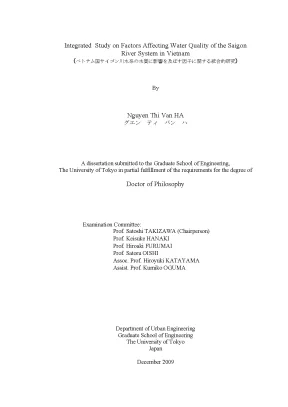
Luận án tiến sĩ kỹ thuật mang tên "Integrated Study on Factors Affecting Water Quality of the Saigon River System in Vietnam" (Nghiên cứu tích hợp về các nhân tố ảnh hưởng đến chất lượng nước hệ thống sông Sài Gòn tại Việt Nam) do nghiên cứu sinh Nguyễn Thị Vân Hà thực hiện tại Khoa Kỹ thuật Đô thị, Trường Cao học Kỹ thuật, Đại học Tokyo (Nhật Bản), dưới sự hướng dẫn của Giáo sư Satoshi Takizawa (Chủ tịch Hội đồng chấm luận án) cùng các thành viên hội đồng gồm Giáo sư Keisuke Hanaki, Giáo sư Hiroaki Furumai, Giáo sư Satoru Oishi, Phó Giáo sư Hiroyuki Katayama và Trợ lý Giáo sư Kumiko Oguma; hoàn thành và bảo vệ vào tháng 12 năm 2009.
Hệ thống sông Sài Gòn, bao gồm hồ chứa Dầu Tiếng ở thượng lưu và dòng chính sông Sài Gòn, đóng vai trò là nguồn nước thiết yếu trong lưu vực sông Đồng Nai phục vụ cấp nước sinh hoạt cho Thành phố Hồ Chí Minh và tỉnh Bình Dương, đồng thời là hệ sinh thái thủy nông phục vụ tưới tiêu lớn nhất Việt Nam. Lưu vực sông có chiều dài khoảng 280 km, diện tích lưu vực 4.717 km², chảy qua các trung tâm kinh tế phát triển nhanh ở miền Nam Việt Nam. Sông Sài Gòn mang đặc trưng của một hệ thống sông chịu ảnh hưởng bán nhật triều phức tạp, vận hành dưới sự chi phối đồng thời của lưu lượng xả điều tiết từ hồ Dầu Tiếng, dòng chảy tự nhiên, dòng tiêu thoát lũ và dao động thủy triều biển Đông. Nhu cầu khai thác nước thô từ sông Sài Gòn cung cấp cho Thành phố Hồ Chí Minh được tính toán chiếm 24% (540.000 m³/ngày) vào năm 2010 và dự báo tăng lên 33% (1,6 triệu m³/ngày) vào năm 2025.
Mặc dù có vai trò sống còn, chất lượng nước của hệ thống sông Sài Gòn suy thoái nghiêm trọng do tốc độ tăng trưởng kinh tế, đô thị hóa và công nghiệp hóa nhanh của các tỉnh Tây Ninh, Bình Dương và Thành phố Hồ Chí Minh. Tại thời điểm nghiên cứu, chỉ khoảng 10% nước thải sinh hoạt đô thị và khoảng 50% nước thải công nghiệp tại lưu vực được xử lý trước khi xả ra nguồn tiếp nhận. Sự tích tụ các chất ô nhiễm hữu cơ, vi sinh vật, hiện tượng xâm nhập mặn trong mùa khô, cùng sự gia tăng bất thường của nồng độ sắt và mangan làm gia tăng nguy cơ rủi ro sức khỏe cộng đồng và gây cản trở cho các nhà máy xử lý nước cấp. Phần lớn các chương trình quan trắc chất lượng nước quốc gia trước đây chỉ tập trung ở khu vực hạ lưu thuộc địa phận Thành phố Hồ Chí Minh, thiếu các đánh giá mang tính hệ thống toàn diện từ thượng lưu hồ Dầu Tiếng đến vùng cửa sông. Bên cạnh đó, nguồn gốc và cơ chế địa hóa kiểm soát sự giải phóng kim loại nặng (sắt, mangan) từ các vùng đất phèn và trầm tích đáy sông chưa được làm rõ, đồng thời thiếu các công cụ dự báo dao động độ mặn theo giờ để hỗ trợ công tác vận hành lấy nước thô an toàn.
Mục tiêu tổng quát của luận án là xác định hiện trạng chất lượng nước của hệ thống sông Sài Gòn và cung cấp các hiểu biết khoa học về các nhân tố tự nhiên lẫn nhân sinh ảnh hưởng đến chất lượng nước của hệ thống sông, làm cơ sở xây dựng các chiến lược và chính sách quản lý tài nguyên nước bền vững cho toàn bộ lưu vực.
Để hoàn thành mục tiêu tổng quát, luận án xác định 6 nội dung và nhiệm vụ nghiên cứu cụ thể:
- Điều tra biến thiên chất lượng nước theo mùa tại hồ chứa Dầu Tiếng;
- Ước tính các nhân tố tự nhiên và nhân sinh tác động đến chất lượng nước hồ Dầu Tiếng;
- Đánh giá tác động của hoạt động nuôi cá lồng bè đối với chất lượng nước hồ Dầu Tiếng;
- Xác định các nguồn phát sinh và cơ chế tiềm năng giải phóng mangan và sắt vào hệ thống sông Sài Gòn;
- Làm rõ hiện trạng chất lượng nước dọc sông Sài Gòn và tại trạm thu nước Hóa Phú (Nhà máy nước Tân Hiệp) thông qua kỹ thuật quan trắc tự động liên tục trong 2 năm đối với các thông số chất lượng nước, mực nước và vận tốc dòng chảy;
- Ứng dụng mô hình mạng nơ-ron nhân tạo (ANN) để mô phỏng biến thiên độ mặn theo giờ tại trạm thu nước Hóa Phú trên sông Sài Gòn.
Phạm vi nghiên cứu về mặt không gian bao quát toàn bộ lưu vực sông Sài Gòn từ hồ Dầu Tiếng (tỉnh Tây Ninh) qua địa phận tỉnh Bình Dương đến vùng hạ lưu thuộc Thành phố Hồ Chí Minh, tập trung vào các điểm lấy mẫu nước mặt, đất phèn và trầm tích tại sông chính, các phụ lưu và kênh rạch (như rạch Thị Tính, rạch Tra, rạch Ba Bếp, rạch Bến Cát). Về mặt thời gian, dữ liệu nghiên cứu được thu thập qua các đợt: quan trắc hàng tháng tại hồ Dầu Tiếng từ tháng 3/2005 đến tháng 3/2006 (13 tháng); 4 đợt khảo sát sông ad-hoc vào tháng 3 (mùa khô) và tháng 9 (mùa mưa) trong hai năm 2005 và 2006; một đợt khảo sát bổ sung vào tháng 5/2008; chuỗi quan trắc tự động liên tục 2 năm từ tháng 4/2006 đến tháng 4/2008 tại trạm thu nước Hóa Phú; cùng đợt đo đạc lưu lượng dòng chảy liên tục 72 giờ tại mặt cắt ngang sông vào tháng 1/2008.
Tổng quan tài liệu và vị trí của luận án
Luận án tiến hành điểm luận các công trình nghiên cứu trong nước và quốc tế trên bốn nhóm chủ đề học thuật chính:
Quản lý chất lượng nước tại các quốc gia châu Á: Tác giả tổng hợp bài học thực tiễn từ các trường hợp ô nhiễm nguồn nước mặt tại Nhật Bản (hồ Kasumigaura, sông Ayasegawa - Oishi và Ikushima, 2008), Campuchia (hồ Tonle Sap), Indonesia (sông Ciliwung - Djadjadilaga và cộng sự, 2008), Lào (lưu vực sông Nam Ngum - Komany, 2008), Myanmar (Than, 2008), Hàn Quốc (sông Geumho và Nakdong), Thái Lan (lưu vực sông Thachin - Yolthantham, 2008), Philippines (hồ Laguna - Pascual và cộng sự, 2008). Tại Việt Nam, tác giả điểm lại tình trạng ô nhiễm tại lưu vực sông Cầu, sông Nhuệ - Đáy, hệ thống sông Đồng Nai - Sài Gòn và sông Thị Vải (Hanh và Dong, 2008; Dan và cộng sự; Triet và Ha, 2008), nhấn mạnh rằng các thách thức quản lý phần lớn bắt nguồn từ hạ tầng xử lý nước thải yếu kém, nguồn ô nhiễm phân tán và sự thiếu hụt các mạng lưới quan trắc tự động liên tục.
Đánh giá trạng thái phú dưỡng hồ chứa nhiệt đới và khung quản lý TMDL: Luận án viện dẫn các nghiên cứu nền tảng về thủy văn học hồ nhiệt đới của Lewis-Jr. về phân loại hồ monomictic ấm (warm monomictic) với đặc tính phân tầng nhiệt và xáo trộn một lần trong năm. Tác giả phân tích các hệ thống chỉ số trạng thái dinh dưỡng (Trophic Status Index) theo thang đo của Tổ chức Hợp tác và Phát triển Kinh tế (OECD, 1982), chỉ số Carlson, các định nghĩa về phú dưỡng của CEC (1991), khái niệm tải lượng tới hạn của Vollenweider (Kneale, 1997) và các mô hình cân bằng khối lượng thực nghiệm giữa tải lượng phốt pho và nồng độ phốt pho tổng số trong hồ (Vollenweider, Dillon - Rigler, Larsen - Mercier). Luận án cũng phân tích khung lý thuyết về Tải lượng Tối đa Hằng ngày (Total Maximum Daily Loads - TMDL) theo hướng dẫn của Cục Bảo vệ Môi trường Hoa Kỳ (USEPA) và Sở Bảo vệ Môi trường Bang New Jersey (NJDEP, 2004).
Các vấn đề môi trường của đất phèn (Acid Sulfate Soils - ASS): Tác giả tổng quan quá trình hình thành, phân bố địa lý của đất phèn tiềm tàng (PASS) và đất phèn hoạt động (AASS). Quá trình oxy hóa pyrit ($FeS_2$) khi tiếp xúc với không khí giải phóng axit sulfuric ($H_2SO_4$), làm suy giảm nghiêm trọng độ pH môi trường nước và hòa tan các ion kim loại độc hại từ đất vào dòng chảy mặt (Dent; van Breemen).
Sự ô nhiễm mangan, sắt và chu trình địa hóa tại ranh giới trầm tích - nước: Luận án phân tích các dạng tồn tại của sắt và mangan trong tự nhiên, các rủi ro sức khỏe theo Tổ chức Y tế Thế giới (WHO) và Hệ thống Thông tin Rủi ro Tích hợp (IRIS) của USEPA, các tiêu chuẩn thứ cấp về nước uống (SMCL). Tác giả tổng hợp các công trình nghiên cứu về chu trình chuyển hóa kim loại tại ranh giới tiếp xúc trầm tích - nước (sediment-water interface), vai trò của thế oxy hóa khử (Eh), độ pH và các vi khuẩn oxy hóa mangan (MOB) cũng như vi khuẩn khử mangan (MRB) trong các điều kiện hiếu khí và yếm khí.
Ứng dụng mạng nơ-ron nhân tạo (ANN) trong nghiên cứu tài nguyên nước: Luận án điểm cứu các công trình áp dụng ANN trong mô hình hóa chất lượng nước (Huang và Foo, 2002), mô phỏng (Showronska và cộng sự, 2006), dự báo nồng độ ô nhiễm (Kuo và cộng sự, 2006; Zhang và cộng sự, 2002) và dự báo xâm nhập mặn (Ying và cộng sự, 2007; Zhang và Stanley, 1997; Jain và Singh, 2003). Tác giả so sánh ưu thế của ANN so với các mô hình quá trình (process-based models) như VRSAP trong việc xử lý các mối quan hệ phi tuyến phức tạp mà không đòi hỏi chi tiết hóa các phương trình động lực học dòng chảy.
Khoảng trống nghiên cứu mà luận án lựa chọn giải quyết bao gồm: (1) Thiếu một nghiên cứu tích hợp đa phương pháp trên toàn bộ lưu vực sông Sài Gòn, kết nối giữa hồ chứa nhân tạo ở thượng nguồn và đoạn sông hạ lưu chịu triều; (2) Chưa bóc tách và định lượng được sự đóng góp tương đối giữa nguồn thôi nhiễm từ đất phèn (ASS) và nguồn giải phóng từ trầm tích đáy sông (sediment) đối với hàm lượng sắt và mangan trong nước mặt; (3) Chưa có mô hình học máy ứng dụng các thông số thủy lý hóa quan trắc tự động liên tục để mô phỏng sự xâm nhập mặn theo giờ tại vị trí công trình thu nước cấp sinh hoạt của Thành phố Hồ Chí Minh.
Cơ sở lý thuyết và phương pháp nghiên cứu
Luận án áp dụng cách tiếp cận nghiên cứu đa ngành, kết hợp nghiên cứu thực nghiệm môi trường, quan trắc hiện trường, phân tích phòng thí nghiệm và mô hình hóa tính toán học máy.
Khung lý thuyết và khái niệm sử dụng:
- Khái niệm hồ monomictic ấm: hồ không đóng băng, phân tầng nhiệt ổn định trong một giai đoạn của năm và xáo trộn hoàn toàn mỗi năm một lần, chia thành ba tầng nước theo chiều sâu: tầng mặt (epilimnion), tầng chuyển tiếp nhiệt (metalimnion/thermocline) và tầng đáy (hypolimnion).
- Đánh giá trạng thái dinh dưỡng: Sử dụng phân loại OECD (1982) và Carlson dựa trên nồng độ Nitơ tổng số (TN), Phốt pho tổng số (TP), Diệp lục tố a (Chlorophyll a) và độ sâu đĩa Secchi (SDD). Phân tích tỷ số Nitơ vô cơ tổng số trên Phốt pho trực thấu tổng số ($TIN/TOP$) theo khung NJDEP (2004) để xác định chất dinh dưỡng hạn chế (limiting nutrient) đối với sự phát triển của tảo.
- Khung tính toán TMDL: Dựa trên mô hình cân bằng khối lượng (Mass Balance) cho hồ chứa, liên kết nồng độ phốt pho trạng thái dừng với tải lượng đưa vào từ lưu vực, tốc độ lắng đọng và thời gian lưu nước.
- Lý thuyết địa hóa học oxy hóa - khử: Phân tích sự chuyển pha của Fe và Mn dựa trên biểu đồ tương quan thế oxy hóa khử chuẩn (Eh) và pH; cơ chế oxy hóa khoáng pyrit ($FeS_2$) tạo thành khoáng jarosit và giải phóng ion $H^+$, $Fe^{2+}$, $SO_4^{2-}$.
- Cấu trúc mạng nơ-ron nhân tạo: Áp dụng mạng nơ-ron truyền thẳng ba lớp với thuật toán lan truyền ngược sai số (Back-Propagation Neural Network - BPNN) để mô phỏng mối quan hệ phi tuyến giữa các thông số thủy lực, thủy văn và độ dẫn điện (độ mặn).
Phương pháp thực tế triển khai:
- Điều tra xã hội học: Tiến hành phỏng vấn trực tiếp các chủ bè nuôi cá tại hồ Dầu Tiếng bằng bảng câu hỏi để thu thập số liệu về số lượng bè cá, sản lượng thu hoạch, lượng thức ăn sử dụng, trình độ văn hóa, nguồn nước sinh hoạt và lý do bắt đầu/chấm dứt hoạt động nuôi.
- Khảo sát thực địa và phân tích chất lượng nước: Thực hiện quan trắc hồ Dầu Tiếng định kỳ hàng tháng tại các điểm đại diện cho nhánh phía Tây, nhánh phía Đông và khu vực trung tâm hồ, tại ba tầng nước (tầng mặt 0–5 m, tầng giữa 6–10 m, tầng đáy >11 m). Khảo sát sông Sài Gòn được thực hiện qua các đợt quan trắc ad-hoc dọc theo tuyến sông và các phụ lưu chính.
- Đo đạc hiện trường: Sử dụng thiết bị đo đa chỉ tiêu Horiba W-23XD và máy đo đa thông số cầm tay YSI để xác định tại chỗ nhiệt độ, độ sâu, pH, độ dẫn điện (EC), oxy hòa tan (DO), tổng chất rắn hòa tan (TDS), thế oxy hóa khử (ORP) và độ đục.
- Quan trắc tự động liên tục (CR-WQME): Lắp đặt trạm quan trắc tự động tại trạm thu nước Hóa Phú (Nhà máy nước Tân Hiệp), vị trí cảm biến đặt cố định ở độ cao cách đáy sông khoảng 4 m. Hệ số liệu thu thập bao gồm 3 thiết bị ghi dữ liệu tự động chuyên dụng hoạt động từ tháng 4/2006 đến tháng 4/2008 với chu kỳ ghi nhận 10 hoặc 30 phút/lần: máy đo dòng Doppler âm học Aquadopp (Nortek AS, Na Uy) ghi nhận mực nước và vận tốc dòng chảy; thiết bị YSI 6600 V2 (YSI, Hoa Kỳ) quan trắc các thông số hóa lý; thiết bị Compact-CLW (JFE Advantech/Allec Co., Nhật Bản) quan trắc độ đục và chlorophyll a bằng cảm biến quang học LED.
- Đo lưu lượng dòng chảy bằng ADCP: Tiến hành chiến dịch đo đạc thủy văn liên tục trong 72 giờ tại mặt cắt ngang trạm Hóa Phú bằng máy đo dòng Doppler âm học ADCP WM-CP 1MHz (Nortek) lắp trên thuyền quét ngang mặt cắt kết hợp với thiết bị Aquadopp đo vận tốc tại mép bờ ($V_p$), phục vụ thiết lập tương quan giữa vận tốc mép bờ và vận tốc trung bình mặt cắt ngang ($V_c$).
- Thí nghiệm thôi nhiễm mẻ (Batch Leaching Tests): Thu thập mẫu đất phèn tiềm tàng (PASS), đất phèn hoạt động (AASS) và mẫu trầm tích đáy sông tại trung lưu và hạ lưu sông Sài Gòn. Mẫu đất và trầm tích được đưa về phòng thí nghiệm của Khoa Kỹ thuật Đô thị, Đại học Tokyo, bảo quản trong tối và tiến hành thí nghiệm chiết mẻ bằng dung dịch nước sông Sài Gòn nhân tạo (Synthetic Saigon River water) có thành phần ion kiểm soát. Các thí nghiệm được thiết kế dưới các điều kiện thay đổi pH (từ 1,5 đến 6,0) và trạng thái khí (sục khí hiếu khí bằng oxy hoặc duy trì yếm khí bằng khí nitơ) để đo động học giải phóng cation và anion.
- Phân tích hóa nghiệm phòng thí nghiệm:
- Các chỉ tiêu kim loại (Mn, Fe, Al, Ca) trong dịch chiết và mẫu nước được phân tích bằng máy quang phổ phát xạ nguyên tử plasma cảm ứng cao tần (ICP-AES, Optima 3000DV, Perkin-Elmer, Hoa Kỳ).
- Các ion âm ($SO_4^{2-}$, $Cl^-$) được phân tích bằng máy sắc ký ion (761 Compact IC, Metrohm, Thụy Sĩ).
- Phân tích khoáng vật đất và trầm tích bằng kỹ thuật nhiễu xạ tia X (XRD) trên máy Rigaku Geigerflex Diffractometer sử dụng bức xạ CuKα (A-41L-Cu 60KV, 2.0KW) tại Đại học Yamanashi, Nhật Bản.
- Các thông số $BOD_5$, $COD$, $TN$, $NH_4^+-N$, $NO_2^--N$, $NO_3^--N$, $TP$, $PO_4^{3-}-P$, chlorophyll a, vi khuẩn E. coli và Coliform tổng số được phân tích theo Quy chuẩn phân tích chuẩn (Standard Methods) tại Phòng thí nghiệm Khoa Môi trường, Trường Đại học Bách khoa - Đại học Quốc gia Thành phố Hồ Chí Minh.
- Phần mềm và công cụ phân tích dữ liệu: Dữ liệu được xử lý thống kê bằng phần mềm SPSS 13.0 for Windows; xây dựng bản đồ chuyên đề bằng MapInfo 8.0; cấu hình và huấn luyện mô hình mạng nơ-ron nhân tạo bằng Neural Network Toolbox trong môi trường phần mềm MATLAB R2008a (The MathWorks Inc.).
Nội dung chính theo từng chương
Chương 1: Introduction (Mở đầu)
Chương mở đầu phân tích bối cảnh áp lực tài nguyên nước trên bình diện toàn cầu và khu vực châu Á, khẳng định khủng hoảng nước trong thế kỷ 21 chủ yếu bắt nguồn từ sự buông lỏng quản lý chất lượng nước thay vì sự khan hiếm tuyệt đối về mặt vật lý. Tác giả dẫn chứng lưu vực sông Hằng (Ấn Độ) và lưu vực sông Đồng Nai - Sài Gòn (Việt Nam) như những điểm nóng điển hình về suy thoái chất lượng nước. Chương 1 giới thiệu cấu trúc địa lý của sông Sài Gòn với chiều dài 280 km, lưu lượng trung bình 85 m³/s, đổ 2,96 tỷ m³ nước mỗi năm vào sông Đồng Nai. Tác giả nêu bật vai trò của hồ Dầu Tiếng (vận hành từ năm 1985 với dung tích 1,58 tỷ m³), áp lực khai thác nước ngầm quá mức tại Thành phố Hồ Chí Minh (mực nước ngầm hạ 2–3 m/năm do khai thác vượt mức 520.000 m³/ngày), dẫn đến nhu cầu cấp thiết phải chuyển đổi sang khai thác nước mặt sông Sài Gòn. Tác giả chỉ rõ các vấn đề chất lượng nước hiện hữu: đợt cá chết và bùng nổ ô nhiễm do nuôi cá lồng bè năm 2004 tại hồ Dầu Tiếng, hiện tượng xâm nhập mặn và ô nhiễm mangan, sắt ở trung lưu, sự thiếu hụt trạm xử lý nước thải sinh hoạt tại hạ lưu. Trên cơ sở đó, tác giả xác lập mục tiêu, phạm vi nghiên cứu và sơ đồ logic gồm 7 chương của luận án.
Chương 2: Literature Review (Tổng quan tài liệu)
Chương 2 hệ thống hóa cơ sở tri thức khoa học hiện đại phục vụ đề tài. Tác giả tổng kết tình hình quản lý chất lượng nước tại 8 quốc gia châu Á; phân tích chức năng sinh thái và các đặc thù của hồ nhiệt đới so với hồ ôn đới. Chương này đi sâu vào cơ chế phân tầng nhiệt của các hồ monomictic ấm, các ngưỡng đánh giá trạng thái dinh dưỡng (OECD, Carlson) và mô hình hóa cân bằng dinh dưỡng theo phương pháp TMDL. Tác giả trình bày chi tiết bản chất hóa học của đất phèn, chu trình oxy hóa pyrit và các hệ lụy môi trường do axit hóa. Phần tiếp theo của chương tổng quan về sự phân bố của mangan và sắt trong vỏ trái đất và thủy quyển, độc tính và quy chuẩn nước uống quốc tế, các cơ chế hóa lý và sinh học chi phối chu trình Mn-Fe tại bề mặt ranh giới trầm tích - nước. Cuối cùng, chương 2 phân tích nguyên lý cấu tạo của mạng nơ-ron nhân tạo, thuật toán lan truyền ngược (BPNN), tổng kết các nghiên cứu tiền nghiệm ứng dụng ANN trong mô hình hóa tài nguyên nước và so sánh ưu nhược điểm giữa ANN với các mô hình quá trình (process-based models).
Chương 3: Materials and Methods (Tư liệu và phương pháp nghiên cứu)
Chương 3 trình bày các đặc điểm địa lý tự nhiên, hiện trạng sử dụng đất, phân bố dân cư, phát triển công nghiệp và nhu cầu sử dụng nước của Thành phố Hồ Chí Minh và lưu vực sông Sài Gòn. Tác giả mô tả chi tiết phương pháp luận của 5 cách tiếp cận nghiên cứu; cung cấp quy trình thu thập mẫu nước, đất phèn và trầm tích; công thức pha chế dung dịch nước sông Sài Gòn nhân tạo dùng cho thực nghiệm. Chương này mô tả kỹ thuật các thiết bị quan trắc liên tục (Aquadopp, YSI 6600 V2, Compact-CLW) và phần mềm điều khiển chuyên dụng (AquaPro Win32, EcoWatch, Win CKU); quy trình vận hành, hiệu chuẩn cảm biến và bảo trì định kỳ tại trạm Hóa Phú. Tác giả cũng trình bày phương pháp phân tích phòng thí nghiệm (ICP-AES, IC, XRD, phân tích vi sinh và hóa lý) cùng cấu trúc toán học của mô hình ANN ứng dụng cho chuỗi dữ liệu chu kỳ ngắn.
Chương 4: Natural and Anthropogenic Factors Controlling Water-Quality Variations in the Dau Tieng Reservoir (Các yếu tố tự nhiên và nhân sinh kiểm soát biến thiên chất lượng nước hồ Dầu Tiếng)
Chương 4 công bố kết quả của chương trình quan trắc 13 tháng (3/2005 - 3/2006) tại hồ Dầu Tiếng. Kết quả quan trắc khẳng định hồ Dầu Tiếng là hồ monomictic ấm, có sự phân tầng nhiệt yếu và xuất hiện hiện tượng axit hóa nước hồ theo từng đợt (episodic acidification) trong mùa mưa do tiếp nhận nước chảy tràn có độ pH thấp từ đất phèn và rừng cao su trong lưu vực. Hồ được phân vùng thành 3 khu vực nước: nhánh phía Tây, nhánh phía Đông và khu trung tâm hồ; đồng thời phân hóa thành 3 tầng nước theo chiều sâu: tầng mặt (0–5 m), tầng giữa (6–10 m) và tầng đáy (>11 m).
Biên độ biến thiên của các thông số chất lượng nước trong hồ Dầu Tiếng ghi nhận như sau: pH dao động từ 4,72 đến 7,8; độ dẫn điện (EC) từ 2 đến 8 μS/cm; độ đục từ 2 đến 77 NTU; DO từ 0 đến 12,85 mg/L; ORP từ -169 đến 326 mV; $NH_4^+-N$ từ 0 đến 0,77 mg/L; vi khuẩn E. coli từ 0 đến 12 CFU/100mL và Coliform tổng số từ 0 đến 295 CFU/100mL. So chiếu với Quy chuẩn nước mặt loại A dùng cho mục đích cấp nước sinh hoạt (TCVN 5942-1995), hồ Dầu Tiếng có 51% số mẫu vượt ngưỡng cho phép đối với amoni, 26% số mẫu không đạt chuẩn đối với oxy hòa tan (DO), 20% mẫu vượt ngưỡng nitrit và 15% mẫu vượt chuẩn Coliform tổng số.
Phân tích trạng thái dinh dưỡng cho thấy hồ Dầu Tiếng nằm ở ranh giới giữa phú dưỡng trung bình (mesotrophic) và phú dưỡng (eutrophic). Tỷ số $TIN/TOP$ khẳng định phốt pho là chất dinh dưỡng hạn chế (limiting nutrient) đối với sự phát triển của thực vật phiêu sinh và tảo trong hồ. Luận án tính toán tổng tải lượng dinh dưỡng nạp vào hồ đạt 4.729 tấn TN/năm và 412 tấn TP/năm. Tải lượng bề mặt diện tích đạt 1,5 g TN/m²/năm và 0,13 g TP/m²/năm vào năm 2005; các giá trị này lần lượt cao gấp 6 lần đối với nitơ và 8 lần đối với phốt pho so với ngưỡng tải lượng tới hạn theo mô hình Vollenweider.
Về nguồn gốc tải lượng, dòng chảy tràn bề mặt đóng góp 73% lượng TN và 24% lượng TP nạp vào hồ. Hoạt động nuôi cá lồng bè và chăn nuôi gia súc ven hồ đóng góp đáng kể vào tổng lượng dinh dưỡng: nuôi cá lồng bè chiếm 15% TN và 39% TP; chăn nuôi gia súc đóng góp 4% TN và 13% TP. Tại thời điểm phát triển cực đại, hoạt động nuôi cá lồng thu hoạch 9.600 tấn cá/năm nhưng đồng thời thải trực tiếp vào nước hồ 1.200 tấn TN và 281 tấn TP mỗi năm, làm tăng cục bộ nồng độ $BOD_5$, orthophosphate và amoni. So sánh chất lượng nước trước và sau khi có lệnh cấm nuôi cá lồng (năm 2005) cho thấy sự suy giảm rõ rệt của $BOD_5$, $NH_4^+-N$, $TN$ và $TP$. Tác giả tính toán rằng việc giới hạn quy mô nuôi cá lồng dưới 250 lồng và chấm dứt chăn nuôi gia súc quanh vùng bán ngập sẽ cắt giảm được 28% tổng tải lượng phốt pho nạp vào hồ (tương đương giảm 147 tấn TP/năm).
| Nguồn phát thải |
Tải lượng TN (tấn/năm) |
Tỷ lệ đóng góp TN (%) |
Tải lượng TP (tấn/năm) |
Tỷ lệ đóng góp TP (%) |
| Nước chảy tràn bề mặt (Runoff) |
3.452 |
73% |
99 |
24% |
| Hoạt động nuôi cá lồng bè |
709 |
15% |
161 |
39% |
| Hoạt động chăn nuôi gia súc |
189 |
4% |
54 |
13% |
| Các nguồn thải khác trong lưu vực |
379 |
8% |
98 |
24% |
| Tổng cộng |
4.729 |
100% |
412 |
100% |
Chương 5: Manganese and Iron Sources and Transports in the Saigon River Basin (Nguồn gốc và sự vận chuyển mangan và sắt trong lưu vực sông Sài Gòn)
Chương 5 tập trung làm sáng tỏ cơ chế địa hóa của mangan và sắt trên sông Sài Gòn dựa trên các đợt khảo sát sông mùa mưa các năm 2006, 2008 và chuỗi thí nghiệm thôi nhiễm mẻ. Luận án chia sông Sài Gòn thành ba phân đoạn đặc trưng:
- Đoạn thượng lưu (từ sau đập hồ Dầu Tiếng đến ranh giới tỉnh Tây Ninh và Thành phố Hồ Chí Minh): Nước có độ đục cao do xói mòn đất và dòng chảy mang hạt lơ lửng từ lưu vực nông nghiệp.
- Đoạn trung lưu (từ ranh giới Tây Ninh - Thành phố Hồ Chí Minh đến cầu Bình Phước): Nước bị suy thoái do độ pH thấp và sự rửa trôi các ion hòa tan từ các vùng đất phèn (ASS), dẫn đến nồng độ sắt và mangan tăng cao đe dọa nguồn nước cấp cho Thành phố Hồ Chí Minh và Bình Dương.
- Đoạn hạ lưu (từ cầu Bình Phước ra hạ lưu): Nước bị ô nhiễm hữu cơ nghiêm trọng với nồng độ amoni, nitơ tổng số và phốt pho tổng số tăng vọt do tiếp nhận nước thải sinh hoạt và công nghiệp chưa qua xử lý, kèm theo nồng độ mangan hòa tan duy trì ở mức cao và mức độ nhiễm khuẩn E. coli, Coliform rất lớn.
Luận án chỉ ra hai nguồn phát sinh chính đưa mangan và sắt vào sông Sài Gòn:
- Tại đoạn trung lưu, sự thôi nhiễm từ đất phèn (ASS) là nguồn chi phối chính. Lượng sắt thôi nhiễm từ ASS lớn hơn mangan rất nhiều do hàm lượng sắt trong đất phèn cao vượt trội so với mangan. Độ pH môi trường là nhân tố quyết định: khi pH xuống dưới 3,0, các khoáng chứa sắt bị hòa tan giải phóng mangan liên kết và thúc đẩy mạnh mẽ quá trình oxy hóa pyrit. Khi hạ pH từ 4,0 xuống 1,5, lượng mangan thôi nhiễm từ đất phèn tiềm tàng (PASS) tăng gấp 10 lần và lượng sắt thôi nhiễm tăng gấp 14 lần.
- Tại đoạn hạ lưu, quá trình hòa tan và khử từ các lớp trầm tích giàu sắt - mangan lắng đọng dưới đáy sông là nguồn đóng góp chủ đạo. Tại phân đoạn này, nguồn giải phóng mangan từ trầm tích trở nên quan trọng hơn nguồn thôi nhiễm từ đất phèn. Hàm lượng mangan ghi nhận trong trầm tích cao gấp 10 lần trong đất phèn, và tốc độ giải phóng mangan từ trầm tích cao gấp 14 lần tốc độ thôi nhiễm từ đất phèn.
Ngược lại với quá trình thôi nhiễm từ đất, sự giải phóng mangan từ trầm tích đáy sông diễn ra độc lập với sự giải phóng sắt. Mangan trong trầm tích đáy sông Sài Gòn dễ dàng hòa tan trực tiếp vào pha lỏng do nước sông vốn có tính axit tự nhiên (pH < 6), và thế oxy hóa khử (Eh) không biểu hiện tác động trực tiếp lên quá trình hòa tan mangan từ trầm tích. Trong khi đó, sắt giải phóng từ trầm tích diễn ra rất chậm và phụ thuộc chặt chẽ vào sự sụt giảm của Eh: khi điều kiện nước trở nên yếm khí hoàn toàn (low Eh kéo dài), quá trình khử sắt mới diễn ra mạnh mẽ. Luận án khẳng định nước hồ Dầu Tiếng, xói mòn đất thông thường và nước thải công nghiệp không phải là nguồn phát sinh chính của sắt và mangan trên dòng chính sông Sài Gòn.
| Đặc tính so sánh |
Đất phèn (Acid Sulfate Soils - ASS) |
Trầm tích đáy sông (Sediment) |
| Khu vực phát sinh tác động chính |
Đoạn trung lưu sông Sài Gòn |
Đoạn hạ lưu sông Sài Gòn |
| Hàm lượng tương đối trong pha rắn |
Hàm lượng Fe rất cao, Mn thấp |
Hàm lượng Mn cao gấp 10 lần so với ASS |
| Tốc độ giải phóng ion kim loại |
Tốc độ giải phóng Mn thấp hơn |
Tốc độ giải phóng Mn cao gấp 14 lần ASS |
| Tính chất phụ thuộc lẫn nhau |
Mn và Fe giải phóng phụ thuộc đồng thời |
Giải phóng Mn độc lập với giải phóng Fe |
| Nhân tố chi phối giải phóng |
Phụ thuộc mạnh vào pH (pH < 3 tăng vọt) |
Mn hòa tan sẵn do pH < 6; Fe phụ thuộc Eh thấp |
| Kim loại hòa tan chiếm ưu thế |
Sắt hòa tan ($Fe^{2+}$) chiếm ưu thế |
Mangan hòa tan ($Mn^{2+}$) chiếm ưu thế |
Chương 6: Water Quality Variations and Salinity Simulation Using Artificial Neural Network (Biến thiên chất lượng nước và mô phỏng độ mặn sử dụng mạng nơ-ron nhân tạo)
Chương 6 phân tích chuỗi dữ liệu quan trắc tự động liên tục trong 2 năm (4/2006 – 4/2008) tại trạm thu nước Hóa Phú và áp dụng mô hình ANN. Dữ liệu ghi nhận theo giờ cho thấy nước sông tại công trình thu nước không đạt tiêu chuẩn cấp nước sinh hoạt của Việt Nam đối với chỉ tiêu pH và DO trong hầu hết các thời điểm trong năm, đồng thời không đạt quy chuẩn về độ mặn trong mùa khô. Dải biến thiên các thông số quan trắc tự động tại Hóa Phú ghi nhận: pH dao động từ 3,1 đến 7,1; nhiệt độ từ 26,8 đến 32,9 °C; DO từ 0 đến 6,0 mg/L; độ mặn từ 0 đến 0,713 g/L; Eh từ 211 đến 698 mV; chlorophyll a từ 1,1 đến 12 mg/m³; và độ đục từ 6 đến 150 NTU. Mùa mưa đặc trưng bởi sự sụt giảm pH và hiện tượng cạn kiệt DO; tháng 4 hàng năm ghi nhận nồng độ chlorophyll a tăng cao; trong khi các đỉnh mặn cao nhất xuất hiện tập trung vào các tháng mùa khô.
Từ thí nghiệm đo đạc lưu lượng 72 giờ bằng ADCP, tác giả xây dựng mối quan hệ hàm số giữa vận tốc đo tại điểm mép bờ ($V_p$) của thiết bị Aquadopp và vận tốc bình quân trên toàn bộ mặt cắt ngang ($V_c$), thiết lập mô hình tính toán diện tích mặt cắt ngang ướt ($A$) theo mực nước ($H$), từ đó hoàn thiện phương pháp ước tính chuỗi số liệu lưu lượng tức thời và lưu lượng bình quân của sông Sài Gòn tại trạm Hóa Phú.
Về mô hình hóa độ mặn, tác giả phát triển mô hình mạng nơ-ron nhân tạo lan truyền ngược 3 lớp để mô phỏng biến thiên độ dẫn điện (đại diện cho độ mặn) theo chu kỳ giờ. Phân tích tương quan chỉ ra một phát hiện quan trọng: mặc dù pH thường không được coi là biến số tác động vật lý lên độ mặn, trên sông Sài Gòn pH có hệ số tương quan cao và biến thiên đồng pha với độ mặn (do nước triều xâm nhập từ biển mang tính kiềm và độ mặn cao, đối lập với nước ngọt thượng lưu có pH thấp). Việc đưa pH kết hợp cùng vận tốc dòng chảy mép bờ ($V_p$) và mực nước ($H$) làm véc-tơ đầu vào giúp nâng cao rõ rệt độ chính xác của quá trình huấn luyện ANN. Mô hình đạt sai số toàn phương trung bình $MSE = 0,3$ và hệ số tương quan $R = 0,86$ trên tập dữ liệu huấn luyện, mô phỏng sát diễn biến mặn thực tế và phục hồi hiệu quả các đoạn dữ liệu bị khuyết trong chuỗi quan trắc liên tục.
| Thông số cấu trúc và hiệu năng ANN |
Giá trị thực nghiệm trong luận án |
| Thuật toán học của mạng |
Lan truyền ngược sai số (Back-Propagation Algorithm) |
| Cấu trúc số tầng của mạng |
3 lớp (Lớp vào - Lớp ẩn - Lớp ra) |
| Các biến số đầu vào được lựa chọn ($M$) |
Độ pH, Vận tốc dòng chảy mép bờ ($V_p$), Mực nước sông ($H$) |
| Biến số đầu ra ($N$) |
Độ dẫn điện / Độ mặn theo chu kỳ giờ tại trạm Hóa Phú |
| Sai số bình phương trung bình tập học ($MSE$) |
0,3 |
| Hệ số tương quan tập huấn luyện ($R$) |
0,86 |
| Ứng dụng thực tế của mô hình |
Mô phỏng biến thiên mặn và tái tạo chuỗi số liệu quan trắc bị khuyết |
Chương 7: Conclusions and Recommendation (Kết luận và kiến nghị)
Chương cuối tóm lược các kết luận khoa học rút ra từ các hợp phần nghiên cứu của luận án, khẳng định vai trò của các yếu tố nhân sinh và cơ chế địa hóa trong việc định hình chất lượng nước hệ thống sông Sài Gòn. Trên cơ sở đó, tác giả đưa ra các nhóm giải pháp quản lý chiến lược và gợi ý các hướng nghiên cứu mở rộng trong tương lai.
Kết quả và những đóng góp mới
Luận án mang lại các đóng góp mới về mặt lý luận khoa học và thực tiễn quản lý môi trường:
Đóng góp mới về mặt lý luận và khoa học:
- Cung cấp hiểu biết toàn diện về đặc tính limnology của hồ chứa nhiệt đới Dầu Tiếng, xác lập bản chất hồ monomictic ấm với hiện tượng axit hóa nước hồ theo từng đợt vào mùa mưa do dòng chảy tràn từ lưu vực đất phèn và rừng cao su; chứng minh phốt pho là chất dinh dưỡng giới hạn chính đối với sự phú dưỡng của hồ.
- Làm sáng tỏ cơ chế địa hóa phân dị của sự ô nhiễm sắt và mangan trong hệ thống sông: chứng minh sự thôi nhiễm từ đất phèn (ASS) kiểm soát nồng độ sắt và mangan tại đoạn trung lưu dưới tác động hòa tan của pH thấp; trong khi sự giải phóng và hòa tan từ trầm tích đáy sông giàu Fe-Mn kiểm soát nồng độ kim loại tại đoạn hạ lưu, trong đó mangan giải phóng độc lập với sắt và có tốc độ giải phóng cao gấp 14 lần từ đất phèn.
- Khẳng định tính hiệu quả của mô hình mạng nơ-ron nhân tạo (ANN) trong việc mô phỏng dao động độ mặn theo giờ tại vùng sông chịu ảnh hưởng bán nhật triều phức tạp, phát hiện quy luật biến thiên đồng pha giữa pH và độ mặn trong môi trường sông nhiệt đới chịu xâm nhập mặn.
Kiến nghị và giải pháp đề xuất:
- Áp dụng công cụ Quản lý Tải lượng Tối đa Hằng ngày (TMDL) cho hồ Dầu Tiếng; thực thi nghiêm ngặt việc khống chế số lượng lồng cá dưới 250 lồng và chấm dứt chăn nuôi gia súc quanh vùng bán ngập để cắt giảm 28% tổng tải lượng phốt pho (147 tấn TP/năm).
- Cải thiện quản lý sử dụng đất và phương thức canh tác trên vùng đất phèn (ASS) tại lưu vực trung lưu, ngăn ngừa xới xáo lớp đất phèn tiềm tàng nhằm hạn chế sự oxy hóa pyrit và rửa trôi axit cùng kim loại nặng ra sông.
- Thực thi nghiêm ngặt các quy định bảo vệ môi trường, áp dụng nguyên tắc người gây ô nhiễm phải trả tiền (Polluter Pays Principle), nâng cao tỷ lệ thu gom và xử lý nước thải sinh hoạt và công nghiệp trước khi thải ra sông Sài Gòn.
- Xây dựng mạng lưới quan trắc tự động liên tục chất lượng nước trên hệ thống sông với tối thiểu 3 trạm chiến lược: trạm DT7 (khu trung tâm hồ Dầu Tiếng), trạm SG15 (trạm thu nước Hóa Phú) và trạm SG19 (khu vực hạ lưu sông Sài Gòn).
- Ứng dụng mô hình ANN và quan trắc tự động để thiết lập lịch vận hành khai thác nước thô linh hoạt tại trạm thu nước Hóa Phú theo các pha triều, tránh thời điểm nước triều mặn, pH suy giảm hoặc nồng độ kim loại nặng dâng cao; đồng thời nghiên cứu khả thi phương án công trình dẫn nước trực tiếp từ hồ Dầu Tiếng về phục vụ cấp nước cho Thành phố Hồ Chí Minh.
Hạn chế và hướng nghiên cứu tiếp
Hạn chế của luận án:
- Các thí nghiệm thôi nhiễm sắt và mangan mới dừng lại ở quy mô thí nghiệm mẻ (batch leaching) trong phòng thí nghiệm sử dụng nước sông nhân tạo, chưa mô phỏng hết điều kiện xáo trộn thủy lực động lực học và các yếu tố tương tác phức tạp ngoài lòng sông tự nhiên.
- Dữ liệu mô hình ANN độ mặn mới sử dụng 3 biến số đầu vào đơn giản ($pH$, $V_p$, $H$), chưa tích hợp đầy đủ chế độ dòng chảy đảo chiều phức tạp của triều và độ trễ truyền mặn giữa thượng lưu và hạ lưu.
- Khảo sát các biến động chất lượng nước sinh học hồ chứa mới tập trung vào chỉ tiêu chlorophyll a và các thông số dinh dưỡng cơ bản, chưa phân tích cấu trúc quần xã thực vật phiêu sinh chi tiết.
Hướng nghiên cứu tiếp theo (được tác giả đề xuất tại mục 7.5):
- Nghiên cứu sâu hơn ảnh hưởng tương tác giữa pH và các hợp chất dinh dưỡng trong việc kiểm soát sự bùng phát phát triển của tảo tại các hồ chứa vùng nhiệt đới.
- Nghiên cứu các biện pháp kỹ thuật và cơ chế cố định hóa học (immobilization) đối với mangan và sắt trong đất phèn và trầm tích đáy sông nhằm ngăn ngừa sự thôi nhiễm ra nguồn nước.
- Nâng cấp mô hình ANN dự báo độ mặn bằng cách nghiên cứu bổ sung 6 biến số đầu vào: (1) hướng dòng chảy (water flow direction), (2) hàm thời gian (time function), (3) độ trễ của các biến đầu vào (lag of inputs), (4) sự chênh lệch mực nước giữa hai chuỗi thời gian liên tiếp, (5) các chế độ triều đặc trưng, và (6) chuỗi số liệu mực nước cùng độ mặn đồng thời ở cả thượng lưu và hạ lưu. Tái cấu trúc hình học mạng ANN để tiến tới dự báo sớm xu hướng suy thoái chất lượng nước phục vụ điều hành lấy nước thô.
- Tiến hành các nghiên cứu chuyên sâu về tính khả thi kỹ thuật và kinh tế của phương án lấy nước trực tiếp từ hồ Dầu Tiếng cấp cho Thành phố Hồ Chí Minh, cùng với việc phát triển mô hình quản lý tài nguyên nước dựa vào cộng đồng (community-based water management).
Giá trị tham khảo
Luận án là tài liệu tham khảo chuyên khảo hữu ích cho các nhóm đối tượng:
- Nghiên cứu sinh, học viên cao học và nhà nghiên cứu: Thuộc các chuyên ngành Kỹ thuật Môi trường, Kỹ thuật Tài nguyên nước, Thủy văn học và Quản lý Lưu vực sông. Luận án cung cấp khung phương pháp luận kết hợp chặt chẽ giữa điều tra xã hội học, phân tích số liệu quan trắc dài hạn, thực nghiệm địa hóa phòng thí nghiệm và ứng dụng thuật toán học máy.
- Giảng viên các trường đại học: Sử dụng làm học liệu minh chứng thực tế trong giảng dạy các học phần Quản lý Chất lượng nước Nâng cao, Xử lý Số liệu Môi trường, Mô hình hóa Môi trường và Địa hóa học Môi trường Đô thị.
- Nhà hoạch định chính sách và cơ quan quản lý: Bộ Tài nguyên và Môi trường, Ủy ban Quản lý Lưu vực sông Đồng Nai, Sở Tài nguyên và Môi trường các tỉnh Tây Ninh, Bình Dương và Thành phố Hồ Chí Minh, Công ty TNHH MTV Khai thác Thủy lợi Dầu Tiếng. Các đơn vị này có thể tham khảo phương pháp luận TMDL để phân bổ hạn ngạch xả thải và quy hoạch nuôi trồng thủy sản.
- Đơn vị vận hành cấp nước đô thị: Tổng công ty Cấp nước Sài Gòn (SAWACO), Công ty Cổ phần Cấp nước Trung An, Nhà máy nước Tân Hiệp. Các số liệu thực đo về chu kỳ biến thiên mặn, pH, DO, sắt và mangan tại trạm Hóa Phú cung cấp căn cứ kỹ thuật để tối ưu hóa quy trình châm hóa chất keo tụ, sục khí khử sắt - mangan và lịch bơm nước thô theo con triều.
Câu hỏi thường gặp
1. Hai nguồn phát sinh chính đưa mangan và sắt vào sông Sài Gòn là gì và cơ chế giải phóng của chúng khác nhau như thế nào?
Luận án chỉ ra hai nguồn chính: (1) Tại đoạn trung lưu, sự thôi nhiễm từ đất phèn (ASS) là nguồn chi phối, trong đó lượng sắt giải phóng cao hơn mangan do hàm lượng sắt trong đất phèn vượt trội; độ pH thấp (pH < 3) là nhân tố quyết định hòa tan sắt và thúc đẩy oxy hóa pyrit. (2) Tại đoạn hạ lưu, sự hòa tan và khử từ trầm tích đáy sông giàu Fe-Mn là nguồn chủ đạo; mangan giải phóng độc lập với sắt, hàm lượng mangan trong trầm tích cao gấp 10 lần trong đất phèn và tốc độ giải phóng mangan từ trầm tích cao gấp 14 lần từ đất phèn. Do nước sông có tính axit tự nhiên (pH < 6), mangan trong trầm tích dễ dàng hòa tan mà không phụ thuộc vào Eh; trong khi sắt chỉ giải phóng mạnh khi nước rơi vào trạng thái yếm khí (Eh thấp kéo dài).
2. Hoạt động nuôi cá lồng bè tại hồ Dầu Tiếng đã gây ra những tác động môi trường cụ thể nào và việc quản lý tải lượng được tính toán ra sao?
Giai đoạn cực đại trước năm 2005, hoạt động nuôi cá lồng bè đạt sản lượng thu hoạch 9.600 tấn cá/năm nhưng thải trực tiếp vào hồ 1.200 tấn TN và 281 tấn TP mỗi năm, làm gia tăng cục bộ $BOD_5$, orthophosphate, amoni và gây hiện tượng cá chết. Nuôi cá lồng bè đóng góp tới 39% tổng tải lượng phốt pho và 15% tổng tải lượng nitơ nạp vào hồ. Luận án tính toán rằng việc ban hành lệnh cấm hoặc giới hạn quy mô dưới 250 lồng nuôi kết hợp chấm dứt chăn nuôi gia súc quanh lòng hồ giúp cắt giảm 28% tổng tải lượng phốt pho nạp vào hồ Dầu Tiếng (giảm 147 tấn TP/năm).
3. Dữ liệu quan trắc tự động liên tục trong 2 năm tại trạm thu nước Hóa Phú ghi nhận những thông số nào vi phạm tiêu chuẩn cấp nước sinh hoạt?
Dữ liệu quan trắc chu kỳ ngắn từ tháng 4/2006 đến tháng 4/2008 cho thấy chất lượng nước tại trạm thu nước Hóa Phú không đạt tiêu chuẩn nước mặt dùng cho mục đích cấp nước sinh hoạt của Việt Nam đối với chỉ tiêu pH (dao động từ 3,1 đến 7,1) và chỉ tiêu oxy hòa tan DO (dao động từ 0 đến 6,0 mg/L) trong hầu hết các thời điểm trong năm. Ngoài ra, nguồn nước không đạt tiêu chuẩn về độ mặn trong các tháng mùa khô. Mùa mưa thường xuyên ghi nhận hiện tượng axit hóa (pH thấp) và cạn kiệt oxy hòa tan, trong khi tháng 4 ghi nhận sự gia tăng đột biến của chlorophyll a.
4. Mô hình mạng nơ-ron nhân tạo (ANN) được thiết lập như thế nào để mô phỏng độ mặn theo giờ tại trạm Hóa Phú và hiệu quả đạt được ra sao?
Mô hình sử dụng mạng truyền thẳng 3 lớp với thuật toán lan truyền ngược sai số (BPNN). Véc-tơ đầu vào gồm 3 biến số: độ pH, vận tốc dòng chảy mép bờ ($V_p$) và mực nước sông ($H$). Biến độ pH được đưa vào mô hình do có quy luật biến thiên đồng pha với độ mặn tại vùng triều sông Sài Gòn, giúp nâng cao đáng kể độ chính xác của quá trình huấn luyện mạng. Kết quả mô phỏng đạt sai số toàn phương trung bình $MSE = 0,3$ và hệ số tương quan $R = 0,86$ đối với tập dữ liệu huấn luyện, cho phép mô phỏng sát diễn biến mặn theo giờ và tái tạo chính xác các số liệu quan trắc bị gián đoạn.
5. Luận án đề xuất mạng lưới quan trắc tự động liên tục chất lượng nước trên hệ thống sông Sài Gòn gồm những vị trí trọng yếu nào?
Luận án đề xuất thiết lập mạng lưới quan trắc tự động với tối thiểu 3 trạm quan trắc liên tục chiến lược: (1) Trạm DT7 đặt tại khu vực trung tâm hồ chứa Dầu Tiếng để kiểm soát chất lượng nước đầu nguồn và hiện tượng phân tầng/phú dưỡng; (2) Trạm SG15 đặt tại công trình thu nước Hóa Phú (Nhà máy nước Tân Hiệp) để giám sát xâm nhập mặn, suy giảm DO và axit hóa phục vụ lấy nước sinh hoạt; (3) Trạm SG19 đặt tại khu vực hạ lưu sông Sài Gòn để theo dõi tải lượng ô nhiễm từ đô thị và các đợt phát tán mangan từ trầm tích đáy.
Kết luận
Luận án của nghiên cứu sinh Nguyễn Thị Vân Hà đã giải quyết một cách có hệ thống bức tranh chất lượng nước của hệ thống sông Sài Gòn thông qua việc kết hợp quan trắc chuỗi thời gian liên tục, phân tích thực nghiệm địa hóa và mô hình hóa học máy. Công trình đã làm rõ các quy luật limnology của hồ chứa Dầu Tiếng, bóc tách cơ chế giải phóng khác biệt của mangan và sắt từ đất phèn và trầm tích đáy sông, đồng thời khẳng định hiệu quả của mô hình mạng nơ-ron nhân tạo trong mô phỏng xâm nhập mặn theo giờ tại trạm lấy nước sinh hoạt. Các phát hiện khoa học và hệ thống giải pháp kiểm soát tải lượng TMDL, quản lý đất phèn và quy hoạch mạng lưới quan trắc tự động trong luận án cung cấp luận cứ khoa học quan trọng cho công tác bảo vệ an ninh nguồn nước và quản trị tích hợp lưu vực sông Sài Gòn.