Tổng quan luận án
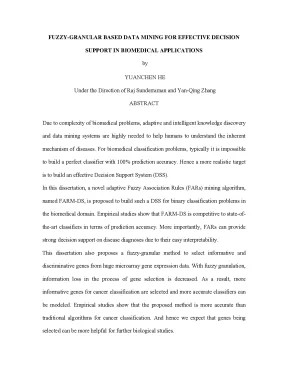
Luận án tiến sĩ mang tên “Fuzzy-Granular Based Data Mining for Effective Decision Support in Biomedical Applications” (Khai phá dữ liệu dựa trên tính toán hạt mờ phục vụ hỗ trợ ra quyết định hiệu quả trong các ứng dụng y sinh) được nghiên cứu sinh Yuanchen He hoàn thành năm 2006 tại Khoa Nghệ thuật và Khoa học, Đại học Bang Georgia (Georgia State University), Hoa Kỳ, dưới sự hướng dẫn của hai đồng giáo sư Rajshekhar Sunderraman và Yan-Qing Zhang cùng hội đồng đánh giá gồm Saeid Belkasim và Yichuan Zhao.
Tính cấp thiết của đề tài bắt nguồn từ sự phát triển của công nghệ hệ gene (genomics) và hệ protein (proteomics), dẫn đến sự gia tăng theo cấp số nhân của các cơ sở dữ liệu y sinh học. Các cơ sở dữ liệu này có đặc trưng kích thước lớn, số chiều thuộc tính rất cao nhưng số lượng mẫu hạn chế, đồng thời chứa đựng mức độ không chắc chắn và phức tạp nội tại. Trong các bài toán phân loại y sinh học, việc xây dựng một bộ phân loại lý tưởng đạt độ chính xác dự đoán tuyệt đối 100% là điều không khả thi. Do đó, tác giả xác định mục tiêu thực tế hơn là phát triển một Hệ hỗ trợ ra quyết định (Decision Support System - DSS) thông minh và thích nghi. Vai trò của DSS không nhằm thay thế chuyên gia y tế, mà cung cấp các quyết định có độ tin cậy cao cùng khả năng giải thích rõ ràng dựa trên tri thức có thể hiểu được bởi con người.
Khoảng trống nghiên cứu được tác giả chỉ ra gồm hai điểm mấu chốt:
- Các thuật toán khai phá quy tắc kết hợp định lượng hiện hữu thường áp dụng kỹ thuật chia khoảng rời rạc với ranh giới cứng (crisp boundaries), gây mất mát thông tin và tạo ra các quy tắc phân loại cứng nhắc, khó giải thích về mặt ngữ nghĩa lâm sàng. Một số mô hình phân loại mờ khác lại gặp phải hiện tượng bùng nổ tổ hợp quy tắc khi số chiều dữ liệu tăng cao hoặc đòi hỏi tri thức chuyên gia định sẵn để thiết lập hàm liên thuộc.
- Dữ liệu biểu hiện gene vi mảng (microarray gene expression data) có số chiều cực lớn (hàng nghìn đến hàng chục nghìn gene trong khi chỉ có vài chục mẫu bệnh phẩm). Việc lựa chọn đặc trưng gene truyền thống thường làm mất mát thông tin tương quan quan trọng, dẫn đến việc giảm độ chính xác của các bộ phân loại ung thư.
Mục tiêu nghiên cứu tổng quát của luận án bao gồm:
- Xây dựng một thuật toán khai phá luật kết hợp mờ tự thích nghi mới, đặt tên là FARM-DS (Fuzzy Association Rule Mining for Decision Support), dành cho các bài toán phân loại nhị phân trong miền y sinh học.
- Thiết kế phương pháp chọn lọc gene dựa trên tính toán hạt mờ (Fuzzy-Granular gene selection) nhằm trích xuất các gene giàu thông tin, giảm thiểu mất mát dữ liệu và nâng cao độ chính xác phân loại ung thư.
Các nhiệm vụ và câu hỏi nghiên cứu cụ thể trong luận án được triển khai thành các bước:
- Thiết lập cơ chế phân vùng khoảng mờ tự thích nghi cho từng thuộc tính định lượng mà không cần chuyên gia can thiệp trước.
- Phát triển quy trình trừu tượng hóa dữ liệu thông qua phân cụm để chuyển đổi các mẫu số lượng sang giao dịch rời rạc mờ.
- Ứng dụng giải thuật Apriori trên các giao dịch mờ để khai phá tập luật kết hợp mờ phân loại dạng “IF-THEN” phục vụ chẩn đoán bệnh.
- Xây dựng mô hình hạt hóa mờ kết hợp thuật toán phân cụm mờ c-means (FCM) nhằm xếp hạng và chọn lọc các gene có tính phân tách cao từ dữ liệu biểu hiện gene vi mảng.
Đối tượng và phạm vi nghiên cứu:
- Đối tượng nghiên cứu: Mô hình khai phá dữ liệu y sinh, luật kết hợp mờ (FARs), phương pháp phân cụm mờ và tính toán hạt trong bài toán phân loại nhị phân.
- Phạm vi không gian và dữ liệu thực nghiệm: Bộ dữ liệu lâm sàng Wisconsin Breast Cancer (ung thư vú) từ kho lưu trữ máy học UCI; ba bộ dữ liệu biểu hiện gene vi mảng microarray gồm bệnh bạch cầu cấp tính (AML/ALL), ung thư đại tràng (Colon cancer), và ung thư tuyến tiền liệt (Prostate cancer).
- Phạm vi thời gian nghiên cứu: Các công trình lý thuyết và thực nghiệm được tác giả thực hiện, tổng hợp và bảo vệ trong giai đoạn năm 2006.
Tổng quan tài liệu và vị trí của luận án
Trong luận án, tác giả Yuanchen He đã tổng thuật hệ thống các công trình nghiên cứu đi trước thuộc các phân ngành liên quan:
Về khai phá luật kết hợp và phân loại dựa trên luật kết hợp:
- Agrawal cùng các cộng sự (1993) đề xuất khái niệm khai phá luật kết hợp đầu tiên cho bài toán phân tích giỏ hàng (market basket analysis) trên cơ sở dữ liệu giao dịch nhị phân, cùng thuật toán Apriori dựa trên tính chất “đóng xuống” (downward-closed property) của độ hỗ trợ (support). Các biến thể cải tiến Apriori sau đó gồm băm (Park et al., 1995), giảm giao dịch (Agrawal & Srikant, 1994; Han et al., 2000), phân vùng dữ liệu (Savasere et al., 1995) và lấy mẫu (Toivonen, 1996).
- Ứng dụng luật kết hợp cho phân loại (Associative Classification): Lent cùng các cộng sự (1997) xây dựng hệ thống ARCS sử dụng phân cụm để khai phá luật kết hợp định lượng; Dong cùng các cộng sự (1999) đề xuất mô hình CAEP dựa trên các mẫu mới nổi (emerging patterns); Wang cùng các cộng sự (2000) xây dựng cây quyết định dựa trên luật kết hợp ADT; Baralis cùng các cộng sự (2004) phát triển thuật toán L3; Liu, Hsu và Ma (1998) đề xuất khung tích hợp luật kết hợp lớp (CARs); Li, Han và Pei (2001) đưa ra giải thuật CMAR mở rộng cấu trúc FP-tree; Yin và Han (2003) xây dựng CPAR kết hợp thuật toán tham lam nhằm khắc phục nhược điểm sinh quá nhiều luật của CMAR và CARs.
Về tính toán mềm, logic mờ và khai phá dữ liệu định lượng:
- Lý thuyết tập mờ khởi nguồn từ Zadeh (1965, 1973), đặt nền tảng cho tính toán mềm (Soft Computing) cùng mạng thần kinh và suy luận xác suất. Việc ứng dụng tập mờ vào mô hình dữ liệu quan hệ được phát triển bởi Raju & Majumdar (1988), Chen (1998).
- Xử lý dữ liệu định lượng: Srikant & Agrawal (1996) đề xuất luật kết hợp định lượng với độ đo hoàn chỉnh một phần; Fukuda et al. (1996) và Yoda et al. (1997) sử dụng vùng đơn điệu và lưới chữ nhật; Miller & Yang (1997) phát triển phương pháp dựa trên khoảng cách. Các phương pháp chia khoảng rời rạc cổ điển đều gặp vấn đề biên cứng (sharp boundaries).
- Khai phá luật kết hợp mờ (FARM): Chan & Au (1997, 1998, 2001) giới thiệu F-APACS và các thuật toán dùng sai số hiệu chỉnh (adjusted difference) cùng độ đo trọng số bằng chứng (weight of evidence); Chun (1998) dùng yếu tố ý nghĩa dựa trên sigma-counts; Chien et al. (2001) dùng phân cụm thứ bậc theo mật độ; Bosc et al. (1998, 2003) tóm tắt ngôn ngữ cơ sở dữ liệu; Hu et al. (1999, 2003) xây dựng FGBRMA trên lưới mờ; Kaya et al. (2002) dùng giải thuật di truyền đa mục tiêu để tối ưu hàm liên thuộc; Chen et al. (1999, 2000) khai phá mờ trên cấu trúc phân loại; Delgado et al. (2003) đưa ra khái niệm giao dịch mờ.
- Luật kết hợp mờ cho phân loại: Hu et al. (2000) trích xuất luật phân loại kết hợp mờ trên lưới mờ nhưng bị hạn chế trong kỹ thuật công nghiệp và gặp hiện tượng bùng nổ tổ hợp quy tắc (rule explosion); Chatterjee et al. (2005) đề xuất IRSS sử dụng FCM nhưng đòi hỏi nhiều tham số do chuyên gia chỉ định trước.
Về tính toán hạt và phân cụm:
- Tính toán hạt (Granular Computing) được Zadeh (1997) và Lin (1998) nghiên cứu, biểu diễn thông tin thành các hạt thông tin (information granules) theo nguyên lý phân chia để trị.
- Các giải thuật phân cụm: k-means (MacQueen, 1967), k-medoids (Kaufman & Rousseeuw, 1990), CLARANS (Ng & Han, 1994), CURE (Guha et al., 1998), CHAMELEON (Karypis et al., 1999), BIRCH (Zhang et al., 1996) và thuật toán phân cụm mờ c-means FCM (Bezdek, 1981; Dunn, 1973).
Khoảng trống nghiên cứu được luận án giải quyết:
Luận án lấp đầy khoảng trống về một phương pháp phân loại y sinh có khả năng tự động xác định hàm liên thuộc mà không cần tri thức chuyên gia định sẵn, hạn chế tối đa số lượng luật sinh ra để tránh bùng nổ tổ hợp, đồng thời duy trì khả năng diễn giải ngôn ngữ tự nhiên thông qua các luật IF-THEN kết hợp tính toán hạt mờ để giảm thiểu thất thoát thông tin trong dữ liệu gene.
Cơ sở lý thuyết và phương pháp nghiên cứu
Luận án sử dụng nền tảng lý thuyết tính toán mềm, logic mờ và tính toán hạt:
-
Định nghĩa tập mờ: Tập mờ $F$ trên không gian nền $U$ được xác định bởi hàm liên thuộc $\mu_F: U \to [0, 1]$. Tập mờ được biểu diễn dưới dạng:
$$F = {\mu(u_1)/u_1, \mu(u_2)/u_2, \dots, \mu(u_n)/u_n}$$
Các phép toán mở rộng trên hai tập con mờ $A$ và $B$:
- Phép hợp: $\mu_{A \cup B}(u) = \max(\mu_A(u), \mu_B(u))$
- Phép giao: $\mu_{A \cap B}(u) = \min(\mu_A(u), \mu_B(u))$
- Phép bù: $\mu_{\bar{A}}(u) = 1 - \mu_A(u)$
- Tích Descartes: $\mu_{A_1 \times \dots \times A_n}(u_1, \dots, u_n) = \min(\mu_{A_1}(u_1), \dots, \mu_{A_n}(u_n))$
Luật bài trung không còn đúng trong đại số tập mờ ($\mu_{A \cup \bar{A}}(u) \neq 1$).
-
Các dạng hàm liên thuộc (Membership Functions - MFs) được sử dụng:
- Hàm tam giác (Triangular): xác định bởi 3 tham số ${a, b, c}$.
- Hàm hình thang (Trapezoidal): xác định bởi 4 tham số ${a, b, c, d}$.
- Hàm Gauss (Gaussian): xác định bởi ${c, \sigma}$, trong đó $c$ là tâm và $\sigma$ là độ rộng:
$$\text{gaussian}(x; c, \sigma) = e^{-\frac{1}{2}\left(\frac{x-c}{\sigma}\right)^2}$$
- Hàm chuông tổng quát (Generalized bell): xác định bởi ${a, b, c}$:
$$\text{bell}(x; a, b, c) = \frac{1}{1 + \left|\frac{x-c}{a}\right|^{2b}}$$
- Hàm Sigmoid (Sigmoidal): xác định bởi ${a, c}$:
$$\text{sig}(x; a, c) = \frac{1}{1 + \exp[-a(x-c)]}$$
- Hàm Trái-Phải (Left-Right): xác định bởi ${\alpha, \beta, c}$ và hai hàm suy giảm $F_L, F_R$.
-
Khung phân tích bài toán phân loại nhị phân:
Tập dữ liệu huấn luyện gồm $l$ mẫu độc lập cùng phân phối: $(x_1, y_1), (x_2, y_2), \dots, (x_l, y_l)$, trong đó $x_i \in \mathbb{R}^d$ là vector đặc trưng độ dài $d$, $y_i \in {+1, -1}$ là nhãn lớp (+1 cho lớp dương, -1 cho lớp âm).
Hệ thống đo lường hiệu năng gồm:
- Sai số phân loại nhầm (Misclassification error): Tỷ lệ các mẫu dự đoán sai trên tập kiểm thử.
- Độ chính xác (Accuracy):
$$\text{Accuracy} = \frac{TN + TP}{TN + FN + FP + TP}$$
- Độ nhạy (Sensitivity / True Positive Rate):
$$\text{Sensitivity} = \frac{TP}{TP + FN}$$
- Độ đặc hiệu (Specificity / True Negative Rate):
$$\text{Specificity} = \frac{TN}{TN + FP}$$
- Trung bình nhân $g\text{-mean}$:
$$g\text{-mean} = \sqrt{\text{Sensitivity} \times \text{Specificity}}$$
- Diện tích dưới đường cong ROC (AUC-ROC), phân cấp theo hệ thống điểm học thuật: 0.9 - 1.0 (Xuất sắc - A), 0.8 - 0.9 (Tốt - B), 0.7 - 0.8 (Khá - C), 0.6 - 0.7 (Kém - D), dưới 0.6 (Trượt - F).
- Độ chuẩn xác (Precision): $TP / (TP + FP)$
- Độ thu hồi (Recall): tương đương độ nhạy $TP / (TP + FN)$
- Giá trị $F$ ($F\text{-value}$):
$$F\text{-value} = \frac{2 \times \text{Precision} \times \text{Recall}}{\text{Precision} + \text{Recall}}$$
- Diện tích dưới đường cong Precision/Recall (AUC-PR).
-
Độ hỗ trợ và độ tin cậy của luật phân loại kết hợp nhị phân:
$$\text{SUP}(AR) = \frac{S_{PG}}{S_W}, \quad \text{COF}(AR) = \frac{S_{PG}}{S_G}$$
Trong đó $S_W$ là số mẫu huấn luyện có cùng nhãn lớp với phần hệ quả (THEN-part), $S_G$ là số mẫu thỏa mãn phần điều kiện (IF-part), và $S_{PG}$ là số mẫu được phân loại đúng bởi luật.
-
Phương pháp và kỹ thuật phân tích thực nghiệm:
- Phương pháp kiểm định: Kiểm định chéo 5 lần (5-fold cross validation), kiểm định chéo loại một mẫu (Leave-One-Out Cross Validation - LOOCV), và kỹ thuật tái lấy mẫu .632 bootstrapping.
- Kỹ thuật tính toán: Tối ưu hóa tham số hàm liên thuộc bằng hệ suy luận mờ thích nghi mạng ANFIS (Adaptive Network-based Fuzzy Inference System) trên mô hình TSK (Takagi-Sugeno-Kang) bậc 0 một vào - một ra (1-in-1-out).
- Thuật toán phân cụm k-means và phân cụm mờ FCM.
- Thuật toán Apriori khai phá luật kết hợp.
- Máy vector hỗ trợ (Support Vector Machine - SVM) sử dụng làm bộ phân loại đối sánh trong chọn lọc gene vi mảng.
-
Nguồn dữ liệu thực nghiệm:
- Bộ dữ liệu ung thư vú Wisconsin (Wisconsin Breast Cancer dataset): 699 mẫu, 9 thuộc tính số nguyên từ 1 đến 10, phân loại lành tính (benign, nhãn -1) và ác tính (malignant, nhãn +1).
- Dữ liệu vi mảng AML/ALL (Golub et al., 1999): phân loại bệnh bạch cầu dòng tủy cấp tính và dòng lympho cấp tính, 72 mẫu, 7.129 gene ban đầu.
- Dữ liệu vi mảng ung thư đại tràng Colon cancer (Alon et al., 1999): 62 mẫu (40 mô u, 22 mô bình thường), 2.000 gene.
- Dữ liệu vi mảng ung thư tuyến tiền liệt Prostate cancer (Singh et al., 2002): 102 mẫu (52 mẫu u, 50 mẫu bình thường), 12.600 gene.
Nội dung chính theo từng chương
Chapter 1: Introduction
Chương này đặt nền móng cho toàn bộ luận án bằng việc định nghĩa bài toán phân loại nhị phân trong y sinh học dưới góc độ khai phá dữ liệu và học máy. Tác giả phân tích tính cấp thiết của việc xây dựng Hệ hỗ trợ ra quyết định (DSS) thay vì các bộ phân loại “hộp đen”. Tác giả định nghĩa không gian bài toán với $l$ mẫu độc lập cùng phân phối, không gian đặc trưng $\mathbb{R}^d$ và nhãn nhị phân ${+1, -1}$. Luận án làm rõ nhiệm vụ chọn lọc đặc trưng (lựa chọn $d_i$ đặc trưng mang thông tin và loại bỏ $d_n$ đặc trưng nhiễu/dư thừa từ $d$ đặc trưng ban đầu). Chương 1 thiết lập toàn bộ công thức toán học cho các chỉ số đánh giá: Accuracy, Misclassification error, Sensitivity, Specificity, g-mean, AUC-ROC, Precision, Recall, F-value và AUC-PR. Cuối cùng, chương đưa ra thách thức về tính hiệu quả (effectiveness - độ chính xác đi đôi với tính diễn giải) và cấu trúc 7 chương của luận án.
Chapter 2: Related Works
Chương 2 tổng thuật toàn diện cơ sở tri thức hiện hành liên quan đến đề tài:
- Khám phá tri thức, khai phá dữ liệu và kho dữ liệu, phân biệt giữa khai phá mô tả (descriptive) và khai phá dự đoán (predictive).
- Nguyên lý khai phá luật kết hợp và giải thuật Apriori kinh điển của Agrawal et al. (1993), bao gồm hai pha sinh tập mục thường xuyên và sinh luật dựa trên ngưỡng minsup và minconf.
- Các mô hình phân loại dựa trên luật kết hợp (Associative Classification): ARCS, CAEP, ADT, L3, CARs, CMAR, CPAR, cùng vấn đề nan giải về tính dễ hiểu của tập luật (understandability problem).
- Lý thuyết tập mờ và mô hình dữ liệu mờ: các phép toán logic mờ, hàm liên thuộc, sự khác biệt giữa phân phối xác suất và tập mờ.
- Chuyển đổi dữ liệu định lượng: phân tích nhược điểm của phương pháp chia khoảng rời rạc (gây mất mát thông tin tại biên) và vùng chồng lấn (làm phóng đại tầm quan trọng của phần tử biên) so với phân vùng mờ trơn tru.
- Các giải thuật khai phá luật kết hợp mờ: F-APACS, phương pháp của Au et al., Chun, TP, Chien et al., Bosc et al., FGBRMA của Hu et al., và phương pháp tối ưu hóa tham số mờ bằng giải thuật di truyền của Kaya et al.
- Khai phá luật kết hợp mờ cho bài toán phân loại: đánh giá mô hình lưới mờ của Hu et al. (bị bùng nổ quy tắc tổ hợp theo số chiều) và hệ thống IRSS của Chatterjee et al. (đòi hỏi tham số tiên nghiệm từ chuyên gia).
- Tính toán hạt (Granular Computing): nguyên lý chia để trị, hình thành hạt thông tin thuần khiết (pure granules) và rút ngắn phần điều kiện IF để tránh quá khớp (overfitting).
- Phân cụm và trừu tượng hóa dữ liệu: k-means, k-medoids, CLARANS, CURE, CHAMELEON, BIRCH, FCM; các cơ chế biểu diễn cụm bằng tâm cụm (centroid), cây phân loại hoặc biểu thức logic liên kết.
Chapter 3: Fuzzy Association Rule Mining for Decision Support
Chương 3 trình bày chi tiết thuật toán đề xuất FARM-DS gồm hai pha: Pha huấn luyện (Training Phase) và Pha kiểm thử (Testing Phase). Pha huấn luyện thực hiện 4 bước (Step 1 và Step 2 có thể chạy song song độc lập):
- Bước 1: Phân vùng khoảng mờ (Fuzzy Interval Partitioning): Xây dựng mô hình mờ TSK bậc 0 dạng 1-in-1-out cho từng đặc trưng $f_i$:
$$\text{If } f_i \text{ is } M_{ij}, \text{ then } Y = {-1, 1}$$
Ở dạng mặc định, mỗi đặc trưng được định nghĩa hai thuật ngữ ngôn ngữ (“low” tương ứng $Y = -1$, “high” tương ứng $Y = 1$) với hàm liên thuộc dạng hình thang. Một hệ thống ANFIS 1-in-1-out được dùng để tối ưu hóa tham số hàm liên thuộc nhằm cực đại hóa độ chính xác phân loại trên tập huấn luyện cho riêng từng đặc trưng, giúp quá trình phân vùng diễn ra hiệu quả mà không bị bùng nổ tính toán.
- Bước 2: Trừu tượng hóa dữ liệu (Data Abstracting): Thực hiện phân cụm (sử dụng k-means) trên toàn bộ dữ liệu huấn luyện để nắm bắt cấu trúc phân phối nội tại của dữ liệu và trích xuất các tâm cụm đại diện.
- Bước 3: Tạo giao dịch rời rạc mờ (Generating Fuzzy Discrete Transactions): Chuyển đổi các tâm cụm từ Bước 2 thành các giao dịch mờ bằng cách chiếu các giá trị thuộc tính của tâm cụm lên các khoảng mờ đã tối ưu ở Bước 1. Mỗi giao dịch mờ ghi nhận các mục ngôn ngữ có độ liên thuộc thỏa mãn.
- Bước 4: Khai phá luật kết hợp (Mining Association Rules): Áp dụng thuật toán Apriori trên tập các giao dịch rời rạc mờ để sinh ra các luật kết hợp mờ IF-THEN dạng:
$$\text{If } f_1 \text{ is } M_{1k} \text{ and } f_2 \text{ is } M_{2p} \dots \text{ then } Y = {+1, -1}$$
Trong pha kiểm thử, các mẫu mới chưa biết nhãn được ánh xạ vào tập luật kết hợp mờ này để đưa ra dự đoán nhãn lớp cùng giải thích y khoa tương ứng.
Chapter 4: FARM-DS from Medical Data
Chương 4 thực hiện đánh giá thực nghiệm mô hình FARM-DS trên bộ dữ liệu ung thư vú Wisconsin Breast Cancer gồm 699 mẫu (458 mẫu lành tính, 241 mẫu ác tính, loại bỏ 16 mẫu có giá trị khuyết thiếu còn 683 mẫu hoàn chỉnh).
- Phân tích hiệu quả (Effectiveness): Thực hiện kiểm định chéo 5 lần (5-fold cross validation). Tác giả so sánh FARM-DS với các thuật toán phân loại kinh điển gồm C4.5, CPAR, CMAR, SVM. FARM-DS đạt sai số kiểm định trung bình cạnh tranh với các thuật toán tốt nhất, đồng thời giữ được số lượng luật ở mức rất tinh gọn.
- Phân tích hiệu năng tính toán (Efficiency): Luận án chứng minh thời gian chạy của FARM-DS vượt trội so với các thuật toán sinh luật kết hợp đầy đủ, do FARM-DS đã trừu tượng hóa dữ liệu thông qua phân cụm trước khi sinh giao dịch rời rạc mờ.
- Phân tích tính diễn giải (Interpretability): Luận án đi sâu phân tích 12 mẫu bị phân loại sai trên bộ dữ liệu Wisconsin Breast Cancer; phân tích các luật được kích hoạt có tính khái quát nhất (ngắn nhất, ít điều kiện nhất) và các luật đặc thù nhất cho từng mẫu; thống kê tần suất kích hoạt (activation frequency) của 9 đặc trưng lâm sàng để xác định các thuộc tính có vai trò quyết định trong chẩn đoán ung thư vú.
Chapter 5: FARM-DS from Microarray Expression Data
Chương 5 ứng dụng thuật toán FARM-DS vào dữ liệu biểu hiện gene vi mảng. Tác giả thảo luận các thách thức đặc thù của dữ liệu tin sinh học: số chiều thuộc tính gene cực lớn so với số lượng mẫu hạn chế.
- Khám phá tập gene hoàn hảo (Perfect Gene Subsets): Áp dụng thuật toán để lọc ra các tập gene tối thiểu có khả năng phân tách hoàn toàn các mẫu bệnh phẩm trên ba bộ dữ liệu:
- Dữ liệu AML/ALL: trích xuất tập gene hoàn hảo giúp phân tách tuyệt đối hai nhóm bệnh bạch cầu.
- Dữ liệu Colon cancer: xác định tập gene phân tách mô u và mô bình thường.
- Dữ liệu Prostate cancer: tìm tập gene hoàn hảo cho chẩn đoán ung thư tuyến tiền liệt.
- So sánh 4 mô hình thực nghiệm dựa trên các chỉ số: Sai số phân loại (Classification errors), Diện tích dưới đường cong ROC (AUC), Số lượng luật sinh ra (Rule numbers), và Chiều dài trung bình của luật (Average rule lengths).
- Trích xuất tri thức sinh học: Luận án công bố chi tiết danh sách các luật kết hợp mờ thu được: 5 luật mờ cho AML/ALL, 8 luật mờ cho Colon cancer, và 15 luật mờ cho Prostate cancer, mang lại tri thức trực quan cho các nhà nghiên cứu y sinh.
Chapter 6: Fuzzy-Granular Gene Selection from Microarray Expression Data
Chương 6 đề xuất một thuật toán mới dựa trên tính toán hạt mờ để chọn lọc gene dấu chuẩn (biomarker genes) từ dữ liệu vi mảng:
- Phân tích các thuật toán chọn gene truyền thống, phân loại ung thư bằng SVM và thuật toán xếp hạng đặc trưng dựa trên tương quan.
- Thiết kế giải thuật Fuzzy-Granular Gene Selection: kết hợp phân cụm mờ c-means (FCM) để nhóm các gene có biểu hiện tương tự thành các hạt thông tin mờ. Thay vì chọn lọc cứng nhắc làm mất các gene có mối liên kết phức tạp, phương pháp hạt mờ duy trì độ liên thuộc của từng gene đối với cụm, nhờ đó giảm đáng kể sự mất mát thông tin.
- Đánh giá thực nghiệm phân loại ung thư bằng mô hình SVM trên tập gene được chọn lọc:
- Trên bộ dữ liệu Prostate cancer: thực hiện kiểm định chéo loại một mẫu (LOOCV) và kỹ thuật tái lấy mẫu .632 bootstrapping.
- Trên bộ dữ liệu Colon cancer: thực hiện kiểm định chéo LOOCV và .632 bootstrapping.
Kết quả chỉ ra rằng phương pháp chọn gene Fuzzy-Granular giúp nâng cao độ chính xác phân loại của SVM so với các phương pháp chọn lọc đặc trưng truyền thống.
Chapter 7: Conclusions and Future Works
Chương 7 tóm tắt các đóng góp chính của luận án trong việc phát triển FARM-DS và thuật toán chọn lọc gene mờ hạt. Tác giả chỉ ra các định hướng nghiên cứu tiếp theo: mở rộng mô hình phân loại nhị phân sang bài toán phân loại đa lớp (multi-class classification) và bài toán hồi quy (regression modeling); tối ưu hóa thuật toán để xử lý các cơ sở dữ liệu y sinh có quy mô lớn hơn nữa.
Kết quả và những đóng góp mới
Luận án tự xác định các đóng góp mới về lý luận và thực tiễn như sau:
Đóng góp về mặt lý luận
- Đề xuất thuật toán FARM-DS: Thiết lập một khung kiến trúc phân loại kết hợp mờ tự thích nghi hoàn chỉnh cho bài toán phân loại nhị phân. Thuật toán tích hợp mô hình mờ TSK bậc 0 tối ưu hóa bằng ANFIS để phân vùng khoảng mờ cho từng đặc trưng một cách độc lập, giúp tránh hiện tượng bùng nổ tổ hợp quy tắc thường gặp ở các mô hình lưới mờ (FGBRMA).
- Quy trình trừu tượng hóa dữ liệu thông qua phân cụm: Đưa ra cơ chế kết nối giữa phân cụm dữ liệu định lượng và sinh giao dịch rời rạc mờ. Việc chiếu tâm cụm lên các khoảng mờ giúp nén kích thước dữ liệu huấn luyện, tăng tốc độ khai phá luật Apriori mà vẫn bảo toàn cấu trúc phân phối của dữ liệu gốc.
- Phương pháp lựa chọn gene dựa trên tính toán hạt mờ (Fuzzy-Granular based gene selection): Ứng dụng lý thuyết tính toán hạt kết hợp thuật toán phân cụm FCM trên dữ liệu biểu hiện gene vi mảng. Cơ chế này giảm thiểu thất thoát thông tin trong quá trình lọc gene, khắc phục nhược điểm của các thuật toán xếp hạng đặc trưng truyền thống chỉ dựa trên biên cứng hoặc tương quan độc lập.
Đóng góp về mặt thực tiễn
- Cung cấp Hệ hỗ trợ ra quyết định lâm sàng có tính diễn giải: Mô hình FARM-DS trích xuất các quy tắc kết hợp mờ dạng IF-THEN sử dụng các thuật ngữ ngôn ngữ trực quan (“low”, “high”). Các quy tắc này cho phép bác sĩ và nhà nghiên cứu sinh học hiểu rõ lý do mô hình gán nhãn cho một mẫu bệnh phẩm, hỗ trợ đắc lực cho công tác chẩn đoán bệnh ung thư vú và các bệnh lý phức tạp.
- Phát hiện tri thức sinh học từ dữ liệu vi mảng: Luận án đã trích xuất thành công các tập gene tối ưu (“perfect gene subsets”) cùng hệ thống quy tắc mờ cụ thể cho ba loại ung thư nguy hiểm:
- 5 luật kết hợp mờ cho bộ dữ liệu bệnh bạch cầu AML/ALL.
- 8 luật kết hợp mờ cho bộ dữ liệu ung thư đại tràng Colon cancer.
- 15 luật kết hợp mờ cho bộ dữ liệu ung thư tuyến tiền liệt Prostate cancer.
- Nâng cao hiệu năng phân loại thực nghiệm: Các thử nghiệm kiểm định chéo và tái lấy mẫu trên dữ liệu lâm sàng và vi mảng khẳng định mô hình đề xuất đạt độ chính xác cạnh tranh với các thuật toán phân loại máy học tiên tiến (C4.5, CPAR, CMAR, SVM) trong khi vượt trội về tính gọn nhẹ và khả năng suy luận ngữ nghĩa.
Bảng tổng hợp các bảng biểu thực nghiệm chính trong văn bản luận án
Dưới đây là bảng tổng hợp các bảng dữ liệu thực nghiệm tiêu biểu được tác giả trình bày trong luận án:
| Bảng |
Tên bảng trong luận án |
Nội dung và kết quả chính phản ánh trong văn bản |
| TABLE 4.1 |
Characteristics of datasets used for experiments |
Thống kê số lượng mẫu, số lượng đặc trưng và phân bố lớp của bộ dữ liệu y tế Wisconsin Breast Cancer. |
| TABLE 4.2 |
FARM-DS modeling results with trapezoidal-shaped membership functions by 5-fold cross validation |
Kết quả phân loại của FARM-DS sử dụng hàm liên thuộc hình thang qua kiểm định chéo 5 lần. |
| TABLE 4.3 |
Validation error comparison by 5-fold cross validation |
So sánh sai số kiểm định giữa FARM-DS và các bộ phân loại khác (C4.5, CPAR, CMAR, SVM) qua 5-fold CV. |
| TABLE 4.4 |
Running time comparison with 5-fold cross validation |
So sánh thời gian thực thi của FARM-DS với các thuật toán đối sánh trên bộ dữ liệu y tế. |
| TABLE 4.5 |
The feature information of the Wisconsin Breast Cancer data set |
Mô tả chi tiết 9 đặc trưng lâm sàng của dữ liệu ung thư vú Wisconsin. |
| TABLE 4.6 |
12 wrongly classified samples on Wisconsin Breast Cancer dataset |
Phân tích chi tiết 12 trường hợp mẫu bệnh phẩm bị phân loại sai để đánh giá ranh giới phân loại. |
| TABLE 4.7 |
The most general and the most specific fired rules for the 1st sample in fold 1 |
Trích xuất luật kết hợp mờ ngắn nhất và dài nhất được kích hoạt trên mẫu bệnh phẩm đầu tiên của fold 1. |
| TABLE 4.8 |
Activation frequency of features on the Wisconsin Breast Cancer data |
Thống kê tần suất xuất hiện và kích hoạt của từng thuộc tính lâm sàng trong tập luật phân loại. |
| TABLE 5.1 |
Characteristics of datasets |
Thống kê các tham số của ba bộ dữ liệu vi mảng: AML/ALL, Colon cancer, Prostate cancer (số mẫu, số gene). |
| TABLE 5.2 - 5.4 |
Perfect gene subset selected on AML/ALL, Colon, Prostate datasets |
Danh sách các tập gene hoàn hảo được thuật toán lựa chọn để phân tách các lớp bệnh lý. |
| TABLE 5.5 - 5.8 |
Classification errors, AUC, Rule numbers, Average rule lengths of the four models |
So sánh đối sánh 4 mô hình thực nghiệm trên dữ liệu vi mảng theo sai số, diện tích AUC, số luật và độ dài luật. |
| TABLE 5.9 - 5.11 |
Fuzzy association rules for AML/ALL (5 rules), Colon (8 rules), Prostate (15 rules) |
Danh mục chi tiết các luật kết hợp mờ được khai phá cho từng loại ung thư. |
| TABLE 6.1 - 6.4 |
LOOCV and .632 bootstrapping performance on Prostate and Colon cancer datasets |
Đánh giá hiệu năng phân loại của mô hình SVM kết hợp giải thuật Fuzzy-Granular gene selection qua kiểm định LOOCV và .632 bootstrapping. |
Hạn chế và hướng nghiên cứu tiếp
Hạn chế của nghiên cứu được tác giả nêu rõ trong văn bản:
- Mô hình FARM-DS tập trung giải quyết bài toán phân loại nhị phân (binary classification, nhãn nhãn lớp ${+1, -1}$). Luận án chưa cài đặt mở rộng trực tiếp cho các bài toán phân loại đa lớp (multiclass classification) hoặc bài toán hồi quy (regression).
- Việc thiết lập mô hình mờ TSK ở Bước 1 mặc định sử dụng 2 thuật ngữ ngôn ngữ (“low” và “high”) cùng hàm liên thuộc hình thang; việc mở rộng cho nhiều thuật ngữ ngôn ngữ hơn phụ thuộc vào cấu hình thực nghiệm cụ thể.
- Bước trừu tượng hóa dữ liệu bằng phân cụm k-means đòi hỏi xác định số cụm phù hợp để đảm bảo bao quát đúng phân phối dữ liệu mà không làm phát sinh chi phí tính toán lớn.
Hướng nghiên cứu tiếp theo được tác giả chỉ ra tại Chương 7:
- Mở rộng khung kiến trúc FARM-DS để áp dụng cho các bài toán phân loại đa lớp và các bài toán dự đoán giá trị thực (hồi quy) trong y sinh học.
- Khai thác sâu hơn ý nghĩa sinh học phân tử của các tập gene chỉ dấu được phương pháp Fuzzy-Granular trích xuất, hỗ trợ các nhà sinh học thực nghiệm trong việc phát triển các liệu pháp điều trị hướng đích.
- Tối ưu hóa thuật toán khai phá quy tắc kết hợp mờ nhằm xử lý các cơ sở dữ liệu y sinh có quy mô mẫu và số chiều biểu hiện gene ngày càng gia tăng.
Giá trị tham khảo
Luận án mang lại giá trị tham khảo rõ ràng cho các đối tượng học thuật và ứng dụng:
- Đối với nghiên cứu sinh và học viên cao học ngành Khoa học máy tính, Khai phá dữ liệu và Trí tuệ nhân tạo: Luận án cung cấp một kiến trúc kết hợp chặt chẽ giữa hệ mờ ANFIS, giải thuật phân cụm và thuật toán khai phá luật kết hợp Apriori. Quy trình 4 bước của FARM-DS là tài liệu tham khảo mẫu mực cho việc xử lý thuộc tính định lượng và giải quyết bài toán bùng nổ tổ hợp quy tắc.
- Đối với nhà nghiên cứu tin sinh học và sinh học tính toán: Phương pháp chọn lọc gene dựa trên tính toán hạt mờ (Chương 6) và kỹ thuật tìm tập gene hoàn hảo (Chương 5) cung cấp giải pháp giảm chiều dữ liệu hiệu quả cho dữ liệu biểu hiện gene vi mảng microarray có số chiều cực lớn.
- Đối với chuyên gia y tế, bác sĩ lâm sàng và nhà phát triển Hệ hỗ trợ ra quyết định (DSS): Khung phân loại mờ IF-THEN trong Chương 3, Chương 4 và Chương 5 cung cấp một hướng tiếp cận minh bạch, giúp người ra quyết định y khoa không chỉ nhận được kết quả chẩn đoán mà còn kiểm tra được căn cứ suy luận thông qua các mức độ ngôn ngữ dễ hiểu.
Các phần đáng tham khảo nhất trong luận án gồm:
- Quy trình 4 bước của thuật toán FARM-DS tại Chương 3 (từ trang 34 đến 46).
- Phương pháp phân vùng khoảng mờ bằng ANFIS 1-in-1-out (Mục 3.1).
- Danh mục các luật kết hợp mờ sinh học cho bệnh ung thư máu, ung thư đại tràng và ung thư tuyến tiền liệt tại Chương 5 (Bảng 5.9, 5.10, 5.11).
- Thuật toán Fuzzy-Granular Gene Selection và kỹ thuật đánh giá bằng .632 bootstrapping tại Chương 6.
Câu hỏi thường gặp
1. Hệ thống FARM-DS giải quyết nhược điểm biên cứng của các thuật toán phân vùng khoảng rời rạc truyền thống bằng cách nào?
Trong các thuật toán truyền thống, việc chia khoảng rời rạc (discrete interval method) tạo ra các biên cứng (crisp boundaries), khiến một phần tử nằm sát ranh giới có thể bị loại trừ hoặc gán nhãn cứng nhắc, gây mất mát thông tin tương quan nội tại. FARM-DS khắc phục điều này bằng cách sử dụng hệ thống ANFIS 1-in-1-out trên mô hình mờ TSK bậc 0 để tối ưu hóa các hàm liên thuộc mờ (mặc định là hàm hình thang) cho từng thuộc tính độc lập. Nhờ đó, ranh giới giữa các khoảng được chuyển tiếp trơn tru thông qua độ liên thuộc liên tục từ 0 đến 1, loại bỏ tác động tiêu cực của các biên cứng.
2. Tại sao luận án lại đặt mục tiêu xây dựng Hệ hỗ trợ ra quyết định (DSS) thay vì xây dựng một bộ phân loại đạt độ chính xác 100%?
Tác giả Yuanchen He lập luận rằng do tính phức tạp, độ không chắc chắn và quy mô khổng lồ của các cơ sở dữ liệu y sinh học, việc tạo ra một bộ phân loại hoàn hảo đạt độ chính xác dự đoán 100% trên dữ liệu chưa thấy là điều không khả thi trong thực tế. Do đó, mục tiêu thực tế và có ý nghĩa hơn là phát triển một Hệ hỗ trợ ra quyết định (DSS) hiệu quả. Vai trò của DSS không phải là thay thế bác sĩ hay chuyên gia y sinh, mà là hỗ trợ họ đưa ra các quyết định lâm sàng đáng tin cậy hơn thông qua các quy tắc mờ IF-THEN có khả năng giải thích và diễn giải ngữ nghĩa cao.
3. Quy trình chuyển đổi mẫu dữ liệu định lượng thành các giao dịch rời rạc mờ trong FARM-DS diễn ra như thế nào?
Quy trình này được thực hiện ở Bước 2 và Bước 3 của pha huấn luyện FARM-DS. Đầu tiên, dữ liệu định lượng được phân cụm (dùng k-means) để trừu tượng hóa dữ liệu và trích xuất các tâm cụm đại diện cho phân phối dữ liệu. Sau đó, ở Bước 3, FARM-DS chiếu giá trị thuộc tính của từng tâm cụm lên các khoảng mờ đã được ANFIS tối ưu hóa ở Bước 1. Các thuật ngữ ngôn ngữ có độ liên thuộc thỏa mãn sẽ được giữ lại, từ đó hình thành nên các “giao dịch rời rạc mờ” (fuzzy discrete transactions). Các giao dịch này sau đó được đưa vào thuật toán Apriori kinh điển để khai phá luật kết hợp mà không cần biến đổi phức tạp.
4. Phương pháp chọn lọc gene Fuzzy-Granular ở Chương 6 có ưu thế gì so với các thuật toán chọn lọc đặc trưng truyền thống?
Các thuật toán chọn lọc gene truyền thống hoặc thuật toán xếp hạng dựa trên tương quan thường đánh giá các gene một cách cô lập hoặc dùng ngưỡng cắt cứng, dẫn đến nguy cơ loại bỏ các gene có mức độ biểu hiện trung bình nhưng lại liên kết mật thiết với các nhóm gene khác. Giải thuật Fuzzy-Granular Gene Selection sử dụng phân cụm mờ c-means (FCM) để nhóm các gene có biểu hiện tương tự thành các hạt thông tin mờ. Bằng việc duy trì độ liên thuộc mờ của gene đối với các hạt cụm, phương pháp giảm thiểu tối đa sự thất thoát thông tin trong quá trình tinh lọc, giúp bộ phân loại SVM đạt độ chính xác cao hơn khi kiểm định qua LOOCV và .632 bootstrapping.
5. Những bộ dữ liệu y sinh và vi mảng cụ thể nào đã được sử dụng để kiểm chứng thực nghiệm luận án?
Luận án sử dụng 4 bộ dữ liệu thực tế gồm:
- Bộ dữ liệu y tế lâm sàng Wisconsin Breast Cancer (ung thư vú) từ kho lưu trữ UCI với 699 mẫu ban đầu và 9 thuộc tính lâm sàng.
- Bộ dữ liệu biểu hiện gene vi mảng AML/ALL (bệnh bạch cầu cấp tính) của Golub et al. (1999) gồm 72 mẫu và 7.129 gene ban đầu.
- Bộ dữ liệu vi mảng Colon cancer (ung thư đại tràng) của Alon et al. (1999) gồm 62 mẫu và 2.000 gene.
- Bộ dữ liệu vi mảng Prostate cancer (ung thư tuyến tiền liệt) của Singh et al. (2002) gồm 102 mẫu và 12.600 gene.
Kết luận
Luận án tiến sĩ của Yuanchen He đã giải quyết bài toán khai phá dữ liệu phân loại nhị phân trong y sinh học thông qua việc đề xuất thuật toán luật kết hợp mờ tự thích nghi FARM-DS và phương pháp chọn lọc gene Fuzzy-Granular. Bằng cách kết hợp mô hình mờ TSK tối ưu bởi ANFIS, kỹ thuật phân cụm trừu tượng hóa dữ liệu và thuật toán Apriori, nghiên cứu đã khắc phục thành công hạn chế biên cứng của dữ liệu định lượng và hiện tượng bùng nổ quy tắc tổ hợp. Các kết quả thực nghiệm trên bộ dữ liệu lâm sàng Wisconsin Breast Cancer cùng ba bộ dữ liệu vi mảng AML/ALL, ung thư đại tràng và ung thư tuyến tiền liệt chứng minh mô hình đạt độ chính xác phân loại cạnh tranh với các thuật toán hiện đại, đồng thời cung cấp các quy tắc IF-THEN tường minh phục vụ hiệu quả cho các Hệ hỗ trợ ra quyết định lâm sàng. Công trình là tài liệu học thuật có giá trị tham khảo cao đối với các nhà nghiên cứu trong lĩnh vực khai phá dữ liệu, tính toán mềm và tin sinh học ứng dụng.