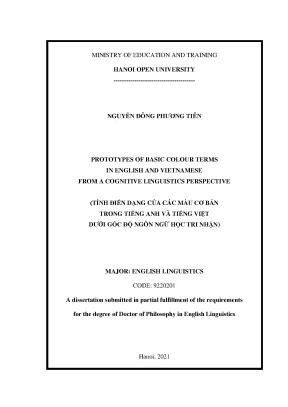
Tổng quan luận án
Luận án tiến sĩ ngữ văn Anh với đề tài "Prototypes of basic colour terms in English and Vietnamese from a cognitive linguistics perspective" (Tính điển dạng của các màu cơ bản trong tiếng Anh và tiếng Việt dưới góc độ ngôn ngữ học tri nhận) do nghiên cứu sinh Nguyễn Đông Phương Tiên thực hiện dưới sự hướng dẫn khoa học của PGS. Hoàng Tuyết Minh, bảo vệ tại Trường Đại học Mở Hà Nội năm 2021 (Mã số chuyên ngành: 9220201).
Tính cấp thiết và khoảng trống nghiên cứu
Màu sắc và hệ thống từ chỉ màu sắc phản ánh các giá trị đặc thù trong văn hóa và tri nhận của mỗi dân tộc. Theo Vũ Phương Anh (2011), từ chỉ màu sắc không chỉ dừng lại ở chức năng biểu đạt ngữ nghĩa thông thường trong đời sống hàng ngày mà cần được khảo sát từ các bình diện tri nhận sâu xa nhằm làm sáng tỏ mối liên hệ giữa một từ chỉ màu và các điển dạng (prototypes) tương đương trong tâm trí con người. Các nghiên cứu trước đây tại Việt Nam và trên thế giới thường tiếp cận từ chỉ màu dưới góc độ từ vựng học đơn thuần, phân tích ngữ nghĩa của một vài từ màu riêng lẻ hoặc so sánh cấu trúc thành ngữ mà chưa kết hợp một cách hệ thống lý thuyết điển dạng với các bình diện văn hóa và tri nhận trên một hệ thống ngữ liệu văn học quy mô lớn. Do đó, việc nghiên cứu các điển dạng của từ chỉ màu cơ bản giữa tiếng Anh và tiếng Việt nhằm giải thích những điểm tương đồng và khác biệt về mặt văn hóa và tri nhận là vấn đề cấp thiết.
Mục tiêu nghiên cứu
Mục tiêu bao quát của luận án là so sánh và đối chiếu các điển dạng của nhóm từ chỉ màu cơ bản: black/đen, white/trắng, red/đỏ, yellow/vàng, green/blue/xanh, grey/xám trong ngữ liệu tiếng Anh và tiếng Việt từ góc độ tri nhận và văn hóa.
Để đạt được mục tiêu tổng quát, luận án xác định ba mục tiêu cụ thể:
- Phân loại các sở chỉ thực thể (object referents) đóng vai trò là vật quy chiếu màu sắc của các từ chỉ màu cơ bản trong ngữ liệu tiếng Anh và tiếng Việt thành 06 lớp (classes) và các tiểu loại phạm trù (categories).
- Xác định các điển dạng (prototypes) của các từ chỉ màu cơ bản trong ngữ liệu tiếng Anh và tiếng Việt dựa trên lý thuyết điển dạng.
- Chỉ ra những điểm tương đồng và khác biệt giữa các điển dạng của từ chỉ màu cơ bản trong ngữ liệu hai ngôn ngữ dưới góc độ tri nhận và văn hóa.
Câu hỏi nghiên cứu
Luận án giải quyết ba câu hỏi nghiên cứu:
- Các lớp (classes) và phạm trù (categories) của các từ chỉ màu cơ bản trong ngữ liệu tiếng Anh và tiếng Việt là gì?
- Các điển dạng (prototypes) của các từ chỉ màu cơ bản trong ngữ liệu tiếng Anh và tiếng Việt là gì?
- Những điểm tương đồng và khác biệt giữa các điển dạng của các từ chỉ màu cơ bản trong ngữ liệu tiếng Anh và tiếng Việt dưới góc độ tri nhận và văn hóa là gì?
Đối tượng và phạm vi nghiên cứu
- Đối tượng nghiên cứu: Các điển dạng của các từ chỉ màu cơ bản và các sở chỉ thực thể liên kết với các từ chỉ màu này trong tiếng Anh (black, white, red, yellow, green, blue, grey) và tiếng Việt (đen, trắng, đỏ, vàng, xanh, xám).
- Phạm vi ngữ liệu: Ngữ liệu được thu thập từ các tác phẩm văn học thông qua các cấu trúc thành ngữ so sánh dạng
as + tính từ màu cơ bản + as + sở chỉ thực thể X trong tiếng Anh và tính từ màu cơ bản + như + sở chỉ thực thể X trong tiếng Việt.
- Tiêu chí loại trừ: Ban đầu, 11 từ màu cơ bản theo tiêu chí của Berlin và Kay (1969) được xem xét. Tuy nhiên, các cặp từ brown/nâu (17/01 trường hợp), purple/tím (04/02 trường hợp), pink/hồng (02/10 trường hợp), orange/cam (01/00 trường hợp) không đạt ngưỡng tối thiểu (trên 10 trường hợp xuất hiện ở cả hai ngôn ngữ) để đảm bảo độ tin cậy thống kê cho việc xác định điển dạng đối chiếu, nên bị loại bỏ. Đối với tiếng Việt, hai thuật ngữ xanh da trời/xanh dương và xanh lá cây không thỏa mãn tiêu chí từ đơn độc lập của Berlin và Kay, do đó thuật ngữ xanh được chọn làm đơn vị cơ bản để đối chiếu với cả green và blue trong tiếng Anh.
Tổng quan tài liệu và vị trí của luận án
Tác giả phân loại lịch sử nghiên cứu từ chỉ màu trên thế giới và ở Việt Nam thành 4 hướng tiếp cận chính:
Hệ thống nghiên cứu trước về từ chỉ màu
1. Hướng tiếp cận từ vựng học (Lexicon)
- Nghiên cứu quốc tế: Gladstone (1858) và Geiger (1869) đề xuất mô hình tiến hóa từ vựng màu sắc song hành với sự phát triển sinh học của thị giác. Klineberg (1935) và Jackendoff (1952, 1953) nghiên cứu nhận thức màu sắc ở các bộ lạc bản địa Bắc Mỹ. Lenneberg và Roberts (1953) khảo sát hiện tượng nhớ màu ở người Zuni và người nói tiếng Anh, củng cố giả thuyết tính tương đối ngôn ngữ. Conklin (1955) nghiên cứu hệ thống định danh màu của người Hanunoo ở Philippines. Battig và Montague (1965), Brown (1978) nghiên cứu các phạm trù từ vựng màu sắc. McDaniel (1972, 1974) gắn từ vựng màu sắc với cấu trúc sinh học thị giác. Lakoff (1987) phân tích các màu tiêu điểm (focal colours). Taft và Sivik (1997) khảo sát khả năng ghi nhớ từ màu. Biggam (1997) phân tích từ chỉ màu trong tiếng Anh cổ. Kay và Maffi (1999) mở rộng nghiên cứu Khảo sát Màu sắc Thế giới (World Colour Survey). Hardin (2005) phân biệt từ màu sơ cấp và thứ cấp. Saunders (2014) phê phán tính quy chuẩn phương Tây trong mô hình của Berlin và Kay.
- Nghiên cứu tại Việt Nam: Lê Anh Hiền (1971) nghiên cứu ẩn dụ màu sắc trong thơ Tố Hữu. Biện Minh Điền (2000) và Nguyễn Thị Thành Thắng (2001) khảo sát từ chỉ màu trong thơ Nguyễn Khuyến. Hà Thị Thu Hoài (2006) phân tích từ chỉ màu trong sáng tác của Tô Hoài. Trịnh Thị Thu Hiền (2004) khảo sát từ chỉ màu cơ bản và từ chỉ màu phái sinh. Trịnh Thị Minh Hương (1999) phân tích ý nghĩa miêu tả và biểu trưng của từ ngữ chỉ màu sắc trong tiếng Việt.
2. Hướng tiếp cận ngữ nghĩa học (Semantics)
- Nghiên cứu quốc tế: Kövecses (1986) chỉ ra các điểm nút ngữ nghĩa trung tâm của phạm trù màu sắc. Lucy (1992) phân tích phạm vi quy chiếu và sự phân bố ngữ pháp của từ chỉ màu qua các ngôn ngữ.
- Nghiên cứu tại Việt Nam: Hoàng Văn Hành (1982) đối chiếu cấu trúc ngữ nghĩa tính từ tiếng Việt và tiếng Nga. Bùi Thị Ngọc Anh (2008) nghiên cứu cấu trúc từ màu kết hợp với từ chỉ bộ phận mặt người. Trần Văn Sáng (2009) khảo sát từ chỉ màu trong ca dao người Việt. Vũ Phương Anh (2003) nghiên cứu từ chỉ màu trong thành ngữ tiếng Anh. Nguyễn Hoàng Phương Linh (2014) đối chiếu thành ngữ màu sắc Anh - Việt quy mô nhỏ. Nghiêm Thị Bích Diệp (2018) nghiên cứu đặc trưng ngữ nghĩa thành ngữ tình cảm gia đình. Nguyễn Thị Tố Hoa (2017) phân tích cụm từ chứa từ chỉ màu đen, trắng. Bùi Thị Thúy Phương (2004) đối chiếu từ chỉ màu trong tiếng Hán và tiếng Việt. Lê Phương Thảo (2018) nghiên cứu cấu trúc định danh và chuyển nghĩa của từ chỉ màu cơ bản tiếng Anh và tiếng Việt.
3. Hướng tiếp cận văn hóa học (Culture)
- Nghiên cứu quốc tế: Turner (1967) phân tích phân loại màu trong nghi lễ của người Ndembu. Chevalier và Gheerbrant (1997) hệ thống hóa biểu tượng màu sắc thế giới. Surridge, Osorio và Mundy (2003) gắn sự phát triển từ ngữ màu sắc với nhu cầu giao tiếp văn hóa. Regier, Kay và Cook (2005) khẳng định ảnh hưởng của văn hóa tới việc mã hóa ngôn ngữ màu sắc. Wierzbicka (1996, 2005, 2006) xây dựng ngữ nghĩa học văn hóa và định nghĩa biểu trưng màu sắc qua các phổ niệm văn hóa.
- Nghiên cứu tại Việt Nam: Nguyễn Khánh Hà (1995) phân tích mối liên hệ giữa các tiểu hệ thống từ vựng màu sắc với đặc trưng văn hóa dân tộc. Trần Thị Thu Huyền (2001) nghiên cứu nhóm biểu trưng thực vật trong thành ngữ màu sắc Anh - Việt. Lê Thị Vy (2006) tổng thuật tác động của văn hóa và ngôn ngữ tới từ chỉ màu. Nguyễn Đức Dân (2006) tiếp cận biểu tượng màu sắc dưới góc độ ký hiệu học văn hóa.
4. Hướng tiếp cận tri nhận luận (Cognition)
- Nghiên cứu quốc tế: Rivers (1897) nghiên cứu khả năng phân biệt màu sắc ở các bộ tộc Bắc Cực. Brown và Lenneberg (1954) đưa ra khái niệm khả năng mã hóa ngôn ngữ (linguistic codability). Berlin và Kay (1969) công bố công trình nền tảng về 11 từ màu cơ bản và các điển dạng phổ quát. Rosch (1973, 1974, 1975), Heider (1971, 1972), Mervis, Catlin và Rosch (1975) hoàn thiện Lý thuyết Điển dạng (Prototype Theory), chứng minh cấu trúc nội tại của phạm trù màu sắc với các thành viên trung tâm và ngoại vi. Kay và McDaniel (1978) áp dụng lý thuyết tập mờ vào tri nhận màu sắc. Kay và Chad (1978) phân tích cơ chế thần kinh học ngôn ngữ. Soriano và Valenzuela (2006) khảo sát mối liên hệ giữa màu sắc và từ vựng cảm xúc.
- Nghiên cứu tại Việt Nam: Đào Thản (1993) nghiên cứu nhận thức thị giác và quang phổ màu. Trần Thị Lan (2001) đối chiếu các thực thể quy chiếu của thành ngữ so sánh màu sắc Anh - Việt. Trịnh Thị Thu Hiền (2002) phân tích ngữ nghĩa từ màu sắc trong thành ngữ. Lê Văn Thanh (2014) khảo sát tỷ lệ thực thể so sánh màu sắc từ nguồn Internet. Hoàng Tuyết Minh (2014) đối chiếu thành ngữ so sánh tiếng Anh và tiếng Việt. Hoàng Tuyết Minh và Nguyễn Văn Quang (2015), Nguyễn Văn Quang (2017) khảo sát phạm trù màu đen/black và các thực thể quy chiếu văn hóa trong tri nhận của hai dân tộc.
Khoảng trống nghiên cứu luận án giải quyết
Mặc dù đã có các công trình nghiên cứu riêng lẻ, chưa có công trình nào đối chiếu toàn diện hệ thống điển dạng của các từ chỉ màu cơ bản giữa tiếng Anh và tiếng Việt dựa trên lý thuyết điển dạng của Eleanor Rosch kết hợp với khung phân loại 06 lớp thực thể quy chiếu (Griber et al.) trên ngữ liệu thành ngữ so sánh trích xuất từ tác phẩm văn học, đồng thời giải thích thấu đáo các khác biệt và tương đồng đó dưới lăng kính tri nhận và văn hóa dân tộc.
Cơ sở lý thuyết và phương pháp nghiên cứu
Cơ sở lý thuyết và khung phân tích
- Lý thuyết Tri nhận và Thuyết Định danh (Cognition and Nomination Theory):
- Tri nhận là quá trình tương tác giữa cơ thể sinh học và môi trường tự nhiên - xã hội (Barsalou, 1999; Johnson & Rohrer, 2007; Lý Toàn Thắng, 2008).
- Quá trình định danh (Nomination) gắn liền với nhận thức thế giới khách quan (Humboldt, 1956; Kolshansky dẫn qua Nguyễn Thị Bích Hà, 2000; Hà Quang Năng, 2013; Hoàng Thị Huệ, 2019), trong đó con người chọn lựa các đặc trưng nổi trội nhất của đối tượng để gắn với ký hiệu ngôn ngữ.
- Lý thuyết Điển dạng và Phạm trù hóa (Prototype Theory and Categorization):
- Khái niệm phạm trù cổ điển của Aristotle dựa trên các điều kiện cần và đủ bị thay thế bởi mô hình phạm trù hóa tri nhận (Rosch, 1975, 1978; Lakoff, 1987; Trần Văn Cơ, 2007; Lý Toàn Thắng, 2009).
- Điển dạng (Prototype) là thành viên nổi bật nhất (most salient exemplar), là đại diện tốt nhất của một phạm trù, được bao quanh bởi các thành viên có mức độ tương đồng giảm dần.
- Mô hình phân loại 06 lớp thực thể quy chiếu (06-Class Classification): Luận án áp dụng khung phân loại của Griber et al., chia toàn bộ các thực thể quy chiếu của từ chỉ màu thành 06 lớp:
- Flora (Thực vật)
- Fauna (Động vật)
- Inanimate nature (Tự nhiên vô sinh)
- Food and beverage (Thực phẩm và đồ uống)
- Man-made object (Vật thể nhân tạo)
- Body and bodily product (Cơ thể và sản phẩm cơ thể)
- Mô hình Phân tích Đối chiếu Lý thuyết (Theoretical Contrastive Analysis): Áp dụng mô hình của Fisiak et al. (1978) nhằm xác định sự hiện thực hóa của phạm trù phổ quát X (ở đây là điển dạng từ chỉ màu) trong Ngôn ngữ A (tiếng Anh) và Ngôn ngữ B (tiếng Việt).
        Phạm trù phổ quát X (Điển dạng màu sắc)
                    /             \
                   /               \
   Hiện thực hóa trong Ngôn ngữ A    Hiện thực hóa trong Ngôn ngữ B
           (Tiếng Anh)                      (Tiếng Việt)
                  \                 /
                   \               /
       So sánh & Đối chiếu (Văn hóa & Tri nhận)
Phương pháp nghiên cứu
- Phương pháp định lượng (Linguistic statistical method): Sử dụng phần mềm SPSS để tính toán tần số xuất hiện và tỷ lệ phần trăm (%) của từng thực thể quy chiếu liên kết với mỗi từ chỉ màu cơ bản trong ngữ liệu. Thực thể có tỷ lệ phần trăm xuất hiện cao nhất trong phạm trù được xác định là điển dạng của từ chỉ màu đó.
- Phương pháp định tính (Descriptive & Qualitative method): Miêu tả đặc trưng ngữ nghĩa và phân tích bản chất tri nhận, văn hóa của các thực thể quy chiếu và điển dạng.
- Phương pháp so sánh - đối chiếu (Contrastive method): Đối chiếu các điển dạng tương ứng giữa tiếng Anh và tiếng Việt theo 3 tiêu chí: tần suất xuất hiện, ngữ nghĩa biểu đạt, đặc trưng văn hóa và mô hình tư duy tri nhận.
Nguồn dữ liệu và quy trình thu thập
Ngữ liệu được trích xuất từ các tác phẩm văn học Anh - Mỹ và Việt Nam:
- Ngữ liệu tiếng Anh: 430 ngữ cảnh (tokens) trích từ 169 tác phẩm văn học của 27 tác giả Anh - Mỹ.
- Ngữ liệu tiếng Việt: 443 ngữ cảnh (tokens) trích từ 219 tác phẩm văn học của 52 tác giả Việt Nam.
- Cấu trúc ngữ liệu khảo sát:
as + [basic colour term] + as + [object referent X] và [từ chỉ màu cơ bản] + như + [thực thể X].
Nội dung chính theo từng chương
Chương 1: Tổng quan tài liệu (Literature Review)
Chương 1 hệ thống hóa các nghiên cứu trong và ngoài nước liên quan đến từ chỉ màu theo 4 hướng: từ vựng, ngữ nghĩa, văn hóa và tri nhận. Đồng thời, chương này thiết lập nền tảng lý thuyết cho luận án bao gồm mối quan hệ ngôn ngữ - tri nhận - văn hóa (Humboldt, Sapir, Whorf, Lantolf, Trần Ngọc Thêm, Nguyễn Đức Tồn); lý thuyết phạm trù hóa và lý thuyết điển dạng của Rosch; các tiêu chí ngôn ngữ học xác định 11 từ màu cơ bản của Berlin và Kay (1969); thuyết định danh trong ngôn ngữ học; và khung phân loại 06 lớp thực thể quy chiếu của Griber et al.
Chương 2: Phương pháp nghiên cứu (Methodology)
Chương 2 trình bày chi tiết về cách tiếp cận nghiên cứu kết hợp định tính - định lượng và phương pháp phân tích đối chiếu lý thuyết (Fisiak et al., 1978). Tác giả mô tả chi tiết các bước thu thập ngữ liệu từ 169 tác phẩm văn học tiếng Anh và 219 tác phẩm văn học tiếng Việt, quy trình lọc ngữ liệu theo tiêu chí tần số xuất hiện (> 10 tokens/cặp từ), quy trình xử lý thống kê bằng công cụ SPSS và quy trình 3 bước so sánh điển dạng.
Chương 3: Phân loại lớp và phân loại tiểu phạm trù của các từ chỉ màu cơ bản trong ngữ liệu tiếng Anh và tiếng Việt (Classes and Categories of Basic Colour Terms in English and Vietnamese Data)
Chương 3 trình bày kết quả phân loại 873 tokens thu thập được vào 06 lớp thực thể quy chiếu (Flora, Fauna, Inanimate nature, Food and beverage, Man-made object, Body and bodily product) và các tiểu phạm trù chi tiết cho từng từ màu trong ngữ liệu tiếng Anh và tiếng Việt:
- Ngữ liệu tiếng Anh (430 tokens): Phân tích chi tiết 7 từ chỉ màu: black, white, red, yellow, green, blue, grey. Xác định sự phân bổ của các thực thể quy chiếu trong từng lớp.
- Ngữ liệu tiếng Việt (443 tokens): Phân tích chi tiết 6 từ chỉ màu: đen, trắng, đỏ, vàng, xanh, xám.
Dữ liệu tổng hợp xác định điển dạng có tỷ lệ phần trăm cao nhất cho mỗi từ màu được khái quát trong bảng sau:
| Từ chỉ màu tiếng Anh |
Điển dạng tiếng Anh (Prototype) |
Từ chỉ màu tiếng Việt |
Điển dạng tiếng Việt (Prototype) |
| Black |
Night (Đêm) |
Đen |
Mực |
| White |
Snow (Tuyết) |
Trắng |
Ngà |
| Red |
Blood (Máu) & Rose (Hoa hồng) |
Đỏ |
Son |
| Yellow |
Corn (Ngô/bắp) |
Vàng |
Nghệ |
| Green |
Emerald (Ngọc lục bảo) |
Xanh |
Tàu lá |
| Blue |
Sapphire (Ngọc bích/xa-phia) |
|
|
| Grey |
Badger (Con lửng) |
Xám |
Tro/gio |
Chương 4: So sánh các điển dạng của từ chỉ màu cơ bản trong ngữ liệu tiếng Anh và tiếng Việt (Comparison of Prototypes of Basic Colour Terms in English and Vietnamese Data)
Chương 4 tiến hành so sánh đối chiếu từng cặp điển dạng đã xác định ở Chương 3 dưới góc độ tri nhận và văn hóa:
- Black (night) vs Đen (mực): Tiếng Anh tri nhận màu đen gắn liền với tự nhiên vô sinh (night - bóng đêm bao trùm không gian vũ trụ), trong khi tiếng Việt tri nhận màu đen gắn với đồ vật nhân tạo (mực - mực tàu, chất liệu gắn liền với chữ nghĩa, học vấn truyền thống hoặc sản phẩm đời sống).
- White (snow) vs Trắng (ngà): Tiếng Anh lấy snow (tuyết - hiện tượng tự nhiên khí hậu hàn đới đặc trưng) làm điển dạng; người Việt tri nhận màu trắng điển dạng qua ngà (ngà voi - chất liệu quý tự nhiên gắn với động vật miền nhiệt đới, tượng trưng cho màu trắng đục, quý phái).
- Red (blood & rose) vs Đỏ (son): Tiếng Anh có hai điển dạng: blood (sản phẩm cơ thể, phản ánh cảm xúc mạnh, sự sống/cái chết) và rose (thực vật, biểu tượng cái đẹp và tình yêu). Tiếng Việt lấy son (vật thể nhân tạo - chất khoáng màu đỏ dùng làm mực quan hoặc mỹ phẩm phụ nữ, biểu trưng cho sự may mắn, son sắt).
- Yellow (corn) vs Vàng (nghệ): Tiếng Anh chọn corn (ngô - cây lương thực đặc trưng phương Tây); tiếng Việt chọn nghệ (cây gia vị, vị thuốc dân gian quen thuộc trong văn hóa nông nghiệp nhiệt đới).
- Green (emerald) & Blue (sapphire) vs Xanh (tàu lá): Tiếng Anh phân biệt rạch ròi hai phổ màu green và blue với điển dạng đều thuộc lớp tự nhiên vô sinh là các loại đá quý (emerald, sapphire). Tiếng Việt sử dụng một phạm trù từ đơn xanh bao hàm cả xanh lục và xanh lam, với điển dạng là tàu lá (thực vật - biểu tượng nổi bật của môi trường thực vật nhiệt đới gió mùa).
- Grey (badger) vs Xám (tro/gio): Tiếng Anh chọn badger (con lửng - lớp động vật đặc thù của hệ sinh thái ôn đới xứ lạnh); tiếng Việt chọn tro/gio (lớp tự nhiên/chất thải vô sinh - tàn dư của bếp củi trong văn hóa sinh hoạt gia đình truyền thống).
Kết quả và những đóng góp mới
Đóng góp về mặt lý luận
- Luận án cung cấp bức tranh toàn diện và hệ thống về việc áp dụng Lý thuyết Điển dạng (Prototype Theory) kết hợp với mô hình phân loại 06 lớp thực thể quy chiếu trong việc nghiên cứu ngữ nghĩa từ vựng màu sắc giữa hai ngôn ngữ khác loại hình (tiếng Anh - ngôn ngữ biến hình, phân tích tính và tiếng Việt - ngôn ngữ đơn lập).
- Làm sáng tỏ cơ chế tương tác giữa Ngôn ngữ - Tri nhận - Văn hóa, chứng minh rằng sự hình thành các điển dạng màu sắc không chỉ là hiện tượng sinh học thị giác thuần túy mà là kết quả của quá trình tri nhận gắn liền với môi trường sinh thái, phương thức sinh hoạt kinh tế và truyền thống văn hóa đặc thù của mỗi dân tộc.
Đóng góp về mặt thực tiễn
- Dạy và học ngoại ngữ: Cung cấp tư liệu đối chiếu chi tiết giúp người học tiếng Anh và tiếng Việt hiểu đúng bản chất ngữ nghĩa, tránh việc dịch thô hoặc nhầm lẫn văn hóa khi gặp các thành ngữ so sánh màu sắc (ví dụ: as black as night không tương đương trực tiếp về mặt trải nghiệm hình ảnh với đen như mực).
- Biên phiên dịch: Hỗ trợ biên phiên dịch viên lựa chọn các đơn vị từ vựng tương đương tương thích về mặt điển dạng văn hóa trong tác phẩm văn học.
- Giao tiếp liên văn hóa: Nâng cao nhận thức về sự khác biệt trong mô hình tư duy, giúp người bản ngữ hai thứ tiếng hiểu sâu hơn về thế giới quan của nhau, hạn chế hiện tượng sốc văn hóa.
Kiến nghị và giải pháp đề xuất
- Đưa kiến thức về điển dạng ngôn ngữ học tri nhận vào giáo trình giảng dạy ngữ nghĩa học và văn hóa học đường tại các trường đại học chuyên ngữ.
- Xây dựng các từ điển đối chiếu thành ngữ so sánh Anh - Việt có kèm chú giải tri nhận và nguồn gốc văn hóa của các thực thể so sánh.
Hạn chế và hướng nghiên cứu tiếp
Hạn chế của luận án
- Do tiêu chí lựa chọn ngữ liệu khắt khe (chỉ xét các từ đơn độc lập có trên 10 trường hợp xuất hiện trong các tác phẩm văn học khảo sát), luận án chưa thể bao quát 4 cặp từ màu cơ bản còn lại: brown/nâu, purple/tím, pink/hồng, orange/cam.
- Phạm vi ngữ liệu mới tập trung vào các tác phẩm văn học thành văn, chưa mở rộng sang khẩu ngữ hàng ngày, văn bản báo chí hoặc các phương tiện truyền thông hiện đại.
Hướng nghiên cứu tiếp
- Mở rộng nguồn dữ liệu khảo sát sang ngữ liệu đa phương thức, mạng xã hội và ngôn ngữ quảng cáo thương mại để khảo sát thêm các từ màu thứ cấp (secondary colour terms) và các từ màu mới xuất hiện (novel evocative colour terms).
- Nghiên cứu sâu hơn về sự biến đổi của các điển dạng màu sắc theo trục thời gian lịch sử (diachronic approach) nhằm theo dõi sự dịch chuyển tri nhận của người Việt và người nói tiếng Anh trong kỷ nguyên toàn cầu hóa.
Giá trị tham khảo
Luận án là tài liệu tham khảo chuyên khảo dành cho:
- Nghiên cứu sinh và học viên cao học ngành Ngôn ngữ học, Ngôn ngữ Anh: Tham khảo khung lý thuyết kết hợp giữa Ngôn ngữ học Tri nhận (Lý thuyết Điển dạng) và Phân tích Đối chiếu Ngôn ngữ học, cùng quy trình xử lý số liệu định lượng bằng SPSS trên ngữ liệu văn học.
- Giảng viên giảng dạy Ngôn ngữ học, Dịch thuật và Giao tiếp liên văn hóa: Sử dụng kết quả nghiên cứu tại Chương 3 và Chương 4 để thiết kế bài giảng về ngữ nghĩa học từ vựng, thành ngữ học so sánh và chuyển dịch văn hóa trong dịch thuật văn học.
- Người làm công tác biên phiên dịch và nhà nghiên cứu văn hóa: Tra cứu nguồn gốc tri nhận, sắc thái ngữ nghĩa và các thực thể quy chiếu tương đương của hệ thống thành ngữ so sánh màu sắc Anh - Việt.
Câu hỏi thường gặp
1. Tại sao các từ chỉ màu brown/nâu, purple/tím, pink/hồng, orange/cam không được đưa vào so sánh chính thức trong luận án?
Theo tiêu chí phương pháp luận của luận án, để đảm bảo độ tin cậy thống kê cho việc xác định điển dạng đối chiếu, mỗi từ màu cần đạt tối thiểu trên 10 tokens xuất hiện ở cả hai ngôn ngữ. Trong ngữ liệu văn học thu thập được, số lượng tokens của các cặp từ này lần lượt là: brown/nâu (17/01), purple/tím (04/02), pink/hồng (02/10), orange/cam (01/00). Do tỷ lệ xuất hiện không đồng đều và quá thấp ở một trong hai ngôn ngữ, tác giả đã loại bỏ 4 cặp từ này khỏi phạm vi khảo sát chính.
2. Tại sao luận án quy hai từ green và blue trong tiếng Anh về chung một từ xanh trong tiếng Việt để đối chiếu?
Dựa trên tiêu chí ngôn ngữ học của Berlin và Kay (1969), một từ chỉ màu cơ bản phải là từ đơn độc lập (single root word). Trong tiếng Việt, xanh da trời/xanh dương và xanh lá cây là các từ ghép phân tích tính, không thỏa mãn tiêu chí từ đơn. Do đó, luận án sử dụng từ đơn xanh trong tiếng Việt (phạm trù bao hàm cả sắc độ xanh lục và xanh lam) để so sánh đối chiếu với hai phạm trù độc lập green và blue trong tiếng Anh.
3. Căn cứ nào để luận án khẳng định một thực thể là "điển dạng" (prototype) của một từ chỉ màu?
Luận án kết hợp Lý thuyết Điển dạng của Eleanor Rosch với phương pháp thống kê định lượng. Trong một phạm trù màu sắc, thực thể quy chiếu (object referent) nào có tần số và tỷ lệ phần trăm (%) xuất hiện cao nhất trong cấu trúc so sánh trích xuất từ ngữ liệu văn học sẽ được xác định là thành viên tiêu biểu nhất, đóng vai trò là điển dạng của từ chỉ màu đó.
4. Khung phân loại 06 lớp thực thể quy chiếu mà luận án áp dụng gồm những lớp nào?
Luận án áp dụng khung phân loại của Griber et al., bao gồm 06 lớp:
- Flora (Thực vật)
- Fauna (Động vật)
- Inanimate nature (Tự nhiên vô sinh)
- Food and beverage (Thực phẩm và đồ uống)
- Man-made object (Vật thể nhân tạo)
- Body and bodily product (Cơ thể và sản phẩm cơ thể)
Kết luận
Luận án của tác giả Nguyễn Đông Phương Tiên đã giải quyết thành công việc phân loại và xác định các điển dạng của hệ thống từ chỉ màu cơ bản trong tiếng Anh (black, white, red, yellow, green, blue, grey) và tiếng Việt (đen, trắng, đỏ, vàng, xanh, xám) dựa trên ngữ liệu thành ngữ so sánh văn học phong phú. Thông qua phương pháp nghiên cứu kết hợp định tính, định lượng và phân tích đối chiếu, công trình đã làm sáng tỏ 13 điển dạng đặc thù của hai ngôn ngữ và phân tích nguồn gốc của chúng từ sự khác biệt về môi trường tự nhiên, phương thức kinh tế nông nghiệp/công nghiệp và truyền thống văn hóa dân tộc. Kết quả nghiên cứu không chỉ đóng góp giá trị lý luận cho chuyên ngành Ngôn ngữ học Tri nhận và Ngôn ngữ học So sánh Đối chiếu tại Việt Nam mà còn mang lại giá trị ứng dụng thiết thực cho hoạt động giảng dạy ngoại ngữ và biên phiên dịch Anh - Việt.