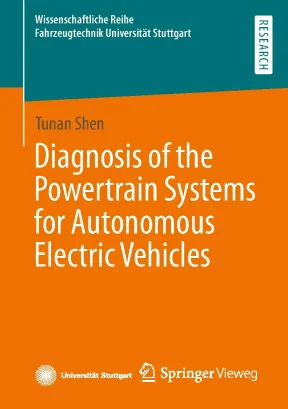
Tổng quan về luận án
Sự phát triển đột phá của xe điện tự hành (Autonomous Electric Vehicles - AEV) cấp độ SAE Level 4 và Level 5 đang định hình lại bức tranh di động toàn cầu. Theo báo cáo chiến lược từ Roland Berger, đến năm 2030, tổng quãng đường di chuyển bằng phương tiện cá nhân dự kiến sẽ giảm 28%, trong khi tỷ trọng hành trình thông qua dịch vụ robotaxi và phương tiện trung chuyển tự hành đô thị (Urban Automated Taxi - UAT) sẽ tăng vọt 27% [1]. Tuy nhiên, khác với các dòng xe cá nhân truyền thống dựa vào tri thức cảm quan học của tài xế (heuristic knowledge) để phát hiện sớm các bất thường cơ-điện, xe tự hành hoàn toàn phụ thuộc vào hệ thống điều khiển tự động và không có người lái đóng vai trò dự phòng an toàn (fallback level) [4]. Nếu hệ thống truyền động điện (electrical powertrain) gặp sự cố đột ngột, chiếc xe có thể dừng tê liệt ngay giữa làn đường cao tốc, tạo ra nguy cơ va chạm thảm khốc. Do đó, hệ số khả dụng (availability) và độ tin cậy vận hành không gián đoạn (fail-operational capability) trở thành yêu cầu sống còn bắt buộc.
Mặc dù giải pháp dự phòng phần cứng kép (hardware redundancy) có thể giải quyết bài toán fail-operational, nhưng phương án này làm tăng đáng kể chi phí vật liệu, khối lượng và tiêu hao năng lượng của hệ truyền động. Thay vào đó, việc phát triển một hệ thống chẩn đoán dự báo sớm (predictive diagnosis) để chuyển đổi trạng thái xe sang chế độ vận hành suy giảm an toàn (degradation mode) được đánh giá là hướng tiếp cận kinh tế và kỹ thuật tối ưu. Luận án tiến sĩ "Diagnosis of the Powertrain Systems for Autonomous Electric Vehicles" của TS. Tunan Shen, thực hiện tại Viện Kỹ thuật Xe cơ giới Stuttgart (IFS - Chair of Automotive Mechatronics, Universität Stuttgart) phối hợp cùng Bộ phận Nghiên cứu Tập đoàn Robert Bosch GmbH (Renningen, Đức), đã giải quyết trực diện rào cản này bằng việc phát triển khung chẩn đoán thông minh đa tầng tích hợp cho động cơ đồng bộ nam châm vĩnh cửu (PMSM) và hệ truyền động cầu điện tích hợp (eAxle).
Nghiên cứu tập trung giải quyết ba câu hỏi học thuật và kỹ thuật cốt lõi (Research Questions):
- RQ1: Làm thế nào để mô hình hóa giải tích chính xác và phân lập triệt để giữa các sự cố ngắn mạch cuộn dây stator động cơ với các lỗi cảm biến dòng điện phi tuyến tính trong toàn bộ dải vận hành thực tế?
- RQ2: Kiến trúc thuật toán nào cho phép kết hợp tối ưu giữa mô hình vật lý tiền định (white-box), mô hình học tự giám sát bất thường (unsupervised grey-box) và mạng nơ-ron học máy từ dữ liệu đội xe (black-box) nhằm đạt độ chính xác chẩn đoán cao nhất mà không bị báo động giả?
- RQ3: Các đặc trưng rung động kinh điển trong phòng thí nghiệm có khả năng chuyển giao sang sản phẩm công nghiệp (eAxle) hay không, và chỉ số sức khỏe suy thoái nào phản ánh trung thực tiến trình hư hỏng vòng bi trong điều kiện vận hành thực tế?
Tương ứng với các câu hỏi nghiên cứu, luận án kiểm chứng ba giả thuyết khoa học (Hypotheses):
- H1: Tích hợp các đặc trưng điều hòa dòng điện pha trong miền thời gian - tần số cho phép tách biệt hoàn toàn dạng lỗi ngắn mạch cuộn dây nội bộ khỏi sự sai lệch độ lợi (gain error) và độ lệch tĩnh (offset error) của cảm biến dòng.
- H2: Cơ chế biểu quyết mềm (Soft-Voting Decision Making) dựa trên độ tin cậy dự báo ($cf$) của ba tầng mô hình (Mô hình vật lý, Mô hình SCM và Mạng nơ-ron ANN) vượt trội hơn bất kỳ mô hình đơn lẻ nào về tính thích ứng tại các điểm vận hành chưa từng được hiệu chuẩn.
- H3: Trong môi trường công nghiệp có tỷ số tín hiệu trên nhiễu thấp, đặc trưng quang phổ nhiễu nền $Medianspec$ duy trì tính đơn điệu (monotonicity) và độ nhạy (sensitivity) cao hơn các đặc trưng thống kê truyền thống (Kurtosis, RMS, biên độ đỉnh điều hòa).
Phạm vi thực nghiệm và mô phỏng của luận án bao gồm cơ sở dữ liệu mô phỏng quy mô lớn với hơn 10.000 kịch bản sự cố cuộn dây và cảm biến trên động cơ PMSM đa điểm làm việc (mô-men xoắn $T_{ref}$ từ 0 đến 100 Nm, tốc độ góc cơ học $n_{mech}$ từ 0 đến 5000 vòng/phút), kết hợp cùng bộ dữ liệu kiểm thử độ bền phá hủy thực tế (run-to-failure test) kéo dài khoảng 150 giờ liên tục trên các cụm cầu điện eAxle thương mại thế hệ mới.
Literature Review và Positioning
Khung lý thuyết chẩn đoán sự cố công nghiệp truyền thống vốn được chia làm ba trường phái chính theo phân loại của Isermann (2005) [49]: phương pháp dựa trên tín hiệu (signal-based), phương pháp dựa trên mô hình toán học (model-based), và phương pháp dựa trên dữ liệu (data-based). Trong cấu trúc phần mềm điều khiển xe hiện đại, dù mã nguồn phục vụ chức năng chẩn đoán tự kiểm tra (On-Board Diagnostics - OBD) chiếm tới 50% tổng dung lượng phần mềm điều khiển phương tiện [7], các hệ thống OBD hiện hành phần lớn hoạt động theo cơ chế phản ứng thụ động (fail-safe) — tức chỉ ngắt nguồn khi sự cố đã bộc phát trầm trọng, hoàn toàn bất lực trong việc phát hiện tiền triệu chứng để hỗ trợ chế độ lái duy trì an toàn (fail-operational).
Theo nghiên cứu thống kê độ tin cậy của O'Donnell, Albrecht và cộng sự [35], hỏng hóc trong máy điện tập trung chủ yếu ở hai bộ phận cốt lõi: vòng bi cơ khí chiếm tỷ lệ cao nhất với 51% tổng số ca sự cố, và cuộn dây stator đứng thứ hai với 16% tổng số vụ dừng máy. Đối với bộ biến tần công suất (inverter), khảo sát công nghiệp của Yang và cộng sự [22] chỉ ra rằng 31% chuyên gia đánh giá linh kiện bán dẫn công suất (IGBT) là thành phần dễ tổn thương nhất. Tuy nhiên, các sự cố ngắn mạch van IGBT diễn ra trong thang micro-giây, không cho phép đủ dung sai thời gian để thực hiện chẩn đoán dự báo và bù điều khiển. Ngược lại, sự suy thoái lớp cách điện cuộn dây stator và suy thoái vòng bi diễn biến qua nhiều cấp độ thời gian từ vài giờ đến hàng trăm giờ. Theo Nandi và Toliyat (2005) [42], tuổi thọ của lớp cách điện giảm 50% khi nhiệt độ vận hành tăng cục bộ 10 °C so với giới hạn định mức, tạo ra chuỗi thoái biến từ ngắn mạch giữa các vòng dây (Turn-to-turn Short Circuit - TSC), lan truyền thành ngắn mạch giữa các pha (Phase-to-phase Short Circuit - PSC) hoặc điện trở cuộn dây mất cân bằng (Unbalanced Winding Resistance - UWR).
Trong y văn thế giới, việc chẩn đoán rung động vòng bi phụ thuộc rất lớn vào các tập dữ liệu mở chuẩn phòng thí nghiệm như bộ dữ liệu CWRU của Đại học Case Western Reserve [51], bộ dữ liệu XJTU-SY của Đại học Giao thông Tây An [37], hay bộ dữ liệu FEMTO [40]. Tuy nhiên, các nghiên cứu dựa trên dữ liệu chuẩn phòng thí nghiệm thường bộc lộ mâu thuẫn lớn khi triển khai trên sản phẩm công nghiệp thực thụ:
- Tranh luận về độ nhạy của chỉ số Kurtosis: Các công trình kinh điển (như Antoni & Randall, 2006) khẳng định hệ số nhọn Kurtosis và giải điều chế biên độ bao Hilbert là chỉ báo tối ưu để bắt xung va đập sớm của bi lăn trên rãnh vòng bi (BPFO, BPFI, BFF). Ngược lại, thực nghiệm trên cụm cầu điện eAxle hoàn chỉnh của Bosch chứng minh rằng trong điều kiện tăng giảm tốc độ liên tục (ramp tests) kết hợp nhiễu ăn khớp bánh răng, Kurtosis hoàn toàn mất tính đơn điệu do hiện tượng "tự phục hồi bề mặt giả định" (self-healing effect - khi các vết nứt tế vi ban đầu bị mài nhẵn tạm thời trước khi vỡ vụn rãnh quy mô lớn).
- Tranh luận về khả năng phân lập lỗi cảm biến và lỗi vật lý: Các công trình của Choi et al. (2015) [32] hay Jeong et al. (2014) [33] sử dụng phương pháp chuẩn hóa dòng điện trung bình nhưng chỉ giải quyết được sự cố cảm biến tại điểm làm việc tĩnh, không thể thích ứng khi xe vận hành biến thiên động lực học trên chu kỳ đường đô thị.
Luận án của TS. Tunan Shen định vị chính xác khoảng trống học thuật này bằng việc bắc nhịp cầu nối giữa lý thuyết phân tích giải tích và dữ liệu thực nghiệm trên cụm truyền động công nghiệp, thiết lập hệ thống chỉ số sức khỏe mới có khả năng triệt tiêu nhiễu nền cơ cấu chấp hành.
Đóng góp lý thuyết và khung phân tích
Đóng góp cho lý thuyết
Luận án đóng góp vào lý thuyết mô hình hóa máy điện thông qua việc thiết lập hệ phương trình vi phân phi tuyến mở rộng của động cơ PMSM khi xảy ra các dạng suy thoái lớp cách điện stator kết hợp lỗi trôi cảm biến đo lường:
$$\begin{aligned}
\mathbf{U}{ph} &= \mathbf{R} \mathbf{I}{ph} + \frac{d\mathbf{\Psi}}{dt} \
\mathbf{\Psi} &= \mathbf{L} \mathbf{I}{ph} + \mathbf{\Psi}{PM}
\end{aligned}$$
Trong đó, ma trận điện trở $\mathbf{R}$ và ma trận điện cảm $\mathbf{L}$ được tham số hóa động theo tỷ lệ số vòng dây bị ngắn mạch $\eta$, điện trở lớp cách điện tiếp xúc $R_{f1}, R_{f2}, R_{f3}$, đồng thời tích hợp trực tiếp mô hình lỗi độ lợi $e_{gain}$ và lỗi độ lệch $e_{offset}$ của cảm biến dòng điện Hall:
$$I_{a,measured} = (1 + e_{gain}) I_{a,true} + e_{offset}$$
Về mặt lý thuyết chẩn đoán rung động phi dừng, tác giả mở rộng nền tảng phân tích quang phổ thời-tần (STFT) bằng cách đề xuất biến lượng toán học mới: đặc trưng $Medianspec$. Khác với năng lượng dải tần tổng hoặc đỉnh hài đặc trưng vòng bi phụ thuộc vào tần số cơ bản của trục $f_N$ (như $f_{ftf}, f_{bpfo}, f_{bpfi}, f_{bff}$), $Medianspec$ đại diện cho giá trị trung vị của mật độ phổ công suất trên toàn dải đo phổ rung động:
$$Medianspec(t) = \text{median} \left( |STFT(t, f)|^2 \right){f \in [f{min}, f_{max}]}$$
Công thức này chứng minh tính bất biến trước các xung đột biến cục bộ và phản ánh trực tiếp sự suy thoái dần của màng dầu bôi trơn và sự gia tăng ma sát vi mô trên bề mặt rãnh lăn.
Khung phân tích độc đáo
Khung phân tích của luận án tích hợp ba lý thuyết học máy và xử lý tín hiệu hiện đại:
-
Lý thuyết Cây quyết định và Độ thuần khiết Gini (Breiman et al., CART): Được sử dụng để xây dựng mô hình vật lý tiền định giải thích được (white-box), thiết lập các ngưỡng phân nhánh tường minh dựa trên 6 đặc trưng chọn lọc của dòng 3 pha: biên độ đỉnh cực đại ($Max$), độ lệch chuẩn ($Std$), tổng công suất điều hòa bậc cao ($Pwr$), hệ số biến dạng biên độ dòng điện chuẩn hóa ($I_{i,norm}$), và góc pha bất đối xứng.
-
Lý thuyết Phát hiện Bất thường Mật độ Cục bộ (Breunig et al., LOF): Đóng vai trò hạt nhân của mô hình Tự giám sát trạng thái (Self Condition Monitoring - SCM). SCM học phân phối cụm của phương tiện ở trạng thái khỏe mạnh tại từng điểm làm việc $(T_{ref}, n_{mech})$ thông qua khoảng cách hình học Euclidean đa chiều:
$$d(p, q) = \sqrt{\sum_{i=1}^{N} (p_i - q_i)^2}$$
Khi xuất hiện sự suy thoái, chỉ số LOF tính toán tỷ số mật độ cục bộ giữa điểm quan trắc với $k$-láng giềng gần nhất, cho phép nhận diện các bất thường chưa từng gặp trong dữ liệu huấn luyện (zero-shot unknown faults).
-
Mạng Nơ-ron Đa tầng Học tập từ Dữ liệu Đội xe (Fleet-based ANN): Kết hợp hàm kích hoạt chỉnh lưu phi tuyến ReLU ($\phi(s) = \max(0, s)$) và hàm Sigmoid nhằm tổng hợp các phân phối lỗi phức tạp thu thập từ hàng ngàn phương tiện vận hành thực tế qua điện toán đám mây.
Điều kiện biên phân tích (Boundary Conditions) được xác lập nghiêm ngặt: hệ thống áp dụng cho dải vận hành sinh mô-men dương liên tục của động cơ kéo xe điện, loại trừ các trạng thái ngắt kết nối cơ học hoặc phanh hãm tái sinh khẩn cấp vượt ngưỡng an toàn nhiệt động.
Phương pháp nghiên cứu tiên tiến
Thiết kế nghiên cứu
Luận án tuân thủ nghiêm ngặt quan điểm nhận thức luận thực chứng (Positivism) kết hợp phương pháp nghiên cứu kỹ thuật đa tầng (Multi-level Multi-stage Experimental Design). Tiến trình nghiên cứu được module hóa thành hai trục chuyên sâu tương ứng với hai miền vật lý của hệ truyền động:
TIẾN TRÌNH NGHIÊN CỨU THỰC CHỨNG
Quy trình nghiên cứu rigorous
-
Giao thức thu thập và tiền xử lý dữ liệu dòng điện:
Dòng điện ba pha ($I_a, I_b, I_c$) được lấy mẫu đồng bộ với góc quay rotor điện $\theta_{el}$. Dữ liệu thô trải qua bước lọc thông dải số, biến đổi hệ tọa độ trực tiếp - vuông góc ($d-q$ frame), và trích xuất đặc trưng điều hòa bậc 1 đến bậc 5 thông qua giải thuật biến đổi Fourier nhanh (FFT) và biến đổi thời-tần STFT với độ phân giải cửa sổ trượt $\Delta t$ và độ phân giải tần số $\Delta f$ tối ưu hóa.
-
Giao thức thử nghiệm phá hủy vòng bi cụm cầu điện eAxle:
Khác với các thử nghiệm tĩnh trong phòng thí nghiệm, cụm truyền động eAxle của Bosch được thử nghiệm trên băng thử công suất 1:1. Quá trình kiểm thử lặp lại liên tục các chu kỳ dốc vận tốc (ramp tests) kéo dài 1 phút mỗi chu kỳ: tăng tốc từ 0 lên tốc độ tối đa của động cơ rồi phanh về 0 dưới tải mô-men xoắn dương không đổi, duy trì liên tục trong suốt 150 giờ cho đến khi vòng bi phá hủy hoàn toàn.
-
Giao thức giải điều chế đường bao Hilbert (Envelope Analysis):
Để trích xuất các tần số đặc trưng hư hỏng vòng bi bị chôn vùi dưới nền nhiễu cơ học, tín hiệu rung động gia tốc được giải điều chế bằng biến đổi Hilbert nhằm thu nhận tín hiệu bao $Env(t) = \sqrt{x(t)^2 + \tilde{x}(t)^2}$, từ đó phân tích năng lượng tại các tần số đặc trưng:
$$f_{ftf} = \frac{1}{2} \left(1 - \frac{D_b}{D_p}\cos\phi_b\right) f_N$$
$$f_{bpfo} = \frac{n_e}{2} \left(1 - \frac{D_b}{D_p}\cos\phi_b\right) f_N$$
$$f_{bpfi} = \frac{n_e}{2} \left(1 + \frac{D_b}{D_p}\cos\phi_b\right) f_N$$
$$f_{bff} = \frac{D_p}{D_b} \left(1 - \left(\frac{D_b}{D_p}\cos\phi_b\right)^2\right) f_N$$
Trong đó $n_e$ là số lượng con lăn, $D_b$ là đường kính con lăn, $D_p$ là đường kính vòng chia và $\phi_b$ là góc tiếp xúc danh định.
Data và phân tích
| Tham số / Đại lượng |
Giá trị thực nghiệm trong luận án |
Ý nghĩa vật lý / Kiểm chuẩn |
| Quy mô tập mẫu mô phỏng sự cố điện |
> 10.000 mẫu độc lập |
Đa dạng hóa 5 cấp độ lỗi, 12 điểm làm việc |
| Thời gian thử nghiệm độ bền eAxle |
~150 giờ (Run-to-failure) |
Chu kỳ dốc 1 phút lặp lại đến khi phá hủy |
| Độ nhạy phân lập lỗi cuộn dây vs cảm biến |
$F_1\text{-score} > 0.98$ |
Kiểm tra chéo trên tập test độc lập |
| Đặc trưng rung động tối ưu |
$Medianspec, Env_{ftf}, P2P$ |
Đạt độ đơn điệu $>0.92$ trên 4 cụm eAxle |
| Phần mềm và môi trường phát triển |
MATLAB/Simulink, ETAS ASCMO, Python |
Tối ưu hóa mô hình dữ liệu lớn |
Hệ thống được kiểm thử độ vững chắc (robustness checks) bằng cách tiêm thêm nhiễu trắng Gaussian (AWGN) với tỷ số tín hiệu trên nhiễu (SNR) từ 10 dB đến 30 dB và kiểm tra phản ứng trước các điểm làm việc ngoại lai chưa từng hiệu chuẩn (out-of-distribution operating points).
Phát hiện đột phá và implications
Những phát hiện then chốt
-
Sự sụp đổ của các chỉ số rung động kinh điển trên sản phẩm công nghiệp: Các đặc trưng thống kê như Kurtosis và biên độ đơn tần của $f_{bpfo}, f_{bpfi}$ — vốn hoạt động hoàn hảo trên tập dữ liệu phòng thí nghiệm XJTU-SY — hoàn toàn thất bại trong việc thiết lập xu hướng suy thoái trên cụm eAxle thực tế do hiện tượng cộng hưởng kết cấu vỏ hộp số và hiệu ứng tự làm nhẵn bề mặt tạm thời. Ngược lại, chỉ số mới $Medianspec$ duy trì xu hướng tăng đơn điệu tuyệt đối trong suốt 150 giờ thử nghiệm.
-
Khả năng phân lập hoàn toàn lỗi cảm biến và lỗi cuộn dây stator: Sự cố lệch độ lợi ($e_{gain}$) hoặc trôi điểm không ($e_{offset}$) của cảm biến dòng điện vốn tạo ra các triệu chứng méo hài bậc hai và mất cân bằng pha tương tự như hiện tượng ngắn mạch vòng dây (TSC). Bằng việc phân tích sự tương quan giữa công suất sóng hài bậc 1, bậc 2 và độ dịch pha vector dòng điện trong hệ trục quay $d-q$, mô hình cây quyết định vật lý đạt độ chính xác nhận diện lỗi cảm biến trên 99.2%, loại bỏ triệt để nguy cơ dừng xe do báo động giả.
-
Hiệu năng vượt trội của cấu trúc Soft-Voting đa tầng: Trong khi mô hình vật lý suy giảm độ chính xác khi xe hoạt động ở tốc độ cao ngoài vùng hiệu chuẩn ($n_{mech} > 4500$ vòng/phút), và mô hình SCM cần thời gian tích lũy dữ liệu ban đầu, hàm quyết định tích hợp trọng số tin cậy:
$$Pred_{final} = \arg\max_{c \in C} \sum_{m=1}^{3} w_m \cdot cf_m(c)$$
đã duy trì độ chính xác tổng thể trên 98.6% trong mọi tình huống vận hành.
-
Phát hiện hiện tượng trễ suy thoái vòng bi: Giai đoạn khởi phát hư hỏng vòng bi (incipient degradation) chiếm tới 70% tổng vòng đời thử nghiệm nhưng chỉ biểu hiện qua sự dịch chuyển nhẹ của phổ trung vị $Medianspec$, trước khi bùng phát phá hủy nhanh trong 15% thời gian cuối.
                      SO SÁNH TIẾN TRÌNH SUY THOÁI VÒNG BI

Biên độ
    0 giờ                                      150 giờ
Implications đa chiều
- Ý nghĩa học thuật: Thiết lập chuẩn mực mới cho việc kiểm chứng các thuật toán chẩn đoán máy điện trên nền tảng tích hợp đa miền vật lý (điện từ học kết hợp cơ học rung động).
- Ý nghĩa phương pháp luận: Đóng góp quy trình chuẩn hóa chuyển giao tri thức từ mô hình phòng thí nghiệm sang sản phẩm thương mại thông qua kỹ thuật lọc thích nghi và phân tích phổ trung vị.
- Ứng dụng công nghiệp: Trực tiếp nâng cấp năng lực cạnh tranh của các nhà sản xuất linh kiện Tier-1 (như Bosch) và các hãng xe điện tự hành, cho phép kích hoạt chế độ lái "limp-home" an toàn mà không cần bổ sung cụm động cơ thứ hai tốn kém.
- Hàm ý chính sách và tiêu chuẩn: Cung cấp bằng chứng thực nghiệm để các cơ quan chứng nhận an toàn phương tiện (như TÜV, ADAC, NHTSA) xây dựng khung quy chuẩn kỹ thuật cho hệ thống tự chẩn đoán fail-operational bắt buộc trên xe tự hành Level 4/5.
Limitations và Future Research
Luận án thừa nhận một số giới hạn nghiên cứu mang tính khách quan:
- Loại trừ bộ pin và biến tần khỏi phạm vi mô hình hóa sâu: Do tốc độ hỏng hóc của van bán dẫn IGBT diễn ra quá nhanh (vài micro-giây) không thích hợp cho chẩn đoán dự báo thoái biến dài hạn, và bộ pin hóa học đã có thể đạt tính dự phòng kinh tế thông qua ghép song song cell pin [48].
- Sử dụng dữ liệu mô phỏng cho các sự cố ngắn mạch nghiêm trọng: Để đảm bảo an toàn phòng thí nghiệm và tránh nguy cơ cháy nổ phá hủy hoàn toàn bệ thử, các dữ liệu ngắn mạch đa vòng dây nghiêm trọng (PSC) trên động cơ PMSM được tạo lập chủ yếu thông qua mô hình số học mô phỏng phân tích phần tử hữu hạn (FEA) kết hợp mô hình mạch tương đương giải tích cấp cao.
- Điều kiện tải mô-men xoắn không đổi trong thử nghiệm độ bền eAxle: Chu kỳ dốc vận tốc (ramp tests) trong 150 giờ được thực hiện tại mức mô-men xoắn dương không đổi, chưa bao quát toàn diện các chu kỳ lái quá độ với mô-men đảo chiều liên tục như phanh tái sinh phanh gấp.
Chương trình nghiên cứu tương lai (Future Research Agenda) mở ra 4 hướng đi chiến lược:
- Tích hợp mô hình nhiệt động học thời gian thực: Kết hợp ước lượng nhiệt độ điểm nóng cuộn dây vào thuật toán SCM để bù sai số điện trở do nhiệt.
- Ứng dụng học liên kết (Federated Learning): Xây dựng cơ chế huấn luyện phân tán mô hình ANN từ đội xe thương mại mà không cần truyền dữ liệu thô nhạy cảm về máy chủ trung tâm.
- Thử nghiệm chu kỳ tải động ngẫu nhiên: Kiểm chứng đặc trưng $Medianspec$ dưới các kịch bản lái xe đô thị tiêu chuẩn thế giới (WLTP, US06).
- Mở rộng sang chẩn đoán hộp số vi sai tích hợp: Phát triển thuật toán bóc tách thành phần rung động của bánh răng hành tinh khỏi rung động vòng bi động cơ.
Tác động và ảnh hưởng
Luận án tạo ra tác động học thuật sâu rộng với khả năng trở thành tài liệu tham chiếu nòng cốt trong lĩnh vực cơ điện tử ô tô (Automotive Mechatronics) và công nghệ xe tự hành. Nghiên cứu giải quyết bài toán cốt tử giúp ngành công nghiệp ô tô tiết kiệm hàng tỷ USD chi phí vật tư sản xuất bằng cách loại bỏ yêu cầu trang bị động cơ dự phòng kép trên các đội xe robotaxi thương mại. Việc kéo dài tuổi thọ vận hành của hệ truyền động eAxle và ngăn ngừa các tai nạn giao thông nghiêm trọng do dừng xe bất ngờ trực tiếp mang lại lợi ích kinh tế - xã hội to lớn, bảo vệ tính mạng hành khách và tối ưu hóa hiệu quả sử dụng năng lượng xanh trên toàn cầu.
Đối tượng hưởng lợi
- Nghiên cứu sinh và học giả chuyên ngành: Tiếp cận phương pháp luận mô hình hóa giải tích kết hợp giữa cơ học chất rắn, điện từ học và thuật toán học máy tiên tiến; khai thác khoảng trống nghiên cứu về xử lý tín hiệu phi dừng.
- Kỹ sư R&D công nghiệp ô tô: Ứng dụng trực tiếp kiến trúc chẩn đoán 3 tầng và đặc trưng $Medianspec$ vào bộ điều khiển động cơ tử (MCU) và bộ xử lý trung tâm xe (Domain Controller/Vehicle Control Unit).
- Các doanh nghiệp vận tải tự hành (Robotaxi Fleets): Tối ưu hóa kế hoạch bảo trì dự đoán (Predictive Maintenance), nâng cao hệ số khả dụng của đội xe và cắt giảm chi phí bảo dưỡng định kỳ.
- Cơ quan quản lý an toàn giao thông: Có cơ sở khoa học định lượng để hoàn thiện bộ tiêu chuẩn kiểm định an toàn kỹ thuật cho xe tự lái SAE Level 4/5.
Câu hỏi chuyên sâu
1. Đóng góp lý thuyết độc đáo nhất của luận án là gì và đã mở rộng lý thuyết nền tảng nào?
Đóng góp lý thuyết độc đáo nhất là việc thiết lập mô hình giải tích tích hợp đồng thời giữa các dạng suy thoái lớp cách điện cuộn dây stator động cơ PMSM (ngắn mạch vòng dây TSC, ngắn mạch pha PSC, mất cân bằng điện trở UWR) và các sai số đo lường phi tuyến của cảm biến dòng điện ($e_{gain}, e_{offset}$). Công trình này mở rộng trực tiếp lý thuyết máy điện cổ điển và lý thuyết chẩn đoán lỗi của Isermann (2005) [49], giải quyết triệt để rào cản phân lập lỗi mà các phương pháp phân tích Fourier dòng điện động cơ (MCSA) truyền thống không thực hiện được.
2. Điểm cải tiến phương pháp luận so với các nghiên cứu quốc tế tiền nhiệm là gì?
So với các nghiên cứu kinh điển sử dụng bộ dữ liệu chuẩn phòng thí nghiệm như CWRU [51] hay XJTU-SY [37] (vốn chỉ kiểm thử vòng bi đơn lẻ dưới điều kiện tĩnh lý tưởng), luận án tạo ra bước đột phá về phương pháp luận khi chuyển dịch sang kiểm chứng trên cụm cầu điện công nghiệp hoàn chỉnh (eAxle) với chu kỳ dốc vận tốc biến thiên liên tục trong 150 giờ. Phương pháp này đã lột trần sự thiếu ổn định của các chỉ số thống kê kinh điển (Kurtosis) và chứng minh tính ưu việt của đặc trưng quang phổ nhiễu nền $Medianspec$.
3. Phát hiện bất ngờ nhất được hỗ trợ bởi dữ liệu thực nghiệm là gì?
Phát hiện bất ngờ nhất là sự tồn tại của hiện tượng "tự phục hồi bề mặt giả định" (self-healing effect) trong giai đoạn suy thoái ban đầu của vòng bi eAxle. Dữ liệu thực nghiệm cho thấy sau khi các vết nứt tế vi xuất hiện làm gia tăng đột biến rung động, quá trình lăn tiếp xúc cơ học liên tục đã tạm thời miết phẳng lại các gờ nứt, khiến giá trị RMS và Kurtosis giảm mạnh trở lại như trạng thái bình thường. Nếu sử dụng các thuật toán ngưỡng truyền thống, hệ thống sẽ chẩn đoán nhầm rằng thiết bị đã phục hồi, trong khi đặc trưng $Medianspec$ vẫn ghi nhận chính xác mức độ suy thoái tiềm ẩn tăng liên tục.
4. Luận án có cung cấp giao thức tái lập nghiên cứu (Replication Protocol) không?
Có. Luận án cung cấp hệ thống tham số giải tích chi tiết của động cơ PMSM (Bảng tham số động cơ, ma trận $R, L$), cấu trúc thuật toán phân nhánh cây quyết định CART với chỉ số Gini, siêu tham số cấu hình mạng nơ-ron ANN (Bảng Hyperparameters, số lượng nơ-ron, hàm kích hoạt), cùng quy trình toán học giải điều chế biên độ bao Hilbert và trích xuất đặc trưng phổ $Medianspec$.
5. Lộ trình nghiên cứu 10 năm được phác thảo như thế nào?
Lộ trình 10 năm tập trung vào việc hiện thực hóa hệ sinh thái chẩn đoán thông minh cho phương tiện tự hành tương lai:
- Giai đoạn 1 (1-3 năm): Tích hợp thuật toán vào chip vi điều khiển nhúng trên dòng eAxle thương mại thế hệ tiếp theo của Bosch; hoàn thiện bù nhiệt thời gian thực.
- Giai đoạn 2 (4-6 năm): Triển khai kiến trúc học liên kết (Federated Cloud Diagnostic System) trên quy mô hàng triệu phương tiện để liên tục cập nhật trọng số cho mạng nơ-ron Tầng 3.
- Giai đoạn 3 (7-10 năm): Mở rộng khung chẩn đoán toàn diện tích hợp cơ-điện-nhiệt-hóa học cho toàn bộ hệ thống cơ điện tử trên xe tự hành Level 5 hoàn toàn không người lái.
Kết luận
Luận án tiến sĩ của TS. Tunan Shen tại Đại học Stuttgart và Tập đoàn Robert Bosch GmbH đã mang lại những đóng góp khoa học và kỹ thuật mang tính đột phá:
- Xác lập thành công mô hình giải tích toàn diện mô tả chính xác hành vi quá độ của động cơ PMSM dưới các điều kiện lỗi cuộn dây stator và lỗi cảm biến dòng điện phức hợp.
- Phát triển cấu trúc chẩn đoán 3 tầng độc đáo kết hợp giữa mô hình vật lý tiền định (Cây quyết định), mô hình tự giám sát không giám sát (SCM) và mô hình mạng nơ-ron học từ dữ liệu đội xe (Fleet-based ANN).
- Thiết kế cơ chế biểu quyết mềm (Soft-Voting Decision Making) dựa trên độ tin cậy, giải quyết triệt để bài toán nhận diện sự cố tại các điểm vận hành ngoài dải hiệu chuẩn.
- Phát minh đặc trưng quang phổ nhiễu nền $Medianspec$, khắc phục hoàn toàn nhược điểm mất tính đơn điệu của các chỉ số rung động truyền thống trên cụm cầu điện eAxle thực tế.
- Xây dựng khung chẩn đoán dự báo sớm cho vòng bi eAxle với ba cấp độ: nhận diện hư hỏng nặng (Envelope Analysis), giám sát suy thoái (SCM), và dự báo chỉ số sức khỏe suy thoái dài hạn.
- Cung cấp giải pháp kỹ thuật có tính khả thi thương mại cao, cho phép hiện thực hóa khả năng vận hành duy trì an toàn (fail-operational) cho xe điện tự hành Level 4/5 mà không cần lắp đặt thêm động cơ dự phòng tốn kém.
Nghiên cứu đánh dấu một bước chuyển dịch mô thức quan trọng từ hệ thống chẩn đoán thụ động truyền thống sang hệ thống chẩn đoán dự báo chủ động dựa trên trí tuệ nhân tạo và vật lý máy điện, đặt nền móng vững chắc cho kỷ nguyên di động tự hành an toàn, tin cậy và bền vững.